A Sand County Almanac: With Essays on Conservation by Aldo Leopold

First, let me say a word about this edition. I requested A Sand County Almanac from my local public library, and took what they gave me. It was only by luck (or, more to the point, the wise purchasing decisions of said library) that I got this lovely anniversary edition, with introduction by Charles W. Schwartz and photographs by Michael Sewell. The introduction explains that Schwartz & Sewell spent time on Leopold’s ranch, the place where Leopold wrote, and that he wrote about; all the photographs were taken either on the ranch or in the surrounding environs (where Leopold wandered as well). If you can get a hold of this edition, by all means DO: the photos are to die for, and really add something to the text itself, and I found Schwartz’s introduction to be helpful in placing, and appreciating, Leopold’s work. I’m not completely clear on what’s included in every edition of the title ‘A Sand County Almanac‘, so please ‘scuse my ignorance, but this edition did include two essays following the twelve-month formatted almanac: “Marshland Elegy” and “The Land Ethic.” I’m not sure they’re included in every edition.

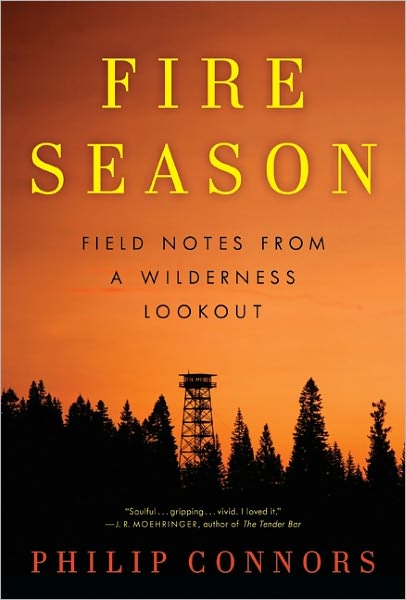
I was drawn to this book by its place in the genre of literary nature writings that I am recently enamored of; starting with Fire Season of course, which then led me through Edward Abbey and miscellaneous others. It was also recommended on the Gila National Forest’s recommended reading page (scroll to bottom), which I’ve been referencing in preparation for a trip there this summer.

Aldo Leopold was an pioneer in the conservation and restoration movement, early in the definition and creation of ecology or environmentalism. His Almanac belongs in line with the works of Muir, Thoreau, Rachel Carson, and Edward Abbey. This is a beautiful book. Leopold is among the best of his genre: he writes lyrically, passionately, bringing to life and recognition the smallest and most seemingly insignificant pieces of his world. There is humor, celebration, and thoughtful consideration and development of a philosophy for the burgeoning movement; Leopold is one of its fathers, without question (see Schwartz’s discussion in the introduction of how far his influence extends today). This book is filled with calls to action, as well as quiet, reverent praise and celebration of the minutest members of the natural world.

Leopold writes from his ranch in the “sand counties” of Wisconsin, where he dedicated himself on weekends to restoring the land and its inhabitants to their previous state of nature, before agriculture, cattle ranching, and industry encroached. Schwartz’s introduction emphasizes that Leopold’s great work on conservation and restoration is now perhaps best applicable to restoration, as “almost all the wilderness that can be saved has been saved. For the duration of our time on the planet – for whatever piece of eternity we have left here – restoration will be the great task” (Schwartz). Leopold was quite successful on the 120 acres under his care. “On the road to extinction, traffic travels both ways,” writes Schwartz, noting the repopulation of sandhill cranes in the state of Wisconsin since Leopold’s day.

The loving and thoughtful process Leopold undertook on this ranch is contemplated in this book, first in twelve month-chapters, January – December, in which he describes what he sees and discusses the significance of the passing seasons, the migrations of the sandhill cranes, the felling of “the good oak.” Thus the reader is let inside the process, not only of Leopold’s growing and maturing love for his world, but of the development of ecological philosophy. As Schwartz points out, the philosophy has continued to develop beyond Leopold’s understanding: for example, he overplanted pines on his land at the expense of other trees; he was an avid hunter, which habit would at least come under discussion today. But his legacy is palpable. Following the twelve-month almanac, in two essays, he further develops eco-philosophies, for example, the concept of the pyramid of life, in which he takes our well-known concept of food chains and ties these innumerable chains together into an infinitely complex pyramid.

I found much to appreciate in this book. Leopold is thoughtful, writes beautifully, poignantly, evocatively, makes me want to see and touch and smell the world he describes. Sewell’s accompanying photographs complete the experience; the only thing better would be to be there, myself. It is an important work; despite being more than 50 years old now, the philosophies Leopold develops are, heart-breakingly, more relevant than ever.

I’ll leave you with one of my favorite lines:

Books on nature seldom mention wind; they are written behind stoves.

Leopold has gotten out into the draft to bring back to us the sensation of movement. Read him!


Rating: 9 lovely drifting leaves.

Down the River by Edward Abbey

Down the River is a collection of Abbey’s essays, mostly (if not all) previously published in various publications but generally (if not always) reworked for latter publications, as was his habit. The theme here, of course, is rivers; but he uses his theme lightly and spreads it out wide. The collection has four parts. Part I, “Thoreau and Other Friends,” gives us “Down the River with Henry Thoreau,” a lengthy study of that man over the course of Abbey’s ten-day trip down the Green River in Utah with friends. “A crusty character, Thoreau. An unpeeled man. A man with the bark on him.” …about which the same could be said of Abbey himself. Also in this first section appears “Watching the Birds: the Windhover,” about a season spent as a fire lookout, looking out also for birds, in which he gives us this lovely image:

The redtail hawk is a handsome character. I enjoyed watching the local hunter come planing through the pass between our mountaintop and the adjoining peak, there to catch the wind and hover in place for a while, head twitching back and forth as it scans the forest below. When he – or she – spots something live and edible, down she goes at an angle of forty-five degrees, feet first, talons extended, wings uplifted, feathers all aflutter, looking like a Victorian lady in skirts and ruffled pantaloons jumping off a bridge.

Part II is “Politicks and Rivers” and earns its name; here Abbey waxes philosophical and praises nature while criticizing our treatment of her. Part III, “Places and Rivers,” tells more stories of Abbey’s river trips, to which I am especially partial; his descriptions of lost (or soon-to-be-lost) rivers and valleys and canyons are poignant and might in fact make you cry. Finally, Part IV, “People, Books and Rivers” contains “Footrace in the Desert,” detailing possibly Abbey’s first and last running race, and a lovely portrait of John de Puys (“My Friend Debris”), Abbey’s good friend. It finishes with “Floating,” another dirge for lost rivers.

Repeatedly Abbey is funny, even ridiculous, and often lecherous. But this is also a man who has me looking up words like ‘gelid’ (‘very cold, icy, or frosty’), ‘dithyrambic’ (‘wildly enthusiastic; wildly irregular in form’), ‘oleaginous’ (‘rich in, covered with, or producing oil’), and who uses phrases like ‘concupiscent scrivener’ (definition: Edward Abbey). Remember, he had a master’s degree in philosophy. But he also writes, in “Meeting the Bear,”

Though a sucker for philosophy all of my life I am not a thinker but – a toucher. A feeler, groping his way with the white cane of the senses through the hairy jungle of life. I believe in nothing that I cannot touch, kiss, embrace – whether a woman, a child, a rock, a tree, a bear, a shaggy dog. The rest is hearsay. If God is not present in this young prickly pear jabbing its spines into my shin, then God will have to get by without my help. I’m sorry but that’s the way I feel. The message in the bottle is not for me.

This collection, like *almost all the Abbey I’ve read, I highly recommend. It offers a great and varied example of his best nonfiction; it’s poignant, funny, light-hearted and deathly serious, and beautifully, beautifully done. I hope you love it as much as I do.


*Continue to beware of Black Sun for its self-indulgent and unrealistic fantasy of the middle-aged man landing a sex-hungry teenaged virgin for wild romps in a natural paradise.


Rating: 8 raft trips.

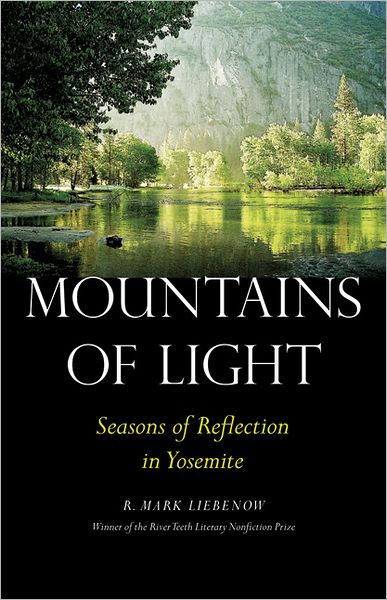
Mountains of Light by R. Mark Liebenow

A quiet, moving memoir of grief and recovery set in the Yosemite Valley.


When his wife of 18 years died, R. Mark Liebenow was overcome with grief. He sought relief by following in John Muir’s footsteps, consulting naturalists, historians, spiritual guides and artists along the way. Mountains of Light covers a year which he spends (in many short trips) in the Yosemite Valley, contemplating the natural world and the significance of death. He is “looking for the mystery of life,” he writes, “even if it can’t be solved but only hiked further into.”

Mountains of Light is lyrical and decidedly literary. Liebenow’s focus drifts: he describes a mountain vista, waxes mystical about the roles that insects and waterfalls and clouds play in the universe, quotes poetry (and Muir), confers with cutting-edge science and remembers his late wife. He includes morsels of history (particularly of Yosemite, from Native Americans through the Mariposa Battalion to the present) and catalogues plant and animal life. He considers various religious and spiritual understandings of nature and death and the mountains, mulling over his options for accepting his tragedy. The background for all this musing is dynamic, as Liebenow takes challenging hikes, explores, gets lost in the wilderness and watches his fellow campers and mountain climbers take still greater risks. The scenery changes drastically in four seasons, which Liebenow interprets metaphorically.

Part travelogue, part natural study and part memoir of grief, Mountains of Light is meditative, lovely, thought-provoking and, yes, sad–but worth it for the appreciation of this natural gem and the redemption it brings.


This review originally ran in the March 9, 2012 issue of Shelf Awareness for Readers. To subscribe, click here, and you’ll receive two issues per week of book reviews and other bookish fun!


Please note that this book makes a fine readalike for Fire Season or Edward Abbey’s Desert Solitaire. And look at that lovely cover, too!


Rating: 6 moments of contemplation.

Spokesongs: Bicycle Adventures on Three Continents by Willie Weir

This slim (140-page) volume is less traditional travel memoir and more a series of one-to-two page reports on individual experiences, or meditations on what it means to be a cycle-tourist in underdeveloped areas. The eponymous three “continents” of India, South Africa and the Balkans make up only a small portion of Weir’s experience as a cyclist and as a cycle-tourist (that is, someone traveling by bicycle). He also has experience as a bicycle courier in Seattle, something which will always increase credibility in my eyes. (I did the same in Houston for a few years, in an earlier life.) He calls his brief vignettes “verbal songs of the road,” which I think is a nice turn of phrase.

Each episode or anecdote tells a very simple, brief story; as a whole they don’t make up much of a sum narrative, which is not a criticism. This could be a coffee-table book, to be picked up time and again at random. It’s very easy, an effortless glimpse into one man’s adventures, with a touch of a love story coming in at the end. The writing isn’t sophisticated (nor even consistently correct, grammatically) but it’s sweet, and it’s real. While there are certainly far more complete, involved stories of bicycle adventures of various kinds, this might be the simplest to enjoy and one of the briefest. It was a gift from our buddy Fil to Husband, the Not-Reader, and I think it actually has a chance of being read by him, at least in parts, which is saying something. I recommend it for what it is: a brief look at cycle-touring in the developing world, or a collection of brief, captivating experiences.

The Absolute #1 Best Book of 2011

Ahem. Did I not make a point of choosing an overall favorite when I did that year-end post the other day? Shame on me. Sorry. I shall keep this brief. I just want to say that the best book I read in 2011 was…

Fire Season by Philip Connors.

If you’re interested, you can read my review; read my father’s review; or read about how Fire Season inspired my father and eventually me into some further reading.

It doesn’t hurt, of course, that this talented author whose book touched my life so much back in May, ended up contacting me and has been a pleasant correspondent ever since! But no, it’s not a popularity contest; Fire Season wins for what’s in between its pages, alone. Thanks Phil for writing, though. 🙂

Honorable mention goes to Dorothy Canfield’s The Home-Maker.

Hemingway’s Boat by Paul Hendrickson

A lyrical, textured, and meticulously researched meditation on Hemingway from a fresh new angle.

Paul Hendrickson, NBCC award-winning nonfiction author for Sons of Mississippi, pulls off the remarkable feat of finding a fresh, new angle from which to approach Ernest Hemingway: his boat Pilar. Purchased in 1934 with an advance from his longtime publisher Scribner, she saw him through three wives, great achievements and critical failures in his writing career, big fish and little ones, and the beginnings and the endings of many relationships. Hendrickson suggests that Pilar may have been the love of Hemingway’s life.

This is not a biography but a careful and compassionate rumination on the man through the lens of the boat. Hendrickson has brought to his readers a Hemingway who is neither object of worship nor monster, but a full and complex human who made serious mistakes in his relationships and fought pitched battles against his own demons, and finally lost.

The Hemingway fan will be enthralled with new details of his life, and the study of figures previously treated as minor but now revealing new facets of the man. The less familiar reader will be fascinated by this comprehensive account of the master and his complex spiderweb of varied effects on so many lives, large and small. Hendrickson presents his unusual and noteworthy story with beautifully quiet intensity and contemplation. Hemingway’s Boat achieves a terrific feat in reworking Hemingway’s story.


This review originally ran in the September 23, 2011 issue of Shelf Awareness for Readers. To subscribe, click here, and you’ll receive two issues per week of book reviews and other bookish fun!


Further notes… I can’t tell you how much this book moved me. Perhaps you have noticed that pagesofjulia is a raving fan of Hemingway. I’ve read several biographies, works of literary criticism, and other spinoffs (see The Hemingway Hoax and The Paris Wife); I’m a little obsessive. But Hemingway’s Boat holds a very special place for me. Hendrickson (PH) treats Papa (EH) sort of gently, but doesn’t spare EH in his moments of monstrosity… PH comes from several different angles, interviewing different people who knew EH more or less well, unearthing some new details. PH approaches EH with the relatively unique concept that he was just a man – a great artist, but also human, with flaws and moments of everyday beauty. This book was noteworthy in all my reading of EH and the surrounding literature. It made me laugh and cry; I treasure this galley copy, where I usually pass them on as soon as I’ve turned in my review. This book alone has made my recent career as Shelf Awareness book reviewer worthwhile. (PH also recently came around here to comment on a post, which I found very exciting. Hi Paul!) I wholeheartedly recommend this book for fans of Hemingway, or of literary biography, or of well-written nonfiction, or for those looking for vignettes in Key West or Havana history.

In Cold Blood by Truman Capote (audio)

Truman Capote captured my undivided attention with this medium-largeish* book in remarkable fashion. My first issue for this review: is this fiction, or non? It is most commonly referred to as a “nonfiction novel,” a term I have a lot of trouble with. The story is either based very closely on, or is, the true story of the quadruple murder of the Clutter family in small-town Kansas, and the investigation, arrest, and eventual execution of the two perpetrators. (My library’s OCLC listing calls it “postmodern fiction.”) Capote himself said, “I wanted to produce a journalistic novel, something on a large scale that would have the credibility of fact, the immediacy of film, the depth and freedom of prose, and the precision of poetry.” So, fiction or non? I’m going with fiction, but clearly this is one of those areas where the line blurs. More on that in a bit.**

I came across this book recently in several blogs, which is curious because it’s not new; it was first published serially in Life magazine in 1965, and in book form in 1966. I already had the book on my radar, but these fine fellow bloggers definitely solidified my interest. In telling you about the story, and the book constructed about the story, I’m going to be fairly spoilery, because this is history. If you want to read it yourself and be surprised, I’m not your top-choice review.

So. The subtitle reads, “A True Account of a Multiple Murder.” On the night of November 15, 1959, the Clutter family was bedding down on their farm in Kansas, just outside the small town of Holcomb, itself a suburb of Garden City. Herbert Clutter, the patriarch, was a respected member of the community and devout Methodist; his wife Bonnie had been suffering from depression and had been in and out of hospital, but at this time was home. Sixteen-year-old Nancy, the belle of local society, sweet, talented, generous, and universally beloved, had just sent her boyfriend Bobby home and was getting ready for bed. Fifteen-year-old Kenyon was slightly socially awkward but friendly and respected as a member of a well-liked and important family. The two older Clutter daughters were living on their own outside the home – one married, one about to be.

Meanwhile, two paroled convicts of the Kansas state prison system were on the road. Perry Edward Smith and Richard Eugene “Dick” Hickock had been cellmates and although very different in temperament, had teamed up for an endeavor that Dick described as being the perfect crime. As you’ve already guessed (or already knew), these six characters converge when Dick and Perry kill the Clutters in the night and make off almost as perfectly as Dick imagined. They spend months traveling, living briefly in Mexico where Perry hoped to become a successful treasure hunter, and then roaming the US again until they were apprehended in Las Vegas. They were tried in Kansas, convicted, and finally hanged in April of 1965.

Capote follows both groups of characters – the Clutters, and Perry & Dick – alternately in the days leading up to the night of the murder. Then he follows Perry and Dick in their roaming, and then through their imprisonment and trial, and right up to the hangings. His voice is omnipotent third person, and he quotes extensively from letters, documents, and trial proceedings, as well as from his interviews with various players and especially Dick and Perry themselves. Capote was on the case (so to speak) well before they became suspects, and published after they were killed, so his perspective and the timeline of his coverage is pretty extensive.

But, perhaps not entirely objective. The Clutters are painted in admirable detail, in lovely little vignettes. But their role is minor and short-lived (ouch, pun not intended). And of the two killers, Perry Smith is treated far more sympathetically and examined more deeply. I was pondering this as I listened to the book, wondering if this was all Capote’s apparent subjectivity, or if Perry was inherently more sympathetic; in other words, would I have found him so if I had been researching this case myself? There are a few fairly easy markers for this, at least for me: for one, Dick liked to rape little girls. Perry apparently stopped him from raping Nancy (by both their accounts). Dick ran over stray dogs with his car for fun, which Perry found revolting (as do I, obviously). Perry’s childhood was patently rough, while Dick’s is characterized as fairly normal. Perry seems to more clearly have a mental illness or defect that “causes” his criminal and violent tendencies. But, I’m not sure we get all of Dick’s story; Capote looks much more closely into Perry’s past. So what I’m trying to say is, I think there may be a bias in favor of poor Perry the murderer, having been manipulated by evil Dick. Apparently, it was alleged that Capote in fact had a sexual relationship with Perry while he was imprisoned, although obviously I can’t speak to that. This is not a criticism. I just want to point out that perhaps Capote is not entirely impartial with regards to his two main characters.

I found this book incredibly powerful. Capote has a fine sense of drama and of timing. Scenes and people are sketched artfully, sometimes quickly and with broad strokes that paint a pretty complete picture just briefly, and sometimes in painstaking detail. The stories of the Clutters’ deaths and Dick and Perry’s adventure and executions are fascinating and engrossing, yes. But it’s Capote’s rendering that makes this book, more than his subject matter. (I guess this is always the case.) I was blown away by the emotional effect of this story. I couldn’t get enough; I wanted more of the inside of Perry’s head, of Dick’s (ew, how creepy), of the small-town life of Holcomb and Garden City. This is my first experience with Truman Capote, and I’m a fan.


Also, as Marie said at The Boston Bibliophile, Scott Brick’s narration is excellent. I recommend this book on audio if you’re so inclined. (I also picked up a paperback, though, to have on hand. I never did reference it while listening but I think I’d like to have it for future use.)


*My audio version is 12 cd and 14.5 hours; my paperback edition is just under 400 pages.

**Back to the fact vs. fiction question. It does seem that Capote behaved like a journalist in putting this book together: gathering facts, interviewing key players, confirming dates. It could pass as “true crime,” a genre which itself may have trouble with fact vs. fiction. The biggest place where Capote appears to leave the realm of nonfiction behind is in dialogue; he has recreated a great many pieces of dialogue, mostly between Perry and Dick, that were unrecorded. He has relied upon Perry and Dick themselves in this recreation, I think, but memory being what it is, some creativity definitely come into play. I did note that on the night of the Clutters’ deaths, Capote has not tried to recreate their experience or any dialogue, except in the accounts shared by Perry and Dick in their confessions. This seems to show a reluctance to just “make things up,” and a respect for the question that (I think) still remains: did Perry kill the two male Clutters and Dick the two women, as Perry originally claimed? Or did he Perry kill all four, as he amended his story to say, and as Dick claimed all along? Capote doesn’t answer this question for us – presumably because he respects the fact that he can’t answer it authoritatively. (I do wonder what he thought, though, considering that he apparently was very close to Perry in particular.)

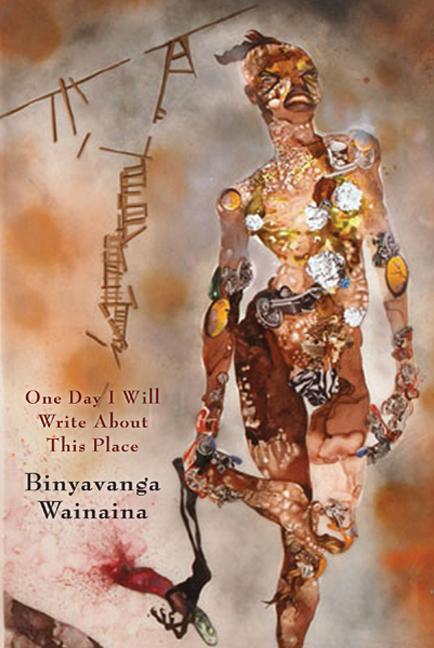
One Day I Will Write About This Place by Binyavanga Wainaina

Binyavanga Wainaina’s memoir, with details of various African backgrounds and his sensitive artist’s perspective, paints a poignant and lively picture.

Wainaina’s memoir of his life in Africa begins with his childhood in Kenya, follows him through university in South Africa, to a family reunion in Uganda, and on to his travels throughout Kenya, to land him finally in New York State as a writer and professor. His tale, however, is far from simply a recounting of one man’s life. At its heart, the book is the story of an artist, his struggles as a child to adjust to his view of the world and his discovery of writing as an outlet. His perspective as a child verges on the fantastical as he confuses colors with shapes and objects with sounds. The lyrical, imaginative writing throughout the book reflects this unusual vision. Wainaina paints pictures with words; his writing is reflective and playful and worth lingering over. Music, too, plays a role–almost as another character–as he describes his intense reactions to the music of Kenya, of Africa and of the world.

Another worthwhile aspect of this book is its intelligent and informed study of the politics of the African continent and the diversity of Kenyan perceptions. Wainaina tells of the battle between tribalism and a united Kenya, and the richness of linguistic and cultural perspectives there. Politics, however, is never the main subject; it is merely a background to his personal story. The Africa evoked is captivating and will be exotic and new to many readers.

Wainaina’s memoir is by turns funny, sad, hopeful and occasionally cynical, but always engaging. Fanciful abstractions of his environment and instructive tales of African politics combine to give us a fascinating vision of his world.


This review originally ran in the July 22, 2011 issue of Shelf Awareness for Readers. To subscribe, click here, and you’ll receive two issues per week of book reviews and other bookish fun!

The Devil in the White City by Erik Larson

THIS is how I like my nonfiction! See, Castaneda? Like this! I can’t exactly explain the difference. There’s just something very narrative, conversational, interesting about this. Similarly, Dethroning the King, Janet Malcolm, Annie Londonderry, etc. It’s not sensationalist; it’s just exciting. Written like a thriller or like a work of fiction, but no less serious a work of nonfiction for it. How to explain? Let me quote a very average paragraph for you, from page 27:

Each man recognized and respected the other’s skills. The resultant harmony was reflected in the operation of their office, which, according to one historian, functioned with the mechanical precision of a “slaughterhouse,” an apt allusion, given Burnham’s close professional and personal association with the stockyards. But Burham also created an office culture that anticipated that of businesses that would not appear for another century. He installed a gym. During lunch hour employees played handball. Burnham gave fencing lessons. Root played impromptu recitals on a rented piano. “The office was full of a rush of work,” Starrett said, “but the spirit of the place was delightfully free and easy and human in comparison with other offices I had worked in.”

See, that second sentence is long and convoluted and uses biggish words, but it flows and communicates; it doesn’t impede communication, and what it certainly doesn’t do is brag.

All right, rant aside, this is an excellent book! I started it Friday night and finished it Sunday afternoon. Not to repeat the back-of-the-book blurbs, but this work of nonfiction absolutely reads like a thriller; it’s difficult to put down. Very enjoyable. After years (literally) on my TBR shelves, I picked it up because I had such a groove going, after Annie Londonderry and Clara and Mr. Tiffany, two books set in the same era with overlapping locations – Annie in New York, Boston, and Chicago as well as all around the world, and Clara in New York, with the Chicago World Fair playing a role as well. I enjoyed both of these books so much, and especially the extra immersion in time-and-place I got by reading them back-to-back, that I wanted to go straight into The Devil and the White City next. And I’m so glad I did.

The story is this: Daniel H. Burnham, along with a huge cast of other talents and characters and against all odds, pulled together the World’s Columbian Exposition of 1893, better known to us as the Chicago World Fair. Concurrently, a man named Herman Webster Mudgett but known by his most-used alias, Dr. H.H. Holmes, murdered an unknown number of people, at least 27 but estimated as high as 200, in Chicago on the very edge of the fair grounds. Larson tells the story of the fair, of the serial murders, and of a larger time-and-place from the points of view of these two men, mostly, with side journeys into several other lives.

The World’s Fair is a character unto itself, as is the city of Chicago. Larson gives us the styles and morals of the time, and helps us to understand how it was that dozens of people, mostly young women experiencing a freedom unknown to their parents’ generation, could disappear into Holmes’ grasp. We see the wonder and beauty and ambition and angst of those who worked to produce the landmark event that was the White City, as the fair was known. We see the everyday struggles that allowed Holmes to methodically go about his evil pleasures.

Larson walks a fine line in trying to enter the heads of historical figures, especially the elusive Holmes, and still call his book nonfiction; but he’s got me convinced. He points out that everything in quotation marks is attributable, and defends the two murder scenes he chooses to portray with the evidence available to him in his research. In fact, as an aside, I enjoyed his “Notes and Sources,” and the brief story of his research there. He even mentions, in some cases, in which library or rare book room he found a particular elusive source. Further, also from Notes and Sources, page 395-6:

I do not employ researchers, nor did I conduct any primary research using the Internet. I need physical contact with my sources, and there’s only one way to get it. To me every trip to a library or archive is like a small detective story.

I know all of us booklovers (and librarians) enjoy that.

This is an engaging, riveting read. The historical value is vast. I’m always amazed by how the pieces of our history fit together. Am I the only one? I feel like there are so many names, personalities, and events in our history, but we learn them as individual bits; it’s always a little thrill when they come together in ways I don’t expect. For example, reading that Elias Disney worked as a carpenter and furniture-maker in the building of the fair, and went home to tell his sons, including little Walt, stories of the “magical realm beside the lake.” Isn’t that a charming little anecdote? Several of these connections are left in suspense, too; if your history is a bit weak in the right places, as mine was, you get these happy little surprises. I like that.

I found this book captivating, and I recommend it as a pleasurable read that may sneak some learning in on you. I invite readers of thrillers and evocative nonfiction to enter this fantastic, glittering, magical, and deadly – and true – world.

guest review: Fire Season by Philip Connors, from Pops

Today we’re visiting my father again, who’s traveling this summer. I put the screws on to compel him to buy a copy of Fire Season for himself to read on the road because I loved it so much (see here). I promised to buy it off him if he regretted the purchase; and I may, anyway, because I want to own a copy. Actually, though, I don’t know if it’s for sale. He did like it. I’m compiling some of his thoughts via email to share with you; they’re mostly in response to my original post (see link above) but I thought his slightly different perspective was worth sharing. Here’s Pops.

I finished Fire Season yesterday while I was camping in the finest of the rain forest valleys in Olympic NP, the Hoh river. I found it as exceptional as you said. The timing was impeccable; e.g. I was reading his passages about the magical meditative element of long walks… (or, I would say, endurance activities – you could read Bill McKibben’s Long Distance for a bit of the same; I found it wonderful, and you should know who McKibben is anyway for his potential to be one of the great environmental soothsayers of our time) …and it helped me decide a plan for my Monday walk: a full 10 hour day of wandering up and down the valley in rain and mist marveling at the magical forest – when I wasn’t daydreaming. I loved how he wove in stories of Kerouac, Edward Abbey, Chief Victorio, Alice the dog, Aldo Leopold, Cormac McCarthy, Gary Snyder (new to me) – and others. And we certainly learn about wildfires. Thanks for the tip.

So glad you liked it!! [And, incidentally, what safety precautions are you taking on 10-hour walks? Do you call Mom to let her know you’re going off on such things, and then call in when you return?]

And have you made the connection with current events? – with a massive fire burning for weeks now in eastern Arizona (the western borders of Fire Season) and today all around the Carlsbad Caverns area in NM (within the eastern horizon view of Fire Season).

Maybe not specifically those fires; but West Texas has been ravaged for months and it made my reading of the book a touch more personal. This spring race series, we raced two races in a row only to hear that the race course saw a wildfire start as we were leaving. (We promise we didn’t start these fires.) One was in Arksansas, one in central Texas. And we have a friend/teammate who tried to race in Ft. Davis, but the event was canceled due to one of the bigger fires we’ve seen; it swept across a considerable part of the state we’re used to driving and riding through. Close to home.

Did you also make the connection that we all went camping in the Gila Wilderness twice when you were 3 and 4 yrs old? (and that, because we had been there before you were born)

No, of course I don’t remember that, but very cool!

I really endorse what you said about his eclectic voice, and the many priceless vignettes he blends into his story. (I really wish I had read it with a highlighter!)

I also found him to be an endless stream of contradictions (perhaps we all are?) – he could be a sedentary slug for hours/days on end, but was also often driven to minimalist walks & overnights (an evening walk from a summit inevitably involves a serious down & UP!); he obviously functioned well in cities & bars, as well as wilderness; he became well versed in much wilderness language, yet succumbed to the elementary, pitiful, dreadful trap of the young fawn.

I cried over the fawn.

And, re: your comment about the contradictions. I am reminded of David Guterson’s The Other as well as Jon Krakauer’s Into the Wild (the first, fiction, the latter non) – both books about young men going into the wilderness, thinking they wanted to get away from it all, but also strangely and paradoxically clinging to certain odd elements of society. As the protagonists of both books came to unpleasant ends, I think perhaps Connors has found the perfectly balanced way to do it! In fact, I think I mentioned balance in my initial review. The writing in his book is balanced; and his interactions with his world are balanced. His saintly wife helps him be balanced. I daresay we all aspire to a lifestyle like this; I know I do, and I think, Pops, that you do. But then, you’re closer than most of us right now!

Based on your and my reactions, I’m guessing that readers will appreciate many different aspects of this book. You particularly noted the lessons about wildfire & forest policy, which I knew much of already. I loved the many references and new details about Kerouac, Snyder and the various personalities of the Beat generation who so influenced my 60s & 70s, and subsequent characters like Edward Abbey and Dave Foreman.

You barely mention Alice! I thought she was an elusive minor character, disappearing for times but playing a key role at many turns. Moments were familiar to Barley’s world; like her unilateral retreat to accompany Martha home from the lookout summit, and her personality change from city to wilds. Most poignant – Alice evoked my most secret lonely moments, far up a mountain trail without Barley’s companion spirit, spunk and relentless energy. “Alice is the only living being I know who will take a forty-mile walk in the woods without any need of cajoling, planning, or consulting a calendar.”

My apologies to Alice; you’re entirely right… she was a special creature and character, and a neat side-story proving (yet again) that dogs are our best friends and offer relationships unlike what we humans can offer one another. Here, I’ll treat our readers to a picture:

Hops (brown) & Ritchey (short white hair) who live with Husband and I, and my parents' Barley (scruffy white hair)

Finally: “…the movements of my limbs help my mind move too, out of its loops and grooves and onto a plane of equipoise… If I weren’t a walker I suppose I would be a television addict, a dope fiend, a social butterfly.”

Because I had to look it up, I’ll share. Equipoise: an equal distribution of weight; even balance; equilibrium.

Thank you for your musings, Pops. I hope we’re (still) encouraging folks to find this book! I think I’m ready to call this my best read of 2011 to date.