Let’s Pretend This Never Happened by Jenny Lawson (audio)

I was already a fan of The Bloggess, Jenny Lawson’s blog-alias. And her local connection (she’s Texas, with some time logged in a Houston suburb) didn’t hurt, either. Well, now having listened to her book as an audio read by the lovely Jenny herself, I can even more wholeheartedly recommend her to you.

Jenny has a quirky, crass sense of humor: she is fond of the word “vagina” and curses a fair amount. These things do not bother me, but fair warning. She combines that style, however, with an occasional earnestness that is endearing and captivating. This is her “mostly true memoir” (which I think is a great way to speak of memoir, in general! my impression is this one is as “true” as most), and therefore it’s the story of her childhood, growing up, marriage, and family life with husband Victor and daughter Hailey, including moving around the state. One emphasis is the crazy upbringing she experienced in a tiny tiny Texas town with an eccentric taxidermist father (whose idea of a loving welcome is tossing a baby bobcat at her new boyfriend) and long-suffering mother. Another is the mental illness Jenny suffers from, including generalized anxiety disorder and post-traumatic stress. (Disclaimer: I have no print version of this book at hand and am going by memory. But I am fairly confident in my memory.)

Her handling of these subjects is on the one hand hilarious, outlandish, and obscene, and on the other, as mentioned earlier, serious and thoughtful. For someone who suffers fairly debilitating bouts of depression and mental illness, Jenny is surprisingly positive in her interpretation of her own experiences. Presumably her feelings in the moment are often much less cheery; but in the format of this book, where she got to think it through and get it right, her philosophies are refreshing, graceful, helpful, optimistic. She comes across in the end as damaged, yes, but also hopeful, wise, and fun. I want to be her friend. In other words, I give Jenny, her book, and her website my ringing endorsement! Oh, and do check out the audio version if you can. She reads it herself (and sings all the chapter titles), there’s a blooper reel at the end (really just a bunch of off-color ramblings), and I always like to get things in the author’s own voice if possible – in a memoir most of all. In fact, I will pay her the compliment of putting Let’s Pretend This Never Happened up next to Tina Fey’s Bossypants, also read by the author and also hilarious. Go check out Jenny Lawson because she is unique and bizarre in the best possible way.


Rating: 8 self-reflections.

Keep It Real: Everything You Need to Know About Researching and Writing Creative Nonfiction, edited by Lee Gutkind

This is an excellent and succinct tool. It first offers some discussion of the parameters of creative nonfiction by a man “often referred to as ‘the godfather behind creative nonfiction,'” Lee Gutkind. It’s just what I was looking for. Gutkind’s introduction muses on the definition of the genre (difficult to pin down, of course, as these things always are), and addresses the concerns sometimes raised about the conflict between creativity and nonfiction. He also acknowledges some of the literary controversies (James Frey, Stephen Glass, Jayson Blair, etc.) that have hurt the genre’s credibility. And then the bulk of the book begins: writing advice. “The ABCs of Creative Nonfiction” move from “Acknowledgement of Sources” through “Writers’ Responsibility to Subjects” (the contributing writers apparently didn’t want to force the issue by contriving a Z, for which I respect them).

Each of these sections is concise – the whole book barely makes 150 pages – but packed with good advice. Legal and ethical issues receive more than a few pages, which I think is appropriate. Although the central recommendation there seems to be “when in doubt, get a lawyer,” there’s more to it than that: they cite legal precedent and explore the definition of libel, which I found useful and informative. There were also sections addressing interview techniques and the pros and cons of note-taking vs. tape recording (or other audio recordings). There are bits of creative-nonfiction-specific guidance, like how to get inside the heads of characters who are not you and still stick to the facts. And finally, certain chapters deliver straightforward writing advice: how to show, not tell; find a voice; structure a story; and set a scene.

This is not a book for a professional journalist, necessarily, although I could be wrong; maybe those professionals should read this book, too. It’s certainly brief and informative. But I get the impression that it is more geared towards people like me: laypersons without journalism backgrounds who are interested in writing creative nonfiction and want to know the basics. I found it a valuable piece of instruction at just my level; it gave me things to think about, books to put on my list, and actually inspired me to jot a few passages down towards my own project. I recommend it.


Rating: 7 pagesofjulia.

The Warmth of Other Suns: The Epic Story of America’s Great Migration by Isabel Wilkerson (audio)

I didn’t really know what this book was about when I picked it up – only that it was well-regarded. I’m so glad it found its way into my hands. Isabel Wilkerson has taken on a large-scale, ambitious subject here, and rendered it beautifully. And the audio reading by Robin Miles is lovely to boot.

The “great migration” in the subtitle refers to the movement of black Americans out of the South and into the northern and western United States in 1915-1975. Wilkerson starts from the very beginning, looking at the experiences of former slaves just after Emancipation in an impoverished region struggling to rebuild with a new order of things. The creation and expansion of Jim Crow laws designed to hold blacks down took time after the end of the Civil War to take effect. In the new caste system, former slaves and their descendents were unable to move up in the world and were in constant fear for their lives if they were to misstep around Southern whites. By 1915, they had begun to move out of the South, in what became a mass migration along lines so distinct that enclaves of blacks from specific towns and states were recreated in new locations.

Wilkerson shifts between two ways of studying the Great Migration. Sometimes she takes a broad view of history, in which she cites her own interviews (she states that she did over 1,200) with migrants and their descendents as well as a number of historical sources, to render the story of the Migration generally. And sometimes she follows the specific personal stories of three individuals who she interviewed at great length over a long period of time, traveling the country with them and becoming part of their lives. (In this respect, the journalist/author becoming part of the family of her subject, I was reminded of Rebecca Skloot’s amazing The Immortal Life of Henrietta Lacks.) George Swanson Starling moved from Eustis, Florida to New York City, later sending for his wife Inez to join him there. He had to leave Florida suddenly because a friend tipped him off that a lynch mob was coming for him; he had been involved in organizing his fellow citrus pickers to demand higher wages. Ida Mae Brandon Gladney moved with her husband George and their two children, with a third on the way, from Mississippi where they had been sharecroppers. They would eventually end up in Chicago, by way of Milwaukee. And Robert Joseph Pershing Foster was an ambitious surgeon and veteran from Monroe, Louisiana, with his heart set on Los Angeles. Known as Pershing in Monroe, he would resettle as Robert (or Bob, or Doc) in LA and send for his wife and daughters to join him there, where he built a new life in high society with the big house and booming practice he’d always wanted.

I found this shifting back and forth between the broad view and three personal histories extremely effective. Anecdotes from the lives of Southern blacks drove well home the misery of their bottom-rung status there; some of these stories are horrific, but important to show the desperation some migrants felt when they left their homes in the South. National trends played a role – for example, during WWII demand for Florida’s citrus was high while the supply of labor to pick the fruit was low, with everyone off at war, and this imbalance led to George Starling’s ability to demand higher wages. And the history of Chicago’s race relations and residential segregation puts Ida Mae Gladney’s home ownership into the proper perspective. You get the point. The history is well-documented and, I’m convinced, well-researched; and the personal stories make it all, well, personal. I was deeply involved with our three representative individuals by the end of the book and, yes, I cried.

I love that Wilkerson brought such a large-scale, important trend, that has had such huge effects on American history, to life the way she did. I also like that she examined the broad effects of the Great Migration, in terms of the cultures of both white and black residents of the North and the South, and took the time to show that black migrants were really far more like immigrant groups in history than like migrants within their own country. I recommend this book as part of a study of American history – but one need not be an academic to appreciate it. The story of the Great Migration is made accessible here, and I’m glad I know more about it now. This 19-disc audiobook (over 600 pages in print) went by easily. This is how I like to take my history lessons. Check it out.


Rating: 8 train rides north.

Before the Rain by Luisita Lopez Torregrosa

An impassioned memoir of love between two journalists, set amid travel and revolution.


Luisita López Torregrosa (The Noise of Infinite Longing) is a New York newspaper editor when Elizabeth comes aboard as a new reporter in the 1980s. Her quiet, self-contained, slightly mysterious air draws Luisita’s attention. When Elizabeth lands a sought-after position as foreign correspondent, she builds a home for herself in Manila. Luisita joins her there, and the two women throw themselves hesitatingly and then wholeheartedly into a passionate affair against the backdrop of the fall of Ferdinand Marcos.

As a love story, Before the Rain is spellbinding and heartwrenching, but Torregrosa’s highest feat is perhaps one of poetry. Her tone is haunting, lyrical and sensuous. Readers will feel the equatorial heat of the Philippines and the beat of the Manila Blues, smell the mangoes and squatters’ camps, taste the margaritas and then feel the biting cold of New York winters as the story returns to the United States.

Before the Rain is a memoir of revolution as well as love: the beauty, upheaval and political turmoil of the Philippines are handled sensitively and lovingly. Besides Manila, Luisita and Elizabeth live and travel in New York, Tokyo, Los Angeles, Miami, Rio and Washington, D.C.– and each of these places leaves its mark. But their relationship is always the book’s main focus. The two women travel, move, work various jobs (some rewarding, some soul-draining); and throughout, their ardor has a momentum all its own. Even in its painful finale, that love is this book’s most lovely evocation.


This review originally ran in the August 10, 2012 issue of Shelf Awareness for Readers. To subscribe, click here, and you’ll receive two issues per week of book reviews and other bookish fun!


Rating: 8 sheets of newsprint.

Soundings: The Story of the Remarkable Woman Who Mapped the Ocean Floor by Hali Felt

I’m so glad I picked this book up (and bought it for the library where I work). It sounded like just the sort of thing I appreciate: a biography of a little-known historical figure who made an important contribution to the world as we know it but was herself forgotten. In this case, the “remarkable woman” of the subtitle is Marie Tharp, whose meticulous study and cartography of the ocean floor established the concept of plate tectonics that science now recognizes as fact, but was at best a blasphemous and ridiculous notion before Tharp came along. Her achievements, however, were minimized by a scientific culture in which women did not belong. This biography is additionally appealing to me for its mood: author Hali Felt takes a whimsical, dreamy, almost fanciful tone at times. She describes her own attraction to Tharp’s story (born in part of Felt’s mother’s, and her own, fascination with maps) and the relationship she felt to her subject. She dreams of Tharp coming to her to explain the mysterious and unspoken parts of her life. This book is nonfiction, but it’s honest, personally related, and warm.

There is also an enigmatic love story of sorts hiding within Soundings: Tharp’s career and life were both tied to a man named Bruce Heezen. Heezen was her coworker, then her technical superior; but they shared a partnership in work, in science, in discovery, and apparently in all things. It is known that they were a couple, although they never married and the details of this side of their relationship are very few.

Felt follows Tharp from her childhood with a science-minded father she adored, through her education in English, music, geology, and mathematics, and to her first job in the oil & gas industry (oh, how familiar to this Texas girl). But she was held back: this was the 1940’s, and women in science were mostly expected to make copies, compute numbers, and brew coffee. Eventually Tharp found her way to New York, to Columbia University and the Lamont Geological Observatory. This is where she would meet and work with Heezen and quietly make history.

The science in this book is very friendly and accessible to a general reading public; the story that Felt set out to tell is more that of a woman’s life and accomplishments despite the limitations of her society, than that of tectonic plates per se. For that matter, Felt shows that it was Marie’s combined backgrounds in art as well as science that made her perfectly suited to play the role she did in history. Her meticulous re-checkings of data and attention to detail were indispensable – but so was her interest in visually representing the data available in a way that would show the general public (not just academics) what she’d discovered. So her achievement was artistic as well as scientific. Soundings does make the science side clear, but doesn’t dwell, and is never dry. Rather, Marie Tharp comes to life: she is a precocious child; an ambitious, able, frustrated student; a dedicated scientist; a life partner; an eccentric aging woman caught up in her own past, campaigning to honor and preserve the legacy of her other half.

Hali Felt was honest about the role she plays in the story she relates. She begins in her Introduction by briefly describing her own attraction to maps, and then follows a chronological format, beginning with Tharp’s childhood and following her life, and eventually her death. And then Felt returns to the story: her discovery of Marie Tharp’s existence, her interest, her decision to follow that interest, her research, her relationships with the living descendents of Tharp and Heezen’s world (the “Tharpophiles”), and in the Acknowledgements at the end, she even hints at the process by which she came to write and publish this book. I found all of these Felt-related details interesting too.

In a word, this is a lovely biography, and the style and tone of it may be my favorite part.


Rating: 9 double-checkings of data.

The Perfect Storm by Sebastian Junger (audio)

In October 1991, a number of factors converged to create a storm of inconceivable strength off the Massachusetts coast. Vessels large and small struggled in its path, and a few didn’t make it out. Sebastian Junger follows a few of the men, women and boats involved in this remarkable work of nonfiction. He begins by introducing us to Bobby Shatford and his girlfriend Chris, and their town of Gloucester, Mass. Bobby and Chris wake up hungover – Bobby has a black eye – and drive around town, visiting with friends and Bobby’s mother Ethel, bartender at the Crow’s Nest, and making final arrangements for Bobby’s departure on the Andrea Gail, a small fishing boat with a crew of six. We then follow Bobby’s path and that of his fellow fishermen: the two men who get funny feelings and refuse to sail with the Andrea Gail, and the five who join him on her for an intended 4-week fishing trip. We track their fishing, the decisions made by their captain Billy Tyne, the radio communications between Tyne and other fishing boat captains. We watch the storm approach, checking in with meteorologists and getting quick lessons in storm formation, and we visit other boats as well, including the Satori, a 32-foot sailboat, and the Eishin Maru, a Japanese longliner, both fated to have complications and exciting moments. We also get to know two rescue crews, made up of Air National Guard pararescue jumpers and Coast Guard rescue swimmers. I won’t give too much away (although, all of this being a matter of historical record, it’s out there), but not all of the characters introduced survive the storm.

That’s about all I want to say about the events detailed here; you can find out more by reading the book yourself (or listening to the audio, as I did – more on that in a bit), which I highly recommend. And here’s why. This is an incredibly adrenaline-pumping adventure tale. There are sad endings for some of the men and women involved, yes, but there is also great heroism, amazing skin-of-your-teeth survival, drama, even a love story or two mixed in. The human interest, in other words, is huge. For excitement, really, could you ask for more than rescue swimmers jumping out of a helicopter into the storm of the century to rescue men and women from sinking ships or from the open ocean? I submit that you could not.

In addition, the story is told in a unique way. Junger jumps subjects throughout: we meet a few characters in Gloucester, then we review the fishing history of the town of Gloucester, then we study up on commercial fishing for a bit, back to the characters… eventually we get lessons in meteorology, the physics of boat building, wave formation, and what exactly happens when a person drowns. As I wrote before, Junger is fairly strict and journalistic in following the facts. Where parts of the story he tells are unknown, he doesn’t claim to know, but he does interview people who have been through similar scenarios and survived; so we get an educated estimation of what the players might have been through, while making nothing up. It’s a method I respect; I found it both dramatic and fully-wrought, and reliable.

The audiobook I listened to is excellent, too. Read by Richard M. Davidson, it has all the taut, tense action it needs without ever feeling over-dramatized. And as a bonus, it includes a recording of the author speaking about the making of the book. This flows like his-side-only of an interview; I imagined someone in between asking specific question. Like the foreword, I found this a substantial addition. At the time of the storm, in 1991, Junger was working as a high climber, taking trees down for a tree company, and selling freelance magazine articles for a living. The storm inspired him, and he wrote a chapter about it, initially for a book he conceived about various dangerous jobs: the commercial fishermen of Gloucester would have been joined by loggers, smokejumpers, forest-fire fighters and the like. But his agent landed him a deal for a whole book about “the perfect storm” – whereupon Junger became anxious. How would he fill a whole book with just the storm? he wondered. (I loved hearing the author, in his own voice, discuss his nerves! And the whole process, really.) So he decided to follow all the sub-plots and related topics he could, to flesh it out, and this is why we are treated to the lessons in weather, boats, the fishing industry, etc. What struck me about this is that it is a rather Moby-Dick method, and ironically, while that classic work of fiction is notoriously difficult to read (come on, even its fans admit this, right?), this work of nonfiction – even though readers often fear nonfiction will be dry or cumbersome – flowed delightfully and effortlessly. Those subplots mightily enriched the whole. Even the questions left unanswered, about the fates of those who disappeared and whose remains were never found, Junger turns to advantage. As he says, because he investigated the experiences of others who lived through similar situations, we get a richer, more layered story than had he interviewed a sole surviving fisherman.

Sorry for another long review! (Usually this means I really liked the book.) In a nutshell: moving, emotional, adrenalizing, scientific, faithful, thrilling! Check it out.


Rating: 8 swordfish.

EDIT: I also reviewed the movie, here.

City of Ravens: London, the Tower and Its Famous Birds by Boria Sax

A bird’s-eye view of the Tower of London’s famous raven residents and their role in history and myth.


The Tower of London combines commercial tourism, history and myth in a single site, and its iconic ravens are a part of all three functions. Legend has it that when the ravens leave the Tower, Britain will fall. Boria Sax’s City of Ravens blends a highly readable narrative style with academic research into Britain’s history, the study of birds and Sax’s own interest in animal-human relationships. Sax examines the ravens’ changing significance in London’s imagination, from being harbingers of death and doom as they fed off the bodies of those executed at the Tower to being heralded as guardians of Britain’s Empire–likely due to their role, during the Blitz, of warning of incoming bombs.

Sax’s research largely dispels the popular belief that ravens had been pets at the Tower since medieval times, and he is ambivalent about the accuracy of the historical raven record. After highlighting a few individual ravens’ personal histories, he finishes by considering the ecological questions raised by the captive birds whose wild counterparts have begun to repopulate London, weighing the options for protecting both the ravens and their mythical standing.

These musings, admittedly conjectural at times, draw on diverse resources including newspaper archives, popular literature, early tourist guides to the Tower and other historical sources–as well as fictional accounts. Part history, part deconstruction of myth, part bird study, always lovingly respectful of the birds themselves, City of Ravens is a whimsical, entertaining and informative journey into London legend.


This review originally ran in the July 13, 2012 issue of Shelf Awareness for Readers. To subscribe, click here, and you’ll receive two issues per week of book reviews and other bookish fun!


Rating: 5 wings.

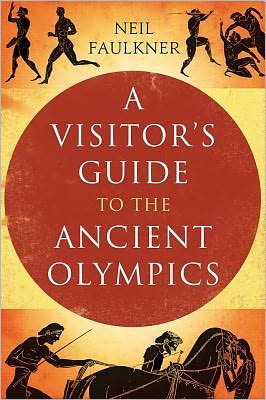
A Visitor’s Guide to the Ancient Olympics by Neil Faulkner

What an odd mix of genres this book is. It sets itself up as a travel guide: eat here, sleep here, don’t forget to pack this – but to a destination that would require time travel. As Faulkner says in his introduction, this is necessarily (by its fantastical nature!) not an entirely academic book; but he does have an academic background, and rather than wildly making things up, he does follow history & research. He just uses his imagination where it makes sense to do so, and in a way that makes sense: he makes educated guesses. (As he points out in the intro, again, he has to pick a day for each event; it is unrealistic that a guide to an Olympic festival would be unable to say when the footraces would be held.) So, note my tags for this post: travel guide; sports; historical fiction; nonfiction. It is a puzzle. A uniquely styled book.

And an enjoyable one, too. At just under 250 pages, it’s an easy read. The sections are short. There is an emphasis for most of the book on ancient Greek culture in general, and on what the Olympic Games represent in that culture (in a nutshell: this is a religious festival; sport is merely a form of religious ritual). The sport itself comes in only late in the book, and I confess that this was a slight disappointment to me: that section of the book that describes the athletic contests was very interesting to me and I wanted more of the same. But the detail on ancient Greece was intriguing, too; I have an interest in ancient Greek mythology & literature, and there were plenty of references that I was pleased to connect.

This book is probably most successful as a travel guide, which is a little awkward since as much as one might wish to, it is in fact impossible to attend the Olympic Games of 388 BC. Faulkner does a good job of elucidating the issues a person would face in attending these Games if she could. Again in a nutshell: there is no lodging, transport is difficult to arrange and expensive, food is odd and limited, and the Olympic Village would be teeming with refuse, stink, and insect activity. It would be hard to see the events on display as there are no stands; spectators 100,000 strong merely shove each other around for a view. In other words, he might have talked me out of the trip if I were planning on it. As a view into the life of ancient Greeks and especially the role of professional athletes in their society, this book was informative and fascinating. Its unique format, too, added special interest. I am bemused and intrigued. Recommended, but probably for a fairly distinct audience. I was well entertained, with my intersecting interests in sport and ancient Greece, and my tolerance for an odd format.


I read an uncorrected advance proof.

Rating: 6 events.

Walking It Off by Doug Peacock

My path to this book feels so very obvious: I have become a big fan of Edward Abbey, and of The Monkey Wrench Gang, and it seems a very natural step to pick up Walking It Off. Peacock was one of Abbey’s closest friends, viewed him as a father figure of sorts, and this memoir focuses in part on their relationship, which was made pricklier by publication of The Monkey Wrench Gang: Peacock was the model for the hero-character George Hayduke, making Peacock a cult figure unto himself. Therefore nothing could be more natural, as I read up on Abbey and his ilk, than to read Peacock. I wonder how many people come to Walking It Off on other paths? There are other paths, of course. First of all, I must give Peacock credit for being a gifted writer himself; it’s not just that he has a powerful story to tell. Nor is Abbey the only object of consideration here; another subject is Peacock’s experience as a Green Beret in Vietnam (which he shares with Hayduke, of course) and the PTSD he suffers ever after. And finally, it is a lovely piece of nature writing, and a contemplation of death – not for the first time am I reminded of Hemingway, who like Abbey spent much time and ink meditating on the meaning of death, preparation for a “good” death, and considering suicide.

The subtitle of this book is “A Veteran’s Chronicle of War and Wilderness,” and that it is. Abbey is a thread that Peacock picks up and puts down, but more constantly, we follow him through wilderness walks and his process of trying to live with what he experienced in Vietnam. I would not have thought that there would be such a connection between war and wilderness, but it makes sense now that I’ve read this book.

After my war, home was the Rocky Mountains. I wasn’t looking for grizzlies but found them anyway. What was invaluable was the way the bears dominated the psychic landscape. After Vietnam, nothing less would anchor the attention. The grizzly instilled enforced humility; you were living with a creature of great beauty married to mystery who could chew your ass off anytime it chose.

Over the course of this memoir, Peacock walks and camps in various wild spaces; we jump around in time, revisiting a mountain-climbing trip in Nepal that nearly killed him. We revisit Abbey, too; early on, Peacock describes Abbey’s death in a fair amount of detail, and the burial, and the conflict of not wanting to let go of a dearly beloved friend who was more ready for his own death than Peacock was ready to lose him. Later, he remembers Abbey, reads some of his journal passages for the first time, and finally, many years after its publication, he struggles to read Hayduke Lives!, the sequel to The Monkey Wrench Gang. But it turns out that Abbey plays a smaller role than I had perhaps expected, and that is more than okay, because this book has so much to offer. I’m doing my own considering of wilderness, its value to us urbanized humanfolk, and the appropriate treatment of our natural spaces, and Peacock gave me still more to think about. From Aldo Leopold’s A Sand County Almanac:

All conservation of wildness is self-defeating, for to cherish we must see and fondle, and when enough have seen and fondled, there is no wilderness left to cherish.

Which is a very fair point about limiting our use. From Peacock:

You don’t visit the Grizzly Hilton for the salve of gentle nature, a relief from your real life at the office. Here, you live within the land with all its creatures; you engage with it. You have no choice in this realm but to enter the ancient flow of life. This is not the sort of place to compose a wilderness journal of self-reflection.

The Grizzly Hilton is Peacock’s name for a tiny haven of perfect grizzly habitat that he likes to visit; his first book was the result of many years studying the bears, called Grizzly Years and recommended by Phil Connors. Virtually all the action in this book takes place in wilderness areas, on wilderness walks, most of them solo; it’s only inside Peacock’s head, in his contemplation, that we see war, Abbey, other options. We see his first marriage end, and we see him struggle to be the best father he can be. Peacock is a difficult character, a difficult man. How much of this we attribute to the PTSD is I suppose a cause for debate; I would imagine a lot, but perhaps it’s a moot point.

The aging warrior was weary of his own predictable behaviors and emotional tightness fueled by senseless rage. I detested this legacy of anger and, aware that its deeper roots lay in war, knew it wouldn’t be easy to shake. I wanted to stalk this elusive center, using my primitive tools of self-examination – walking, solitude, wildness – to reach back in and touch the source of my wound. Of course I was a poor candidate for a meditative life. My life was a catalogue of psychotic twitches and addictions: official government-sanctioned post-traumatic stress disorder, a combat disability, borderline attention deficit disorder, marginal Tourette’s syndrome, occasional depression, a borderline schizoid paranoiac, a history of alcohol abuse. Guys like that don’t become Zen masters.

But it’s funny, because in a way he does offer Zen. Peacock’s musings on wilderness are thoughtful, beautifully composed, and rooted in history, considerate of ancient cultures and of differences. This is an intelligent book, a lovely consideration of war and its ugliness and also nature and its beauty – and, as a necessary corollary, the ugliness again of humans’ and industry’s effects on nature. Walking It Off is Peacock’s continuing quest for redemption and peace. It is much better than I expected, and I recommend it.


Rating: 9 grizzly bears.

When Women Were Birds by Terry Tempest Williams

Terry Tempest Williams’s thoughtful, melodious meditations on the contents of her mother’s journals.


Terry Tempest Williams (Leap, Refuge, etc.) approaches a very personal subject in When Women Were Birds. The opening scene sets the stage: Williams’s mother, on her deathbed, directs Williams to her journals (of which the author was unaware). They turn out to be empty–and the rest of the book is a series of ruminations on this mystery.

Williams contemplates the meaning of a person’s (or more specifically, a woman’s) “voice,” in the sense in which a writer might use the term and in its more literal sense. She contemplates mothers and daughters and the meaning of their relationship, sharing some of the traditions of her own family and of the Mormon faith in which she was brought up. She also shares anecdotes from her marriage, so that the book follows her (in nonlinear fashion) from her foremothers through her childhood and into the present. There are lots of women in this book, as well as lots of birds. Williams touches on serious topics–including abortion, environmental activism and ax murderers–but always with a respectful, quiet, lyrical tone.

Often as much poetry as prose, and full of lists, quotations and letters, When Women Were Birds is truly a tribute to several generations of the strong, inspiring and interesting women of Williams’s tribe. It is a loving creation, showing all the musical, reflective intelligence we expect from Williams, and a lovely example of her own voice.


This review originally ran in the April 20, 2012 issue of Shelf Awareness for Readers. To subscribe, click here, and you’ll receive two issues per week of book reviews and other bookish fun!


Rating: 7 pagesofjulia.