A Girl Named Zippy by Haven Kimmel

zippyHaven Kimmel wins again. This is her best-known and best-selling book, and her first memoir, and my first of her nonfiction. It is everything I had hoped for. She’s hilarious. She communicates a rather modestly lived mid-American existence in such a way that it is compelling, interesting, and occasionally involves small-scale tragedies; and at the same time it is recognizable as the lives of all of us. But on the other hand, make no mistake: Kimmel’s life as a small girl called Zippy (for her high speeds) is frequently bizarre. She was apparently funny-looking, with eyes too close together, and as a baby she was bald for an unusually long time, save a tuft of hair on the top of her head. She did not speak a single word until she was nearly three, when she began (we are told) with complete sentences. As in her novels, Kimmel introduces fully realized canine and other animal characters that her reader comes to love.

I would read anything Haven Kimmel writes; but I am especially excited about She Got Up Off the Couch, her memoir of her mother. Said mother is a character in Zippy who receives relatively little treatment, but is hinted to possess hidden depths, and I can’t wait to get to know her in my next read. Kimmel’s father, a funny, likeable mischief-maker, is a little more heavily featured. Her brother continues the theme of odd, amusing relatives. Friends from the neighborhood and from school, the local storekeeper, the old lady in the haunted house next door, and various teachers are described in brief sketches that make me giggle and paint a complete portrait in a paragraph.

A Girl Named Zippy is very, very funny; occasionally sad; insightful, beautifully written, and long on pathos. Tomorrow, come back around for quotations from a few of my favorite passages.


Rating: 8 science fiction novels.

Crossing the Borders of Time by Leslie Maitland (audio)

crossingCrossing the Borders of Time is a grand, sweeping story, combining history and tragedy with romance, and to top it off it’s nonfiction. Leslie Maitland grew up with the legend of her mother Janine’s great love, a man named Roland that she had to leave as a teen during World War II, when as a Jew she fled Europe with her family for the United States by way of Cuba. Roland was a French Catholic and had to stay behind, but the young couple pledged to marry as soon as they could. Janine’s family cooperated with the war to keep the two apart until Janine married an American man and had two children; her troubled marriage weathered several storms, but she always remembered Roland wistfully. As the book opens, Leslie’s father Len is dying, as Leslie heads off with trepidation on a journey to find the lost Roland and give her mother another chance at love. The author reads this audio version herself – a phenomenon with which I have had 100% success, continued here with Leslie’s own heartfelt recollections, and her relation of Janine and Roland’s stories complete with the French and German (and Spanish) accents that season their lives.

The iPod can be misleading when it comes to audiobooks. I don’t even remember loading this one into my gadget, and I certainly hadn’t remembered its length, so I was surprised as it unfolded into no fewer than 15 discs’ worth, about 19 hours. However, it was well worth the time spent. Maitland makes no pretense about the romance of this story – that is, that it is a love story, but also that she approached with a sense of romance, despite her training as a journalist. She occasionally has to stop herself and try to pull back, and question whether she’s behaving rationally, as she searches for the mythologized Roland. But this is a personal matter rather than a professional one, and it’s no surprise that she feels strongly, having grown up hearing about her mother’s first love.

Nevertheless, much of the tale is told in flashback, and in journalistic style, as Maitland reports the lives of her forbears: her great-grandparents Simon and Jeanette; her grandparents, Sigmar and Alice; and Janine, born Johanna (Hanna or Hannele) in German-held Alsace. As Alsace exchanged hands between France and Germany over the years, so Janine/Hanna struggled to define herself, as her parents’ first escape from Nazi Germany takes them just over the border from Freiburg into the French town of Mulhouse where she first met Roland. She would call herself French rather than German from that point forward. As Maitland’s story reaches her own era, her first-person voice reappears: she tells us her own perspective on her parents’ marriage, how distant her father, how conflicted her feelings about that beloved parent when he leaves for another woman and then comes back home again.

When the narrative fully inhabits the modern day and Maitland’s own perceptions, the pace picks up; what has been a history becomes a race against time as Janine ages and Roland remains elusive. Perhaps it is not too much of a spoiler to say that he is finally located; as a coworker of mine pointed out, there likely would not have been a book if Maitland had been unable to find him. But the final fates of our romantic hero and heroine are not straightforward, so you’ll still have to read the book to find out how it all concludes!

One of the greatest strengths of Crossing the Borders of Time has to be Maitland’s tone. I appreciated the air of nostalgia that permeates her telling of Janine’s history before and during the war; she combines journalistic style (citing sources, noting the odd inconsistency, describing an interviewee) with the emotional daughter searching for her mother’s legend. And if she lapses into the sentimental and romantic as things draw to a close, I don’t think she owes us an apology; I found this voice compelling and convincing, and entertaining.

Narrative nonfiction with emotion, but also a commitment to truth, always makes for a fine way to learn history. I found this an enjoyable, evocative, feeling story.


Rating: 7 hidden telegrams.

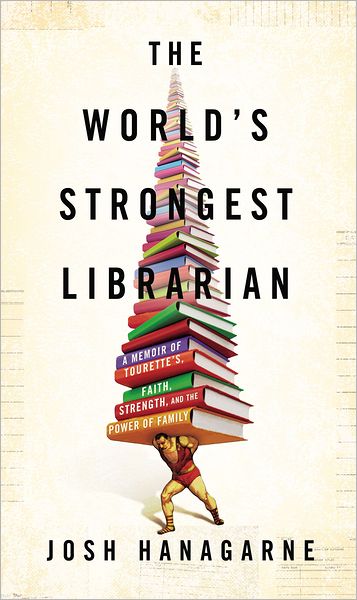
Maximum Shelf: The World’s Strongest Librarian by Josh Hanagarne

Maximum Shelf is the weekly Shelf Awareness feature focusing on an upcoming title we love and believe will be a great handselling opportunity for booksellers everywhere. The features are written by our editors and reviewers and the publisher has helped support the issue.

My editor recently asked me if I’d like to put together my first Maximum Shelf for them, and said she had just the book in mind for me: The World’s Strongest Librarian: A Memoir of Tourette’s, Faith, Strength, and the Power of Family, by Josh Hanagarne. (My father found this a hilarious expression of what my editor thinks of me. I’ll let you work that one out. I haven’t.) I was thrilled; and I loved the book. Because this would make for an extra long blog post, I’ve split the Max Shelf issue into two posts for you, so please enjoy my review today and my interview with the gracious & funny Josh tomorrow.


worldsstrongest

Josh Hanagarne, blogger at The World’s Strongest Librarian, “might be the only person whose first three-hundred-pound bench press was accompanied by the Recorded Books production of Don Quixote.” This is just one of his remarkable singularities. A gentle giant who tears phone books for fun, at 6’7″ he tends to catch the eye at the Salt Lake City Public Library, even when his Tourette Syndrome is not acting up. His memoir explores these contradictions and oddities, and his remarkable journey from idyllic childhood to painfully jerky young adulthood to a contented family and work life.

Hanagarne had a happy childhood, beloved by his mother, an incorrigible prankster and devout Mormon, and his devoted, irreverent bear of a father. He grew up in libraries, a passionate bookworm disturbed only by the tics that began in first grade but would go undiagnosed until high school (although his father suspected Tourette’s from the beginning). By young adulthood, they were not only embarrassing but violent and debilitating. He would eventually suffer a hernia from the force of his involuntary shouting tics, and his larger movements resulted in injury to himself and chaos in his immediate surroundings. After high school he spent years trying numerous cures, in and out of college, working various jobs and struggling with depression. Lifting weights at the gym stilled the tics somewhat, and for a while he got regular Botox injections in his vocal cords to quiet the shouts and whoops. During that time he met and married a lovely Mormon folklorist named Janette. For the first eight months of marriage, he couldn’t speak to her above a whisper.

Although deeply in love, the atmosphere of Josh and Janette’s story early in their marriage remains clouded. For years they try to get pregnant. Janette suffers two miscarriages and they are harshly rejected by the Mormon Church as adoptive parents. Josh continues to tussle with Tourette’s. For a short time, he finds a position as assistant special educator quite satisfying, not least because his tics become unremarkable in a room full of special needs. But he soon leaves that job, because he seeks challenge: crucially, he aspires to overcome Tourette’s, to beat his tics into submission. Pondering what might present the greatest challenge to a man who can’t keep quiet, Josh is drawn to the quietest place he knows, a place that has always offered succor and delight. He gets a job as a clerk in the library and begins a master’s program in library science. And a key piece of marital bliss is finally achieved when Janette delivers a healthy baby boy named Max.

Josh continues to battle Tourette’s in the gym, discovers kettlebell lifting along the way, and makes a new friend in Adam Glass, a former Air Force tech sergeant and strongman: he bends wrenches and horseshoes and tears decks of cards and phone books. Josh’s story takes an inspiring turn as the twitchy librarian and the foul-mouthed strongman gradually develop a friendship; as Adam helps Josh build strength, together they also begin to understand and subdue the tics. He finds Adam a little strange, and the explanation for his social awkwardness is also what makes him the perfect mentor for overcoming Tourette’s: Adam is autistic.

The adult Josh Hanagarne who relates his story is content and stable, happily married, thrilled to be a father to four-year-old Max, and working full-time at the Salt Lake City Public Library. As he relates his stranger-than-fiction story, he intersperses present-day anecdotes from a workplace that he wryly notes is rife with strange and occasionally smelly patrons and events. He muses eloquently and powerfully about the role of libraries in society, and their future possibilities. Throughout his life and this book, Josh struggles with his Mormon faith, as he sets off on the expected mission and faces myriad challenges in school, work, marriage and parenthood. In telling a story about family, church and Tourette Syndrome, he always circles back to libraries and to books, in many charming literary references. And always central to Josh’s story is his love of family. From his loving parents and exceptionally close siblings through the clear delight Josh finds in marriage and fatherhood, he stresses the inestimable gift of a loving family.

Josh’s memoir is thoughtful, heartfelt, often hilarious– and unsparingly honest. He is not proud of every moment in his own past, but he shares nonetheless. The image of the man today who wrote this book and who works in a large branch of a public library in a large city is that of a serious yet funny, mature, loving family man, and this image is only partly at odds with the earlier, less secure young man we come to know in these pages. The younger Josh was unsure and unstable, and the author is more comfortable in his own skin. But both have tics, and stories to tell.


This review originally ran on April 9, 2013 as a Shelf Awareness special issue. To subscribe, click here, and you’ll receive two issues per week of book reviews and other bookish fun!


Rating: 9 minutes of calm.

Tomorrow: I interview The World’s Strongest Librarian.

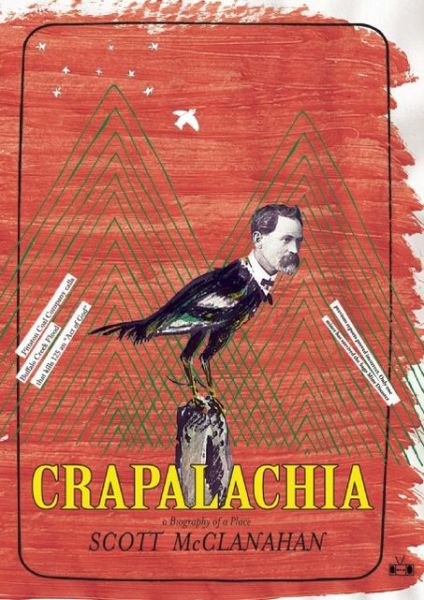
Crapalachia: A Biography of a Place by Scott McClanahan

The author of Stories and its followups, Stories II and Stories V!, shares a memoir of Appalachian boyhood filled with the requisite hardships but ultimately redemptive.

crapalachia

Scott McClanahan centers Crapalachia on two characters of his West Virginia youth who rule over much of the narrative–his Grandma Ruby, an ornery, fantastical mother of 13 (or so) children who also photographed dead people, and his uncle Nathan, who had cerebral palsy and enjoyed listening to the radio preacher and having six-packs of beer poured down his feeding tube. We also meet his schoolboy friends, like Little Bill, an eventual roommate with obsessive-compulsive disorder and a destructive crush on a girl down the street.

Crapalachia is an unusual story told in an unusual fashion, peppered with second-person references, advice to the reader on how to live, how to remember and forget. The attentive reader will also appreciate McClanahan’s “Appendix and Notes” for its revelation of where he’s twisted the truth (as he remembers it) to suit the story he wanted to tell. Like many memoirists, McClanahan is concerned with the nature of memory, its credibility and value. He sometimes gets mired in the unpleasant, cringeworthy details of life, then pans out for grand, loving, hopeful statements. This is a gritty look at life–in Appalachia, yes, but also in a universal sense. Historical detail turns what looked to be a memoir of childhood into the subtitle’s promised “biography of a place.” In the end, despite various tragedies, this poetic, rambling series of remembrances is surprisingly optimistic.


This review originally ran in the March 26, 2013 issue of Shelf Awareness for Readers. To subscribe, click here, and you’ll receive two issues per week of book reviews and other bookish fun!


Rating: 6 gallstones.

In the Garden of Beasts: Love, Terror, and an American Family in Hitler’s Berlin by Erik Larson (audio)

gardenAs the title indicates, this is a creepy work of nonfiction. Erik Larson, popular author of (among other things) The Devil in the White City, here tackles the subject of one American family living in Berlin in the years leading up to World War II. William E. Dodd was an unassuming professor of history in Chicago in the early 1930’s, wishing for a little more free time to finish his life’s work, a 4-volume history of “the Old South.” He lobbied Roosevelt, through his modest political connections, for a quiet diplomat’s post to somewhere like Belgium or the Netherlands. There he hoped to settle down to finish his books and not have to do too much real diplomatic work, to which he readily confessed he was not well suited. Instead, owing to a strange combination of forces – mostly, no one else being willing to take the post – he was appointed to be the United States’ diplomat to Berlin in 1933. He traveled to Hitler’s Germany with his wife and grown son, Bill Jr., both of whom play almost no role in the story, and with his grown daughter, Martha, who stars next to the elder Dodd himself.

William E. Dodd is a conscientious man, rather to the point of annoyance. His sense of humor is wry and not well appreciated in diplomatic circles. He comes from a modest background and lives on a professor’s salary, and now a diplomat’s, which is quite moderate; in Berlin he plans to live within the bounds of that salary, which is the first time he offends protocol, but not the last. As Larson explains, diplomats are traditionally wealthy men of great style – valets, fancy chauffeured cars, fine wines, grand balls and the like – and make up what Larson quotes one diplomat as calling a “pretty good club.” Dodd will fail to fit into this club, and will, to the aggravation of all, criticize it throughout his tenure.

Martha is a sultry young woman very comfortable with her charms and her ability to wield her sexuality as a weapon against the men in her world; she enjoys men, and sex, and is in the process of ending a secret marriage even when she sets sail for Germany. When she gets there, she is charmed by the Nazis, handsome and blonde and polite and uniformed, and is not unhappy to be characterized as a “little Nazi” herself. Among the lovers we assume she took in Germany (Larson points out what we don’t know for sure, but makes a strong case) are a Gestapo leader, a French diplomat, a close assistant to Hitler, and eventually a Russian diplomatic assistant who turns out to be a Soviet spy. She is even at one point asked to be “Hitler’s woman,” and introduced to him, but nothing comes of it (not for lack of her attraction to the man of power, however). By the end of the Dodds’ years in Berlin, however, she has noted the evils of the Third Reich and flirts with becoming a spy for Stalin, herself.

Larson’s fine work here is in bringing a time and a place to life, and it raises goosebumps. Hitler’s Berlin is chilling, in large part because we, the modern readers, have the benefit of hindsight, and it is deeply disturbing to watch humanly flawed men and women walk around that time and place without realizing just how bad things are going to get. There is willful ignorance, naturally, as well as antisemitism in varying degrees: the Dodds share this prejudice with many of their contemporaries, and it helps them to excuse Hitler’s regime longer than they should… but again, this is all with the 20/20 vision we possess today. It’s difficult to imagine the tolerance shown by the United States, and Dodd, and the world, for Hitler; but this is history.

The decision to showcase Martha alongside Dodd was a fine one. They are two very different characters, both tending to minimize Germany’s faults at the start of the story but both (very differently) eventually coming to understand and fear the changes to come. When the Dodds left Berlin in 1937, the United States were yet years from a war with Germany, but Dodd had begun to prophecy some of the terrors to come.

Larson’s In the Garden of Beasts (poetically named for the literal translation of Tiergarten, a garden & neighborhood in Berlin where the Dodds lived) is to my tastes a great way to read history. The story electrifies, brings the past to life, and promises to faithfully follow the sources available. An enjoyable and worthwhile, if unnerving, read (or listen).


Rating: 7 breaches of protocol.

multimedia journalism from the NYT: “Snow Fall” by John Branch

I have a librarian coworker, Liz, who always finds the coolest latest thing, and is expert at sending me articles (etc.) that will interest me. Recently, that was an article from the New York Times that blew my mind in a few different ways. For one, the story is striking: in February 2012 an avalanche in Washington state had tragic consequences for a group of skiers. The story of that day is told in this article in a structure that I very much appreciate. In a manner reminiscent of Jon Krakauer’s Into Thin Air (a book that started as an article in Outside magazine) and Sebastian Junger’s The Perfect Storm, journalist John Branch approaches his subject from various angles. He informs us on the science of weather and snowpack and how avalanches form; the latest trends in backcountry skiing; the biographies of the individuals involved. As a text article, it would be very impressive, and very moving.

But that’s not the full story on this story. As presented online, Branch’s article uses a variety of media: still images and animations, video and audio clips, computer-generated demonstrations of (for example) avalanche activity. And, as Liz points out, all the media are combined in such a way that, as one scrolls to read the article, it all flows and combines smoothly without distracting the reader. How many times have you seen this done the wrong way, where flashing images pull your eyes and/or mind away from the content you’re trying to access? I think I can say that this is the finest multimedia presentation I’ve seen online. Combined with the incredibly powerful story Branch has to tell, this is a unique experience you don’t want to miss.

And with that long introduction…


Real Man Adventures by T Cooper

A dryly witty journey from female to male, with musings on what it means to be a man.

T Cooper, the author of several successful novels (including The Beaufort Diaries and Lipshitz 6), is fascinated by masculinity, perhaps in part because he’s had to work a little harder than the average man to get there: he was born female. Yet even as he explores the essence of masculinity and his own experiences with gender in Real Man Adventures, he expresses some reluctance to delve into the personal.

There is definitely some autobiographical content, but Cooper takes his own privacy seriously, as well as that of his wife and daughters, and is less interested in hashing out the details of his own life than he is in exploring the meaning and role of masculinity in society and the difficulties facing transgender men and women. Real Man Adventures sidesteps the concept of a straightforward memoir, instead compiling a whimsical collection of miscellanea: letters, interviews, lists and original art all help Cooper and his readers explore together what makes a man. This structure works perfectly, and feels like a conversation with Cooper himself.

Deeply honest, even while guarding a few precious items of privacy, Real Man Adventures is a brave book. Cooper does a great service not only to transgender people whose paths might be made a little clearer, but also to their loved ones, neighbors and acquaintances, who should find it a little easier to navigate relationships and communications thanks to this frank discussion. And the irreverent, wry humor throughout keeps Cooper’s brash personality at center stage, where it belongs.


This review originally ran as a *starred review* in the Nov. 27, 2012 issue of Shelf Awareness for Readers. To subscribe, click here, and you’ll receive two issues per week of book reviews and other bookish fun!


Rating: 8 pronouns.

guest review: The Longest Race by Ed Ayres, from Pops

As I read The Longest Race, I thought of my father throughout. He is a marathon runner and a trail runner, and has been contemplating issues of climate change, sustainable living, and humans’ place in nature quite a bit recently. I thought this would be a perfect book for him in its combination of themes, which you can read about in my review. Here, he responds. [His page numbers come from my advance review copy.]

Julia has already done her usual commendable job reviewing this book; my personal interest in Ayres’ two main themes – running, and human degradation of our earthly habitat – compel me to comment further (as she knew it would.) At the same time, I want to parse her use of “metaphor” to describe how running and human development are related in Ayres’ story. While he does often employ metaphor, I believe in many cases he is saying that running actually is part of human development and does have an impact on how we relate to the world. Such is the hubris that plays a part in his tale.

For the above reasons, I really enjoyed this read. That doesn’t mean I found it uniformly superb or satisfying, but the book’s strengths were more than enough to keep me going.

Using a 50-mile ultra to structure his narrative worked better than I expected. There were few threads about his race that required following intently, and those were not lost as we periodically reconnect to that story. The more esoteric subjects he contemplates along the way vary greatly – just as would one’s thoughts during the hours of such an endurance event. In fact, that is an example of the athletic authenticity I found throughout. While I was only familiar with Ayres generally as editor of the early magazine “Running Times,” his deep experience as a lifelong runner shows through. His mental meanderings during a 50-miler – and their sometimes-questionable lucidity – are a familiar element of “running long.”

I was not familiar with Ayres’ background in the themes of human impact on the earth; he worked for the Worldwatch Institute and describes how this commitment evolved from a Quaker upbringing and through a lifetime’s experience. Along the run, we gather bits of his own back-story and “meet” such characters as Mohammed Ali, Mikhail Gorbachev and Ted Taylor (nuclear weapon physicist); such moments are fun and interesting – and chilling, as with his quotation from Taylor evoking the cold war’s nuclear terror (p.94). Also chilling is Ayres’ observation that for those who study the science of ecology, the survival of modern human society is “not just an abstract, academic concept;” it is very immediate.

We learn with him on his journey; e.g. Jared Diamond’s observation that agriculture is “in many ways a catastrophe from which we have never recovered” (p.102) – or “anthropomorphism as a major root cause of the ecological crisis” as noted by many literary luminaries over the years (p.106) – or the 1992 consensus-scientists’ dire & explicit climate change declaration so long ago (p.163) – or a reminder that the regressive “progress” of a suburban lifestyle model may prove to be a mere 2-generation phenomenon. We also meet such authorities as Paul Shepard, Rachel Carson and Wendell Berry along the way.

Similarly, Ayres has much to offer about running itself – not just practical stuff, but history and science as well. He met and/or learned from such names as Joan Benoit, Ted Corbitt and George Sheehan. He cites a Joe Henderson article that I know I read at the same time 25 years ago. Ayres is not the namedropper – that’s my doing throughout here – but rather all these names simply arise as part of his story.

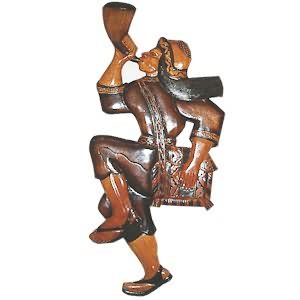
His introduction to the JFK ultra event’s origin unwinds into a period piece on the Kennedy Physical Fitness campaign (which I too experienced), including analysis of JFK’s civic motivation and his 1960 column in Sports Illustrated (who knew?!). I loved learning of David Carrier’s fascinating theory of primitive “persistence hunting,” where humans demonstrated the superior endurance trait that we runners still attempt to conjure (Ch.4). In fact, the role of endurance running throughout early history is compelling – including the Chasquis, the Inca runner-messengers.

Chasqui runner

Chasqui runner


The brief 23 page Appendix, “Notes for an Aspiring Ultrarunner,” is an worthy overview but any really interested reader will do well to research the many other references available.

All together, I enjoyed the blending of themes, emotions and ideas in Ayres’ book. Here is a single passage where Ayres is so nicely able to blend his heritage, running and science:
“The last sounds of the spectators faded, and, after a period of silence that could have been either five minutes or the hundred years it takes for a Quaker kid to sit through Sunday meeting, I found myself glancing left and right, the way I’d been taught as a teenager to drive a car – keep your eyes moving, don’t get fixated on the road ahead. Maybe that was a vestige of the hunter-gatherer’s need to read his surroundings.”

While it is different in some ways, a reader drawn to Ayres book may also appreciate Long Distance, by Bill McKibben. Here you would find a foremost climate change writer who instead writes about his experience pursuing an endurance goal (cross-country skiing) and the lessons he derives for surviving in our every day lives. (Interestingly, the one promotional blurb on the cover of Ayres’ book is a McKibben quote.)

Finally, I must note two of my own favorite observations about running, which he mentions along the way. One is the uncanny and almost inexplicable way that a seasoned trail runner, moving quicker than the eyes seem to process, can cover rough ground dense with rocks & roots – and yet every footstep survives the gauntlet (“almost inexplicable” because there is a scientific story, of course); this phenomenon is well-captured in the exclamation “do my feet have eyes of their own?!” (p.58)

The other fave comes after he has related the many challenges that can test a runner’s resolve and motivation, all the aches & pains & setbacks – which are all so easily overcome by the most sublime moments (or preferably hours!) This he also captures with a mere phrase: “When running is good, there is nothing like it.” (p.98) Alas, as we age, it becomes harder to remember that lesson – but after 35 years it can still be good, and there is still nothing like it.

So glad you liked it, Pops. Thanks for sharing.

Walden by Henry David Thoreau

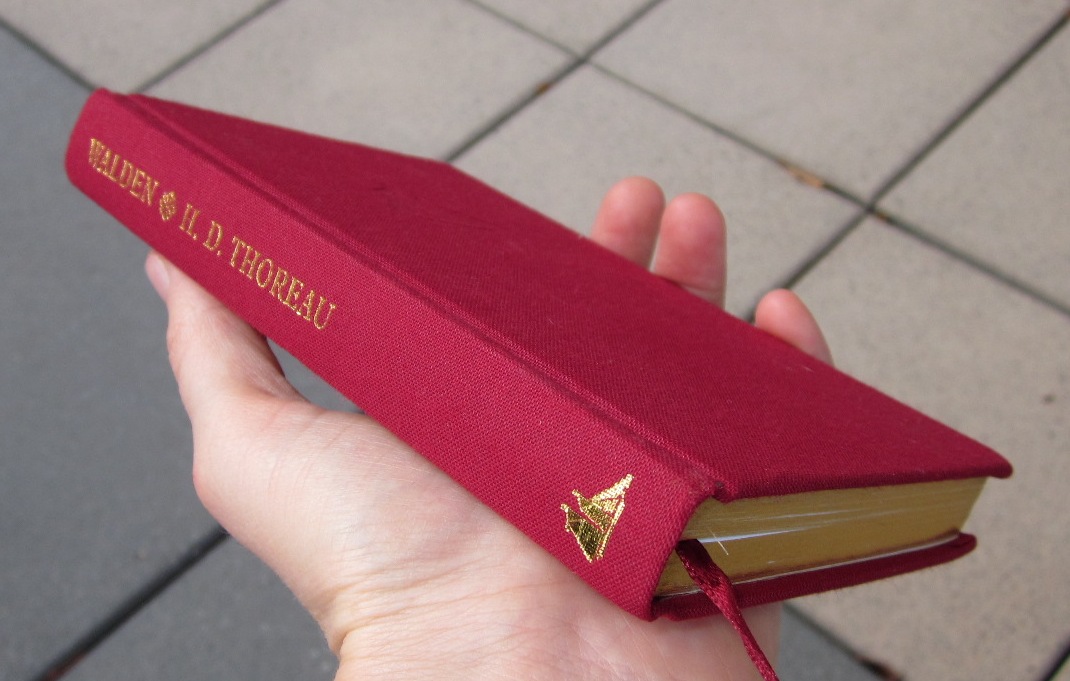
my charming little copy of Walden


I have been thinking this review over carefully. Walden is an “important” book. I had some troubles with it, particularly about midway through, when I stalled for several days and was sure I was going to give up. This was while visiting Concord and Walden Pond, no less! I think I owe my father credit: he recommended that I just read it through, with less attention to note-taking and interpretation at every page along the way. And on my long travel day home, I got back into it.

What is it that made this book a little difficult for me? Well, the language is somewhat dated, and the sentences tend to be long and rambling. Picture several long clauses strung together, and then having to look back up half a page to see what the subject was that this verb, finally, is acting upon. That will slow a person down. And the subject matter, the thoughts being communicated, are often quite dense. When Thoreau writes descriptions of his natural surroundings, I can settle into the imagery and the poetry, and float along pleasantly. But when he philosophizes, I am often in trouble. Large ideas are presented here, regarding our relationship with the natural world, politics, and religion. Thoreau jumps around between these subjects. Perhaps this begins to help you understand my trouble.

The first chapter, “Economy,” is lengthy. In my edition it occupies 80 pages, of 350. And no later chapter runs longer than 20 pages. I enjoyed “Economy”: I sympathize with the points Thoreau makes therein. But maybe I was wearied by it. It wasn’t until 200+ pages that I stalled badly. And once I got back into it, I enjoyed it again. I can’t entirely explain that pattern, and I’m sure yours was/will be different. I think the biggest help I got was visiting Walden Pond. This is obvious, no? When my mother and I toured The Wayside, our park ranger/tour guide quoted Nathaniel Hawthorne (and I wish I could find the quotation) on visiting authors’ homes. The gist was that visiting the home of an author is the best way to better understand his or her work, and my (limited) experience visiting authors’ homes certainly backs this up. In this way, walking around Walden Pond enriched my appreciation of Walden and renewed my interest in it.

Walden is a memoir; a political tract; a geographical study; a fine piece of nature writing; and a poetic rambling by a unique sort of Renaissance man. I found it rather effortful reading, but worth it in the end. For those who enjoy thought-provoking, challenging, lyrical writings (and longish sentences), it should be a big hit. For those who find these characteristics a little daunting, but are interested in the legacy of Henry David Thoreau, I recommend giving it a go just the same. I’m glad I did. And go see the place in question if you can, too!


Rating: 6 fallen leaves.

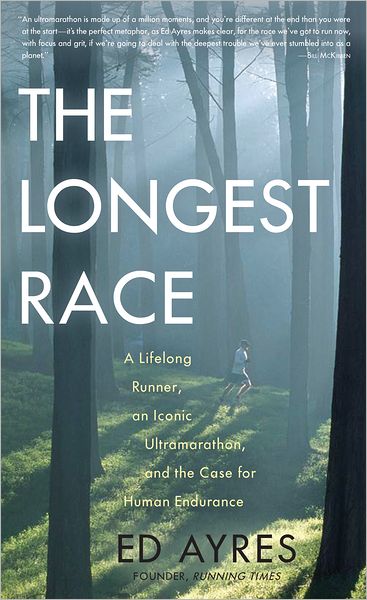
The Longest Race: A Lifelong Runner, an Iconic Ultramarathon, and the Case for Human Endurance by Ed Ayres

An ultramarathon, run by a master of the sport, becomes a metaphor for the race for human sustainability we are all running.

Ed Ayres has been running competitively for more than half a century. On a professional basis, he’s also studied climate change, sustainability and a variety of issues facing the future of the human race and our planet. The Longest Race is the story of his 2001 run at the JFK 50 Mile, the United States’ oldest ultramarathon. As Ayres attempts, at age 60, to set a new age-group course record, he contemplates the relationship of human endurance to the sustainability of human life in a fast-changing world.

Ayres’s recollections a decade later are heavy on metaphor. The ultramarathon is a symbol not just for his life, but for any man or woman’s life, and ultimately for the lifespan of humanity. The attributes that work toward sustainability at an individual level are equally valuable in a large society, Ayres says, and today’s “sprint culture” would do well to reconsider the concept of pacing. He also touches on the atom bomb, human evolution, the U.S. crisis in physical fitness and the reasons for following a vegetarian diet. But for all its peripatetic allegory, The Longest Race is always the story of one epic 50-mile race in all its technical and visceral elements, and also a celebration of the sport of running and of our ability to keep running in changing times. For those readers inspired by his story, the appendix offers practical advice to the aspiring ultrarunner.


This review originally ran in the October 19, 2012 issue of Shelf Awareness for Readers. To subscribe, click here, and you’ll receive two issues per week of book reviews and other bookish fun!


Rating: 8 miles to go.

EDIT: See also my father’s glowing review of same.