A Buzz in the Meadow: The Natural History of a French Farm by Dave Goulson

A celebration of biology and the joy of discovery–and a reminder to tread lightly.

buzz
Dave Goulson follows A Sting in the Tale, about his years studying bumblebees, with A Buzz in the Meadow: The Natural History of a French Farm. In 2003, Goulson purchased a 33-acre property with a decaying farmhouse and barn, and turned it into a private nature reserve; here he describes the multitude of wildlife he shares those acres with. His goal is to celebrate the wonder of the natural world–especially insects, which make up roughly two-thirds of known life on Earth.

Goulson charmingly depicts the mating practices of dance flies and the many butterfly species he sees on his daily run, and elucidates the habits of the famously cannibalistic female mantis with added knowledge gained through his own studies. A Buzz in the Meadow is both a descriptive work and a call to arms, a reminder that all species are precious and necessary, even the tiny ones. Goulson repeatedly states that conservationists should look beyond large and charismatic creatures like whales and tigers; he perhaps overstates that “the extinction of the giant panda… would not have any knock-on consequences. There would perhaps be a tiny bit more bamboo in a forest in China,” but his point is well taken–that insects make up the majority of life and play an outsized role in the interconnectivity of biological systems worldwide. Goulson’s tone is personal, even humorously self-effacing, but clearly expert. A Buzz in the Meadow accessibly presents natural science and gracefully offers an earnest wake-up call to conservation.


This review originally ran in the April 28, 2015 issue of Shelf Awareness for Readers. To subscribe, click here, and you’ll receive two issues per week of book reviews and other bookish fun!


Rating: 6 dormice.

The Light of the World by Elizabeth Alexander

Moving, charming, delicately lovely, this memoir of a husband’s death offers solace and even joy.

light world

Poet Elizabeth Alexander (Crave Radiance; the 2009 Inaugural Poem) was enjoying a loving, creative, exultant and full life with her husband, Ficre Ghebreyesus, and their two sons, when Ficre died suddenly. The Light of the World is her record of that man–a husband and father, an artist, activist and chef–and of Alexander’s grief and gratitude for the years she shared with him and the love and family they made.

This astonishing and naturally poetic memoir of love and loss is vivid and abundant with sensory detail and bright color. Alexander includes recipes–Ficre’s, and those that comforted her after his death; gives evocative descriptions of his paintings and the food and music they both loved; counts his scars; and recounts her dreams of him. But The Light of the World is not a dream itself: Alexander is lucid and absolutely present. Perhaps to ward off the end it threatens, the story she sets out to tell starts, and starts again, and starts again: at their respective mothers’ pregnancies; at Ficre’s 50th birthday, the week of his death; when they met at a coffee shop in 1996. Alexander then resolutely travels through the tragic center of her story and into the life that follows, when her family of four becomes “a three-legged table,” as she phrased it in her first poem afterwards. In this tender, perceptive portrayal, Ficre comes alive again: an Eritrean native, a peace-lover born into war, a painter also accomplished in photography, collage and sculpture, an eager reader fluent in seven languages and who “could say hello and thank you in literally dozens of other[s],” an activist and member of African, African-American and global communities. “Your life is just like a foreign film!” a friend rightly exclaims, and Alexander’s is just the voice to portray his broadly informed, musical, painterly existence.

Short chapters and language of unrivalled beauty ease a sad story, and Alexander and her sons do make a joyful noise in the end. She feels that she carries “a Santa’s sack of gifts” of Ficre’s thoughts and impressions that belong to her alone; she celebrates the time they had. Their shared dreams, scars, meals, songs, dances, history and family are fittingly and exquisitely honored here.


This review originally ran as a *starred review* in the April 23, 2015 issue of Shelf Awareness for the Book Trade. To subscribe, click here.


Rating: 9 red lentils.

class: Foundations of Creative Nonfiction – B

I took a class from Creative Nonfiction this spring, for 10 weeks from January through March. Foundations of Creative Nonfiction is taught in two sections, A and B, and the difference is in the readings assigned, so that neither is a prereq; rather, it’s basically an opportunity to expand into 20 weeks by taking both, and get more reading-and-discussing out of it. Also, presumably, different instructors. My instructor for this section was Meghan O’Gieblyn.

Let’s see, how to begin? Like many online classes, this one involved reading 3-5 short pieces per week and commenting on them in discussion forums. Meghan posted her written lectures (3-5 pages) for each week, as well as two examples of the writing form in question, and often a few more optional readings. My classmates and I were to post a comment on the week’s readings, and reply to one another’s comments as well. Then there were writing assignments: short, optional ones, and three longer (3,500 word) pieces. These, too, the instructor as well as my classmates responded to.

Now, I got my master’s degree almost entirely through this very format. The difference here is that my classmates and I are here even more by choice: we paid for this class, and it gets us nowhere in terms of a degree or class credit; it’s purely for personal enrichment. (If any of my classmates got a pay raise or a new job out of this, I didn’t hear of it.) If anything, one might expect the discussion to be slightly elevated over my (rather disappointing) graduate school experience. And… I guess it was, a little, but the drawbacks were the same. For one thing, I think online discussions are unavoidably more stilted than live, in-person ones. There’s little chance to speak off the cuff in an online forum; there’s a chance for editing and deleting. Some classmates cited technical difficulties interrupting their comments, too. It’s always rewarding to hear from other human beings about anything you’re reading, writing, or otherwise interesting, so that benefit was present. But I remain unsold on the digital format: if real people are available, in person, in real life, I think they will always be preferable.

I did get a lot out of this class, of course. I got a lot of readings and lectures (all of which I’ve saved for future reference). I got feedback on several short and the three long writing pieces I did. I gained only a little help with the concept of getting my work properly published; but that still feels awfully remote anyway. And to be fair, if it felt closer, the opportunity was present to ask those questions.

Instructor Meghan was excellent: responsive, kind, and full of specific, detailed criticism and advice. Overall, the class may not have been utterly world-changing, but it was worth the time, although I think an in-person class would be better. And if you consider CNF for an online class like this, I’d highly recommend Meghan.

Hammer Head: The Making of a Carpenter by Nina MacLaughlin

The pile of boxes dwindled at the bottom of the stairs and grew at the top. Ten boxes left, then four, then one, and I realized I should not have left the two bags of cement for last. I climbed eight hundred and ten stairs that day, hauled up nine hundred ninety-five pounds, nearly half a ton. The feeling that resulted from the effort, the satisfaction, was so different from the one I knew putting a final period on a book review or a profile on deadline.

The journey of a journalist-turned-carpenter, a woman in a man’s world, both thoughtful and spirited.

hammer head

Nina MacLaughlin studied English and Classics in college, and went on to work for a Boston newspaper. She spent her 20’s there, increasingly frustrated by pointing and clicking and sinking into her desk chair, so she walked away, unsure of what was next, until she spotted an ad for a carpenter’s assistant: “Women strongly encouraged to apply.” MacLaughlin relates the journey offered by that opportunity in Hammer Head: The Making of a Carpenter.

MacLaughlin’s new boss, Mary, describes herself as a “journeyman-level carpenter and a slightly better tiler.” MacLaughlin doesn’t know what these words mean, but brings her strength, work ethic and quickness to learn, and finds an unexpectedly rewarding new life working with her hands: “The feeling that resulted from the effort, the satisfaction, was so different from the one I knew putting a final period on a book review or a profile on deadline.” She documents years spent learning and working in a male-dominated field, occasionally seasoned with observations referencing poets and ancients, but mostly living and reveling in the tangible: calluses, sinews, wood and sweat. That interplay of the physical and the intellectual centers this book, which is itself both intelligent and well-muscled, hardy and poetical.

Organized by tools that represent qualities of character, Hammer Head is unsurprisingly beautifully written, and well supported in both its structural and its cerebral elements. MacLaughlin’s voice is wise and playful, wondering and astute, and Mary is a marvelous character, levelheaded and non-demonstrative. The result is a charming, thought-provoking, utterly lovely ode to work and life and learning.


This review originally ran in the March 24, 2015 issue of Shelf Awareness for Readers. To subscribe, click here, and you’ll receive two issues per week of book reviews and other bookish fun!


Rating: measure 9 times.

Maximum Shelf: Spinster: Making a Life of One’s Own by Kate Bolick

Maximum Shelf is the weekly Shelf Awareness feature focusing on an upcoming title we love and believe will be a great handselling opportunity for booksellers everywhere. The features are written by our editors and reviewers and the publisher has helped support the issue.

This review was published by Shelf Awareness on March 4, 2015.

spinster

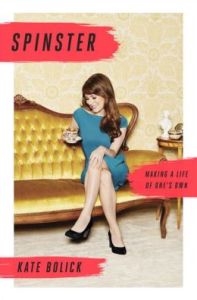
“Whom to marry, and when will it happen–these two questions define every woman’s existence, regardless of where she was raised or what religion she does or doesn’t practice… even if the answers are nobody and never.” Kate Bolick explores her own answer to the classic questions, arduously and over the years of her own life; she examines their place in society, and the way other women she admires have answered them, mining the lives of female writers who have affected her. The resulting book, Spinster: Making a Life of One’s Own, is less a polemic than one might expect, and more a thoughtful, generous consideration of our world, and a woman’s best options to honor herself.

Bolick begins with her family background, her loving parents and brother, and her home in Newburyport, Mass. In a personal and family tradition of talking, reading, discussing and writing, Bolick naturally gravitates toward literary models for the life she hopes to build. After her mother’s death, she seeks to re-create the conversations they used to share, “not with other, real, live women… but real, dead women, whom I could sidle up to shyly and get to know slowly, through the works they left behind and those written about them.” In the opening pages, she introduces her five “awakeners,” women of the written word who have offered her lessons about how to live as a woman, married or not. These awakeners are an essayist, a columnist, a poet, a novelist and a social visionary (although each, of course, crosses over and between those categories).

Maeve Brennan (1917-1993), essayist at the New Yorker, offers a loving picture of single city life and an admirable sense of style. She will also come to provide a frightening negative version of the stereotypical single woman’s final days. Neith Boyce (1872-1951), columnist at Vogue and representative of the Bachelor Girl, supplies a glimpse into the life of working women, a novel possibility in her time; although as Bolick points out, the chance of sex or sexiness in the workplace presents a “negotiation [that] continues today.” Edna St. Vincent Millay (1892-1950), poet and legendary lover, brings revelations. “Her legacy wasn’t recklessness, but a fierce individualism that even now evades our grasp.”

Edith Wharton (1862-1937), novelist and grand dame (“society’s favorite version of the single woman”), built herself a house, the Mount, with two rooms of her own, a public “boudoir” for entertaining and a spare bedroom in which to do her writing. She represents a model for the prioritization of one’s work, and also for the work Bolick reluctantly takes on in editing a luxury decorating magazine: rather than mere frivolity, this focus offers another opportunity to get to know herself. Charlotte Perkins Gilman (1860-1935), social visionary and prolific writer (of The Yellow Wallpaper, for example), inspires self-improvement and a different way to go about making a home.

Bolick tells her own story chronologically. As she discovers each of her five awakeners (a term borrowed from Wharton) and the lessons she finds with them, she changes jobs, moves from Newburyport to Boston to New York City, and dates and cohabitates with different men (referred to only by the first letter of their first names). She started using the word “spinster” in her journals in her early 20s, and always considered it a positive appellation, one posing possibility. Her evolving interest in spinsterhood is tracked by all of these layered journeys, the lives and writings of the awakeners interspersed with her own. Along the way, she also makes brief calls on Virginia Woolf, Mary McCarthy, Anne Sexton, Annie Dillard and others. Bolick acknowledges that the subjects of her investigations are all like her: straight white women of New England; diversity is not her focus.

Spinster‘s tone is charming, by turns confessional, collegial and academic. Bolick’s erudition is leavened by a playful, casual tone, even as she references Shakespeare and the Lernaean hydra in a single page. Not only a memoir, Spinster employs research into the lives of the five profiled writers, as well as into history and sexual politics. As the narrator of this voyage, Bolick is amiable, credible and fun to know.

Interestingly, all five of the awakeners eventually married, in some cases more than once. While it thoughtfully contemplates the possibilities for and arguments in favor of women remaining unmarried, Spinster is not a mandate. Bolick does not insist upon spinsterhood for her readers. Rather, she offers assistance in “holding on to that in you which is independent and self-sufficient,” whether single, happily or unhappily coupled. The word “spinster,” and all it entails–and Bolick makes great strides toward the proud and pleased application of this embattled historical term–is thus a tool for our individual contentedness.

Entertaining, wise and compassionate, Spinster is the result of Bolick’s lifetime of meditations, ruminations, angst and joy; of research, reading and appreciation of five intriguing lives; of dating, moving in with someone and time spent alone. While allowing that the coupled lifestyle is fine for some, Bolick’s message for readers is a celebration of the delights, challenges, and opportunities of remaining single.


Rating: 8 women.

Come back tomorrow for my interview with Bolick.

Travels in Vermeer by Michael White

A poet’s quiet, beautifully composed, powerful story of self-healing by viewing the paintings of Vermeer will be a balm to troubled minds as well as satisfying to lovers of art and memoir.

travels

Poet Michael White’s unusual and riveting memoir, Travels in Vermeer, opens in the midst of a nasty divorce and custody battle. White lost his first wife to cancer, but counts this second marital tragedy as a “total loss,” of faith as well as of his partner. Reeling, he flies to Amsterdam (“all I’d wanted was an ocean behind me”), and heads to the Rijksmuseum to see Rembrandts. But what he sees instead is The Milkmaid, a tiny painting by Johannes Vermeer. The maid evokes a “tingling at the back of [his] scalp,” and this knee-buckling discovery inspires a plan, hatched on the museum grounds, to devote his breaks from teaching university-level creative writing to traveling the world viewing all the Vermeers he can. For the next 14 months, he chases the life-changing insights and soothing, healing effect provided by the Dutch master’s small-scale, intuitive paintings, in which he sees expressions of love.

White studies biographies and art criticism about Vermeer, while visiting museums in The Hague, Washington, D.C., New York City and London. The reader shares in this lucid examination of Vermeer’s remarkable lighting techniques, occasional trompe l’oeil and the solitary women who feature in his work (alongside a few group scenes and landscapes). White sheds light as well on his difficult childhood, including a scene when his mother dumps him unannounced at his father’s apartment, following their divorce: unlike White’s own daughter, he was an apparently unwanted son. While Vermeer occupies the bulk of this brief, eloquent book, a few scenes from White’s battle with alcoholism and his tentative success with Alcoholics Anonymous round out a self-portrait sketched with great feeling in few words. Only a poet could communicate so economically, in language deserving of contemplatively paced reading.

White’s descriptions competently guide even the most unfamiliar or untrained reader through an appreciation of the mechanics and mysticism of Vermeer’s art. Readers will regret the lack of reproductions of the paintings under consideration; but as he observes upon meeting Girl with a Pearl Earring, “reproductions are useless.”

Travels in Vermeer is a thoroughly user-friendly piece of art education, but it is even better as a thoughtful, spare memoir of pain and recovery, unusually formatted and exquisitely moving. For a companion piece, consider White’s previously published book of poetry inspired by the same journey, entitled Vermeer in Hell.


This review originally ran in the February 27, 2015 issue of Shelf Awareness for the Book Trade. To subscribe, click here.


Rating: 9 daubs.

Bird by Bird by Anne Lamott

bird by birdI have known of this book for some time – I first remember hearing of it in Natalie Goldberg’s Writing Down the Bones – and recently yet another reference made me finally go looking for a copy of my own. I’m so glad I did. While Writing Down the Bones had some good writing tips, and Keep It Real provided good nuts and bolts, this was a great combination of writing tips, and nuts and bolts, and also heartfelt and encouraging advice about (as the subtitle says) writing and life.

Lamott’s conversational and even confessional tone makes me feel like we are friends – me and her, personally. She tells me confidentially some of the same things she tells her students in the writing classes she teaches; but it feels like I get a more intimate version. Her description of life as a writer is honest; she pulls no punches about publishing and the woes of full-time writing – well, what would I know about it, but at least I believe she has pulled no punches; that’s the impression her tone gives.

We get some a glimpse of Lamott’s life: her upbringing in a joyfully readerly household; her beloved father, the writer; her long and painful journey towards publication, and her discovery that it doesn’t solve the problems of the world or even of her world; her experiences as a single mother. We get to know her good friends. Lamott is hilarious and imaginative as well as kind. I love her; I want to go have a glass of wine with her right now.

As often when I love something, I find myself reduced to listing my favorite lines.

All you can give us is what life is about from your point of view. You are not going to be able to give us the plans to the submarine. Life is not a submarine. There are no plans.

Wonderful. Not a submarine. She is full of these excellent, inventive lines. This is why she is a writer.

Writing is about hypnotizing yourself into believing in yourself, getting some work done, then unhypnotizing yourself and going over the material coldly.

…And, I would add, repeatedly. When I am doing my best work, this is exactly what happens. I don’t know if I’m hypnotized, precisely, but for me the analogy is vomiting: when it’s going well, I just sit down and braaaaaaap it all just… comes out. And later I can go over it and clean it up. But what I needed to get out, I got out all in one go.

Writers tend to be so paranoid about talking about their work because no one, including us, really understands how it works. But it can help a great deal if you have someone you can call when you need a pep talk, someone you have learned to trust, someone who is honest and generous and who won’t jinx you. When you’re feeling low, you don’t want anyone even to joke that you may be in some kind of astrological strike zone where you’ll be for the next seven years. On a bad day you also don’t need a lot of advice. You just need a little empathy and affirmation. You need to feel once again that other people have confidence in you.

Again, this is advice not only for writing but for life. I think I am going to send this on to everyone I might ever ask for a pep talk, so they can be sure to get it right.

Her writing advice is decidedly geared toward fiction, and I am an aspiring writer of nonfiction. But I think there is still a great deal to be gained here. This is my favorite book of writing-and-life advice to date.


Rating: 9 birds, if that’s not too obvious.

Maximum Shelf: Dead Wake: The Last Crossing of the Lusitania by Erik Larson

Maximum Shelf is the weekly Shelf Awareness feature focusing on an upcoming title we love and believe will be a great handselling opportunity for booksellers everywhere. The features are written by our editors and reviewers and the publisher has helped support the issue.

This review was published by Shelf Awareness on February 9, 2015.


dead wakeIn May of 1915, a torpedo fired from a German submarine struck the RMS Lusitania, a British passenger ship with nearly 200 Americans aboard. She sunk off the coast of Ireland in less than 20 minutes (due to a sequence of events unforeseen even by its attacker), killing 1,200 passengers and crew, fully half of whose remains were never recovered. Common knowledge has it that this event drove the United States to enter a European war that would become World War I, but, in fact, while the Lusitania‘s fate played some role in that decision, it took two full years and the secret German Zimmerman telegram for the U.S. to enter the war in 1917.

Erik Larson examines this extended U.S. isolationism, the final days aboard the Lusitania, and related events and characters in Dead Wake: The Last Crossing of the Lusitania. As in his earlier books (Isaac’s Storm; In the Garden of Beasts), Larson presents exhaustive research with precision and accuracy, in extraordinarily compelling prose. Dead Wake is a masterpiece of gripping narrative nonfiction, arguably the most riveting of Larson’s works.

Nearly 2,000 people boarded the Lusitania in New York City, bound for Liverpool, including 1,300 passengers, of whom 189 were Americans. An unusually large proportion were children and babies. The Lusitania was the biggest and fastest civilian ship on the seas in that 10th month of European war. These superlatives–plus the reassurances of the captain, William Thomas Turner, and the Liverpool-based Cunard Line–allowed the ship to confidently set sail despite a German warning published in all the New York papers on the morning of the Lusitania‘s departure, that “vessels flying the flag of Great Britain, or of any of her allies, are liable to destruction.” Larson provides detail and humanity by profiling several passengers and crew members, including a Vanderbilt heir; a psychic; and a Boston bookseller who boarded with a small but invaluable collection of William Makepeace Thackeray’s original illustrations and Charles Dickens’s own copy of A Christmas Carol, complete with the author’s marginalia.

Just weeks earlier, another vessel had departed from the other side of the Atlantic Ocean. German Unterseeboot-20 was captained by Walther Schwieger, a well-regarded young Kapitänleutnant known for his aggressive and innovative tactics. Because submarines lost radio contact with their bases almost immediately upon departure and remained out of contact for much of their cruise, Schwieger was in full charge of his boat, empowered to cruise, dive and attack on his own, with the full support of his government. In following Schwieger’s submarine in the weeks leading up to the climax, Larson gives the story dimension; far from presenting the German captain as a monster, he is humanized, for example, by the devotion of the men who worked under him, and the presence on board of a litter of puppies rescued, interestingly, from another ship sunk by torpedo.

As he builds toward the inevitable intersection of U-20 with the Lusitania, Larson introduces more characters. Captain Turner of the Cunard Line had decades of experience at sea, and had just testified in a civil case against the owners of the Titanic on behalf of the families of deceased passengers. He was known to his men as a brave and capable but old-fashioned captain, with “one foot on the deck of a sailing ship.” U.S. President Woodrow Wilson had had a rough year, even without the European conflict: having lost his wife Ellen in late 1914, his mourning left him unmoored and struggling to concentrate, until he met widow Edith Bolling Galt. His love for her would prove overwhelming, and their courtship strained–she rejected his first marriage proposal. This love story is affecting, and if it serves as a distraction from the sinking ship at the center of this book, that is a fine style choice by Larson: it was a distraction for Wilson, too.

Meanwhile, a secret section of the British Admiralty was tasked with intercepting and decoding German wireless messages, a purpose known to only nine senior officials, who were hampered in using any information gained for fear of having its cryptanalysis ability revealed. They would therefore fail to warn Turner of U-20’s preying presence in the waters he sailed. Such parallel plots and individual profiles add color and depth to Larson’s account, as when the chief of British naval intelligence is described as “part Machiavelli, part schoolboy.”

The Lusitania‘s story is in itself moving, and carries great historical significance, but these events positively glitter with life in Larson’s engaging, quick-paced and captivating prose. Though it incorporates well-documented history, Dead Wake still contains elements of suspense for all but the most expert readers; as Larson acknowledges, he had his own misconceptions coming into this project, and learned surprising facts in his research, as readers surely will. The pages fly by as such details are revealed and the action ratchets up toward a climactic event that we all see coming, but that still makes us catch our breath. In spellbinding, immediate language, Larson contrasts the “books, and cigars, and fine foods, afternoon tea, and the easy cadence of shipboard life” on the Lusitania with the “U-boat sweat,” foul odors and close air aboard U-20. His enthralling description of passengers joking about submarines and torpedoes, in the very moments before the torpedo strike, and “making polite apologies” just after, in the scramble for life jackets, keep the reader fully engaged. Appealingly, in his “Note to Readers” and “Sources and Acknowledgments,” Larson writes in a more personal voice about the joy of the research process, and about his frank difficulty in understanding the passengers who boarded the Lusitania in the face of warnings from Germany about travel in a war zone.

Dead Wake is both a thoroughly satisfying read, and an unparalleled adventure into world history. Larson’s fans will rejoice, and grow in number.


Rating: 8 life jackets.

How lucky am I to get to interview Erik Larson?? Come back tomorrow to read the result.

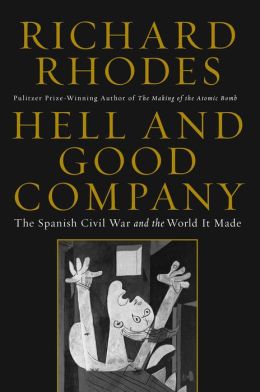
Hell and Good Company: The Spanish Civil War and the World it Made by Richard Rhodes

The Spanish Civil War, and its medical, military and artistic contributions to modernity.

hell

The Spanish Civil War was a precursor to World War II, and served as a practice field where medical and military leaders experimented with new technologies and refined strategies. Creative minds from around the world drew inspiration and horror from the conflict, yielding Picasso’s Guernica, Hemingway’s For Whom the Bell Tolls, Miro’s El Segador and Orwell’s Homage to Catalonia. In Hell and Good Company, Richard Rhodes (The Making of the Atomic Bomb) examines the Spanish Civil War not in exhaustive chronology or complex international intrigue–although both are present–but in its gifts, good and bad, to the world that followed.

As Germany and Italy begrudgingly contributed to the Spanish nationalist (fascist) side, and the Soviet Union just as reluctantly supplied the republicans, new military technologies met old. Advances in aircraft were matched by new strategies, including “carpet bombing,” a term used for the carnage at Guernica. In response, doctors and nurses from Spain and abroad innovated as well: while reliable blood typing and preservation for blood banking had been under development since World War I, safe transfusions in the field were born in the Spanish Civil War, as was the autochir (a mobile, sterile surgical unit).

Rhodes follows various individuals, famous (Hemingway, Picasso) and less so (volunteer doctors, nurses and soldiers from around the world), providing a vivid, wrenching view of war, art and love. While it scrutinizes world-changing new technologies and ways of life, Hell and Good Company is also a fine, accessible introductory history of the Spanish Civil War, and an evocative human story.


This review originally ran in the February 6, 2015 issue of Shelf Awareness for Readers. To subscribe, click here, and you’ll receive two issues per week of book reviews and other bookish fun!


Rating: 7 bombs.

“Total Eclipse” by Annie Dillard (from Teaching a Stone to Talk)

I began by thinking I could review this essay, but I can’t. Annie Dillard and the force of these words here are too much for my limited powers of communication. Read this and wonder.


(As usual from that excellent source of excellent things, Liz.)