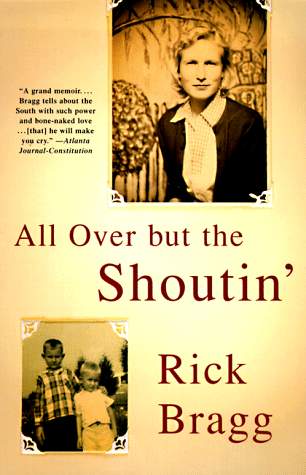
Teaser Tuesdays: All Over But the Shoutin’ by Rick Bragg

Teaser Tuesdays is a weekly bookish meme, hosted by MizB of Should Be Reading.

all over

I read the most mind-blowing book this week.

I had grown up in a house in which there were only two books, the King James Bible and the spring seed catalog. But here, in these boxes, were dozens of hardback copies of everything from Mark Twain to Sir Arthur Conan Doyle. There was a water-damaged Faulkner, and the nearly complete set of Edgar Rich Burroughs’s Tarzan. There was poetry and trash, Zane Grey’s Riders of the Purple Sage, and a paperback with two naked women on the cover. There was a tiny, old copy of Arabian Nights, threadbare Hardy Boys, and one Hemingway. He had bought most of them at a yard sale, by the box or pound, and some at a flea market. He did not even known what he was giving me, did not recognize most of the writers. “Your momma said you still liked to read,” he said.

There was Shakespeare. My father did not know who he was, exactly, but he had heard the name. He wanted them because they were pretty, because they were wrapped in fake leather, because they looked like rich folks’ books. I do not love Shakespeare, but I still have those books. I would not trade them for a gold monkey.

If those lines don’t hit you deep inside, I don’t know what you’re doing with my blog.

guest review: All the Wrong Places by Philip Connors, from Tassava

My buddy Tassava read both of Philip Connors’s books after I did, and he loved both, as I did. He had a different final conclusion, however. Here is the beginning of his review of the second, All the Wrong Places.
wrong places

Last year, Julia had recommended that I read Connors’ first book, Fire Season, a long essay on his work at a lookout in a fire tower in a huge wilderness area in New Mexico. Both a reflection on a solitary endeavor and a historical and philosophical examination of the nature of wildness, Fire Season is exceptionally good, and well worth the time of anyone who enjoys memoir or nature writing.

All the Wrong Places is a kind of prequel to Fire Season, a partial explanation of why Connors abandoned a good life and career in New York City for the isolation and inwardness of the fire tower. In brief, the second book is the story of Connors’ efforts to understand how his older brother, Dan, came to commit suicide, more or less out of the blue.

…You can read the rest of Tassava’s review here. And, my review of same.

Thanks, Tassava, for your contribution.

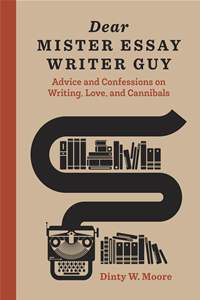
Dear Mister Essay Writer Guy: Advice and Confessions on Writing, Love, and Cannibals by Dinty W. Moore

Finely crafted short essays masquerading as self-effacing jokes about writers and writing, in q&a form.

dear mister essay writer guy

Dinty W. Moore (Between Panic and Desire), the editor of Brevity, solicited respected contemporary essayists for questions regarding the form, so he could answer them in Dear Mister Essay Writer Guy: Advice and Confessions on Writing, Love, and Cannibals. An essay riffing on the question at hand accompanies each q&a. The resulting collection of self-deprecating humor includes bits of writing advice as a bonus.

Cheryl Strayed has concerns about her predilection for the em dash: Moore assures her that “em dashes can replace commas, semicolons, colons, the large intestine, and parentheses.” Brenda Miller worries that Facebook “is like one big communal personal essay”; Moore answers with a selection of his status updates over a period of months, which are as sage and instructive as they are hilarious. Roxane Gay wonders about the value of writers writing about writing. Other seekers of wisdom include Judith Kitchen, Phillip Lopate, Brian Doyle and Lee Gutkind. Moore makes room to share a “found essay” left on his voicemail by Mike the Tree Guy, and to list the side effects of memoir, including “nausea, sleep problems, constipation, gas, and swelling of the navel.”

Moore is rarely serious and keeps his tongue in his cheek throughout, but the result is enlightening as well as entertaining. With fewer than 200 pages, Dear Mister Essay Writer Guy is a quick and enjoyable read, to be taken in pieces as small as the reader prefers. Its witty, modest tone belies the artistry of the essays contained, which are exemplars of the short form.


This review originally ran as a *starred review* in the August 28, 2015 issue of Shelf Awareness for Readers. To subscribe, click here, and you’ll receive two issues per week of book reviews and other bookish fun!


Rating: 7 polar bears, naturally.

Creative Nonfiction, issue 56: Waiting (summer 2015)

You can read my review of the previous issue here.

waiting“True stories, well told.” In this issue, they are stories concerned with waiting, whatever that might mean to the writer. (A few craft-related essays are also included.) Unsurprisingly, I am very impressed with the stories CNF chose to publish.

There’s not much not to love here, beginning with Editor Lee Gutkind’s opening piece about all the waiting that goes on in his and my line of work; Dinty W. Moore’s ponderings on the genre name “creative nonfiction” (I am an unrepentant Moore fan); and the essay “Waiting and Wading through Story” by Maggie Messitt, about immersion research and storytelling and the lessons she’s learned from other writers. But I was really blown away by this issue’s winning essay: I agree wholeheartedly with their choice of Joe Fassler’s “Wait Times” as winner of the Best Essay Prize. If you read nothing else in this magazine, please go read this story. It is heartrending and thought-provoking and disturbing, and I’ve thought about it at least daily for more than a week since reading it. It’s about a medical emergency experienced by his wife.

I found Judith Kitchen’s “Any Given Day” harder to love, and I’m sorry to say that, because I’ve heard such wonderful things about her (and have her Half in Shade waiting on my TBR shelf), not least from Gutkind in his opening piece. She died last fall of cancer, and this piece is in part about that ending. But the form of it – loose, amorphous, wandering – didn’t quite work for me. Just a personal reaction; perhaps you’ll find it mindblowing, and I’d love to hear if you do. Certainly she is a fine artist. But this piece didn’t work for me quite so well.

“Lost and Found” by Josephine Fitzpatrick was more a straightforward narrative piece, and call me simple-minded but that struck me more forcefully. Fitzpatrick’s brother went missing in Vietnam when they were both teenagers, and this is the story of waiting for him to come home or for his story to be somehow resolved, for many decades. It is of course touching and thoughtful and, I think, potentially helpful for others suffering from “ambiguous loss” (see also Sonya Lea’s outstanding Wondering Who You Are). Mylène Dressler’s “End Over End”, about coming to surfing as a mature adult and finding the stoke, finds a good balance between cerebral wanderings and narrative.

Following essays and stories about waiting, Sangamithra Iyer’s “The Story Behind the Story,” about searching for her grandfather’s history as civil servant turned activist in Burma, is a touching and instructive piece, not least in its realization that “not getting the story was part of my story, too… the loss of memories, the erasure of our histories, is part of the narrative of many of us children of the diaspora.” I love this concept.

Rachel Beanland’s “Required Reading” was another revelation, about handling the loss of her father by reading numerous memoirs of others’ losses. This strategy was deemed strange or not shared by others but made sense to her, helped her, and this makes sense to me, too. Look, I just said something similar, above, about “Lost and Found” and Wondering Who You Are. This is a short but powerful essay and it contains lots of titles and snippet-quotations that I’m marking for later.

I always look forward with intrigued anticipation to “Pushing the Boundaries,” the section of each issue that includes an “experiment in nonfiction.” This time it is Nathan Elliot’s “An Honest Application,” a response to the part of an immigration application that asks him to justify and place a value on the marriage that hopes to qualify him for permanent Canadian residence. His actual written response is short and simple, but it is accompanied by lengthy footnotes that include all the emotion and indignation he couldn’t put in his application. It is genius – I loved it – and I love as well the story of love that he has to tell.

There were others, but these are my favorites. You can view these pieces and more, or buy the whole issue (do that!) here.

Wondering Who You Are by Sonya Lea

A woman’s thoughtful account of life after her husband’s traumatic brain injury.

wondering

When Sonya Lea’s husband, Richard, had surgery to treat his rare appendiceal cancer, they knew there were risks. But they had not considered that Richard would wake up with no memory of his 23 years of marriage and two young adult children, or of his own personality and past. Sonya considers their shared history and difficult recovery in her memoir, Wondering Who You Are.

The details of Richard’s medical story are inarguably painful but often sweet. Sonya’s changed husband is empathetic, guileless and highly motivated to learn. Alternating chapters cover the trauma of his surgery and aftermath, and the story of their teenage romance and decades of marriage, until the timelines merge into one: Sonya’s quest for the husband she lost and her eventual acceptance of the one she’s found. This powerful, gut-wrenching narrative negotiates spirituality, hope and despair, sexual experimentation and a dedicated caregiver’s tireless research and advocacy. Sonya and Richard’s family story wanders geographically as well, from Kentucky to Ontario, Banff, Memphis, Seattle, California, France, India and more. Through assorted, arduous adventures, they learn again to rely on one another, to persist and to accept.

Sonya Lea is a fascinating narrator, by turns vulnerable and fierce, patient and maddened, always devoted. Her writing is contemplative and lovely, and contains just enough scientific detail. The result is a lyrical, intensely candid meditation on memory, identity and the stories we create for ourselves–and a love letter to both the new and old versions of Richard.


This review originally ran in the July 28, 2015 issue of Shelf Awareness for Readers. To subscribe, click here, and you’ll receive two issues per week of book reviews and other bookish fun!


Rating: 9 journal entries.

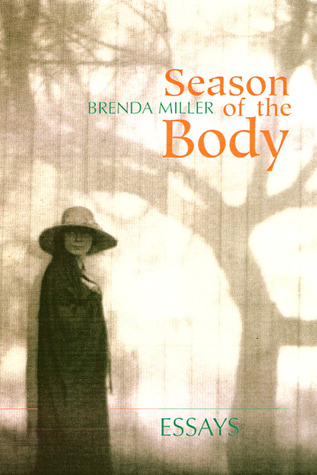
Season of the Body by Brenda Miller

season of the bodyBy one of the authors of Tell It Slant, Season of the Body is a collection of lovely essays which showcase Miller’s extraordinary, often poetic prose. She writes intimately about her own body and love affairs; two miscarriages when she was twenty which resulted in her inability to have children, and her feelings about that inability over the course of a life; her explorations in spirituality; different forms of family; and art. Her writing is sensual and muscular. I wonder if I use those words to describe it because the title, Season of the Body, cued me to do so. I think they ring true.

Without going back to investigate whether this is literally true, I am left with the impression that these essays run more or less chronologically in terms of the time in Miller’s life that they handle. So we meet her first as a young woman, dealing with the medical side of two miscarriages, and exploring her maternal ancestry and Jewish heritage. We see her pursuing relationships that work out more and less well; she becomes a godmother to a friend’s child, and wishes for her own. Later, we see her reflecting back from a certain distance. These essays also carry her through space, and because a sense of place is important to me, that intrigues me – all the more so because Miller and I now live in the same town, so I see some of her vistas out my own windows.

The fineness of this writing is indisputable. It is emotionally very powerful and evocative, and an extraordinary showcase for what language can do; her essays should really be read at least twice, for their content and again for their music. As craft, these essays are exemplary. In terms of their subject matter, they really got me thinking about the idea of the universal in personal writing. Writers of creative nonfiction are urged to find the universal in the personal story. I found myself sometimes distant from the sort of physical flesh of these essays: spiritual questing and yearning for babies are not experiences that resonate with me. I had to stop to consider how Miller’s writing did and didn’t speak to me. But I continued to feel pulled into the story, for the beauty of the writing as much as anything else. A friend characterized the themes of this collection a little less physically than I did: he cited “hope deferred and fractured desire.” In these terms, the stories Miller tells are much more universal, and maybe that’s where I responded to them, too.


Rating: 7 photographs.

The Writing Life by Annie Dillard (audio)

From Dillard’s website:

The Boston Globe called it “a kind of spiritual Strunk & White, a small and brilliant guidebook to the landscape of a writer’s task.

Recalling how I felt about Strunk & White, and my admiration for Dillard, this is promising.

writing lifeThe Writing Life is brief, and very enjoyable. Her voice as read by Tavia Gilbert feels just right for Dillard’s tone, which is knowing, wry, funny, and serious, by turns and often simultaneously (as I believe I noted in my recent teaser).

As fine as this audio version was, however, it left me wishing I’d had more time to peruse and mull. I have already ordered a print version to keep. For one thing: the format is a series of essays, and this format was a little lost on me in audio form. The transitions felt abrupt sometimes. (Perhaps I could have been paying closer attention to signals of transition. A failure of the medium, or of mine? No matter, the point is it didn’t work perfectly for me.) But I let go and just listened. Don’t be fooled by the title: this is neither the story of Dillard’s life as a writer, nor an instruction on how to live it, ourselves. It’s a bunch of musings and meditations. There are pieces of advice, and stories too, mixed in. But it’s a buffet, lots of things at once. It was fabulously enjoyable when allowed to wash over me. Next time, I will study it more closely, in print.

For the Bellingham local in me – and I recommend it to my father for this reason – there are a few wonderful references to this place, including the inspired story of the Bellingham-based stunt pilot. (Other reviewers seem to find this the best chapter of the book. It was certainly among them.) For the place-obsessed me, there were excellent reflections on various places, including islands in the Puget Sound; Roanoke, Virginia; and Cape Cod. About writing, I enjoyed hearing Dillard’s ideas about where to write (“appealing workplaces are to be avoided”) and how to write: I loved the idea that, paradoxically, writers need to live less in order to create the time and isolation necessarily to write about that life which they have somewhat backed away from. There is less firm advice than encouragement – mixed in with discouragement, but of a collegial type.

Reviews out there in the world are mixed, and seem (according to my brief survey) to base their criticism on the idea that this book is made up of wonderful parts, mixed in with less wonderful parts, that fail to make a single, wonderful whole. I guess that might be born out by my struggles with the audio form. But actually, a bunch of wonderful parts is no failure at all, and I was left feeling enchanted. For that matter, I recall that Pilgrim at Tinker Creek had uneven effects on me, too – I can hardly believe that I gave it only 6 mushrooms, because I remember it so strongly and positively, but that shows how much I struggled with some parts of it, too. But really, I say again, we could do worse than many thought-provoking and wondersome components, which is what I found here.

It’s Annie Dillard, y’all. It’s good reading. The audio is good listening, although you may struggle to find it cohesive in that form. But that is the big criticism of this book anyway. So read, or listen, don’t worry about cohesion, and enjoy. I did.


Rating: 8 moths to a candle flame.

Tell It Slant: Writing and Shaping Creative Nonfiction by Brenda Miller & Suzanne Paola

tell it slantBrenda Miller and Suzanne Paola are faculty members in at the local university where I live now, and they have written a book about writing creative nonfiction: this was an easy choice for me. Tell It Slant is instructive, and comes in three sections. First, “Unearthing Your Material” is a series of subjects we might write about: the family, spirituality, the arts, nature. These subjects come with brief successful examples of each from established writers like Didion, Dillard and Talese, and writing prompts; we are exhorted to pay attention to scenes, sensory detail, and dialog. The second section is about “The Forms of Creative Nonfiction,” including the personal essay and more experimental forms; it also covers how to do research, and the ethical challenges of the genre. Finally, “Honing Your Craft” discusses what makes for good writing generally, the importance of revision, and writing groups. Each chapter opens with a very brief piece of creative writing by one of the book’s two authors, and these short pieces are the most simply enjoyable part of the reading experience.

This book was published in 2005, and for the most part works as well today as it would have ten years ago: although the examples of successful essays might look a little different now, the examples are still excellent ones. The only section that felt slightly dated was the one concerning research. Or maybe, as a librarian, it just felt a little simplistic to me. The advice to go find yourself an excellent reference librarian to help you along was and remains very fine advice, though!

I think I struggled a little bit with the ordering of the book. It could have used a little more introduction, or maybe beginning with part 2 would have worked better for me, because the subject-oriented part 1 felt rather like jumping right into a laundry list, lacking context. I settled in, though – and part of what helped me to do this was flipping ahead and scanning parts 2 and 3, to see what I had to look forward to. I certainly saw the value of the writing prompts. They won’t all work for every writer, but there are lots to choose from; and responding to a prompt that feels empty is a worthwhile exercise in itself, I grudgingly admit. The list of recommended reading at the back of the book is valuable: of course it would be updated to some advantage today, as I said, but that doesn’t take away from the quality of the essays listed here, either. (Also, we are directed to ways to keep up to date with the best contemporary essays being published, including literary magazines and best-of collections.)

The audience for this book is never explicitly defined, but I think it becomes clear that it’s written for creative writers who hope to have their work read and appreciated by the public. There is an emphasis on producing work that is appealing to a larger audience, so that this is not a manual for people who write for therapy, for fun, for a hobby, etc. Rather, Tell It Slant teaches us to write for general readership.

I didn’t discover anything earth-shattering here, although the authors’ very brief pieces at the start of each chapter were good reading. I would keep these writing prompts around as practice opportunities. This is a fine primer, and valuable in that it is specific to the creative nonfiction genre.


Rating: 6 sensory details in memory.

Teaser Tuesdays: The Writing Life by Annie Dillard

Teaser Tuesdays is a weekly bookish meme, hosted by MizB of Should Be Reading.

writing life

Annie Dillard is wonderful. I am glad to be back with her funny, wise but slight self-deprecating voice – and about writing this time! Wonderful. Check out these words of “comfort” to writers disappointed with their slow pace of production.

It takes years to write a book. Between two and ten years. Less is so rare as to be statistically insignificant. One American writer has written a dozen major books over six decades. He wrote one of those books, a perfect novel, in three months. He speaks of it still with awe, almost whispering. Who wants to offend the spirit that hands out such books? Faulkner wrote As I Lay Dying in six weeks. He claimed he knocked it off in his spare time from a 12-hour-a-day job performing manual labor. There are other examples from other continents and centuries, just as albinos, assassins, saints, big people and little people show up from time to time in large populations. Out of a human population of four and a half billion, perhaps 20 people can write a serious book in a year. Some people lift cars, too. Some people enter week-long sled dog races, go over Niagara Falls in barrels, fly planes through the Arc du Triomphe. Some people feel no pain in childbirth. Some people eat cars. There is no call to take human extremes as norms.

This, I feel, is a great example of her voice: funny and filled with factoids while simultaneously being entirely serious, and empathetic. Of course I am enjoying this audio edition. Strangely, since I mention voice, the voice doing the reading is not Dillard’s. I guess I don’t know what her literal voice sounds like, but the reader here is suiting me fine.

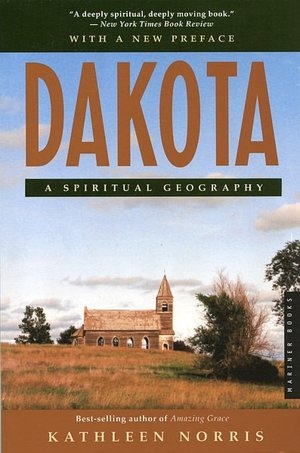
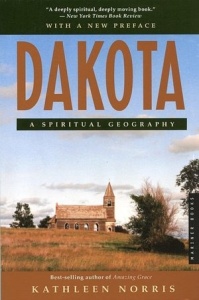
Dakota: A Spiritual Geography by Kathleen Norris

dakotaContinuing in my series of not-new-but-still-important creative nonfiction readings (see The Kiss and The Liars’ Club)… Kathleen Norris’s essay collection, Dakota, is brilliant. I see somewhat where it is dated, discussing for example economic depression and agricultural crisis – because, if anything, things are worse now. But her astute ideas and conclusions are brilliant and in many ways timeless.

You saw my teaser earlier this week, so you know I am impressed. Norris, a poet, of course writes beautifully; it’s worth reading her words for their language alone. But I was really drawn in by the ideas behind them. As her subtitle notes, she is concerned with spirituality and geography. As you might have noted by now about me, I am not attracted to spiritual musings, but I was won over by the geography (in so many senses) and the sense of place which is at the heart of this collection. And I found myself on board for a certain amount of spirituality as well.

My favorite parts of the book were those that characterize place: the physical, biological, climactic characteristics that make “Dakota,” the unique region of both western North and South Dakota that Norris calls home, as well as the cultural and human characteristics of this scarcely populated area. I love thinking about and learning what is definitive about place, in both those senses: the natural, physical, extra-human as well as the human, and the idea of their interconnectedness. (Dakota would doubtless look a little different without people – Las Vegas certainly would – but there is no possibility, I think, of people without place.)

“The Holy Use of Gossip” taught me how gossip can be a good thing, or rather, taught me to recognize as “gossip” (originating, according to the Oxford English Dictionary, from God + sibling) the talking about each other we do in my close group of friends: when we share with each other that one of us is having a bad day, has suffered a loss, needs our help. This is well-intentioned and positive sharing that I’m glad we do. “Gatsby on the Plains” explores how community can lift its members up, or cut itself off from help: Norris writes that

…disconnecting from change does not recapture the past. It loses the future.

Intermittent “Weather Reports” read like short, poetic journal entries of real, specific days, in between more formal essays. They are often not strictly reports on the weather, unless we expand our definitions of weather, which we may well be intended to do.

She writes a good bit about community, how it is formed and how it can be both good and bad for itself. Norris came (back) to Dakota as an adult: her grandparents were of that place, and when she inherited their home there, she and her husband moved in. She is both from there (because the communities knew her grandparents) and not (because she grew up elsewhere, and came in as a traveled, educated, artistic outsider), which made for some interesting challenges for her and her new neighbors. Her 2001 introduction to this edition of the 1993 book discusses her adopted community’s reaction to her work, her publicization of Dakota: in a word, there was both pride and anxiety, but the fact that she stuck around eventually earned her a more thorough local membership.

On the subject of community, I am intrigued by her repeated conflation of the desert, the plains, and even the ocean that once covered this region, with the monastery. She spends quite a few pages throughout comparing the sense of quiet, of great distances increasing mutual support, and contrasting some of the ways in which these communities work. For example, I appreciated the idea (in “Where I Am” – naturally one of my favorite essays) that the monastery is different from small plains towns in that the former has a formal text or rulebook that they agree to live by: in the case of Norris’s central example, Saint Benedict’s Rule, which guides Benedictine monasteries. The small towns often find conflict because they are not all working from one central, agreed upon set of rules or values or ethics.

As an artist, Norris finds that she benefits immensely from the immensity of space in the plains. And she’s got some great stories to tell about sharing art and poetry with her new communities.

I find that prairie people are receptive to a broad range of contemporary poetry, although they’d be unlikely to cross town to attend a poetry reading at a college, were there a college in the vicinity. Their appreciation of the poems I’ve read aloud – from a broad spectrum of contemporary American poets – has given me a new understanding of the communal role of poets, a role poets have mostly abandoned by closeting themselves in academia. Surprises await poets who venture out into the larger community.

I love this idea, that poets (and by extension, many formally educated or academic folks) have quarantined themselves with those like them, and are both failing to share what they have and – more so – failing to learn from others, by locking the doors to the ivory tower.

In a strange counterpoint to this sentiment, though, I found Norris occasionally off-puttingly snobbish about the reading of books: that more prairie people should do it, that they shouldn’t consider themselves well-educated or wise without doing it. Now, don’t get me wrong: clearly I love reading books and find a great deal of value in doing so, and I think books have a lot to offer everyone and everyone should read more. But I also think that people can be very intelligent, wise, and valuable without formal reading; I think that the same prescriptions don’t work for all of us, and I think it’s a shame if she’s found (for example) a great oral storytelling tradition and then laments the lack of book reading. It makes her sound snotty in a way that the rest of the book does not. I like her better than this.

I think it’s just a moment of weakness or misstep, though, because in fact she returns to this subject with more sensitivity in “Status: Or, Should Farmers Read Plato?”

I know as well as anyone that a lot of book learning doesn’t make a person wise (sometimes it simply legitimizes stupidity), but I can’t help but connect the fact that so many Dakotans have been denied access to their culture with the fact that they don’t trust that their own stories are worth much.

The fact of their inhibited access to their own culture and stories is perhaps the best argument for lack of book-reading as a major problem. And she goes on to contemplate what difference it makes to a pig farmer to miss out on Plato, and what Tolstoy and the Brontes can bring to a small-town waitress. I like the nuanced discussion there.

Dakota gets more and more spiritual in its subject matter as it progresses, so that I struggled more toward the end. Discussion of monastic retreats, and Norris’s relationship with the religious communities of Dakota, were often interesting to me; they are in some ways further discussion of community ideals, and I am more or less on board with the spirituality of nature, of relating to wind and sky and plant life. But occasionally there was too much God for my personal tastes. When I encounter the idea of monasteries, and other writers’ productive experiences there, I have found myself tempted sometimes to consider the same; but then I realize what I really need is to just go camping alone.

I found a lot to love and a lot to continue to consider here: about place, about inheritance, about storytelling and relating to one another, about community and about definitions of spirituality. I love Norris’s writing. Although I struggled here and there, or perhaps because I did, this beautiful and thought-provoking book will stay with me and, I think, continue to guide me.


Rating: 8 readings.