No Less Strange or Wonderful: Essays in Curiosity by A. Kendra Greene

Astonishingly imaginative, wise, and weird, the essays in this illustrated collection–featuring natural phenomena, children, death, and costuming–have the power to reshape the way one sees the world.
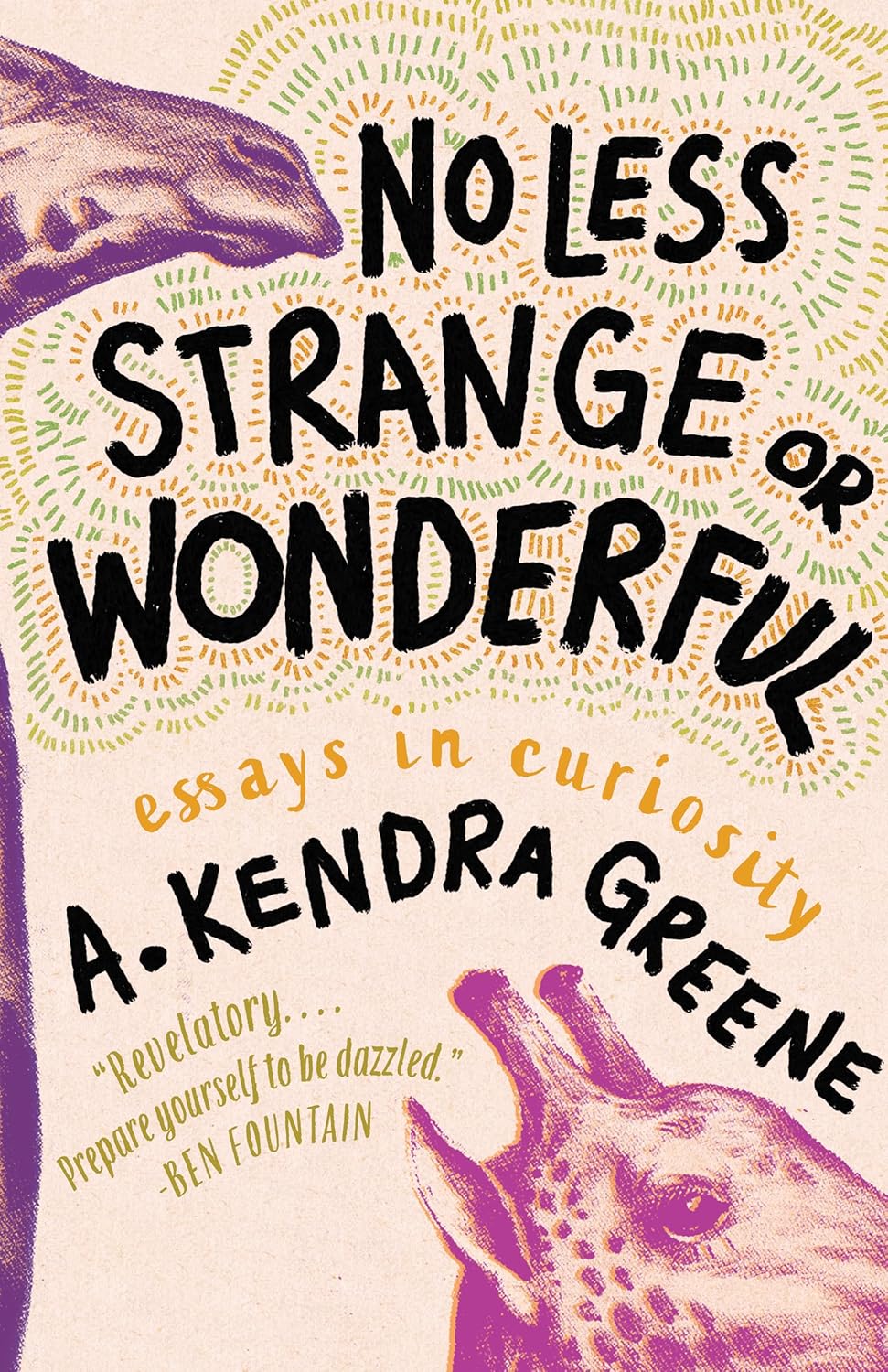

A. Kendra Greene (The Museum of Whales You Will Never See) offers a magical, mind-expanding selection of observations in No Less Strange or Wonderful: Essays in Curiosity. Greene employs a delightful, often childlike wonder in this collection about discovery–where she interacts with others, where humans interact with the rest of the world, and what might be made of all of it. Greene’s perspective is fresh and inventive, open to all possibilities, and the results are surprising and wondrous.

Greene’s essays vary in length and take place around the world. “Wild Chilean Baby Pears” considers a crime: in 1979, a museum visitor stole a specimen of the extinct ivory-billed woodpecker from the University of Iowa Museum of Natural History. Greene, who has been a museum visitor as well as a museum worker and a teacher, explores this act from several angles; unexpectedly, she empathizes deeply with the thief she calls “Visitor X.” “Until It Pops” details a dress made for the author out of balloons, and her experience of traveling to Chicago for Twist and Shout (the annual balloon twisters’ convention).

Brief and spellbinding, “The Two Times You Meet the Devil” describes encounters on a country road in Argentina and in a bookstore of unnamed location, respectively. “The more I think about it, the more I wonder how many times we have met, crossed paths at least, exchanged a look, and the devil has said nothing.” “The Sorcerer Has Gone to Italy” is about death, as well as rocks, valleys, turf houses, forgetting, stick-shift cars, whales, kayaks, summer staff, television, and metaphor. “People Lie to Giraffe” is about real giraffes (one in particular) as well as the likeness of a giraffe suggested by a photo of the author’s long arm and pinched fingers. It explores everything encompassed in a child’s imagination, how to make the world, and what it means to tell the truth or tell a story.

Greene is always present, participating in the action and dialogue, postulating philosophies and understandings. Greene is an artist in several media (book arts, photography, illustration), and a teacher as well as a writer; this collection is illuminated by her own illustrations and images. The scope of her essays (26 in total) is mesmerizing, her language glittering, and her ideas exuberant and profound. She says it best herself: “It is a thing the essay loves: to tend, carefully, painstakingly, to the fact of the world.” As for what we communicate with art: “everything resonant and whole and shining, all at once, perfect, every bell ringing, yes.” Yes.


This review originally ran in the January 27, 2025 issue of Shelf Awareness for the Book Trade. To subscribe, click here.


Rating: 9 sprays of bougainvillea.

rerun: Dirt Work: An Education in the Woods by Christine Byl

Because I still talk about and think about Dirt Work, and because (I still can’t believe my good fortune) I now get to build trails for a living, it feels right to talk again about this transcendent book. I hope I get time to reread it someday. Original publication and review from 2013. For more, check out Lookout, which also got a 10 (and those are rare).

Christine Byl opens her memoir with the pleasant scene of herself and three fellow crew members, crusty and dirty, having a post-hitch beer at a small-town Montana bar. A young woman approaches and asks how she keeps up with the boys, one of whom volunteers that it’s all they can do to keep up with her.

She then backs up and tells the story of how she got there. Like many young women in our culture, Christine was expected and expecting to go to college, to do cerebral work and keep her hands (literally) clean; but a summer gig held her, and she reveled in physical challenges, in learning new things, in the mechanical world. Eventually she reveled in her hardening muscles and her expertise, in surprising men with her ax-work and in mentoring other young women coming up in the “matriarchy” of trail work (still predominately male) within Glacier National Park.

After six seasons in Glacier, alongside boyfriend and eventual husband Gabe (a delightful character: mostly off screen, but clearly a capable young man in his own right, and clearly happy to stay lovingly out of Christine’s way), she does return to graduate school, in Alaska. But during the summers she still works on building and maintaining trails, this time in Denali. Christine and Gabe come to love Alaska – yes, even the winters: there is a delightful passage arguing that the light summers are in some ways harder than the dark winters, and I made both my parents (recently moved from the Mexican to the Canadian border) read it. They settle a few miles outside the borders of Denali National Park, and Christine finds a balance between the cerebral – she gets an MFA in fiction, and writes this beautiful book; and the physical – she and Gabe now run their own independent trail-building company.

So many things to love in this book; where to begin? As a sometimes volunteer trailworker myself, I don’t pretend to know 2% of what Christine does; but I might know just enough to appreciate what she loves about it, and what a challenge it can be. I still haven’t mastered the efficient, all-day ax swing myself, but I’d like to. Also, I have a friend named Susan who I’ve written about before, who has a great deal in common with this author. (I briefly wondered if “Christine Byl” was a pseudonym.) Susan, like Christine and apparently like many trail workers, has an advanced degree but chooses to labor for a living; she’s a woman in what is clearly a man’s world, and is half of an independent trailbuilding company. I get the impression that while it’s hard work, Susan and her husband Ryan wouldn’t do anything different.

Christine writes beautifully about the phenomenon of choosing to do physical work when she could be keeping her hands soft. She writes about the well-intentioned questions her family asked, about when she was going to get a “real job”: she says that they have confused happiness with orthodoxy. (I can only imagine how many of us can sympathize with that concept!) She writes about the “sorority” of men in trailwork, and the way that pulls women together; she writes about the pride she feels when upending male expectations of her blonde head and small frame. As a writer, and clearly a gifted one, she structures this book as solidly as she would a bridge or retaining wall. Each of 6 chapters is represented by a tool (axe, rock bar, chainsaw, boat, skid steer, shovel), a location (North Fork, Sperry, Middle Fork, Cordova, Denali twice) and a locale (river, alpine, forest, coast, park, home). Within those chapters she roves and rambles, musing on natural phenomena, social relations, her own body and personality, strengths and shortcomings, and then returns to tool and place to ground herself. The structure of this book, then, is both well-anchored and floating, and I found that it worked very well.

I was charmed by Christine Byl’s honesty; her love of place; her range of experiences and understanding of two worlds, that of universities and that of woods; and of course her lovely writing. She’s hard as nails, with two hernia surgeries and a preference for outhouse over indoor plumbing. She’s brash and can tend towards a loud and dirty mouth (that makes two of us), but she’s got a soft core. I like her; I’d like to be her friend, and of course I’d really love to learn from her.


Rating: 10 pulaskis (my personal favorite trailwork tool).

So good.

rerun: The Warmth of Other Suns: The Epic Story of America’s Great Migration by Isabel Wilkerson (audio)

Now seems like a fine time to revisit Isabel Wilkerson’s excellent 2010 work, in my 2012 review here. (For later reads, also check out Caste and a corresponding interview I was lucky to get.)

I didn’t really know what this book was about when I picked it up – only that it was well-regarded. I’m so glad it found its way into my hands. Isabel Wilkerson has taken on a large-scale, ambitious subject here, and rendered it beautifully. And the audio reading by Robin Miles is lovely to boot.

The “great migration” in the subtitle refers to the movement of black Americans out of the South and into the northern and western United States in 1915-1975. Wilkerson starts from the very beginning, looking at the experiences of former slaves just after Emancipation in an impoverished region struggling to rebuild with a new order of things. The creation and expansion of Jim Crow laws designed to hold blacks down took time after the end of the Civil War to take effect. In the new caste system, former slaves and their descendants were unable to move up in the world and were in constant fear for their lives if they were to misstep around Southern whites. By 1915, they had begun to move out of the South, in what became a mass migration along lines so distinct that enclaves of blacks from specific towns and states were recreated in new locations.

Wilkerson shifts between two ways of studying the Great Migration. Sometimes she takes a broad view of history, in which she cites her own interviews (she states that she did over 1,200) with migrants and their descendants as well as a number of historical sources, to render the story of the Migration generally. And sometimes she follows the specific personal stories of three individuals who she interviewed at great length over a long period of time, traveling the country with them and becoming part of their lives. (In this respect, the journalist/author becoming part of the family of her subject, I was reminded of Rebecca Skloot’s amazing The Immortal Life of Henrietta Lacks.) George Swanson Starling moved from Eustis, Florida to New York City, later sending for his wife Inez to join him there. He had to leave Florida suddenly because a friend tipped him off that a lynch mob was coming for him; he had been involved in organizing his fellow citrus pickers to demand higher wages. Ida Mae Brandon Gladney moved with her husband George and their two children, with a third on the way, from Mississippi where they had been sharecroppers. They would eventually end up in Chicago, by way of Milwaukee. And Robert Joseph Pershing Foster was an ambitious surgeon and veteran from Monroe, Louisiana, with his heart set on Los Angeles. Known as Pershing in Monroe, he would resettle as Robert (or Bob, or Doc) in LA and send for his wife and daughters to join him there, where he built a new life in high society with the big house and booming practice he’d always wanted.

I found this shifting back and forth between the broad view and three personal histories extremely effective. Anecdotes from the lives of Southern blacks drove well home the misery of their bottom-rung status there; some of these stories are horrific, but important to show the desperation some migrants felt when they left their homes in the South. National trends played a role – for example, during WWII demand for Florida’s citrus was high while the supply of labor to pick the fruit was low, with everyone off at war, and this imbalance led to George Starling’s ability to demand higher wages. And the history of Chicago’s race relations and residential segregation puts Ida Mae Gladney’s home ownership into the proper perspective. You get the point. The history is well-documented and, I’m convinced, well-researched; and the personal stories make it all, well, personal. I was deeply involved with our three representative individuals by the end of the book and, yes, I cried.

I love that Wilkerson brought such a large-scale, important trend, that has had such huge effects on American history, to life the way she did. I also like that she examined the broad effects of the Great Migration, in terms of the cultures of both white and black residents of the North and the South, and took the time to show that black migrants were really far more like immigrant groups in history than like migrants within their own country. I recommend this book as part of a study of American history – but one need not be an academic to appreciate it. The story of the Great Migration is made accessible here, and I’m glad I know more about it now. This 19-disc audiobook (over 600 pages in print) went by easily. This is how I like to take my history lessons. Check it out.


Rating: 8 train rides north.

rerun: Soundings: The Story of the Remarkable Woman Who Mapped the Ocean Floor by Hali Felt

Please enjoy this time capsule from August of 2012.

I’m so glad I picked this book up (and bought it for the library where I work). It sounded like just the sort of thing I appreciate: a biography of a little-known historical figure who made an important contribution to the world as we know it but was herself forgotten. In this case, the “remarkable woman” of the subtitle is Marie Tharp, whose meticulous study and cartography of the ocean floor established the concept of plate tectonics that science now recognizes as fact, but was at best a blasphemous and ridiculous notion before Tharp came along. Her achievements, however, were minimized by a scientific culture in which women did not belong. This biography is additionally appealing to me for its mood: author Hali Felt takes a whimsical, dreamy, almost fanciful tone at times. She describes her own attraction to Tharp’s story (born in part of Felt’s mother’s, and her own, fascination with maps) and the relationship she felt to her subject. She dreams of Tharp coming to her to explain the mysterious and unspoken parts of her life. This book is nonfiction, but it’s honest, personally related, and warm.

There is also an enigmatic love story of sorts hiding within Soundings: Tharp’s career and life were both tied to a man named Bruce Heezen. Heezen was her coworker, then her technical superior; but they shared a partnership in work, in science, in discovery, and apparently in all things. It is known that they were a couple, although they never married and the details of this side of their relationship are very few.

Felt follows Tharp from her childhood with a science-minded father she adored, through her education in English, music, geology, and mathematics, and to her first job in the oil & gas industry (oh, how familiar to this Texas girl). But she was held back: this was the 1940’s, and women in science were mostly expected to make copies, compute numbers, and brew coffee. Eventually Tharp found her way to New York, to Columbia University and the Lamont Geological Observatory. This is where she would meet and work with Heezen and quietly make history.

The science in this book is very friendly and accessible to a general reading public; the story that Felt set out to tell is more that of a woman’s life and accomplishments despite the limitations of her society, than that of tectonic plates per se. For that matter, Felt shows that it was Marie’s combined backgrounds in art as well as science that made her perfectly suited to play the role she did in history. Her meticulous re-checkings of data and attention to detail were indispensable – but so was her interest in visually representing the data available in a way that would show the general public (not just academics) what she’d discovered. So her achievement was artistic as well as scientific. Soundings does make the science side clear, but doesn’t dwell, and is never dry. Rather, Marie Tharp comes to life: she is a precocious child; an ambitious, able, frustrated student; a dedicated scientist; a life partner; an eccentric aging woman caught up in her own past, campaigning to honor and preserve the legacy of her other half.

Hali Felt was honest about the role she plays in the story she relates. She begins in her Introduction by briefly describing her own attraction to maps, and then follows a chronological format, beginning with Tharp’s childhood and following her life, and eventually her death. And then Felt returns to the story: her discovery of Marie Tharp’s existence, her interest, her decision to follow that interest, her research, her relationships with the living descendents of Tharp and Heezen’s world (the “Tharpophiles”), and in the Acknowledgements at the end, she even hints at the process by which she came to write and publish this book. I found all of these Felt-related details interesting too.

In a word, this is a lovely biography, and the style and tone of it may be my favorite part.


Rating: 9 double-checkings of data.

I remember it fondly.

Life After Dead Pool: Lake Powell’s Last Days and the Rebirth of the Colorado River by Zak Podmore


With Life After Dead Pool: Lake Powell’s Last Days and the Rebirth of the Colorado River, investigative journalist Zak Podmore tackles a massive, complicated set of questions about western water management and the Glen Canyon Dam, the construction of which created a reservoir called Lake Powell. Arguably the most politically fraught and symbolic dam in the southwestern United States, Glen Canyon has long had its fans and detractors. The Millennium Drought, “an indefinite change in precipitation patterns” in the region, has “done three-quarters of the work toward draining Lake Powell already,” but this leaves numerous challenges: Indigenous people’s water rights, engineering and hydrology puzzles, the ecological implications for long-flooded lands freshly exposed to open air or buried under millions of acre-feet of sedimentation, and more.

Podmore acknowledges his own biases about the dam, which was in place before he was born. But he proceeds with copious and in-depth research into the many and complex issues it poses, considers what he learns with an open mind, and integrates hard science, cultural awareness, and competing viewpoints into an admirably accessible work of creative nonfiction. Podmore avoids binary options and magical thinking, and his study is richer for it. Included are surprisingly hopeful notes, such as the rapid recovery of native plants and ecosystems in newly exposed side canyons: “A canyon one hundred miles away, drowned for half a century, had restored itself in fewer than twenty years.” With narrative style and colorful characters, Podmore (Confluence) has composed a compelling, readable, and entertaining as well as educational text. Life After Dead Pool is superlative: important, insightful, and a pleasure to read.


This review originally ran in the August 30, 2024 issue of Shelf Awareness for Readers. To subscribe, click here, and you’ll receive two issues per week of book reviews and other bookish news.


Rating: 8 cans of beans.

Something in the Woods Loves You by Jarod K. Anderson

A profoundly depressed poet takes to the woods and delivers a lovely, moving memoir of nature writing and mental illness.

In his 40s, poet Jarod K. Anderson (Field Guide to the Haunted Forest; Love Notes from the Hollow Tree) left his job in academia to try to survive the debilitating depression he’d mostly hidden for decades. Early on in his memoir, he describes taking a walk in the woods, quietly observing nature as he had not in some time. He communes with a great blue heron and finds that there may be solace in a place where he’d forgotten to look.

Something in the Woods Loves You describes the slow and difficult process of seeking help and getting better, in increments, and with relapses. Anderson’s journey to wellness is not and perhaps never will be complete, but he does progress, and with a poet’s sensibility and attention to language and detail, this memoir relates not only his story but also philosophies and outlooks that will be helpful to many readers. While its subject matter is undeniably heavy, Something in the Woods Loves You is frequently light and positive.

There are notes of advice, but they’re always couched within Anderson’s personal experience, which he acknowledges will not be universal. The result is a memoir of the slow passage toward improved mental health, a deeply beautiful work of nature writing, and a treatise on the underestimated connections between the human and “natural” worlds. The setting is solidly grounded in Anderson’s home landscapes in Ohio (and, briefly, Tacoma, Wash.).

Organized in a seasonal cycle, Something in the Woods Loves You opens in winter: “A white page. An elm scribbled on a snow hill. Empty space making each syllable of life more vital…. Winter is the deep breath before a song.” In that stark season, not without effort, Anderson decides to seek help. In spring (“a gentle calamity of warmth and color”), he obtains access to antidepressant medication and, after a false start, finds a good fit in a counselor trained in cognitive behavioral therapy. In summer, the depression begins to lift. Fall brings a relapse, and the lesson that life will involve ups and downs.

Something in the Woods Loves You is also structured around 20 species, which include sugar maple, morel, eastern bluebird, lightning bug, raccoon, and human. “Fieldmouse” considers toxic masculinity in Western culture, including the unwillingness to ask for help. “Crow” contemplates a balance between science and magic. These are joined by many shining, glinting details, rendered in a poet’s prose under a careful eye: great blue herons “are a mix of shaggy and angular, a blade of yellow stone dressed in flowing robes stitched from overcast skies.” With these and other scintillating observations, Something in the Woods Loves You is revelatory.


This review originally ran in the July 16, 2024 issue of Shelf Awareness for the Book Trade. To subscribe, click here.


Rating: 8 seeds.

The Salt of the Universe: Praise, Songs, and Improvisations by Amy Leach

Playful, celebratory, wise, impertinent, Amy Leach turns her lyricism and wit on a fundamentalist upbringing and the wealth of experiences beyond.

Amy Leach’s third book, The Salt of the Universe: Praise, Songs, and Improvisations, upholds the singular spirit of Things That Are and The Everybody Ensemble with a deepening of personal and spiritual subject matter. Whimsical, frank, funny, shrewd, and ever unpredictable, Leach’s phrasing and concepts continue to surprise, delight, and edify.

Where her previous works explored the world with curiosity, awe, an endearing silliness, and joy, The Salt of the Universe picks up with a new focus on Leach’s upbringing and the Seventh-Day Adventist Church in which she was raised. “Now, in this book, I will let my soul speak for itself… I figure I’ve heard about five thousand sermons in my life, and now… I have something to say too.” What she has to say will be familiar in tone to her established readers, but fresh in its more personal angle.

Leach remains the master of the list, especially lists of the unexpected. Look out for how Walmart has taught her to find items she was not searching for, including “inflatable bathtub neck pillows and tropical Popsicles and Guinness Baltimore Blonde and misty-scented candles and Minions whistles.” Her subjects include not only gods but music and poetry; babies generally and her own two children in particular; snake grass and daffodils; brown dwarf stars and muons; an “interior Texas” and an outdoor heart and everything in between; the wide, wide world, both the small and the large; and the wonder and wondrousness of all forms of art, life, and love. In examining her relationship with Adventism and religion in general, Leach can be drolly tongue-in-cheek, and though earnest, never unfun.

This is a serious investigation into how to live, while coming from a religion that outlaws pickles and dancing. “We know not to read Shakespeare, or Boethius, but what are we to think of Snoop Dogg or Chubby Checker?… It is so hard to be stranded in the twenty-first century with only God as our guide.” Leach has split from Adventism, rejecting the prohibitions on spicy foods, literature, and, yes, pickles (though she still refrains from eating meat), but retains her sense of marvel and reverence at the vast and varied world–the tubax, dancing robots, sloths, Edith Wharton, Bob Dylan. “The apocalypse can’t be had for the hankering but the concerto sometimes can.” She does not profess to prescribe, but will still inspire. Sincerely inquisitive and wildly, fancifully imaginative, Leach’s perspective is a gift. The Salt of the Universe may be life-changing, even life-saving.


This review originally ran in the June 7, 2024 issue of Shelf Awareness for the Book Trade. To subscribe, click here.


Rating: 9 unsuitable subordinates.

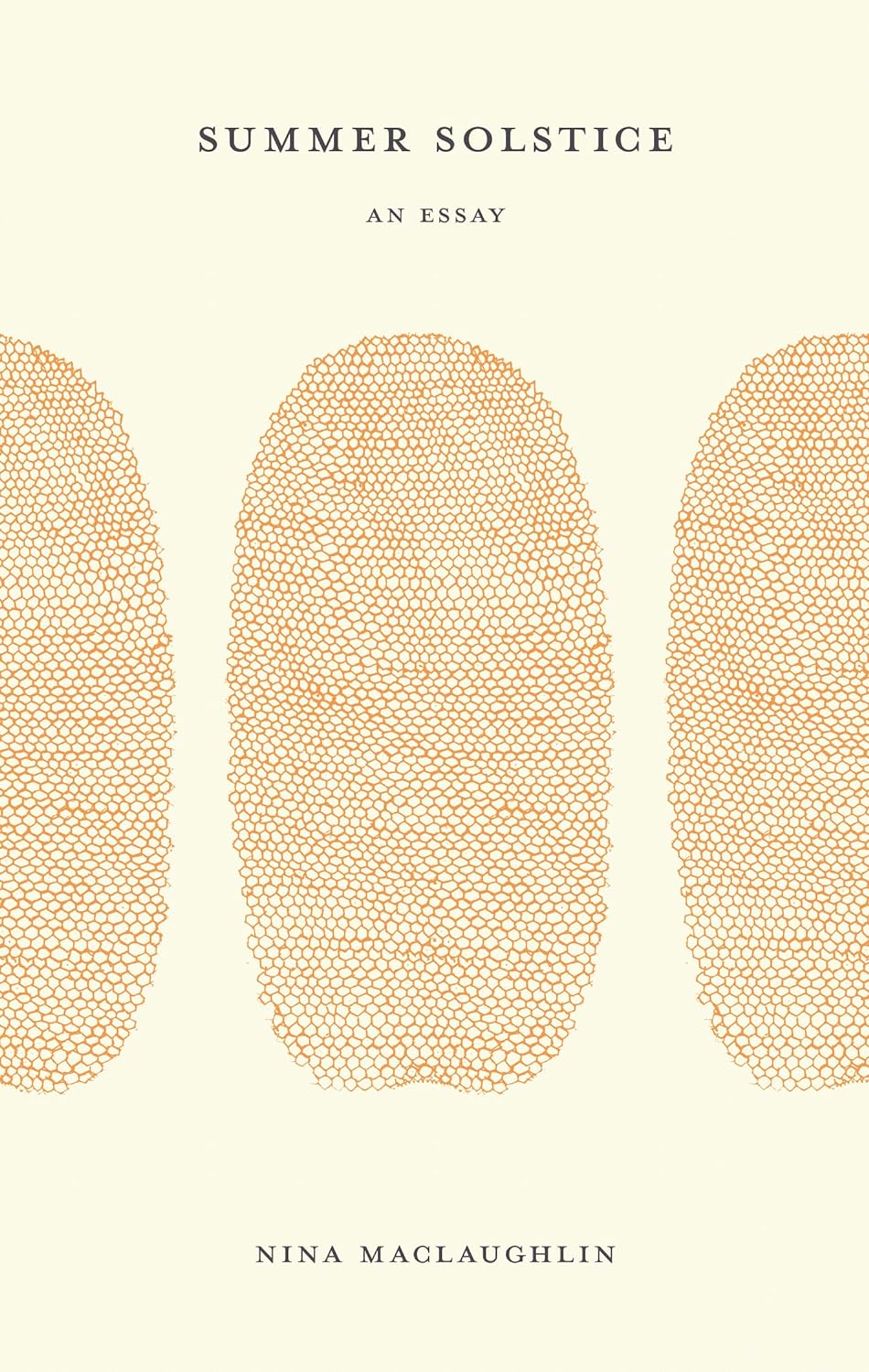
Summer Solstice by Nina MacLaughlin

Summer is the saturated season. The color floods back in. Each dip is another shot at being reborn, into summer where the world’s blood runs green.

For the summer solstice last night, I had my usual, traditional backyard fire. The traditions – my traditions – are accumulating: this time I had friends and food and drink around the fire as well. And I had a chapter from The Wheel of the Year to read (review forthcoming; it is wonderful), and I had a Nina MacLaughlin essay-book.

Six months ago I read her Winter Solstice, and now the summer one. It is the loveliest kind of homework to wake up and see what timely read I have for the day.

This little book barely clears 50 pages for the essay portion itself: perfectly sized for a same-day read, which is what I did. Now, this means I missed the advice to get up and wash one’s face in the solstice dew at dawn (also admittedly the summer solstice dawn is quite early for me). It is basically a lengthy meditation on summer and its resonances, for MacLaughlin and beyond; she has a number of works cited, mostly other works of literature (poetry, music) to which she refers, as jumping-off points for further musing. This won’t feel like ‘research’ so much in the traditional and dry-sounding way you might be thinking (although it *does* count as research!); more of a mining of other minds and cultural markers for how we think about summer, and midsummer or the solstice in particular. She does begin in early June, building into summer that way. MacLaughlin’s summer involves much swimming and waters, as well as fire, and sweat and sun and shade and fireflies (or lightning bugs) and a few other things we may hold, culturally, in common around here (several mentions are made of hot dogs). At least compared to my memory of Winter Solstice, I think there was less study of other cultural and historical handlings of the event. That could be my memory. Or it could be that Summer predated Winter by several years (ha) and the concept developed a bit in that time. This one does still offer an addendum of “Plant Matter,” featuring a few prominent plants and herbs associated with the summer solstice. I like that part.

I was not entirely surprised, in the Afterword, at MacLaughlin’s confession that she prefers winter. Again, perhaps it was just (or partly) the few years between books, but Winter Solstice felt fuller and richer to me. (Or maybe it was the hot mulled wine that accompanied that one, for this reader.) I am a summer person, myself, but her work on winter enriched that time for me considerably. There is still, here, the sensuality that I appreciated so much.

I would eat up more like this. I wonder if MacLaughlin would do the equinoxes, and maybe samhain and lúnasa and more…


repost: No Son of Mine by Jonathan Corcoran

This is a repost of an earlier review, because this moving book has just become available today.


Disclosure: Jon has taught as guest faculty in my MFA program. I admire his work and he is a dear friend.


I found this memoir remarkable. It encompasses much in terms of its time span and the bigger events in the world, and Jon accomplishes something special by being raw and vulnerable, and never self-indulgent. I think the struggles he portrays here will offer something to any reader, because we are all struggling to navigate even the closest of relationships. I am impressed by the writing in terms of that larger storytelling and meaning-making, as well as line by line.

Corcoran grew up in a small town in West Virginia that is just a few minutes’ drive from where I live now. (It’s always a little exciting to read a place written well that you personally know, and I did enjoy that part here. Elkins is not perfect, but I think this author has handled it with respect for both positive and negative qualities.) As a gay kid, he suffered in the town, in the evangelical church his family attended, and in his family itself. He did some secretive explorations of sexuality in West Virginia (not too dissimilar, I think, from those in The Rope Swing, which is however fiction), but did not live as an openly gay man until he left for college at Brown University. Coming from poverty, Brown was both a great accomplishment and a shock: a wider world, but rarified, and Jon was a foreigner to many of his peers and professors there. It’s at Brown that he met Sam.

In his second year at Brown, Jon is in Portland, Maine, with his boyfriend, Sam, meeting Sam’s family for the first time. It’s his twentieth birthday when his mother calls, seething with what she’s discovered. Jon confirms that he is gay. “You are no longer my son,” she says, and she hangs up. This leaves him traumatized, trying to finish college with no financial or emotional or any other kind of support, with no family, and no options, surrounded by Ivy League administrators whose understanding of what all this means is so poor that he is advised to take a year off and travel. His mother spends the next six months calling in the early morning and waking him up to tell him he will die of AIDS or go to hell, or both.

Jon and his mother spend years–fifteen years, the rest of her life–being estranged and trying again, having massive, blow-up fights and years of silence, and abuse and toxicity and cautious attempts at peace and acceptance. Her bad behavior is horribly, shockingly bad. But tangled up with the bad is the fact that this is his mother, his caretaker, whom he has loved, and who still (somewhere, twistedly) loves him, and misses him when they are on the outs. It’s a level of trauma that’s hard to fathom if you haven’t lived it. But as a narrator, he does a good job of describing its effects, including a mistrust of memory and various physical ailments. It also poses some challenges for his relationship with Sam, which will continue until they eventually marry, and into the present.

This is a memoir of trying to reconcile a parent that the narrator loves, his memories of her and of his hometown, with the pain inflicted at the hands of that same person (and place). It’s all a puzzle, to question the causes, to wonder how much forgiveness is due to such a figure. It’s a memoir that is also an assay, both a personal narrative and an exploration of ideas. “…some part of my brain is perpetually trying to explain her actions, to find the root cause for them, and what this really comes dangerously close to is the notion that her actions have an excuse, that if I searched hard and long enough the hurt and pain she caused me can be written away. But she hurt more, a voice says, and I don’t doubt that. So here I am, operating the world’s worst justice system from the recesses of my brain.” “I do not know how to balance all the pain she caused with all the pain she felt.”

There’s a lot to appreciate here, and a lot of wisdom that I think will help just about anybody. Not to say answers, but wise observations about one man’s experience. Most of us are wrestling with difficult, tangled-up relationships where abuse and love meet; many of us are struggling with what to take and what to leave about a family or a place. “I hear her laugh, hear the crinkle of her dyed-blonde hair. I rub her cracked feet, feel her hand on my back. I smell her nicotine fingers. There is her cup of Lipton tea in the little ceramic mug that is white with flowers around the brim. I taste the milky black tea. And I say, I don’t want to lose this all. I don’t want to lose what made me.” There is also some lovely writing here. If the story itself is often difficult, there’s a remarkable amount of grace, beauty, and hope. I think it’s a book for anybody and everybody. Thank you, Jon, for sharing so much in a way that feels both raw and wide-open, and careful and thoughtful. I’m awed.


Rating: 9 paper bags.

Braiding Sweetgrass: Indigenous Wisdom, Scientific Knowledge and the Teachings of Plants by Robin Wall Kimmerer

Hold out your hands and let me lay upon them a sheaf of freshly picked sweetgrass, loose and flowing, like newly washed hair.

Definitely one of the best of the year, Braiding Sweetgrass is a big serious one that I fear I won’t do justice. In good company, it reminds me of Pieces of White Shell and Soil. The good news is, many more thoughtful than I have also written rave reviews. It’s not a new one (original publication 2013) and the praise has been coming for years.

This is a beautifully written book, with poetry and metaphor and gentle, thoughtful articulations of big, important ideas. Robin Wall Kimmerer is a highly trained scientist – a botanist and a college professor; she is also a member of the Citizen Potawatomi Nation, with a background in thinking about the world in very different ways from the standard, Western, materialist, human-centered culture that many of us (including me) are more familiar with. Part of her life story has been the reconciling of those two parts of herself, or the training of them to work in concert, when one did not always welcome the other. But it’s to our great advantage that she’s been working so hard at that intersection, and sharing it here. I’ll characterize that work as the integration of a sense of interconnectedness, and the idea that other-than-human entities hold their own identities and importance aside from what they offer to humans, with modern “hard” science.

I love the structure of this book, which progresses through Kimmerer’s life and perspectives on the natural world and humans’ relationship with it, always with sweetgrass as an organizing principle. The preface, whose first line introduces this review, succinctly describes the importance of sweetgrass to the culture Kimmerer comes from. The braid “is an intertwining of science, spirit, and story–old stories and new ones that can be medicine for our broken relationship with earth, a pharmacopoeia of healing stories that allow us to imagine a different relationship, in which people and land are good medicine for each other.” There follow five sections–“Planting Sweetgrass,” “Tending Sweetgrass,” “Picking Sweetgrass,” and braiding and burning it–each composed of individual essays. The first essay, “Skywoman Falling,” begins with an origin story of North America as Turtle Island, starting with “a great turtle” that holds the earth on his shell, an origin story that holds significance for me; the first few pages of this book won me over completely. And I remained captivated throughout.

Any book about the natural world and human relationships and responsibilities these days is bound to contain some bad news; I find myself shrinking back from some of this reading, while I’m also still drawn toward it, because of the pain I feel at that bad news. But Kimmerer has some real wisdom to offer about the choice between despair and joy, the question of whether we can view hard truths and still find good parts too. “What could such a vision create other than woe and tears?… it is not enough to weep for our lost landscapes; we have to put our hands in the earth to make ourselves whole again. Even a wounded world is feeding us. Even a wounded world holds us, giving us moments of wonder and joy. I choose joy over despair. Not because I have my head in the sand, but because joy is what the earth gives me daily and I must return the gift.” Thank you, Sweetgrass, for that gift.

Gifts are an important topic throughout, too. The Native American culture of gift-giving, the importance of reciprocity, and the emphasis on giving with a faith that things will come back around applies not only to interhuman relationships but the ones with the earth and its nonhuman inhabitants too. The difference between a capitalist, materialist, consumerist culture and one of gifts and reciprocity is profound. An essay titled “Learning the Grammar of Animacy,” in part about language (and the near-extinction of the Anishinaabe languages Kimmerer might have learned to speak as a child, “had history been different,” and which she now studies as an adult), is also about some of these cultural concepts, and the fact that language shapes the concepts we’re even capable of comprehending. Like some of the best books in the world, Sweetgrass is about paying attention, and the importance of the choice of what we attend to.

Individual essays tell stories from Kimmerer’s family life (from childhood through motherhood), from the different communities in which she’s lived, from her experiences as a student and as a teacher. They take place in different parts of Turtle Island, including New York state and the Oregon rainforests, and integrate some pretty serious science with traditional storytelling and Kimmerer’s own. There is so much to learn here, and I love science made accessible by story. I won’t begin to try to tell you what all is available here; I really want you to discover it yourself.

This book might just change the way you look at the world. I hope it does. Please give it a chance.


Rating: 9 raindrops.