Ostend: Stefan Zweig, Joseph Roth, and the Summer Before the Dark by Volker Weidermann, trans. by Carol Brown Janeway

This poetic contemplation in translation illuminates an uneasy creative community of artists and writers gathered one summer as fascism and Nazism are growing in Europe.

ostend

Volker Weidermann’s Ostend: Stefan Zweig, Joseph Roth, and the Summer Before the Dark is a glimmering work of language and an insightful tribute to literary friendship in a singular historical moment.

Stefan Zweig was a successful and popular Austrian writer; Joseph Roth was less successful but also gifted, a tortured, heavy-drinking writer whom Zweig called his “literary conscience.” When war loomed in the summer of 1936, Zweig returned to the Belgian seaside town of Ostend, where he had spent the summer of 1914. His work no longer welcome in Germany, his home in Salzburg defiled by police and his marriage collapsed, he nonetheless joyfully embarked on new work and new love with his secretary, Lotte Altmann. And he brought along Roth, supporting him financially and in his work (support that would strain their complex, fraternal relationship throughout). The troubled Roth, too, found new and rejuvenating love with a German writer, Irmgard Keun, one of the few non-Jews in their small émigré community.

Aside from brief background and epilogue, Weidermann stays within the boundaries of the summer of 1936–the summer before the dark, in which Zweig, Roth and an assortment of “detractors… fighters… cynics… drinkers… blowhards… silent onlookers” manage for a single season to love, laugh and exercise creative genius in a world rapidly falling into war and fascism. Translated from the German into lyrical, meditative prose by Carol Brown Janeway, Ostend is a brief but scintillating portrayal of this season, its spirit and a set of remarkable characters.


This review originally ran in the February 5, 2016 issue of Shelf Awareness for Readers. To subscribe, click here, and you’ll receive two issues per week of book reviews and other bookish news.


Rating: 8 little schnapps glasses.

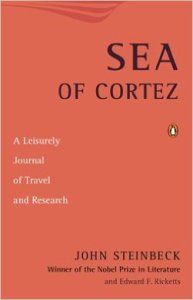
Teaser Tuesdays: Sea of Cortez: A Leisurely Journal of Travel and Research by John Steinbeck and Edward F. Ricketts

Teaser Tuesdays is a weekly bookish meme, hosted by MizB of Should Be Reading.

I love Steinbeck. I know we just saw this one in a book beginning, but there is more to love. Check out this paragraph.

sea of cortez

The safety-valve of all speculation is: It might be so. And as long as that might remains, a variable deeply understood, then speculation does not easily become dogma, but remains the fluid creative thing it might be. Thus, a valid painter, letting color and line, observed, sift into this eyes, up the nerve trunks, and mix well with his experience before it flows down his hand to the canvas, has made his painting say, “It might be so.” Perhaps his critic, being not so honest and not so wise, will say, “It is not so. The picture is damned.” If this critic could say, “It is not so with me, but that might be because my mind and experience are not identical with those of the painter,” that critic would be the better critic for it, just as that painter is a better painter for knowing he himself is in the pigment.

I think this is a lovely echo (better than the original) of a post I wrote just the other day. And I appreciate the insertion of this idea about critics, since I consider myself one: that we need to recall our place, acknowledge that my impression is only my own. I hope I remember to do that.

book beginnings on Friday: Sea of Cortez: A Leisurely Journal of Travel and Research by John Steinbeck and Edward F. Ricketts

Thanks to Rose City Reader for hosting this meme. To participate, share the first line or two of the book you are currently reading and, if you feel so moved, let us know what your first impressions were based on that first line.

sea of cortez

I am feeling good to have finally found time to open a big fat Steinbeck book I have had on my shelves for years (and yes, moved across the country with me). Coauthor Ed Ricketts was, among other things, the model for the character Doc in Steinbeck’s Cannery Row. That was my first Steinbeck, and I loved it, and thus that was my introduction to Ricketts. I have heard about their shared work of nonfiction for years, and spent some time myself on the Sea of Cortez, kayaking by day and sleeping on the beaches of Baja by night. So, much to look forward to here.

The very first lines paid off.

The design of a book is the pattern of a reality controlled and shaped by the mind of the writer. This is completely understood about poetry or fiction, but it is too seldom realized about books of fact. And yet the impulse which drives a man to poetry will send another man into the tide pools and force him to try to report what he finds there.

I have been studying creative nonfiction writing for a while now (aside from reading and appreciating it), so this concept really struck me. I knew I could count on Steinbeck. Now when will I find the time for East of Eden?

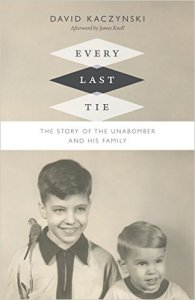
Every Last Tie: The Story of the Unabomber and His Family by David Kaczynski

David Kaczynski’s contemplation of his brother’s life and crimes is sensitive and skillfully composed, with broad appeal.

every last tie

David Kaczynski is a poet, a former English teacher, an impassioned opponent of the death penalty and the younger brother of Ted Kaczynski, better known to the world as the Unabomber. In Every Last Tie, he contemplates “loving memories and painful outcomes,” hoping to illuminate his brother’s and his own experiences.

Some of David’s message involves correcting misconceptions. For example, he says it was not his heroism but his wife Linda’s compassionate and principled actions that identified the Unabomber. He relates the process of recognizing Ted’s voice in the Unabomber’s manifesto: Linda’s concern, David’s denial, the careful considerations they conducted together and the final decision–betrayal of his brother or betrayal of yet more innocent lives. David often contemplates such difficult questions as how to explain Ted Kaczynski’s illness and actions, coming from a family that David portrays as caring, close and committed to education and integrity. He characterizes Ted as a loving older brother increasingly withdrawn from society, a tortured genius and, finally, a mentally ill man David no longer understands. The decision to identify his brother still prickles. “Ted’s cruelty stigmatizes my good name; but my reputation for goodness comes at his expense. Like all contrived opposites, we reinforce one another.”

Every Last Tie is beautifully written, searingly honest, in no way the sensational tell-all it might have been, but a careful exercise–sometimes emotional, sometimes intellectual–in self-examination. David clearly wants to pile praise on his beloved parents, but chooses to consider their complexities, seeking truth over comfort. The result contains a certain amount of psychological analysis (especially in a thorough afterword by James L. Knoll IV, a forensic psychiatrist who has both studied Ted Kaczynski’s case and come to know David well), but the book is also a meditation on notions of family, “the premise that a brother shows you who you are–and who you are not.” David struggles to reconcile the brother he loved and the serial killer he turned in, but does not belabor the point, choosing instead to remember and share what he knows, and acknowledge the mystery. Knoll’s afterword makes a more pointed criticism of the United States’ “nonsystem” of mental health care.

This slim, intriguing book is the story of a family whose two sons lead different lives. David Kaczynski’s voice is quietly thoughtful, and his writing is lovely; he ranges from family anecdote to psychological puzzle to philosophical musing while retaining an even tone. Every Last Tie is both a straightforward story and a complex consideration of an extremely difficult one.


This review originally ran in the January 26, 2016 issue of Shelf Awareness for the Book Trade. To subscribe, click here.


Rating: 8 letters.

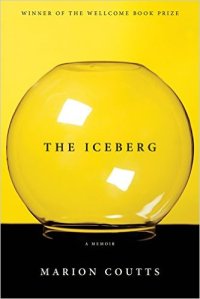
The Iceberg by Marion Coutts

An artist reflects in a variety of ways on the end of her writer husband’s life.

iceberg

Tom Lubbock was an art critic for the Independent and the father of an 18-month-old boy, when he was diagnosed with brain cancer in 2008. In The Iceberg, his wife, Marion Coutts, a versatile and prolific artist and writer, recalls his final years. The resulting memoir is musing, lyrical, ambling and sometimes digressive. The range of emotions she expresses is startling and real.

Coutts begins with “a diagnosis that has the status of an event” as she introduces her husband and their son, Ev. Tom works with words and concepts, meticulously and thoughtfully constructing the writings that are his livelihood and passion. When he has a seizure, a tumor is discovered in the speech and language part of his brain: Tom and Marion must reinvent communication. They practice and make lists: of names of friends, of ideas for outings, of opposing word pairs (big/small, light/heavy). They play a game of yes/no questions when Tom has something to discuss: Is it about your work? Is it about us? Is it food or clothing? These coping mechanisms are an interesting intellectual exercise, but are also central to this family’s experiences. Coutts writes: “I have lost the second consciousness that powers mine. Lost my sounding board, my echo, my check, my stop and finisher. I am down to one.”

The Iceberg neatly captures the events of diagnosis and death, with a stark attention to what comes in between, and little reference to the rest of life. Tom’s medical conditions are described with varying levels of detail, as Coutts often has only a vague understanding of them. Her encounters with the British National Health Service are frequently frustrating. These physical realities are less than central, however. The Iceberg is a forthright emotional account, often celebratory, even exultant: Tom especially often finds joy late in his life. Of course, Coutts is also destitute, bereft, undone. Such feelings alternate with a cerebral, even detached perspective. These jarring intersections are at the center of her story. She writes unflinchingly of her short temper with Ev, and occasionally with Tom; she relates both anguish and resolve, resignation and anger, often with a striking sense of remove. “There is going to be destruction: the obliteration of a person, his intellect, his experience and his agency. I am to watch it. This is my part.” Or of sitting at his deathbed: “I love being in position here. It is perfectly correct.”

Coutts’s prose is layered, textured, dense with meaning and interjected with brief e-mails to loved ones about Tom’s status along the way. As a consideration of art, life, death and love, the full impact of The Iceberg is deeply moving and intelligent, a worthy elegy.


This review originally ran in the January 22, 2016 issue of Shelf Awareness for the Book Trade. To subscribe, click here.


Rating: 7 words.

“Those I’ve Loved” at Word Riot

Word Riot published a short piece of my creative nonfiction in their January 2016 issue. Thanks for checking it out!


Edit: Word Riot‘s site is down. I’m not sure if it’s coming back or not, which makes me sad–not only for the sake of my own work, but for all the good stuff they’ve published over the years, and all they might have published.

I’m posting here my essay as they published it, according to my notes.


Those I’ve Loved

It all started with a little red Schwinn with 16-inch wheels. I don’t remember riding it, but there are pictures. As a teen living in a sordid shotgun house with two other bike messengers, I sold it to the man next door for $20.

Next was a boy’s black Schwinn with 24-inch wheels. I liked black better than pink.

I reclaimed Mom’s dusty maroon Nishiki road bike from the garage when I got my first job, teaching special education. Rode it to work, learned to love battling traffic on it. That’s how I met the bike messengers.

The first bike I ever bought myself was a yellow Haro mountain bike from that pawn shop on Washington Avenue that used to be so good for bikes. I broke the front shock, rode it that way for years. Eventually sold it to a bartender.

The first bike I ever bought myself new was a blue and white Redline Conquest Pro. Messengered on it, raced it, equipped it with fancy race wheels, nearly died on it when hit by a late-model white Ford F-150. Hung it on the wall for years, had it repaired and rode it some more.

I bought my first sponsored gear through my first race team, in college. I never could have otherwise afforded an Orbea road bike, Euskaltel-orange with carbon stays.

Next a red Cannondale CAAD-4, second-hand. Rode, raced, wrecked on a training ride at 29 mph. Life-Flighted. Brain injured. Will I learn to read again?

Then the Colnago, sky blue. Raced for several years on several velodromes, flew to California for the national championships (no results). My aluminum soulmate, annex to my body. It belonged to the team, so I gave it back when I switched allegiances. My fiancé tracked it down and surprised me with it as a wedding present. The team manager was happy to return it to me: he understood. I cried.

Vintage, jewel-red Univega mixte, restored by a former messenger who moved out of state. I put a basket on it for my dog. We rode together that way to my wedding.

———-

When I got my first professional job after grad school, I celebrated with a Cannondale CAAD-10 road bike, white, and another Redline Conquest Pro, black and red and white.

Cannondale’s orange Caffeine hardtail started my mountain biking career. Quickly thereafter, a Specialized Epic, through a shop where I worked for just four months. Then a blue Redline singlespeed, to get me through mud races at Rocky Hill Ranch.

Discovering 29-inch wheels: a titanium Salsa El Mariachi, custom-built with all the high-end parts. Then a Salsa Spearfish, cheaper, less exhilarating. A bright green rattle-canned singlespeed with decals that read “Ferrigno,” a little household joke. Another mud race: crashed the Ferrigno, and impaled my upper inner thigh on a tree branch. Rode back in with crotchless shorts.

There have been others. A green Schwinn road bike from the first bike shop that employed me. Another Redline, stripped for its parts. A dark red Tsunami track frame, donated to a pair of young twins. Salsa’s Casseroll, factory-recalled. A short-lived Trek T-1. The Surly Long-Haul Trucker, meant for touring, but that year I had knee surgery instead. An AMF Nimble with front basket, for the smaller dog this time. More titanium: a Salsa Warbird, for gravel racing. (A good excuse to travel, seeking gravel in an increasingly paved world.) A black Surly Karate Monkey with racks, fenders, and basket, for the city.

———-

Now, upon moving from the far South to the far North, a new bike for a new life I don’t yet love. The Santa Cruz 5010 is an epiphany, with 27.5-inch wheels, 5 inches of rear travel, a slack head tube and virtual pivot points. Beautiful orange-and-lime-green paint job, clean lines, dropper seatpost. This should fix everything.

The Year of Magical Thinking by Joan Didion (audio)

I said I was laying off the audiobooks, because my present life & schedule don’t allow for enough listening time. But then I picked up another, and another. Among other things, I’ve hurt my knee again and am back in the gym. But you’re not here to hear about my knee.

year of magical thinkingI’m so glad I tuned into The Year of Magical Thinking. It’s not a feel-good story: it tracks the year in Joan Didion’s life following her husband’s death, and maps her experience with grief. It’s almost New Year’s, and Joan and husband John have been visiting their daughter in the hospital, where she is unconscious with a life-threatening case of pneumonia and septic shock. On December 30, 2003, he collapses at the dinner table, is rushed to the hospital and pronounced dead that night. John is John Gregory Dunne, also an accomplished writer, and their lifestyle has always kept them very close: working from home, together, consulting on every aspect of their lives, from work, food, family and world events to the most insignificant details. Didion is of course, obviously, shocked and unmoored. During the year that follows she experiences different types of grief, shock and bafflement. This book is a little like a diary of that time, which it charts chronologically, ending one year and one day after John’s death.

Along the way, she nimbly weaves in the research she performs on related subjects within psychology, medicine and anthropology: research on grief, on cultural relationships with death and dying, and on medical issues, as she tries to understand when, how and why John died. This last is a surprisingly opaque question, covering the time between his collapse and the doctor’s pronouncement about an hour and a half later. What had been done in the interim? What could have been done? She examines the reports of the ambulance team, the nurses and the ER doctor.

And to compound the complicated and tragic story, daughter Quintana spends most of this year in and out of hospitals, near death on multiple occasions. What we know, although Didion at the time of writing does not, is that Quintana died within the year after the book’s timeline closes. Her later memoir, Blue Nights, covers that personal loss. I haven’t read that one – yet.

The difficulty of this book, then, is obvious: it is filled with sad stuff. Didion is a deft and clever writer, though. We see more than a little joy, although much of it is remembered. We see a strong family, and we see good times. The entwining of personal experience (past and present) and research is beautifully done. Didion uses repeated phrases to draw her reader along the book’s line, to tie everything together. It’s a lovely piece of work, although I did have to turn away when I had a particularly bad day. The subject matter is what it is.

My one criticism is that Didion fails to recognize and acknowledge a certain privilege: that her life is set against the Ritz, the Royal Hawaiian Hotel in Honolulu, the fancy home in Malibu, Chanel, Brooks Brothers, an endless parade of the food, clothing, and scenery of her choice and at her command. This privilege, compounded by her failure to acknowledge it (is it possible she is unaware?), distanced me from her. She is both a fine writer and a complex and sympathetic person; it is my instinct to identify with her, and that is where this memoir shines; but that effect is lessened by her experience of the world to which she is apparently blind. Near the end, she describes a difficulty early in her marriage, when she and John had made a $50,000 down payment on a house in an L.A. suburb but hadn’t yet sold their home in Malibu: where would the money come from? They go to a luxury resort in Hawaii to think it out, then find that the Malibu home has an acceptable offer. She does speak briefly to the irony of the Hawaiian brainstorming session. We could call this a partial exception to my complaint. The episode still comes off a little tone-deaf, though.

This is a fairly small criticism. Because of this privileged position, Didion lost a few degrees of identification with her reader. On the whole, though, she is a sympathetic and fully realized character. Her story is shocking but true; it is beautifully structured and well written, and I will definitely read more Didion.

Barbara Caruso’s narration felt spot-on to me.


Rating: 7 leis.

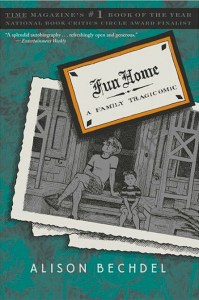
Fun Home: A Family Tragicomic by Alison Bechdel

fun homeFun Home won awards and got more attention than Bechdel’s later Are You My Mother?, which I loved, so this was an obvious choice and yes, I will add my praise to the chorus.

This is a memoir centering around Bechdel’s father Bruce, her own discovery that she is a lesbian and her coming out to her parents, which is immediately followed by the discovery that her father is gay, too, shortly before he kills himself just weeks later. (The evidence is inconclusive, but she makes a good argument for her conviction, that it was suicide.) The title is a reference to the family business, which is a small-town funeral home that they call ‘Fun Home.’ That’s a lot, right? It is also a memoir in graphic form, and I am crazy about Bechdel’s technique, which combines dialog (speech boxes for the characters in her panels) with a voiceover-style narrative in different boxes that sort of caption those same panels. It’s astonishing how much can be communicated in pictorial form.

Despite the often heavy subject matter, Bechdel is often laugh-out-loud funny, while also taking her material seriously. She beautifully evokes the absurdity of many different elements of her story. Bruce is a passionate restorer of historic homes, down to all the details, the bizarrely frothy, lacy, heavy decor. This is both hilarious and pathological. He “treated his furniture like children, and his children like furniture.” Bechdel and her father are most intimate when they share books and reading (note that this is an intimacy with decided remove). Bruce works as an English teacher as well as a funeral director; and two thematic elements of the book are death and books. Bechdel is best able to understand and characterize her parents when viewing them through the lens of literature: her father as Icarus, then Daedalus, then a character from Fitzgerald; her mother one from Henry James. “I employ these allusions to James and Fitzgerald not only as descriptive devices, but because my parents are most real to me in fictional terms.” On the other end of the cultural spectrum, as a child Bechdel confused her family with the Addams family.

The reader has a different experience of the story than she does, because we find out earlier than she does the big reveal – that her father has had relationships with men and boys. But she still has us share in mixed feelings of relief, shock, perplexity.

The story is weird, fascinating, and moving; Bechdel has a gimlet eye for the psychological struggle in each chapter of it; the structure of this book – the disordered chronology and release of facts – is a smart puzzle. But the art is what completes the perfection: I’m still reeling from, and trying to comprehend, how precisely she uses visual images (with those careful text additions) to communicate. I can’t adequately articulate it, but this is a special, a uniquely wonderful way to tell a uniquely interesting story. One to study.


Rating: 9 books, of course.

book beginnings on Friday: Fun Home by Alison Bechdel

fun home

Thanks to Rose City Reader for hosting this meme. To participate, share the first line or two of the book you are currently reading and, if you feel so moved, let us know what your first impressions were based on that first line.

I loved Are You My Mother?, and don’t know why it took me so long to pick up Fun Home, her earlier work and sort of a partner to Mother. She is still hilarious, insightful, and smart.

Because this is a graphic memoir, I’ll have to do this beginning a little differently. Here is an image of the whole first page.

fun home start

That reference to Icarus was when I knew (not that I doubted) that we were going in a good direction. I can’t wait to spend some more time with Bechdel and her wacky family and amazing mind.

book beginnings on Friday: The Rarest Bird in the World: The Search for the Nechisar Nightjar by Vernon R. L. Head

Thanks to Rose City Reader for hosting this meme. To participate, share the first line or two of the book you are currently reading and, if you feel so moved, let us know what your first impressions were based on that first line.

Today, a fanciful and wondering story of birdwatching in our strange world. It begins:
rarest bird

Eyes are for searching, and sometimes the search is for eyes in the night. I blinked, turning my cheeks to the dusty mud. Shapes slid before me, slicing like the shadows from a tent, stealing bits of shine.

It was an elemental evening in Ethiopia.

Among other things, I have enjoyed encountering places in this book – like Galveston Island State Park (where I have played since I was a baby, and where a dear friend works as park interpreter today), and Haleakala, a mountain in Hawaii that I have ridden a bicycle down (but not up). Stay tuned…

This quotation comes from an uncorrected advance proof and is subject to change.