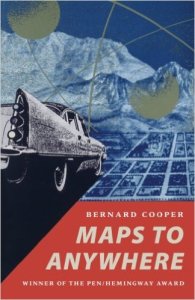
Maps to Anywhere by Bernard Cooper

maps to anywhereMaps to Anywhere is a surprising, complex, lovely collection of essays. I read it for class (one of the creative nonfiction writing classes I’m taking at Western Washington University), and I wonder how I would have approached it otherwise: would I still have been quite so focused on reading like a writer, on dissecting and searching for Cooper’s process and strategies? I hope so, but I can’t say.

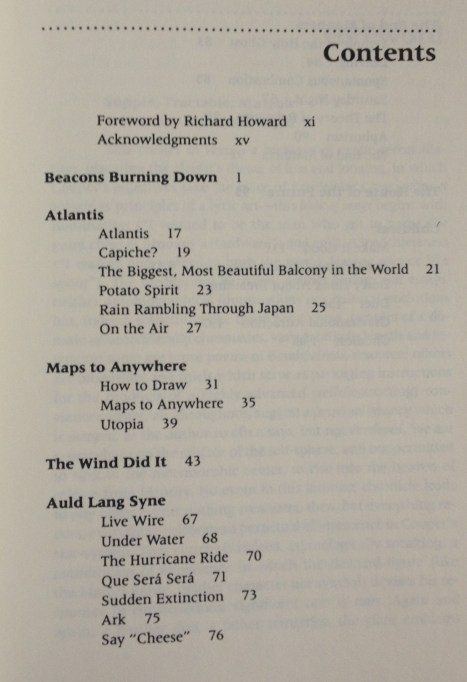
It is an impressive collection of work, and I mean ‘collection’ precisely. The essays themselves are impressive, and varied: some lyrical, including some I unequivocally call prose poems; some more narrative; some conceptual and wandering, some rooted firmly in fact, and some clearly rooted in imagination. But the method of collecting the individual essays is one of the central points of genius that caught my mind. How selected, and how arranged?

Some longer essays are their own entire section. Some sections are made up of shorter essays, and take the name of one of them.

first page of table of contents

first page of table of contents

I marveled over Cooper’s titles, and also his final lines, the way they wrap things up and the way they leave an image or a sound (or both) in the reader’s mind. He is a very aural writer: much of his work demands to be read out loud, or simply makes itself heard. I found assonance I loved, as in the line, “Can mother muster enough thrust to leave the earth in a sudden leap?” (How is this not poetry?) There were amazing concepts, intriguing stories, and a perfect evocation of an era: the U.S.’s forward-looking, plastic-happy 1950’s. In other words, so many skills: I can see why a writing class teaches this book! But again, it was the organization of the moving parts that most confounded and fascinated me. I think I understand that Cooper builds an overall movement (and a sense of movement is central to his work throughout) from a childhood self to a mature and outward-looking one. But the content of the pieces in between jump around in time; it’s far from chronological. Oh, a puzzle: I can’t entirely explain this collection to you. You should go explore it for yourself.


Rating: 9 names.

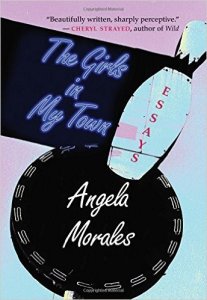
The Girls in My Town by Angela Morales

This collection of essays about a Los Angeles childhood is strongly rooted in place and universal in its themes.

girls in my town

Angela Morales’s The Girls in My Town is a collection of striking, lovely essays about her upbringing in Los Angeles. Vignettes paint a number of vivid scenes: her parents’ appliance store, and the bowling alley where she went to escape it; an elementary school where the girls demanded to be allowed to wash dishes like the boys; a room where a grandmother lay dying, as generations of children ran laps in the yard outside; the community college where Morales teaches remedial English to an ex-con with a pitiable past. These portraits, and the characterization of a larger Los Angeles, form a sense of place that enlivens and colors the collection.

Themes include family, and the changes seen over generations, as in Morales’s journey from daughter to mother, and in telling her grandparents’ stories. Recurring patterns of teen pregnancy, violence against women and girls and the fear it inspires add a tone of somber musing. A series of animal characters–the pet dogs of the author’s childhood, her own children’s pet rats, a mountain lion in the hills–bring layers to a setting both urban and wild, becoming dreamlike on her pre-dawn bike rides. Morales has a strong, lyrical voice, and her essays and anecdotes can be humorous and loving and darkly meditative as they address family, beauty and violence, loss and love. In short, this collection is as varied, charming, stark and inspiring as life itself, in Los Angeles or anywhere.


This review originally ran in the April 8, 2016 issue of Shelf Awareness for Readers. To subscribe, click here, and you’ll receive two issues per week of book reviews and other bookish news.


Rating: 8 bike rides.

A Distant Heartbeat: A War, a Disappearance, and a Family’s Secrets by Eunice Lipton

An inquisitive memoir investigates the author’s uncle, who was killed in the Abraham Lincoln Brigade in the Spanish Civil War.

distant heartbeat

Eunice Lipton grew up with an awareness of her uncle Dave that was specific and conflicted in emotional tone, and vague in points of fact. She knew he’d been in the Abraham Lincoln Brigade in the Spanish Civil War, and killed in action when he was 22. His brother Phil says, “Dave died for something. He was somebody.” His brother Louis, the author’s father, says he died for nothing. The author’s mother says he was the nicest man she ever knew. A Distant Heartbeat asks: Who was Dave Lipton? Why did this respectful son lie, tell his parents he would be working at a hotel in the Catskills, and then go to Spain? What does his story have to offer history?

Dave Lipton (formerly Lifshitz) was a Latvian Jewish immigrant, immersed in leftist youth politics in 1930s New York City. Surrounded by peers whose convictions mirrored his, Dave was one of very few to join that foreign war. His niece, born after his death, grew up with only scraps of his life and death: the repeated refrains of family members–died for nothing, died for something–and a few photos discovered in her childhood. She speaks to surviving veterans and friends of Dave, travels to an International Brigades reunion in Spain, studies letters and archival photographs. She finds more questions: What is the nature and cause of familial betrayal? Who was Dave’s mystery companion? In the end, Lipton’s research and musings offer only fleeting conclusions about family and principles, in a precise, elegiac journey through history, family tensions and human drama.


This review originally ran in the April 8, 2016 issue of Shelf Awareness for Readers. To subscribe, click here, and you’ll receive two issues per week of book reviews and other bookish news.


Rating: 7 photographs.

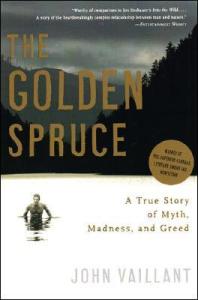
guest review: The Golden Spruce: A True Story of Myth, Madness, and Greed by John Vaillant, from Pops

Some of you will recall that I enjoyed John Vaillant’s The Jaguar’s Children. So I am of course interested in his creative nonfiction, as well. Here’s Pops to fill us in.

golden spruce

On its face, this is the true tale of a man who in 1997 secretly felled the genetically & culturally distinct Golden Spruce at the north end of Haida Gwaii – Queen Charlotte islands of British Columbia. But to disclose this shorthand version is not to spoil the narrative, for it only raises questions: Why was this such a compelling and violent act? Why did he do it? Can it be justified? Can we find wider meaning in the tragedy? And there are more.

Vaillant only gradually provides the tale’s factual skeleton, which reveals no satisfying answers in itself. More significantly, he offers us the chance to learn: about the Pacific northwest temperate rainforest that is so special on this earth; about the people who have inhabited the region for untold millennia, with an oral history linked to special places – and trees; about the waves of outsider “discoverers” that washed on meager shores to harvest the land’s natural riches; and about the logging sub-culture that, while professing its love of trees, is dependent on a timber economy that to this day acts to diminish the forest ecosystem while serving an insatiable global market.

It is only after five chapters of grounding that we first meet the disturbing – and disturbed – character, Grant Hadwin. Yet Vaillant continues to serve up nuance and insight as the narrative unfolds in bits and we wrestle with those questions. His tone suggests a colloquial & confident familiarity with facts – a reflection, no doubt, of both keen research and personal observation by this BC-based author. A fine storyteller, his voice is largely dispassionate and unsentimental, floating above temptations to judge or conclude. As literature is a human realm, one naturally expects telltales of an author’s values; here they are mere wisps – candid, balanced, welcome.

Where some details of Hadwin’s mystery are not known, Vaillant does not embellish or needlessly speculate. There are end notes, but few and spare. It is revealing that the story brings the author to mention Ted Kaczynski – but then also Joan of Arc, Billy the Kid, Scarlet Pimpernel and others. While citing some authority on obvious questions of Hadwin’s mental state, these are not hyper-analyzed. This is refreshing candor consistent with Vaillant’s approach to our limits of understanding.

Indeed, uncertainty of both man & nature is part of our landscape in this saga, as is myth. We are drawn in and encouraged to embrace it. Both natural & human elements of the story’s terrain are informed by the depths of Haida thought and oral history. Vaillant deftly wrestles with the challenges involved, e.g. western “rational” thought ill-equipped for such murkiness; and the tenuous continuity of oral history in a culture nearly extinguished by disease and genocide. He notes: “Time and events are clearly elastic in this version of the story… It is exactly this willingness to host the implausible that makes the islands and their surroundings so extraordinary.”

Logging is treated to a similar reflective treatment, involving our conflicted history of rich benefits, wanton destruction and tragic social dependence. For not the first time, we must glance in a mirror: “in this world, a certain tolerance for moral and cognitive dissonance is necessary.” This account reminds us that, like other chronicles of exhausted natural resources, logging created a culture that also produces human victims, “expendable canaries in the coal mine of resource extraction,” with collective social consequences.

Vaillant’s generous background-telling is no mere regional history or delivery of anecdotes; it can be a gift for those willing to receive – an unusual opportunity to crawl inside forest richness, stretch for cultural understanding, examine our own heritage in new ways and view events from the eyes of others. And the accumulating awareness is not always comfortable, in the way that keen perception often is not: sometimes painfully intimate, sometimes achingly universal, often irresolute and incomplete.

Each chapter opens with a quotation. One is from William Blake: “A fool sees not the same tree as a wise man sees.”

In the end we must recognize this tale is about a tree, not a man. Our young civilization still has much to learn, in the limited time remaining to act; and it is often original cultures and nature’s wonder doing the teaching. In the context of deep time and an infinitely special place, this man’s story is brief and largely complete: he lived, he acted, and he is gone. But as both Haida cultural lore and our lauded science both suggest, the tree’s story reaches far back in time, is inescapably interwoven with the place, and stretches well into the future beyond our knowing.

Teaser Tuesdays: Joe Gould’s Teeth by Jill Lepore

Teaser Tuesdays is a weekly bookish meme, hosted by MizB of Books and a Beat.

Teaser

This is one of the best books I’ve read this year. Please pardon the double-teaser. I couldn’t choose.

First and more complicatedly, Lepore quotes her subject, Joe Gould, in a letter to Ezra Pound in 1930. Gould is known (among other things) for being supposedly at work on a massive “Oral History of Our Time.” The parenthetical is hers.

joe gould's teeth

“Of course, I am a book-reviewer not a critic. That, I fear, is a distinction. It seems marvelous how many critics there are. And the blathering pother they make… Here is something cheerful to think about. To some extent the radio will supersede printing. That is good. There will be fewer books.” (The Oral History, he once explained, would include a discussion of this transformation: “I intend to write a series of chapters on the various means of communication, from oxcarts to airplanes.”)

I really wanted to share the oxcarts-to-airplanes concept because I thought it was delightful. But of course I couldn’t help going up a bit to see the book-reviewer-vs.-critic question, too! And as a bonus: people have been predicting the death of the printed book since way before e-readers. (Spoiler: Joe Gould died in an insane asylum.)

I was also struck by Lepore’s observation, below.

It has taken me a very long time, my whole life, to learn that the asymmetry of the historical record isn’t always a consequence of people being silenced against their will. Some people don’t want to be remembered, or heard, or saved. They want to be left alone.

Compared to the tone of the first teaser I chose, this second is more sober, and sobering. It’s an interesting concept for a historian to keep in mind – for the purposes of research strategies, but possibly ethics as well.

Check out Joe Gould’s Teeth. It’s outstanding.

This quotation comes from an uncorrected advance proof and is subject to change.

Alligator Candy by David Kushner

This tender, intimate memoir probes the childhood murder of the author’s older brother.

alligator candy

On a Sunday afternoon in 1973, 11-year-old Jon Kushner rode his bike through the woods to the 7-Eleven. His four-year-old brother, David, had asked for one kind of candy in particular. Jon’s family never saw him alive again. Journalist David Kushner still struggles to fathom his brother’s murder and his family’s experience; Alligator Candy is his memoir of investigation and connection.

Kushner lovingly portrays his hippie parents, eldest brother and Jon, who struggled with an auditory deficit disorder and was known for his compassion. Their community in Tampa, Fla., included activists and academics, and emphasized freedom and the outdoors. It was perfectly natural for a boy to ride alone through the woods. Jon’s murder presaged an end to the “ability of kids to simply get on their bikes and go,” as one family friend put it.

Alligator Candy explores how a family and community survive loss. The twin terrors of not knowing fully what happened versus knowing the horrific details of exactly what was done to Jon comprise only two reasons that this is a painful story. However, Kushner can also be funny, and he skillfully captures a child’s innocent curiosity, even in loss. He writes so simply, but this is deceptive. Alligator Candy is sensitive, insightful and understated.

Forty years later, Kushner (Bones of Marianna; Masters of Doom) still struggles with grief, isolation and guilt. In writing Alligator Candy, however, he discovers certain details of his brother’s case for the first time, begins to comprehend his family’s coping methods and, finally, achieves a long-sought connection with Jon.


This review originally ran in the March 25, 2016 issue of Shelf Awareness for Readers. To subscribe, click here, and you’ll receive two issues per week of book reviews and other bookish news.


Rating: 7 pieces of gum.

Teaser Tuesdays: The Hour of Land by Terry Tempest Williams

Teaser Tuesdays is a weekly bookish meme, hosted by MizB of Should Be Reading.

Terry Tempest Williams is as wonderful as ever. As I explore her work, I keep returning to her lesser-known Pieces of White Shell as my personal preference, but The Hour of Land is a new favorite.
hour of land
In these essays, she applies her wise, poetic eye to place, history, ecology, the future, and how we relate to one another, resulting of course in phenomenal writing. Naturally I turn to her chapter on Big Bend for today’s teaser, a single line I loved.

Ocotillo is a green withheld in winter.

Keep your eyes open for this treasure to come in June.


This quotation comes from an uncorrected advance proof and is subject to change.

The Rarest Bird in the World: The Search for the Nechisar Nightjar by Vernon R. L. Head

A master birdwatcher lyrically describes his quest for the first scientific sighting of a little-known species.

rarest bird

“Searching enquiringly, steeped in a willingness to learn, we felt a connection with biodiversity and an appreciation of species.” This recurring concept of inquiry, combined with a sense of wonder, dominates Vernon R.L. Head’s poetic musings in The Rarest Bird in the World: The Search for the Nechisar Nightjar. A conservationist and lifelong birdwatcher, Head was entranced by the findings of a 1990 scientific expedition to the Nechisar plains in Africa’s Great Rift Valley: among many specimens, the team collected a single wing of a bird that turned out to be unknown to science. After some discussion within the ornithological community–can a species be defined by a single body part?–it was named the Nechisar Nightjar, Caprimulgus solala (“solala” meaning “only wing”). “The new species was announced, and birdwatchers like me began to dream.”

Decades later, Head and three elite birdwatching buddies trek to the Plains of Nechisar in Ethiopia to search for this elusive, prized, nearly mythical creature. In an awestruck tone, he describes their journey, interweaving the story of the 1990 discovery, reflections on humanity’s place in the natural world, memories of other birds, and thoughts on taxonomy and naming. Head is appreciative of metaphor and playful with words: he coins the collective “an incantation of ibises,” calls Addis Ababa “a eucalyptopolis,” sees a cliff of striated rock as a “shelf of books to the past.” This fanciful mood defines much of the book, although Head does turn somber in contemplating the future of many rare birds. After slower paced sections, as in recalling the birdwatchers he travels with, the adrenaline increases as they draw closer to meeting the Nechisar Nightjar.

Head’s story of birdwatching and its relationship to conservation is also a meditation on extinction and an ode to the natural world. He is unafraid of wandering within these subjects, and his passion for this work is clear: “Each name [on a birdwatcher’s list] is a story of an interaction, a time of connection with the pristine, a collection of memories, an understanding of our place in the system of natural things, and a hope for the future of that place.” The skills involved in spotting rare species approaches magic, even as it references science. This combination of reverence and scientific history is attractive as both a work of literature and an illumination. The Rarest Bird in the World is an alluring view into birdwatching and multiple rarities.


This review originally ran in the February 22, 2016 issue of Shelf Awareness for the Book Trade. To subscribe, click here.


Rating: 7 eyeshines.

Sea of Cortez: A Leisurely Journal of Travel and Research by John Steinbeck and Edward F. Ricketts

It is advisable to look from the tide pool to the stars and then back to the tide pool again.
sea of cortezIn a word, Steinbeck is as wonderful as ever. (I don’t have an idea of how strong a role Ricketts played in the writing of their shared story.) This unique work, a blend of travelogue, science writing, humor and wide-ranging philosophy, has all the Steinbeck voice and attitude that we love.

Steinbeck, as we know, was a prolific novelist, attached to the central California coast. Ed Ricketts was a marine biologist, and the model for the character Doc in Steinbeck’s Cannery Row. They were good friends. In 1940, they chartered a fishing boat called The Western Flyer to take them from Monterey, California, down around the tip of Baja California, and up and down the Sea of Cortez (also known as the Gulf of California), on a scientific collecting trip. With a small crew and a large (but not large enough) supply of collecting equipment, they toured the coast, visiting small settlements and making notes on local culture, fishing for their meals, drinking more than a little beer, and collecting. The littoral zone they examined yielded enormous numbers of creatures: crabs and fishes, anemones and sea cucumbers and sea hares and shellfish and snails and starfish, on and on.

This is a fat book. My copy of Sea of Cortez: A Leisurely Journal of Travel and Research runs 598 pages. But the narrative or journal part forms only half that (and, as it turns out, is contained in The Log From the Sea of Cortez at 320 pages). The second half of the book is composed of “A Note on Preparing Specimens”; photographs, drawings and charts, of select collected species; and an “Annotated Phyletic Catalogue” (plus references, abbreviations, glossary, index). I confess I read only the narrative, and the introduction to the “Annotated Phyletic Catalogue”; browsing the catalogue itself told me that it was hundreds of pages of descriptions of littoral sea creatures, a significant contribution to science but not something I needed to spend my time on.

This is in part why, as the back-of-book blurb puts it, “Sea of Cortez is one of those rare books that are all things to all readers… science to the scientist, philosophy to the philosopher, and to the average man” (ahem, woman) “an adventure in living and thinking.” There is plenty of good science in this book, including much in the narrative itself, which the authors make accessible and interesting; I didn’t need the list version. I purposefully bought the long, full copy of this book, when it turns out I could have gone with just The Log.

The philosophy referred to in that blurb is no small thing. My only struggle was a chapter of about 20 pages arguing the merits of teleological versus non-teleological thinking, which I found fairly mind-numbing in its abstraction, and about 17 pages too long. Other philosophical musings are more enjoyable, as in discussing the habit of both people and other animals of getting “soft” when the going is too easy, or our yearning for the magic and mystery of the unknown: “Men really need sea-monsters in their personal oceans.” There is a common question, in our world, of whether people still living more “primitive” lives – in this case, Mexican Indians whose chief concerns are food and shelter – are happier than more “civilized” people who worry over

tremendous projects, great drives, the fantastic production of goods that can’t be sold, the clutter of possessions which enslave whole populations with debt, the worry and neuroses that go into the rearing and educating of neurotic children who find no place for themselves in this complicated world…,

etc. This question is as well stated here as anywhere, and sensitively approached, I think, which is to say not entirely answered. After much musing on political concepts and the meaning of life, Steinbeck-Ricketts returns to the immediate question at hand: “our own interest lay in relationships of animal to animal.”

It almost goes without saying that descriptions are lovely and filled with sensory detail that make one want to see this land this sea, or return there.

The sweet smell of the land blew out to us on a warm wind, a smell of sand verbena and grass and mangrove. It is so quickly forgotten, this land smell. We know it so well on shore that the nose forgets it, but after a few days at sea the odor memory pattern is lost so that the first land smell strikes a powerful emotional nostalgia, very sharp and strangely dear.

On a personal note, I was delighted to find reference to places I have been: Loreto, Mulege (where they did not stop, because of the infamous malaria), Coronado Island.

I suspect, as I have before, that Steinbeck is at his best when describing parties. No one has ever written so convincingly, lovingly, entertainingly about people drinking together. And he does it with a sort of formal tone, so that we see his eyes twinkling at us over his real meaning, as when he’s told of an earlier collector who left “large families” of his offspring behind in local communities – “a whole tribe of them” – and the voice of Steinbeck-and-Ricketts notes, “We honor this man for all his activities. He at least was one who literally did proliferate in all directions.” A delightful passage beginning “There is nothing more doleful than a little cantina…” is a perfect capsule tale, that I will reread with pleasure, and if he lets me, read out loud to Husband. See also the party when The Western Flyer leaves the dock in Monterey.

Steinbeck-Ricketts’s discussion of the nature of diplomacy, as their little party prepared to sail into Mexico in a time of international tensions, employs this same tone of formal language poorly disguising sparkling satire. I never loved Steinbeck so much. In this spirit, in praise of clarity, comes a discussion in chapter 10 (March 18’s entry) of the common dullness of scientific writings. “We have not known a single great scientist who could not discourse freely and interestingly with a child.” And so here is Sea of Cortez, a perfect example of a non-dull piece of science writing. Who says creative nonfiction is a new invention?

I have trouble attributing the loveable qualities of this book to one man, or two. It seems obvious on cursory glance that one man is the writer and the other the scientist, but what do I really know of their shared writing process? Ricketts had to have been a fun and full personality, in part because Steinbeck would have required it, I think, and in part because Doc was. There are several anecdotes told in which “one of us” does something or the other, and we are left to wonder.

Perhaps the authors’ best quality is the overall tone of wonder and playful humor in observing the everyday. I especially enjoyed the ongoing joke of the Sea Cow, a motor attached to a little skiff used to leave the boat and go collecting. The Sea Cow is personified as a being with a malevolent will of its own, determined to thwart: it works on beautiful, sunny days for short distances (“in a word, on days when it would have been a pleasure to row”) but never in bad weather, over long distances, or after dark. The Sea Cow figures as a large personality throughout the book.

Their scientific knowledge is not boundless, and they are honest about this fact. Their purpose in this collecting expedition is to collect, that scientists may then study. When encountering a strange islet: “It is nearly all questions, but perhaps someone reading this may know the answers and tell us.” Acknowledgment of what is not known or understood is so rare, and refreshing.

As the back-of-book blurb (quoted above) indicates, this book is many wonderful things in one package, and that package of Steinbeck design: what more could we ask? A delightful true story of travel, of Mexico, of the wonder of really looking around at one’s world, of camaraderie, of joie de vivre. Recommended, of course.


Rating: 8 Sally Lightfoots.

shorter prose: essays, etc.

I took myself away recently for a solo writer’s retreat to a cabin in the woods, on a lake, in the mountains. No phone or internet. Husband dropped me off with the two little dogs and the gear I’d need for two nights. Forty-five minutes after he left the cabin lost power, which put a damper on my reading & writing abilities; but it came back on at 1:37am. I know, because I had left all the lights switched on.

I took lots of work with me. One book completed that needed a review; the second, completed in those first minutes without power, needed a review. The next one, of which I read the half by candlelight that first night, which needed a review and prep for an author interview; four more books in reserve. Seventeen essays, 5 book excerpts, 2 lectures, 2 short stories, 1 piece of longform journalism, and 7 poems. Twenty classmates’ responses to an essay I’d submitted for workshop, representing a range of ideas for expansion and revision. One class assignment, and a broad and vast mandate to create more new work. My only other goals were to feed myself and the dogs, and take us all to go to the bathroom as necessary. I would not get through it all, of course. I had brought so much so that I could pick and choose, and not get bored. On day two, I resisted the urge to go back to the candlelit book of that first night, in favor of all those essays and other writings.

And so here we are. I will not subject you to my reviews of 17 essays, 5 book excerpts, 2 lectures, 2 short stories, 1 piece of longform journalism, and 7 poems; frankly (for this purpose, happily) they were not all worth it. There were some special ones, though. Rebecca Lee’s “The Banks of the Vistula” was shocking, invigorating, and persistent: after several days, I can’t stop thinking about it. Simultaneously, it was beautiful, and it bothers me.

The excerpt from Virginia Holman’s Rescuing Patty Hearst was likewise tantalizing, especially since my copy, for whatever reason, ends mid-sentence: that will bear further review.

Jonathan Swift’s “A Modest Proposal,” which I remember reading – can it have been in middle school? – but don’t much remember, was as wonderful as I suspected, filled to brimming, every line, with humor and of course stinging satire. Montaigne was too densely written; I’m not up for this. Robert Louis Stevenson, rendered here as Robert Lewis Stevenson (and what’s up with that?) is reliable: “An Apology for Idlers” was good and “On the Enjoyment of Unpleasant Places” was outstanding. RLS has this to offer my retreat weekend: “There is no country without some amenity–let [her] only look for it in the right spirit, and [she] will surely find.”

Flannery O’Connor’s “A Good Man Is Hard to Find” was… what? disturbing? I will need some help with this one. Brenda Miller’s “36 Holes” is beautiful, a very different sort of form and one that appeals to me: meditative, wandering, but cohesive; I will reread this. As a fan of the semicolon and general geek, I very much appreciated learning more from Paul Collins in “Has Modern Life Killed the Semicolon?“, which yields such quotations as this one from the Times of London:

The semicolon is the enemy of action; it is the agent of reflection and meditation.

(That must be why I like it so much.) And,

The semicolon allows woozy clauses to lean on each other like drunks for support.

which is less an argument for support, but a great sentence.

One of the best things* I read over the weekend was “Some Holy Ghost,” by David K. Wheeler. Full disclosure: I work with Dave; he’s my editor at Shelf Awareness. But the essay was objectively wonderful, I insist. I love everything about this piece: the structure, wherein he walks around the Art Institute of Chicago meditating on large questions while looking at paintings with specific bearing on those questions; the perfection of his phrases (Dave is also, perhaps foremost, a poet); and the themes and the job he does with them. This is an essay about religion, a subject that usually makes me twitchy, but his thoughts are accessible and revelatory.

The longform journalism is The Bones of Marianna, by David Kushner. It tells the story of a reform school in Florida, the mysteries and pain surrounding its history, and the efforts of citizens and forensic archaeologists to uncover the past. This is a riveting story, and it’s beautifully presented at the link above. Kushner’s telling is more straightforwardly journalistic than creative; I miss the voice I came to know in Alligator Candy (review to come), but this is a good read – just different.

I did not get around to the poems, so those will wait for another day.


*It will be the subject of another post on another day, but I’ll just say here that I can’t stop raving about Lily and the Octopus, a debut novel by Steven Rowley which blew me away. (This is the one begun by candlelit, and finished the second night.) It’s a startling, original piece of work and I highly recommend it.