Girls with a Voice and Girls with Courage by Ann Turnbull and Adèle Geras

Another loan from my favorite 11-year-old, this is a pair of historical novels linked by location. Girls with a Voice, by Ann Turnbull, is about a 12-year-old girl named Mary Ann who travels from London to a boarding school in the nearby village of Chelsea in 1764. She is excited to study singing and the harpsichord there, because she wants to perform as an opera singer onstage (an ambition her family is not especially supportive of). She makes good friends, not only with her fellow pupils, but with a maid in the large house where the school is located. The maid, Jenny, also has a fine singing voice, but because of her class, cannot have the same training as Mary Ann. Jenny sings ballads in the streets for money, however, which Mary Ann finds extraordinary. When circumstances change for Mary Ann’s family, she has to get creative in problem-solving to continue following her dream.

In Girls with Courage, set in 1857, Adèle Geras tells us about Lizzie, also 12, who is on a journey from her home in the country into London, to stay with family in their large, impressive home on Chelsea Walk. This is the same home that housed Mary Ann’s boarding school nearly 100 years earlier; what was then an outlying village is now part of the city, and Lizzie, a country mouse, is awed by the bustle. Lizzie’s father died when she was young, and her beloved mother Cecily is now remarried to a dour man who has suggested Lizzie go away for a spell, as Cecily is pregnant. Lizzie will stay with her father’s brother’s family: uncle, aunt, three cousins including a boy her own age, another uncle who has been injured in the Crimean War, and a grandmother, as well as several servants. Compared to her spare country upbringing, this life strikes Lizzie as grand and luxurious, although also limiting: she enjoyed learning about plants and trees from a local orchardist, and now is forced to do needlework that she finds very tedious. Cut off from her late father’s books by the mean stepfather, she now yearns to learn the math and science that her cousin Hugh gets to study. She misses her mother terribly–and when something seems to have gone amiss back home, Lizzie will have to be brave to help.

As you can tell from these summaries, both stories are a bit sweet and instructive. While I like these protagonists, they are earnest and simple and good-hearted in a way that leaves off the grit and snark and fun I like in all my reading, children’s and young adult of course included. Compared to the Dragon Slippers trilogy this same young friend introduced me to, Girls is less delightful. That said, I passed a pleasant enough day-and-a-half here, and have no argument with the messaging about girls following their passions – whether in music or botany – and standing up for themselves (and their mothers). This messaging is not exactly radical, but still solid. And I’m glad my young friend is interested in history. I look forward to hearing what she loved about the book, and will continue reading anything she brings me.


Rating: 6 walnuts.

Dragon Flight by Jessica Day George

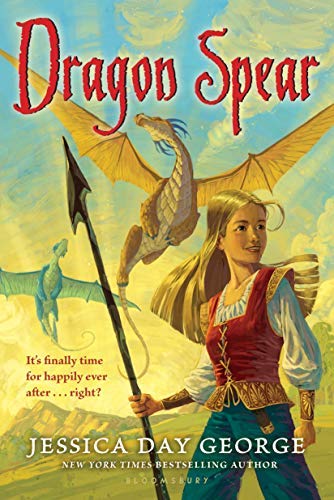
Book two in the trilogy that began with Dragon Slippers is at least as good – my young friend who recommended them to me prefers the first book but I think this one might be better. Creel, in her late teens, is now an entrepreneur, running a dress shop in King’s Seat along with her best (human) friend and business partner, Marta. Marta is engaged to marry Tobin, former bodyguard to the younger prince, Luka; Creel is less secure in her relationship, but the reader can see that Luka himself is smitten with her, commoner or no. Because this is the Dragon Slipper series, trouble quickly arises: a distant country is poised to invade with an army of soldiers riding dragons. We know that dragons are not hostile by nature, so something funny (probably of the alchemical variety, as in book one) must be afoot.

One thing I love about Creel is her genuine devotion to her dragon friends. Her first friend, really, was a dragon, while she definitely has some good human ones. She is adamant in her defense of the misunderstood dragons, anxious both to protect their reputations and keep them safe. The humans also need dragons to keep them safe, and Creel is the liaison between the two groups.

I love the friendships among and between humans and dragons. I love Creel’s (and Marta’s) innovations and puzzling through problems, and their bravery. The romances are sweet, but what I love most about the pairings is that Creel and Marta are outright heroes while their respective beaus just follow along, supportive but a little bumbling, good-natured about their partners’ impressive accomplishments. (I considered sharing this observation with the 11-year-old who recommended these books to me, then realized I’d actually rather she live in a world where this was unremarkable.)

Charming, daring, whimsical, loveable, endearing. I’m in for book three.


Rating: 7 scales.

Dragon Slippers by Jessica Day George

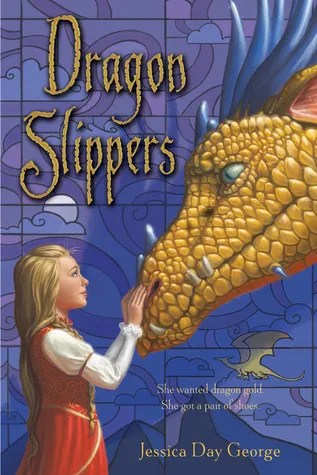
My favorite 11-year-old saved this book especially to loan to me, and I was so excited to be given the assignment. And I quite enjoyed it! Rated for grades 5-6, Dragon Slippers has engaging action, humor, sweet friendships, a hint of romance, and snappy pacing. It’s also got some good messaging, which I approve of. It’s the first in a series and I thought I’d walk away after just one, but the surprise ending (and the sample chapters of book two!) got me.

In poverty and desperation, with a hint of a Hansel & Gretel dynamic, Creel’s aunt decides she should be abandoned to the rumored local dragon, in hopes that a noble knight will rescue her and uplift the whole family. (“Why should anyone be rewarded for defeating a dragon by being saddled with a dowryless, freckled wife and well over a dozen daft and impoverished in-laws?” Creel wonders, but nobody asked her.) This device gets Creel in the company of a dragon that no human has seen in generations, and she quickly learns that their hoards of gold and treasure are a false rumor – this one prefers shoes – and that they’re not terribly motivated to kill humans. She makes a friend, gains a beautiful pair of blue slippers that fit just right, and heads off to the city of King’s Seat hoping to make her own living rather than return to an aunt who tried to feed her to a dragon. Creel is a talented maker of what her late mother called fancywork: embroidery, weaving, and (if necessary) sewing. In the city, she is repeated called a country bumpkin. Events move quickly: she falls afoul of a visiting princess; meets a friendly prince (no relation); gets a job in a dressmaker’s shop; and finds herself embroiled in a few messes. One, working for a boss involves the kind of exploitation anyone in our present, real capitalist system will recognize. Two, her coworkers range from friend material to backstabber. Three, the prince’s attentions and the princess’s hostility somehow manage to entangle Creel in political intrigue and matters of state that also – surprise – turn out to involve her dragon friends.

(Following an early whiff of Hansel & Gretel, the slippers and the prince definitely recall Cinderella. Just echoes.)

I asked my favorite 11-year-old what she liked about the book, and she started with the initial meeting with the first dragon. (Dragons are one of her two favorite animals.) She also mentioned Creel: she likes her strength and her unwillingness to take any crap. She identifies with that. We talked about the friendships in the book, and the pacing. She said she wanted me to read it because she thought I would like Creel, and she was right.

If Creel’s interest in pretty gowns, sashes, and slippers is a bit prissy for me, she is on the other hand a highly practical feminist entrepreneur, with a dangerous habit of speaking her mind even to royalty, and a strong sense of her own powers. I love the urge to make her own way in the world. She’s brave. And she’s a good friend to a handful of dragons as well as humans, and might just turn out to be a hero. I appreciate the positive messaging, and the imaginative world of dragons. There were a few very minor plot holes that I think would likely be tolerated (or missed) by many adult readers, and certainly by younger ones. And as I said, I was hooked by a surprise finish. All in all, my young friend gave a good recommendation.


Rating: 7 collars.

The Last Graduate by Naomi Novik

Book two of the Scholomance series was every bit as thrilling and engaging as book one. I love our grumpy, standoffish teddy bear of a protagonist.

El had good character development in A Deadly Education; now she’s continuing to develop as a person, both because she’s a teenager (coming of age) and because she’s made friends for the first time in her life. She’s reluctant to believe in this, because she’s endured a lifetime of trauma at the hands of almost everyone she’s ever known. Her new friends and allies do have something to gain from working with her at graduation, now that her power as a wizard is becoming more widely known, so she’s not entirely wrong to consider that this may motivate their friendship; but the reader can see better than she can that their friendship is real, too. It’s poignant to see such a sweet but enormously curmudgeonly, damaged, dear kid struggle to accept that people might actually care about her.

The privileges of class and nationality at work here, the power structures that are most invisible to those in power, and the injustice of it all, are more overtly at the center of this book. I think there are some good magical parallels to our real world here that can be instructive but also entertaining and fit neatly into the fantastical wizard-y world of Novik’s imagination, which is prodigious, by the way; this is expert-level worldbuilding. Late in the book the focus begins to move beyond the Scholomance to consider the whole world, which is clearly where book three will take us; this one ends on another final-line cliffhanger (!), so I’ll be getting there fairly quickly.

Perhaps because they were both Liz recommendations, I am reminded of the Murderbot series here, which also featured an outsider first-person narrator who is actually a loveable marshmallow on the inside but puts forward a hard, aggressively antisocial exterior. Despite being mostly rejected by their respective societies, both are driven to right the big wrongs. I do love this set-up, and I love El for being a hard-nosed, sarcastic badass.

In this installment, I actually questioned the YA label. The series does star teenagers, and deal with coming-of-age problems (therefore YA). On the other hand, it also deals with some very dark themes, heavy enough that some readers move it out of the YA category; but after some consideration, I don’t think that’s necessarily a disqualifier. It’s definitely for older kids, not least because there’s some (non-graphic) sex in this one. Maybe the line between YA and adult is blurred; certainly it depends on the reader. There’s no question that these are books for adults (hi), but I think they’re also books for young adults who are up for serious thinking on dark subjects, and some really good writing. This is a step adultward from Hunger Games, which are however very fine books in their own right. Who’s to say what kids should read, anyway? My parents didn’t seem to me to monitor my reading much, and I definitely read some stuff beyond my comprehension at a young age, and all that seems to have done is whet my fire. As ever, your mileage may vary.


Rating: 8 glaciers.

Clap When You Land by Elizabeth Acevedo

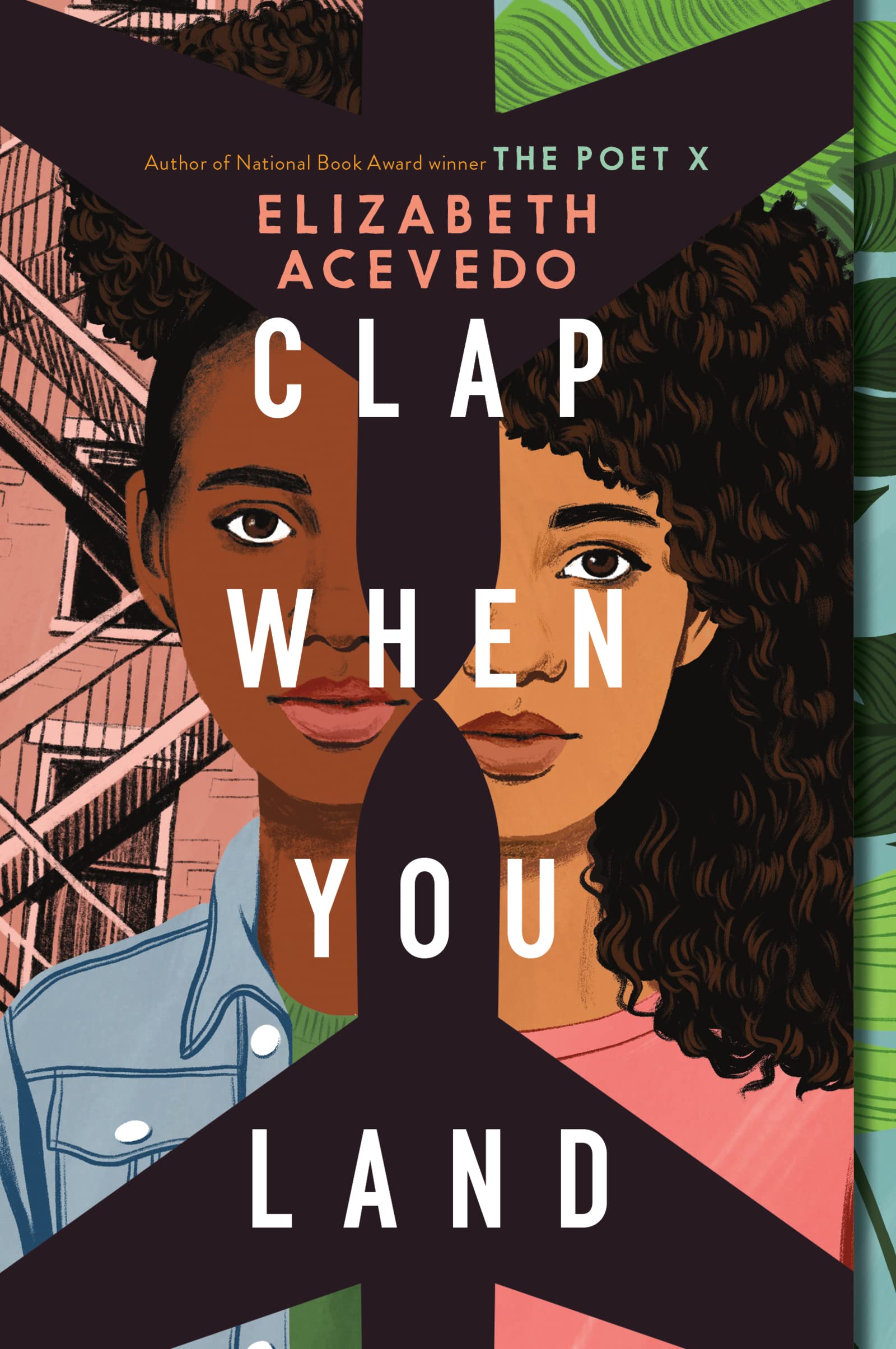
Clap When You Land is a novel in verse, in two alternating perspectives. Camino lives in a village in the Dominican Republic with her Tía, who has raised her since her mother died some years ago. Her father lives in New York, and comes to stay each summer for several months. Camino loves her father, and feels loved in return; he supports her and her Tía better than they could afford to do on their own, with the small funds raised by Tía’s doctoring duties. She’s a healer and midwife, skilled with herbs and prayer, and Camino wants to follow in her footsteps, but take it a step further: her dream is to study medicine at Columbia University. Meanwhile, Yahaira lives in New York City with her parents. She’s a former chess champion, but she’s given it up, which has put a rift between her and her father. The two girls are just two months apart in age, approaching 17. They have the same father, but they don’t know it until after he is killed in a plane crash, traveling from his home with Yahaira to spend the summer in the DR, as he does every year.

In their alternating chapters, we see two teenaged girls wrestle, first, with their futures: Camino is concerned about where to go with her life if her father doesn’t help her get to the States. Her options in the DR are few, and there is a predatory young man after her. Yahaira is upset because she’s discovered that her father had a secret – although it’s not the big one she’s about to learn, that she has a sister. Each girl has a best friend: Camino’s is about to give birth, and Yahaira’s is also her partner. We see them both struck by the loss of a father that each loved and admired. And then we see them hit by another shock: they’ve lost a father, but each has gained a sister. What will they do with that knowledge?

I like the questions raised by the twinning of the two girls, what each might have been under different circumstances, what is conveyed by certain advantages. (Camino’s household is better off than most in her village, but still much poorer than Yahaira’s unremarkable middle-class home in Morningside Heights.) At its heart, this is a story about family love, grief, and forgiveness. It’s lovely told in simple verse: easy to read but also contemplatively paced, dealing as much with emotions as events. As a YA novel, I think it would be well suited to thinking about loss for young people, or for any of us.

Papi’s two families, and his keeping the girls in the dark about each other’s very existence, isn’t much dealt with: the character is dead before we meet him, so we only see him in their memories, and he never gets to justify his choices. That’s rather more complicated.

Another thread involves the crashed airplane, which is based on the real American Airlines flight 587. Both the fictional and the real flights left New York headed for the DR filled with Dominican-Americans; the Dominican community in New York was badly shaken by its loss, and that’s a large part of what inspired Acevedo to write this novel (as described in her Author’s Note). That community-wide impact is well described here, which I think is a service.

Sad, thought-provoking, but also a beautiful honoring of a community.


Rating: 7 bachata songs.

Nine Liars by Maureen Johnson

The fifth Stevie Bell novel, and the last to date, although I saw that Johnson is writing more.

Stevie’s back at Ellingham, with most of her friends: Janelle, Vi and Nate are there as well, hard at work on their college applications, while David is away at school in London. Stevie is struggling: she lacks focus except when hyperfocused on a case, and right now there’s no case. “[Hers] was a good brain, but it had only two modes–fog and frenzy.” She’s not functioning well at ‘just’ going to school; she pines for David, and she’s unmotivated. She can’t wrap her head around the college stuff at all. (I begin to think that there’s something diagnosable about Stevie, between her unfocused/hyperfocused poles and her difficulties with social cues, but that’s not my job and she’s fictional. That’s Johnson’s job.) To save the day, a drunken late night call from David sets up a trip for Stevie and her friends to visit London: ostensibly for a little study abroad but mainly, obviously, for the couple.

There’s a cold case – Stevie’s specialty. It involves nine friends who called themselves ‘the Nine’ when they were college students back in the 1990s, and they are obviously counterparts to Stevie and her crew in some respects. There is also Stevie’s evolving relationship with David, her troubles relating to other humans in general, her detective mastermindedness, and everyone’s anxiety about college applications.

I had some frustrations about this novel. I’m disappointed in Stevie, and in David, and frankly, in Johnson as well. [Mild spoilers follow.] In this installment, Stevie makes a big error in her friendship with – well, with all of them, but particularly with Janelle. It is in line and in theme with the title, and the themes of the case she’s working on (which she points out to us herself, in case we’d missed it): the friend group who’ve experienced the murders (two in an old cold case and one present-day missing) are guilty of lying, and so is Stevie. Her crime against Janelle feels so serious to me, and I’m dreading Janelle busting her because I know Stevie’s life is going to change so profoundly when that friendship takes the blow. And then it just fizzles out, like, oh, everything is fine. I feel that Stevie doesn’t suffer consequences appropriate to her misstep. I was dreading the consequence; but when she gets to skip it, I feel that the author has let us down. I feel it was out of character for Janelle to respond the way she did.

And then comes David’s big bonehead move at the end. I guess it’s not entirely out of character, nor out of character for dumb teenagers. But I feel the let-down pretty hard. This one is less about inconsistency, at least, and more about my frustration with the character himself. My bigger gripe here (especially after it’s been a few days) is about the cliffhanger she’s left us on! (I think it was book two that also ended on a big one. But I was already holding book three! And book six doesn’t even exist yet!)

If anything, my frustrations are because I feel so much love for this series, so all is not lost yet. But I am now anxious for the next book in more ways than one.


Rating: 6 and a half slices of doner kebab.

Juno Loves Legs by Karl Geary

In this bittersweet coming-of-age story, scrappy childhood friends from Dublin’s outskirts grow tenuously into young adults with only one another for support.

Juno Loves Legs is a sensitive, scarred coming-of-age story by Karl Geary (Montpelier Parade) set in a troubled housing estate and nearby Dublin in the 1980s. Amid poverty, a harsh and judgmental Catholicism, family dysfunction and personal torment, preteens Juno and Seán form an unlikely but sturdy friendship that will carry them through trauma and violence and–if they’re lucky–into a wider, freer life.

Juno’s harried mother takes in sewing alterations for the neighbors, who look down on her family’s poverty and cheat her out of her meager pay. Her father drinks his days away. “Mam shouted up at him; he shouted down at her. They were two mouths and I was their ear.” Her older sister is absent following her own particularly awful childhood. Catholic school is a trial for a girl as headstrong and underprivileged as Juno. “We were beaten. A sour-smelling odour emerged from Father before he was done. And even Sister’s hands were crimson.” Then she meets Seán, who is shockingly clean but whose home life is equally, if differently, disturbed. For his awkward height she dubs him Legs, and they form an alliance, until an extraordinary act of violence tears everything apart. Years later in Dublin, with new troubles, the young adult versions of these childhood friends attempt a beautiful, possibly doomed, second start.

Juno’s first-person voice is angry, indignant, righteous, both jaded and pitifully innocent: at 12 she sets out to save the family by calling in the small debts owed her mother by their neighbors, but in her temper botches the job. She blusters to hide her vulnerability, where Legs leaves his tender side open and allows the blows to land. Not only the world at large–strangers, predatory adults, a grimly punishing Catholic church, the big city–but their own families are hopelessly cruel to these misfit children: Juno for her poverty, Legs for his sexuality. (A kind librarian provides an appealing single point of light.) They are stronger together, and their bond is artless, crude and true. This is in part a story about the families we build for ourselves: an ode to friendship in which the friends may still not survive. Geary’s young protagonists will face shocking pains before the ending, which glimmers with a touch of hope.

Juno Loves Legs is tender and heartbreaking. Young friendship takes on all the world’s challenges–love, art, family, the simple and overwhelming task of survival–with tragic, poignant results. Readers will find Juno’s bravado and Legs’s persistent sweetness unforgettable.


This review originally ran in the March 23, 2023 issue of Shelf Awareness for the Book Trade. To subscribe, click here.


Rating: 7 small debts.

The Box in the Woods by Maureen Johnson

The Stevie Bell series continues, but we’ve left Ellingham behind, Stevie having solved the Truly Devious murders (although the world only knows a bit of that story). At this novel’s start, she’s puttering around at home with her parents, selling deli meats and cheeses at the grocery store and cleaning up the salad bar by night. Then she gets an invitation to really go to work: as far as her parents know, she’ll be a counselor at Camp Sunny Pines, but she’s really there to investigate the Box in the Woods murders of 1978, from back when this was Camp Wonder Falls. The tech-bro who’s hired her says he’ll employ her friends, too, which means Nate and Janelle, because David is enjoying his voter registration work in a different (and I’m pretty sure unnamed) part of the country. Stevie’s a bit disappointed, but she respects his mission.

Camp Sunny Pines is an amusing setting. Massachusetts is warm and muggy in the summertime, and Stevie is more cerebral than outdoorsy. She buys into the idea of rugged go-everywhere detectiveship in theory, but she quickly runs out of signature black t-shirts because she has to change them so often – these are sweaty environs, and she’s also doing far more running and biking than she’d like. It’s kind of fun to see her challenged in these ways. Her tech-bro boss does not have a good bedside manner for engaging with the community; Stevie is better at this, but less adept with her personal relationships, and one in particular: David (now her actual boyfriend) finds a reason to come out after all, but Stevie’s responsibilities and preoccupation with the case mean she doesn’t engage all that well with him. He does some driving her around, and tries to have an important conversation, but she’s too checked out. In contrast to what I said about the last few books, I felt sorry for David, who tries to be a good boyfriend and friend, while Stevie’s a bit awkward and inattentive.

I remain baffled by her friendships: Janelle, the purported best friend, is totally rad but much less a day-to-day ride-or-die joined-at-the-hip BFF than Nate, who I feel doesn’t get enough credit.

One of the things that made Nate and Stevie such good friends was their mutual hatred of sharing emotional things. Somehow, they managed to have a deeper bond by staying on the surface–as if they were snorkeling their feelings, floating along side by side, observing all of nature’s wonders without getting close enough to be stung by something under a rock.

That Janelle gets the best friend label is a feature of Johnson’s writing that just confuses me.

But I still love Stevie herself, even in her bumbling. There was, again, a passage that I hold onto as emblematic of her loveable personality. She’s preparing to meet David, and considers fixing herself up a bit, and then just kind of gives up – I love this facet of her, that she’s aware she’s not quite meeting an external social measure of so-called beauty but can’t bring herself to entirely care. (And David doesn’t. It’s fine.) I relate to this entirely.

The mystery is compelling, and I appreciate the final scene, even if the solution is a bit awkward too… I’m really here for Stevie’s clever mind, her interactions with other humans (for better and for worse), and her dear strangeness. I enjoy Johnson’s use of the classic feature wherein the detective just talks it out with her friends and acquaintances, and lets her mind drop things into place. I’m definitely excited about book five.


Rating: 7 crafts.

The Hand on the Wall by Maureen Johnson

On a day that I claimed to be overwhelmed with the student papers I had to grade, I also managed to wake up and immediately begin this book… and then stay up til midnight finishing its nearly 400 pages in the same day. I loved Truly Devious and was even more entranced by The Vanishing Stair, which annoyed me with a cliffhanger the night before and sent me directly into this one, book three. My main goal today is not to read a whole book by accident when I’m supposed to be working.

The Hand on the Wall is book three of three in the Truly Devious series – but the Stevie Bell series continues for two more books, a bit confusingly. The Truly Devious murders themselves (aka the crime of the century, the murder/kidnapping at Ellingham Academy in the 1930s) are wrapped up in this book, but newly minted detective hero Stevie apparently continues on. (I haven’t read book four yet! I’m staying strong.) This installment sees the advancing of Stevie’s investigations and her modest decline in terms of personal hygiene and nutrition; the beginning of real fears for her personal safety and/or that Ellingham may indeed be cursed; the continuing friendship and alliance with Security Larry (this is a relationship I have really enjoyed in two books now); and the bumpy evolution of Stevie’s match with the troubled David. I said in my last review that getting to know him a bit better would yield more sympathies, and we do get that here. I still find him a bit obnoxious and don’t appreciate his treatment of Stevie, but they’re making progress.

Stevie grows in her relationships with others. A bit weirdly, the amazing Janelle continues to be identified as Stevie’s best friend, but our hero actually spends more time talking with and confides more in Nate, a hilariously Eeyore-like blocked writer. Janelle is a great friend, but involved in her own love match (that’s going more smoothly than Stevie’s), and it’s actually Nate who ends up fulfilling a day-to-day best-friends role. We have a new friend as well, Mudge, who is loveable if a bit of a cariaciture: he’s here to exhibit exactly how drolly eccentric Ellingham students can be.

Mudge was Stevie Bell’s lab partner–a six-foot-something death-metalhead who wore purple-colored contacts with snake pupils and a black hoodie weighed down with fifty Disney pins, including some very rare ones that he would show off and explain to Stevie as they dissected cows’ eyes and other terrible things for the purposes of education. Mudge loved Disney more than anyone Stevie had ever met and had dreams of being an animatronic Imagineer. Ellingham Academy was the kind of place where Mudges were welcomed and understood.

Security Larry, mentioned above, is a former police detective and becomes a mentor to Stevie in her own work, both cautioning and trying to enforce the rules upon her and gradually, increasingly, viewing her as a peer. He’s great. Several other faculty members develop as well. I very much related to poor Dr. Quinn trying to convince her students to do the readings before class.

I love Stevie more and more. She “would rather eat bees than share her tender inner being with anyone else–she didn’t even want to share it with herself.” She undergoes an actual epiphany (pages 108-109) when she realizes that her weird, awkward self is just a perfectly fine version of a human, and that her own unique combination of qualities is precisely what’s gotten her where she is in life; this is a passage I would like to share with everyone I know, but especially young people and especially girls just making their way and finding themselves. I would follow this protagonist anywhere.

As befits the final book in a trilogy, this one ends on a note of triumph, closure, and hope – perhaps a bit neatly tied up, in fact, but I know there’s another Stevie Bell book to follow. Again, for the sake of my sleep I’m taking a day or two off, but expect more any time now. Maureen Johnson is my new favorite. Thanks again, Liz.


Rating: 9 moose.

The Vanishing Stair by Maureen Johnson

Book two of the Truly Devious series flew by. I stayed up late to finish this one and it ended on a serious cliffhanger, so look for my review of book three to follow this one immediately.

At the close of Truly Devious (for which there are mild-to-moderate spoilers here), The Vanishing Stair opens with Stevie glumly returned home to her parents’ house and her public high school. The gamechanger comes quickly in the form of the despicable Senator Edward King, her parents’ hero and employer and (surprise) the father of her love interest from Ellingham Academy. King has arranged everything for Stevie to return to Ellingham – funding the trip, heightening security following a student’s mysterious death, and convincing her parents of her safety. He wants Stevie, in return, to keep an eye on his wayward son David, with whom Stevie’s not on particularly good terms anyway. She’s thrilled to be back at the school where she feels stimulated: with her friends Nate and Janelle again, working on her life’s greatest passion, the solving of the 1930s Ellingham murders, and yea, David. Quickly a second body is added to the modern Ellingham count. Stevie gains a new advisor, an eccentric academic from the local (Burlington, Vermont) university with a drinking problem and a very nice nephew. David’s moods and attitude toward Stevie continue to swing wildly, hot to cold to nuclear.

The best thing about these books is Stevie herself. She’s socially awkward but mostly doesn’t care; she’s occasionally bothered by her inability to fit in back in the ‘normal’ world (of which Ellingham is not part), but only when she remembers. Despite sometimes showing signs of a standard teenager’s low self-esteem, she generally carries on as herself, unbothered. I like her. She’s an extremely focused detective – perhaps to the point of mild self-neglect, but that’s part of a long tradition of detective types in fiction (a fact she’s aware of). Johnson’s prose is downright funny: after camping out overnight in the school’s yoga studio, Stevie “felt a waffle pattern of yoga blanket on the right side of her face and the faint smell of lavender and patchouli permeating her being. It was like she had been run over by a boulder made of hippies.” Our young hero can be a little bumbling and dense – just like a teenager, no matter how smart. I have a little less patience for David’s antics, perhaps in part because he’s a rich boy? but mostly, I think, because we don’t have the close third person window into his interior self that we have into Stevie’s. He’s a suffering kid, too, and I think if we got inside his head it would be just as sympathetic as hers.

The mystery plot remains compelling: this book focuses in on the riddle that Albert Ellingham left behind on his final day, which the title of this book nods to. We’re learning things, about the historic murders as well as the modern suspicious deaths, but not the big final thing we want to know. Again: this one ends on a mad cliffhanger; I was actually a little peeved, and even more relieved that I already had book three ready and waiting. I recommend you do the same.

Liz was (as ever) 100% correct about this one. I’m pretty sure she said she ripped through the whole series, as I am clearly going to do as well.

These books are recognizably YA in a few ways: teenaged protagonists, a gentle handling of gore, violence, and sexual content, and humor. But the plotting is not too simplified for adult readers to enjoy, and a strong female lead who is still in her teens appeals to this reader at any age. I’m a fan.


Rating: 8 cats.