The White Hot by Quiara Alegría Hudes

Delightful, unpredictable, and often harrowing, this mother-daughter tale of growing and learning will keep any reader riveted.

With The White Hot, Quiara Alegría Hudes (My Broken Language; Pulitzer Prize-winner for the play Water by the Spoonful) offers an expansive, surprising coming-of-age story about both a mother and a daughter. The novel opens on Noelle’s 18th birthday, when she receives an envelope. “It wasn’t the handwriting that dinged memory’s bell so much as the pen’s feral indentations.” Since she was 10, when her mother disappeared, Noelle has lived with her father, stepmother, and two half-brothers in New Jersey. Readers have just met the teenager when the voice shifts. “Dear Noelle… I am not going to send this,” the letter begins. What at first masquerades as an interlude quickly takes over the book. Breathlessly, alongside Noelle, readers take in April Soto’s story.

“That awful day began with your classroom art show.” At age 26, April is weary. Her 10-year-old daughter is precocious, an artistic and academic genius, and disturbingly observant of her mother’s shortcomings. Their household comprises four generations of Soto women: Abuela Omara (who emigrated from Puerto Rico), Mamá Suset, April, and Noelle, “not a speck of dust–or man–in sight.” April is undone by her child’s gimlet eye, her own unrealized potential, her lack of options, and daily drudgery, and in the wake of a scene at the dinner table, she simply walks away from their Philadelphia home.

What follows is an epic and astonishing journey of self-discovery. April muses on the influence of Hermann Hesse, Charles Mingus, sex as revelation, violences witnessed and perpetrated; she undertakes a wilderness trek (profoundly unprepared in sandals and sequins), and experiences painful, blissful realizations via blisters and hunger. She tells her child she knows her leaving was a betrayal, but hopes she has also offered choice. By book’s end, the briefest return to Noelle’s own 20s presents a full-circle perspective of the parallels in these two lives, and the significant differences.

April’s narrative is astounding and vibrant. In her best and worst moments, she describes being cracked open, experiencing epiphanies: “She felt an un-looming, a separation into threads, some of which rose and drifted through nearby windows whose unseen inhabitants shimmered inside her, too.” These, as well as the mundane, yield stunning, lightning-bolt prose: “Within this deluge, the frog and the oak, the tuba and congregants were not discrete phenomena but native to each other, and I to them. That I of all creatures should be tapped for a glimpse? A bewilderment.” The White Hot is wide-ranging, thought-provoking, tender, and raw–unforgettable.


This review originally ran in the September 23, 2025 issue of Shelf Awareness for the Book Trade. To subscribe, click here.


Rating: 7 olives.

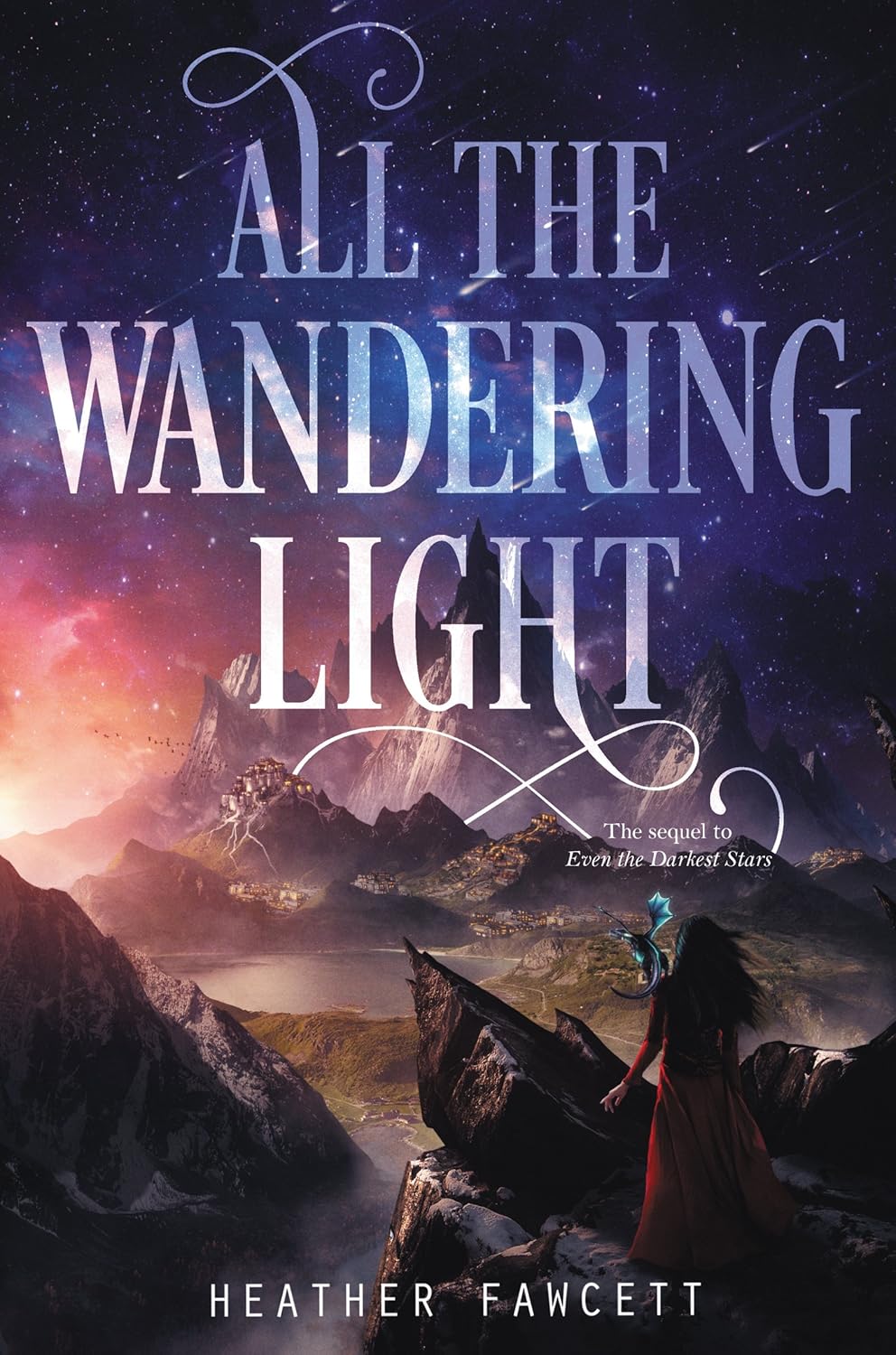
All the Wandering Light by Heather Fawcett

This one follows Even the Darkest Stars, with similar darkness, coming-of-age growth and learning and complication, and love. As is my usual practice, this review will contain spoilers for that previous book but not for this one.

So, on with the spoilers: at the end of book one, we had been hit with the shocking news that River himself was secretly a witch, and therefore obviously (to Kamzin and those of her world) a natural enemy. He has broken the binding spell that stole the witches’ power generations ago, and now their powers are restored, and the Empire is in danger. We learn quickly, though, that River is not so much motivated by wanting to overthrow or hurt anybody; rather, he wanted the freedom of possessing the powers he was born to. He wants to be himself. But by releasing all witches, he has enabled those who have crueler goals than he does, including revenge. His brother Esha intends to be the next emperor of the witches, and desires power enough to destroy the humans’ Empire, including Kamzin and everyone she loves.

In similar fashion to book one, a race is on, this time to get to a fallen star that is said to offer unimaginable power to whomever wields it: the human Emperor or the witch one. Kamzin travels with her friend Tem, her sister Lusha (and the two sisters offer nearly infinite messy siblinghood), and for part of the way, Mara, who was once a member of River’s crew. In the other camp, River reluctantly, even half-heartedly, helps his brothers. The plot of the book follows these two groups, centered on our protagonist, Kamzin–angry and hurt at her betrayal by the magnetic River, who had been a bit of a romantic interest–and her counterpart, River himself, who is likewise confused at the way the world reshapes around him and the power struggles that involve him even without interesting him much. This conflict will build to affect (again) the very fate of the world, and hinge upon the ability of the humans, in particular, to reconsider old prejudices.

Along the way, the part of this book that I struggled most with was the detail in some of the fighting or conflict scenes. Maybe it’s just this reader, for whom the fighting (in its minutia) will never be the most interesting part of the story. But especially with the ethereal, ghostly sort of enemy (and other only-halfway-there monsters), the shadowplay violence is a bit abstract, and doesn’t hold my attention well enough to sustain the way some of those scenes dragged on. I got a bit impatient. I think where Fawcett excels is, yes, worldbuilding, but most of all relationships: the way people (or witches, or stars!) interact and communicate and treat each other. And/or, this is where I’m most engaged with any story. There was lots to love here, just a little that I wished moved a bit more quickly. It’s worth noting that the two books in this duology were Fawcett’s first two. It’s clear to me that she’s improved from here.

I have just two more middle grade books of hers to read and then we have to wait for her to write more. Fawcett remains one of my favorite authors of the last year or two, so I hope she’s hard at work!


Rating: 7 beautiful ball gowns (what?!).

A Galaxy of Whales by Heather Fawcett

I needed this little break in between heavier reads, and I love knowing I can turn to Heather Fawcett to scratch that itch. A Galaxy of Whales is offered for readers ages 8-12, and features 11-year-old Fern, who is having a difficult summer. Her best friend Ivy has been pulling away from her, spending more time with other friends. Her family’s business, Worthwhale Tours, is in some trouble. Their main rivals, Whale of Fortune, are also their next-door neighbors, the Roys; and 11-year-old Jasper Roy is especially annoying to Fern. Her one-year-older brother Hamish is always buried in a Space Dragons book – also annoying. Worst of all, Fern still misses her father. “Maybe if your dad had died three years and two months ago, you shouldn’t be sad enough to cry anymore.” She’s not sure.

Then she learns about the youth wildlife photography contest. It’s perfect: if she wins, her photo will be on the front page of the paper. It might be enough to win Ivy back. The prize money could help the family business. She could defeat Jasper, who wants to enter the contest as well, despite not being into photography at all. And photography is absolutely Fern’s thing – the thing she shared with her father, whose camera and gear she takes with her everywhere, who taught her everything she knows. She has to win.

Just off Fern’s little Pacific Northwest town of Goose Beach, on the Salish Sea, there is a famed pod of endangered killer whales that she knows is just the right subject for her award-winning shot. But they’re hard to track, and time is running out. Fern tries to work together with Ivy, who is clearly not all that interested. She tries to work with Hamish, who is decidedly indoorsy, not a natural wildlife photography assistant. Finally, she resorts to working with Jasper, the enemy – unless he’s becoming her new best friend.

In this momentous summer between fifth and sixth grades, Fern learns a lot about family, friendship, whales, astronomy, and how to continue to navigate grief. A Galaxy of Whales offers these lessons organically and sweetly, in just the sort of package I was looking for: wholesome and loving.


Rating: 8 ice cream sandwiches.

Most Ardently: A Pride & Prejudice Remix by Gabe Cole Novoa

I wasted no time after Into the Bright Open in getting into the next remix. Here, Pride and Prejudice retains its setting in time and place and the essentials of characters, with one great exception: the individual we know in the original as Elizabeth Bennet is here a trans boy named Oliver. Only a few people know his truth: his older sister Jane, his aunt and uncle, and two dear friends, Charlotte and Lu, who are, secretly, a same-sex couple and not the close friends their community believes them to be. He has arranged a workable system for going out as himself, sometimes climbing out the bedroom he shares with Jane at night in clothes stored under his bed, and sometimes going to Charlotte’s to change into clothes she keeps there for him. When he meets Darcy for the first time, he finds him handsome, but is repelled by his poor social graces and Darcy’s obvious disdain for the young person presented as Elizabeth.

Gabe Cole Novoa opens this novel with a note acknowledging that Oliver is frequently misgendered, and his deadname used, by his community and his own family, “though never by the narrative.” Novoa observes that this will be painful for some readers, and gives them fair warning: the author has done his best to handle the issues with sensitivity, but the book centers in some ways around Oliver’s dysphoria. As a reader who does not share this experience, I can only say that I thought Oliver’s dysphoria, misgendering, and seeking against convention for his authentic self were represented with nuance and grace, and accurately as far as I can see from here. Indeed, I thought the portrayal was of a sort to help other cis people like myself empathize with something we haven’t experienced for ourselves, in the best ways, which is some of the best work fiction can do for us.

Beyond that good work, Most Ardently is as sweet and transporting a love story (and a mess of misunderstandings) as the original it’s based on. Oliver presenting as ‘Elizabeth’ versus himself, to the same groups of people – and most importantly Darcy – offers some Shakespearean scenes of confusion, although these are less comedic because the Elizabeth character is a painful lie Oliver is forced to tell. There is one scene when Darcy laughs and laughs at an ironic turn that I do find nicely funny. And there is a parallel to the expected happy ending that is so oh satisfying – perhaps more so for its unlikeliness. (Novoa includes a historical note speculating on trans people who have ‘passed’ undetected in history. By definition, these are unknown to us. Novoa takes a hopeful stance.) I found the whole result sweet, entertaining, sympathetic, and wholly rewarding in the end. This was an easy and fulfilling read, and I’m ready for more in the series. I’m so glad this book is in the world.


Rating: 7 pairs of trousers.

Into the Bright Open: A Secret Garden Remix by Cherie Dimaline

I stumbled into this book because I was following Cherie Dimaline (VenCo), but am glad to have discovered the “Remixed Classics” series from Square Fish, in which “authors from marginalized backgrounds reinterpret classic works through their own cultural lens.” I’m looking into a few of those, including Clash of Steel (Treasure Island), So Many Beginnings (Little Women), and Most Ardently (Pride and Prejudice). I love a daisy chain like this.

Into the Bright Open retells Frances Hodgson Burnett’s The Secret Garden, but in 1901 Ontario. Mary Craven is the unpleasant, lonely, spoiled-and-simultaneously-neglected child of a wealthy, important couple in Toronto, raised mostly by a nanny she does not like who does not like her, when her parents are killed in a car crash and she is shipped off to the Georgian Bay to live with an uncle she’s never met. He is not present when she arrives; she is greeted instead by household staff who treat her with more familiarity than she finds appropriate, but she quickly rethinks her stance as she finds them also warm, even friendly. Her uncle’s estate is grand, but by Mary’s standards, wild. Gardens border upon woods, and the ocean is an untamed thing. Native people and “half-breeds” initially offend her snobbish sensibilities, but Mary is just fifteen: young enough, and lonely enough, to change her mind. This version of Mary struck me as more introspective and more capable of self-criticism than I remember the original Mary Lennox to be. It also got me thinking: while readers are certainly accustomed to accepting flawed and imperfect protagonists, Mary Lennox might be an unusually unlikeable one. This Mary Craven, though: she definitely does unlikeable things, but with the benefit of access to her thoughts & feelings (this is told in a close third person), I find her quite sympathetic. She’s learning. She’s growing.

So. At the uncle’s house, Mary of course discovers the expected (if you know the original): the secret garden, and the secret child, a new friend for the friendless orphan girl, hidden away. There is a neighborhood friend as well, here a girl with wondrous comfort, confidence, and skills in the outdoors. There are further parallels to the original novel, but also a sinister twist.

This version, though set at the same point in history, feels more modern in its perspective, and I suspect would feel a bit more accessible to the modern young reader. I’m excited about the “Remix” series, and still excited by Dimaline.


Rating: 7 lines of poetry.

The School Between Winter and Fairyland by Heather Fawcett

Can’t get enough Heather Fawcett; I’m powering through her books for younger readers. This is offered to ages 8-12. Autumn Malog is twelve years old when we meet her. She serves as a beastkeeper for the Inglenook School for young magicians, as the Malogs always have. It is a humble role, and she’s a little wistful for the magicians’ cloaks and privileges and learning, but you can’t change what you come from. And anyway, she’s far more concerned about her twin brother, Winter, who has been missing for nearly a year now, presumed dead by everyone but Autumn. She has always been able to feel Winter and his whereabouts; she can’t tell where he is now, but she is sure that he still is. “Nobody believed her, and she couldn’t really blame them. It sounded far-fetched even to her. So, rather than trying to convince anyone, she set about gathering evidence.” Autumn is no-nonsense like that. Better to get it done than to muck about. She is burdened with three useless older brothers, and the family is rounded out by Gran, even more no-nonsense than Autumn, unsentimental, but gifted in her care of the monsters that the family keeps safe and healthy for Inglenook.

Then Autumn encounters Cai Morrigan, one of Inglenook’s most famous students ever. Just twelve years old, he is prophesied to save their kingdom from the Hollow Dragon. But he is less impressive up close than his reputation would have it; and he shares with Autumn his great secret: he is terrified of dragons, to the point of fainting within dozens of yards of them. He asks for her help, and Autumn in turn asks him to help her find Winter. These two quests will bond the two young people, and offer bigger, more existential challenges than either anticipates.

I love this wholesome story about toughness, finding one’s tribe, and when to accept and when to push back against the limitations life proposes. It is also about friendship as well as familial love. And fanciful monsters, and plucky heroes, and the call of the forest. All good things, compellingly told. I will continue to live in Fawcett worlds as long as she creates them.


Rating: 7 slices of seabread.

rerun: Gone to the Woods: Surviving a Lost Childhood by Gary Paulsen

I still think about this book and should find time for a reread. In case you missed it, please check on Gary Paulsen and his wonders (and traumas).

I had not thought of Gary Paulsen in years, until I saw the Shelf Awareness review of this new book. (Hat tip to my colleague Jen Forbus for that review.) Paulsen might have been the first author I really fixated on; I remember setting out to own all his books, and while I didn’t get very far (maybe six or eight of them), I’m pretty sure I wrote “Julie’s Gary Paulsen library” or some such inside the cover of each one, and had them set up on their own little shelf. Early signs of something, there. My favorite was Hatchet, of course, and its sequel; and I vividly remember a scene from the beginning of another book where the narrator watches a… chipmunk? eating another creature, blood down its front… what book was that?

Anyway – when I saw that he’s returned with a memoir of his own childhood, I was sold. And let me tell you. This book had me entranced from the opening lines. I wept.

Gone to the Woods has an innocence and a simplicity built into its writing style and the value system, I think, of its narrator. This makes it accessible to younger readers, but not at all to them alone. I think this is a memoir for everyone. Paulsen tells his story in the third person, calling his protagonist only ‘the boy,’ although the name ‘Gary’ is used once or twice by other characters. This helps to give the boy an elemental quality, like he’s sort of an archetypal boy, although his story is very specific. When the book opens, he is five years old, living in Chicago with his mother in 1944. She has a factory job, and coming from a small farm in northern Minnesota, is “not even remotely prepared to resist the temptations of the big city.” She lives in the bars and does not parent her small son, who she’s trained to perform for the men who try to win her favor. Grandmother hears of this lifestyle and is “critical, then concerned, and finally… past horrified and well into scandalized.” Her solution colors the boy’s method of problem-solving for life: “If it doesn’t work Here, go over There.”

The first adventure of the book, then, is the five-year-old boy’s solo journey by train from Chicago to International Falls, Minnesota. This takes several days and involves a train absolutely jam-packed with severely injured soldiers, smelling of and oozing pain and death, so that the boy is physically ill from it all – because didn’t I say, his father, who he’s never met, is a soldier off in the war. The boy becomes stuck in a train toilet, among other things, and observes out the train window the woods that will become his sanctuary. By the time he arrives at his aunt and uncle’s farm he is wrung out with exhaustion, trauma, and confusion. But the farm will be a perfect place for him, the first place he feels he belongs, is valued, is taught. He’s given his own room and bed. It’s lovely. Then it’s taken away from him.

I’ll stop summarizing here. The boy’s upbringing is one trauma after another, including a few years on the streets of American-occupied Manila, and a continuing absence of parental concern. I appreciate that the narrator is slow to judge his parents, and I think it would have been easy (narratively speaking) to be ugly about the mother’s drinking and many boyfriends, for example, but neither the young boy nor the adult man who writes these lines takes that easy road. (At least until the teenager’s perspective, at which point he thinks of both parents as vipers. But this is about the damage they do to him, rather than some puritanical judgment of mom’s moral choices.) He is an unjudgmental creature in general. Paulsen is wonderfully good at the innocent child’s perspective, elements of which are present in the teenager too.

Trauma after trauma, but with a few bright points, like the aunt and uncle in the Minnesota woods, and a saintly librarian when he is thirteen years old who makes him a gift of notebook and pencil, for whom this book might be considered a gift in return. And the woods and rivers and streams, which are always a bright point. From age five, the boy learns that the woods will allow him to take care of himself, even when he lives in a city again, keeping to the alleys and nights to avoid bullies, and escaping to the stream where he can fish for food or shoot squirrels and rabbits when his parents fail to provide for him. Even in Manila, a city of a certain sort of trauma (truly, the violence and death this child witnesses by his sixth birthday is unfathomable), he finds beauty and human kindness.

At times the events were hard for me to take in, and I wondered if younger readers were really the right audience for this. But on reflection, I think Paulsen offers just enough. I think children might take away what they need from this book – I’m no proponent of censoring life’s pains from kids – and it’s the adult mind and perspective that makes it even harder to read, if that makes sense.

The story is harrowing but also lovely, always riveting, and an important testimonial from a generation that we will eventually lose access to. It is excruciatingly beautiful in how it’s told. The immediacy of traveling with the boy is heart-rending and direct. I can’t imagine how this book could be improved upon.


Rating: 10 willow branches.

Even the Darkest Stars by Heather Fawcett

I just went ahead and followed Ember and the Ice Dragons with another Fawcett book for younger readers. This one is a bit darker than that; I see that Ember is catagorized as middle-grade where this one is young adult, for what that’s worth.

Even the Darkest Stars is set in a magical-world version of the Himalayas, with yaks and butter tea and very high, very cold mountain climbing. But a parallel world to our own, in which an emperor rules over a huge region, keeping everyone safe from the witches of a bygone time. Our protagonist is Kamzin, a teenaged girl in the village of Azmiri, which is far from the emperor’s Three Cities. Her father is the village Elder; her mother was a great explorer in service to the emperor, but she’s been dead for years. Her older sister Lusha will be the next Elder. She studies astrology. As the younger daughter, Kamzin’s fate is to be the village’s next shaman. She is apprenticed to the current shaman, but is a poor student. Instead, Kamzin has always felt a strong pull to travel, to climb, to run, to map, to explore. When the emperor’s Royal Explorer, the famous River Shara, comes to the backwater of Azmiri, Kamzin knows she must stop at nothing to become a part of whatever has brought him here.

And after some brief intrigue and machinations, we wind up with a race. Lusha, the obnoxious older sister, takes to the road with one of River’s own retinue, aiming to beat the Royal Explorer himself to the top of Raksha – the highest mountain in the world, never climbed by a human, which defeated even Kamzin and Lusha’s late mother. Kamzin succeeds in joining up with the great River Shara, a handsome young man – younger than she’d expected – whom she finds bewitching. Also in their small party is Kamzin’s best friend, Tem, a far more accomplished (though untrained) shaman. And a stowaway: Kamzin’s familiar is a fox (or foxlike critter) named Ragtooth. They share a close bond but also he is apt to bite her. Oh and there are dragons: they are more tangential here than in the last book, but your standard ‘house dragon’ will eat just about anything remotely edible and in response, their bellies put out light. So an alternative to a lantern is to feed your scraps to a dragon. Part pet, part appliance, sometimes a nuisance. It’s quite fun. There’s a lot that is fun in this imaginative world… but also, Kamzin’s world and everyone she loves is in grave danger. It takes a while for the true nature of River’s quest to Raksha to be revealed, but once it is, the stakes couldn’t be higher.

This is a compelling story, populated by mystery, magic, fun creatures, breathtaking landscapes, true friendship, the germ of romance, and a tortured coming-of-age made harder by the possible end of the world. There is also great adventure, death-defying climbs, races for fun and for life-or-death… bit of a Princess Bride list there. My favorite part is that it ends with a clear nod to a sequel, which I’ll have my hands on in a day or so. But yes, also darker than Ember. More bad things happen here, and more is at stake. I may not hand it off to the thirteen-year-old yet. But I am so in for book two.


Rating: 7 sour apples.

A Sharp Endless Need by Marisa Crane

This poignant coming-of-age novel combines outstanding sports writing and heartfelt expression of the teen experience, set to small-town Pennsylvania basketball.

Marisa (Mac) Crane’s second novel, A Sharp Endless Need, is a propulsive, perfectly crafted coming-of-age story centered on basketball and queer sexuality. With razor-honed prose, Crane (I Keep My Exoskeletons to Myself) offers authentic descriptions of teen angst and young love as well as exemplary sports writing, and a few memorable sex scenes.

Crane’s protagonist, Mack, is a star point guard and the only one at her small-town Pennsylvania high school who is Division-I bound. Between her junior and senior seasons, her beloved but troubled father dies, and on the heels of this trauma, a new girl transfers to the team: Liv is being scouted by the same schools as Mack, and the two are instantly inseparable. Their on-court chemistry is transcendent; off-court, they share good times but are also nearly immobilized by a desire that both are at great pains to conceal. Mack’s senior year is marked by larger-than-average difficulties: grieving her father, struggling with her distant, disengaged mother, playing hard with drugs and alcohol, and grappling with a sexuality that feels firmly forbidden in her community. The basketball scholarship she’s headed for feels imperative. Her mother sees it as a financial necessity; Mack knows it’s bigger than that. “I needed a future that was all basketball all the time because it was the only future I could imagine for myself. Basketball, I knew, was the only thing keeping me alive.”

Mack’s first-person voice is written from a distance of some years, a voice of wisdom looking back on her high school days. This perspective is one of the novel’s strengths. It is the older, wiser Mack who observes that another player “didn’t notice or appreciate the poetry of her pump fakes–she simply used them for their designated purpose. I guess what I mean is there was no romance.”

Anyone who’s ever been a teenager will relate to Mack’s broader struggles with self-destructive behaviors, desires, and pain. Her particular challenges involve a devotion to craft and the one-and-only ticket out that basketball represents. “Everything outside of that stadium, our problems, our anxieties, our fears, could wait; nothing else mattered but this last play.” The best sports writing evokes not only movement, sensory detail, and skill, but passion, and Crane has a firm grasp on these facets. As Mack’s final season nears its close, her relationship with Liv, her college decision, and more hinge upon a handful of choices and impactful moments. A Sharp Endless Need is unforgettable.


This review originally ran in the April 14, 2025 issue of Shelf Awareness for the Book Trade. To subscribe, click here.


Rating: 8 photographs.

Girls with Long Shadows by Tennessee Hill

Identical triplet girls are linked to tragedies across generations in this evocative first novel set along the swampy Texas Gulf Coast.

Tennessee Hill’s first novel, Girls with Long Shadows, is a dreamy, atmospheric tale of sisterhood and coming-of-age in the fictional town of Longshadow, on the Texas Gulf Coast. Nineteen-year-old triplets Baby A, Baby B, and Baby C were orphaned when their mother died in childbirth; their father’s identity remains a mystery. But they have always known family in the form of their loving but distant Gram (“Manatee” to the townsfolk, for her swimming prowess) and their adopted, nearly deaf younger brother, Gull. The whole town looks askance at the girls, spookily identical and associated with their mother’s early death. The family’s golf course, Bayou Bloom, provides respite, and the bayou itself (where Gram takes a daily swim, joined sometimes by one or more of the girls) offers a connection to nature, its fecundity and floods. Then one fateful summer, an act of violence, combining desire and objectification, ruptures the triplets, the family, and the town.

A tautly plotted Southern gothic, Girls with Long Shadows takes a distinctive perspective in Baby B’s elegiac narration. “That weekend something gurgled beneath, rattled us where we stood.” And: “Even before the worst of what that summer would bring was upon us, I began to mourn the girls we had been.” Baby B speaks as “we” as often as “I.” Only a few people other than themselves can tell the girls apart; even the boys they date may not make the effort. And intermittently the perspective shifts to a “Front Porch Chorus,” in which the town speaks collectively, observing the girls from without: “They’re a blur we never bothered to untangle.” This lack of distinction is both a wound for the triplets and an indelible part of their identity. They feel each other’s sensations and know that this is a boon. Without that link, they would be less themselves. In the eyes of the town, however, they are less human for being undifferentiated, more object or mirror. “All those boys touching all of us at the same time, hands on hands on bodies on hands. It wasn’t even that Pete was the one touching me, it was all of them, their inability to leave us be.”

Encompassing a single summer in the dripping, humid South, Hill’s haunting debut deals in lyricism and tragedy as it considers the harm done to young women by the outside gaze.


This review originally ran in the March 31, 2025 issue of Shelf Awareness for the Book Trade. To subscribe, click here.


Rating: 7 bikini tops.