Great Bear Wild: Dispatches from a Northern Rainforest by Ian McAllister

Beautiful photographs of the Great Bear Rainforest, at risk on the west coast of Canada.

great bear
Great Bear Wild: Dispatches from a Northern Rainforest is an impassioned plea for the conservation of the Great Bear Rainforest in British Columbia, photographed and written by Ian McAllister (“talk to anyone in the Great Bear about wildlife and eventually Ian’s name will come up,” writes Robert F. Kennedy, Jr., in the foreword). This distinctive coastal region is threatened by pipelines, oil tankers and liquefied-natural-gas transport; environmental groups and First Nation people are coming together in the fight to protect the enormous biodiversity, cultural heritage and immense beauty at stake.

McAllister, an accomplished photographer and longtime resident of the Great Bear, has local connections and a deep understanding of the issues at hand. Readers can flip through his work solely for the breathtaking photographs–of bat stars, spirit bears, sea wolves, salmon and many other remarkable creatures–but this accomplished collection also begs to be consumed chapter by chapter, for its ardent, beautifully written, informative prose.


This review originally ran in the November 28, 2014 gift issue of Shelf Awareness for Readers. To subscribe, click here, and you’ll receive two issues per week of book reviews and other bookish fun!


Rating: 9 herring eggs.

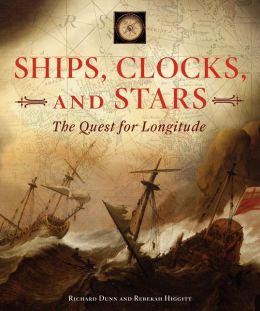
Ships, Clocks, and Stars: The Quest for Longitude by Richard Dunn and Rebekah Higgitt

The historic quest for naval navigation measurements, heavily illustrated and enlightening.

ships

For the tercentenary of Britain’s Longitude Act of 1714, the Royal Museums Greenwich offers an exhibition and accompanying book, Ships, Clocks, and Stars: The Quest for Longitude. For centuries, longitude, which locates a place on the Earth on an east-west basis, was impossible to track at sea, posing not only economic but safety challenges. This issue was eventually solved in the 1700s, largely by British scientists and philosophers, including astronomers, inventors and clockmakers. The story of quest for a solution–first define the question, then ascertain a reliable way to determine longitude while out in the open ocean, then build reliable and consistent tools–is one of innovation, cooperation and competition, as well as science. Richard Dunn and Rebekah Higgitt, both researchers and museum curators, relate the quest for longitude in accessible prose, complementing the text with more than 150 images, maps and artwork. While the ample notes will be welcomed by academic readers, the intriguing and varied illustrations and lively subject matter–a first-class adventure tale–will entertain anyone who dreams of travel and exploration.


This review originally ran in the November 28, 2014 gift issue of Shelf Awareness for Readers. To subscribe, click here, and you’ll receive two issues per week of book reviews and other bookish fun!


Rating: 6 degrees.

The Book of Jezebel: An Illustrated Encyclopedia of Lady Things by Anna Holmes

A colorful and clever reference guide to life as a woman that readers can enjoy straight through, cover to cover.

jezebel

The Book of Jezebel, edited by the creator of the popular feminist website with contributions from many of its writers, is an illustrated encyclopedia of “lady things.” The Jezebel definition of lady things includes body parts, clothing, historical and contemporary women in pop culture, literature and politics–and women’s issues related to feminism, reproductive rights and relationships. It also contains an “ode to female friendship,” (mostly) humorous attacks on certain public figures and plenty of photographs and illustrations that add to the book’s informational value and its hilarity.

Although often funny, The Book of Jezebel is serious in its underlying intent, aspiring to balance empowerment with femininity. It’s not just for women, but for men who love them as well.


This review originally ran in the November 29, 2013 issue of Shelf Awareness for Readers. To subscribe, click here, and you’ll receive two issues per week of book reviews and other bookish fun!


Rating: 8 steps.

Football Nation: Four Hundred Years of America’s Game

A multifaceted, pictorial perspective on America’s favorite sport.

football nationa

With the aid of awe-inspiring images from the Library of Congress, Susan Reyburn (Baseball Americana) masterfully recounts a detailed history of the gridiron in Football Nation. From colonial times to the commercialism of contemporary professional and college ball, Reyburn offers a look at football’s journey toward becoming the most popular sport in the country.

With previously unreleased images, including cartoons, illustrations and photographs, Reyburn traces the historical relationship between the United States and the game. Fans will gain a deeper understanding and appreciation for the sport, but even casual followers of the game will be enthralled with an unprecedented depth of perspective on this glamorized spectacle in history and in popular culture. Football Nation is an appealing read for anyone remotely interested in what many call the United States’ most popular sport–and how it got that way.


This review originally ran in the November 29, 2013 issue of Shelf Awareness for Readers. To subscribe, click here, and you’ll receive two issues per week of book reviews and other bookish fun!

The Hunted Whale by James McGuane

An evocative photographic study of historic whaling tools and techniques.

huntedwhale

“The hunt is one of man’s most ancient endeavors,” begins The Hunted Whale. James McGuane’s photographic exploration into the bygone practice of whaling transports the reader back in time, when whale oil lit the streetlights of the world’s major cities and lubricated the burgeoning textile industry. Whaling was a significant economy unto itself, employing countless young men who were convinced to ship out for years at a time by employment agents known as “land sharks.” It was a trade performed by hand, and McGuane examines its many aspects: hunt, ship, whaleboat, crew, whale, tools and more.

McGuane’s text is accompanied by more than 200 fine, detailed color photographs depicting whaling artifacts, including several examples of scrimshaw–the art of painted, engraved or carved whalebone or teeth. Photographs of twisted and mangled–but intact–harpoons give visceral evidence of the whale’s power to resist human efforts, and McGuane details the methods in practice. Also showcased are innovative technologies, such as toggled harpoons or “irons.”

Selections from Logbook for Grace, a diary kept by naturalist Robert Cushman Murphy aboard the whaleship Daisy in 1912, add a valuable firsthand perspective and bring McGuane’s subject to life. With all its salty flavor, The Hunted Whale is an obvious choice for fans of Moby-Dick, but history or naval buffs and fans of pre-mechanized times will be equally charmed by this detailed pictorial view of the ancient industry of whaling.


This review originally ran in the November 5, 2013 issue of Shelf Awareness for Readers. To subscribe, click here, and you’ll receive two issues per week of book reviews and other bookish fun!


Rating: 5 scrimshanders.

Stretching by Bob Anderson, illustrated by Jean Anderson

I received my copy of Bob Anderson’s iconic Stretching on my 16th birthday, as you can see here:
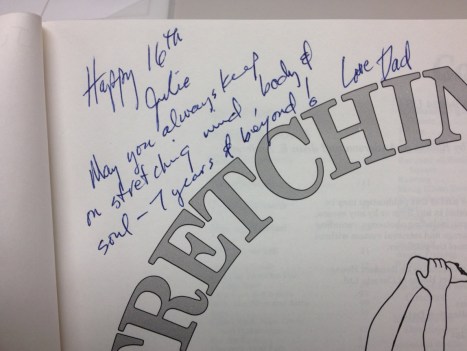
stretch

That inscription reads, “Happy 16th Julie. May you always keep on stretching mind, body & soul – 7 years & beyond! Love, Dad.” You see I was Julie rather than Julia and he was Dad rather than Pops – it’s been a little while! (The 7-year part is a reference to my aunt (my father’s sister) Laura Kastner’s book, The Seven Year Stretch.) I was a young athlete and my father was a slightly older one, and he wanted to pass on the important lessons communicated here.

stretchingStretching was originally published in 1980, before I was born; my copy was printed in 1997, but this book has been through multiple editions since. I still see posters on the walls at gyms and the like with Jean Anderson’s recognizable illustrations, teaching Bob Anderson’s stretches. Paging through this book now, I am impressed at how well it stands up. We mostly still use the concepts outlined here. I showed it to my physical therapist’s intern (hi, Percy!) and he thought it still looked pretty solid.

The book opens with chapters on who should stretch (hint: he’s pretty inclusive), when to stretch, why to stretch, etc., and then begins on the stretches themselves, which are heavily illustrated. The illustrations, by the author’s wife, are perfect: simple line drawings that show the positions used, with cross-hatching to indicate where I should feel the stretch.

I hope the Anderson's won't mind my sharing of this one page (click to enlarge)

I hope the Anderson’s won’t mind my sharing of this one page

A good portion of the book is dedicated to these text-and-illustration teachings; and then come combinations of stretches, like stretching routines for times of day and while watching television, and for various sports. As a soccer player I wore out that two-page spread; as a cyclist I keep a photocopy of the corresponding two pages handy. Then there are exercises for developing strength; a note to teachers and coaches; and advice on nutrition, back care, and running and cycling techniques. The nutrition part is a little more apt to be dated – possibly outdated, depending on what you believe, but mostly dated in the sense that today a person could read copious volumes on any one of several dozen faddish, extreme dietary programs (yes, I’m looking at you, Paleo), and Anderson’s advice is old-fashionedly simple. Also charmingly dated is the bit on cycling technique; nothing I found in a quick skim is wrong, but as with nutrition, it’s a far cry from the laser-heavy methods of precision bike fitting we use today. Frankly, I miss Anderson’s matter-of-factness and simplicity, but there you are.

In a word, this is a great reference manual for anybody – literally – but possibly of special interest to athletes, because of the sport-specific advice offered. Although old, it’s still gold. Thanks, Pops! Still stretching!


Rating: 9 deep breaths.

book beginnings on Friday: The Hunted Whale by James McGuane

Thanks to Rose City Reader for hosting this meme. To participate, share the first line or two of the book you are currently reading and, if you feel so moved, let us know what your first impressions were based on that first line.

huntedwhale

The title recalls a certain famous fictional white whale, or is that just me? This is a coffee-table style book, I expect (my copy is pre-publication), and filled with images. It begins:

The hunt is one of man’s most ancient endeavors. One can barely imagine an early time when man was free from the need to find nutritious food or eliminate a dangerous predator. It’s been posited that language itself grew out of the need for precise communication as men stalked and hunted prey.

No argument there, I don’t think. And I like that McGuane pulls language into his opening lines – this being a work of written artistry, after all. But The Hunted Whale promises to star the whale, as well as the hunt, so stay tuned.

These quotation comes from an uncorrected advance proof and is subject to change.

From Alaska to Tierra del Fuego: Across the Americas in Two Years by Michael Boyny

fromalaskaAnother gift from Fil, and another winner!

This is a coffee table book that is part travel narrative and part photography or art book. Author Michael Boyny tells us that he and his partner, Sabine, are travel junkies. They conceived of this road trip from tip to tip of the Americas and planned it well in advance, buying a 1985 Ford F250 with motorhome cab in their native Germany, fitting it out and test-running it on a trip through Scandinavia before shipping it to New York and setting off across Canada. Chapters each detail a segment of the trip and run, oh, 4-8 pages each: quick descriptions of places that struck them in terms of natural beauty, culture, physical activity, or other item of interest (good and bad). Whole states may be covered quickly or require more time, depending on how they struck Boyny. Two years of travel are covered in under 200 pages, and a number of those pages are devoted to photographs (on which more in a minute), so the text is necessarily a little cursory here and there; but no matter. It is less an in-depth study of anyplace in particular and more a travel journal: just the highlights. I took my time reading this book in bursts of just a few pages or chapters at a sitting – at my coffee table, in fact. And it was very enjoyable.

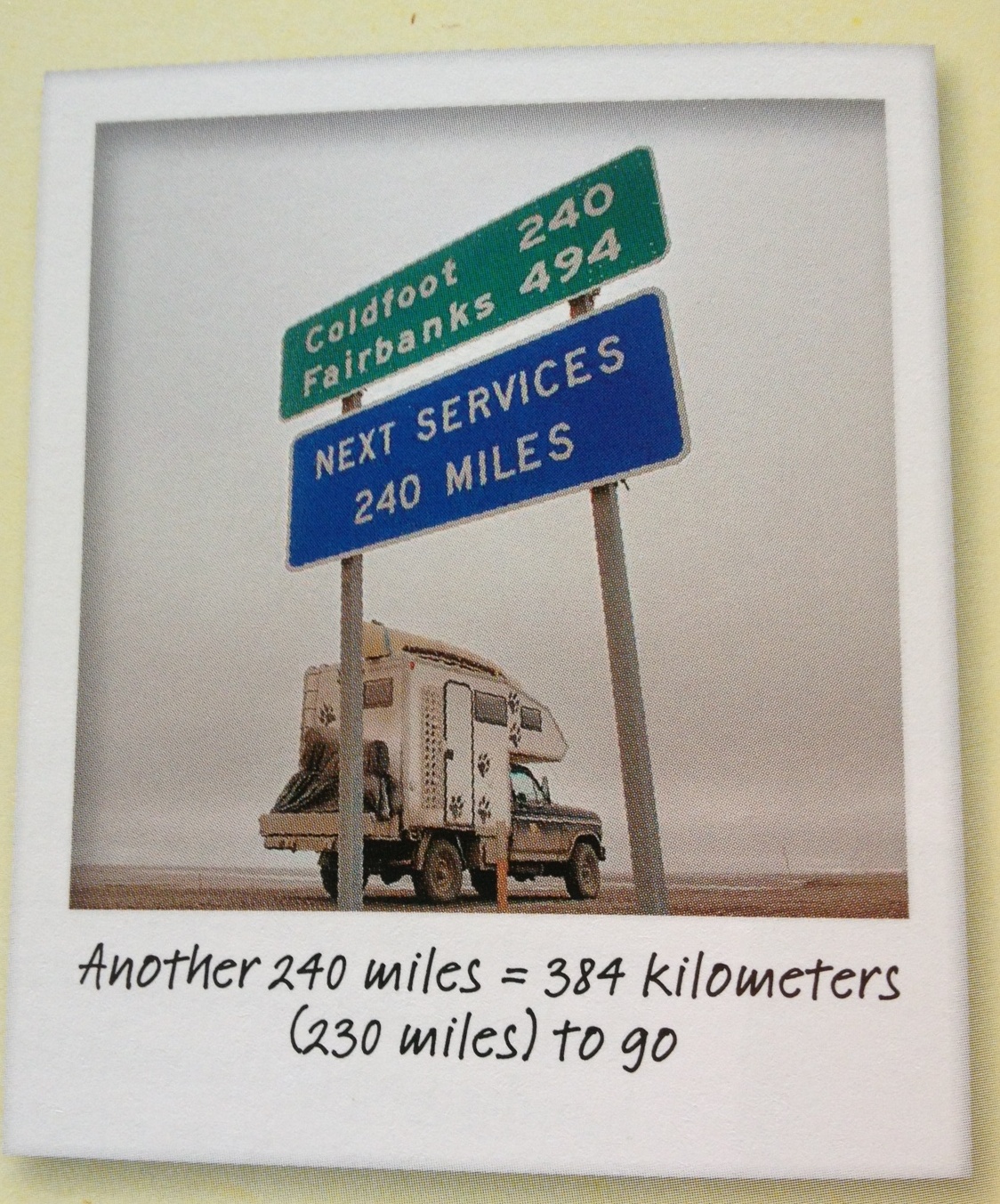
Boyny’s English is perfectly fine, but sometimes a little odd; he is very fond of adjectives. Perhaps someone told him that an adjective for every noun was a good method of descriptive writing? At least that was my impression in the opening pages; either he settled down or I stopped noticing. Call it a nuance that I noted, but didn’t get in the way too much. Another funny item I noticed was the exhaustive translation of kilometers to miles (centimeters to inches, etc.), which I appreciate very much in theory but which sometimes turned downright amusing in practice:

240 becomes 230, like magic!

240 becomes 230, like magic!

Michael and Sabine see Alaska; Canada; the Western United States; Mexico; Central and western South America. They are outdoorsy types (perhaps this goes without saying: they’re living in a truck for two years!) and often camp outside, sometimes rent rooms or hotel rooms, even occasionally a more permanent dwelling (seven weeks in a rented house in San Miguel de Allende taking Spanish lessons). They also do quite a bit of hiking (overnight backpacking included), and outings (again sometimes overnight) in the canoe they carry on top of the truck; a scooter racked behind allows for easy short trips as well. The physical activities they undertake set them well apart from your average (American) RV dweller. They compile a fine list of places they could live, across both continents, and are kind in their sparse criticisms; the coast of Peru gets a poor rating but the highlands of that same country become a highlight just pages later.

But oh, the photographs. Don’t get me wrong: Boyny’s narrative of two years spent traversing 15 countries was well worth reading, an interesting education in snippets, even within my own country or places I’ve visited, because he enjoys his own unique perspective. But the photographs alone make this book a special find. Boyny is a passionate amateur photographer (maybe I shouldn’t say amateur; it’s how he makes his living when he stays in one place) and his photos share roughly equal space with text, including a good number of amazing two-page spreads. These photographs include portraits of the inhabitants of various places, wildlife (toucan! quetzal!) and scenes of commerce and lifestyles; but the strongest, unsurprisingly, are landscapes. The largest spreads include views of the Yukon; Monument Valley; the Grand Canyon (naturally); Bryce Canyon; the Mayan ruins at Tulum (Husband and I have been there!); the Galapagos; Machu Picchu; and Patagonian lakes. I can’t say enough about his captures of some of the most extraordinary views on the planet – they alone make this trip worth it, both for Michael and Sabine, and for his readers.

A major hit for photos alone; an an interesting travel story to boot. Thanks, Fil!


Rating: 8 muddy tracks.

Teaser Tuesdays: From Alaska to Tierra del Fuego: Across the Americas in Two Years by Michael Boyny

Teaser Tuesdays is a weekly bookish meme, hosted by MizB of Should Be Reading. The idea is to open your current read to a random page and share a few sentences. And try not to include spoilers!

fromalaska

Randomly chosen from this beautiful coffee table book:

In the days of our stay, we experience a city as fragmented as its history is fascinating: repulsive and charming, poverty-stricken and glamorous, terrifying and endearing – probably as full of contradictions as the Mexican soul itself.

The city in question is Mexico City, and I imagine that this list of contradictions is an accurate start, at least.

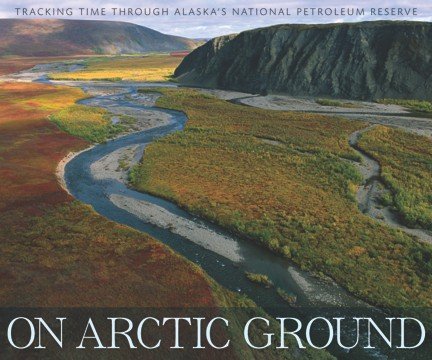
On Arctic Ground: Tracking Time Through Alaska’s National Petroleum Reserve by Debbie S. Miller

A call for the preservation of Alaska’s natural heritage, with exquisite photos.

At 23 million acres, Alaska’s National Petroleum Reserve is the largest single unit of public lands in the United States, none of it permanently protected. Rich in oil, gas and coal, it is also home to an astounding diversity of plants and animals, many endangered and threatened; the migratory birds of six continents begin their lives in the Reserve. Debbie S. Miller’s On Arctic Ground is a striking plea for the conservation of this irreplaceable natural space.

Although it can be read cover to cover, the best way to enjoy this book is to take its short chapters one by one. Each provides mind-boggling details–like the bar-tailed godwit’s nonstop, 7,000-mile migration from western Alaska to New Zealand–and makes the starkly moving point that this incomparable area is highly vulnerable. Breathtaking full-page pictures throughout offer stunning portrayals of the Reserve’s strange and spectacular life forms.


This review originally ran in the Nov. 23, 2012 issue of Shelf Awareness for Readers. To subscribe, click here, and you’ll receive two issues per week of book reviews and other bookish fun!


Rating: 8 caribou.