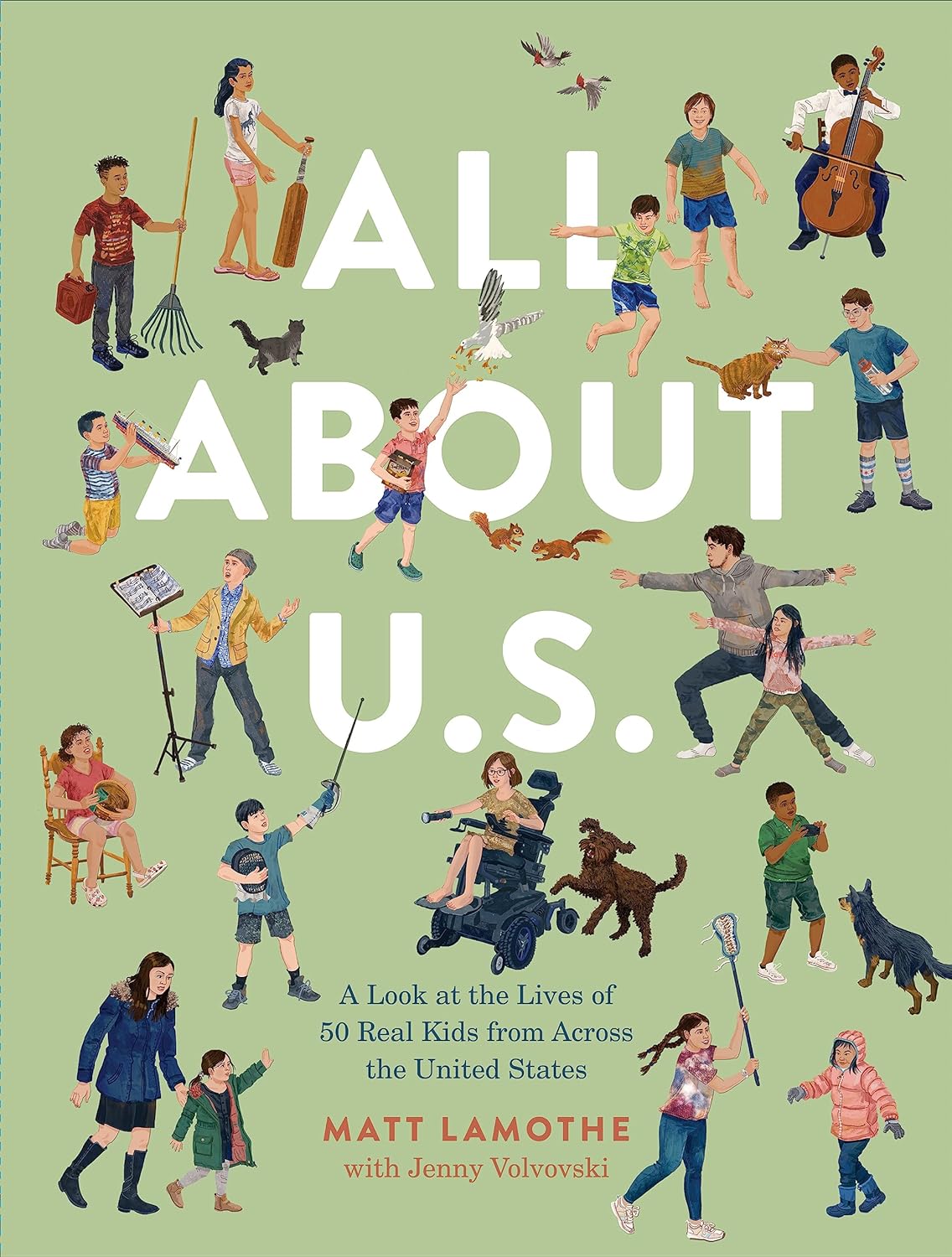
 I loved the look of this large-format illustrated book for kids (and their adults!), and preordered it for a couple of my favorite kids, sisters ages 8 and 12. The book is labeled as serving ages 8-12, so I figured that would be perfect. And naturally I had to take a look first.
I love the concept. From the authors of This Is How We Do It comes this glimpse into the lives of 50 kids, one apiece from the 50 states. Author/illustrator Lamothe and author/designer Volvovski took great pains to closely approximate the demographics of the country as a whole in choosing the kids and families they feature here: sections on Process and Demographics at the end of the book detail those elements, in writing that will skew toward the older end of the book’s projected age range and/or serve adults best. The 50 families in the book match national stats in religion, family type, structure and size, gender identities, school and home types, annual family income, national origin of parents and guardians, sexual orientation of parents and guardians, and more, quite closely. “The biggest demographic discrepancy in the book is the overrepresentation of multiracial kids. However, the race/ethnicity of their parents and guardians more closely matches the demographics of the country. According to Pew, the number of Americans who identify as more than one race almost doubled between 2010 and 2020 [when work began on the book]. As this trend seems likely to continue, we feel it is important to show how multiracial families balance their cultures and traditions.” This struck me as solid reasoning. I’m also comfortable with slight overrepresentation of traditionally underrepresented groups.
The bulk of the book is the kids themselves. Each gets either a single page or a two-page spread (of which most of the space is illustration; my impression is that the written stories are equal in size) in this large-format book. A beautiful, engaging, full-color, detailed illustration accompanies a brief written profile of a child, ages 5-11, in the context of their family and home. Generally, parents’ or guardians’ jobs or interests are mentioned, as well as siblings and pets, but the kid in question gets the most focus, via their hobbies, tastes, favorites foods and toys, activities, etc. I love the charming images as (yes) illustrations of what is described in print. I can easily see the sisters I’m giving this book to enjoying the combination of images with text; I expect the older sis to have an easier time with the reading part.
Clearly the enormous diversity of the kids and families featured here is a big part of the appeal. I really enjoyed how varied these lives appear. There are many skin tones, religions, family structures and styles; there are kids with mental and physical health differences and those who have faced major life challenges. Some are rural and some are urban (a demographic element apparently not tracked). I’m pretty sure that each story includes at least one direct quotation, so that the kids’ voices come through. Across all their differences, they all sound stimulated by the chance to talk about their own lives.
And these are real kids. Near the front of the book is a spread with each child’s illustrated head shot; near the back, a similar spread of photographs of the same kids. A few source images are included there as well, like landscape views, and descriptions of how this research was completed (many hours of video calls, online questionnaires, photographs and video tours). I especially appreciate how detailed are the illustrations, and liked reading that each family was consulted in back-and-forth correspondence on both the illustrations and the text before publication.
I was on the lookout for stereotypes. (I did note the authors’ acknowledgment that no one family could represent an entire state.) With such attention paid to demographic data, I feel good about the overall portrait of the country; but what does it look like to choose a single kid/family to stand for New York or Texas? Heavens. I of course turned first to the two states I know best, Texas and West Virginia. In Texas, Noah lives with a large family who enjoy traveling to Big Bend (yes!) from what might be San Antonio. In West Virginia, Jade raises prize-winning steers at his rural home. These are individual stories, woven into a tapestry with plenty of diversity in it.
All in all, it’s a beautiful book that I think will yield some great conversation, and I feel great about giving it to my young friends.
Rating: 8 windows.
Filed under: book reviews | Tagged: children's/YA, coffee table books, illustrated, nonfiction, young friends | Leave a comment »













 pagesofjulia