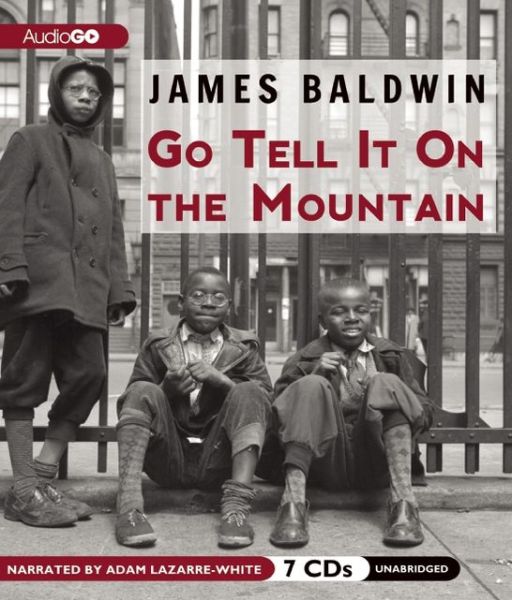
book beginnings on Friday: Go Tell It On the Mountain by James Baldwin

Thanks to Rose City Reader for hosting this meme. To participate, share the first line or two of the book you are currently reading and, if you feel so moved, let us know what your first impressions were based on that first line.

go tell it

I had a heck of a time getting this electronic audiobook from my local public library onto my iPod, but I have succeeded and thus well earned this listen. I started off with James Baldwin’s Notes of a Native Son, which I enjoyed; but it made me want to go back to the beginning of his work, and Go Tell It On the Mountain is his most famous novel, so here we are. It begins:

Everyone had always said that John would be a preacher when he grew up, just like his father. It had been said so often that John, without ever thinking about it, had come to believe it himself.

I think these are strong starting lines. They tell us who our protagonist is; they tell us his family background, and they both name an expected fate for John, and imply that this expectation will not be fulfilled. It also bears noting that on the first page, there is also reference to John’s father fondling one of his daughters, implying that this preacher is not as virtuous as we’d expect. It’s a very casual mention, downplaying the import of this fact. To me, this says that the family doesn’t think much about it; or maybe they don’t know yet. At any rate, it’s disconcerting to have molestation treated so lightly, and I think Baldwin makes a real impact by introducing such disturbing information so off-handedly.

Please note that I have only just begun this book, so I don’t know yet if my interpretations here are correct! Stay tuned…

movie: The Great Gatsby (2013)

Well, we finally got around to it! Sadly, my friend Justin and I missed this one in theaters; I think it would have been oustanding on the big screen, but Justin has a large-ish screen at home too, so we did okay.

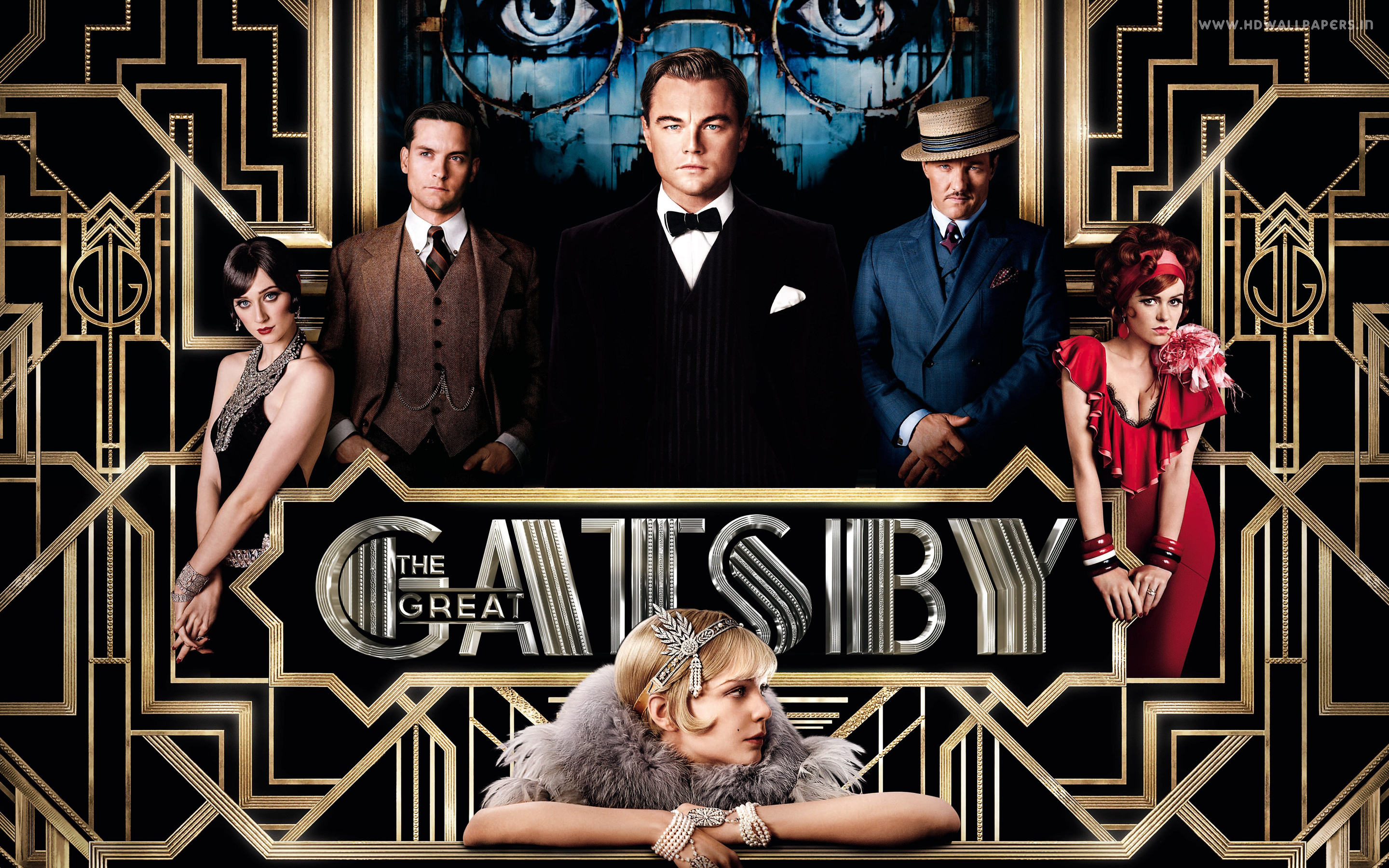
My first comment on this movie is that it is wildly visually pleasing, and impressive, and extravagant – much like the Roaring 20’s.

photo credit (click to enlarge)

photo credit
(click to enlarge)


The spirit of Gatsby’s parties, the lavish lifestyle, is well evoked. Actually, I am impressed with the faithfulness to the book in story, too; it’s been years since I’ve read it, so I may be missing the minor details, but the feel was right. Perfectly rendered are the beautiful women in outrageous costumes, with a tendency to turn their heads just so to catch their lovely profiles; Gatsby’s larger-than-life personality and biography, and his arresting discomfort in the shadow of Daisy’s presence; and Nick’s own retiring persona. There is a framing element added to the movie that was not present in the book; it’s a little unsettling for us book-purists, but minimally so, and I think I can understand how it felt necessary, to explain Nick’s narration.

And oh, did I mention the visual appeal? The women, the clothing, and the outrageous parties – not to mention Leonardo DiCaprio himself as Gatsby – are positively eye candy. Leo is at his best, exhibiting the boyish, almost childlike charm we knew him for in earlier years (singularly in the scene involving the shirts – “they’re such beautiful shirts”), an older man’s brooding, and all the rest of his handsome faces. It was easy to get lost in some of the scenes and scenery. The film is clearly color-enhanced; I’m no expert and can’t explain this, but the color is clearly doctored. This adds to a fairy-tale-like feeling throughout, which is not faithful to the book, but somehow works. In this different medium, the larger-than-life effect feels like the proper analogy to Fitzgerald’s book. Towards the sad ending, the movie transitions to the disaffected tone of the book with perhaps some abruptness. But really, it’s a damn fine job – and gorgeous.


Rating: 8 beads.

movie: A River Runs Through It (1992)

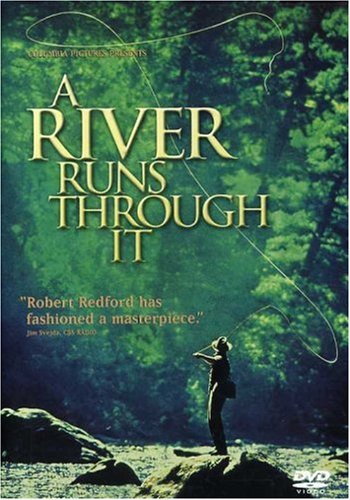
rivermovieI was pleased when Husband found this movie for me the other night. I enjoyed the book by Maclean so much, and I had heard good things about the movie. Robert Redford’s involvement speaks well, too.

First of all, this film is very visually pleasing; the scenery is lovely (IMDB says it was shot in Montana and Wyoming – not onsite in Missoula, but convincingly nearby), the fishing scenes are appropriately peaceful, and the actors are attractive. Thank you, Hollywood, for a typical, unrealistic portrayal! Although Paul Maclean in particular was supposed to be a very good-looking young man; and whatever your feelings about Brad Pitt, I don’t think you can argue that his role as Paul is less than gorgeous. (See below.) Also pleasing are the glimpses of 1920’s flapperdom, particularly in the character of Jessie Burns (later Maclean’s wife), who is charmingly represented.

young Brad Pitt

young Brad Pitt

The film opens and closes with Norman Maclean as an old man, fly-fishing, accompanied by a voiceover (by Robert Redford) quoting from the book. This is appropriate, and effective. Otherwise, the film’s connection to the book comes and goes. The Maclean family onscreen is quite faithful to the Maclean family of the novella (although I found the Reverend a little friendlier in the book than in the movie), but the action diverges often. I missed the couple that happen upon Paul’s masterful fishing in the book, but at least the scene is represented in the film. I was perhaps most thrown by the scene in which the Maclean brothers take a daring whitewater trip in a “borrowed” boat; I could feel how disconnected this section was from Maclean’s own writing, and indeed, it felt out of character with the brothers as I knew them from the page. Coming early in the movie as it did, it was even more disjointed for me. When the fishing trips (two of them) with Jessie’s brother take place in the book, Norman and Jessie are already married; in the movie, they’ve just begun dating, and there’s only one scene. It is, however, well represented with both humor and outrage.

As of course is standard in book-to-movie adaptations, we get less in the film than we did on the page. Naturally I missed the parts we lost, because I loved the book so. This is to be expected. Part of what I missed was the immersion (no pun intended) in the world of fly-fishing that Maclean brings so fully to life, in such an interesting manner even to those of us who don’t care much for fishing. The depth of all the characters also naturally loses some development in a 2-hour movie. All things considered, this was an enjoyable movie – for its natural landscapes, peaceful yet tortured tone, and familiarity with the Maclean family of whom I cannot get enough. It doesn’t do the book justice, but no movie could, so I won’t hold much of a grudge for that.


Rating: 6 trout.

a compilation of lists

Whew! You all might know that I’m a sucker for book lists. It can get a little exhausting with everyone publishing their own “100 greatest books” etc. (you know I did!), and this is a highly subjective matter. But I’m still attracted.

But then I saw this list (through Shelf Awareness, naturally). It’s a chart compiled from all the books on 11 lists of 100 books. [One list says “American novels”, where the others seem to be international. Eight of the 11 say either “novels” or “literature,” and a glancing survey does seem to confirm that this is a fiction list. These rules are not entirely made clear.] There aren’t 1100 books, because there’s overlap: that’s the point of this chart. And what fun: statistical analysis! Three books make 10 of the 11 lists: Catch-22, Lolita, and The Great Gatsby. Four books make 9 lists; 4 make 8; and so on from there. I found it fascinating to see the semi-democratic selections between these lists. Of course, each of those 11 lists is just another subjective view; but it’s nice to the the intersections. The lists, if you’re curious, come from sources like bookriot.com; TIME magazine; Entertainment Weekly; Modern Library; Goodreads; and Reddit.

Naturally what I want to do now is show which ones I’ve read, plan to read, or don’t plan to read (hello, Faulkner and Ulysses). Let’s say bold are those I’ve read, italics are those I want to read, and underlined for those I’ve picked up and put back down or don’t intend to.

Please excuse my laziness in listing only titles and not authors. You will fairly easily figure it out yourself or find the author via The Google. A few of these titles, for the record, didn’t ring a bell to me at all. Some authors are available at the original link; others are not. I’m guessing this was a copy/paste in from the 11 lists themselves…

Made 10 lists:
Catch-22
*Lolita
*The Great Gatsby

Made 9 lists:
Invisible Man (Ralph Ellison, not H.G. Wells. I have read the one by Wells, actually.)
Slaughterhouse-5
The Catcher in the Rye
The Sound and the Fury

Made 8 lists:
*1984
Beloved
The Grapes of Wrath
To Kill a Mockingbird

Made 7 lists:
The Sun Also Rises

Made 6 lists:
An American Tragedy
Atlas Shrugged
Brave New World
Gone With the Wind
Midnight’s Children
My Antonia
*On the Road
* The Adventures of Huckleberry Finn
The Heart is a Lonely Hunter
The Hitchhiker’s Guide to the Galaxy
The Tropic of Cancer
Their Eyes Were Watching God
To the Lighthouse
Ulysses

Made 5 lists:
A Clockwork Orange
A Passage to India
All the King’s Men
Animal Farm
Brideshead Revisited
Crime & Punishment
Fahrenheit 451
Go Tell It On the Mountain
Heart of Darkness
Infinite Jest
Light in August
Lord of the Flies
Moby-Dick
Mrs. Dalloway
Native Son
One Hundred Years of Solitude
*Pride and Prejudice
The Age of Innocence
The Call of the Wild
* The Lord of the Rings
* The Old Man and the Sea
The Stand
The World According to Garp
Things Fall Apart
* Wuthering Heights

Made 4 lists:
*A Confederacy of Dunces
A House for Mr. Biswas
A Portrait of the Artist as a Young Man
Anna Karenina
Blood Meridian
Charlotte’s Web
Death Comes for the Archbishop
Don Quixote
Ender’s Game
Howards End
I, Claudius
Naked Lunch
Neuromancer
One Flew Over the Cuckoo’s Nest
Rabbit, Run
Ragtime
Sons and Lovers
Sophie’s Choice
The Adventures of Augie March
The Brothers Karamazov
The Color Purple
The Fountainhead
The Golden Bowl
The Handmaid’s Tale
*The Hobbit
The Maltese Falcon
The Moviegoer
The Sheltering Sky
Under the Volcano
War and Peace

And on.

I have added *asterisks* for the 11 that overlapped with MY list of 100: that was interesting to note. In such subjective measurements, I think that’s not a bad statistic. And some of the ones on this list that I’ve been looking forward to reading may well end up on my own list.

What are your reactions?

final review: Light in August by William Faulkner (audio)

augustI am challenged by Faulkner. I already began to share my frustrations in an earlier post that you might want to check out.

So then, the second half of the book. The short story is I still don’t understand what this book is about. It opens with a pregnant country woman, traveling on foot in pursuit of the missing father of her child. He left her when he found out she was pregnant, promising to send for her when he had a household set up; everyone Lena talks to, and I the reader, understand that he’s no good and this is a lie, but she is dogged. She succeeds in tracking him down, this man she knows as Lucas Birch, to all our surprise, and he is indeed no good (and also now goes by Joe Brown). And then the story shifts to that of a companion of Birch/Brown’s, a man named Joe Christmas. We learn his entire life story. He was an orphan, living mostly as a white boy/man but occasionally outed as being part black. (Note that there are lots of n-words in this book. Something to keep in mind in the audio format, if you’re driving around with your windows down.) There is also a Byron Bunch, who cares for Lena while she gets close to having her baby; and a man named Hightower, a former minister who advises Byron Bunch. We learn pieces of their stories, as well. We don’t learn terribly much about Birch/Brown himself, despite in some ways him being the hub around which these spokes rotate. And I’m torn between wishing we knew more about Lena, and being frustrated (and therefore satiated) by what I do know of her.

The bottom line is that I still do not understand what this book is about. On one hand, that makes it really a pretty good candidate for what I’m doing with it, which is listening to it to prepare to to listen to a lecture explaining to me what the heck it’s about and what Mr. Faulkner was trying to do with it. On the other hand, it has not aided my enjoyment of this book. I’m confused. Why do we care about these people? I never learned to care about these people. Are we concerned with Lena? Or are we concerned with Christmas? Are we concerned with Byron Bunch?

I found it strange that certain characters make very long, descriptive speeches, when they’re meant to be simple people. When they speak, I hear Faulkner, not Lena, or Mrs. Hines or whomever. I’m not a fan of the author speaking through the dialog of his characters.

My audio edition concluded with an interview – of all people – with James Lee Burke. This is strange because he’s one of my favorites (and stranger still because I just days ago finished his new book, Light of the World – sorry, the review won’t post til the book is published in late July). It turns out that he puts Faulkner right up there with his top four greatest writers of all time: Chaucer, Milton, Shakespeare and Keats. I am baffled. I won’t try to re-hash this interview for you, in which Burke touches on the gifts of Faulkner; suffice it to say it’s the first time I failed to “get” James Lee Burke. [If you’re interested, it’s the Brilliance Audio production of 2011, read by Will Patton. The interview with Burke is conducted by an awesomely-named James Atlas.]

I think that maybe Faulkner transmits on a frequency I don’t receive. I understand vaguely that this is a work of allegory. Perhaps the Yale University class lectures that I plan to listen to eventually (you can find them here on iTunes U) will illuminate things; possibly they will not. This is a non-review, I know. I’m sorry. I don’t get Faulkner.

Next up in my audio collection is The Sound and the Fury and I don’t think I’m brave enough. Jason’s recommendation of As I Lay Dying was encouraging, but I’m still a little gun-shy; plus my local library doesn’t have that one on audio. For now, I will take a break from Faulkner. Maybe I’ll even start with some of the Yale lectures and see if I’m inspired and educated.


Rating: requires discussion.

When trying to come up with a numbered rating for this book, I think: I did not like this book. But whose fault is that? Is it partly my fault? Do I share some blame for being unable to appreciate or follow? I give Light in August a 3 for my enjoyment level, but to acknowledge my complicity in our minds’ failure to meet, Faulkner’s and mine that is, I will assign a very generous 5 grumbles and hope for either better, or no, future Faulkner reads.

an interim report on Light in August by William Faulkner (audio)

augustI am nearly halfway through Light in August, and I need to get some things off my chest.

The lack of physical descriptions in this book is bothering me. Race is clearly a major issue, and yet I am often left confused about who was of what race. In some stories that would be a strength – that neutrality – but considering that I suspect it is so darned important here, I would like to know who is who. Rarely do we get a physical description. And then, out of nowhere, I get this:

She was a waitress in a small, dingy, back street restaurant in town. Even a casual adult glance could tell that she would never see thirty again. But to Joe she probably did not look more than seventeen too, because of her smallness. She was not only not tall, she was slight, almost childlike. But the adult look saw that the smallness was not due to any natural slenderness but to some inner corruption of the spirit itself: a slenderness which had never been young, in not one of whose curves anything youthful had ever lived or lingered. Her hair was dark. Her face was prominently boned, always downlooking, as if her head were set so on her neck, a little out of line. Her eyes were like the button eyes of a toy animal: a quality beyond even hardness, without being hard.

This is both lovely and, in some ways, bothersome to me. I love that she was not short, but rather “not tall.” And then that “smallness… not due to any natural slenderness but to some inner corruption of the spirit” comes along and I wanted to sarcastically retort, “you mean like a cocaine addiction is an inner corruption of the spirit”? Her face “always downlooking, as if her head were set so on her neck” is quite amazing and evocative; it makes me pause to picture this. But I can’t quite tolerate the “quality beyond even hardness, without being hard.” Come off it, Faulkner.

My impatience with his writing makes me question myself. I am often a little scornful of what strikes me as pretentious Literaryness; but then I’m so often appreciative of lyrical writing, so where do I draw the line? Am I letting my prejudice against (or to be more honest, my fear of) Faulkner get in the way of an honest appraisal? How to account for taste – even my own? It remains a puzzle. As I’ve written before, I think we all should attempt – as I am trying to do – to own our own reactions and tastes, and not apologize for not liking those who are called literary greats (Henry James, T.S. Eliot, I’m looking at you). Why don’t I like Faulkner? Take in a sentence like this:

I do not know yet that in the instant of sleep the eyelid closing prisons within the eye’s self her face demure, pensive; tragic, sad, and young; waiting, colored with all the vague and formless magic of young desire.

I’m sorry, but this reminds me of the abstract art that us philistines can’t tell from a kindergartner’s work. Speaking of vague and formless – this reminds me of The Waste Land, or Gertrude Stein, for goodness’ sake. If I keep reading this, I may go crazy.

On the other hand, I took in Jason’s lovely, helpful comments on the book beginning I posted, and I am somewhat encouraged. Some of this will just turn out to be a matter of taste; Jason can have Faulkner and I can have Hemingway, who some people abhor and that is fine, etc. etc. But perhaps I can continue with Faulkner and find more to like, too. Jason, I’m still looking forward to As I Lay Dying. I am trying; don’t lose patience with me yet. 🙂

And for now, I continue, but wish me luck.

book beginnings on Friday: Light in August by William Faulkner

Thanks to Rose City Reader for hosting this meme. To participate, share the first line or two of the book you are currently reading and, if you feel so moved, let us know what your first impressions were based on that first line.

august

Friends, I have a confession: I fear Faulkner. I tried to read The Sound and the Fury once, and I was left feeling certain that either I’m an imbecile, or he is. The jury is still out. But I found this collection of audio lectures on iTunes University, from Yale, on Hemingway, Fitzgerald and Faulkner; and I already love two of those authors, and the three are often considered together; and I want to listen to these lectures and be able to follow along; so here I am again, attempting Faulkner. I’m told Light in August is a little easier than The Sound and the Fury. Wish me luck. It begins lucidly enough:

Sitting beside the road, watching the wagon mount the hill toward her, Lena thinks, ‘I have come from Alabama: a fur piece. All the way from Alabama a-walking. A fur piece.’ Thinking although I have not been quite a month on the road I am already in Mississippi, further from home than I have ever been before. I am now further from Doane’s Mill than I have been since I was twelve years old

[Regarding punctuation: I checked two print editions and both left off that final period, so I guess that was Faulkner’s work. I actually value punctuation, myself; trying not to let this make me nervous.]

Any Faulkner fans out there who can reassure me? I want to like this book!

I confess, I’m jumping on board: The Great Gatsby, the movie.

I do have some reservations; but I am cautiously excited about the new Gatsby movie.

I bought a second paperback copy of the novel and gave it to my movie buddy Justin to read before we go. (Husband doesn’t do movies.) I had to buy Justin a copy because it turns out that my copy, which dates from high school, is hideously marked up: one of my high school English teachers had us turn in our books to be graded on how entirely we had defaced them with highlighter and margin notes. I got a 100 on The Great Gatsby, which means it’s entirely unacceptable for me to hand over to a first-time reader. I’m just glad I noticed before he took it home with him. [I’ve discussed marginalia here before. In a nutshell, I’m not a big fan.]

So, Justin has a copy of the book, and we will be seeing the movie. I’ve read that it’s not a perfect match – and when is a movie ever a perfect match to the book? The right strategy, I think, is to know and accept that going in. Hopefully we can do this, and enjoy Leonardo DiCaprio and all the glitz and glamour.

gatsby

It does look very pretty.

As an added bonus, Shelf Awareness published a fun piece the other day, in honor of BookExpo America: Gatsby’s New York. Great fun there.

So stay tuned for a movie review to come! Ideally I would have found time to reread the book myself. But I’ll just have to go on the strength of multiple rereadings of years ago – and Justin’s recent experience.

Anybody else excited about this one?

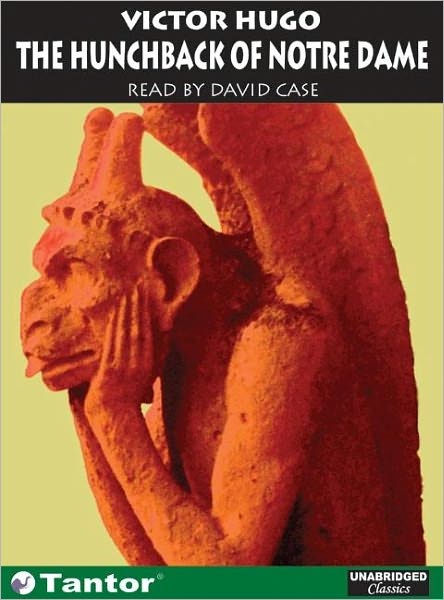
The Hunchback of Notre Dame by Victor Hugo (audio): second half

hunchbackIn brief: better than the first half.

In the first half of this classic novel, I felt there was a bit much explication of aspects less interesting to me personally: most to the point, the architecture of Paris and the history of that architecture. This turns out to be a historical facet that does not fascinate me. If you feel otherwise, enjoy. I said then that Hugo’s strengths lay in the narrative of his story, especially in dialogue; and it seemed to me that this second half had more of that. I am still refraining from plot summary, since that question is well answered by the internet at large. So, briefly, in this second half our characters meet their fates. La Esmeralda, Quasimodo, Claude Frollo, Phoebus, Gringoire and Sister Gudule are for me the central characters, and each comes to a resolution by the end; Hugo wraps up very neatly in that regard.

I found the story interesting – not riveting, but engaging in that I cared about the fates of these characters. It moved a little too slowly to be called riveting, but I did remain mostly attentive. (The description of Parisian building styles through the centuries was not entirely absent in this latter half of the book, so I did still zone out some.) Gringoire’s comic soliloquies are among the best moments; and the Archdeacon’s depravity was shocking and certainly absorbing. I think he easily equals the sociopaths featured on Criminal Minds. One of my observations on finishing this book is that 15th-century French society unfortunately allowed for such crazed and dangerous behaviors if one only held a high position in the church.

This is mild praise, you realize. The Hunchback of Notre Dame struck me as a fine story, but unremarkable. And yet Victor Hugo is a big name, and this one of his best-known works (I am not excited about Les Miserables!), so what have I missed? Well, for one thing, there is this assertion that I got from Wikipedia:

Hugo introduced with this work the concept of the novel as Epic Theatre. A giant epic about the history of a whole people, incarnated in the figure of the great cathedral as witness and silent protagonist of that history. The whole idea of time and life as an ongoing, organic panorama centered on dozens of characters caught in the middle of that history. It is the first novel to have beggars as protagonists.

Notre Dame de Paris was the first work of fiction to encompass the whole of life, from the King of France to Paris sewer rats, in a manner later co-opted by Honoré de Balzac, Gustave Flaubert and many others, including Charles Dickens.

And when put in this perspective, I see its value a little more clearly. Upon its publication in 1831 there were no novels like this; okay. On the other hand this is Wikipedia (and there is a sentence fragment in the above quotation, oh the horror), so, grain of salt. Certainly I can see how this is a great, sweeping view of 15th century France, as stated involving both the King and the beggars, and I am happy to nod to the precedent set even if this is not my favorite example of the genre.

The narrator, David Case, turned out to be perfectly fine and appropriate. I liked the different voices he plays for the very different characters of Gringoire (comic, self-important, whinging), the Archdeacon (dark, conflicted), Esmeralda (sort of a wilting lily), and Quasimodo (deaf). He gave the piece flavor.

In the end, though, I shrug at this lengthy audiobook and move on without looking back.


Rating: 5 gargoyles.

Teaser Tuesdays: The Hunchback of Notre Dame by Victor Hugo, again

Teaser Tuesdays is a weekly bookish meme, hosted by MizB of Should Be Reading. The idea is to open your current read to a random page and share a few sentences. And try not to include spoilers!

hunchback

Yes, I just did this one last week. The good news is that there continues to be text worth quoting! I liked these lines of dialogue:

“The gallows lead to hell.”

“That is a rousing fire.”

“Jehan, Jehan! The end will be bad!”

“The beginning at least will have been good.”

There is something Shakespearean, I think, in this repartee. As I said in my mid-way-through review, Hugo is at his best in narrative (or dialogue!), when he is pithy and entertaining. Still enjoying this one, on the whole.