Alex Haley: And the Books That Changed a Nation by Robert J. Norrell

History and literary criticism enrich the first biography of Alex Haley, author of Roots and Malcolm X’s Autobiography.

alex haley

Alex Haley wrote The Autobiography of Malcolm X (as told to him), and Roots, the story of his family from Africa through slavery and the Civil War. Separately, these books had a profound impact on how the United States viewed race relations and its own history. Together, their influence could hardly be overstated, and that is what Robert J. Norrell argues in Alex Haley: And the Books That Changed a Nation, the first biography of Haley and a study of his two seminal works and the controversies they fostered.

Norrell covers Haley’s forebears and Tennessee childhood, his three marriages and a writing career growing from the Coast Guard (where ghost-writing personal letters led to public relations assignments) to magazine work, which led to his interviewing Malcolm X for Reader’s Digest and Playboy. The process for Malcolm’s Autobiography (1965) was dynamic, as Haley walked the fine line between Malcolm’s voice and Haley’s more moderate political position, and as Malcolm’s views on race relations evolved. The Pulitzer Prize-winning Roots (1976) was even harder won, as Haley drew a short book contract out over more than 11 years of research and travel. The effect of the book, and its accompanying television miniseries, was astounding. And yet the rest of his life and work would be shadowed by accusations of copyright infringements and invention in what Haley called a work of nonfiction.

With sensitivity and careful study, Norrell examines Haley’s embattled life and extraordinary achievements. His final conclusion about this “likeable narcissist” is that despite Haley’s imperfections, his influence was prodigious and deserves our respect and continued study today.


This review originally ran in the December 18, 2015 issue of Shelf Awareness for Readers. To subscribe, click here, and you’ll receive two issues per week of book reviews and other bookish fun!


Rating: 7 pieces of gossip.

National Theatre Live presents Jane Eyre (2015)

Pops suggested this stage production of Jane Eyre to me, and I confess that I was at first hesitant. Jane Eyre is not among my favorite novels. Perhaps in juxtaposition to Wuthering Heights, I at some point developed some rather negative feelings about it. (Recall my discussion with Erin Blakemore, here.) But it was an intriguing concept, this adaptation to the stage; and I have been nothing but impressed with past National Theatre Live performances (Treasure Island; A View From the Bridge). So we went.

The Lincoln Theatre in Mount Vernon (a town about 30 minutes south of where I live now) is always a treat, and we found a tiny hole-in-the-wall Thai place beforehand that was worthwhile, too. And I had rearranged my mindset by the time we got there. It has been years since I read Jane Eyre. And I love the stage. This will be great, I thought. Of course it was!

JaneEyre

As we have seen at past NT Live shows, the set design was innovative and well done: so extraordinarily simple, just a few platforms and levels of planking, with lots of stairs and ladders throughout, so that the players create the impression of distance covered by sort of doing laps. And because there was no decor, any space could be anyplace at all. Same with the actors: I believe it was a crew of about six who played every character in the story, by simple costume changes and adjustments in accent and attitude; we never had trouble following along. Another less-is-more approach, which is always a clear winner with me. I think I’m done with elaborate costuming and set design. (She says, until the next beautifully elaborate production comes along.)

I was taken with the way they put together this adaptation, too. The company did it cooperatively, through improvisation: they all read the book, got up and freestyled. There’s a great clip, Devising Jane Eyre – and you get a glimpse of some of the actors there. (Then check out the trailer.) It’s a stripped-down version this way, purified if you will. This is not the Jane Eyre I remember. I remember Jane Eyre being a rational, thinking woman’s novel, almost austere, where Wuthering Heights was all passion; but this play was steeped in passion, as well as that groundbreaking feminist thought that we recall Jane for. She still makes (the same) choices of self-deprivation, but they are made with passion. I loved this woman. This company made of Bronte’s work something different – and, for me, better. (I can hear the novel’s fans gasping. They’re just personal reactions, folks.)

The acting was magnificent, and I will say that this version of Rochester was a heartthrob (also something I do not recall from the novel). But all the acting was magnificent. The woman who played Jane’s friend from boarding school, and later played the pastor Rivers who proposes, was perfect in every role; and the woman who played Jane’s mother, then the maid, then Rochester’s girlfriend, was stunning. Even Rochester’s dog, Pilot, is a joy to watch, played by a man (great fun). The communication of Jane’s inner thoughts – always a problem in adapting books to screenplays or stage plays – is solved with pure genius: a group of (I think) 4 actors gather round her, all talking at once, like a Greek chorus inside her head. She dialogues with them. Pops and I were both mesmerized by this inventive and entertaining solution.

Another unique angle we observed was gender- and race-bending (if you will). There were two black actors who fit right into the story without comment or need for explanation; we both liked that introduction, a modernization if you will, since historically Jane Eyre’s mother was decidedly not black; but we were happy to see it fit right in. And during Jane’s stay as a student at Lowood Institution, a boarding school for girls, all the same actors played her classmates – including two men, one of them bearded. But we understood: in this scene, these are all little girls. I think we were both tickled by these new angles, and happy to play along.

The cues used to switch us from Jane as newborn baby, to Jane as young girl, to teacher, to governess, to bride, etc. were simple but effective. She never left the stage, I don’t think, in the whole performance; she made tiny costume changes onstage, not hidden but as part of the action. Her Greek chorus helped her changed into her wedding dress and then back again into the costume of her lower social standing, and this was a symbolic and important part of the story. I liked this new way of signalling changes in time, place and action. Again, minimalist but effective.

The stark simplicity of stage and costuming, and even in the number of actors involved, and the distillation of the novel to its most powerful, moving, and passionate elements, was supremely successful. I regret my hesitation: I will see anything produced by National Theatre Live. And on that note, let me point out that all those fine folks in the Bristol audience paid a lot more money than I did to see this play in person; but I got close-up shots and all the right angles. The invisible element to the National Theatre Live format is cinematography. They claim, and it is true, that each of us at the Lincoln Theatre in Mount Vernon, Washington had the best seat in the house. What a deal.

And now the question of whether to reread. When I try a beer again after years, that I used to love, and I no longer like it: have my tastes changed, or my very taste buds; or have they changed the recipe on the beer? When your professionally-fit bicycle no longer feels right, has the bike changed? No, your body has aged. I wonder if I would appreciate the novel more today because of my age, maturity, life experience then I did when I was… I think I read this as a teen and again in my early twenties. Or is it just this production that worked so well for me? What do you think?

Not in question is my rating of this theatre experience. Go find yourself some NT Live: it’s worth it.


Rating: 10 fires burning brightly.

The Darling by Lorraine M. López

A complex and disarming young woman follows her heart, lust, and taste for adventure in an unusual route to maturity and self-actualization.

darling

Lorraine M. López’s The Darling is a coming-of-age story in the time-honored tradition, a tribute to literary giants, and a fresh perspective on life and love. Its heroine challenges assumptions, and after a winding and bumpy journey, evokes a spirit of celebration.

…Click here to read the full review.


This review was published on November 27, 2015 by ForeWord Reviews.

IMG_4538


My rating: 7 items of marginalia.

The Early Stories of Truman Capote

These previously unpublished stories written in Truman Capote’s youth are instantly recognizable.

early stories truman capote

The Early Stories of Truman Capote contains 14 stories, most previously unpublished, written in Capote’s teens and 20s, and only recently unearthed among his papers in the New York Public Library archives. Presented with a foreword by Hilton Als of the New Yorker, these are short pieces, studies of subjects Capote would continue to favor in the later works for which he is known: sensitive young children, fractious ladies, the poor and the disenfranchised. They are set in the Deep South, in New York City, in swamps and in small towns.

The talents of the author of In Cold Blood and Breakfast at Tiffany’s are evident in this early work. His descriptions are simple but strongly evocative: “curly, wig-like grey hair” and eyes “bright, like bubbles of blue glass.” His characters tend to be laconic but expressive, with interjections speaking as loudly as words. In “Swamp Terror,” a boy chases a convict into the woods and gets a bigger taste of adulthood than he bargained for. In “Louise,” a schoolgirl lets her petty jealousies do irreparable harm. “Traffic West” presents a remarkable collection of characters and events, in experimental form. In other stories, a young boy finds the dog of his dreams in a park, but the dog belongs to another child; and two wives muse on the hypothetical murder of their husbands.

These easy-reading, alternately amusing and haunting stories offer a fresh, new glimpse of Capote’s genius, and simultaneously feel intimately familiar.


This review originally ran in the November 6, 2015 issue of Shelf Awareness for Readers. To subscribe, click here, and you’ll receive two issues per week of book reviews and other bookish fun!


Rating: 7 deaths.

movie: Psycho (1960)

How about a horror movie for Friday the 13th, hmmmm?

I enjoyed this Hitchcock classic. I don’t care what Husband says.

He says he can’t believe people were frightened by this. But I think that 1960 was a different time. Susanne Antonetta writes in Body Toxic, “Nobody was supposed to talk about Psycho. My parents came home unable to sleep.” I can believe that this movie was scarier then; I thought it was scary now, although I certainly noted the ways in which it’s dated: slower paced, longer pauses, far less graphic (on which more in a moment). The psychological question is every bit as chilling as ever. The bones of this movie are still scary; the production is of another era, is all.

Some of the elements for which Hitchcock is known – creative camera angles (downright innovative at the time), stark, simple shots and sets, psychological drama, and in this case, low budget black-and-white – were plainly evident. For that matter, it was graphically violent for its time, I’m told. (We noted that there was strangely little blood in that one scene, but maybe it was a lot by comparison.) It’s a little hard to see these things in context, as I was neither alive nor a movie-goer in 1960 when this film was released. But even from the vantage point of 2015 – when new releases are frantically fast-paced and horror movies flow with blood – I can see the artistry here. It’s a different viewing experience now than it would have been then. Now, it looks vintage, dated, but still charming, and still chilling. Janet Leigh’s pin-up-style beauty is classic; all those shots of her dramatic mascara in black-and-white are arty in a way you don’t really see any more. The one really famous scene was striking, again, whatever Husband may think. I also noted the MacGuffin (a term I learned just the other day while looking up Hitchcock). Actually, the item that bothered me was not a shortage of frightfulness, but a hole in logic: it didn’t make sense to me that Lila and Sam would be so confident in the existence of Mother when they have just talked to two people who saw her buried. (Spoiler in white text – highlight or select to view.)

If you notice I’m being cagey about the plot, it’s because I hold out hope that there may still be someone out there like me, who has never seen this movie and really doesn’t know much going in; and for that person, should I reach her or him, I am avoiding all plot description. Go see it blind, Hypothetical Reader.

I’m on board for the classic thriller/suspense/horror genre, and I like a good psychological twist. More Hitchcock to come.


Rating: 7 sandwiches.

Final note: Husband was deeply frustrated by the consistent habit of drivers, traveling alone, to get in and out of their cars via the passenger-side door, sliding across the bench seat. I have offered that the hoods on these old cars are so long that maybe this really does provide a short cut?

“The Birds” by Daphne du Maurier

I came to “The Birds” by the following convoluted path: I encountered the movie Psycho in two books at once (Body Toxic and Memento Mori), and made a note that I wanted to see it. I realized I’d not seen any Hitchcock, in fact, and he so famous! (You know I’m underexposed to movies.) I looked up Hitchcock and his long list of films, and noted a few that I’d like to see (and realized I have seen one, Strangers on a Train). The Birds made my list; so I thought I’d read it, first. I got my full-text version here (with only a few typos).

"The Birds" was first published in the 1952 collection The Apple Tree. Wiki image

“The Birds” was first published in the 1952 collection The Apple Tree. Wiki image

It’s been a while since I read Rebecca, but I felt like du Maurier’s tone here was more simply and straightforwardly narrative, like there was less sense of foreboding. Nat works part-time at a farm on the English coast, and receives a pension for a wartime disability. (Which war? I’m going with the First World War.) He and his wife and two small children live just nearby. They live a simple life which is simply described; although, the very first sentence does offer a note of warning.

On December third, the wind changed overnight and it was winter.

It is on that night that the birds first attack and, well, the story grows from there.

Nat’s family is isolated and ill-prepared for an unexpected but extraordinarily powerful enemy (and in this way, actually, parallels the zombie apocalypse story concept that’s so popular just now). Their world immediately shrinks to a very small area that they hope to secure against foes so numerous as to be irresistible, and this I think is what makes it terrifying – that, and the possibility that they are alone in the larger world as well. It is stark, sudden, and total; the situation beyond Nat’s line of sight is unknown to him, and his final fate is unknown to us, which is quite unsettling. I found it effective as a short story, and so austere. Also short: and that is the challenge for the movie, which I can only guess expands generously upon this story. I look forward to it. And acknowledge du Maurier’s skill, as ever.


Rating: 7 wrens.

Breakfast at Tiffany’s by Truman Capote

BreakfastatTiffanysWhere to begin? Breakfast at Tiffany’s is so classic as to seem larger-than-life. As is often the case, though, I’d never seen the movie either (that’s up next), so at least I didn’t have any of those preconceptions working against me.

I love this beginning, because it speaks to me:

I am always drawn back to places where I have lived, the houses and their neighborhoods.

The narrator is awfully like Truman Capote himself, and looks back upon a time when he was living in a brownstone apartment building in New York City. The bartender from around the corner, who was a friend or at least a regular acquaintance at that time, has asked him to visit. It’s about Holly Golightly, who was the narrator’s neighbor and another bar regular. Joe Bell, the bartender, reports that she has ostensibly been spotted in Africa, of all places. There she is reputed to have slept with a woodcarver:

“I don’t credit that part,” Joe Bell said squeamishly. “I know she had her ways, but I don’t think she’d be up to anything as much as that.”

Which is a rather excellent characterization of Joe Bell, I think.

We then flashback, as the narrator recalls his coming to know Holly, her outrageous comings and goings and relationships, and her departure – fleeing the city while out on bail, headed for Rio. He got a postcard:

Brazil was beastly but Buenos Aires the best. Not Tiffany’s, but almost.

The narrator concludes that he hopes Holly eventually found somewhere she belonged, “African hut or whatever.”

Of course that summary leaves out everything in between, which is the good stuff. I think I’ll leave that be, and if you’re like me and had never read the story, I hope you will.

Holly is a mysterious character. Her erstwhile Hollywood agent says, “She isn’t a phony because she’s a real phony. She believes all this crap she believes.” She is said to have given different versions of her past, although I think we never see her do so on-screen: she may give no version at all, but I’m not sure we ever hear her own voice offer contradictory stories. That may be one of the layers of artifice to this tale, which is obsessed with artifice. Damn; I already need to go back for a reread.

Holly is almost too fabulously odd and wild, somehow sweet and conniving at once, too fantastical, for my tastes. The narrator, now, he’s somebody I’d like to study. I love that he is off-screen (because we look through his eyes, we never see him) but also the center of everything: we see through his eyes, see what he sees. He is both undescribed and reveals himself everywhere, like Gatsby‘s Nick Carraway. Is he honest? Is he real? In what artifices is he engaged? And, of course I wonder, to what extent is he Truman Capote? (I read recently that Holly is based “by Truman’s admission” on a few women he knew – stay tuned for my review to come of Brooklyn: A Personal Memoir. It will be worth your wait.)

There’s a lot going on here; I think it’s a good candidate for a close reading. And I’m especially curious now about the movie, because the novella I just read doesn’t lend itself easily to the screen. For one thing there’s that narration question; and I think there’s actually less action, less ramping-conflict-to-denouement than movies like. I read this as a mystery story, in part: which is the real Holly? And I fear a movie would be apt to go ahead and answer that question, where Capote hasn’t. But this is all guesswork. I’ll be looking for the movie next.

Holly and our unnamed narrator are both compelling and memorable characters. I expect I’ll be wondering about them for some time now. Her story is sensational and salacious, and interesting in that regard; but I find the mystery of Holly’s inner truth (if you will) the central gem of this book. It is, of course, decorated by Capote’s language and eye for detail, as in characterization via dialog; for example, Holly goes on amusing and surreal several-page-long monologues which bring her into focus for me. But my favorite line of the book was this one:

Aprils have never meant much to me, autumns seem that season of beginning, spring; which is how I felt sitting with Holly on the railings of the boathouse porch.

And I think we’ll leave it at that.


Rating: 7 pieces of memorable speech.

movie: Capote (2005)

I was so pleased when Husband expressed an interest in watching Capote with me the other night. It’s rare that we agree so easily! And I have some Capote readings coming up – The Early Stories of Truman Capote for a Shelf Awareness review, and Breakfast at Tiffany’s for a beer-drinking book club; and I do like a little immersion when I get to know a writer. I recall being deeply impressed by In Cold Blood, but I hardly remember Other Voices, Other Rooms at all, so there’s that.

capoteCapote‘s storyline is concerned with the writing of In Cold Blood, with no examination of Capote outside that timeline. Opportunities are missed there, of course, as the man had a fascinating life in general; but as a fan of In Cold Blood I can’t complain. Any work of art, literature, or film has to choose its scope. In this case we are glad to get to meet Nelle Harper Lee (played by Catherine Keener), as she assisted Capote with his research in Kansas: I read somewhere recently that she was an ideal helper there as her soft, Southern femaleness alarmed the Kansans a little less than Capote’s flamboyant New Yorkness (of Southern roots, yes, but still). The late Philip Seymour Hoffman stars as Capote and does as outstanding a job as I had heard (for which he won an Academy Award for Best Actor, among others).

The Clutter family has just been killed in rural Kansas. Capote reads about it in the New York Times, and immediately feels that this is a story he needs to write; he takes a train down to Kansas from New York with Nelle, his childhood friend. In their distinct styles – Capote pushier, Nelle more quietly sympathetic – they interview the locals and get the feel for things. Then two suspects are arrested, Dick Hickox and Perry Smith. When Capote first lays eyes on Perry, he changes his plans from an article to a full-length book. “There’s just something about him, he’s so lonely” (I paraphrase wildly). The film emphasizes the connection between Capote and Smith, which reads here, on screen, as somewhere between a strong psychological bond and infatuation. Husband struggled with Capote’s character as he transitions from apparently having a crush on Perry, and getting him a new lawyer to help him out in an appeal (and, as he later acknowledges, help himself out in terms of having a book to research)… to exploiting Perry for his story and being sorry that the man won’t die quickly enough. This makes Capote a less sympathetic character: absolutely true. But is it an accurate depiction of the man? I think quite possibly yes, so don’t hold it against the filmmakers. Finding the protagonist likable is not, I think, a requisite for art.

I was particularly intrigued by and suspicious of the implication that the epigraph for Capote’s final, unfinished work Answered Prayers was a comment on his experience with Perry Smith and In Cold Blood. It was a convenient epilogue to this film, certainly, but I think it’s a bit complex an idea to just throw out with the finishing credits. I’d enjoy exploring Capote’s life and work with this idea in mind, though. Whatever else you might say about him, I think we have to agree that he’s an intriguing guy. My favorite biographical subjects are always those that raise complicated reactions in us, and Capote fits that bill.

Capote is an arty, well-produced and interesting film that mostly follows the true and also interesting story of Truman Capote and In Cold Blood. Hoffman’s acting is very fine: his expression of Capote’s voice, mannerisms and prima donna behaviors are often a little grating but I think that was true of the original, and he does a good job with the character switching Capote used for different scenarios. I enjoyed Capote and Capote both very much.


Rating: 7 cigarettes.

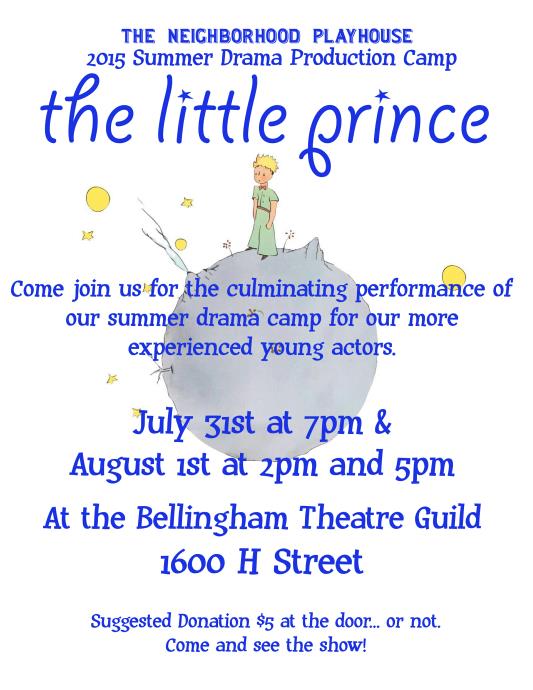
The Neighborhood Playhouse presents The Little Prince

little princeThe Little Prince is a magical tale, and I was immediately sold on the idea of a local production, performed by young people no less. The Neighborhood Playhouse Summer Drama Camp culminated in this production after less than two weeks; the ability of these teens to stand up with confidence and memorized lines after such brief prep is impressive enough, even if the play hadn’t been beautifully and feelingly done, which it was. Wow.

This was a musical production, and as I said about The Drowsy Chaperone, there were moments of less than perfect polish: these actors (whether youth or adult) are not professionals. But that’s okay! In fact, like when I go to watch college or adult-league sports, it’s part of the charm: I can see that these are “just” real people, like me, pursuing a passion. And I’m not criticizing. The level of performance here was very high – just not Broadway.

There were several very strong singers up there, especially the young lady who played the flower, but they all played their parts well. I felt the magic of St. Exupery’s original work, as these young actors communicated all the emotion of the pilot – his frustration, his regrets – and the prince, whose innocence is part of his appeal. I felt happy and lucky to be in the small audience. Thank you, Neighborhood Playhouse, and to the kids: bravo.


Rating: 7 snakebites.

The Winter’s Tale by William Shakespeare

I am working on a Maximum Shelf for the first book of Hogarth Shakespeare: The Gap of Time, by Jeanette Winterson. In preparation, naturally, I got myself a copy of The Winter’s Tale, which Winterson retells, so that I could see the connections clearly.

This is one of Shakespeare’s later plays, variously described as a romance, a comedy, or (as Winterson tells it) a play about forgiveness. It is indeed funny at times, although also tragic and pathos-ridden: in an echo of Othello, a jealous royal husband accuses his wife and best friend of being unfaithful together, resulting in deaths and betrayals he will deeply regret. The Winter’s Tale is indeed a more forgiving version, however, as the next generation gets a chance to correct these wrongs and start fresh; in fact, depending on your interpretation, even the jealous king himself gets a second chance.

There is the requisite Shakespearean clown, a lovable character known only as Clown; there is the requisite Shakespearean rogue, who successfully appears to the same people over and over in a variety of disguises. Which leads me to another Shakespearean requisite, the suspension of disbelief, as a father disguises himself successfully from his own son who knows him well, and a lost identity is easily provable after a lapse of 16 years. It’s all in good fun, though: these are accepted devices of the stage.

And fun it is, despite the unhappy scenes along the way. I also enjoyed a strong female character who stands up to the king and does not get damned for it: another shrew, if you will, but less ambiguously represented; this one is clearly a hero. The Winter’s Tale is a pleasing blend of humor and romance in the end, and I am excited to explore Winterson’s take on it. I only wish I could see it performed now that I’ve enjoyed Shakespeare’s telling. He remains a master.


Rating: 7 bears.