Slaughterhouse-Five by Kurt Vonnegut (audio)

Full title:

Slaughterhouse-Five, or the Children’s Crusade: A Duty Dance with Death
It seems a little odd to me that I’ve never read this book, and in fact I wondered if maybe I had, and had just forgotten. But as soon as we started listening to this audiobook (my parents and I, on the way home from New Orleans) I knew I’d never heard or read this book before. Vonnegut is always thrilling and fascinating! I know I really enjoyed his Cat’s Cradle and Breakfast of Champions, and Slaughterhouse-Five shares with them a very surreal, time-warped, rambling, fantastical tone. It feels like Fear and Loathing in Las Vegas, particularly the scene in the movie where they take the ether and things turn on their sides.

For those who don’t know, this is Vonnegut’s autobiographical story of the bombing of Dresden, which he experienced, like his protagonist Billy Pilgrim, as a POW in a slaughterhouse. Vonnegut, and Billy, survived only because they were holed up in the meat locker there, while the vast majority of the city burned.

Billy’s story involves war, bullying, sex, time travel, optometry, drinking, and misunderstanding. Overarching themes of death and timelessness tie the winding threads together. The world does not believe that Billy travels in time or that he was kidnapped by little green aliens from the planet of Tralfamadore. We hear of Billy’s whole life, as a small child, as a student, as a soldier in the war, as a young husband, as a professional optometrist, as a feature in a zoo on Tralfamadore, and as an old man. Like Billy, we don’t keep these experiences in sequence, but drop in here and there.

Billy’s story is preceded by a long intro in which Vonnegut narrates, not his experience as a soldier or a POW, but as a writer, many years later, struggling to write about Dresden. He visits an old war buddy and learns of this buddy’s wife’s fear of war. She’s concerned that he’ll write a book glorifying the experience and thereby encouraging future generations to make war. He reassures her that “there won’t be a part for Frank Sinatra or John Wayne” in his book, if he even ever finishes it. He also promises her he’ll call it “The Children’s Crusade”, agreeing with her that they were just babies over there.

This is a very powerful story. Descriptions of the horrors of war are evocative, perhaps even more so the depiction of the POW’s in the railroad cars passing steel helmets filled with their excrement to the men standing near the ventilation slots. War is bad. But there’s much more to this book than the point that war is bad; it’s also a fascinating story about family and relationships. (I’m reminded of Breakfast of Champions with its bizarre family structures and roles and dysfunction.) And the world of Tralfamadore is fantastical, incredibly imaginative, and so fully-developed in its details, I just wonder at Vonnegut. Where does he get this stuff? The turns of phrase are memorable. A drinking man’s breath smells of mustard gas and roses. That’s poetry.

This story is beautiful, strange, and strangely feels endless. It finishes with a question-mark; loose ends are not entirely tied up. How could they be, when events are presented out of sequence, and Tralfamadorian concepts teach that no one moment ever ends? Vonnegut was a genius, and I want to keep reading him all my life. (There are still a number of titles I haven’t touched, and were you aware? just this January, a new volume of his previously unpublished short fiction came out. It’s called While Mortals Sleep.) Oh, and I want to mention the reader of this audio version. He speaks in a strange whisper, and his style is very, very effective for this book. Guess who? None other than Ethan Hawke. I was surprised, and tried throughout to place this handsome actor behind the voice I was hearing; but I couldn’t put the guy I know from Reality Bites and Training Day into Vonnegut’s world. Very strange. I guess that’s the mark of a great actor, that he can fill different roles believably. I’m impressed.

Rebecca by Daphne du Maurier

Here’s yet another book I can’t believe I waited so long to read! I struggle to categorize this book. I think I thought it was genre romance, and I still tend to shelve it that way, but I also feel that sells it short. (Sorry, romance readers. Bear with me. I’m not trying to be ugly.) Of course, categorization is often problematic, and often doesn’t do a book justice. But we persist in trying to do it, for several good reasons. Labels are helpful in describing a book to your friends, and grouping like items together on a shelf assists browsing. So, I thought Rebecca was romance, or romantic suspense, as it says right on the cover of my paperback copy. And to me, this sounds like genre fiction: readable, easy, even “light”, entertaining, and in accordance with a known structure or format. Not a bad thing – I love a lot of genre fiction (although mostly mystery, and not romance). But I’ve also heard this book referred to as a classic. I’ve seen it written about and referred to repeatedly as a standard of sorts. My curiosity grew, and I had to pick it up.

And what a delicious little treasure it is! From the first page, I was transfixed. The mood is outstanding. I had only the vaguest of notions that something bad happened in this book, and I could feel the ghostly mist creeping unseen around my shoulders from literally the first few sentences. There is an air of foreboding that is absolutely unexplainable, as the plot proceeds in an outwardly staid and steady fashion. How does she do it?

Our narrator, who I believe remains unnamed throughout, is living a painfully awkward underprivileged youth when she meets a striking and tragic widower who abruptly proposes to her after a brief quasi-courtship. (This is not a spoiler, I don’t think, or not a very bad one. It is fairly well known from the first pages.) Anticipating this proposal was great fun for me. She accompanies him back to his famous (or infamous?) estate, and the legacy of the dead first wife looms.

Now I shall stop telling you the story. I might have known this much going in (at a maximum) and it was a real pleasure to breathlessly turn pages in ignorance of what was to come. It is suspense, people, as the cover says! If you haven’t read this, avoid spoilers with great care! And go get yourself a copy immediately! Here, you can borrow mine. (The library has several.)

The suspense is outstanding. The narrator’s awkwardness occasionally gets a little frustrating but it’s so REAL – my frustration is entirely realistic because she is realistic. The bad-guy characters are infuriatingly, in a juicy-delicious fictional way. The striking husband remains tragically striking, sort of admirable and obnoxious by turns, but I suppose the romance part drew me in, because I was right there with the nameless wife, wanting him to love us. And the background moodiness, the ghost-story feel, the gothic mists about my shoulders were entirely pleasurable.

I wish I could read this book again for the first time! I know du Maurier has written much else. I hope it is up to this standard because I thought it was outstanding. Genre fiction? I don’t know, I’m stumped, but whatever it is, it’s worth reading.

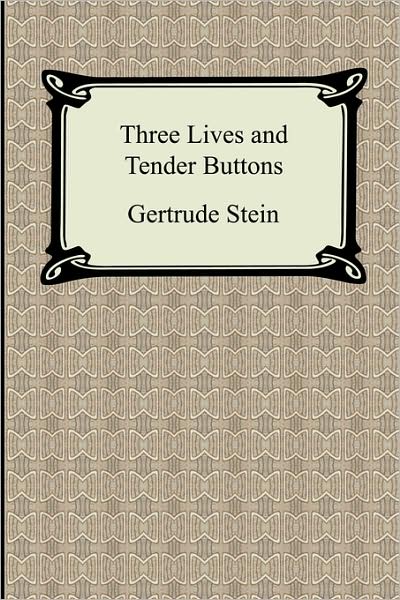
Three Lives and Tender Buttons by Gertrude Stein

I have this Digireads edition, see

I’m cheating a touch, because I read Three Lives some time ago. But it is bound with Tender Buttons in my edition and I’m going to write about them together. It is my hope that my writing about two Stein conundrums will distract you from the fact that I’m confused.

I found some unexpected free time one evening, and knew that I had reading commitments to fulfill, so I didn’t want to start anything of any significant length. I’ll try Tender Buttons, I thought. It’s all of 30 pages, I thought, how hard could it be? HA! Maybe I should have turned back to one of the stories out of The Things They Carried or a chapter of This Book Is Overdue! Either one of those would have been easier options.

So my interest in Gertrude Stein is entirely born of my intense interest in Ernest Hemingway. As we know, Stein was an early friend and mentor, with whom his relationship later soured; he greatly admired, then denigrated, her work, which is famously… er, unique.

When I read Three Lives I was a bit dismayed at my failure to appreciate it. I didn’t find it as difficult as Faulkner, thank goodness, but she certainly doesn’t follow anyone’s model structure for story-telling. Three Lives is made up of three novella-style life stories, of three women in a fictional small town. Their stories don’t go anywhere particular, nor do they join for any greater purpose, although they are evocative and poignant in their moments. I suppose they are vignettes, and well-done at times in their own way; but unorthodox and a little unsettling.

Tender Buttons is a wholly different proposition. It’s a long free-verse poem of sorts, presented sort of as a series of descriptions or discussions of random nouns. For example.

A MOUNTED UMBRELLA.
What was the use of not leaving it there where it would hang what was the use if there was no chance of ever seeing it come there and show that it was handsome and right in the way it showed it. The lesson is to learn that it does show it, that it shows it and that nothing, that there is nothing, that there is no more to do about it and just so much more is there plenty of reason for making an exchange.

or

A NEW CUP AND SAUCER.
Enthusiastically hurting a clouded yellow bud and saucer, enthusiastically so is the bite in the ribbon.

At first this bothered me very much, because I was trying to make sense of it. Her sentences are not sentences; they do not seem to have meaning, or if they do, I am too dense to find it. Unlike the poetry I am familiar with (and I’m no scholar of poetry, but I have read some, and even free-verse generally has some structure – some clues as to how to read it, like line breaks or, hello, punctuation!), there is no guide for where the natural breaks are in language – where a person would draw breath when reading aloud, for instance. (I tried reading this out loud to the Husband while he worked on our deck and he was NOT tolerant.)

But then I decided that Gertrude Stein’s poetry is like Cirque du Soleil or Cats, in that there is no plot or point to speak of, but there is poetry. Read Tender Buttons aloud; it makes music. This is the best way that I can find to appreciate Stein. She is a challenge, make no mistake. And perhaps there is great depth of meaning and I’m missing it because I’m simple. If so, please do comment here, being gentle and kind about it, and explain what I’ve missed. I’m willing to make an effort to appreciate Stein, for Papa’s sake (unlike Faulkner, who I’ve given up on, I think) but she does require an effort. On the other hand, with effort, I find Tender Buttons an intriguing puzzle and it does stimulate and entertain me; just not in the way I usually expect books to do!

I am claiming this one for credit in the Classics Challenge. I think I’ve earned it. Please don’t make me write a book report as I remain a little baffled. But, I’m also excited at the prospect of reading Janet Malcolm’s Two Lives (a biography of Stein and her lifelong partner Alice B. Toklas. notice the play on Stein’s Three Lives), which has patiently resided on my shelf for years now. Look for that one to come. Perhaps Ms. Malcolm will help me understand Ms. Stein!

Teaser Tuesdays: Rebecca by Daphne du Maurier


Teaser Tuesdays is a weekly bookish meme, hosted by MizB of Should Be Reading. Anyone can play along! Just do the following:

* Grab your current read
* Open to a random page
* Share two (2) “teaser” sentences from somewhere on that page
* BE CAREFUL NOT TO INCLUDE SPOILERS! (make sure that what you share doesn’t give too much away! You don’t want to ruin the book for others!)
* Share the title & author, too, so that other TT participants can add the book to their TBR Lists if they like your teasers!

OH this is a fabulous book! I love that there are SO many great reads out there. I know that I can keep saying this my whole life: why did I wait so long??

Your teaser today comes from page 36:

I wanted to go back again, to recapture the moment that had gone, and then it came to me that if we did it would not be the same, even the sun would be changed in the sky, casting another shadow, and the peasant girl would trudge past us along the road in a different way, not waving this time, perhaps not even seeing us. There was something chilling in the thought, something a little melancholy, and looking at the clock I saw that five more minutes had gone by. Soon we would have reached our time limit, and must return to the hotel.

I’m adoring this book; it’s delicious. The beginning is mostly in pursuit of romance, and I’m excited for the engagement that is clearly coming (this is not a spoiler; the whole book is about the narrator’s role as Wife). But even in the midst of a budding marriage, the tone is spooky. The story is written from a distance of years, and with the narrator’s knowledge of what unpleasantness is to come – but I, the reader, don’t share this knowledge. I know something unpleasant is coming, but don’t know what. It feels like a ghost story but actually I really don’t know what’s wrong at Manderley! How exciting! I know, I’m very late to discover this enjoyable book, but I am enjoying it now!

The Heroine’s Bookshelf by Erin Blakemore

I have a delightful little book to share with you today! I mightily enjoyed Erin Blakemore’s The Heroine’s Bookshelf: Life Lessons, from Jane Austen to Laura Ingalls Wilder.

Blakemore’s message is this: we are all heroines in our daily lives, or at least we can and should be; and we have a wealth of heroines to learn from. These are the women of our favorite books. She organizes her book by chapters which each deal with one lesson or attribute (including dignity, happiness, and simplicity), represented by one author (all are women) and one female character, from one book or series. I would love to list them all here for you but feel I should leave you something to discover when (not if!) you pick this book up yourself; so I shall tease you with Alice Walker and Margaret Mitchell, on top of the two authors Blakemore names in her subtitle.

It’s a very sweet, comforting, and comfortable little book. Twelve chapters explore twelve women’s literary impact on our world. Eleven of them I definitely call classics; one I’d never heard of! but of course I don’t know everything. Blakemore’s approach is intimate and loving and a touch incisive. It’s not an academic or intellectual book, but it’s not what you might call “fluffy”, either. She did do some research, I’m sure, as she discusses not only what’s between the pages of the books in question, but also notes biographical details about the authors and draws some conclusions. For instance, I didn’t know about the 2008 revelation by the descendants of Lucy Maud Montgomery about her death. This book is not too serious – a light read – but an important one, at the same time.

I am absolutely inspired to read, and re-read, the books examined here. I share Blakemore’s love for Jo March, and I wonder at her selection of Jane Eyre over Wuthering Heights, but we’re all unique, individual heroines, aren’t we. I marvel at her call to compare Frances Hodgson Burnett to Britney Spears and Amy Winehouse! but I admire her for it, too. Again, the adjectives that come to mind are comfortable, almost warm-n-fuzzy.

I need to own this book; the library’s copy will not suffice. And I think YOU should own it, too. Who am I talking to here? Well, I readily accept that many of these books are “girls’ books” (or women’s). But some are absolutely essential to us all: A Tree Grows in Brooklyn, for example, is an important book all around. This book is directed at women, but is not necessarily to be enjoyed by them exclusively. I’m sure you know who you are.

I can almost see a book club (or reading blog) project coming out of this. I would be very happy to shelve this book, in my home library, next to its twelve objects of study, and read them all in a streak of thirteen, with a mind to discussion. This would be a lovely thing to share with other women – and a willing man or two if they could be located. I don’t have the energy to put this together at this time, but do invite me if you decide to. 🙂

I’m so glad I found this little jewel. I hope you’ll find it, and enjoy it, too.


Edit: My mother asked who this author is, and I had to go looking for the answer, so here it is, Mom: she calls herself “a writer, entrepreneur, and inveterate bookworm” on her website, and I was immediately drawn in to her blog and have added it to the list of blogs I follow.

Main Street by Sinclair Lewis

This is a real star. I’ve been so pleased to take in this witty, bitingly satirical story of small-town life. The setting is the fictional town of Gopher Prairie, Minnesota, based on Lewis’s hometown of Sauk Centre; but as he says in the introduction, “the story would be the same in Ohio or Montana, in Kansas or Kentucky or Illinois, and not very differently would it be told Up York State or in the Carolina hills.”

This is my first experience with Sinclair Lewis, and I’m sorry I waited so long. Certainly his other work is now on my long list TBR.

It’s the story of Carol Kennington (née Milford), who as a college student has some vague and lofty ideas of improving small towns, before she marries and settles in Gopher Prairie. This small town (patently representative of small towns everywhere – Lewis all but beats us over the head with this statement) does not want to be improved, does not believe it needs improving, and disapproves of Carol on every level. It’s a painful story, and it drags along, not becoming boring, but definitely oppressive in Carol’s pain. She’s no pristine heroine, repeatedly distracted from her lofty goals of uplifting Gopher Prairie and the human race; she’s decidedly flawed. And yet I don’t think the reader can help but sympathize with her.

She tries to implement her idealized improvements but is rejected in her theater group, her improvement of the town library, her crossing of social, economic, and class lines. She tries to escape in a few cheap flirtations, but none is consummated – her choices of love are disillusioning. She finally makes her husband take her on a trip to leave behind the doldrums, but her relief is temporary. From page 393:

Yes. She was back home! Nothing had changed. She had never been away. California? Had she seen it? Had she for one minute left this scraping sound of the small shovel in the ash-pit of the furnace? But Kennicott preposterously supposed that she had. Never had she been quite so far from going away as now when he believed she had just come back. She felt oozing through the walls the spirit of small houses and righteous people. At that instant she knew that in running away she had merely hidden her doubts behind the officious stir of travel.

Finally, just when I thought we were going to wallow forever, Carol up and leaves town with her three-and-a-half-year-old son for Washington, D.C., where she starts a new and relatively satisfying life. But she is still not ultimately fulfilled… Relatively quickly, she ends up back in good ole GP with good ole Will Kennicott. The book ends with Carol resigned to GP, with an oddly comfortable but not entirely content feeling. I found this a ending a little strange. So much of the book had been writhing discomfort and dissatisfaction and dreaming and planning for something different. Then we finally – very late in the game (by which I mean the book) – saw Carol go to DC for a life that I do see was not entirely suited to her, but also seemed very much an improvement. And then she went back… home? Do we call it home? She makes a few final defiant statements at the end of the book; but her defiance is in spirit and not in action or even, I feel, in emotion. I’m not disappointed with the ending. I suppose I’m a bit surprised. I’m awfully removed from Carol’s world. I will see my 30th birthday a good 95 years after hers; and I’m if anything a bit independent in my own time. Her life in DC looked pretty interesting to me but I realize that I am not Carol. And who on earth could I have been in her day? But I digress.

Lewis’s criticism of Gopher Prairie and by extension, all of the U.S., is almost cruelly biting, but also wonderful, witty, and funny. I was entertained from the first page. Besides American hypocrisy, or maybe even before it, its largest social issue is definitely feminism and women’s place in the home. But there is also tangential treatment of war (World War I), communism, workers’ rights, religious hypocrisy, class structures… and Carol doesn’t escape criticism, either. Lewis reserves a sneer for the out-of-touch artsy do-gooder in her. But in the end I think he retains something of a loving touch for most of his characters at the same time.

The writing was delightful. I laughed out loud and I felt Carol’s pain, and I felt for the ridiculous Will Kennicott (who mostly, I did not like) when he stoically handled Carol’s infidelity-in-spirit. But I also gloried in the turns of phrase. I loved “that amiable contempt called poise” and that Carol “picked [the book] up carelessly, with a slight yawn which she patted down with her fingertips as delicately as a cat.” Does that not paint a portrait?

I was interested to find, in the Afterword (by Mark Schorer of the University of California, in my Signet Classic paperback edition of 1961), discussion of this book in relation to Madame Bovary. Apparently my repeated comparison of the two, while I was reading, has a strong precedent. Schorer writes,

Madame Bovary is more than a study of provincial manners in a certain time and place in France; that much is only the setting for a highly dramatic presentation of human catastrophe. But Main Street cannot be lifted out of its historic setting, which is, in effect, the whole of it.

Perhaps this is what I was saying above, about trying to put myself in Carol’s shoes. At any rate I found the Afterword to be a few thoughtful pages, worth the time I spent on it.

I picked this up as a casual read and it was very enjoyable and worth my time and interest. I’m going to apply it towards the Classics Challenge at which I am so miserably far behind, so there we go. More to come!

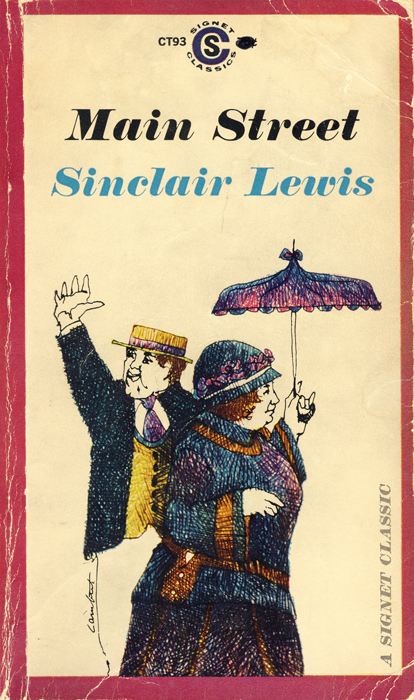
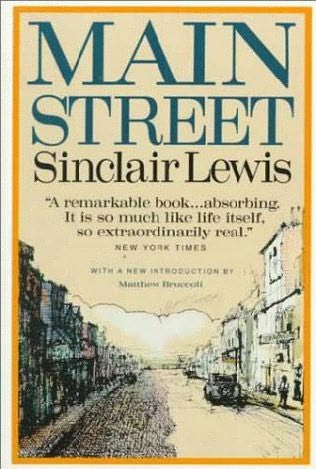
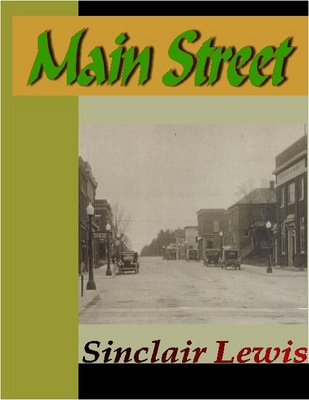
Main Street by Sinclair Lewis: a study of covers

I’m not finished reading this book yet – I’m still splitting my time between Dethroning the King and Main Street. They’re both delightful! And a bit long, but mostly I’m just very busy right now. (School is ramping up for the end of the semester, and my big race is in a week and a half…) So, thanks for your patience. Anyway – I haven’t finished Main Street, and I haven’t written much about it here; I’m waiting to finish and write up all my thoughts at once. (I have lots of thoughts.) But in the meantime, I went looking for different covers.

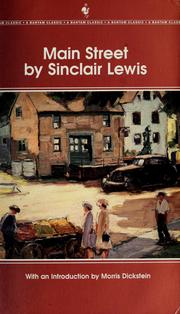
There have been many editions of this book, and many different covers. I’ve got a collection of them here for you. This won’t mean much to you if you haven’t read the book yet, but I wonder about your thoughts. Some of these cover designs seem to emphasis the titular Main Street, and I guess that’s a nice picture, and plays into the title. But I feel that the real Questions (capital Q) of the book deal with the People who color the street, if you will. The cover of the edition I’m reading is the very last one pictured here, and I actually think I like it the best. (It’s a charming little paperback that requests to be sold for 75 cents!) It concentrates on the people, leaving Main Street out altogether, and the fact that the two people (overlapping, and presumably “together”) are turned away from each other, and each seeming to hail someone else, seems especially appropriate to me. The book indicates that the inhabitants of Gopher Prairie, Minnesota are overly concerned with the opinions of others. It all fits, to me.

With no further ado, lots of Main Street covers for you! Do you have any thoughts? Any favorites? Or have you not read this book and I’m boring you completely? (My full write-up will come eventually. I promise.)


my Signet Classic edition

Teaser Tuesdays: Main Street by Sinclair Lewis


Teaser Tuesdays is a weekly bookish meme, hosted by MizB of Should Be Reading. Anyone can play along! Just do the following:

* Grab your current read
* Open to a random page
* Share two (2) “teaser” sentences from somewhere on that page
* BE CAREFUL NOT TO INCLUDE SPOILERS! (make sure that what you share doesn’t give too much away! You don’t want to ruin the book for others!)
* Share the title & author, too, so that other TT participants can add the book to their TBR Lists if they like your teasers!

I am going to revolt and share a slightly longer passage because it’s just too funny (from page 194):

They had gone to the “movies.” The movies were almost as vital to Kennicott and the other solid citizens of Gopher Prairie as land-speculation and guns and automobiles.

The feature film portrayed a brave young Yankee who conquered a South American republic. He turned the natives from their barbarous habits of singing and laughing to the vigorous sanity, the Pep and Punch and Go, of the North; he taught them to work in factories, to wear Klassy Kollege Klothes, and to shout, “Oh, you baby doll, watch me gather in the mazuma.” He changed nature itself. A mountain which had borne nothing but lilies and cedars and loafing clouds was by his Hustle so inspirited that it broke out in long wooden sheds, and piles of iron ore to be converted into steamers to carry iron ore to be converted into steamers to carry iron ore.

If that’s not clever and funny and insightful I don’t know what is.

And in case you need help (like I did) with mazuma, Answers.com tells me it is slang for money or cash.

I’m enjoying Dethroning the King simultaneous with Main Street. Aren’t I a lucky girl!

What is a Classic?

I’ve been struggling with this question lately. I think my concern began in contemplating the Classics Challenge which I have NOT been active on. But it’s an interesting question generally. I was thinking yesterday’s post might aid us. Is everything on this list-of-lists (-in-cloud-form) a classic? How many classics are there in this crazy world? Too many to list, right? Is everything by one classic author then a classic? (Nabokov wrote Lolita; is Pnin then also a classic?) How about timing? Do we have to muse over a title for a decade or several, or can we declare in its publication year that it is a classic? (Is there a waiting period, time for us to cool off and see if the fire still smolders?)

Courtney, who is hosting this challenge over at her blog, Stiletto Storytime, does define it for us:

What is a classic you ask? A classic to me is a book that has in some way become bigger than itself. It’s become part of culture, society or the bigger picture. It’s the book you know about even if you have not read it. It’s the book you feel like you should have read.

This sounds like a pretty forgiving definition to me – and thank goodness, since as stated, I haven’t made much progress on this challenge yet! But I yearn to hear your definition, too. What is a classic?

(And by the way, I’m hanging in there; I’m currently really enjoying Main Street by Sinclair Lewis. That’s a classic, right?)

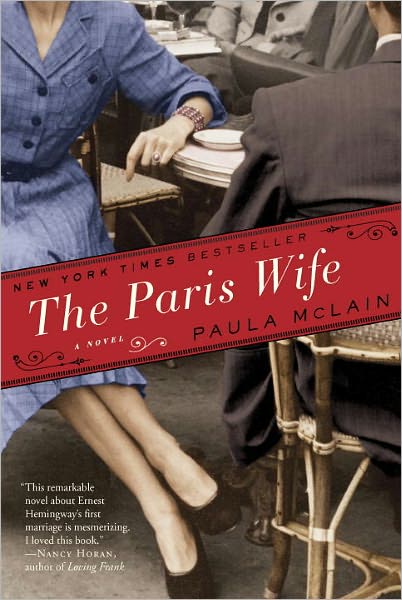
The Paris Wife by Paula McLain

Ahhh. This was really a joy and a pleasure to consume. I’m just sorry it’s over.

(Let me apologize in advance for a lengthy post today, but I have a lot to say about this book.)

Ernest Hemingway is my greatest literary obsession; I’ve certainly loved, and returned to, and reread, and studied other authors, but Hemingway has been the love of my reading life. Certainly, that was a large part of the appeal of this book: to come home to familiar and much-loved territory. We all know that feeling, I think: visiting an old neighborhood, hearing a song from one’s happy youth, telling old friends the same old stories of shared memories.

So, as I’ve said, part of the luxuriant pleasure of this book was all the intertwining threads of familiarity. I have recently been reading By-Line: Ernest Hemingway, a collection of his newspaper and magazines stories and dispatches, many from the Hadley era of his life. I’ve read 3 or 4 biographies, and piles of his novels and short stories, and nonfiction/memoirs like Death in the Afternoon (about the bullfights he saw) and A Moveable Feast (about his life in Paris with Hadley). And I just yesterday purchased The Garden of Eden, a novel published posthumously (and controversially edited by his surviving family), about a couple who becomes a triangle on the beaches of France and in Spain. I read it years ago but wanted to own my own copy. I remember really loving this book, although it’s surrounded by critical ambivalence and debate; this is where Hemingway most directly ventures into gender-changing, gender ambiguity, cross-dressing, bisexuality, threesomes… and all sorts of interesting and disturbing subjects linked by some biographers to Hemingway’s mother’s tendency to dress him up as a little girl when he was young. I find it all fascinating.

my Hemingway library at present


Hadley Richardson was Hemingway’s first wife; they married when he was just 22, and she was 29, and surprised at herself for landing such a vibrant, popular, ambitious young man. They took off for Paris quickly, and shared the early years of Hemingway’s career, including the publication of Three Stories and Ten Poems, In Our Time, and The Sun Also Rises, his first novel and the one that really launched his career. They also shared poverty and insecurity, a number of hardships, an unstable but scintillating circle of famous friends, and an unplanned pregnancy. Their story ends (I’m not giving anything away here, it’s history) when Hemingway begins an affair with Pauline Pfeiffer, who will be his second wife (who will be thrown over for the third, who will be thrown over for the fourth, who will hear the gunshot when he commits suicide just before his 62nd birthday).

So, as I’ve said, a large part of the joy of this book for me was sharing so intimately in the life of someone I feel I know well, and whose work I love. But there was a real danger there; for if it had been done badly or in poor taste (overly sentimental or maudlin, or vindictive towards Hem the womanizer) or inaccurately, imagine my upset! With this subject being so near to my heart, the standards were very high.

Paula McLain has my gratitude and admiration, because she’s done beautifully! This is a gorgeous novel. Her writing style (in Hadley’s voice, in first person) is a bit like Hemingway’s, although not quite so sparse. She paints pictures with short brush strokes. Hadley’s character is an interesting blend of strength and weakness (which is an observation she makes about Hem, too); she repeatedly bemoans her un-modern tendency to obey and bow to her difficult husband, compared with the women around her and their new-age relationship rules. She “lets him go” to Pauline without a fight, from the perspective of several mutual friends. But I think she maintains a certain dignity, and not just in her defeat at the deceitful Pauline’s hands. And at any rate, her voice is clear and authentic and emotionally revealing without being sappy. She seems to be honest with herself, and with the reader. In many ways this is a novel about a woman struggling to find and maintain her own identity in the unique setting of 1920’s expatriate Paris, and while being a loving wife and mother. In this sense it wouldn’t need to be about Hemingway; it’s a woman’s story, and it’s important without the celebrity. It reminded me a little of Kate Chopin’s The Awakening, or The Painted Veil by W. Somerset Maugham.

I loved how McLain (or Hadley) used some of Hemingway’s own rhetoric about truth and turned it back around on him. For example, on page 230, Hadley is dealing with her feelings about being completely left out of the book, The Sun Also Rises, when all the others present made it in as characters (none flattering):

I was incredibly proud of him and also felt hurt and shut out by the book. These feelings existed in a difficult tangle, but neither was truer than the other.

Hadley was a complex and mostly sympathetic character; I got frustrated with her here and there for not standing up for herself a bit more, but she was so authentic and real and human, I mostly was able to take her as she was. Hemingway was not so sympathetic, which is also very authentic and real. He was a cad towards the men and women in his life, pretty consistently. He was also very lovable, which is why so many men and women came back to him over and over for more fun and abuse. He was, as Hadley says on page 311,

such an enigma, really – fine and strong and weak and cruel. An incomparable friend and a son of a bitch. In the end, there wasn’t one thing about him that was truer than the rest. It was all true.

Again with the truth of the thing, which Hem himself loved to cite.

What a work of art this book was, and how evocative of emotions. It was exhausting and cathartic. Is my reaction colored by my love of all things Hemingway? Yes. But my standards were also raised almost impossibly high, so please take me seriously when I give McLain an A+, and thank you, ma’am.