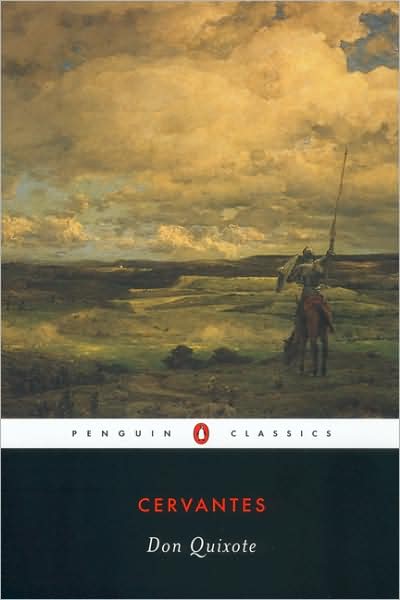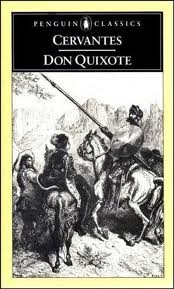
Don Quixote by Cervantes, trans. by J.M. Cohen: The First Part

Thank goodness Cervantes gives us a “First Part” division right at the halfway mark of this big book, because I need it. I have a huge number of galleys to read for review, and the Gone with the Wind readalong going on as well. So Don Quixote is getting a break. But, I am enjoying it and will be picking it back up! So, eventually, expect a Second Part.

For a chunkster, this is surprisingly easy reading. Don Quixote and sidekick Sancho are just goofily traversing the Spanish countryside, having haphazard and silly adventures which they view in different terms. At the beginning, Sancho’s perspective is that of reality, more or less, with an ongoing desire to please his master and see things his master’s way, and Don Quixote’s perspective is entirely fantastical, based on the novels of chivalry he has read until his brain became mush. (The perils of novel-reading, children!) As they continue their adventures, though, Sancho buys into the fantasy – mostly. He retains a more cynical view that his master, who is completely off his rocker where errantry is concerned.

I was definitely intimidated by its bulk, but these 900+ pages of story are split into little episodes only 2-3 pages long in some cases. What I’m saying is, if you’re intimidated by the bulk of Don Quixote, don’t be! It’s remarkably easy, and entertaining, reading.

Don Quixote is a gentleman of leisure living in the countryside of La Mancha. (This is Spain in, erm, the 1600’s or 1500’s? Published in early 1600’s. I’m not too clear on the precise setting in time, 16th vs. 17th century Spain, and the niceties thereof, not being a strong point in my education to date.) He becomes so obsessed with his novels of chivalry and the knights errant and their lady loves and great deeds, etc., that his mind becomes confused. He outfits himself in a comical assortment of bits and pieces and substitute parts, thinking he is an elegant knight. He roams the countryside on his tired old horse, with a squire named Sancho on a mule, imagining that he achieves feats of gallant and courageous battle and strength, when in fact he (famously) does battle with windmills, releases dangerous criminals from the King’s custody, gets himself and Sancho beaten repeatedly, makes promises he clearly will not be able to keep, and generally makes a fool of himself.

The book, which was originally published in two volumes (thus, two parts!), follows a meandering story line; it is more a series of small adventures, the kind that might be published serially. Some of these adventures leave Don Quixote and Sancho sidelined while we meet other temporary protagonists. These are a welcome respite when Don Quixote’s ridiculous behavior becomes tiresome. I get most excited and engrossed in his adventures when there are plenty of other characters milling about; just Don Quixote and Sancho together can get a little bit repetitive. It is easy to get annoyed with Don Quixote because he is exasperating; but this is intended. He is a ridiculous character.

I am surprised at what an easy and quick read this is turning out to be, and at how often I giggled aloud. Don’t fear the chunky Classic of Literature, friends. Although setting the book aside for now, I look forward to returning to it. Part the Second to come.

Teaser Tuesdays: The Picture of Dorian Gray by Oscar Wilde

Teaser Tuesdays is a weekly bookish meme, hosted by MizB of Should Be Reading. Anyone can play along! Just open your current read to a random page and share a few sentences. Be careful not to include spoilers!


I am tackling another classic, this time via audiobook in the car. Unabridged, of course! Here is your teaser. Happy Tuesday.

I remember her bringing me up to a truculent and red-faced old gentleman covered all over with orders and ribbons, and hissing into my ear, in a tragic whisper which must have been perfectly audible to everybody in the room, the most astounding details. I simply fled.

Gone with the Wind part 1 (ch. 1-7)

Oh my. Am I ever glad that I have finally begun to read this book! I shouldn’t have waited so long. It IS a chunkster, and I AM busy right now. But what a book.

How did I get here?

The Great Gone with the Wind Readalong is hosted by The Heroine’s Bookshelf blog. This is what finally prompted me to read a book that’s been on my list for years. Thank you so much, Heroine.

Where am I coming from?

I feel like this is weird, but I have never read this book, never seen the movie, and had only the slightest and vaguest idea what it was about. All this, and I am a Southerner (to the extent that a Houstonian is a Southerner… that’s a different post). In my mind, this book is a little bit crossed with The Glass Menagerie. I don’t know why. I read the latter, in high school, although I do not seem to have a lasting impression of it. I think I did admire it; I remember the glass menagerie itself; I remember the suitors and my frustration with the mother. But there are some blurry lines between the one masterpiece of Southern-set fiction which I have never read, and the one I have. By the end of this readalong I certainly expect to have that cleared up!

What’s the drill?

Erin of The Heroine’s Bookshelf is hosting this readalong that involves 5 discussion dates, by which we will all have read 5 sections of the book. I am doing my best to pace myself so that the section in question is still fresh when the discussion comes along. So, we can all hop over there to join in a discussion, which I certainly will. But! I have my thoughts to share with you here, too.

What do I think so far?

This is an extraordinary work, just in the sense of evocative description, Mitchell’s ability to place me firmly in the time-and-place. At the end of the first page, I was hooked and admiring. She chooses very unique adverbs that draw my attention and let me see what she sees. The twins’ “long legs, booted to the knee and thick with saddle muscles, [were] crossed negligently.” Crossed negligently? She could have spent a paragraph trying to tell me what she has shown with that one adverb. “They were as much alike as two bolls of cotton.” Or earlier, Scarlett’s “green eyes in the carefully sweet face were turbulent, willful, lusty with life, distinctly at variance with her decorous demeanor,” because “her true self was poorly concealed.” I already feel like I know a great deal about all 3 of these characters – with no dialogue – and all this on page one! I’m all the way in.

As promised (threatened?) by Erin, I was indeed tempted to just rush past this first section and keep going. I’ve decided to stick with the schedule, though, which allows me to read other books in between. Part one was delightful, and able to stand alone, at least for a bit. I got to know Scarlett, appreciated her odd and not completely likeable personality and traits. This is a good stopping point, as a chapter of her life ends; part two will clearly begin the next. I look forward to it.

Please be sure to stop by the hosted readalong discussion, too.

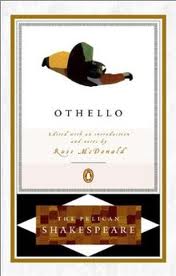
Othello by William Shakespeare

Wow, what a work. There’s a reason we still read, admire, study, and act this play today, what, 4 centuries after its creation. I read this, like The Taming of the Shrew, years ago, but I needed the refresher for the performance I’m going to see tonight.

What can I say about Othello? Othello is “the Moor,” a general in the Venetian army. He has happily married the beautiful Desdemona, and they have set out together to Cyprus where Othello has been posted. They are a happy and loving couple, but Shakespeare gives them a tragic fate. There are men about who do not wish them well. Iago is the main villain; he is jealous of Cassio, who Othello chooses as a second in command. He uses Rodrigo, who wanted to marry Desdemona, as a pawn. Iago tricks Othello, who believes him to be a faithful friend, into thinking that Desdemona and Cassio are lovers. He convinces Rodrigo that Desdemona will be his if he will just kill Cassio; really, Iago wants them both dead, and also encourages Othello to kill his wife. His intention is to gain himself political power. He also uses his wife, Emilia, servant to Desdemona. The handkerchief is the fateful detail: Othello gave it to Desdemona; Iago obtains it and plants it on Cassio; and it seals the innocent, saintly Desdemona’s fate. The final tragic scene ends with Othello’s murder of Desdemona, his discovery of Iago’s treachery, and his suicide.

It is classic Shakespearean tragedy, reminiscent of Romeo and Juliet in that final scene as Othello laments over his beloved wife’s body. The important difference, of course, is that there was no murder in Romeo and Juliet; Othello cannot be an entirely sympathetic character. It is especially frustrating to hear the faithful Emilia argue Desdemona’s innocence and have Othello reject it. But Iago, as I said, is the real villain; Othello is victim to his machinations.

I enjoyed this play all over again and always recommend it, as I do all of Shakespeare’s work. I’ve always been a big fan. I tend to think that I prefer the comedies, but in rereading his tragedies I find the same genius and the same ability to wrench my emotions in the desired direction. He was truly a great artist. I do have a fondness for the comedies, though; I forget, until I see or read them again, how accessible and universal the humor is. Last summer I went to A Midsummer Night’s Dream as produced by the Houston Shakespeare Festival, and marveled, once more, at how appealing, funny, and fun it is. Please! If you’re in Houston, don’t miss this annual summer event. Again, this year they’re producing Othello and The Taming of the Shrew, and it’s FREE, and you can sit on the hill with your dog and/or your picnic dinner and/or your beer, wine, whatever. Couldn’t be better. Check out the Miller Outdoor Theatre schedule for details.

The Taming of the Shrew by William Shakespeare

I am sure I have read this play before, because I have some vague memory of it; but I don’t know when. My reread is inspired by the Houston Shakespeare Festival: I’m going to go see both this, and Othello, in the next week. Fellow Houstonians, don’t miss this event! These two plays are both showing 4-5 times, in the next 8 days or so, at Miller Outdoor Theatre. For FREE. It’s an awesome summer tradition; I’ve been attending the Shakespeare Fest every summer since I was small. Don’t think I’m going to find time to reread Othello, sadly.

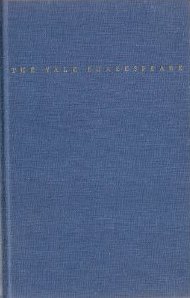
So. The Taming of the Shrew is not one of Shakespeare’s most famous plays (and was rather hard to find at Half Price Books. Lots of Macbeth, Romeo and Juliet, Midsummer Night’s Dream. Thus my very sweet, but visually unstimulating, little Yale Shakespeare blue cloth-bound hardback, pictured), but I think it’s a nice little romp. It’s a comedy involving two sisters: Bianca, the younger, has several suitors; she is attractive and admired. Her older sister Katherina, however, is very difficult, sharp-tongued, scolding, and generally unattractive to prospective suitors. Their father Baptista forbids any suitors to Bianca until such time as Katherina is married. I’m not entirely clear on whether it was his express intention or not, but the result of this is that Bianca’s suitors set out looking for a husband for Katherina, aka the shrew. They find a willing suitor, Petruchio, who feels that Kate’s wealth is worth the fight, and he has a plan. Thus the title: Petruchio sets out to tame the shrew, using such ugly, abusive, domineering, insane behavior that she gives up being “shrewish” and submits to his every desire, agreeing with any crazy thing he says. (The sun is the moon. An old man is a beautiful young maiden. Yes, husband, anything you say.) Petruchio weds, and tames, Kate; sundry other characters wed too. Lucentio marries Bianca, and Hortensio marries a widow (also for her money). The three new husbands make a bet on their wives, as to who can be shown to be most obedient. Petruchio’s reformed shrew wins him the bet, and she ends the play with a speech arguing that a woman should serve and obey her “lord” (husband).

There has been much controversy over this play, pretty much since it was born, regarding gender/marital roles, misogyny, feminism. I’m a bit inclined to agree with the camp that says Shakespeare was actually on the women’s side and was being instructively tongue-in-cheek, but mostly I’m willing to sit back and hear what you think; I don’t find it entirely clear what Shakespeare had in mind, from this distance. (I never did finish Fraser’s Young Shakespeare and thus have not started his Shakespeare: The Later Years. I found the writing awfully dry. If I ever finish these, or find a more palatable biography, perhaps I’ll take a stab at pretending I know what he had in mind. Until then, I am agnostic on this point.) At any rate, it’s an interesting study. Yes, Petruchio’s treatment of Kate is offensive; yes, her final speech makes me shiver. But she wasn’t a respectably independent woman early on; she was just kind of bitchy. Neither of them is sympathetic. So, it’s not as clear-cut as, Petruchio destroys Kate’s fine and virtous strong-woman spirit, or anything.

At any rate, I’m almost certain the upcoming performance will be the first time I’ve seen this play onstage, and I look forward to seeing how the Festival handles the political problems of The Taming of the Shrew. You can expect to see my write-up of the show soon.

Anybody read this play? How do you react to the chauvinism?

book beginnings on Friday: Gone with the Wind by Margaret Mitchell

Thanks to Katy at A Few More Pages for hosting this meme. To participate, share the first line or two of the book you are currently reading and, if you feel so moved, let us know what your first impressions were based on that first line.

I know, I know. But I’ve never read it! I’m in good company, too, because I’m reading this one with The Heroine’s Bookshelf‘s readalong. It’s not too late to join in! (Okay, you might be a bit behind, because the discussion of the first 7 chapters is Monday. It is possible.) I’m very excited.

Beginning:

Scarlett O’Hara was not beautiful, but men seldom realized it when caught by her charm as the Tarleton twins were. In her face were too sharply blended the delicate features of her mother, a Coast aristocrat of French descent, and the heavy ones of her florid Irish father.

There you have it; we’ve met our lady. Have you read this book? Care to join us?

update: more answer to the question, what is a classic?

The other day, y’all, I was really delighted to find a new blog called Dead White Guys: An Irreverent Guide to Classic Literature. This sounds like great fun. I like her philosophy, from my explorations so far. Check it out.

I was perhaps most excited, however, to find her answer to the question: What makes a classic? (You can visit my musing attempt at an answer here.)

I find that we mostly agree. Amanda says a classic is “a book that is timeless (but not necessarily old), excellently written, and contributes to the Great Conversation of human thought (to borrow a phrase from Robert Hutchins).” (Ahem: the Great Conversation is also the name of an annual event at my alma mater. Thank you.) So. I also said timelessness was a criterion, but I am still concerned that maybe there should be some sort of wait list? What if we all LOVE this new book in 2011 and think it’s a classic – can we really know, in 2011, if it will pass the test of timelessness?

Excellently written (elsewhere she says “artistically well done”), yes, absolutely also a criterion. But this is a hairy mess of subjectivity. Taken on a case-by-case basis, and assuming I am the judge of this, okay. Excellently written. I shall judge.

Contributing to the Great Conversation a la Robert Hutchins is an excellent requirement, too. That’s one I left off of my earlier (totally inadequate) musings on the subject. Again, subjective, but I think we might be able to agree on this one a little more easily. Of course all judging of the merits of Art face this problem. Also, what if a book is timeless, and beautifully written, but doesn’t tackle the kind of difficult themes that might cause it to make Contributions? Still a classic?

Do you have any thoughts to share? I’m always interested in input on this subject; it continues to bother me. Please comment. And go check out Dead White Guys; I’ll be doing the same.

Teaser Tuesdays: Don Quixote by Cervantes, trans. by J.M. Cohen

Teaser Tuesdays is a weekly bookish meme, hosted by MizB of Should Be Reading. Anyone can play along! Just open your current read to a random page and share a few sentences. Be careful not to include spoilers!

Here ’tis! The Classics Challenge continues.

My teaser today comes from Don Quixote by Cervantes, translated by J.M. Cohen. From page 158:

When Don Quixote realized that Sancho was making fun of him, he got so furiously angry that he lifted his lance and dealt him two blows which would have relieved the master of the duty of paying his squire’s wages, unless perhaps to his heirs, had they caught him on the head instead of on the shoulders. But when Sancho found himself so poorly rewarded for his joke, he was afraid that his master might carry the matter farther, and said to him with great humility: ‘Gently, your worship; I was only joking, I swear.’

I am just beginning this book (am not even to page 158 yet, and my edition runs over 900 pages!), but I already believe that this is a representative passage. There have been several instances of Don Quixote losing his temper and dealing blows; and this passage was chosen at random. I think the dealing of blows may be a theme.

I’m excited to be into such a formidable classic text. What are you reading these days?

a pair of Quixotes

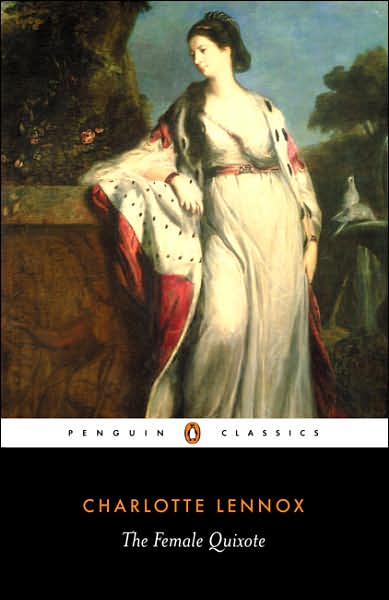
I have a slightly 🙂 ambitious summer plan, y’all. Tell me what you think. I’ve always wanted to read Don Quixote (yes, for the first time), and I hope that this is the year. I have also heard from more than one source about a book called The Female Quixote, or The Adventures of Arabella, by Charlotte Lennox. I think these would make a good pair of companion reads. The latter claims to be “part imitation of and part commentary on” the original Quixote (so says the “product description” on Amazon, usually meaning the back cover or inside flap). Obviously I need the original before reading the imitation & commentary.

This will work towards the Classics Challenge, of course, and will also be a significant reading commitment: Don Quixote runs some 1,000 pages depending on the edition, and the Female is just under 300. I shall take my time! I have a copy of Quixote at home waiting for me, and I’ve just ordered a copy of the Female.
What do you think, am I crazy? Have you read the either? Any thoughts? Any joiners? 🙂 We could call it a readalong if any of you were crazy enough to join me.

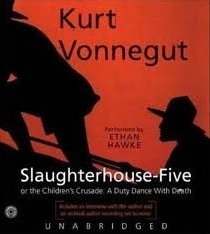
Slaughterhouse-Five by Kurt Vonnegut (audio)

Full title:

Slaughterhouse-Five, or the Children’s Crusade: A Duty Dance with Death

It seems a little odd to me that I’ve never read this book, and in fact I wondered if maybe I had, and had just forgotten. But as soon as we started listening to this audiobook (my parents and I, on the way home from New Orleans) I knew I’d never heard or read this book before. Vonnegut is always thrilling and fascinating! I know I really enjoyed his Cat’s Cradle and Breakfast of Champions, and Slaughterhouse-Five shares with them a very surreal, time-warped, rambling, fantastical tone. It feels like Fear and Loathing in Las Vegas, particularly the scene in the movie where they take the ether and things turn on their sides.

For those who don’t know, this is Vonnegut’s autobiographical story of the bombing of Dresden, which he experienced, like his protagonist Billy Pilgrim, as a POW in a slaughterhouse. Vonnegut, and Billy, survived only because they were holed up in the meat locker there, while the vast majority of the city burned.

Billy’s story involves war, bullying, sex, time travel, optometry, drinking, and misunderstanding. Overarching themes of death and timelessness tie the winding threads together. The world does not believe that Billy travels in time or that he was kidnapped by little green aliens from the planet of Tralfamadore. We hear of Billy’s whole life, as a small child, as a student, as a soldier in the war, as a young husband, as a professional optometrist, as a feature in a zoo on Tralfamadore, and as an old man. Like Billy, we don’t keep these experiences in sequence, but drop in here and there.

Billy’s story is preceded by a long intro in which Vonnegut narrates, not his experience as a soldier or a POW, but as a writer, many years later, struggling to write about Dresden. He visits an old war buddy and learns of this buddy’s wife’s fear of war. She’s concerned that he’ll write a book glorifying the experience and thereby encouraging future generations to make war. He reassures her that “there won’t be a part for Frank Sinatra or John Wayne” in his book, if he even ever finishes it. He also promises her he’ll call it “The Children’s Crusade”, agreeing with her that they were just babies over there.

This is a very powerful story. Descriptions of the horrors of war are evocative, perhaps even more so the depiction of the POW’s in the railroad cars passing steel helmets filled with their excrement to the men standing near the ventilation slots. War is bad. But there’s much more to this book than the point that war is bad; it’s also a fascinating story about family and relationships. (I’m reminded of Breakfast of Champions with its bizarre family structures and roles and dysfunction.) And the world of Tralfamadore is fantastical, incredibly imaginative, and so fully-developed in its details, I just wonder at Vonnegut. Where does he get this stuff? The turns of phrase are memorable. A drinking man’s breath smells of mustard gas and roses. That’s poetry.

This story is beautiful, strange, and strangely feels endless. It finishes with a question-mark; loose ends are not entirely tied up. How could they be, when events are presented out of sequence, and Tralfamadorian concepts teach that no one moment ever ends? Vonnegut was a genius, and I want to keep reading him all my life. (There are still a number of titles I haven’t touched, and were you aware? just this January, a new volume of his previously unpublished short fiction came out. It’s called While Mortals Sleep.) Oh, and I want to mention the reader of this audio version. He speaks in a strange whisper, and his style is very, very effective for this book. Guess who? None other than Ethan Hawke. I was surprised, and tried throughout to place this handsome actor behind the voice I was hearing; but I couldn’t put the guy I know from Reality Bites and Training Day into Vonnegut’s world. Very strange. I guess that’s the mark of a great actor, that he can fill different roles believably. I’m impressed.