Their Eyes Were Watching God Readalong, part 3

Today we’re finishing up a readalong, hosted by The Heroine’s Bookshelf, of Their Eyes Were Watching God. I’m discussing chapters 14-20 (please pop over to THB at the above link to join in). We recently discussed chapters 1-6 and chapters 7-13. Caution: spoilers follow.

A lot happened in the final third of the book! Janie and Tea Cake settled, at the end of part 2, in southern Florida, and many of us readers were concerned with Tea Cake’s reliability. Would he make a good man for Janie? Well, we see them continue to establish a life together, and Tea Cake did turn out to be a good man for Janie – at least in Janie’s eyes. I’m sure I’m not alone in being unhappy with him for being jealous, for flirting with Nunkie, and finally, for beating Janie. But she continues in her opinion that he’s perfectly wonderful, and I do see the good: he brought her a sense of adventure, a sense of community, someone and something to work for and feel good about. I guess I can’t begrudge her the happiness she found. Although the idea that Janie getting beat up “aroused a sort of envy in both men and women” is not one I appreciate.

And then the hurricane! My, but that was some action. Tea Cake and Janie choose to wait out the storm – in their little cabin right on Lake Okechobee – despite the animals and the Indians wisely taking off for higher ground. Their flight from the path of the storm – “de lake is comin’!” – is high drama. And it’s nice that almost none of Janie & Tea Cake’s friends lose their lives. I enjoyed this part quite a bit.

But the tragic ending… I recall that I wasn’t the only one concerned, from the beginning, that Tea Cake “left” Janie. But I guess we didn’t guess how he’d leave. That was high drama, too; I was moved by the courtroom scene, the insinuations that the jury was moved by Janie’s beauty, the insinuations of racism, and finally the transition from indignation to shame and apologetic acceptance on the part of Janie’s community. Tea Cake died as a result of saving Janie during the storm. I guess I have to retract some of my concern. Although beating her was still uncool.

The final scene wraps up Janie & Pheoby’s conversation, in some beautiful language. “Love is lak de sea. It’s uh movin’ thing, but still and all, it takes its shape from de shore it meets, and it’s different with every shore.” Lovely.

I enjoyed this read, and I look forward to joining in the discussion (THB) today.

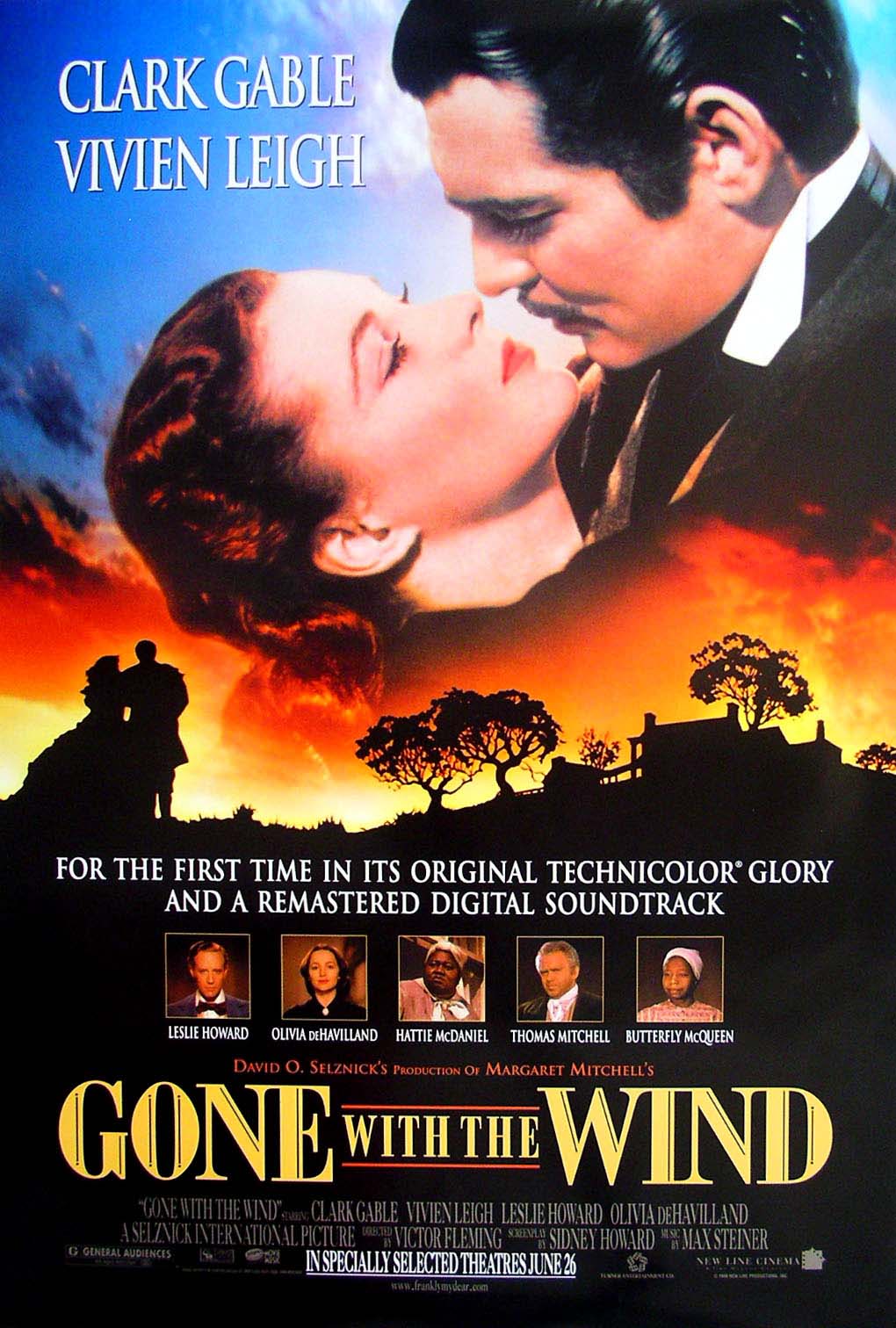
movie: Gone With the Wind (1939)

Well I finally got around to it. I think I was the last person alive who had not seen this movie; and having finally read the book just this year as part of the Great Gone With the Wind Readalong (thanks Erin!), and then being laid-up post-knee-surgery, what better time?

It’s certainly an amazing movie. The score and the cinematography were outstanding; dated, yes, but obviously classic and absolutely admirable even in late 2011. Vivien Leigh made a lovely Scarlett and Clark Gable made a perfect Rhett. If anything, I found Ashley an even more obviously weak man, and Rhett a more obviously handsome and preferable pick, onscreen. I loved the Technicolor! It was beautiful to look at. If I have some criticisms, they are only the obvious and unavoidable ones: even in an almost-four-hour movie, the format clearly doesn’t allow for the inclusion of ALL of Mitchell’s 1000 pages of details. (This is why I always struggle with movies made from books. I am attached to ALL those details.) But to be fair, the movie did a pretty wonderful job of sketching the book in broad strokes; they included just about all the important bits. And if they sometimes felt a bit rushed-together – Scarlett makes her “I’ll never be hungry again” speech immediately upon reaching Tara, giving it less power than it had in the book, after months of suffering there – this method did give the movie the same epic, sweeping, long-time-line feel that the book had. I thought it was awfully well done, considering the obvious limitations of the format. The most blatant exclusion, for me, was Scarlett’s two children from her first two marriages. But maybe this just underlines how important poor little Wade and Ella weren’t to Scarlett in the book!

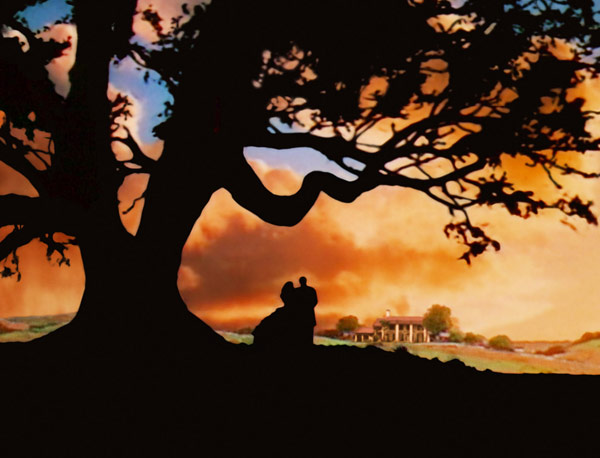
love the Technicolor!


The greatest divergence from the text, and the only one that really bothered me, was Rhett’s constant declarations of love. The great drama of the book is arguably Rhett and Scarlett’s failure to connect their love for one another in time and space, their passing as two ships in the night, their missing of the opportunity to share their love. Without consulting my text, I’ll venture that Rhett never declared his love, in fact denied it, declared he’d never love Scarlett, until it was too late. This changed things somewhat in the movie and bothered me some. (This is why I mostly avoid movies made from books; they disappoint me.) But you know? It didn’t ruin it for me. This was a beautiful and enjoyable movie.

Poor Melanie’s plainness was emphasized clearly enough; she definitely had some bags under her eyes here and there. The slaves were played as fools in a way that I found faithful to Mitchell’s work, which is also to say kind of cringingly offensive to my eyes today. Rhett was a dish. Ashley was a bore. Melanie was sweet; Scarlett was impressive, powerful, beautiful and conniving; Mammy was a nag, and Ellen was grand. And before I neglect, let me also say, I thought both Tara and Atlanta were very well-done, despite receiving very little attention in the movie compared with the book. We get a few shots of Atlanta as (respectively) booming, powerful, covered in dead and dying troops, crumbling and burning, and being rebuilt, which painted Atlanta-as-character very effectively in very little screen time.

If Gone With the Wind, the book, was a masterpiece – and I say it was – Gone With the Wind, the movie, starring Vivien Leigh and Clark Gable, was every bit a masterpiece in its own right, and surprisingly faithful to the book. I’m impressed. It was a fine way to spend a few hours. If there’s anyone else out there who hasn’t seen it yet, I recommend it.

The Autobiography of Benjamin Franklin

I have heard that this was an important, well-written and interesting autobiography. I don’t recall where I heard it, but I made a note and it stuck in my head. So I found the audiobook and gave it a try.

What I learned was a more detailed version of what I knew: Benjamin Franklin was an interesting, hard-working, thoughtful man who helped shape our nation’s history. He was an indentured servant, a runaway, a businessman, an entrepreneur, a diplomat, a politician, an inventor, an author, a militiaman, a scholar and a philosopher, and a father. He invented many items, large and small, that improved the everyday life of people in his time, showing an intelligence and curiosity about how things work that I admire. He was also instrumental in beginning both a school (which became both the University of Pennsylvania, and a free school for poor kids) and a public hospital in his adopted hometown of Philadelphia. He did a lot of good things and had some interesting ideas. He was a moralist, and wrote tracts in which he espoused a “right way” of living.

The style of his autobiography is unfortunately stiff and pompous, though. I think that perhaps the narration of my Mission Audio edition didn’t help. The language in which this book was written is necessarily dated and sounds odd to the modern ear; but if today’s actors can make Shakespeare palatable, for gosh sake, you’d think they could have found a narrator who would bring Franklin to life, too. Instead they went with a sort of whuffling, sedate, staid voice that emphasized not this senior statesman’s timeless wisdom and accessibility – which I think might be there, hidden in the text – but the distance from which he speaks. The long pauses and bombastic tone went a long way towards ruining this experience for me.

I didn’t enjoy this autobiography at all, which was a disappointment. Actually I’m not quite sure why I finished it (Husband asked, and I couldn’t answer); maybe I had that much faith in the long-lost recommendation, or maybe I was just mesmerized by the monotonous narration… I didn’t even get the consolation of learning new bits about Franklin. I came away with the same vague notion of who he was and what his legacy was that I’d started with. For educational purposes, I actually got more out of the “timeline of his life” appended at the end than I did out of the bulk of the book. I feel that the autobiography itself was probably flawed, in that it leans towards anecdotes of little consequence, moralizing, and self-congratulations. But the narration was the final straw. Unfortunately I cannot recommend this book; and if you do decide to seek it out (in which case, let me know if it goes any better for you!), for the love of Dog, avoid the Mission Audio version.

Teaser Tuesdays: The Autobiography of Benjamin Franklin

Teaser Tuesdays is a weekly bookish meme, hosted by MizB of Should Be Reading. Anyone can play along! Just open your current read to a random page and share a few sentences. Be careful not to include spoilers!


I’ve chosen you a teaser today from Benjamin Franklin’s Autobiography, which I’ve heard repeatedly is worth reading.

I disliked the trade [his father’s, of being a tallow-chandler or candle-maker], and had a strong inclination for the sea, but my father declared against it; however, living near the water, I was much in and about it, learnt early to swim well, and to manage boats; and when in a boat or canoe with other boys, I was commonly allowed to govern, especially in any case of difficulty; and upon other occasions I was generally a leader among the boys, and sometimes led them into scrapes, of which I will mention one instance, as it shows an early projecting public spirit, tho’ not then justly conducted.

He then goes on to explain that, needing a wharf to fish off of to keep their feet out of the mud, he and the other local boys – at his urging – purloined some building supplies from a nearby construction site and built themselves a stone wharf. They do get caught.

Their Eyes Were Watching God Readalong, part 1

The Heroine’s Bookshelf is hosting another readalong! Yay! We are reading Their Eyes Were Watching God, and I encourage you to participate. Today we’re discussing chapters 1-6 (please pop over to THB at the above link to join in) and have two discussion dates to come: chapters 7-13 on December 5, and chapters 14-20 on December 12.

Chapters 1-6 introduce us to Janie Crawford, and her tragic family history. At the start of the story, we see a forty-ish Janie coming home from… somewhere, to her town’s gossipy disapproval. And she begins to tell her story to her friend Pheoby. We hear about her youthful marriage, to relieve her aging grandmother’s concern about her future; but she isn’t Janie Killicks for long before leaving him to become Mrs. Mayor Starks, of a brand-new, all-black town. Janie becomes decidedly dissatisfied with being ordered around as Joe Starks’s helpmate and unpaid worker. He’s jealous and keeps her on a short leash, and she wants more out of life. When she was 14 she lay beneath a pear tree in blossom, and felt deeply touched by the springtime rhythms of nature; the descriptions of the pear blossoms, the bees pollinating them, are decidedly sensual and even sexual. Janie is meant for more than working as Joe’s wife-servant. Her perceptions are idealistic and lofty. She has an appreciation for her world that is deeper than that of her power-hungry husband.

Already Janie’s story touches me deeply, and I yearn with her for a world in which a “colored” woman will have value, make decisions for herself, and know love. As a character she’s earned my respect and sympathy.

And such beautiful imagery! I wanted to share with you some of my favorite turns of phrase, but I find them to be many…

“Ships at a distance have every man’s wish on board.”
“The sun was gone, but he had left his footprints in the sky.”
“They made burning statements with questions, and killing tools out of laughs.”
“Janie saw her life like a great tree in leaf with the things suffered, things enjoyed, things done and undone. Dawn and doom was in the branches.”
“She knew the world was a stallion rolling in the blue pasture of ether.”
“Every morning the world flung itself over and exposed the town to the sun.”

The descriptions and the writing are absolutely marvels unto themselves, without even worrying about Janie herself – which I defy you not to.

I’m definitely excited about this book and looking forward to Erin’s readalong. Stop over and join us, won’t you?

book beginnings on Friday: Their Eyes Were Watching God by Zora Neale Hurston

Thanks to Katy at A Few More Pages for hosting this meme. To participate, share the first line or two of the book you are currently reading and, if you feel so moved, let us know what your first impressions were based on that first line.

I am reading Zora Neale Hurston’s classic, Their Eyes Were Watching God, as part of the Readalong being hosted by The Heroine’s Bookshelf blog. The Heroine’s Bookshelf book, which I read (and reviewed) earlier this year, had already prompted an interest in a reread of this book; I read it when I was quite young and don’t remember much. I expect to get more out of it this time. Thanks Erin for getting me started! (Check out also her Great Gone With the Wind Readalong from a few months ago, which got me reading that classic for the *first* time.)

Sorry, let’s get started here. We begin:

Ships at a distance have every man’s wish on board. For some they come in with the tide. For others they sail forever on the horizon, never out of sight, never landing until the Watcher turns his eyes away in resignation, his dreams mocked to death by Time. That is the life of men.

It’s a powerful beginning, isn’t it? I particularly find the first line grasping my interest. Doesn’t really tell us what the story is about, but presumably that’s to come.

What are you reading this weekend?

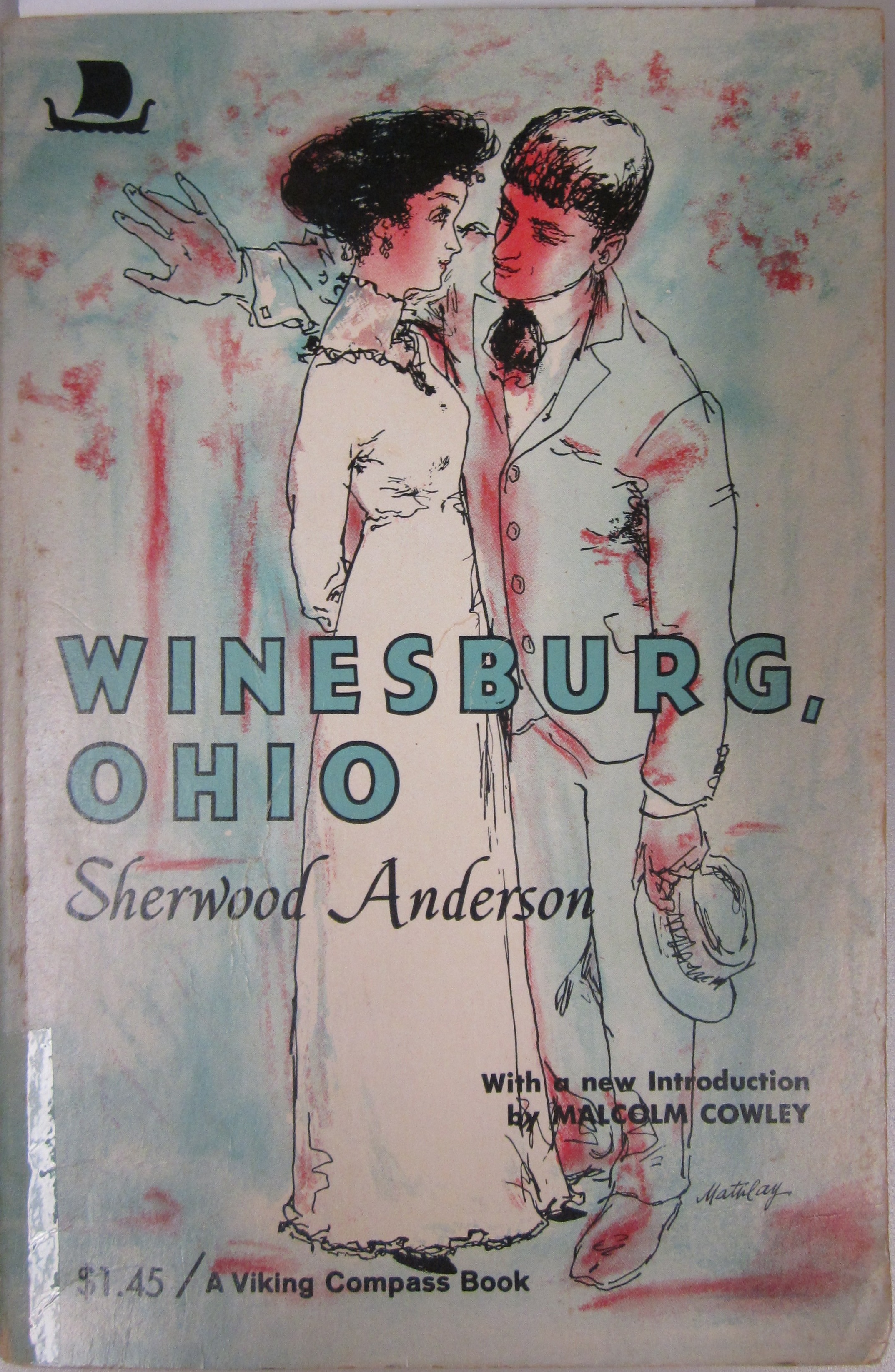
Winesburg, Ohio by Sherwood Anderson

Winesburg, Ohio is a collection of short stories that is more than the sum of its parts; the short stories are connected, all being set in the fictional town of Winesburg and concerning overlapping characters. We are most interested in George Willard, a town native who we most often see as a young man working as a reporter at the town paper (or, “the” reporter). Several of the stories give us Willard’s experiences (always in third person), but a number of them concern other inhabitants of the town. These men and women usually have some small personal tragedy that has thrown off the rhythm or intentions of their lives.

The work as a whole has a very quiet, contemplative tone and mood. Very little of great import goes on; but simple, sad lives are carried out, and hearts are broken quietly. It is moving. Anderson excels at bringing a character to life for a brief moment; and then he moves on.

I came to this book through Hemingway’s recommendation (and was finally motivated to get it off the bookshelf for the Where Are You Reading? Challenge‘s Ohio requirement). It has been a little while since I’ve read a biography of Hemingway so I’m a little rusty on the details, but I recall that Anderson played a role in his early writing career – encouraged him to write, gave him tips, maybe recommended him for publication. I think he pushed Hem to move to Paris as a youngster, which he did with his first wife Hadley, with results that I think we can safely say influenced his career as a writer. Anderson definitely influenced his style; I got this out of Malcolm Cowley’s excellent introduction, but it’s readily evident even without that clue. The same short, simple sentences that say so much with so few words are recognizable in Anderson’s stories; see my book beginnings post, or:

The Presbyterian Church held itself somewhat aloof from the other churches of Winesburg. It was larger and more imposing and its minister was better paid. He even had a carriage of his own and on summer evenings sometimes drove about town with his wife. Through Main Street and up and down Buckeye Street he went, bowing gravely to the people, while his wife, afire with secret pride, looked at him out of the corners of her eyes and worried lest the horse become frightened and run away.

This quotation comes from “The Strength of God,” one of my favorite stories.

As character sketches, these short stories are outstanding. As a whole, though, this book failed to grasp me the way I’d hoped – certainly it failed to grasp me the way Hemingway does. While I saw Papa on these pages, unmistakably, I was also constantly reminded of Sinclair Lewis’s Main Street, another quiet, subdued story about everyday, small-town life and its quiet tragedies. Perhaps it is the repetition of that phrase, “Main Street,” that got me, but I kept seeing Lewis’s work in this one, and frankly Main Street is a more memorable book. Like happens to me sometime when I fail to deeply appreciate one of the “classics” (ahem The Picture of Dorian Gray), I worry that it’s me, not the book, that I’ve missed something beautiful that would be obvious to someone with just a little higher IQ. I have to shrug this off, though. This collection does have value; I don’t want to give an impression otherwise, it just might not be *my* ideal cup. Almost every story builds a character who is real and often sympathetic. The tone is unique and if nothing else, the view into small-town life of a certain era is fairly unique. We can’t all love the same books, and life is more colorful for it.

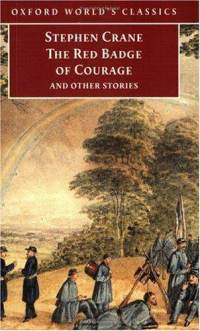
The Red Badge of Courage by Stephen Crane

I came into this book with a vague notion that it is a classic that was taught in schools more commonly before my day, and that it was popular with boy-children, also mostly before my time. It is a Civil War story. “The youth,” as we mostly know him, Henry Fleming, signs up against his mother’s wishes to go fight for the Union, and the book follows his war experience.

The bulk of this story is taken up not with events but with the turmoil inside Henry’s head. He is fascinated by war and wants to participate; it takes a certain amount of internal argument before he signs up, and then he thinks he’ll make his mother proud. Then after much waiting in camp, when it appears that he might actually see battle, he becomes petrified with the fear that he’ll run. He meets battle, stands and fights at first, wondering at his nonchalant courage; and then turns and runs. While a fugitive deserter in the woods on his own, he convinces himself that running was in fact the wise and respectable decision; then upon encountering the army again he comes filled with self-loathing. He watches a friend die. He rejoins his regiment with an excuse for his absence and becomes confident again. And on and on – you get the idea. It’s the story of a young boy’s difficulty with the concept of fighting and, most centrally (as in the title), the concept of courage. I’m not sure we ever learn the age of “the youth,” which I regret; I kept wondering how old he was, but maybe the point was that we’re unclear on that question. There is more fighting; our youth stays and fights; there is a victory. (Perhaps it is The Victory; I’m not sure.) At the end of the story, Henry has found a peace and a confidence in himself; the war seems to have helped him grow up.

I kept track, off and on, of the uses of the color red in this book. Aside from the obvious red of blood, war is repeatedly characterized as a red animal, and the flag is a red and white woman who demands and inspires Henry’s courage. And red is not the only color to receive repetitive attention. Yellow is cowardice and men’s pale, sickly, frightened or wounded faces. (Henry’s mother threw a yellow light on the color of Henry’s ambition, by opposing his wish to join the army.) Purple is twilight; blue is the Union uniform as well as the sky, and rage is variously red, black, and purple.

I like this passage; note all the colors used:

He was being looked at by a dead man who was seated with his back against a columnlike tree. The corpse was dressed in a uniform that had once been blue, but was now faded to a melancholy shade of green. The eyes, staring at the youth, had changed to the dull hue to be seen on the side of a dead fish. The mouth was open. Its red had changed to an appalling yellow. Over the gray skin of the face ran little ants. One was trundling some sort of bundle along the upper lip.

Honestly, though, I was not particularly taken with The Red Badge of Courage. It had its moments of colorful imagery that I found charming; and at times Henry’s turmoil felt very human and sympathetic. But for the most part I was a little bit bored. Relatively little action takes place; mostly we hear about Henry’s anguish. I hate to be callous about his struggles – this is war, he is but a “youth,” war is terrible – but it felt to me like rather much circling around the same emotions. It wasn’t as evocative, at least for me, as it could have been. Books about the war experience should twist the knife deeper than this one did.

I also found a few aspects of Crane’s treatment of war a little surprising. For one thing, we almost never heard about the enemy; aside from being dressed in gray and being the antagonist of the battle scenes, the Confederates aren’t developed at all. Many war stories, and especially Civil War stories, paint the opposing army as tragically familiar, thus illustrating the futility and ultimate tragedy of war. This book seemed to take a pass on any such message, which left me feeling a little hollow.

As I sum up my experience reading this book, I have to say I didn’t find it very moving. I would love to hear from someone else who did, though. Any fans of The Red Badge of Courage out there?

book beginnings on Friday: Winesburg, Ohio by Sherwood Anderson

Thanks to Katy at A Few More Pages for hosting this meme. To participate, share the first line or two of the book you are currently reading and, if you feel so moved, let us know what your first impressions were based on that first line.


I have Winesburg, Ohio on my shelf because Hemingway recommended it. It turned out to be one of the easier ones from his list of recommended reading for me to get: my mother read the list when I originally posted it, and passed on Winesburg along with another I can’t put my finger on at the moment… this paperback copy, “a Viking Compass book,” was the first reset and redesigned edition since the original typesetting of 1919. It was published in 1960 and has my father’s name in the front cover. I wonder when and how it came to him; he would have been young for it in 1960. I wonder if it was for school? Pops, can you help?

This is a collection of short stories, and the first, entitled The Book of the Grotesque (Anderson’s original title for the collection, in fact) begins…

The writer, an old man with a white mustache, had some difficulty in getting into bed. The windows of the house in which he lived were high and he wanted to look at the trees when he awoke in the morning. A carpenter came to fix the bed so that it would be on a level with the window.

I look forward to my first reading of Sherwood Anderson’s work. His name is less known than many of the writers he influenced, even helped shape, or helped establish their careers – Hemingway being one, along with Faulkner and Henry Miller. Have you read any Sherwood Anderson?

Gone with the Wind part 5 (ch. 48-63)

Follow the Great Gone with the Wind Readalong at The Heroine’s Bookshelf. Today we discuss part 5.

So first off, head’s up: this post contains spoilers. I imagine there are still folks out there who have never read OR seen Gone With the Wind (I hadn’t!) and if that’s you, I recommend you go away (she says very sweetly) so that you can enjoy the surprises that I enjoyed as I discovered this book for the first time. Fellow discussers and readers-along, welcome.

Oh, Scarlett. Sigh. This was a painful section to read because of all the missed opportunities for happiness that she and Rhett bungled in their respective pride. It was clear to me throughout that they had tender feelings for one another, but they’re both so proud, and Scarlett is so thick, that they don’t get it together in time. For me, that was the tragedy of part 5 – yes, eclipsing even deaths.

So in this section, Scarlett and Rhett are married, and Scarlett achieves relative contentment; she finally has money and security, and has some fun with her new unscrupulous friends. Her relationship with Rhett is only partially stable, and she’s bothered by his odd attitude and the fact that she has still failed to control him, but she pushes these thoughts away. Melanie continues to be a rock, several times solidifying her role as supporter and true friend to Scarlett, who learns to grudgingly appreciate her, at least most of the time. Scarlett’s lust for Ashley seems to cool, but she’s so accustomed to pining for him that she continues to do so even as his polish fades. The birth of Bonnie sets Rhett off in a whole new direction in life; it’s odd to see him so doting and blind to the spoiled child he’s creating, but of course it’s also endearing to see his love for his daughter.

What did you think of Melanie not believing in Scarlett and Ashley’s unfaithfulness? Is she showing again her admirable strength, or is she a fool for her naivete and blindness? I do feel a hint of the latter; but on the whole I agree with Rhett and (as far as I can tell) Mitchell, that she behaves heroically. Once she decides that a person is her beloved friend and deserving of her support, this woman holds on, doesn’t she? I think Scarlett respects her, too, somewhere deep down. I really liked the maturity that finally came out as a result of the “hair shirt of shame”:

With one of the few adult emotions Scarlett had ever had, she realized that to unburden her own tortured heart would be the purest selfishness. She would be ridding herself of her burden and laying it on the heart of an innocent and trusting person. She owed Melanie a debt for her championship and that debt could only be paid with silence.

Finally, here’s Scarlett showing some personal growth! And no great surprise that it comes through Melanie.

I marveled a bit at a society so deeply concerned with gossip that apparently no one thought to say… “Look, Melanie, I don’t care if Ashley boinked Scarlett or not. I like you and I like India and I’m just going to be neutral on the bedroom concerns; is that okay?” I feel like Melanie might have been open to that kind of frank dismissal of her private business; really that might be her first preference: to have people consider her marriage a private matter and butt out. This is a modern angle, I guess, but as a modern woman it’s the first reaction that comes to my mind, if I were an outer-circle acquaintance of the parties involved.

The end-of-book tragedies that destroy Scarlett’s world all over again fell a little short for me. Bonnie was gorgeously cute, but also spoiled and obnoxious. She wasn’t developed much beyond her role as Rhett’s plaything, his doll, and at best, his new lease on life; I was excited for him in that last aspect, but as a character Bonnie didn’t hold great value for me. I think I felt her death coming on, and when it happened it didn’t move me as deeply as I think it was supposed to. Scarlett grieves, but again not profoundly; she’s never cared that much for her children, and if Bonnie was her most loved, that still wasn’t saying much. Her love was heavily tainted with jealousy, too. I felt that Bonnie’s death was a plot device: things had to fall apart again, and she was the object on which all of Rhett’s energies had focused, and around which Scarlett’s world had begun to revolve, so she fell. But it struck me as a clinical move made by Mitchell, rather than the wrenching death of a child that might have twisted my heart. It fell flat.

Melanie’s death, now, got to me much more – Melanie having been such a strong character who I’d come to love and admire. Although she had her flaws right til the end, too: a blind love for Ashley in all his flaws and a refusal to see Scarlett’s duplicity, which was part of her virtue but also earns some disrespect. It was heart-wrenching that she died, yes. But Scarlett immediately then began her triple revelations, and I lost patience. She loves Melanie! Melanie was a real friend! Ashley is boring! Rhett is a) wonderful, b) just like Scarlett, c) loves her and d) gasp, she loves him too! The reader, of course, knew all these things 100’s of pages ago, so her dramatic realizations and emotional flailings just exasperated me. It’s a shame, really, because this book had me firmly in its grasp for the bulk of it. But in the end I think I lost patience.

I spent the book rooting for Scarlett. I identified with her in her worst moments, and refused to pass judgment. But she let me down by not meeting reality when she most needed to, and for coming around when it was just too late, and then for being so dramatic about it at the end. Rhett became more and more sympathetic, admirable, and crush-worthy as the book went on; but he, too, failed to step up when it most mattered. While I accept his argument that Scarlett valued what she didn’t have, I think he was a bit late in letting her see his love; I think he might have won her with a little tenderness. But maybe he was right and her “love” for Ashley needed to run its course. The ending was certainly tragic – two people destined to be together missing one another like ships in the night. But it may have gone on just a bit too long to hold my interest.

On another note – what do you make of that night that Scarlett and Rhett shared in chapter 54? I know that it is understood as a rape scene by some, but I’m not sure I buy it, for this reason: she enjoyed it, and women don’t enjoy being raped. Clearly it was rough and passionate and she wasn’t sure what to make of it; but she enjoyed it, both in the moment and in thinking about it again the next morning. She blushes, thinking that a “lady” doesn’t enjoy such things (i.e. rough sex). But I think rape is a stretch. What do you think? It seemed like the stark honesty of that night, if nothing else, offered the couple one of those chances to share their feelings for one another and seek happiness, but of course they missed the chance when he dashed off the next morning.

So to wrap up here: I loved this book very much. It’s a page-turner. It has heroes, villains, real human characters, war, love, death, and perseverance. It had me completely wrapped up in its pages – I sat by the pool in Key West and trembled with Scarlett and Melanie on that bumpy ride out of Atlanta with the world burning around us. A hell of a great book, although with some real issues regarding racial sensitivity. But the ending fell a little short for me; the tragedies felt a little manufactured, Scarlett’s pain was a little protracted and tiresome, and I was disappointed that her tortured romance with Rhett didn’t have the least final redemption. I thought we’d earned some, but clearly I was wrong. On the other hand, I did appreciate the note of hope or at least the note of uncertainty it ends with. Where is Scarlett headed next?

Finally, thank you so much Erin for finally getting me to open these pages. It was well worth it. Thanks also to my fellow readers-along; it’s been fun to have someone to share with and to see our different reactions. I’m betting some of you found the ending much more satisfying than I did, and I look forward to hearing your reasons.