Walden by Henry David Thoreau

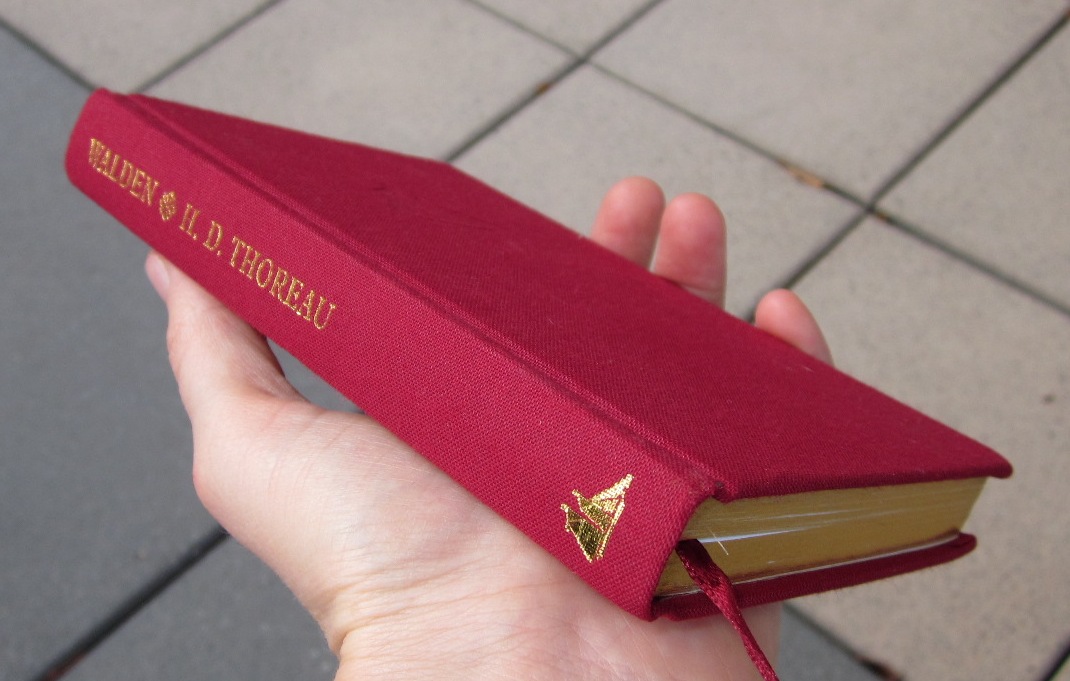
my charming little copy of Walden


I have been thinking this review over carefully. Walden is an “important” book. I had some troubles with it, particularly about midway through, when I stalled for several days and was sure I was going to give up. This was while visiting Concord and Walden Pond, no less! I think I owe my father credit: he recommended that I just read it through, with less attention to note-taking and interpretation at every page along the way. And on my long travel day home, I got back into it.

What is it that made this book a little difficult for me? Well, the language is somewhat dated, and the sentences tend to be long and rambling. Picture several long clauses strung together, and then having to look back up half a page to see what the subject was that this verb, finally, is acting upon. That will slow a person down. And the subject matter, the thoughts being communicated, are often quite dense. When Thoreau writes descriptions of his natural surroundings, I can settle into the imagery and the poetry, and float along pleasantly. But when he philosophizes, I am often in trouble. Large ideas are presented here, regarding our relationship with the natural world, politics, and religion. Thoreau jumps around between these subjects. Perhaps this begins to help you understand my trouble.

The first chapter, “Economy,” is lengthy. In my edition it occupies 80 pages, of 350. And no later chapter runs longer than 20 pages. I enjoyed “Economy”: I sympathize with the points Thoreau makes therein. But maybe I was wearied by it. It wasn’t until 200+ pages that I stalled badly. And once I got back into it, I enjoyed it again. I can’t entirely explain that pattern, and I’m sure yours was/will be different. I think the biggest help I got was visiting Walden Pond. This is obvious, no? When my mother and I toured The Wayside, our park ranger/tour guide quoted Nathaniel Hawthorne (and I wish I could find the quotation) on visiting authors’ homes. The gist was that visiting the home of an author is the best way to better understand his or her work, and my (limited) experience visiting authors’ homes certainly backs this up. In this way, walking around Walden Pond enriched my appreciation of Walden and renewed my interest in it.

Walden is a memoir; a political tract; a geographical study; a fine piece of nature writing; and a poetic rambling by a unique sort of Renaissance man. I found it rather effortful reading, but worth it in the end. For those who enjoy thought-provoking, challenging, lyrical writings (and longish sentences), it should be a big hit. For those who find these characteristics a little daunting, but are interested in the legacy of Henry David Thoreau, I recommend giving it a go just the same. I’m glad I did. And go see the place in question if you can, too!


Rating: 6 fallen leaves.

Teaser Tuesdays: Walden by Henry David Thoreau

Teaser Tuesdays is a weekly bookish meme, hosted by MizB of Should Be Reading. Anyone can play along! Just open your current read to a random page and share a few sentences. Be careful not to include spoilers!

As I’ll be in Concord, Mass. in just a few days to visit the very place (!), I am reading Walden this week. It shouldn’t have taken me this long! There is no shortage of quotable moments in this American classic, many of which you would recognize even if you never knew their provenance; but I chose one I thought especially clever, and a little humorous as well:

I say, beware of all enterprises that require new clothes, and not rather a new wearer of clothes.

Here, here, Mr. Thoreau. One of many gems.

For any Walden fans out there (like my friend I got to visit with this past weekend), I have a recommendation for further reading: I really enjoyed Edward Abbey’s short piece entitled “Down the River with Henry Thoreau.” I read it in the Abbey collection, Down the River, but you can also read it online here.

And what are YOU reading?

Moll Flanders by Daniel Defoe

Moll Flanders is our first-person narrator, presented in the Author’s Preface by Defoe as a real person whose story he has ostensibly edited; but don’t be fooled. It is a novel.

Moll begins with her birth and infancy as she understands it: she was born to a convicted thief in Newgate Prison, who “bled her belly” and was allowed to live until her baby (our titular character) was born. This is the story of Moll’s life, from gypsy infant to favorite child of a widow running a school for small girls, to the charity case in a rich family’s house where she is the elder brother’s mistress and then the younger brother’s wife. This first husband dies young and she leaves the family, starting afresh with a new husband who flees bankruptcy and debtor’s prison, telling her to make her own way and feel free to remarry. This leads her to a third husband, and now it begins to get really juicy: after traveling to Virginia together to farm a plantation, Moll gets to know her mother-in-law and discovers in horror that she is… her own mother. Moll has married her brother, and born him three children. At this point (after some drama) she returns alone to England.

Moll is befriended at Bath by a man who becomes her lover, and she his kept woman, until his near death causes him to repent his adultery and leaves her again shifting for herself. She is courted by an eligible banker – well, he will be eligible as soon as his divorce comes through… but in the meantime, marries a handsome man named Jemmy for his fortune as well as for the affection she feels for him. But she’s not yet to be happy: theirs is a union of double trickery, in which everyone loses, for he has married her for her (nonexistent) fortune as well, and gone into debt courting her, to boot. They part, and Jemmy, like husband number two, releases her to remarry if she finds a good option; but they share some loving moments, and he says he hopes to find her again one day when he’s made a (real) fortune.

At this point Moll intends to return to her banker, now divorced, but finds she is pregnant with Jemmy’s baby, so she takes a quick respite at the house of a woman she calls Mother Midnight. This woman is competent and caring, but criminal in her business of birthing unwanted and illegitimate babies and then disposing of them. After Moll has seen her child into adoption, she does marry the banker, and gets five years or so out of him before he dies. At this point I count five husbands, three of whom are still living, and my entirely casual count gives her something like 10 or 12 children, none of whom she has maintained a relationship with (the latest, the banker’s, she has Mother Midnight pass on). She is, again, destitute, and turns to petty theft and finally back to her friend Mother Midnight for help. This matron takes pleasure in training Moll in the fine arts of pickpocketing and conning, and the two become fast friends and make a fine living together; for the longest period yet, Moll is without male companionship and seems perfectly satisfied, indicating that her liaisons were more for the sake of financial security than anything else, although she has certainly enjoyed herself sexually as well. (There is a brief interlude of prostitution, in the most respectable manner, with a solitary high-class client.)

Moll’s criminal career goes smoothly; she is very good and very lucky. But her name (that is, her alias, “Moll Flanders” – we never know her real name) becomes well-known, and Newgate Prison, place of her birth, looms. Eventually, of course, she is captured, tried, and given a life sentence. During her time in Newgate, which she describes as the hellish place I have no doubt it was, she repents her life of sin (“a horrid complication of wickedness, whoredom, adultery, incest, lying, theft; and, in a word, everything but murder and treason”) and finds God. Eventually, with the ongoing friendship of Mother Midnight on the outside, Moll’s sentence is commuted to transportation, meaning she will be sent overseas into the New World, as was her mother. As a final coincidence, she is reunited with Jemmy, husband number four and rather a true love, who is imprisoned and also facing death for highway robbery. Things are worked out so that they travel together into the New World, where they start fresh with Moll’s still-considerable criminal savings. She meets the son of her incestuous brother-marriage, inherits a plantation from her mother, and continues to repent her days of wickedness. She and Jemmy, at the time of her supposed writing of these memoirs, have resettled in England with great fortune and happiness in their old age.

Whew.

It is a heck of a narrative: entertaining, spicy, lusty, juicy, well-told. There are interjected moral moments: I am amused to note that I’m that audience member Moll worries about, more tickled by her transgressions than moved by her repentance. As a story of her life, I find it diverting, and an interesting look into 17th century England, particularly the difficulties of being a woman without substantial fortune and male relatives to look after her – which good luck would have come with its own tribulations. As my edition’s notes repeatedly explained, Defoe himself spent a few years in Newgate Prison, and could write both passionately and accurately about the horrors of that place.

I read a “Barnes and Noble Classics” paperback, and found it, if anything, over-notated. Some of the helpful hints seemed aimed at a reader who had never ventured out of 20th and 21st century literature before; it was elementary for me, but no harm done. If you’re comfortable reading 18th century writings, I see no need for this edition, but it has something to offer if you’re less comfortable with some of the usages of that time. The introduction makes a case for Defoe writing possibly the first English novel – that was definitely a point of interest.

I enjoyed this book, and think it has an important place in classic lit: it both moralizes and sensationalizes, and entertains to boot. Moll is a rather outrageous character and I like her very much. Her spunk and determination to take care of herself presage Scarlett O’Hara, and her freedom with her own sexuality recalls Madame Bovary and Lady Chatterley somewhat. Yet another banned book, of course, if you’re looking for a read for upcoming Banned Books Week! (That’s Sept. 30 – Oct. 6.)


Rating: 7 illicit relations.

Ajax by Sophocles, trans. by E.F. Watling

I read Ajax from my copy of Electra and Other Plays after being reminded of his tragic story by Madeline Miller’s The Song of Achilles. It is a short play, an easy read, but like so many of the greatest ancient Greek works, very sad.

Ajax was one of the great Greek heroes of the Trojan War. Indeed, Miller says several times in her book (in the voice of Patroclus) that he would have been The Greatest if it weren’t for Achilles – kind of a poignant thought. He’s like the Jan Ullrich of the Trojan War. This play by Sophocles dramatizes the action following Achilles’s death, as known to myth. The background: Achilles quarrels with Agamemnon and boycotts the war; Greeks are dying; Patroclus goes to battle disguised as Achilles to get everybody going again; Hector (the great Trojan hero) kills Patroclus. Achilles is enraged, takes the battlefield, and in turn kills Hector, thus putting into action the prophecy that Achilles himself will die shortly thereafter. He does: killed by an arrow fired by Paris, who started all this nonsense in the first place.

With the Greeks’ hero Achilles dead, it is time for Ajax to shine. But Agamemnon chooses to award Achilles’s trophies of war, not to Ajax, but to Odysseus. Ajax is furious. And now begins the play…

Ajax has determined to kills the sons of Atreus (Agamemnon and Menelaus), Odysseus, and all the Greeks who have failed to honor him as he feels he deserves. He goes on a killing spree overnight. But Athena, good friend especially to Odysseus, tricks his eyes so that he ends up killing a bunch of livestock and no human Greeks. As the play begins, she is explaining this to Odysseus, offering him the view of Ajax, mad, blind, confused, killing sheep and calling them Greek names. Odysseus balks, but we end up seeing the scene. Ajax comes to his senses, sees how he has been shamed, and immediately begins planning his suicide. The Chorus (that tool of Greek drama, the group of citizens that comments on the action) and Ajax’s wife Tecmessa try to talk him out of it, reminding him of the pain his parents would feel, and the dubious fate of Tecmessa and their son if left without husband/father. He seems to change his mind, and goes offstage. But then his brother shows up, distraught, citing a prophecy that Ajax will die today. The scene shifts to watch Ajax bury the hilt of his sword, make a short speech, and throw himself upon it.

Tecmessa and the Chorus mourn; Ajax’s brother, Teucer, mourns, and plans to bury the body. Agamemnon shows up and makes disparaging remarks, commanding that the body of Ajax not be buried at all. Now, I’ve read these things before, and (ahem Antigone) you’d think these characters would have learned by now: you have to bury the dead! The gods are mightily displeased if you do not. This is an important tenet of custom and piety. Luckily, Odysseus next arrives on the scene. He had been insulting Ajax earlier, declared him an enemy, but here he lives up to his reputation for wisdom: Odysseus talks Agamemnon into allowing a reverent burial, and the grief-stricken family of Ajax carries on with their ritual. It seems that Teucer will take care of Tecmessa and her son.

I find this to be a moving story, despite the removal of centuries and the difference of cultures… I guess I’ve read enough related myth that I have learned to identify with it. I love the stories of gods and heroes, how they’re all interrelated and how the actions of one generation can effect so many generations to come. (See the above reference to the House of Atreus. That man’s impious mistake will continue to cost his offspring – just watch what happens to Agamemnon when he gets home from war.) And I mainly read Sophocles (et al) for the stories… so I had to remind myself to slow down and appreciate the language, too. I think I prefer the poetry of Homer, but I can just imagine actually seeing this performed… that would be a treat.


Rating: 6 dramatic gasps.

did not finish: The War of the Worlds by H.G. Wells (audio)

The War of the Worlds is a classic, and H.G. Wells is a respected name. I guess I’d only read his The Invisible Man, as a very young (I had assumed, too young) girl; it didn’t resonate much with me. I thought I’d give him a second chance with this sort of landmark work in early science fiction, and I selected the audio version because of the story attached to its original radio production that caused all that panic when people thought the Martians were *really* attacking. But this one was a fail for me. I quit about halfway through.

First, I’ll give you a partial plot synopsis: Our unnamed narrator-character (not to be confused with the narrator of the audiobook, who will be discussed shortly), a resident of the English countryside, describes what seemed to be falling stars but turn out to be giant cylinders fired from a rocket on Mars. These land, every 24 hours, around London and disgorge Martians, who turn out to be better-armed than the locals, technologically superior, and unfriendly. They operate giant tripod-machines that shoot fire and destroy land, crops, vegetation and people. The Brits try to fight back with their inferior weapons but are getting their butts kicked. And then I stopped listening.

The style of narration was dry. I was easily bored; my mind wandered. I think the audio-narrator, Bill Weideman, was part of my problem. For one thing, he has the odd habit of dropping the occasional leading consonant, like so: “we are ‘ill waiting” (for “still waiting”) and the like. I am perplexed at why you would choose someone with such a strange habit of speech to narrate an audiobook; I was frequently confused as to certain words he pronounced in this manner. Another oddity involved accents. This story is set in England, and when the narrator quotes other characters he gives them an English accent (which by the way seemed excessively nasal and frankly annoyed me), but in the voice of the main-character-narrator, no accent was used (meaning, he sounded American to me). I did not learn, in the half of the book I listened to before giving up, if the narrator was in fact American. But perhaps most generally, Weideman and Wells between them created a monotonous, even soporific effect on me. I couldn’t seem to focus on following the story, as the narrator (in both senses) felt emotionless to me. I can understand how the idea of “total warfare,” total destruction of acres upon acres of land and men and women and children were demolished wholesale in a single sweep of the Martians’ weapons, was shocking to this book’s original audience (1898) and that of the radio drama (1938). But in a world that has seen an atom bomb dropped on Hiroshima, perhaps the impact is lessened.

Of course, as is always the case when I read a Great Classic and do not find myself moved, there is the question of whether there’s something wrong with me: what did I miss? I do not discourage you from trying out this well-known and well-respected book (although I might discourage you from trying Weideman’s audio narration). I hope you like it. I did not.

book beginnings on Friday: The War of the Worlds by H.G. Wells


Thanks to Rose City Reader for hosting this meme. To participate, share the first line or two of the book you are currently reading and, if you feel so moved, let us know what your first impressions were based on that first line.

I am listening to this classic on audiobook, read by Bill Weideman. It begins, somewhat philosophically:

No one would have believed in the last years of the nineteenth century that this world was being watched keenly and closely by intelligences greater than man’s and yet as mortal as his own; that as men busied themselves about their various concerns they were scrutinised and studied, perhaps almost as narrowly as a man with a microscope might scrutinise the transient creatures that swarm and multiply in a drop of water. With infinite complacency men went to and fro over this globe about their little affairs, serene in their assurance of their empire over matter. It is possible that the infusoria under the microscope do the same.

I admit I’m finding it a tad slow, but here we go. Have you read this one? I was attracted by the audio format because of the stories of its original radio broadcast, in which people panicked, thinking it was a real-life news story! What an exciting time that must have been.

What are you reading this weekend?

Anna Karenina by Leo Tolstoy (audio)

This is a very long book, and I am trying to keep this from being a very long review. In a nutshell, I did not find it the life-changing masterpiece that I hoped it might be. (This is alarmingly often true of the very big name classics, it seems. Maybe too much hype?) However, it had some redeeming features, especially early on.

I will refrain from much plot summation (to keep my review shorter!); you can find that online if you like (for example, here’s Wikipedia). But, quick plot points: Levin is in love with Kitty, the youngest daughter of a good family. He proposes and is rejected, because she is expecting a proposal from Count Vronsky. However, just then the married Anna Karenina comes to town, Vronsky is taken with her, and abandons Kitty. Now we have a sad Levin, a sad Kitty (rather ruined, in fact, with her marriage prospects suddenly bleak), and Vronsky chasing Anna. Slight spoiler: he succeeds, and they become lovers, cuckolding Karenin (her husband). There are other characters, other couples mostly, with their own marital issues. Levin is a landowner with a restless intellect; he is probably the character most actively questioning his society’s unwritten rules, debating new ways of running his land and his peasant laborers, etc. One thread of the book follows discussions of society in various forms. The real spoilers follow in white text (highlight to read) if you want to follow it through: Levin does eventually marry Kitty. Anna has Vronsky’s baby, and goes to live with him after leaving her husband, but they are relatively ostracized by the society they were accustomed too, especially Anna; she is increasingly jealous and insecure, and finally kills herself. Levin finds God. There, that’s my quick plot summary. I have left out a great deal.

I struggled with this book for one main reason: I couldn’t find a sympathetic character. I thought I had one here and there, but they failed me time and time again. Kitty & Levin both overcome obstacles; but they never move past the tragedy of Kitty’s losing Vronsky – they continue to let his shadow lean across their lives, and I got sick of that. For all their observing their own happiness, I was unconvinced. Jealousy plays a large role in their relationship. Anna and Vronsky, too, call themselves happy but the jealousy and the quarreling just went on and on; I was annoyed. I went back and forth: poor Anna, she needs her man, he took her out of her home and life and now he leaves her home alone and lonely! And then again, poor Vronsky, this woman is a total drag! It comes back to the same point: I found none of these characters particularly sympathetic, and I did not have the patience for the woe-is-me drama. Tolstoy seems to use lots of superlatives. I think this is what contributed to my feeling of high drama (rolls eyes).

On the other hand, the ideological musings and discussions Levin indulged in failed to perk up my ears, as well. I would have been interested in working through some of these theories, but I never felt that we got any concrete experimentation with them; rather, Levin thought to himself or mentioned to his gentlemanly peers, and then plodded on. I don’t know why this made me impatient, when Jurgen’s struggles and ideologies in Upton Sinclair’s The Jungle hold me so rapt, but so I found it.

I remained engaged, entertained, and concerned for the characters, and caught up in what I’m calling Tolstoy’s high drama, for a time. I would say more than half of this tome. But it dragged on too long; he lost me. I couldn’t care for that long. The characters who started off as semi-sympathetic, or potentially sympathetic, or at least interesting, dragged on into repetition and selfishness that eventually bored me; I would have found them, the story, and the writing style more interesting if he had wrapped up a little sooner. And I do not fear the chunky epic novel, either; I’m capable of enjoying books of this length when they keep me engaged.

While I’m on the subject of length, though, I wonder if the audio format was perhaps the wrong choice here. I read faster than the narrator reads aloud. It would have taken me less time to read this one in print, and maybe that would have allowed me to get through it without becoming exasperated. A reader feeling the need to rush through a book is not a particularly strong endorsement, though.

In fact I was tempted to quit. Towards the end I was very frustrated, with Anna in particular, as she descends into jealousy and insanity. I recognize the misogyny in this book (for example, see my earlier Tuesday Teaser), and perhaps it should be interpreted as a compliment to Tolstoy that it was so convincing: Anna increasingly struck me as weak and nagging. I realize the difficulty of her “position” as it is referred to, and her shortage of options. But her continued complaining rubbed me the wrong way. I wanted to stop listening to this book; but as I completed disc 27, then disc 28, of 30 (!) cds, I knew I’d come too far to turn back. I had to know how it ended – not because I cared about Anna’s fate, you see, but because I was curious to know if Tolstoy was going to finally engage or impress me, or if his finish pulled something off that I had been missing all along.

And I’m afraid he didn’t. Back to the white text here so you can avoid my spoilers (highlight to read): Anna’s suicide almost relieved me. She was suffering, and she was complaining, and I’m glad she put us both out of our misery. See? I’m sure I missed the point here, but I can only report my own reaction. And as for Levin’s finding of the faith… it happened a little bit too fast for me, although the scene with the lightning was certainly interesting. And to be fair, I’m not your ideal audience for finding-God endings, as I’m a confirmed atheist and just fine with that fact.

I regret that I wasn’t more excited by this one, especially considering the weeks it took me to get through it; but I can’t say I regret those weeks. Now I know. The real question is: is there any chance I’ll enjoy War and Peace, or should I cut my Tolstoy-losses now??


Rating: 4 fancy dresses.

Teaser Tuesdays: Anna Karenina by Leo Tolstoy

Teaser Tuesdays is a weekly bookish meme, hosted by MizB of Should Be Reading. Anyone can play along! Just open your current read to a random page and share a few sentences. Be careful not to include spoilers!

Still working on Anna Karenina (and I will be for a little while longer!). Today I had to give you this noteworthy teaser…

…she felt such terror at what she had done, that she could not face it; but, like a woman, could only try to comfort herself with lying assurances that everything would remain as it always had been, and that it was possible to forget the fearful question…

From Part 2, chapter 23. Anybody else a little offended?

Teaser Tuesdays: A Room of One’s Own by Virginia Woolf

Teaser Tuesdays is a weekly bookish meme, hosted by MizB of Should Be Reading. Anyone can play along! Just open your current read to a random page and share a few sentences. Be careful not to include spoilers!

From Woolf’s famous essay on women and fiction, how’s this for a turn of phrase:

…it is doubtful whether poetry can come out of an incubator. The Fascist poem, one may fear, will be a horrid little abortion such as one sees in a glass jar in the museum of some county town.

Eye-catching and evocative! Poetry as abortion! Might be fitting imagery for the odd concept of “fascist poetry,” though. Woolf has some interesting points, I will say that for her.

What are you reading today?

book beginnings on Friday: Anna Karenina by Leo Tolstoy

Thanks to Katy at A Few More Pages for hosting this meme. To participate, share the first line or two of the book you are currently reading and, if you feel so moved, let us know what your first impressions were based on that first line.

I have begun listening to Anna Karenina on audio! Am I crazy? It’s almost 40 hours long! But I enjoy it so far.

I wanted to share the beginning with you. It’s a famous line, and one I recognized, but I didn’t know where from.

Happy families are all alike; every unhappy family is unhappy in its own way.

Lovely, no?

It is likely to be a while before you see a review of this one. 🙂 With my usual listening time, I figure I can finish this within a month. Stay tuned! Anybody out there have anything wonderful (or not) to say about Tolstoy? This is my first experience with him.