Elektra by Jennifer Saint (audio)

I made a 2,500 round-trip drive recently, so check out a few *audiobooks* for the first time in quite a while. I had a blast with them!

I’d been just recently telling a friend my paraphrased-from-memory version of the curse on the house of Atreus, so when I went looking for an audiobook, I was delighted to find Jennifer Saint’s Elektra, read for us by Beth Eyre, Jane Collingwood, and Julie Teal. (It looks like I put this one on a wish list based upon my interview with Claire North aka Catherine Webb.) I liked that this was a retelling with, if you will, a modern angle – told from the points of view of the women – but it is not a modern retelling; it’s still set in the ancient Greek and Trojan world. The three women who narrate their intersecting stories are Cassandra, Clytemnestra, and Elektra. The latter gives her name to the novel, perhaps, because she is the one who survives to its end.

I think this is the most in-depth telling I’ve encountered of Cassandra’s story, in which she, a princess of Troy, becomes a priestess in Apollo’s temple and undergoes the conflicting honor and agony of his gift of prophecy, and his curse that no one will ever believe her (always correct) prophecies. She then sees her city destroyed – sees it in advance and experiences it in real time – and is taken as a war prize by the Greek king-of-kings Agamemnon (who, in all tellings I’ve ever found, comes across as a consistently unlikeable man). Her life ends not long after his does, although with a little different nuance in this version.

[Here, an aside. These events, lying somewhere between myth and, in some cases, *possible* history, originate in an oral tradition. There are many versions, but all are translated at this point across both language and transcription; there are many retellings, but it seems there can be no single, original, authoritative one. I like how freeing this is: there is no reliably “correct” version of Cassandra’s story, or any of them, which I think offers a liberty to riff.]

Clytemnestra has always been a puzzler. She kills her husband (using some deceit, and after cheating on him); she has usurped power in a man’s world; many, especially the more traditional versions, paint her in an unsympathetic light. More modern perspectives point out that one of her greatest crimes may be that she holds power with confidence – she possesses traits that tend to read positively when they belong to men. And it’s not always remembered and pointed out that she kills her husband because he killed their firstborn daughter – sacrificed her to the gods for the fair winds needed to sail for Troy. That sacrifice, or murder, is in turn painted differently depending on whether the storyteller believes in the gods’ need for sacrifice (and the Greeks’ need to sail for Troy). What is one young woman’s life against glory in battle for all the greatest warriors ever, etc., etc. The same dual and dueling perspectives apply to Clytemnestra’s famous sister, Helen of Sparta / Helen of Troy. There the great question will forever be: did Paris abduct her? Or did she leave her husband and run away with another by choice? Victim, or whore? (A shocking number of ambiguities in Greek myth turn on the question of sexual consent.) Clytemnestra remains a difficult character in Jennifer Saint’s version of her story. Her grief over the loss of Iphigeneia is sympathetic; her desire for revenge feels righteous, if perhaps bloodthirsty. But because of the third point of view Saint gives us, we’re also aware of how fully she orphans her remaining three children in her singlemindedness about the one she’s lost.

Elektra is herself single-minded and bloodthirsty, and this is the essence of the curse on the house of Atreus: each killing, meant to set right the last, only sets the next one in motion. Clytemnestra means to avenge Iphigeneia by killing Agamemnon; Elektra feels it necessary to avenge Agamemnon by killing Clytemnestra. She has lived her life in father-worship, mostly in the absence of that father (and again, I’ve not read of anybody who spent time around Agamemnon and liked him). It’s notable to me that both Clytemnestra and Elektra show signs of finding some nuance, rather late in the game for it to make a difference. But I think that’s the curse again, inexorable.

I liked the choice, on audio, of three different readers for the three parts. I’m not sure I ever learned the voices well enough to tell from the first few syllables who we were with, but the changes always nudged me to listen for context clues (which take no time at all).

I always appreciate revisiting these stories that I’ve been taking in, in various forms, for most of my life. I love that they are both familiar and always new – every version offers a fresh perspective or a new take, and each encounter I have enriches the later ones; it’s such a genuine pleasure for me to spend time in this known but changing ancient world. ‘Pleasure’ is a strange word, of course: these stories are full of blood and death and rape (so much rape). But I seem to have a great appetite for the big themes, the continual question of predetermination and personal choice, these gods who are capricious and silly and lustful and jealous and awfully human, although immortal. It’s just always captured me. I loved Jennifer Saint’s contribution to my understanding of these stories.


Rating: 7 old dogs.

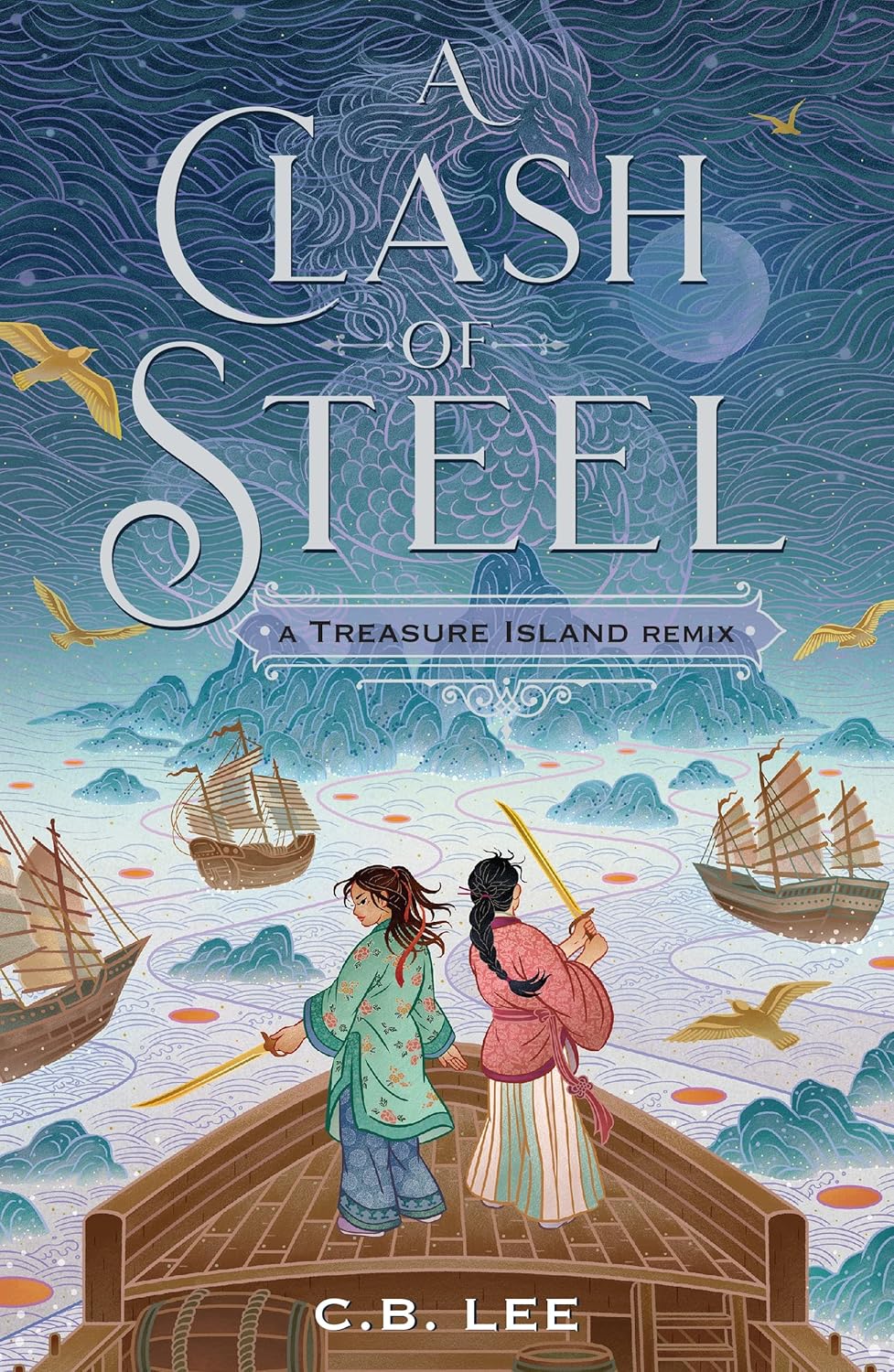
Clash of Steel: A Treasure Island Remix by C. B. Lee

I think this is my favorite of the remix series. Clash of Steel follows Treasure Island perhaps a bit less closely than some, but the broad strokes are there. I love the way that C. B. Lee has adopted their own personal history, and really substantive research into world history, to reset Stevenson’s classic tale of adventure, pirates, hidden treasure, family, loyalty and betrayal (etc.) in the South China Sea in piracy’s golden age. In this process, they offer protagonists who are girls and women, queer, and Chinese and Vietnamese. None of this is cut to fit Stevenson’s story; it’s a riff, set to history, in a time and place where it fits naturally. I loved the whole story. I also loved the supplemental materials at the back of the book, but let’s go in order.

We begin with a prologue set in 1818 South China Sea in which we meet an eight-year-old girl named Anh, aboard a small fishing vessel with her mother (the captain), her little brother, and a small crew. We get a glimpse of dangers at sea, a tight-knit family group, a daring young girl, and an interest in tales of hidden pirates’ treasures. Then we fast-forward to 1826, a small village in China’s Guangdong province. Sixteen-year-old Xiang has never left her village, not for lack of desire. Her father is long dead at sea; her mother is a successful salt merchant and proprietor of several teahouses, including the one where Xiang lives in this backwater, locked away, kept ‘safe’ but unhappy. She dwells in the stories she reads of travel and adventure, and on the high point from where she can view the city of Canton, and dream.

An opportunity comes when she convinces her mother to take her to the city, to visit the larger teahouse there, to see the commercial center–Mother wishes to marry her off to a young man from an appropriate family, but Xiang intends to show enough prowess that she might be permitted to run the teahouse someday. She has always yearned for her mother’s approval, which has never come. If only she could prove herself worthy, she might win that approbation as well as a chance to have a wider life than the village can ever afford. In her brief hours in the city, she meets a magnetic girl her own age–Anh–and gets a snatch of an idea of the kind of life that might be possible: adventure, gumption, authenticity, more. Then a series of events forces her hand. Faced with being shipped peremptorily back to the village forevermore, Xiang takes a chance and runs away. See Xiang on a fishing ship that is also a trade vessel that is also a smuggling ship; see her learn to sail and fend for herself; see her forming closer relationships than she’s ever had before. For a time, it seems all sorts of things might be within reach: family, love, riches, independence. Or violent death and the end of everything she thought she knew about her own background.

Xiang’s story calls on Lee’s own history (descended from Vietnamese refugees of the fall of Saigon, with Chinese roots “tangled together in past generations in conflict and trauma,” and yes, with pirates appearing in that story as well) and the documented history of Zheng Yi Sao, a “pirate queen” who commanded over 70,000 pirates and over 1,200 vessels. I was so pleased by not only the author’s note and acknowledgments, but also language notes, pronunciation guide, and extended historical notes. Finally, we were gifted with an alternate prologue, which (I agree with Lee’s editor) would have revealed too much of the plot if it had appeared at the beginning of the book; but coming where it did, offers intriguing character insight. I wonder if it might have made sense as a sort of flashback late in the story. At any rate, all this extra material enriched my experience of this story, and I loved having the extended historical notes in particular, because I knew nothing of this era of world history in which a Chinese and Vietnamese empire of pirates controlled the South China Sea and subdued all Chinese, British, and Portuguese naval efforts. Thrilling! Oh, and the normalcy of same-sex relationships in this time and place setting, which was apparently disrupted only by Western influence during the Qing dynasty. These references to history make the imaginative adventure tale all the more engaging, at least for this reader.

This story was captivating, and I loved having enough background to appreciate it on several levels. I’ll be looking out for C. B. Lee and am definitely in for more remixed classics.


Rating: 8 baos.

Most Ardently: A Pride & Prejudice Remix by Gabe Cole Novoa

I wasted no time after Into the Bright Open in getting into the next remix. Here, Pride and Prejudice retains its setting in time and place and the essentials of characters, with one great exception: the individual we know in the original as Elizabeth Bennet is here a trans boy named Oliver. Only a few people know his truth: his older sister Jane, his aunt and uncle, and two dear friends, Charlotte and Lu, who are, secretly, a same-sex couple and not the close friends their community believes them to be. He has arranged a workable system for going out as himself, sometimes climbing out the bedroom he shares with Jane at night in clothes stored under his bed, and sometimes going to Charlotte’s to change into clothes she keeps there for him. When he meets Darcy for the first time, he finds him handsome, but is repelled by his poor social graces and Darcy’s obvious disdain for the young person presented as Elizabeth.

Gabe Cole Novoa opens this novel with a note acknowledging that Oliver is frequently misgendered, and his deadname used, by his community and his own family, “though never by the narrative.” Novoa observes that this will be painful for some readers, and gives them fair warning: the author has done his best to handle the issues with sensitivity, but the book centers in some ways around Oliver’s dysphoria. As a reader who does not share this experience, I can only say that I thought Oliver’s dysphoria, misgendering, and seeking against convention for his authentic self were represented with nuance and grace, and accurately as far as I can see from here. Indeed, I thought the portrayal was of a sort to help other cis people like myself empathize with something we haven’t experienced for ourselves, in the best ways, which is some of the best work fiction can do for us.

Beyond that good work, Most Ardently is as sweet and transporting a love story (and a mess of misunderstandings) as the original it’s based on. Oliver presenting as ‘Elizabeth’ versus himself, to the same groups of people – and most importantly Darcy – offers some Shakespearean scenes of confusion, although these are less comedic because the Elizabeth character is a painful lie Oliver is forced to tell. There is one scene when Darcy laughs and laughs at an ironic turn that I do find nicely funny. And there is a parallel to the expected happy ending that is so oh satisfying – perhaps more so for its unlikeliness. (Novoa includes a historical note speculating on trans people who have ‘passed’ undetected in history. By definition, these are unknown to us. Novoa takes a hopeful stance.) I found the whole result sweet, entertaining, sympathetic, and wholly rewarding in the end. This was an easy and fulfilling read, and I’m ready for more in the series. I’m so glad this book is in the world.


Rating: 7 pairs of trousers.

Into the Bright Open: A Secret Garden Remix by Cherie Dimaline

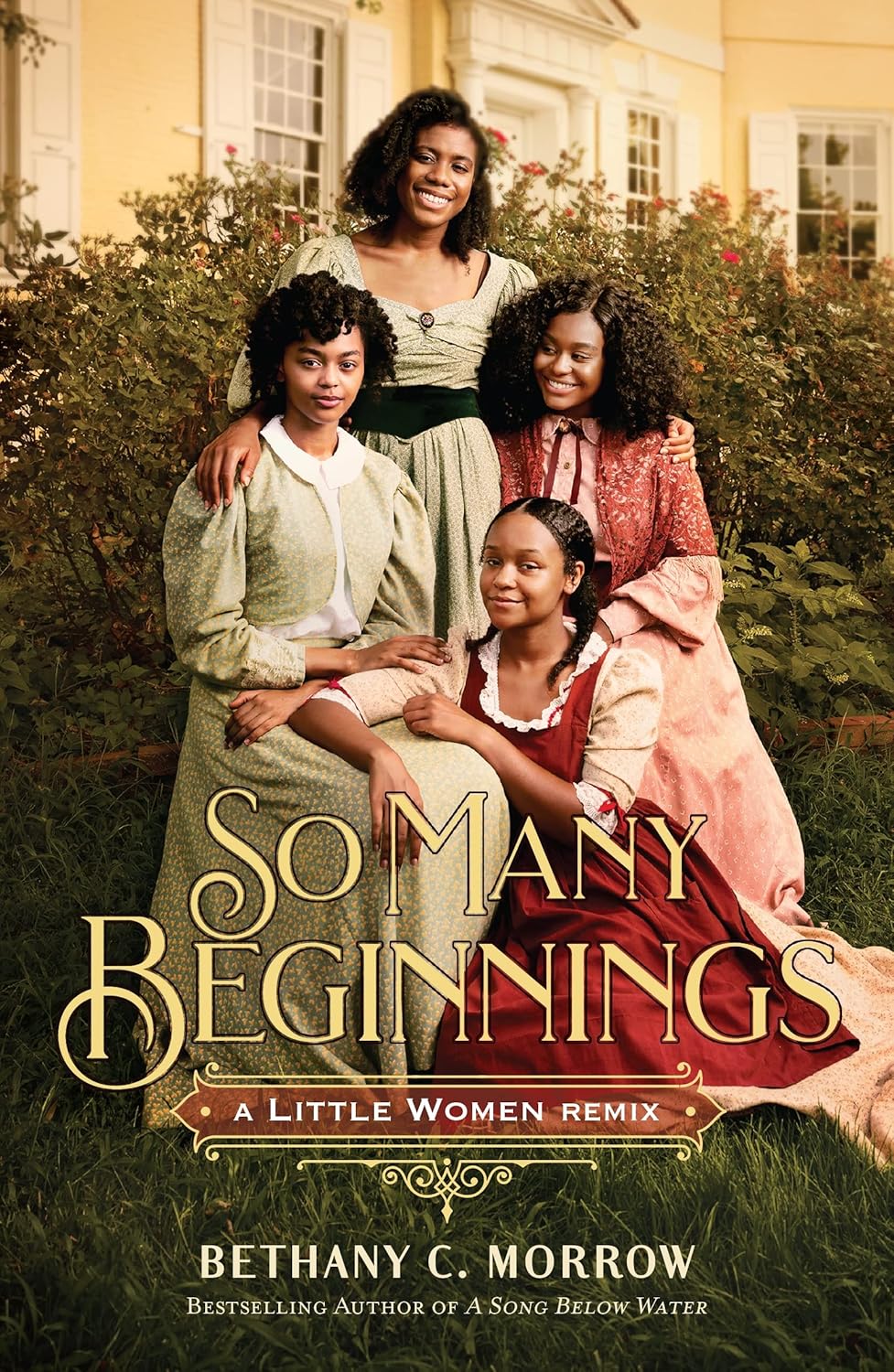
I stumbled into this book because I was following Cherie Dimaline (VenCo), but am glad to have discovered the “Remixed Classics” series from Square Fish, in which “authors from marginalized backgrounds reinterpret classic works through their own cultural lens.” I’m looking into a few of those, including Clash of Steel (Treasure Island), So Many Beginnings (Little Women), and Most Ardently (Pride and Prejudice). I love a daisy chain like this.

Into the Bright Open retells Frances Hodgson Burnett’s The Secret Garden, but in 1901 Ontario. Mary Craven is the unpleasant, lonely, spoiled-and-simultaneously-neglected child of a wealthy, important couple in Toronto, raised mostly by a nanny she does not like who does not like her, when her parents are killed in a car crash and she is shipped off to the Georgian Bay to live with an uncle she’s never met. He is not present when she arrives; she is greeted instead by household staff who treat her with more familiarity than she finds appropriate, but she quickly rethinks her stance as she finds them also warm, even friendly. Her uncle’s estate is grand, but by Mary’s standards, wild. Gardens border upon woods, and the ocean is an untamed thing. Native people and “half-breeds” initially offend her snobbish sensibilities, but Mary is just fifteen: young enough, and lonely enough, to change her mind. This version of Mary struck me as more introspective and more capable of self-criticism than I remember the original Mary Lennox to be. It also got me thinking: while readers are certainly accustomed to accepting flawed and imperfect protagonists, Mary Lennox might be an unusually unlikeable one. This Mary Craven, though: she definitely does unlikeable things, but with the benefit of access to her thoughts & feelings (this is told in a close third person), I find her quite sympathetic. She’s learning. She’s growing.

So. At the uncle’s house, Mary of course discovers the expected (if you know the original): the secret garden, and the secret child, a new friend for the friendless orphan girl, hidden away. There is a neighborhood friend as well, here a girl with wondrous comfort, confidence, and skills in the outdoors. There are further parallels to the original novel, but also a sinister twist.

This version, though set at the same point in history, feels more modern in its perspective, and I suspect would feel a bit more accessible to the modern young reader. I’m excited about the “Remix” series, and still excited by Dimaline.


Rating: 7 lines of poetry.

The Grace of Wild Things by Heather Fawcett

Another hit by Fawcett; I’ve just checked to be sure that *all* of her books are either here or on their way to me.

The Grace of Wild Things is based on Anne of Green Gables, loosely enough that all of its parts move freely, but with enough connection to be recognizable if you know the original. Of course, no knowledge of the earlier classic is required here, and I think Fawcett’s telling will be more accessible to modern young readers, and possibly younger ones. As much as I love Montgomery’s original, I suspect her writing style would be a little harder for my favorite rising eighth grader to take in. This book is absolutely headed to her bookshelf next.

We meet twelve-year-old Grace as she gazes out of the dark woods at the witch’s cottage. Accompanied by her crow friend, Windweaver, she has made a remarkable overland journey to get here, despite hearing about the witch’s evils (including cooking children in her oven and eating them, à la “Hansel and Gretel”). Grace has spent her life at an orphanage featuring no great abuse but a pattern of rejection, loneliness, friendlessness, and a lack of appreciation for her unique qualities, which include talking too much, a love of poetry (shared by Windweaver), an excess of imagination, and oh yes, magic. She is here to apprentice herself to the witch and try to find a home and a life where she can be accepted for who she is.

The first day’s cycle is rough: the witch pretends to welcome her, throws her in the oven and tries to roast her, then, thwarted, rejects her once again: “tomorrow you will go back to that orphanage, if I have to drag you there by your hair.” Grace decides she’d rather be eaten. And she really did love the witch’s cottage, and the perfect little bedroom there that she’d hoped to call her own. But in a combination of cleverness, determination, and dumb luck – or is it magic? – she meets a fairy and saves his life, and impresses the witch with a gift sufficiently that the witch agrees to let Grace attempt a challenge. If Grace can cast every spell in the witch’s first grimoire, from her own childhood, before a venerable cherry tree blooms the next spring, she will become the witch’s apprentice. If she fails, she will give up her magic to the witch. This also means losing Windweaver, her only friend in the world, who the witch says is Grace’s familiar: she never realized.

What else is there to do? Grace agrees. But there are 100 1/2 spells in the grimoire – the last one is incomplete – and they appear increasingly impossible to her untrained eye. (The witch refuses to help.) Luckily, our plucky protagonist quickly makes a friend, Sareena, a clever, no-nonsense neighbor girl who pledges lifelong loyalty. The fairy boy she’d saved, Rum, is bound to come at Grace’s command for three years, the deal they’d cut; but he also insulted her and she desires never to speak to him again. (Some readers will recognize the reworked Diana and Gilbert.) As the always-game Sareena and the increasingly devoted Rum dedicate themselves to helping Grace gather the impossible ingredients for the witch’s spells (a piece of the moon, a pitcher of midnight, three left footprints of a deer, a day lasting twenty-five hours), their little group grows, until Grace is overwhelmed by kindness and friendship. Even the prickly old witch softens slightly, and more disturbingly, sickens. When an outside force threatens their idyllic cottage and garden in what locals have long known to be the witch’s woods, Grace may have even bigger problems than the grimoire. But her powers are growing, too.

Anne-with-an-e is definitely alive and well here, with the imagination, the verbosity, the flair for drama, the questions, the enthusiasm and the emotions. “I never thought witches would be so leaky,” Sareena says of Grace’s disconcerting habit of expressing feelings through tears. We’ve identified Diana and Gilbert; the raspberry cordial episode is reworked, more magically, and that of saving Sareena’s beloved younger sister. The witch makes a fine Marilla, grumpy but secretly charmed by her unwanted orphan girl; she even has a brother, although he’s a bit less corporeal than Matthew was. Prince Edward Island remains the setting, and I am inclined to trust (but did not fact-check) that the many botanical details and spell ingredients are appropriate.

But Grace is also a lovely invention. She struggles with wanting to do good in the world while embracing her true identity and powers, which she takes for granted must be associated with evil. She feels gratitude and loyalty to the witch who gave her a home, even though she can see the witch’s wrongdoings (although we also benefit from learning more about her long and adventurous life). She learns the big lessons. “…the witch had said in one of her few helpful moments that many spells had more than one use. Since then, Grace had come to think of magic like poetry–a poem, after all, could mean more than one thing, or mean different things to different people.” Upon achieving a spell for wisdom: “Being wise, apparently, was not knowing a lot of things, but knowing all the things you didn’t know. It was dreadful. She felt very sorry for all the wise people of the world.” And of course, she has every bit as much gumption and potential as Anne Shirley ever did.

I am devoted to this author. Loved every page, can’t get enough.


Rating: 9 buckets of ice cream.

The Mists of Avalon by Marion Zimmer Bradley

I received a special copy of this book from one of my very best friends. It was originally published the year after I was born – not new, but an important classic. The Mists of Avalon is a ~900 page retelling of the legends of King Arthur, his Companion Knights, including Sir Lancelot, and the Round Table – but from the perspectives of the women involved, including Queen Guinevere (here Gwenhwyfar), Arthur’s mother the Queen Igraine and her sisters, Queen Morgause and Avalon’s Lady of the Lake Viviane… and most centrally, Arthur’s half-sister and lover, Morgaine, who we have also known as Morgan la Fay or Morgaine of the Fairies, and Viviane’s sometime successor as Lady of the Lake. Among others. (Sorry. These name changes are a bit to follow. Lancelot here is Lancelet, etc.)

I generally stay away from books of this length in recent years – I don’t know when I last read a book of 900 pages. It took some adjustment around paid reviews and deadlines, but I’m grateful I was able to find time for this one. It took a little over two weeks, while crocheting a blanket (!) and spending days on an excavator in the woods! But was worth every minute. I enjoyed being able to sink into a story this sprawling, which does call for some in-depth engagement, as we follow generations and lifetimes, a quite convoluted family tree, and shifting allegiances (and names).

My own background with the Arthurian legends is weak, although I definitely loved T.H. White’s The Once and Future King when I was young (high school? earlier still? that one over 600 pages), and I remember an illustrated book of the tales of the knights of the Round Table at some point… I have a loose sense of the romance and idealism of Arthur, Guinevere, Lancelot, and Camelot, but brought no muddied plotlines to this reading. It seems The Mists of Avalon is understood partly as corrective to Morgaine’s reputation as evil sorceress from previous tellings.

There’s no question that Bradley’s is a big, complicated, engrossing story. Its prologue begins with a brief, italicized reminiscence of Morgaine’s from later in her very long life; these retrospective views will punctuate the book. Then we move (with book one, “Mistress of Magic”) to Igraine, who will be mother to both Morgaine and Arthur, when she is a teenaged bride to the much older and coarse Duke Gorlois of Cornwall. Igraine was raised on Avalon, that magical, misty island where an ancient, pagan, woman-centered religion has long been fostered. She has some priestess training and some of the Sight, but it’s been her duty to be a wife and a mother: her daughter Morgaine is Gorlois’s child, and she will later marry Britain’s High King Uther and have a second child who will become the fabled King Arthur. So we begin with Morgaine’s infancy and before Arthur’s birth. I will begin fast-forwarding here… much has been written about this book, and you don’t need my plot summary.

Morgaine will become a priestess of Avalon, and she will become very powerful indeed, but will have to serve the Goddess in ways that pain her deeply. In four parts – “Mistress of Magic,” “The High Queen,” “The King Stag,” and “The Prisoner in the Oak,” we see her play the role of the maiden, the mother, and the crone. She is fierce in her protection and promotion of the religion in which she is trained. It is central to the story of Arthur’s reign, in this telling, that (under Gwenhwyfar’s influence) he shepherds Britain toward a homogenous Christian faith, away from a diversity of indigenous traditions, including the goddess cult of Avalon, and Morgaine fights that transition mightily. Her story is, I think, a tragedy, and includes strong threads of that classic tragic element, hubris (a term Arthur invokes once).

Bradley has chosen to tell this story mostly in a series of close-third-person perspectives, so that the reader can see the thoughts and feelings of one character and then another (the exception being those italicized first-person moments with an older Morgaine), so that we understand that each is dealing with insecurities and ultimately, mostly, good intentions, which heightens the sense of tragedy: that both Arthur and Morgaine want the best for Britain, that Viviane knows she will hurt her beloved niece Morgaine but feels it necessary for the greater good. It is a very fine literary trick to set up no absolute villains or heroes, but rather to offer us flawed humans who try hard and fail. It is hard, though, not to sympathize with the side that wishes to preserve its tradition as one of several, rather than the one that wants to squash out all but one religion.

There are many plot threads, romances, love affairs, couples that produce children (all-important heirs) and those that don’t. There are many themes, a number of which involve women’s various roles in society: to bear children, to be chaste, to support their mates, to participate in political machinations (or not), to be involved in one religion or another. An important difference between the rites of Avalon and those of Christianity centers on sex, which is either a grievous sin in all contexts except strict (marital) reproduction, or a beautiful celebration of life, the natural world, the God and the Goddess coming together. [Same-sex encounters are not many, but also not absent. No surprise that Avalon and Christianity handle them in different ways.] Morgaine’s tradition is inherently feminist, and at odds with Christianity, in that it holds that women belong to no man and may take lovers as they choose and as serves their worship and their life’s work.

This is a work of fantasy (as in magic and sorcery), and a classic retold, as well as historical fiction, as Arthur’s legend offers a version of how the Great Britain we know today came to be. Bradley’s work offers another take, in which a brave woman undertakes to defend indigenous traditions in a time of political and religious upheaval. The outcome, I think, doesn’t change much, but the way we view the different players involved matters a great deal. It’s also, of course, about human relationships. Morgaine, Arthur, Gwenhwyfar and Lancelet go back to childhood together, and there is a refrain late in the book of recalling the few of them who had once been young together. There’s a pretty strong thread of sympathies between friends, lovers, enemies, and those who move between those categories, even when they wind up killing one another.

Bradley’s storytelling is absorbing. It was easy to fall into a world very different from my own here, in the details of women’s lives in royal castles – dark, monotonous, filled with gossip and spinning and sex that’s not entirely consensual, even for privileged women – and in the rapture of Avalon’s powerful priestesses. The mysticism of that religion, the spell of Goddess-blessed sex, and the strong feelings of characters willing to die for their beliefs are all evocatively told. The romance, intrigue and pathos of that famous love triangle between Arthur, Gwenhwyfar and Lancelet is powerful and discomfiting. Heavier scenes are as well written as the light-hearted and humorous ones; Bradley’s characters’ humanity is always present. It was a hell of a journey, and I’m glad to have made it.

Whew. Thanks, Liz.


Rating: 8 scabbards.

Heartless by H. G. Parry

From memory, I’m going to say the Peter Pan story was sweet and heartwarming, with some good healthy ideas in it about always retaining a lovably childlike (not childish!) spirit and the magic of believing. We fly through the stars and have adventures! We help each other. And even when we have to (sigh) grow up, we can access that magic again through the power of imagination.

Then there was the movie Hook, which had Robin Williams and was therefore great, and (again in my possibly faulty memory) more or less followed those themes. We all have to grow up, but it wouldn’t be healthy to lose all the joy of childhood.

This is not that version of Peter Pan.

H.G. Parry, who I fell for hard with The Magician’s Daughter, takes us on a more realistic and darker journey with Heartless. Now the protagonist is neither a Darling nor a Lost Boy nor Peter himself, but an orphaned child in a Dickensian sort of London named James, who gives himself the fanciful last name Hook when he gets a chance at self-invention. James is a born storyteller, a skill which endears him to the only boy at the orphanage James really cares about, a careless but compelling child named Peter. For Peter, James tells stories: ones his mother told him or read him, ones he’s read himself, ones he’s made up. For Peter he makes up the child-king Peter Pan and his sometimes-antagonist the pirate Captain Hook, who inhabit a magical (and made up) island called Neverland. These tales keep Peter at James’s bedside until the night that Peter leaps off the orphanage’s high roof and flies into the stars: “second to the right, and straight on till morning.” James wants to follow his best and only friend, the boy who did not so much as look back. But when James leaps, he falls to the stone courtyard below.

From here we follow James Hook (his new identity) and his friend Gwendolen Darling (who takes the identity of James’s younger brother, George Hook) in their adulthood. James is forever chasing after Peter. He will eventually find what he’s looking for and find also that it’s not what he was looking for at all. This brief book (141 pages) is Peter Pan, yes, but retold with a different protagonist at its sympathetic center and a decidedly sinister twist; fairies are not sweet but uncaring. Captain Hook, of all people, is the one we feel for. And we are centered on the power not only of imagination but of storytelling – and like all of them, this is a power that can be used for good or ill. “[The fairies] didn’t understand that stories weren’t meant to be lived in forever; they were meant to be shared, passed on, questioned, to mingle with a thousand other tales and poems and experiences and be changed by them. They didn’t understand that stories, too, needed to grow. He hadn’t understood himself until recently.”

A retelling of a classic with rather more realism (especially in the London setting) and more darkness, but also still sweet and wholesome, with Parry’s absolutely lovely style; I’m going back for more from her.


Rating: 8 leaves.

Maximum Shelf: Fruit of the Dead by Rachel Lyon

Maximum Shelf is the weekly Shelf Awareness feature focusing on an upcoming title we love and believe will be a great handselling opportunity for booksellers everywhere. The features are written by our editors and reviewers and the publisher has helped support the issue.

This review was published by Shelf Awareness on November 28, 2023.


Rachel Lyon’s second novel, Fruit of the Dead, is a lushly detailed, mesmerizing retelling of the ancient Greek myth of Demeter and Persephone, set in modern times. This version retains original themes and subject matter, including power struggles, sexual assault, and cycles of growth and decay, while adding fresh commentary on addiction, class dynamics, and late-stage capitalism. Readers absolutely do not need familiarity with the myth to enjoy the novel, but such familiarity will be amply rewarded by Lyon’s subtle, clever references. The result is smart, disturbing, rich with opulent detail, and harrowing (there are several scenes of sexual assault).

The figure of Demeter, goddess of the harvest, appears as Emer Ansel, who runs an agricultural NGO. “We design, provide the seeds, outsource growth to farmers, and export to the hungry in Yemen, Syria, South Sudan, etcetera.” She is a woman of lofty principles but has sunk perhaps too comfortably into her professional role; a colleague accuses her of wearing “white savior drag.” Demeter had a beautiful daughter named Persephone, fathered by Zeus (god of the sky, king of the gods); Emer is single mother to Cory, who’s just turned 18, a wayward teen who has been accepted to zero colleges. Mother and daughter are at serious odds.

To escape the Manhattan apartment they share and forestall an uncertain future, Cory takes a job at her long-beloved summer camp, River Rocks. At a vulnerable moment (among other things, she is high), while caring for Spenser Picazo, a sensitive boy she’s befriended who’s also the summer’s youngest camper, she first encounters Spenser’s father. Rolo Picazo–the reimagined character of Hades, god of the underworld–is a self-made, superstar executive of a Fortune 500 pharmaceutical company. He has made his significant fortune on painkillers and now faces congressional hearings for his role in a pattern of destructive addictions.

Cory finds Rolo compelling, intimidating, by turns magnetic and repulsive. He is a massive man with a forceful personality. “His gaze is hard and hungry. It could consume her, she thinks, if she let it.” She finds herself spirited away in “a licorice melt of a Cabriolet,” accompanied by seven-year-old Spenser and his younger sister, Fern, figuring, “what killer would bring his kids along for the ride?” Rolo has her sign an NDA and transports her to a private island with no cell or wifi service, to serve as new nanny to his two young children. Cory is isolated, insecure. Rolo offers a lavish, seductive lifestyle, and literal intoxication. Emer descends into a wild panic over the disappearance of her barely-of-legal-age daughter, as Cory descends into the pleasurable fuzz of the ruby-colored pills Rolo provides.

Among Fruit of the Dead‘s themes is the specter of hazards faced by women and girls. Banishing frightening thoughts, Cory reminds herself dismissively, “occasional visits by violence are part of the cost of growing up female.” Rolo acts as if anything he desires is his for the taking: by charisma, by money, by force. His threat is looming and omnipresent, beyond its embodiment in one character. While these power struggles are central, Lyon excels at creating complex characters: Spenser and Fern are especially charming, well-rounded children.

In one of Lyon’s inspired storytelling choices, chapters alternate between the perspectives of Cory (in close third person) and Emer (first person), so that readers see Cory receive a text from her mother that she interprets as malicious, and later watch Emer send it with hopes of loving inspiration. These quietly tragic misunderstandings abound. Cory has moments of clarity, with misgivings about her disappearance into Rolo’s empire of painkillers and dissipation, but she loves her young charges. She mostly thinks her mom is a jerk, and what did Cory have going on, anyway? Emer quickly spirals, beset by calamities at work even as she searches for Cory. “How long have I spent hunting her down, daughter of evasion, daughter of evaporation, daughter of god help me.” The “daughter of” refrains lend this retelling an appropriately mythic tone. “Daughter of goofing, daughter of grief,…” “daughter of splendor, daughter of heartbreak, daughter of elusion,…” “daughter of warmth, daughter of sweetness, daughter of mine.” And “daughter of unwelcome surprises.”

Lyon (Self-Portrait with Boy) expertly leads readers to sympathize with both mother and daughter, even as their perspectives differ. This push/pull echoes the Greek myth’s focus on seasonal cycles: Persephone’s return to Demeter heralds springtime, her inevitable return to the underworld forcing growth to start over again. The best efforts of the protective mother can only delay the child’s foray into danger; every reawakening continues the struggle. Fruit of the Dead offers hope, but always with a seed of foreboding.

This compulsively enthralling novel recasts an ancient myth in familiar times to great effect. Disquieting, propulsive, wise, and frightening, Lyon’s imaginative second novel is hard to put down and harder to forget.


Rating: 8 succulents.

Come back Monday for my interview with Lyon.

rerun: The Song of Achilles by Madeline Miller

Fun fact: I interviewed Miller for the podcast Critical Wit, and that interview posted on the same day (May 31, 2012) that she won the Orange Prize for this novel, which was a fun piece of synchronicity for all of us, I think. That interview can be heard here.

This review originally posted on May 17, 2012.

I read this book in a day, rapt and tearful and awed. Madeline Miller, I love you. Write more, please.

I expect that most people are at least vaguely familiar with the story of the Trojan War, even if you never read the Iliad, yes? The Greeks sail to Troy in pursuit of Helen, “the face that launched a thousand ships” (that’s these ships!), the most beautiful woman in the world, stolen from her king-husband Menelaus by the Trojan prince Paris. They fight at the gates of Troy for ten years before Odysseus’s characteristically clever notion of the big wooden horse (the Trojan horse of idiom) wins the war for the Greeks. Achilles is a hero of the war, on the Greeks’ side. He had been sitting the war out in protest against an offense to his pride when his close friend (and, most scholars agree, lover) Patroclus goes into battle and is killed. In the opening scene of the Iliad, Achilles is mad with grief and rage, about to rush into battle, kill Hector, and be killed by Paris.

That’s the background. Miller, a scholar of ancient languages (including Greek) and theatre has written a novel from Patroclus’s point of view. This gave her quite a bit of leeway, since Patroclus is not given much coverage in Homer or in ancient myth generally; she got to do what she wanted with him. Here, we see him grow up from a boy: he was a disappointment to his father, then was exiled in dishonor and sent away to be fostered in another kingdom, where Achilles is the prince and heir. The two boys form a decidedly unlikely friendship, with Patroclus the dishonored and weak following in the footsteps of Achilles, whose future is prophesied to be something enormous: he will be Aristos Achaion, the greatest of the Greeks.

Patroclus joins Achilles in his studies and their bond grows closer until they become lovers. They are not eager to join the Greeks and sail to Troy to fight for another king’s wife, but circumstances (and Odysseus, the crafty one) conspire to see them off. From there, you can revisit my synopsis of the Iliad, above – except that we keep Patroclus’s perspective, which actually made the Trojan War that I thought I knew so well spring fresh from the page.

And that is one of the several strengths of this book: that an ancient myth that is familiar to many readers, like me, becomes so real, new, crisp and juicy in Miller’s hands. It definitely made me want to go back and reread the Iliad, as well as other cited works. (Check out the Character Glossary, whether you think you need it or not, for background as well as mentions of other books you’ll want to go find.) The myth of the Trojan War comes alive with Patroclus as it hasn’t before.

Another great strength is the emotional impact Miller achieves. This book is moving, sweet, heartfelt, powerful, in its tragedies as in its loving moments – and the tragedies are plentiful. There is visceral wrath in Achilles’s mother Thetis and her hatred of all mortals and Patroclus in particular; that emotion comes through just as strongly as the love that makes Patroclus put aside jealousy and envy, makes him put Achilles’s needs before his own. I noticed that the first-person voice of Patroclus rarely uses the name Achilles, but just refers to his lover as “he” – thus emphasizing the extent to which Achilles is the center of his world.

As I said at the start of this review, I want more of this! It’s so well done. If you’re taking requests, Ms. Miller, I would like to read a book about what happened to the happy family of Odysseus, Penelope and Telemachus following the conclusion of the Odyssey: how does Odysseus manage to gracefully step down from power and transfer to Telemachus without sacrificing any of his machismo? Reading The Song of Achilles raised this question for me – how a king could step down and preserve his dignity and quality of life. I wonder, too, whether Penelope ever gets grumpy about all the philandering Odysseus did along his homeward journey, while she was standing strong against the suitors.

In a nutshell, this retelling of the Trojan War and the relationship between Achilles and Patroclus is lovely, loving, sweet and deeply emotional; it preserves the grand, sweeping scale and feeling of humanity and drama in the original, but brings it freshly alive in an appealingly different format. The Song of Achilles made me sigh and think and cry, and I wanted more when it was all gone. This may very well be the best book I’ve read in 2012.


Rating: a rare 10 loving caresses.

Maximum Shelf: Ithaca by Claire North

Maximum Shelf is the weekly Shelf Awareness feature focusing on an upcoming title we love and believe will be a great handselling opportunity for booksellers everywhere. The features are written by our editors and reviewers and the publisher has helped support the issue.

This review was published by Shelf Awareness on June 22, 2022.


Claire North (The First Fifteen Lives of Harry August; The Pursuit of William Abbey) offers a new take on a familiar tale with Ithaca, a richly imagined, thought-provoking novel of Penelope’s trials during the Trojan War and its aftermath. The forgotten or misrepresented women and goddesses of ancient Greece bring joy, sorrow, humor and wit.

A lengthy space of time falls between The Iliad‘s story of the Trojan War’s conclusion and The Odyssey‘s story of Odysseus’s protracted homecoming. On the island of Ithaca while its king, Odysseus, is absent, Penelope, his queen, rules uncertainly, beset by unruly suitors wishing to become king, and the hopes and ambitions of her son, Telemachus, an infant when his father went to war and a young adult by the time he returns. Into this gap comes Ithaca, which follows the challenges faced by Penelope and the other women–queens, wives, mothers, goddesses, slaves–who surround her and fight their own often overlooked battles.

The Homeric myths are well-known and familiar territories for many readers and indeed many writers, who have reimagined and retold these stories in abundance. But despite the richness of such retellings, Penelope remains an enigma, and North’s contribution to the genre is unique and welcome. While the Ithacan queen is in some respects its protagonist, Ithaca is narrated by the goddess Hera, wife (and sister) to Zeus, and frequently represented as bitter, jealous and vengeful. Hera’s interest in Penelope is self-serving: as the goddess of women, wives, queens and motherhood, she resents the ways in which Penelope is disregarded by her male counselors, her absent husband, her suitors and her son. While Hera’s stepdaughter, Athena, is chiefly concerned with the hero Odysseus, Hera is entirely here for the women. In fact, it is not Penelope whose fate concerns her first: “No one ever said the gods did not have favourites, and it is Clytemnestra I love best, my queen above all, the one who would be free.”

Clytemnestra’s crime of husband-murder is reframed by the recounted sins of Agamemnon, and when the murderess-queen hides on Ithaca, readers are reminded that she and Penelope are cousins. Next arrive Orestes and Elektra, who seek to avenge their father’s death; Orestes is near-mute and disengaged, while his sister is a magnetic, powerful force, barely remembering that she must at least seem to defer to the will of a man: “aware that she has been perhaps a little too forceful… [she] adds, ‘My brother will issue his commands shortly.’ ” Clever Penelope is more practiced at the trick of subtly sliding her wise points into conversations while seeming to demur. Telemachus is a bit silly, a boy hoping to be a man. Odysseus is entirely off-screen, “groan[ing] in the nymph’s pearly bed.” Both Artemis and Athena make appearances, annoying their stepmother with their own agendas.

Penelope is of course harassed by the unwelcome suitors who place the queen in a sort of stalemate, as she can neither accept their offers of marriage (both because Odysseus may still be living, and because to accept one would be to provoke the others quite possibly to war) nor send them away (because of the culturally sacred host’s obligation). In this version, Penelope is additionally beset by pirates attacking her island nation–pirates dressed as Illyrians but wielding the short swords of Greeks. There seems to be intrigue afoot, offering a whodunit mystery subplot for Penelope and her subtle female counselors (in contrast to her blustering male ones) to investigate. Women warriors lurk in the shadows of this Ithaca. And North does not forget the maids, who are also slaves, and also in some cases Trojans: “Death to all the Greeks,” one of them repeatedly mutters under her breath. The maids are frequently bedmates of the suitors; but to what end, and with what choice in the matter?

Thus is Ithaca the story not only of Penelope, Hera and other queens and goddesses, but of less famed women as well, down to the teenaged village huntress who opens these pages. Hera is quick to remind her audience that the stories that get passed down are written by poets, whose narratives may be purchased, and who rarely notice the contributions of women: “That girl is not remembered now”; “No poet will ever do her homage.” “Freedom only increased the efficacy of her work, though there is not a single poet in all of Greece who would dare breathe of such an outcome.” Hera’s voice is humorous, whimsical, imperious, frequently scornful. But she is also surprisingly easily cowed by the other Olympians, knowing that Zeus holds power over her. “I was a queen of women once, before my husband bound me with chains and made me a queen of wives.” While this story is on its face about Penelope, Clytemnestra, Elektra and the rest, Hera is an engrossing and masterful character in her narration.

North’s prose is clever, funny and as wise as Penelope herself, with an eye for pleasing images as well as deeper meanings. In her capable hands, this ancient landscape is both fresh and timely. Ithaca is the first in a trilogy, and having come to know this three-dimensional Penelope, North’s readers will eagerly await the next two installments.


Rating: 8 dreams.

Come back Monday for my interview with North.