a pair of Quixotes

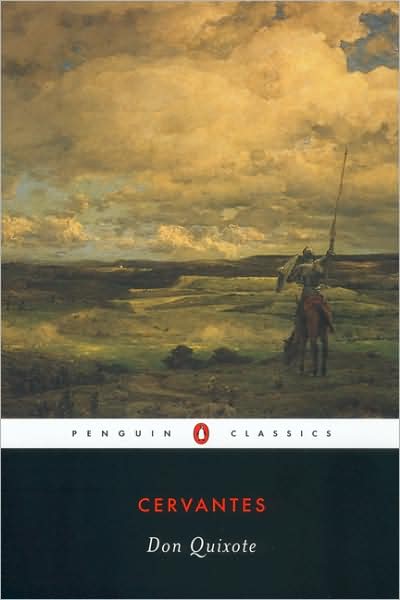
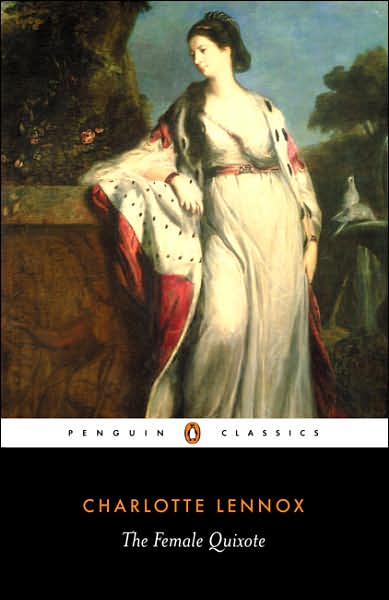
I have a slightly πŸ™‚ ambitious summer plan, y’all. Tell me what you think. I’ve always wanted to read Don Quixote (yes, for the first time), and I hope that this is the year. I have also heard from more than one source about a book called The Female Quixote, or The Adventures of Arabella, by Charlotte Lennox. I think these would make a good pair of companion reads. The latter claims to be “part imitation of and part commentary on” the original Quixote (so says the “product description” on Amazon, usually meaning the back cover or inside flap). Obviously I need the original before reading the imitation & commentary.

This will work towards the Classics Challenge, of course, and will also be a significant reading commitment: Don Quixote runs some 1,000 pages depending on the edition, and the Female is just under 300. I shall take my time! I have a copy of Quixote at home waiting for me, and I’ve just ordered a copy of the Female.
What do you think, am I crazy? Have you read the either? Any thoughts? Any joiners? πŸ™‚ We could call it a readalong if any of you were crazy enough to join me.

Slaughterhouse-Five by Kurt Vonnegut (audio)

Full title:

Slaughterhouse-Five, or the Children’s Crusade: A Duty Dance with Death

It seems a little odd to me that I’ve never read this book, and in fact I wondered if maybe I had, and had just forgotten. But as soon as we started listening to this audiobook (my parents and I, on the way home from New Orleans) I knew I’d never heard or read this book before. Vonnegut is always thrilling and fascinating! I know I really enjoyed his Cat’s Cradle and Breakfast of Champions, and Slaughterhouse-Five shares with them a very surreal, time-warped, rambling, fantastical tone. It feels like Fear and Loathing in Las Vegas, particularly the scene in the movie where they take the ether and things turn on their sides.

For those who don’t know, this is Vonnegut’s autobiographical story of the bombing of Dresden, which he experienced, like his protagonist Billy Pilgrim, as a POW in a slaughterhouse. Vonnegut, and Billy, survived only because they were holed up in the meat locker there, while the vast majority of the city burned.

Billy’s story involves war, bullying, sex, time travel, optometry, drinking, and misunderstanding. Overarching themes of death and timelessness tie the winding threads together. The world does not believe that Billy travels in time or that he was kidnapped by little green aliens from the planet of Tralfamadore. We hear of Billy’s whole life, as a small child, as a student, as a soldier in the war, as a young husband, as a professional optometrist, as a feature in a zoo on Tralfamadore, and as an old man. Like Billy, we don’t keep these experiences in sequence, but drop in here and there.

Billy’s story is preceded by a long intro in which Vonnegut narrates, not his experience as a soldier or a POW, but as a writer, many years later, struggling to write about Dresden. He visits an old war buddy and learns of this buddy’s wife’s fear of war. She’s concerned that he’ll write a book glorifying the experience and thereby encouraging future generations to make war. He reassures her that “there won’t be a part for Frank Sinatra or John Wayne” in his book, if he even ever finishes it. He also promises her he’ll call it “The Children’s Crusade”, agreeing with her that they were just babies over there.

This is a very powerful story. Descriptions of the horrors of war are evocative, perhaps even more so the depiction of the POW’s in the railroad cars passing steel helmets filled with their excrement to the men standing near the ventilation slots. War is bad. But there’s much more to this book than the point that war is bad; it’s also a fascinating story about family and relationships. (I’m reminded of Breakfast of Champions with its bizarre family structures and roles and dysfunction.) And the world of Tralfamadore is fantastical, incredibly imaginative, and so fully-developed in its details, I just wonder at Vonnegut. Where does he get this stuff? The turns of phrase are memorable. A drinking man’s breath smells of mustard gas and roses. That’s poetry.

This story is beautiful, strange, and strangely feels endless. It finishes with a question-mark; loose ends are not entirely tied up. How could they be, when events are presented out of sequence, and Tralfamadorian concepts teach that no one moment ever ends? Vonnegut was a genius, and I want to keep reading him all my life. (There are still a number of titles I haven’t touched, and were you aware? just this January, a new volume of his previously unpublished short fiction came out. It’s called While Mortals Sleep.) Oh, and I want to mention the reader of this audio version. He speaks in a strange whisper, and his style is very, very effective for this book. Guess who? None other than Ethan Hawke. I was surprised, and tried throughout to place this handsome actor behind the voice I was hearing; but I couldn’t put the guy I know from Reality Bites and Training Day into Vonnegut’s world. Very strange. I guess that’s the mark of a great actor, that he can fill different roles believably. I’m impressed.

Rebecca by Daphne du Maurier

Here’s yet another book I can’t believe I waited so long to read! I struggle to categorize this book. I think I thought it was genre romance, and I still tend to shelve it that way, but I also feel that sells it short. (Sorry, romance readers. Bear with me. I’m not trying to be ugly.) Of course, categorization is often problematic, and often doesn’t do a book justice. But we persist in trying to do it, for several good reasons. Labels are helpful in describing a book to your friends, and grouping like items together on a shelf assists browsing. So, I thought Rebecca was romance, or romantic suspense, as it says right on the cover of my paperback copy. And to me, this sounds like genre fiction: readable, easy, even “light”, entertaining, and in accordance with a known structure or format. Not a bad thing – I love a lot of genre fiction (although mostly mystery, and not romance). But I’ve also heard this book referred to as a classic. I’ve seen it written about and referred to repeatedly as a standard of sorts. My curiosity grew, and I had to pick it up.

And what a delicious little treasure it is! From the first page, I was transfixed. The mood is outstanding. I had only the vaguest of notions that something bad happened in this book, and I could feel the ghostly mist creeping unseen around my shoulders from literally the first few sentences. There is an air of foreboding that is absolutely unexplainable, as the plot proceeds in an outwardly staid and steady fashion. How does she do it?

Our narrator, who I believe remains unnamed throughout, is living a painfully awkward underprivileged youth when she meets a striking and tragic widower who abruptly proposes to her after a brief quasi-courtship. (This is not a spoiler, I don’t think, or not a very bad one. It is fairly well known from the first pages.) Anticipating this proposal was great fun for me. She accompanies him back to his famous (or infamous?) estate, and the legacy of the dead first wife looms.

Now I shall stop telling you the story. I might have known this much going in (at a maximum) and it was a real pleasure to breathlessly turn pages in ignorance of what was to come. It is suspense, people, as the cover says! If you haven’t read this, avoid spoilers with great care! And go get yourself a copy immediately! Here, you can borrow mine. (The library has several.)

The suspense is outstanding. The narrator’s awkwardness occasionally gets a little frustrating but it’s so REAL – my frustration is entirely realistic because she is realistic. The bad-guy characters are infuriatingly, in a juicy-delicious fictional way. The striking husband remains tragically striking, sort of admirable and obnoxious by turns, but I suppose the romance part drew me in, because I was right there with the nameless wife, wanting him to love us. And the background moodiness, the ghost-story feel, the gothic mists about my shoulders were entirely pleasurable.

I wish I could read this book again for the first time! I know du Maurier has written much else. I hope it is up to this standard because I thought it was outstanding. Genre fiction? I don’t know, I’m stumped, but whatever it is, it’s worth reading.

Three Lives and Tender Buttons by Gertrude Stein

I have this Digireads edition, see

I’m cheating a touch, because I read Three Lives some time ago. But it is bound with Tender Buttons in my edition and I’m going to write about them together. It is my hope that my writing about two Stein conundrums will distract you from the fact that I’m confused.

I found some unexpected free time one evening, and knew that I had reading commitments to fulfill, so I didn’t want to start anything of any significant length. I’ll try Tender Buttons, I thought. It’s all of 30 pages, I thought, how hard could it be? HA! Maybe I should have turned back to one of the stories out of The Things They Carried or a chapter of This Book Is Overdue! Either one of those would have been easier options.

So my interest in Gertrude Stein is entirely born of my intense interest in Ernest Hemingway. As we know, Stein was an early friend and mentor, with whom his relationship later soured; he greatly admired, then denigrated, her work, which is famously… er, unique.

When I read Three Lives I was a bit dismayed at my failure to appreciate it. I didn’t find it as difficult as Faulkner, thank goodness, but she certainly doesn’t follow anyone’s model structure for story-telling. Three Lives is made up of three novella-style life stories, of three women in a fictional small town. Their stories don’t go anywhere particular, nor do they join for any greater purpose, although they are evocative and poignant in their moments. I suppose they are vignettes, and well-done at times in their own way; but unorthodox and a little unsettling.

Tender Buttons is a wholly different proposition. It’s a long free-verse poem of sorts, presented sort of as a series of descriptions or discussions of random nouns. For example.

A MOUNTED UMBRELLA.
What was the use of not leaving it there where it would hang what was the use if there was no chance of ever seeing it come there and show that it was handsome and right in the way it showed it. The lesson is to learn that it does show it, that it shows it and that nothing, that there is nothing, that there is no more to do about it and just so much more is there plenty of reason for making an exchange.

or

A NEW CUP AND SAUCER.
Enthusiastically hurting a clouded yellow bud and saucer, enthusiastically so is the bite in the ribbon.

At first this bothered me very much, because I was trying to make sense of it. Her sentences are not sentences; they do not seem to have meaning, or if they do, I am too dense to find it. Unlike the poetry I am familiar with (and I’m no scholar of poetry, but I have read some, and even free-verse generally has some structure – some clues as to how to read it, like line breaks or, hello, punctuation!), there is no guide for where the natural breaks are in language – where a person would draw breath when reading aloud, for instance. (I tried reading this out loud to the Husband while he worked on our deck and he was NOT tolerant.)

But then I decided that Gertrude Stein’s poetry is like Cirque du Soleil or Cats, in that there is no plot or point to speak of, but there is poetry. Read Tender Buttons aloud; it makes music. This is the best way that I can find to appreciate Stein. She is a challenge, make no mistake. And perhaps there is great depth of meaning and I’m missing it because I’m simple. If so, please do comment here, being gentle and kind about it, and explain what I’ve missed. I’m willing to make an effort to appreciate Stein, for Papa’s sake (unlike Faulkner, who I’ve given up on, I think) but she does require an effort. On the other hand, with effort, I find Tender Buttons an intriguing puzzle and it does stimulate and entertain me; just not in the way I usually expect books to do!

I am claiming this one for credit in the Classics Challenge. I think I’ve earned it. Please don’t make me write a book report as I remain a little baffled. But, I’m also excited at the prospect of reading Janet Malcolm’s Two Lives (a biography of Stein and her lifelong partner Alice B. Toklas. notice the play on Stein’s Three Lives), which has patiently resided on my shelf for years now. Look for that one to come. Perhaps Ms. Malcolm will help me understand Ms. Stein!

Teaser Tuesdays: Rebecca by Daphne du Maurier


Teaser Tuesdays is a weekly bookish meme, hosted by MizB of Should Be Reading. Anyone can play along! Just do the following:

* Grab your current read
* Open to a random page
* Share two (2) β€œteaser” sentences from somewhere on that page
* BE CAREFUL NOT TO INCLUDE SPOILERS! (make sure that what you share doesn’t give too much away! You don’t want to ruin the book for others!)
* Share the title & author, too, so that other TT participants can add the book to their TBR Lists if they like your teasers!ο»Ώο»Ώ

OH this is a fabulous book! I love that there are SO many great reads out there. I know that I can keep saying this my whole life: why did I wait so long??

Your teaser today comes from page 36:

I wanted to go back again, to recapture the moment that had gone, and then it came to me that if we did it would not be the same, even the sun would be changed in the sky, casting another shadow, and the peasant girl would trudge past us along the road in a different way, not waving this time, perhaps not even seeing us. There was something chilling in the thought, something a little melancholy, and looking at the clock I saw that five more minutes had gone by. Soon we would have reached our time limit, and must return to the hotel.

I’m adoring this book; it’s delicious. The beginning is mostly in pursuit of romance, and I’m excited for the engagement that is clearly coming (this is not a spoiler; the whole book is about the narrator’s role as Wife). But even in the midst of a budding marriage, the tone is spooky. The story is written from a distance of years, and with the narrator’s knowledge of what unpleasantness is to come – but I, the reader, don’t share this knowledge. I know something unpleasant is coming, but don’t know what. It feels like a ghost story but actually I really don’t know what’s wrong at Manderley! How exciting! I know, I’m very late to discover this enjoyable book, but I am enjoying it now!

Challenge Updates

Wow! Is it April already? Let’s do some challenge updates. I am doing better on some than on others, ho hum. I’m only involved in three challenges! I wanted to start my first full calendar year as a blogger a bit conservatively. And, I only wanted to undertake challenges I was both a) confident I could succeed in, and b) actually excited about.

Where Are You Reading? is hosted by Sheila at One Person’s Journey Through a World of Books. The idea is to read one book from each of the 50 states within the 2011 year. (Bonus points are awarded for foreign locations.) This doesn’t strike me as terrifyingly ambitious, although we shall see how far along I am in November and December! You may see me scrambling for some specifically-set books. πŸ™‚ The good news is, fiction, nonfiction, audio, etc. – any book works. Take a look at my map to see where I’ve been. So far, I’ve read in 12 states: New York, Illinois, South Dakota, Texas, Maine, Nebraska, Michigan, California, Missouri, Minnesota, Massachusetts, and Washington; and 6 foreign locations: London, Stockholm, Dublin, Paris, Toronto, and the fictional Caribbean island-country of St. Mark’s. This has been so fun! And as I’m 12 into 50 states in 3 months, I’m feeling perfectly fine about this challenge. Thanks so much to Sheila for a really fun adventure.

The Classics Challenge is hosted by Courtney at Stiletto Storytime (a blog name I love, in case I haven’t said that. how cute). I signed up for the bachelor’s degree level, meaning 10 classics in 2011. I haven’t made near the progress I would have thought by this time. Apparently my reading of classics is not as automatic as I thought it might be, and I wish it were – which just makes this challenge more valuable to me, if it’s going to push me into reading more! When I contemplate classics I find myself often thinking about rereading some of my favorites, which would be lovely but I don’t think that’s exactly the point. (I don’t have Courtney’s take on this, but I’m going to behave as though rereads don’t count.) So far I have very much enjoyed Main Street by Sinclair Lewis, and The Strange Case of Dr. Jekyll and Mr. Hyde by Robert Louis Stevenson. Although I’m behind, being 20% through the challenge and 25% through the calendar, I’m not concerned. I can find PILES of delectable challenges. You just wait.

What’s In a Name? is hosted by Beth Fish Reads. It’s a cute idea: we’re looking for titles with certain elements to them.

  • A book with a number in the title: 61 Hours by Lee Child
  • A book with jewelry or a gem in the title
  • A book with a size in the title
  • A book with travel or movement in the title: Running Blind by Lee Child
  • A book with evil in the title
  • A book with a life stage in the title

One third of my way through this challenge feels okay to me. Like the Where Are You Reading? one, I’m not making any special efforts to date. We’ll see if I have to play catch up later this year.

So! While I’m disappointed to see myself lagging behind in classics, I think I’m doing okay for the year. What fun to have goals in our reading. πŸ™‚ Do you have any challenges going on, or any reading goals in particular for this month, or year, or ??

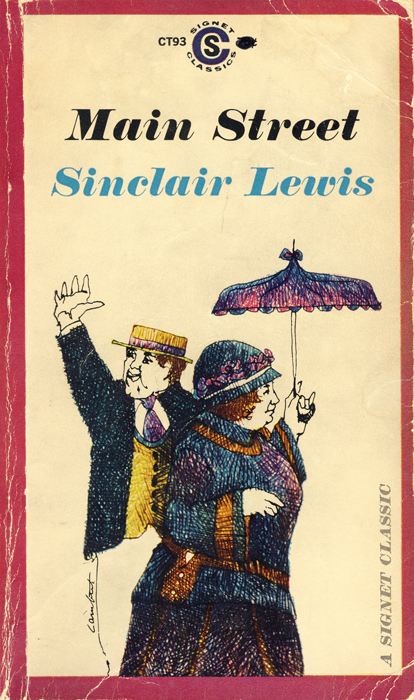
Main Street by Sinclair Lewis

This is a real star. I’ve been so pleased to take in this witty, bitingly satirical story of small-town life. The setting is the fictional town of Gopher Prairie, Minnesota, based on Lewis’s hometown of Sauk Centre; but as he says in the introduction, “the story would be the same in Ohio or Montana, in Kansas or Kentucky or Illinois, and not very differently would it be told Up York State or in the Carolina hills.”

This is my first experience with Sinclair Lewis, and I’m sorry I waited so long. Certainly his other work is now on my long list TBR.

It’s the story of Carol Kennington (nΓ©e Milford), who as a college student has some vague and lofty ideas of improving small towns, before she marries and settles in Gopher Prairie. This small town (patently representative of small towns everywhere – Lewis all but beats us over the head with this statement) does not want to be improved, does not believe it needs improving, and disapproves of Carol on every level. It’s a painful story, and it drags along, not becoming boring, but definitely oppressive in Carol’s pain. She’s no pristine heroine, repeatedly distracted from her lofty goals of uplifting Gopher Prairie and the human race; she’s decidedly flawed. And yet I don’t think the reader can help but sympathize with her.

She tries to implement her idealized improvements but is rejected in her theater group, her improvement of the town library, her crossing of social, economic, and class lines. She tries to escape in a few cheap flirtations, but none is consummated – her choices of love are disillusioning. She finally makes her husband take her on a trip to leave behind the doldrums, but her relief is temporary. From page 393:

Yes. She was back home! Nothing had changed. She had never been away. California? Had she seen it? Had she for one minute left this scraping sound of the small shovel in the ash-pit of the furnace? But Kennicott preposterously supposed that she had. Never had she been quite so far from going away as now when he believed she had just come back. She felt oozing through the walls the spirit of small houses and righteous people. At that instant she knew that in running away she had merely hidden her doubts behind the officious stir of travel.

Finally, just when I thought we were going to wallow forever, Carol up and leaves town with her three-and-a-half-year-old son for Washington, D.C., where she starts a new and relatively satisfying life. But she is still not ultimately fulfilled… Relatively quickly, she ends up back in good ole GP with good ole Will Kennicott. The book ends with Carol resigned to GP, with an oddly comfortable but not entirely content feeling. I found this a ending a little strange. So much of the book had been writhing discomfort and dissatisfaction and dreaming and planning for something different. Then we finally – very late in the game (by which I mean the book) – saw Carol go to DC for a life that I do see was not entirely suited to her, but also seemed very much an improvement. And then she went back… home? Do we call it home? She makes a few final defiant statements at the end of the book; but her defiance is in spirit and not in action or even, I feel, in emotion. I’m not disappointed with the ending. I suppose I’m a bit surprised. I’m awfully removed from Carol’s world. I will see my 30th birthday a good 95 years after hers; and I’m if anything a bit independent in my own time. Her life in DC looked pretty interesting to me but I realize that I am not Carol. And who on earth could I have been in her day? But I digress.

Lewis’s criticism of Gopher Prairie and by extension, all of the U.S., is almost cruelly biting, but also wonderful, witty, and funny. I was entertained from the first page. Besides American hypocrisy, or maybe even before it, its largest social issue is definitely feminism and women’s place in the home. But there is also tangential treatment of war (World War I), communism, workers’ rights, religious hypocrisy, class structures… and Carol doesn’t escape criticism, either. Lewis reserves a sneer for the out-of-touch artsy do-gooder in her. But in the end I think he retains something of a loving touch for most of his characters at the same time.

The writing was delightful. I laughed out loud and I felt Carol’s pain, and I felt for the ridiculous Will Kennicott (who mostly, I did not like) when he stoically handled Carol’s infidelity-in-spirit. But I also gloried in the turns of phrase. I loved “that amiable contempt called poise” and that Carol “picked [the book] up carelessly, with a slight yawn which she patted down with her fingertips as delicately as a cat.” Does that not paint a portrait?

I was interested to find, in the Afterword (by Mark Schorer of the University of California, in my Signet Classic paperback edition of 1961), discussion of this book in relation to Madame Bovary. Apparently my repeated comparison of the two, while I was reading, has a strong precedent. Schorer writes,

Madame Bovary is more than a study of provincial manners in a certain time and place in France; that much is only the setting for a highly dramatic presentation of human catastrophe. But Main Street cannot be lifted out of its historic setting, which is, in effect, the whole of it.

Perhaps this is what I was saying above, about trying to put myself in Carol’s shoes. At any rate I found the Afterword to be a few thoughtful pages, worth the time I spent on it.

I picked this up as a casual read and it was very enjoyable and worth my time and interest. I’m going to apply it towards the Classics Challenge at which I am so miserably far behind, so there we go. More to come!

What is a Classic?

I’ve been struggling with this question lately. I think my concern began in contemplating the Classics Challenge which I have NOT been active on. But it’s an interesting question generally. I was thinking yesterday’s post might aid us. Is everything on this list-of-lists (-in-cloud-form) a classic? How many classics are there in this crazy world? Too many to list, right? Is everything by one classic author then a classic? (Nabokov wrote Lolita; is Pnin then also a classic?) How about timing? Do we have to muse over a title for a decade or several, or can we declare in its publication year that it is a classic? (Is there a waiting period, time for us to cool off and see if the fire still smolders?)

Courtney, who is hosting this challenge over at her blog, Stiletto Storytime, does define it for us:

What is a classic you ask? A classic to me is a book that has in some way become bigger than itself. It’s become part of culture, society or the bigger picture. It’s the book you know about even if you have not read it. It’s the book you feel like you should have read.

This sounds like a pretty forgiving definition to me – and thank goodness, since as stated, I haven’t made much progress on this challenge yet! But I yearn to hear your definition, too. What is a classic?

(And by the way, I’m hanging in there; I’m currently really enjoying Main Street by Sinclair Lewis. That’s a classic, right?)

vacation reading: a series of short reviews

The Strange Case of Dr. Jekyll and Mr. Hyde by Robert Louis Stevenson. Still a good story! Spooky and short, it’s a bit reminiscent of Poe. Action-packed and efficient. I would not have sworn I had read this before, but now I recognize that I have. What a classic. I highly recommend this as a bang-for-the buck, action-packed, early sci-fi spookster with a bit of meditation on the human condition. Not sure if I should count this for the Classics Challenge as its a re-read. :-/


Worth Dying For by Lee Child. (audiobook) Surprisingly good as audio. I wasn’t sure. I’m such a BOOK purist that audio doesn’t always work for me; but it can’t be argued with on a road trip. Part of what made it special, too, is that I got to share it with the Husband, who doesn’t normally read. He got really into it, and we shared this suspenseful adventure together. That’s priceless.

Classic Jack Reacher! He’s such a Rambo. It’s a bit comical in the over-the-top violence and general bad-ass-ness, but I eat it up. It’s great fun. We both enjoy the slight absurdity of it, while also appreciating that we can count on this guy to get it right. And I finally begin to understand, at least a little bit, what was so frustratingly up-in-the-air at the end of 61 Hours. This may be my favorite Reacher novel yet.


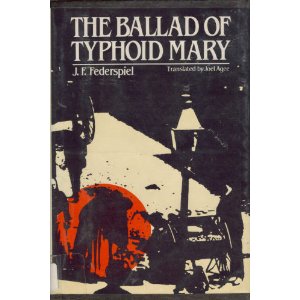
The Ballad of Typhoid Mary by J.F. Federspiel. Opening quotation: “Life is strange and the world is bad.” (Thomas Wolfe) This sets the tone.

This is another creepy story. It’s historical fiction, and I have made a note in large letters to read up on the concept of Typhoid Mary and how much we know about her in the real world. She was a carrier of typhoid fever: she never got sick herself, but she made people around her sick, to the tune of several hundred at least. She was a cook, passionate about cooking for people, despite seeming to understand that she was killing them. She wasn’t a serial killer; she didn’t do it on purpose; she just didn’t let it stop her. What can we expect, in an age with poor understanding of hygiene and the spreading of disease, of a poor, uneducated, abused & orphaned young woman with no opportunities who suspects she might, in some way, be responsible for all these deaths around her? This was a fascinating read, and another very short one, too.


The Man Who Mistook His Wife for a Hat by Oliver Sacks.This is a collection of case studies, or short stories, or essays, by a neurologist who also fancies himself a philosopher with literary leanings. It was quite attention-grabbing, and I had to keep putting it down to tell the Husband stories. Reading about brain injuries or anomalies of the brain is infinitely more interesting to me since I had my bad wreck and experienced some brain injury and healing of my own. The most interesting thing about a number of these cases is that these patients often don’t realize that anything is wrong!
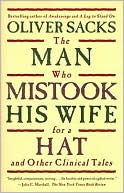
Sacks’s approach is to contemplate the relationship between mind, body, and soul, which perhaps too few of our hard scientists do. It still ended up a bit on the hard-science side for me, perhaps; he made a number of references (unexplained) to other hard scientists, which made it a bit less accessible to us laypersons. But I loved the stories, the concepts, possibilities, complexities of the human mind.


In the Woods by Tana French. I’ve been hankering for more of Tana French since reading Faithful Place. I really fell for that Frank Mackey! This one opens with immediately recognizable poetry-in-prose, stark, gritty, and strongly Irish. Then I was disappointed to recognize a familiar story: grown male detective forced to confront unsolved childhood trauma of missing friend(s). Argh! But I guess why mess with a good thing…
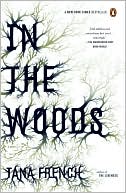
Oh man. I stayed up nearly all night to finish this book. (and this, in a place where I LIKE to get up to watch the sun rise!) Same story my head; it did have its plot similarities but it was so gripping and spooky, like a ghost story, except even spookier because there was nothing supernatural at all, just creepily realistic human nature. I can’t wait to get the next book!

Side note: the beautiful, tragic, doomed, perfect friendship reminded me somewhat of One Day by David Nicholls, which had an entirely different tone to it.


Echo Park by Michael Connelly. (audiobook)Another highly enjoy audiobook! This one unabridged, thank goodness. (I realized AFTER we listened to Worth Dying For that it was abridged, and now have to go back and read the book.) Connelly, for all that he’s sort of stark and black-and-white, also strikes me as a poet; I love that Bosch “educates” his ice with vodka. That’s unique! I’ve read this book before, but it’s been long enough that I still enjoyed the mystery. I like all the background or frame elements in Connelly, like the jazz (and I like that the Library of Congress, and some clever librarian there, make an appearance in relation to the jazz), and the audio format took advantage and gave us a few jazz riffs in the background here and there, which was a nice touch. I hadn’t really thought about using music on on audiobook, and actually, there were some other snippets of music added that I didn’t think worked so well; but jazz behind Connelly is a strong choice.


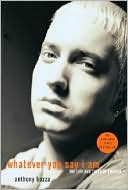
Whatever You Say I Am (the life and times of Eminem) by Anthony Bozza.I put this in the same category as the Hefner biography, actually. These are some highly controversial men, offensive to many if not to all, who have impacted our world; without making a value judgment, I can say I find them interesting to read about. My feelings about Eminem are complicated, just like with Hefner. (I was talking with my Pops the other night along these lines and we put Reagan in the same category but that’s a whole new can of worms.) I haven’t finished this book, am less than halfway through, but I can say I really enjoy the way Bozza puts his reader fully into a time and place. For example, to help place us in the year in which Eminem was working to release his first album, he gives us a full rundown of the musical hits and award winners of the year in various categories, as well as what movies and television were hot. Now, I’m not generally all that up to date on pop culture, but this worked for me; it really evoked a time in my life. I think that works for all of us, because isn’t sound or music second only to smell as a mnemonic? Doesn’t hearing a particular song take to you a time and place? At any rate, I’m enjoying this biographical study of a controversial figure.


And finally, By-Line: Ernest Hemingway. As I’ve said, I’m enjoying reading Hemingway’s usual tone and style, that I know so well, used in journalism. I hadn’t read any of his journalism before. I guess the nonfiction I’ve read would be Death in the Afternoon and A Moveable Feast, and then all that fiction that’s so heavily autobiographical. Any Hemingway I can get, I like.


I’ll keep you up to date on the books I still have to finish; and I have a few Maisie books waiting for me. I might finally be caught up!

Challenge Update: Classics

Continuing in the theme of challenge updates, we have a slow-starter here, for me at least. Good thing I only signed up for a bachelor’s degree in this Classics Challenge; I’m feeling rather ho-hum and not too proud of it.

The idea, as designed by Stiletto Storytime, is expressed with some purposeful vagueness: we get to decide what a classic is! The bachelor’s level comes out to 10 books in a whole year. I can do this! I just haven’t started yet.

I do have a few ideas in mind… I have The Unbearable Lightness of Being by Milan Kundera set aside… and I keep wanting to reread The Count of Monte Cristo. But I don’t think a reread should count; do you? Ah dear. Which brings me to my question for this post – please do comment and let me know! What is a classic? How does one choose? How old does it have to be to be a classic? Can we judge a 2010 book as being a “classic” already? It can be fiction or non, right? The challenger answers thusly: “A classic to me is a book that has in some way become bigger than itself. It’s become part of culture, society or the bigger picture. It’s the book you know about even if you have not read it. It’s the book you feel like you should have read.” …which I think pretty clearly allows nonfiction, but hasn’t settled my question of publication date at all. I don’t really have a book in mind that I’m questioning, but I’ll definitely ask you if I come up with a specific question. πŸ™‚

I think I’m still (still!) suffering from laziness-in-books, after finishing graduate school 14 months ago now. I’m so entertained by fluffy genre fiction (Child! Connelly! Burke! ok he’s less fluffy, a bit), and have trouble getting into heavier books. Does a classic have to be heavy? I did recently sit down and devour Pride and Prejudice in one sitting, yum. (another reread.) Wish me luck in this one… this might be my most challenging challenge, so I’m glad I took it on! Will let you know how it goes.