What is Odysseus, in the end – the hero whose final act of vengeful violence is compared, by means of another memorable simile, to a bard stringing his lyre – but the poet of his own life?
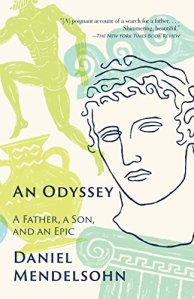 This is the first book I read in 2022, and I feel sure it will make the year’s best-of list, so that’s an excellent start. Another happy synchronicity: I bought this book based off a review I read, but find that Mendelsohn is also the author of a book I’ve had on my shelf for a few years, from a grad school reading list I never got to: The Lost: A Search for Six of Six Million. After this read, that one just moved up the list.
An Odyssey is a memoir focusing on a father/son relationship and a journey, both a literal one and the figurative path to greater understanding facilitated by a yet more famous Odyssey. Daniel Mendelsohn’s father Jay is eighty-one years old the spring he asks his son Dan if he can sit in on his undergraduate seminar course on Homer’s Odyssey. Dan says yes, and together with a small group of college freshmen, father and son explore a work of classic literature and, as Dan sees it, their own relationship. Just after the course ends, they go together on a Mediterranean cruise that follows Odysseus’s presumed route home from the Trojan War. A year later, Jay would be dead.
I bought this book because I read a lovely review of it (which I now cannot find. I thought it was Shelf Awareness but apparently not), but then it sat on my shelf for some time, I think because the concept sounded a little precious, a little pat. And it could have been, in the wrong hands, but Daniel Mendelsohn was the right writer for this story, and I’m so glad. For one, he has a deep expertise in Homer and indeed in the classics – as I briefly (in high school) aspired to do, he learned Greek and Latin sufficient to read Homer, Ovid and Virgil (etc.) in their original forms, just for a start. He is the kind of thoughtful, introspective student of relationships and families that I most appreciate as a writer. He has the nuance to handle such a premise – father and son study the Odyssey and take a trip together – with the subtlety it needs. Talk about a book matched to its reader: Homer, parent/child relationships, contemplative memoir… and a focus on teaching. The result is a beautiful book that I’ll be thinking about for a long time.
Here are a few lines that made me pause.
I was going to read Greek, the Iliad and the Odyssey, the elaborately unspooling Histories of Herodotus, the tragedies constructed as beautifully as clocks, as implacably as traps…
How lovely – and makes me think of Amy Leach’s “Pea Madness.”
And so ring composition, which might at first glance appear to be a digression, reveals itself as an efficient means for a story to embrace the past and the present and sometimes even the future – since some ‘rings’ can loop forward, anticipating events that place after the conclusion of the main story. In this way a single narrative, even a single moment, can contain a character’s entire biography.
A single moment containing a character’s entire biography feels like why I read and write.
About competing literary interpretations,
Whatever else it may mean, the fact that both of these hostile camps could make use of the same examples to prove diametrically opposed interpretations suggests a truth about how all of us read and interpret literary texts – one that is, possibly, rooted in the mysteries of human nature itself. Where some people see chaos and incoherence, others will find sense and symmetry and wholeness.
Following a half-page discussion of the etymology of a certain word that I care about,
In time, this wistful word nostos, rooted so deeply in the Odyssey‘s themes, was eventually combined with another word in Greek’s vast vocabulary of pain, algos, to give us an elegantly simply way to talk about the bittersweet feeling we sometimes have for a special kind of troubling longing. Literally this word means ‘the pain associated with longing for home,’ but as we know, ‘home,’ particularly as we get older, can be a time as well as a place. The word is ‘nostalgia.’
This takes me immediately to a Jason Isbell song (forgive the whiplash), “Something to Love,” and the line “don’t quite recognize the world that you call home.” Naturally, this is a song about art and creativity, and it is sung in the voice of a parent speaking to his child. The idea that two people a generation apart – parent and child – necessarily come from different worlds, because of the way the world changes over time, has been a powerful one for me in the last decade or so.
Here’s another passage that gets to the heart of some of (again) my own thinking about parents.
If only they knew the real him, I thought. Glancing around at the others as they listened to Daddy, at the charmed smiles on Brendan’s and Ksenia’s faces, and then back at his face, relaxed and open, mellow with reminiscence, a face so different from the one he so often presented, at least to his family, I wondered suddenly whether there might be people, strangers he had met on business trips, say, bellhops or stewardesses or conference attendees, to whom he showed only this kindly face, and who, therefore, would be as astonished by the expression of contempt that we knew so well as we were by the rare glimpses of the other, softer side. How many sides did my father actually have, I asked myself, and which was the ‘real’ one? Perhaps this expansive and charming person, so different from the crabbed and coiled man whom only a month or two earlier, I ruefully thought, my Odyssey students had come to know, this song-singing old gentleman who could be so affable and entertaining with total strangers on a ship in the middle of the sea, was the person my father had always been meant to be. Or, perhaps, had always been, although only with those others, the bellhops and stewardesses. Children always imagine that their parents’ truest selves are as parents; but why? ‘Who really knows his own begetting?’ Telemachus bitterly asks early in the Odyssey. Who indeed. Our parents are mysterious to us in ways that we can never quite be mysteries to them.
On teaching:
It was from Fred that I understood that beauty and pleasure are at the center of teaching. For the best teacher is one who wants you to find meaning in the things that have given him pleasure, too, so that the appreciation of their beauty will outlive him. In this way – because it arises from an acceptance of the inevitability of death – good teaching is like good parenting.
This feels like a revelation but also something I recognize because I already understood it. It gets at why passion and excitement make for good teaching. And there’s a profundity to the idea that teaching is about what lives on beyond us. Although shortly after, he’ll make the point that teachers never know who they will reach with which lesson, because these things take years to reveal themselves; just as our own teachers rarely know who they have reached. I think again of Mrs. Smith, who introduced me in high school to Homer and Hemingway.
These moments go on and on. I love a book that offers both lovely lines and thought-provoking ideas.
The only critique I’d make of this exquisite work is some minimizing or simplification of women, especially by contrast to another recent read, Natalie Haynes’s excellent Pandora’s Jar, which was one of the best books I read in 2021, and helped inspire this read. (I regret that my weird reading-and-review schedule has reversed the order in which they appear here.) Haynes set out to address the roles and reputations of women in the Greek myths, and Mendelsohn concerns himself with fathers and sons, so, fair enough. But there were a few moments where I felt Mendelsohn missed a chance to see certain issues of gender, such that it felt like an oversight to me. It’s up for debate, of course, what agency Odysseus gets for his affairs with Calypso and Circe and his flirtations with Nausicaa and others (as opposed to the-gods-made-him-do-it), but to credit his “allegiance to his wife… withstand[ing] the seductive attentions of various goddesses and nymphs” seems a bit rich. I missed a more nuanced treatment of gender relations, both in Homer and in Mendelsohn’s own life. But perhaps this is unfair, considering his stated focus on male relationships.
I’ll be thinking about An Odyssey for a while.
Rating: 9 doors.
Filed under: book reviews | Tagged: classics, creative nonfiction, family, memoir, nonfiction | 1 Comment »







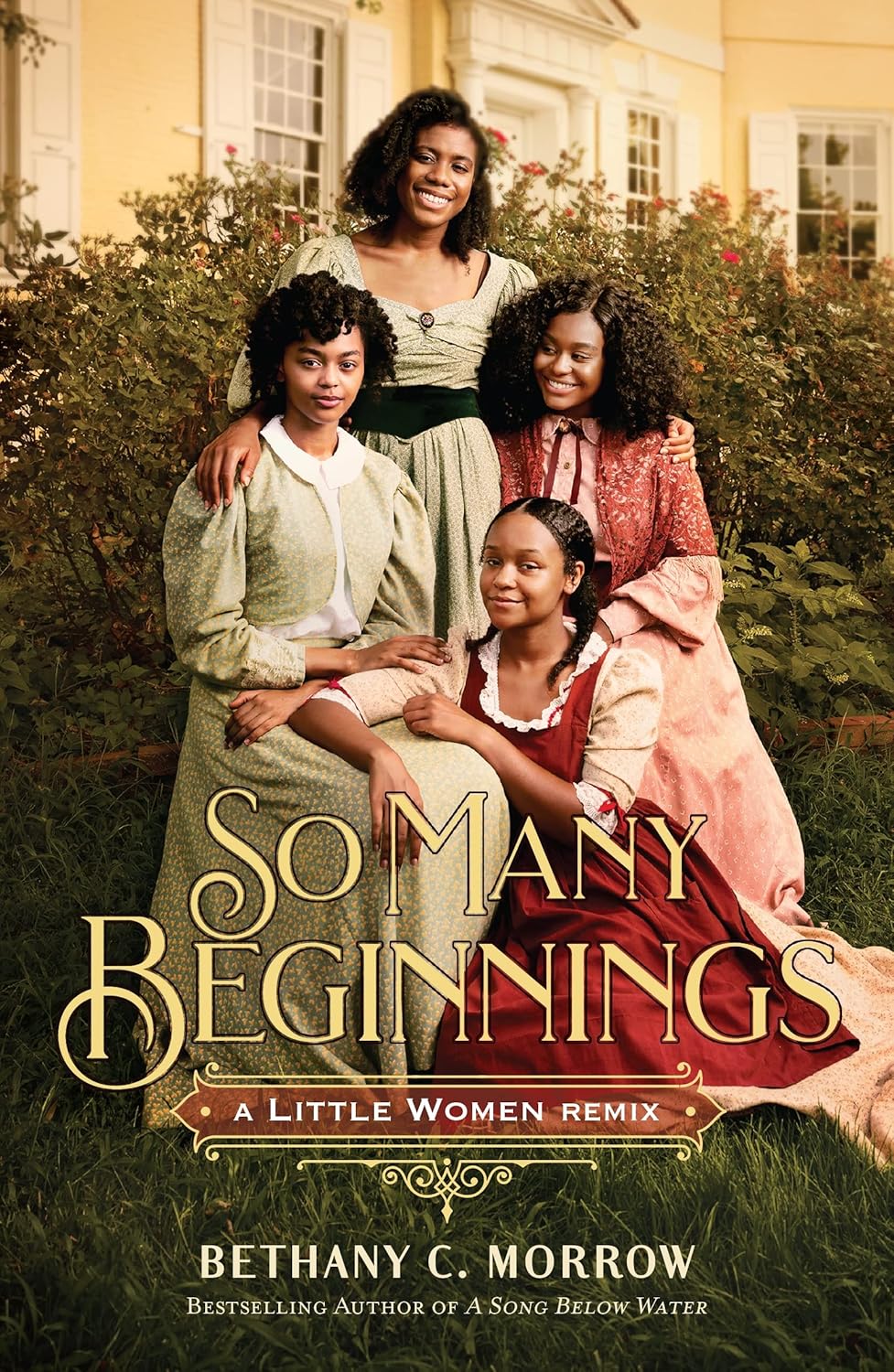 I like these remixes, and I remember Little Women with a warm fondness. Louisa May Alcott’s novel championed strong, outspoken women and questioned classism; and it offered a cozy picture of a certain type of society: in my memory, one that only included white people. Here, Bethany C. Morrow recasts the story in a different frame. Four sisters, bridging girlhood and adulthood, with their adored mother, navigate many changes in a world that is also fast-changing. Their beloved father is away at war or supporting postwar efforts. The novel opens in 1863, and the March family are among the residents of the newly established Roanoke Island Freedpeople Colony. They have their own house, with multiple rooms. Meg teaches the colony’s children to read and write, although she must do so in tents, because the white missionary teachers claim the buildings. Jo and a group of young men work building more houses for the constant influx of new residents. Bethlehem is a whiz of a seamstress, making new clothes for the colony’s people from what the former enslavers left behind. Amethyst wishes to study, to dance, to live all of life; but at 14, she is subject to her family’s wish for her to stay a child a little longer. She helps Beth where she can. Mammy takes transcription for the (white) officers who run the colony.


 pagesofjulia