A Wrinkle in Time by Madeleine L’Engle (audio)

wrinkleWhat fun to dig back into this children’s classic. I only vaguely remembered enjoying this as a kid, and I got to rediscover it via this audiobook, read by the author. My memory didn’t provide much: I think I was most familiar with the opening scene, in which Meg Murry is awake and frightened in her attic room alone by a storm outside. She is grumpy, frustrated with her family: her father for being away for so long; her baby brother Charles Wallace for not feeling her pain and coming to her as he usually does.

Next, of course, Meg and Charles Wallace meet the not-quite-mortal Mrs. Whatsit, Mrs. Who, and Mrs. Which, and an unusual boy from Meg’s school named Calvin. This unlikely team will adventure together via the “tesseract” – a wrinkle in time and space as well, if you will – to try and find Mr. Murry, and save him, and save the world (and all the worlds) from the Black Thing.

This is a children’s chapter book. Madeline L’Engle notes in an introductory section that publishers thought it would be too hard for children; but her own kids loved it, and as it turns out, so does the world. It’s won several awards including a Newberry, and remains popular today. (Originally published in 1962 and still in print.) I can see how it would be “hard” for children, particularly the physics bits; but then, we don’t have to understand it fully to enjoy it, do we? And lots of adults are puzzled by physics too! This book has appeal for adults – perhaps obviously, here I am, and I don’t read a whole lot of children’s books. It still rings like a kids’ book, but I found the characters and the plot both engaging. I have a slight criticism that Meg occasionally sounds a little adult for her age; she does whine appropriately, but sometimes her observations are startlingly astute. It’s a common complaint with young characters in books. But only slightly, here.

Meg, Charles Wallace, and Calvin are all likeable but human; their parents are similarly well-rounded, sympathetic characters. The Mrs’s are charming, and the world-building – in the world of Aunt Beast, for example – is well done. I like that Meg grows some in the course of the story; and L’Engle certainly leaves us open for a sequel, what with the possibility of a burgeoning romance, and the happily-ever-after-at-least-for-now ending (with the Black Thing still looming). Mostly I was just disappointed that it was over so quickly! (Another feature of children’s books.)

I was a little surprised to find religious references within; I didn’t remember those. Not many, but a few mentions of having God on one’s side, or being the chosen ones, fighting for good. It got me thinking. I’m not particularly good at spotting religious allusions, not having been raised in church or on the bible. They mostly pass me by. But spelling out G-O-D will catch my eye every time! It’s not a technique that appeals to me but it wasn’t a central enough theme here that it threw me off much, either. A theme that is central is a good-versus-evil dichotomy, which of course could be interpreted as being religious; but the book-banners have protested certain aspects of this story, too – including the grouping of Jesus with mortal fighters-for-good such as Da Vinci, Michelangelo, Shakespeare, Pasteur, Einstein, Gandhi, Beethoven, Copernicus and a lone woman, M. Curie. So there you are: all matters of interpretation.

In a nutshell, I found this book a delightful, too-brief romp in another world. I am tempted to pursue further work by L’Engle; four books follow this in a quintet, and others of her oeuvre reference the same characters. Realistically, I don’t know if I’ll get to them. But this was an enjoyable read, and not just for children.


Rating: 7 pairs of spectacles.

book beginnings on Friday: A Wrinkle in Time by Madeline L’Engle

Thanks to Rose City Reader for hosting this meme. To participate, share the first line or two of the book you are currently reading and, if you feel so moved, let us know what your first impressions were based on that first line.

wrinkle

I am just as pleased as can be to experience again a book I enjoyed in childhood, a book that won several awards including a Newberry. Madeline L’Engle’s A Wrinkle in Time begins:

It was a dark and stormy night.

In her attic bedroom Margaret Murry, wrapped in an old patchwork quilt, sat on the foot of her bed and watched the trees tossing in the frenzied lashing of the wind.

L’Engle is winking at us, I believe, when she uses this well-worn literary opening line; but it works beautifully, don’t you think? It’s atmospheric, and if it’s “pre-owned,” I find it still effective. It brings to mind the attic reading scene in The NeverEnding Story, which I also loved.

I’m just a few minutes into this audio recording, read by the author, but I’m glad to be back in L’Engle’s world. Happy weekend!

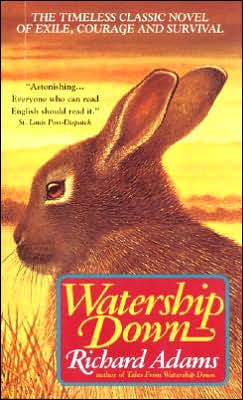
Watership Down by Richard Adams

Remember I read Tales from Watership Down a while back? And noted that this was probably really one to have read in order, meaning *after* Watership Down? I was so right. I wonder if I’ll find the time to go back and reread it now; I’d certainly like to.

This is a charming story. It’s about rabbits – but wait, come back! It’s a story of adventure, battles and bravery and trying new things, stepping into the unknown, making new friends. It’s exciting. And while it is enough when read for the explicit story of these rabbits of Watership Down, it can also be considered allegorically, if you’re so inclined.

At the beginning, a rabbit named Fiver has a premonition of something bad coming to the Sandleford warren where he lives. His friend Hazel has learned to trust Fiver’s intuitions, and the two of them attempt to warn the Chief Rabbit; but he will not be warned. Hazel (a leader type) and Fiver (more shy and withdrawn) gather a small group and leave the warren headed for parts unknown. Their comrades include Bigwig, a trained fighter; Blackberry, a cleverer rabbit than most; Dandelion, an accomplished storyteller; and Pipkin, even smaller and less impressive than Fiver. This unlikely crew faces the dangers of traveling through the open, through the woods, and over a small river; they move into a peculiar but welcoming warren for a time, until they discover the strange danger that dwells there, and have to move on again. As a group, they become closer, learn one another’s strengths and weaknesses and learn to work as a team. Finally they settle at Watership Down, and begin to build an idyllic new life, but there’s a missing piece: without does (female rabbits) to bear their kittens, their warren is doomed to extinction. So our friends launch yet another expedition…

As an adventure story, Watership Down has it all: likeable characters with developed personalities; a plot with beginning, middle, and end, during which those characters grow and mature; suspense, danger, excitement, bravery, personal sacrifice, bad guys, good guys, strange and wondrous creatures and happenings. It’s great fun, and I stayed up too late one night because I wanted to know what happened next (always a good sign). This is an enjoyable story.

And then there is the allegory. Much has been written on the topic, and for the most part I’ll leave it for others to cover the concepts of religious symbolism, historical allegory, and the like. I prefer it as a “straight” story of adventure fantasy as experienced by this gang of rabbits. But I will say that I enjoyed the epic-hero aspects, and the fact that the larger rabbit society has its own set of myths, proverbs, and stories passed down through the generation. Story-telling and the remembering of mythical heroes (and the creation of new ones!) play a large role, and this was familiar to me, as I have long loved the ancient Greek myths. Watership Down has been compared especially to the Aeneid; I actually thought of the Lord of the Rings trilogy-plus-one (to include The Hobbit), in terms of the building cadence of action. (Side note: Adams includes a number of quotations and allusions to classical works, lending credence to the idea that he had some of this explicitly in mind.) Also, I found myself musing from time to time on the statements Adams (or his rabbits) might be making about human civilization. The four warrens we see in this story embody four different cultures and styles of organizing citizens; some work better than others. I’ll say no more, because if you read this book, I believe you might enjoy making your own connections as you will. But yes, there is plenty of opportunity to consider allegory at work in Watership Down.

This is definitely an enjoyable read. Early in the book the pace is measured, as we get to know our characters and invest in their fates; when the cards are on the table later on, the pace ratchets up (this is where I didn’t go to bed on time). I thought it was very enjoyable when read “straight”, and would work as a children’s book. But it also offers fodder for serious thought and discussion. I can see why this one has remained in print for so long! Now to track down Tales of Watership Down again…


Rating: 7 bunnies.

Tales from Watership Down by Richard Adams

in lieu of a cover shot, since mine is a plain hardback missing its dust jacket, I give you one of the fine illustrations from within.

As I noted in my book beginning post last week, I am taking this one out of order, since I have not yet read Watership Down. That original is a well-regarded fable or heroic tale about a group of rabbits overcoming odds to start a new life; these Tales are a late sequel (published more than 20 years after the original), and come in the form of a collection of short stories. They include the fables that the rabbits of Watership Down live with (their own cultural mythology, if you will) as well as stories involving the rabbits of the present day. They are sweet and curious; Adams includes a lapine glossary and gives these anthropomorphized bunnies their own societal norms and shared history. Some of these tales resembled some of the other great heroic myths in our own culture’s tradition; I thought of the ancient Greeks, for instance, because there is some question of god’s (or gods’) interference in the lives of mortals (rabbits). The stories were interesting, somewhat familiar in themes but engrossing. In a nutshell, I enjoyed them very much; they made for a quick, easy, entertaining, evocative session. The emotions that the rabbits feel – courage, fear, love, concern, friendship, curiousity – were very real, and I cared about the characters. Oh, and they have such lovely names! That said, I definitely felt the hole left by my failure to read Watership Down first, and think that that would have enriched the experience. Big events are referred to and not explained; I feel confident that’s what the first book did. So, recommended, but probably not until you’ve read the original, which I shall look forward to doing.


Rating: 5 bunny ears (probably more if I had read the first book first).

book beginnings on Friday: Tales from Watership Down by Richard Adams

Thanks to Rose City Reader for hosting this meme. To participate, share the first line or two of the book you are currently reading and, if you feel so moved, let us know what your first impressions were based on that first line.

in lieu of a cover shot, since mine is a plain hardback missing its dust jacket, I give you one of the fine illustrations from within.

I’m doing it backwards again, since I’ve not read Watership Down, sigh. I look forward to getting my hands on a copy! The first story in this follow-up volume of Tales, entitled “The Sense of Smell,” begins:

“Tell us a story, Dandelion!”

It was a fine May evening of the spring following the defeat of General Woundwort and the Efrafans on Watership Down.

And so we start with several clues as to the history of those gathered around to hear a story; and who amongst us readers doesn’t enjoy storytime? I think it’s an auspicious beginning.

What are you reading this weekend?

Ruby Red by Kerstin Gier, trans. by Anthea Bell

Not being a big reader of YA, or time travel, or fantasy/alternate realty/insert-concept-here, it surprised me how much I was drawn to this book. But I was.

Before I tell you about this story, here’s a funny detail I noted right off: the translator, Anthea Bell, also translated the last book I read from-the-German, The Stronger Sex. This title is YA where that one was decidedly adult material, but I guess a strong German-to-English translator is the same across the board. I hadn’t really thought about it before. Just as I said about The Stronger Sex, Bell gets full credit for making the translation invisible. If anything, the language here is a little more awkward; but having read that other example of Bell’s translation, I think this awkwardness comes from the original. If I hadn’t known, I wouldn’t have suspected translation issues – I would have assumed just what I have come to feel is a common YA writing issue. It feels a little bit effortfully simplified, if that makes sense. It’s something I’ve encountered in YA before. I guess it’s a reading-level thing. Like in Miss Peregrine’s Home for Peculiar Children, it bothered me slightly when I focused on it, but the story ended up engrossing me enough that it faded into the background. I don’t read a lot of YA. If you don’t, either, this little issue may irk you as it does me; if you read a fair amount of YA, chances are good it won’t faze you.

Gwen is trying to live a normal teen existence in present-day London, but her obnoxious cousin Charlotte’s destiny is difficult to ignore. Charlotte has inherited the family’s time-travel gene, and any day now, she’s expected to take her first trip. She’s been trained all her life in languages, history, the mannerisms of different periods, fencing, dancing, and music. But when the first uncontrolled time travel occurs, it’s not Charlotte, but Gwen – of all people! – who finds herself in an unfamiliar era. She’s thrust unprepared into a complicated world, and finds herself partnered in adventure with Gideon de Villiers, the time-travel-gene-carrying teen of his own family. He is snotty and bossy… and sooooo handsome…

I enjoyed the intrigue, the plots and codes and ancient documents and secrets and mysteries. I enjoyed the world Gier builds. I even enjoyed, mildly, the juvenile romance. But I didn’t get enough of any of it. I felt like the set-up for the story took 3/4 of the book, and then the story began and –whoosh– please buy the sequel that comes out in 2012. Is this a YA thing? I was frustrated and unsatisfied; but I’m also intrigued enough to seek out Sapphire Blue, the aforementioned sequel. Sigh. I guess she got me.

the WSJ-YA uproar to which I am late

I had a patron approach me in the library to ask my feelings on this issue.

The background is… more than a month ago, the Wall Street journal published this article by Meghan Cox Gurdon, which immediately became a huge deal. I would encourage you to go read it, because that’s the best way to know what it says, but in a nutshell, this children’s-book-reviewer lady notes an increase in “darkness” in young adult (YA) literature, and comments that darkness is not good for our young adults. While she has some supporters, there was overwhelming indignation among bookish/literary/librarianlike internet dwellers. They have mostly said, in a dark world, kids can actually benefit from reading about situations that are like those they are facing. Also, you shouldn’t censor. The author of the original, offending article has since published, also in the WSJ, a rebuttal.

I resisted entering the fracas, mostly because I feel my opinion is unnecessary (because I’ve read some other excellent responses) and because I don’t feel terribly well-qualified to have an Important Opinion, not being a YA librarian or really much of a reader of YA. Even when I was a YA. But on the other hand, this blog rather exists for the publication of my Not Very Important Opinions, and so I’ll throw it out there.

So. I had a patron approach me here in my (definitively adult) library and ask for my thoughts. I tried to tell her why I’m not qualified to have one but she pushed. So, I told her I agree with those opinions that say, children in rough positions need to read about said rough positions. The cited instances of “darkness” include stories about rape, prostitution, violence in general, poverty, and cutting (self-mutilation). Young people living these situations are in a position to benefit from having them handled wisely in literature, and I appreciate that such things are available. My patron turned out to be (as I understood her position) arguing that children living in darkness need to read about light – happier, brighter situations – to which I say, sure! Great! Let them read that stuff, too! She proceeded to argue that there is too much dark and not enough light; the proportions are wrong; at which point I have to beg off, because my very limited knowledge of current YA doesn’t allow me to debate this point. I don’t know the proportions, quite frankly. I support the idea of diverse options, for sure – in all things, in fact. (For example, there should be more than two political parties in our electoral system.) Lots of options, please. But if you prefer for your YA to read only happier, lighter books, I don’t think that should necessarily limit others – who might be interested in those “darker” ones – in their access to those choices.

I have to take issue with one of Gurdon’s conceptions (from the original article).

In the book trade, [guiding what young people read] is known as “banning.” In the parenting trade, however, we call this “judgment” or “taste.”

I’m afraid she’s confused about “banning.” Or maybe she’s just being imprecise in the phrase, “guiding what young people read.” There are several ways in which parents, guardians, or whoever can guide what young people read. For example, they can pay attention to what their children read, and direct those choices. The Maryland mother whose personal experience begins Gurdon’s article was doing just this. She wasn’t banning anything; she was exhibiting judgment and taste, and guiding her daughter’s reading choices. This is the kind of guidance I recommend; I encourage parents who are concerned about what their children read to pay attention to what their children read, and limit it as they find appropriate. Banning, on the other hand, is what parents and various community members attempt when they submit complaints to public libraries (for example) requesting that certain books be pulled off the shelves. I am in favor of “judgment” and “taste” – I may not agree with yours, but that’s fine as long as your judgment applies only to your child. I am against “banning,” which involves limiting other people‘s access to books. See the difference? Banning is not synonymous with parenting.

I don’t think rape or cutting in books leads to rape or cutting in life. I think it has the potential to offer some relief or catharsis or therapy. Certainly some children don’t need therapy for these traumas; absolutely Gurdon is correct that not all teens are rape victims, thank goodness! But I’m not sure that reading about even those traumas that are outside their experience isn’t necessarily instructive and good, too. (I wasn’t involved in teen violence or gangs, but still found S.E. Hinton’s oft-cited The Outsiders amazing; it was one of my favorite books.) I won’t push these books on your child, certainly, but I fail to see how the availability of these options is a bad thing. Again, I’m all for more options. If I accept my patron’s thesis that there is too much dark and not enough light in YA today, then by all means, let there be more light, in the interest of a multiplicity of options.

But, the vampires I could take or leave, actually.

Miss Peregrine’s Home for Peculiar Children by Ransom Riggs

What an odd, fun, creepy little romp this was! I had been fascinated by the idea of this book months before it came out. The story is this: our first-person narrator, Jacob, has always been close to his grandfather. Grandpa Portman has told him stories all his life of the peculiar, magical children he grew up with, in a home for orphaned refugees during World War II. He even has pictures: a levitating girl (on the cover); an invisible boy; a skinny boy lifting a giant boulder. As Jacob grows up a bit, he begins to understand that perhaps Grandpa’s stories were just that, stories; but when Grandpa dies in a mysteriously disturbing fashion, in Jacob’s arms, and with the strangest of last words, he begins to wonder again. Under the care of a psychiatrist, Jacob travels with his father back to the tiny Welsh island where Miss Peregrine’s Home for Peculiar Children was located. The story he begins to unravel… well. I don’t want to ruin anything for you.

This is really a YA (young adult) book, for two reasons: 1, the reading level, and 2, the young adult protagonist. Jacob is 16 or 17 years old. I found it very enjoyable, though, and I don’t read YA very regularly. It was a quick read, partly because of the rather basic reading level. But here’s the unique bit: there are quite a few pictures mixed in with the text. Grandpa Portman had a collection of pictures; Jacob has a few of his own; he discovers a cache of pictures in his explorations of Cairnholm Island. And every one of the pictures mentioned in the story is included, so we get to do our own examining of them alongside Jacob. This was very cool, because the oddness (or perhaps, the peculiarity) of these pictures is a large part of the point of this book. And here’s the kicker: while this is a work of fiction, and the impossibility of the photos is obvious, I found an interesting detail at the back of the book. The author writes, “All the pictures in this book are authentic, vintage found photographs, and with the exception of a few that have undergone minimal postprocessing, they are unaltered.” I don’t know what “minimal postprocessing” might entail, but it made me go back and reexamine the pictures all over again, knowing that they each have a real life mysterious story behind them. I love it: an additional facet to this curious tale.

This is a paranormal story, even one of time travel. I don’t necessarily spend a lot of time in these areas, but I found Jacob to be a likeable (if doofy – is this a regular facet of YA, too?) protagonist, and his Grandpa was a real hero. The peculiar children were extremely likeable and fascinating. I had a lot of fun with this diversion from my more normal reading.

Teaser Tuesdays: Miss Peregrine’s Home for Peculiar Children by Ransom Riggs


Teaser Tuesdays is a weekly bookish meme, hosted by MizB of Should Be Reading. Anyone can play along! Just open your current read to a random page and share a few sentences. Be careful not to include spoilers!

This book is great fun so far. My teaser comes from page 142:

We walked through the house, past more curious eyes peeping through door cracks and from behind sofas, and into a sunny sitting room, where on an elaborate Persian rug, in a high-backed chair, a distinguished-looking lady sat knitting. She was dressed head to toe in black, her hair pinned in a perfectly round knot atop her head, with lace gloves and a high-collared blouse fastened tightly at her throat – as fastidiously neat as the house itself. I could’ve guessed who she was even if I hadn’t remembered her picture from those I’d found in the smashed trunk.

Inkheart and the failure of McCarthy’s The Road

This week I read Inkheart by Cornelia Funke. This is a children’s book, but I’ve had several (adult) patrons here who have enjoyed it, and also some that haven’t; so I’ve been interested to see what it was like. I can occasionally enjoy children’s lit, although I generally need to follow it with something with a little harder or sharper edge to it. NoveList recommends Inkheart for grades 4-12; our heroine is 12 years old, so that probably tells us who it’s intended for. But again, plenty of adult fans exist as well.

I enjoyed this book. It’s fantasy set in our real world, although our real world doesn’t interact much with that of Mo and Meggie. Mo is a bookbinder and, along with his daughter Meggie and aunt Elinor, general bibliophile. Books are an important element here, which of course I appreciate. There are good guys and bad guys and fairies and fire-breathers, and Meggie gets to be a hero. It’s enjoyable, with good imagery and satisfying good vs. evil action, and it’s the first in a trilogy, so it won’t be giving away too much to say the ending doesn’t leave everything tied up too neatly! I liked it. I would certainly pick up the second book if it crossed my desk at the right moment, but I won’t go requesting a hold at my local library or anything. That’s about a B score, same with J.D. Robb’s series. I’d pick up another but won’t go seeking them out.

When I finished Inkheart I picked up Cormac McCarthy’s The Road because, duh, everybody raved, so it must be good! Wrong! As I like to tell my patrons when they ask “did you like it?”… there’s room for all kinds of tastes in this world. How boring would it be if we all liked the same things? And how long would the lines be? There would have to be like two bands playing the same concert 6 nights a week to crowds of thousands. I think that sounds dull. So, we don’t all like the same things, and The Road is not for me. I was immediately upset by the sentence fragments, and McCarthy’s disregard for certain elements of punctuation. (Maybe he’s the next ee cummings, but I’m not impressed.) I failed to get involved with the father and the son in a few pages, and started skipping around throughout the book to see if I could find some action or interest or chapters or structure or quotation marks or commitment to complete sentences. None of the above. I spent about 30 minutes skimming cover to cover, read the beginning and the end and some parts in between, and I’m ready to say I don’t like this book. As one of my volunteers here at the library says, we’re adults now, we don’t have to finish books we don’t like!

Perhaps the enjoyment of this book lies in considering it as a poem (a la cummings, again, poetic license) or as inspirational fiction; a few reviews have pointed out the elements of faith and love as an important message, but I’m not looking for McCarthy’s version of either. This is a popular and highly reviewed book; clearly there’s a time and a place and a mindset for it. But I’m not there, and that’s ok.

So what’s next? I’m considering Secret Historian: the life and times of Samuel Steward, professor, tattoo artist, and sexual renegade by Justin Spring, or else Running the Books: the adventures of an accidental prison librarian by Avi Steinberg. Enjoy your weekend and I’ll tell you what I chose next week! Thanks…

Edit: Logged onto Librarything and asked it to predict whether I would like The Road or not and it said I probably would not, with very high confidence. Very good Librarything!!