book beginnings on Friday: Edward Abbey: A Life by James M. Cahalan

Thanks to Katy at A Few More Pages for hosting this meme. To participate, share the first line or two of the book you are currently reading and, if you feel so moved, let us know what your first impressions were based on that first line.

Today we’re taking a look at a biography of Edward Abbey.


The more Abbey I read, and love, the more I want to know about the man. Do you do this? My interest in an author of nonfiction invariably turns to the author himself (or herself). I’ve been looking for a few Abbey books, in this case. This was the biography I chose. I also have a copy on the way of Doug Peacock’s Walking It Off. Peacock was the inspiration for Abbey’s fictional character Hayduke, of The Monkey Wrench Gang, and his book is a reminiscence of their relationship. But that’s another post.

Cahalan’s biography of Abbey begins, in the introduction:

This is a book in which I seek to separate fact from fiction and reality from myth. At the outset, I have to tell readers that Edward Abbey was not born in Home, Pennsylvania; he resided in several other places before his family moved close to Home. And he never lived in Oracle, Arizona.

Already I’m learning things. I had already observed, as Cahalan continues, that Abbey claims a birth in Home and a late life and death in or near Oracle. These place-names are nicely symbolic, which has to have appealed to him, and his PO Box in Oracle helped to deflect some of the fans who pursued Abbey in his later years and who he (understandably, I think) wished to avoid. But who knew he fudged the truth so hard, and so early on, and in such relatively unimportant details? (There will be another post here soon about the friction between fact and nonfiction writings.)

I’m really excited about this biography, as I’m excited about Abbey in general and also debunking biographies in general. And I love that in the short introduction, Cahalan mentions Hemingway, riding bicycles, and the ill-fated trip through Big Bend with his then-fiance that Abbey writes about in The Journey Home – three things I love. 🙂

What are you reading this week? And are you excited?

First Lady of Fleet Street by Eilat Negev and Yehuda Koren

The biography of a pioneering female newspaper editor in early 20th-century London.


Rachel Sassoon was the heiress daughter of a wealthy Jewish businessman who was rooted in Baghdad but proud of the family’s new status after he moved them to London in 1860, while Rachel was still a baby. Only nine years old when her father died, Rachel’s options were increased by his fortune and broadened by his absence until, long past the standard marriageable age, and with considerable life experience behind her, she made what her family viewed as an unforgivable decision: she married Frederick Beer, who was also of Jewish ancestry but had converted to Christianity. (For this, Rachel was ostracized from the family until Frederick’s death, when a brother had her certified as “of unsound mind.”)

She found love with Frederick, but more importantly for posterity, she found a newspaper: Beer’s Observer drew her interest, but it took her own newspaper, the Sunday Times, to unleash Rachel’s creative and industrial spirit. She took on issues of women’s rights and suffrage, workers’ rights, the arts, criminal justice, and international political and social issues; the Sunday Times was for a decade Rachel Beer’s personal soapbox.

Eilat Negev and Yehuda Koren’s matter-of-fact portrayal of Rachel’s life sheds light on the experiences of women and people with Jewish backgrounds in her time, while the stories of the Beer and Sassoon families depict larger issues regarding the era’s immigration and business patterns. The First Lady of Fleet Street is an engaging snapshot of several aspects of early 20th-century life as seen through the lens of one remarkable woman.


This review originally ran in the March 2, 2012 issue of Shelf Awareness for Readers. To subscribe, click here, and you’ll receive two issues per week of book reviews and other bookish fun!


Rating: 5 understudied women.

book beginnings on Friday: A Difficult Woman: The Challenging Life and Times of Lillian Hellman by Alice Kessler-Harris

Thanks to Katy at A Few More Pages for hosting this meme. To participate, share the first line or two of the book you are currently reading and, if you feel so moved, let us know what your first impressions were based on that first line.

Alice Kessler-Harris is a well-respected author and historian, and here she tackles the formidable subject of Lillian Hellman. I am not terribly familiar with Hellman, so this book is my introduction, and so far it looks like it will be a fine one. I love biographies of ambiguous, contradictory, not-entirely-loveable characters; they’re so much more interesting than altogether sympathetic or entirely monstrous ones!

For this Happy Friday today I will be sharing several snippets, because I feel like it. First of all, Kessler-Harris opens her introduction with a quotation I loved:

If a man could say nothing against a character but what he can prove, history could not be written; for a great deal is known of men of which proof cannot be brought.
–John Boswell, The Life of Samuel Johnson

I love this idea, and the implication that history involves the unproveable, unavoidably. Beware! This quotation is followed by Kessler-Harris’s first sentences:

In 1976, aged seventy-one, playwright and memoirist Lillian Hellman posed in a mink coat for a resonant advertisement. Cigarette in hand, gazing insouciantly at the camera, Hellman claimed the legendary status she craved.

Indeed. Beginning her introduction with a description of that remarkable photograph (below) really evokes her subject right at the beginning. The photo in question:

The first chapter, however, returns to a standard biography’s beginning:

Beautiful Julia Newhouse, daughter of a wealthy southern family, married Max Hellman–who had nothing to recommend him but charm–in 1904. A year later, Julia gave birth to a child they called Lillian Florence Hellman.

These unadorned sentences tell us a little something about Julia & Max, which I appreciate. Hellman’s story is fascinating, and so far I really enjoy the way Kessler-Harris is portraying it, with the context of her time & place fully involved.

This quotation comes from an uncorrected advance proof and is subject to change.

Papa: A Personal Memoir by Gregory H. Hemingway

Gregory Hemingway, known as Mr. Gig or Gigi to his family, was Ernest Hemingway’s youngest of three sons; his mother was Pauline, Papa’s second wife. This is his memoir of his father, and it begins and ends with Papa’s suicide, and the ways in which that trauma shaped Gigi’s life. It is a short but monumentally touching and surprisingly well-written book; I think it is the most moving biography of Papa (who, presumably, you know I adore) that I have read. While Gigi does relate several of his father’s uglier moments, including crimes against his son, he emphasizes Papa’s humanity and good qualities. The story told here seems to be of a fundamentally good man who got sicker and sicker at the end – though I think he always struggled with mental illness, from being cross-dressed as a toddler through pursuit of success, fame, and the fading of his talent – and fell apart. There are other perspectives out there; many biographers and commentators see Hemingway as a monster, and I accept that that is one perspective, and has evidence to back it up. But I’m always drawn to the outlook that he deserves our pity for the illness he struggled with that finally killed him; and that is more what we get here.

Gigi tells heartwarming stories, and some bad ones (like Papa blaming Gigi for Pauline’s death). He shows what good advice Papa gave; he was a good teacher. He addresses some of the myths surrounding his larger-than-life father, even though he is often unable to refute or confirm them because he was so small (or living with his mother). And it’s all so beautifully done! Who knew Gigi was a bit of a writer, himself? (Make note of the tale of his plagiarized short story, back when he still hoped to follow in his father’s footsteps.)

To me, one of the most poignant things about this slim memoir is our present knowledge of where Gigi went from here. At the time the book was written, he was a practicing physician and still married to Valerie (whose own memoir of Papa I have on my shelf waiting for me). He would later divorce Valerie (after some 20 years of marriage) and go on to two more marriages; become a cross-dresser and take steps toward a sex change; lose his medical license; battle alcoholism; and finally die in a women’s jail in Miami. In his book, there is a general tone of “look at me, I’ve come this far” – not bragging so much as in relief to have resisted the darkness for this long. He seems to have a positive attitude. But there is also quiet acknowledgement, here and there, of the sinister element within himself that he has worked to resist. This same subtle awareness of the darkness inside is present in Papa’s work beginning at a young age, and the youngest son Andrew in Islands in the Stream, clearly modeled on Gregory, has a “badness” in him as well. The descriptive passage about Andrew, in fact, is quoted at the beginning of this book, before Norman Mailer’s (excellent) introduction, implying that Andrew’s darkness as well as Papa’s and Gigi’s is acknowledged by all the parties.

This book was like a gift to me from yet another tragic Hemingway man. It gave me lovely, appealing moments with Papa, as well as those ugly moments in which he could be so vicious. It was beautifully written. I loved getting to know Gigi better; he struck me as a very likeable, sympathetic man. But it was also sad, as reading about the Hemingways always is.

book beginnings on Friday: The First Lady of Fleet Street by Eilat Negev and Yehuda Koren

Thanks to Katy at A Few More Pages for hosting this meme. To participate, share the first line or two of the book you are currently reading and, if you feel so moved, let us know what your first impressions were based on that first line.

Today I’m reading The First Lady of Fleet Street: The Life of Rachel Beer: Crusading Heiress and Newspaper Pioneer. I’m intrigued for several reasons: I tend to appreciate biographies of semi-obscure figures (if they’re well done, which I can’t yet judge of this one); this will be my second newspaperwoman biography of the year (here‘s the first); and I like Rachel’s last name. 🙂 The book begins with a prologue:

Late May 1903. Earl’s Court, a two-storey stone mansion in Tunbridge Wells.

A slight woman sits erect in her chair, nearly swallowed by her weighty crepe mourning dress. Heavily framed mirrors, priceless paintings, dim-gilt Chinese cabinets, and fresh lilies and orchids adorn every inch of the spacious drawing room.

Well done, I say, and I am optimistic.

What are you reading this weekend?

This quotation comes from an uncorrected advance proof and is subject to change.

The Autobiography of Benjamin Franklin

I have heard that this was an important, well-written and interesting autobiography. I don’t recall where I heard it, but I made a note and it stuck in my head. So I found the audiobook and gave it a try.

What I learned was a more detailed version of what I knew: Benjamin Franklin was an interesting, hard-working, thoughtful man who helped shape our nation’s history. He was an indentured servant, a runaway, a businessman, an entrepreneur, a diplomat, a politician, an inventor, an author, a militiaman, a scholar and a philosopher, and a father. He invented many items, large and small, that improved the everyday life of people in his time, showing an intelligence and curiosity about how things work that I admire. He was also instrumental in beginning both a school (which became both the University of Pennsylvania, and a free school for poor kids) and a public hospital in his adopted hometown of Philadelphia. He did a lot of good things and had some interesting ideas. He was a moralist, and wrote tracts in which he espoused a “right way” of living.

The style of his autobiography is unfortunately stiff and pompous, though. I think that perhaps the narration of my Mission Audio edition didn’t help. The language in which this book was written is necessarily dated and sounds odd to the modern ear; but if today’s actors can make Shakespeare palatable, for gosh sake, you’d think they could have found a narrator who would bring Franklin to life, too. Instead they went with a sort of whuffling, sedate, staid voice that emphasized not this senior statesman’s timeless wisdom and accessibility – which I think might be there, hidden in the text – but the distance from which he speaks. The long pauses and bombastic tone went a long way towards ruining this experience for me.

I didn’t enjoy this autobiography at all, which was a disappointment. Actually I’m not quite sure why I finished it (Husband asked, and I couldn’t answer); maybe I had that much faith in the long-lost recommendation, or maybe I was just mesmerized by the monotonous narration… I didn’t even get the consolation of learning new bits about Franklin. I came away with the same vague notion of who he was and what his legacy was that I’d started with. For educational purposes, I actually got more out of the “timeline of his life” appended at the end than I did out of the bulk of the book. I feel that the autobiography itself was probably flawed, in that it leans towards anecdotes of little consequence, moralizing, and self-congratulations. But the narration was the final straw. Unfortunately I cannot recommend this book; and if you do decide to seek it out (in which case, let me know if it goes any better for you!), for the love of Dog, avoid the Mission Audio version.

Teaser Tuesdays: The Autobiography of Benjamin Franklin

Teaser Tuesdays is a weekly bookish meme, hosted by MizB of Should Be Reading. Anyone can play along! Just open your current read to a random page and share a few sentences. Be careful not to include spoilers!


I’ve chosen you a teaser today from Benjamin Franklin’s Autobiography, which I’ve heard repeatedly is worth reading.

I disliked the trade [his father’s, of being a tallow-chandler or candle-maker], and had a strong inclination for the sea, but my father declared against it; however, living near the water, I was much in and about it, learnt early to swim well, and to manage boats; and when in a boat or canoe with other boys, I was commonly allowed to govern, especially in any case of difficulty; and upon other occasions I was generally a leader among the boys, and sometimes led them into scrapes, of which I will mention one instance, as it shows an early projecting public spirit, tho’ not then justly conducted.

He then goes on to explain that, needing a wharf to fish off of to keep their feet out of the mud, he and the other local boys – at his urging – purloined some building supplies from a nearby construction site and built themselves a stone wharf. They do get caught.

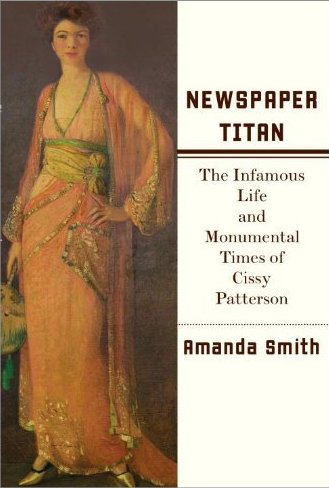
Newspaper Titan: The Infamous Life and Monumental Times of Cissy Patterson by Amanda Smith

The exhaustive–but not exhausting–biography of a complicated and difficult woman, heiress to a newspaper dynasty and a fascinating and controversial figure.

Amanda Smith’s (Hostage to Fortune: The Letters of Joseph P. Kennedy) exhaustively researched biography of Cissy Patterson begins several decades before her birth, with her grandfather Joseph Medill and his creation of the Chicago Tribune. The extended family of Medills, Pattersons and McCormicks would be newspaper royalty for several generations; but perhaps none cut a stranger figure than Cissy.

Eleanor Medill Patterson, known as Cissy, led was born in 1881 into a fractious, influential newspaper family and married a dissolute Polish count who turned out to be broke and who kidnapped their daughter, Felicia. With great effort and the interventions of powerful political figures from around the world, she regained her daughter and divorced. The countess then had a series of unsatisfying relationships and grew estranged from Felicia; published two acclaimed novels; and married a Jewish man despite her apparent anti-Semitism and eventual sympathy with the Nazi cause in World War II. Late in life, she began a newspaper career as journalist, editor and, finally, publisher and owner of the enormously successful Washington (D.C.) Times-Herald, which she created out of two failing papers. When she died in 1948, alcoholic, vindictive and erratic Cissy left a fortune, including ownership of the Times-Herald, whose disposition was held up by court battles sparked by conflicting wills and accusations of her insanity.

Called “perhaps the most powerful” and the “most hated” woman in America in the 1940s, Cissy’s fascinating and curious life is examined here in detail. But this lengthy book is never boring, because its subject is such an outrageously flamboyant and historically significant figure.


This review originally ran in the September 20, 2011 issue of Shelf Awareness for Readers. To subscribe, click here, and you’ll receive two issues per week of book reviews and other bookish fun!

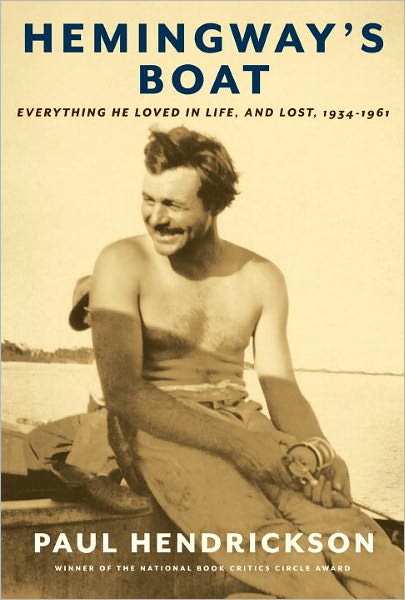
Hemingway’s Boat by Paul Hendrickson

A lyrical, textured, and meticulously researched meditation on Hemingway from a fresh new angle.

Paul Hendrickson, NBCC award-winning nonfiction author for Sons of Mississippi, pulls off the remarkable feat of finding a fresh, new angle from which to approach Ernest Hemingway: his boat Pilar. Purchased in 1934 with an advance from his longtime publisher Scribner, she saw him through three wives, great achievements and critical failures in his writing career, big fish and little ones, and the beginnings and the endings of many relationships. Hendrickson suggests that Pilar may have been the love of Hemingway’s life.

This is not a biography but a careful and compassionate rumination on the man through the lens of the boat. Hendrickson has brought to his readers a Hemingway who is neither object of worship nor monster, but a full and complex human who made serious mistakes in his relationships and fought pitched battles against his own demons, and finally lost.

The Hemingway fan will be enthralled with new details of his life, and the study of figures previously treated as minor but now revealing new facets of the man. The less familiar reader will be fascinated by this comprehensive account of the master and his complex spiderweb of varied effects on so many lives, large and small. Hendrickson presents his unusual and noteworthy story with beautifully quiet intensity and contemplation. Hemingway’s Boat achieves a terrific feat in reworking Hemingway’s story.


This review originally ran in the September 23, 2011 issue of Shelf Awareness for Readers. To subscribe, click here, and you’ll receive two issues per week of book reviews and other bookish fun!


Further notes… I can’t tell you how much this book moved me. Perhaps you have noticed that pagesofjulia is a raving fan of Hemingway. I’ve read several biographies, works of literary criticism, and other spinoffs (see The Hemingway Hoax and The Paris Wife); I’m a little obsessive. But Hemingway’s Boat holds a very special place for me. Hendrickson (PH) treats Papa (EH) sort of gently, but doesn’t spare EH in his moments of monstrosity… PH comes from several different angles, interviewing different people who knew EH more or less well, unearthing some new details. PH approaches EH with the relatively unique concept that he was just a man – a great artist, but also human, with flaws and moments of everyday beauty. This book was noteworthy in all my reading of EH and the surrounding literature. It made me laugh and cry; I treasure this galley copy, where I usually pass them on as soon as I’ve turned in my review. This book alone has made my recent career as Shelf Awareness book reviewer worthwhile. (PH also recently came around here to comment on a post, which I found very exciting. Hi Paul!) I wholeheartedly recommend this book for fans of Hemingway, or of literary biography, or of well-written nonfiction, or for those looking for vignettes in Key West or Havana history.

Teaser Tuesdays: Hemingway’s Boat: Everything He Loved in Life, and Lost, 1934-1961 by Paul Hendrickson

Teaser Tuesdays is a weekly bookish meme, hosted by MizB of Should Be Reading. Anyone can play along! Just open your current read to a random page and share a few sentences. Be careful not to include spoilers!

Ohhh you guys, I almost tear up just thinking about this guy. I’m a big fan of Hemingway’s work, and an amateur scholar of his life; he was such a fascinating, complex, difficult, sad man. I adore him and I love to read what he wrote, and what others have written about him. And Hendrickson is doing it for me! This is a great book, aside from my personal obsession with the subject. More to come (I’ve gushed too much already). Now for your teaser, from page 287 of my galley copy.

To me, the mentions suggest that even or especially up in Michigan, even for an exuberant boy who’s not yet seventeen, getting your sleep is crucial, and not only for physical reasons. Without it, darkness is already visible, if just barely.

I like how he evokes the darkness here. As Hendrickson notes (and every Hem scholar knows!), not only Ernest himself would die by suicide, but also his father, two (or maybe three) of his siblings, and his granddaughter.

This quotation comes from an uncorrected advance proof and is subject to change.