Love from Boy: Roald Dahl’s Letters to His Mother ed. by Donald Sturrock

Forty years of letters from a beloved children’s author to his mother offer an intriguing, entertaining perspective on both the man and the world.

love from boy

Roald Dahl, renowned for both children’s classics and eerie adult short stories, wrote his first letter home from boarding school in 1925, when he was nine years old; Donald Sturrock (Storyteller: The Authorized Biography of Roald Dahl) edits this collection of previously unpublished letters from Dahl to his mother. In Love from Boy, Sturrock’s minimal narrative appears alongside the epistolary bulk of the text, accompanied by a small selection of Dahl’s photographs and drawings.

Organized in seven chapters by phases of Dahl’s life, the correspondence tracks the growth of a beloved imagination and literary career. Over 40 years, Dahl evolves from funny prankster to crafty storyteller to a more serious and cynical mind, particularly following World War II. Dahl had a thoroughly interesting life even before he began writing in earnest: from English boarding schools to travel and corporate work in colonial Africa, hours logged as a Royal Air Force pilot, diplomatic work in the United States and collaboration with Walt Disney in Hollywood. But Love from Boy also provides a personal perspective on his eye for detail and the absurd, his predilection for pranks, his knack for characterization–“He’s a short man with a face like a field elderberry, and a moustache which closely resembles the African jungle. A voice like a frog…”–and his quirky preoccupation with personal hygiene, especially dental care. Love from Boy is both an endearing glimpse of a much-loved author and a sober view of mid-20th-century world events.


This review originally ran in the September 6, 2016 issue of Shelf Awareness for Readers. To subscribe, click here, and you’ll receive two issues per week of book reviews and other bookish news.


Rating: 7 tubes of Euthymol.

Teaser Tuesdays, hemingWay of the day and synchronicity: Love from Boy: Roald Dahl’s Letters to His Mother, ed. by Donald Sturrock

Teaser Tuesdays is a weekly bookish meme, hosted by MizB of Books and a Beat.

Teaser

hembut2
Imagine my thrill to see Roald Dahl and Ernest Hemingway walking alongside one another, pictured in my galley copy of Love from Boy, a collection of previously unpublished letters from the beloved children’s author to his mother.

love from boy

I’m afraid you’ll have to buy the book to see the photo! (It’ll be worth it.)

The caption reads,

Wing Commander Roald Dahl and his literary hero, Ernest Hemingway, in London, 1944. Roald got to meet many of the great and good in the literary world while he was in Washington. He thought Hemingway ‘a strange and secret man’ for whom he felt ‘overwhelming love and respect.’

For me, this was another moment of chimes sounding, so to speak. I hadn’t realized these two had any contact; I guess I hadn’t thought much about their contemporaneity. What fun to find that Dahl – one of my favorite authors when I was a kid – shared my appreciation for Papa’s work. Strange and secret man, indeed.

I was also interested to see Hemingway looking quite short and fat, next to the tall, thin Dahl. I’ve seen a lot of pictures of Hem: mostly the flattering ones he liked released; fewer in which he appears fatter and wearing his glasses (which he generally avoided being photographed in). While he is a perfectly distinguished-looking man here, in a suit and tie and those offending spectacles, both hands in pockets, striding purposefully across a street, beard clearly dark-going-to-gray (even in black and white) – I suspect this is not a photograph he liked. This one, taken during his third marriage, to Martha Gellhorn, hearkens to a slightly older Hemingway.

I love that there is always more to know.


This quotation comes from an uncorrected advance proof and is subject to change.

Stephen King’s The Body: Bookmarked by Aaron Burch

A writer’s examination of the writing that shaped him–even reluctantly–yields layers of self-awareness.

stephen kings the body

Ig Publishing’s Bookmarked series features writers contemplating the literature that has made deep impressions on their lives and work. Aaron Burch’s entry is Stephen King’s The Body, a brief but incisive consideration of King’s novella and Burch’s life in ways that surprise the author and intrigue the reader.

“The Body” is one of four novellas in King’s Different Seasons (which also includes “Rita Hayworth and the Shawshank Redemption”). It is perhaps better known for the film adaptation, 1986’s Stand by Me. Burch’s lifelong fascination began with the movie; he writes here about coming later to King’s written work as he becomes a reader, a writer and a teacher. King’s protagonist, Gordie Lachance, is also a writer and very much resembles King himself. The layers of meta-awareness continue in Stephen King’s The Body: Burch refers to his writing of the book and to its earlier drafts.

“The Body” is a Bildungsroman circling themes of friendship, nostalgia and loss as four childhood friends trek cross-country to view the dead body of a boy their age. Burch explores these themes with tenderness and sentiment, even as he resists the latter. Although “The Body” and Stand by Me provide the framework for Burch’s contemplation, his work is at least as much self-reflective memoir or personal essay as it is literary criticism. As he writes, his marriage looks to be breaking apart–a parallel Burch forces himself to confront. The two processes, writing and considering a marriage, prompt a direct gaze into difficult truths, but as King writes (as Gordie Lachance): “The most important things are the hardest to say.” This is a recurring sentiment in Burch’s slim book, where he earnestly attempts to address those hard things.

Burch exposes himself as a striking character who has a complicated relationship with art–the art he produces (up until now, only fiction) and the art he enjoys. He is an unlikely writer of literary criticism, with his resistance to considering authorial intent, and purposefully avoids behind-the-scenes perspectives on his favorite works. “It can be fun to take apart a magic trick and figure out how it actually works, but it also ruins the magic of the trick.” Having pushed himself, however, Burch is surprised to find his venture into literary criticism extraordinarily enlightening.

Burch elaborates on King’s themes of loss and friendship with those of transitions, of firsts: first date, first kiss, first job, first road trip. As Gordie (or King) writes, “There’s a high ritual to all fundamental events… the rites of passage, the magic corridor where the change happens.” The beauty of Stephen King’s The Body is in Burch entering that magic corridor, and splitting the experience wide open–uncomfortably, even–for the reader to study with him.


This review originally ran in the August 1, 2016 issue of Shelf Awareness for the Book Trade. To subscribe, click here.


Rating: 7 scenes.

author interview: Ridley Pearson

Ridley Pearson is the author of more than two dozen novels, including The Red Room, Choke Point and The Risk Agent, plus the Walt Fleming and Lou Boldt crime series and many books for young readers. He lives with his wife and two daughters in St. Louis, Mo., and Hailey, Idaho. White Bone is the fourth novel in his Risk Agent series.

Pearson at Solio wildlife sanctuary: “Time and time again I was a matter of 15 yards from these rhinos.”


White Bone’s plot centers on elephant poaching in Kenya. How did this issue come to your attention?

I heard a statistic about elephants, and it really shocked me. In 2014, the first real decent study documented that 100,000 African elephants had been killed in three years. One of every 12 African elephants had been killed by a poacher in 2011. Three-quarters of local elephant populations are declining. In nine years, there would be no more wild elephants in Africa.

Then I met Mikey and Tanya Carr-Hartley, who run a four-generation-old guiding service in Kenya. Eventually I went, under their care, to Kenya to do interviews and see the country and dig into the poaching, and my hair was blown back.

I interviewed 24 people over the course of three and a half weeks, and 23 of them in some way lied to me. These were very trustworthy sources, including our own (U.S.) State Department. Finally, my last interview was an activist lawyer, and we went through my interviews and she told me point by point who had fabricated what. My jaw dropped. There I’d been digging into this to help everyone, and in some way or another everyone had manipulated the truth.

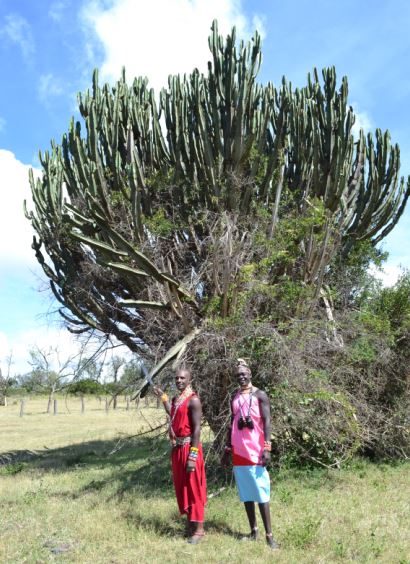
“My guides Ole and Charcoal.”


It was eye-opening, and dangerous. I was in Nairobi when there was a terrorist blast that killed 18 people. I was at a lodge when poachers killed a rhino 300 yards away from me while I slept. There’s a scene in the book where Grace runs into these herdsman, and they try to rape her. Those were two guys I ran into when one of my guides had to go get a vehicle and I was left–by my own choice–and within 10 minutes I ran into these guys, and they did not like me. It was 20 or 30 minutes of, oh boy, all he has to do is lift that spear and I’m going down.

Is there a point at which research makes it harder to write fiction?

My approach is “faction.” My charge is to suspend your disbelief, and I think it works best if I put more fact in than fiction. I do a lot of research. I learned about a guy who was investigating poaching and was a pilot over Mt. Kenya, and his plane happened to go down. A lot of people think that plane was sabotaged; it’s never been proven. I told that story, where a guy was killed in the bush who had been investigating. I just made it a little more palpable and believable for the reader.

Were you searching for John Knox and Grace Chu’s next case, or was this something you needed to write about first, and they were the best fit?

The latter. I just wondered if I could put Knox and Chu into Africa, and what that would look like.

“Ole showed me every plant that could kill you, every root that could heal you: it was unbelievable. I based all that information with Grace off my days with Ole.”


I’ve written 51 books. And I haven’t done this for probably 20 years, but I actually wrote the entire book and put it aside and started over. I just wasn’t buying my own story. It wasn’t lighting me up. And it wasn’t the story my editor (Christine Pepe at Putnam, who’s just one of the greatest editors who’s ever lived) wanted. So I stepped back and thought: What am I doing wrong here? I’ve always wanted to do a book about a person out in the wild with nothing. I’m an Eagle Scout, so I’ve gone through some of this in my own teens. When Ole, my guide, told me that a white person wouldn’t last 24 hours in the bush, I said, well, how could I last 24 hours in the bush? He showed me every plant that could kill you, every root that could heal you. It was unbelievable. I based all that information with Grace off my days with Ole.

How did you handle characterization?

I felt a great depth of participation with Grace because of her circumstances. I think this is the book where readers of the series will go, “Oh, that’s the Grace I’ve been waiting for.” I learned a lot about her. She has a lot of stick-to-it-iveness that I really wasn’t sure about. She’s an accountant by trade, but she went through the Chinese army training, and had some short-lived intelligence experience. So I always sensed that she had this potential. This book was her chance to be out on her own, investigating something that’s a little more money-oriented than pure fieldwork, and then it ends up Fieldwork with a capital F. In previous books you never really got in with Grace and felt her, and were afraid or proud or achieving with her.

The challenge is not to put everything in. In my fieldwork, there were some amazing moments. I had an encounter with one of the people who had lied to me. On the very last night I was there, he came up to me at a party and said, “Hey, listen. I’m terribly sorry about how I played that when we were at Solio.” And I said “Yeah, so am I!” But at least he was man enough at the end to come up and say, “Sorry I just lied to your face.” That was a very emotional moment for me. And you can’t get them all in.

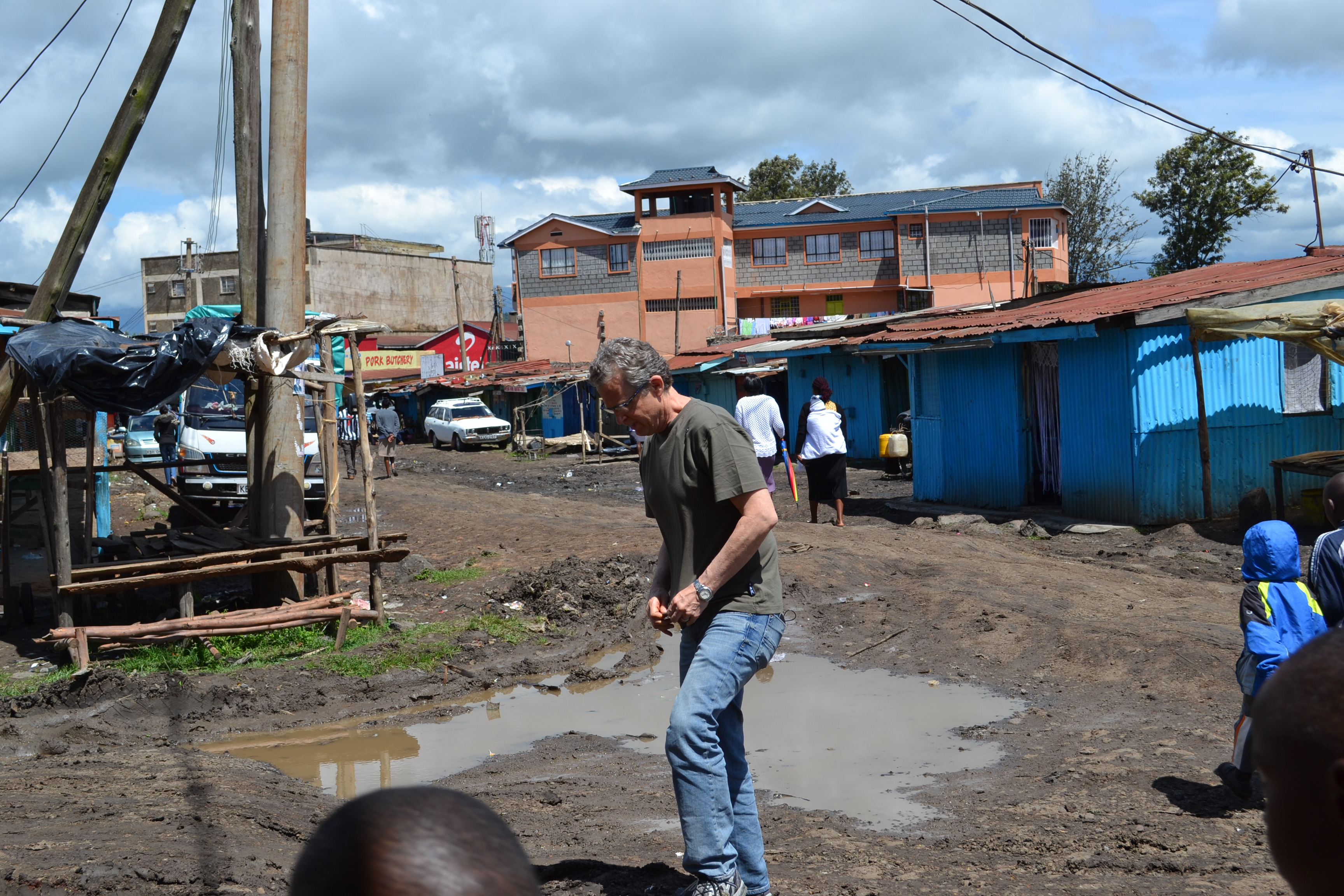
“This is me in what they call a ‘nice’ town near Solio Lodge.”


You regularly write realistically about violence, depravity and corruption. Is this emotionally difficult?

I think you pay for it.

Every day for two years as I wrote this book, these images hung in my head. These stupid idiots come in with automatic weapons on ATVs, they massacre the elephants, they chainsaw their faces off for the tusks, and they’re gone in 15 minutes. For all the dark that Grace and Knox went through, those are the images that haunted me. When you’re there and you see these animals, just how majestic they are–it’s absolutely despicable.

I want to route some of the money from the book there, and get some people at the end of the book to say, “I’ll send $10 to them”–it doesn’t have to be $100,000. It’s just bizarre to me that this is going on, and none of our grandkids will see elephants except in a reserve or in a zoo. An elephant is being killed every 15 minutes, and has been since I started this and long before I started this.

That was the darkness I lived with. Everything else was manufactured. I’ve done a lot of research over 30 years. I’ve been inside the mind of a lot of devious criminals. I’ve spent time in prisons for the criminally insane. I’ve interviewed forensic psychiatrists who have themselves interviewed 140 mass murderers. I’ll say, this is what my guy did, who is he? And we’ll be eating dinner, and the stuff they describe stops me from eating. So there is darkness. And I pay for it.


This interview originally ran in the July 29, 2016 issue of Shelf Awareness for Readers. To subscribe, click here, and you’ll receive two issues per week of book reviews and other bookish news.

movie: Genius (2016)

I have had a book on my shelf for years called Max Perkins: Editor of Genius, by A. Scott Berg. I haven’t gotten around to reading it yet, sadly. But you know I was thrilled to see this movie come out. Genius is based on the book: it’s about Max Perkins of Charles Scribner’s Sons publishing house, who shepherded the careers of Ernest Hemingway, F. Scott Fitzgerald and Thomas Wolfe, among many others.

geniusThis movie is about Perkins’s relationship with Thomas Wolfe (although Fitzgerald and Hemingway make brief appearances). I knew almost nothing about Wolfe when I came to the film, and my impressions of Perkins were hazy, based on what I know of Fitzgerald and Hemingway: I understood him to be a decent, humble, kind man, well-suited to handle such stormy personalities and expert at doing so. He is known to be both a very fine editor and a very fine guardian and guide to the difficult men who were his three most famous writers.
These impressions were held up by the film. Perkins (Colin Firth) is quiet and modest and professional. Thomas Wolfe (Jude Law) is wild: noisy, passionate, emotive. Talented, but unrestrained in several senses. He sought a father and Perkins sought a son, and their relationship is characterized as such. Together they produced Look Homeward, Angel and Of Time and the River.

Wolfe’s lover and patron Aline Bernstein, played by Nicole Kidman, is an especially tragic character. The couple’s threats and fights add pathos and drama to that already provided by Perkins’s conflicts with his own wife (he is perhaps overly committed to his work) and the fiery, explosive talent Wolfe sprays across his life and Perkins’s offices. The acting is great – to be expected from such a cast.

Following closely on my viewing of Papa, I saw parallels. Literary talents can be oh so dramatic, and their lives can be woeful, tragic and (again) dramatic. I enjoyed both movies very much, but I confess they often hit the same emotional notes. This strikes me as accurate; but I can see where a viewer less invested than I am could perhaps get a little weary. These are the risks of loving characters like Hemingway and Thomas Wolfe.

For fans of these writers, their work and their community, not to be missed. Very fine acting & production and a fine film all around.


Rating: 8 marks.

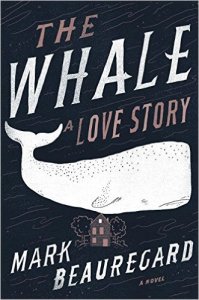
The Whale: A Love Story by Mark Beauregard

Careful research supports this story of a love affair between Hawthorne and Melville that birthed a classic.

the whale

In 1850, Herman Melville was in debt and struggling professionally, particularly with the novel-in-progress he was then calling The Whale. That summer, on a family trip to the Berkshires, he met the older, successful author Nathaniel Hawthorne, and began a relationship that would be passionate and painful, fraught and inspirational. Mark Beauregard explores the intimate friendship between these two literary legends in The Whale: A Love Story.

Based on primary sources including letters and journals, and meticulously researched, this novelization follows the historical record closely, as detailed in an epilogue. Hawthorne’s letters to Melville, lost to history, are re-created here using his other letters and journal entries; Melville’s letters to Hawthorne, however, are reprinted faithfully (with few, documented exceptions). Melville dives deeper into debt to move to the Berkshires and be near Hawthorne. As they discuss cerebral, spiritual and literary matters, grow close and suffer estrangements, Beauregard charts a full-blown love affair. In this telling, Moby-Dick is a labor of love and obsession directed not at a whale but at a man. Melville’s novel (which was dedicated to Hawthorne) continues to compel and confound readers today, and The Whale: A Love Story offers one possible explanation for its tortured mysteries.

In Beauregard’s fittingly emotive account, Melville is preoccupied and fervent, and Hawthorne is changeable, by turns sensitive and cool. Set against a literary community that helped define American letters of the time, this high-spirited story evokes a singular relationship and the complexity of Moby-Dick.


This review originally ran in the June 17, 2016 issue of Shelf Awareness for Readers. To subscribe, click here, and you’ll receive two issues per week of book reviews and other bookish news.


Rating: 7 flashes of lightning.

Everybody Behaves Badly: The True Story Behind Hemingway’s Masterpiece The Sun Also Rises by Lesley M. M. Blume

This study of the creation of The Sun Also Rises illuminates both the compelling story and Hemingway’s complex and not entirely likable personality and behavior.

everybody behaves badly

Many books have been written about Hemingway, but it seems there is still more to be learned. Lesley M.M. Blume’s Everybody Behaves Badly zooms in on the creation of The Sun Also Rises, Hemingway’s first novel and the one that firmly established his reputations, literary and otherwise. As her subtitle promises, Blume seeks the true story: in this case, the real men and women whose lives inspired Hemingway’s fiction, which some claimed was not really fiction at all.

Everybody Behaves Badly is not a biography of Hemingway; it skips his childhood to open with his marriage to Hadley Richardson, and the couple’s move to Paris in pursuit of cheap living and a storied expat community. Blume portrays a devilishly charismatic young writer, ambitious and confident, who easily collected mentors and admirers. She follows that young writer to Pamplona with a group of friends in 1925, and through the weeks after in which he wrote feverishly. Unflatteringly immortalized, one of the people Hemingway transformed into a character spoke of lives divided into B.S. and A.S.: before Sun, and after. Blume’s study concludes as Hemingway’s career expands, his first marriage ends and his second begins.

A biography of a novel, then, Everybody Behaves Badly is itself an engrossing and varied tale: raucous and dissipated, pitiable and serious. Blume’s research offers new detail to a well-studied story, and her narrative style is as entertaining as the original. Obviously required for Hemingway fans, this engaging work of nonfiction will also please a broad audience.


This review originally ran in the June 7, 2016 issue of Shelf Awareness for Readers. To subscribe, click here, and you’ll receive two issues per week of book reviews and other bookish news.


Rating: 8 slight changes.

author interview: Allison Amend

photo: Stephanie Pommez

photo: Stephanie Pommez


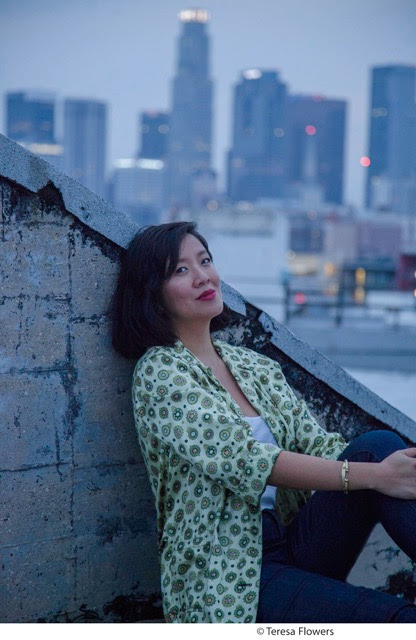
Allison Amend, a graduate of the Iowa Writer’s Workshop, is the author of the novels A Nearly Perfect Copy and Stations West, which was a finalist for the 2011 Sami Rohr Prize for Jewish Literature and the Oklahoma Book Award. She is also the author of the Independent Publisher’s Award-winning story collection Things That Pass for Love. She lives in New York City, where she teaches creative writing. Her latest novel is Enchanted Islands, based on the life of Frances Conway, who lived with her husband, Ainslie, on the Galápagos Islands for several stretches in the 1930s and ’40s. My review is here.

When did you discover Frances Conway, and what about her spoke to you? Did you know you needed to tell this story when you first encountered her?

I discovered Frances through her memoirs. I originally wanted to write about the series of strange disappearances on the Galápagos island of Floreana, but some of the descendants of the people involved are still alive, and Dayna Goldfine and Dan Geller were making a documentary about it, and I felt I wanted more freedom to imagine characters. It was in that period of research, though, that I read Frances’s memoirs and immediately fell in love with her voice. She is funny and witty, self-deprecating and actually a talented writer. This was a voice I wanted to attempt to emulate.

What also struck me about her two books is what they didn’t say. She was 50-year-old woman married to a man more than 10 years her junior, and in her middle age they decided to go to a deserted island? There was some larger story that she wasn’t talking about. It was in the space between the lines that my interest in the story grew.

I had written a full draft of the novel before I went to do research. Frances never mentions in her memoirs that Ainslie has a drinking problem, but I wrote that into the novel. Later, I spoke to the son of someone who knew the couple, who said that the Conways had come to Floreana in part so he could dry out. There are traces of honesty even when we try to hide them.

Have you ever been to the Galápagos?

Yes. My parents took me and my brother when I was just out of high school. It was an amazing trip. During that time I read Floreana, Margret Wittmer’s account of the strange goings-on on the island, and I became fascinated with the human history of the islands.

I returned to do research in February 2015 and found the islands much changed. Land-based tourism is in full effect, and the population of the islands has exploded. I saw many more Ecuadoreans taking advantage of their natural park. It’s wonderful that the islands have become accessible to those who are non-wealthy, but the increased traffic stresses the islands.

Every superlative everyone has uttered about the utter awesomeness of the Galápagos is true. I urge everyone reading this to visit this spot before tourist degradation destroys it.

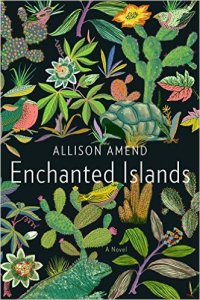
enchanted islandsWhere is the line between fact and fiction? How firm is it? How important is it to you?

Ehhh, line-schmine. I like to say that fiction dwells in the possible, not the probable. Is it possible that Frances and her husband were spying for the U.S. government? Unlikely. But it does seem clear that Ainslie wrote an anonymous feasibility report for the U.S. Navy, and it is rather strange that a mismatched middle-aged couple would play Swiss Family Robinson on a strategically placed island full of Germans just before World War II, so who knows?

If there had been more historical records about Frances and Ainslie, I might have felt more compunction about inventing their lives, but the dearth of facts seemed to me to be a green light.

How much research did you do, and do you find that part of the process enjoyable?

I love to do research, and all of my books have been research-intense. It is one of the most enjoyable parts of writing for me. This may be because I get to procrastinate and call it writing.

I did try to complete a working draft before I started researching so that I would be sure to focus on creating characters rather than writing a Forrest Gump-like series of important events.

I did a lot of my research on the internet, unsurprisingly. There is a fantastic resource on the human history of the islands compiled by John Woram: www.galapagos.to, which has nearly all the historical documents that exist on the islands. I also did a lot of reading on spying tradecraft in the 1930s, and the role of the Pacific and the Panama Canal in the Second World War. Then there was all that research on Chicago during the turn of the century and San Francisco in the periods between the wars. Oh, and I went to the Roosevelt library and the Allan Hancock collection at the University of Southern California.

I read Frances’s memoirs several times, because I wanted her voice in my head. For a while I considered weaving in parts of her memoir, but I decided that would be more of a gimmick than an asset to the novel, so I tried to put the book out of my head and just write from my memory of her voice.

There comes a time, though, when research starts to inhibit imagination instead of spark it, and then it’s time to put the research away and just write.

Do you have a favorite character or one you feel closest to?

Well, obviously I spent four years or so with Frances, so I feel like I know her (or my fictionalized version of her) very well. But I have sympathy and fondness for all the characters in the novel.

In what ways is this book different from your previous work?

All of my books are different from each other. One of my biggest pleasures in writing is to try something new–it keeps the writing exciting and challenging. After my last historical novel, I swore I would never write another… but the pull of this story was just too great.

Enchanted Islands was a challenge because I was writing in first person for the first time in a novel. And I was writing from a voice that already existed. I didn’t have to match it, but I wanted to be true to its spirit. I was also challenging myself to write a tightly plotted novel, with spies and violence and action. From someone who comes from a literary fiction, character-driven background, highlighting plot is like getting a horse to walk backwards.


This interview originally ran in the June 3, 2016 issue of Shelf Awareness for Readers. To subscribe, click here, and you’ll receive two issues per week of book reviews and other bookish news.

author interview: Fernanda Santos

photo: Nick Oza

photo: Nick Oza

Fernanda Santos covers Arizona and New Mexico as the Phoenix bureau chief for the New York Times. Her experience as a journalist is broad, crossing two continents, several languages and a range of subjects. Her first book, The Fire Line (Flatiron Books), is about the deadly 2013 Yarnell Hill, Ariz., wildfire that killed 19 members of the firefighting team the Granite Mountain Hotshots. My review is here.

How was writing this book different from newspaper work?

I wanted to write a book because I couldn’t answer the questions that I wanted answered in newspaper stories. I knew that somebody would write about this fire, and I would have tortured myself for the rest of my life for not having had the courage to write it. I called a colleague in New York, and he said, look at every chapter as a story. Can you write a 4,000-, 5,000-word story? And I said yes, I can write that. He said they just all have to connect in the end. And it seemed so simple.

On one hand, it was that simple. But on the other hand, it’s very different than writing a newspaper story. I had complete control over it. In newspapers, the editors get hold of your text and shape it, or send it back to you and ask for more of this or that, because they want to drive a specific point. With the book, I kept waiting for the moment when the editors would get my chapters and start telling me where to go and what to do next, and it never came. When I was halfway through, I sent it to Colin Dickerman, my editor at Flatiron. I didn’t even know if I’d written something that resembled a book. And he said, there’s a lot of great material here, great reporting, but it’s a little confusing. Why don’t you do an outline? And I thought, oh! I guess that would help! With the outline, everything was easier. I set deadlines for each chapter. I only had a certain amount of book leave, and I didn’t want to jeopardize the job that I really love. So I assigned myself these stories, like my friend told me, and pursued the deadlines as if an editor was there to enforce them. And all of a sudden it flowed, just naturally evolved from one chapter to the next. A lot of the skills I used were developed over those years writing newspaper stories.

How did you gain access to these men’s families, and their trust?

I approached it very differently than I would if I were to just write a story about the deaths. I was not looking for a quote, or a quick couple of lines to throw in a story to define a character. I really wanted to understand who these men were, and I figured the best way to do that was if I got to meet their families. I had a friend in common with the wife of Andrew Ashcraft. I asked this friend to reach out to her, and we met. Then she referred me to her mother-in-law, who was close to another mother, who was close to another family, and the word started to get around. I guess they liked me. They said I had a lot of patience, and I was very interested in learning their stories.

I wrote letters to other families. I explained what the book was about, why I wanted to talk to them, and I said that although I had their addresses, I had not gone knocking on their doors because I didn’t want to add to their anguish. I wanted to leave them in control. I wanted them to reach out to me, and say if, when and where. And before I realized it, I had met everybody.

I also went to the fire academy in Prescott, where a lot of the Hotshots trained, and some of them taught; one of them, Eric Marsh, helped found the academy. I did the basic training, and then another course, and I’m actually going back to a third. I wanted to understand the world they inhabited, because wildland firefighting is a very small world, very tight. Once I went through the academy I could understand better what former members of the crew and families of the men had told me.

fire lineI love that you explore so many facets of this story: firefighting techniques, the history of fire management in the United States, the science of weather forecasting.

I realized early on I had to explain three things. Readers had to understand what wildland fire is, what it is like to fight a wildfire. They had to understand the very specific conditions of the vegetation in that part of the state, which obviously connects to the bigger issues of the drying of the west, climate change, the warming of the planet. And they needed to understand the characteristics of the storm that hit the fire, that hooked the flames and turned them around on the men. So I spent a lot of time in the National Weather Service office here in Phoenix, and the office in Flagstaff. I hung out with meteorologists, asking questions. They referred me to some texts. And I had two very thick fire policy books that I read, which were very helpful. I met several times with the author of those books, Stephen Pyne. In fact, he read my manuscript to make sure I didn’t embarrass myself.

It was in some ways a relief, when the emotional side of things became hard to deal with–you know, spending six hours with a widow, talking about a husband and a life that in many ways resemble my own. These guys were younger than my husband, but we like to do a lot of the same things these guys liked to do with their wives; we have a child, a lot of them had kids–so you understand the broad outlines of a life at home. Emotionally, that is very hard. There were times that I really looked forward to sitting down with a meteorologist and talking about science. It gave me a break, and recharged me so I could go back and sit down with another family for hours and talk about whatever they wanted to talk about. My husband says that I report with my heart first, which is why sometimes I come home a total wreck. I hope that’s what comes through.

Was it easy to return to your work for the Times?

It was not easy. I went from an environment where I was in complete control, and I took the story as far as I wanted to take it, to an environment where I have limits to the stories I write, the amount of time I can spend, even the way I write them. I remember telling my editor after one frustrating story, how is that I can write a book and I can’t write a story? And he said you can write both, but you can’t write a story as if you are writing a book.

I miss my book. It’s very weird, but I miss the intimate connection that I had with that story.

This was very rewarding, then.

It’s interesting. I’m from Brazil. I came here as an adult, I’d never written a story in English, I went to graduate school, I’ve been at the Times 10 years, and now I’ve written a book about wildfires. A very American story, in some ways. It was such an empowering experience for me, as a person. We know all the conventions, the boxes people try to fit us into. You’re a woman, you’re an immigrant, you’re a Latina; therefore you’re expected to know about immigrants, Latinos, parenting. Not about firefighters, a real man’s world. Because English is not my first language, how dare I write a book? Those were the things in my head. What are you thinking? Why did you get yourself into this? I had all these battles with myself, and I obviously overcame them, because I wrote the book. To me, that was such a priceless experience. My daughter is six, and I’ve been talking to her about what people say you can and can’t do, what girls can’t do. And in Latin culture we’re very respectful to authority. So I’m telling her, sometimes you have to break the rules. Sometimes you have to try something that people think you’re never going to be able to do, so you can prove to them that you can. It really taught me a lot about how far I can go.


This interview originally ran in the May 10, 2016 issue of Shelf Awareness for Readers. To subscribe, click here, and you’ll receive two issues per week of book reviews and other bookish news.

Maximum Shelf author interview: Steven Rowley

Following yesterday’s review of Lily and the Octopus, here’s Steven Rowley: On Obstacles and Octopuses.


Steven Rowley is from Portland, Maine, and is a graduate of Emerson College. He has worked as a freelance writer, newspaper columnist and screenwriter, and lives in Los Angeles with his boyfriend and their dog. He is @mrstevenrowley on Instagram and Twitter. Lily and the Octopus is his first novel.

How autobiographical is this story?

photo: Malina Saval

photo: Malina Saval

There’s no way to deny that it’s partly autobiographical. I did have a dog, named Lily, and when she passed away I went into a funk. The depth of grief I felt took me completely by surprise. After about six months or so feeling completely blocked, not just in writing but in life, I sat down to do what writers often do, which is try to put pen to paper and work their way out of a tough spot. Thematically and emotionally it was autobiographical, but as I kept writing, the character and the plot became more fiction. It got weird, certainly, along the way, but I thought, the story can get as weird as it wants to on the surface as long as I stick to the mission of adhering to absolute emotional honesty.

It sounds like you did the writing as a part of healing.

Oh, it was hugely cathartic. Absolutely. Although it’s largely on the surface about a man and his dog, I see the story more about a character who’s stuck in life. Sometimes our biggest obstacles are those that we make up, that we imagine, or if they’re not entirely imagined, that we exaggerate. So it’s really a story about what it takes to get unblocked and power your way though.

Did you know that that was the story before you were writing it?

It’s interesting. I come from a background in screenwriting, and with screenwriting you have the plot much more laid out in advance. And this was something I was approaching from more of an emotional standpoint, looking to examine themes of grief and depression–I hate to harp on those because the book is, hopefully, not without its humor as well. I was surprised where the story took me because I was so focused on the emotion of it. There’s a big set piece near the end that came completely by surprise.

Why on earth an octopus?

Well, I did have a dog that suffered from something that looked a bit like there was a small octopus on her head. But beyond that, I wanted something as different as possible. What’s most different from a dog that’s covered in fur, that’s basically all spine (since she’s a dachshund) than an invertebrate who’s sort of slimy and hairless and lives in the sea? I liked playing with that dichotomy, that they were as different as different can be. On top of that, I have an enormous respect for octopuses (my editor and I have gone over this time and time, and the plural of octopus is octopuses). They’re so smart, and according to scientists they’re playful, can use simple tools and they learn and adapt as they go. And that’s what I needed, a cunning antagonist. Because the main character learns more about the octopus throughout the story as it unfolds, I needed a villain who would learn and adapt as well, continue to know how to needle our narrator. So, that is an octopus. And I do carry some guilt about villainizing them in any way, because they’re really magnificent creatures. Please everyone, don’t hate the octopus. Just the particular one in this story.


How was writing a novel different from your previous work as a screenwriter?

Screenwriting is a collaborative art. Many people help to bring a screenplay to life as a film, and many times it’s not the writer’s original intent that makes it to the screen. On top of that, when you’re writing a screenplay you’re writing a blueprint, it’s not in and of itself the final product. I had in my mind that I wanted to try a novel someday, so that if nothing else I could point to something bound and finished and say, this is what I do.

A screenwriter’s job is to make the internal external. All emotion and feelings are expressed through action and dialog. In this book, I wanted to luxuriate in themes and feelings. The book is very internal; there’s a very limited number of characters. The narrator has one friend, one sibling, one parent and one therapist, and that’s it. He’s sort of removed from humanity, which is why he has such a powerful relationship with his dog. I really wanted to take the time and explore what was going on inside of his head, and when you’re exploring depression it’s often internal like that. So it just seemed that a novel or prose was the right medium for this story.

Your journey to publication was unusual. Congratulations, by the way.

Thank you! When I finished the manuscript, I was very proud of it as a piece of writing, but I saw it as so deeply personal, and to be perfectly honest I was also worried that it was perhaps a little weird. Self-publishing was also attractive to me because, coming from film, I didn’t want too many other voices trying to tell me it can’t be an octopus, it should be an alligator, or whatnot. My boyfriend recommended I hire an independent freelance editor, so I found a woman named Molly Pisani and she and I worked on the book together. I paid her and I never expected to hear from her again. I went about doing what writers looking to self-publish do. I hired a typesetter, looked at ISBN numbers and how to market the book and sell it, all these things, and out of the blue I got a phone call from Molly about three months later. She said, “I can’t stop thinking about your book. I know a woman who works at Simon & Schuster who I think might respond to it in the same way that I did. Do you mind if I send it?” I said no, I certainly don’t mind, but I was so far down the line toward self-publishing that I really didn’t think anything would come of it. And she did say that it could take her friend a month or two to look at it. That was on a Friday, and on Monday morning I woke up to a call from Simon & Schuster, from the woman who is now my editor, Karyn Marcus. It really happened that quickly.

What’s next?

Everyone is asking, will it be a screenplay or novel? And I have to say that publishing is being incredibly kind to me right now. Working on Lily with my editor, she gave me a note once and said, “…but I defer to your creative vision.” And I almost fell out of my chair! Because in 10 or 12 years really giving it a go as a screenwriter, I had never heard those words from a producer or a studio executive. As a writer, that’s kind of addictive. So for many reasons, my next project, which I’m working on right now, is a follow-up novel. I’ve been really fortunate with this publishing deal, which has allowed me to leave my day job, and I’m focusing on writing full time now. I’m excited.


This interview originally ran on May 9, 2016 as a Shelf Awareness special issue. To subscribe, click here, and you’ll receive two issues per week of book reviews and other bookish fun!