The Ministry of Truth: The Biography of George Orwell’s 1984 by Dorian Lynskey

This funny, wise, well-researched study sits at the intersection of biography of Orwell’s life, literary criticism of 1984 and social commentary on literature’s role in life.

Dorian Lynskey (33 Revolutions Per Minute) takes a close look at an ubiquitous classic with The Ministry of Truth: The Biography of George Orwell’s 1984. The novel was a sensation and a controversy when it was published in 1949; again as the year 1984 approached and passed; again in recent years, and at every time in between. Lynskey sets out to examine its ancestry in utopian and dystopian literatures, in Orwell’s experiences during the Spanish Civil War and wartime Great Britain, and the political and cultural responses it’s drawn.

Lynskey spends much time contextualizing outside material: he devotes whole chapters to the literary works of Edward Bellamy, H.G. Wells and Yevgeny Zamyatin. Orwell’s service in the Spanish Civil War, his relationships with other writers and his personal and professional history necessarily figure as background material in Part One of The Ministry of Truth.

Part Two covers the world’s reaction to 1984, all the way through the election of the Unites States’ 45th president. In 1984, the novel surfaced not only in documentaries and articles, but also in a comedy sketch by Steve Martin and Jeff Goldblum, in carpet advertisements, on Cheers and in Charlie Brown–Lynskey writes that it “had mutated from a novel into a meme.” He refers to Margaret Atwood, Rebecca Solnit, Neil Postman and Orwell’s son, Richard Blair. He covers some of the books’ various interpretations: Atwood features as the “most prominent advocate” of the Appendix Theory, which asserts that 1984‘s Appendix, covering Newspeak from a date apparently far beyond 1984, “is a text within the world of the novel, with an unidentified author,” thereby offering a decisive reading.

This wide-ranging and thorough study requires a careful and patient reader. Even one familiar with both Orwell’s work and early communist and socialist histories will need to read closely. Lynskey offers his own appendix: a chapter-by-chapter précis of 1984, which is recommended for everyone. The requisite attention will be well rewarded, as The Ministry of Truth is not only enthralling and research-rich, but often laugh-out-loud funny. When 1984‘s American publishers wrote to J. Edgar Hoover hoping for a back-cover endorsement, Lynskey writes, “Hoover declined the request and instead opened a file on Orwell.” Lynskey’s voice is impassioned and self-aware, and he has an eye for the absurd (as any student of Orwell’s should).

Among Lynskey’s conclusions is that 1984 is “a vessel into which anyone could pour their own version of the future.” Too often it has been mistaken for a prophecy (and critics then argue about how successful it has been in that regard), rather than understood as Orwell intended: to offer a possible future as motivation to work against that possibility. Lynskey argues that such persistent and diverse misreadings are possible because the novel leaves room to become essentially whatever the reader wants it to be, or most fears. This is part of why 1984 remains as forceful and compelling as ever. The Ministry of Truth is a necessary guide.


This review originally ran in the May 3, 2019 issue of Shelf Awareness for the Book Trade. To subscribe, click here.


Rating: 7 lies.

Maximum Shelf author interview: Alex North

Following Wednesday’s review of The Whisper Man, here’s Alex North: The Heart of the Book Starts Beating.


Alex North was born in Leeds, where he now lives with his wife and son. He studied Philosophy at Leeds University, and prior to becoming a writer he worked there in their sociology department.

Chapter by chapter, your characters take turns holding center stage. Was it complicated to manage so many points of view? Is there a strategy for writing this way?

I think the structure is just what this story demanded. Although the characters do come together as the book progresses, they start off in different places, and they each have their own storyline to follow until they do. Tom is clearly the main character, and we follow the majority of the book from inside his head, but there is a surrounding cast whose stories gradually begin to dovetail with his, until all of them are inextricably linked by the end.

I don’t think it’s necessarily any more complicated to write than a more straightforward single narrative. You do have to keep track of things very carefully, though, and you certainly don’t want one strand of the story to overshadow another. In an ideal world, a reader will finish a chapter that focuses on one specific character completely desperate to find out what happens to them next–but equally eager to pick up on things from another character’s perspective in the meantime and see what happens there.

It’s a balancing act, but I do like stories that use this technique. For one thing, if it’s done well, it can drive you through the book. For another, it can sometimes become quite claustrophobic for me if I’m trapped in a single character’s head for the entire story. But most of all, I think it’s interesting when these characters eventually collide and interact with each other. Writing from different perspectives allows you to see things from different angles, because the characters will understand and interpret the same event in their own unique ways. We all do that in real life. And I think it helps to bring nuance and ambiguity to the story, with the truth being revealed through a combination of viewpoints.

Fathers’ impact on their sons forms a central theme of the book. Was that intended, or did it arise as the story unfolded?

It was intended to an extent. To begin with, all I knew was that I wanted to write about a father left alone to care for his son, and finding it difficult. But there was a moment, shortly after moving into our new house, when my own son briefly mentioned that he was playing with “the boy in the floor”–which obviously gave me a bit of a chill! Thankfully, that didn’t last, but at that point I knew the little boy in my story would have imaginary friends, and that some of them might turn out to be quite sinister and disturbing. The book unfolded from there.

But the background theme of fathers and sons definitely expanded the more I wrote. It was on my mind the whole time, and so I found different connections emerging as I went. It felt a lot like things appearing through the mist: the more you write, the more the events in the book begin to link to each other, suggesting other connections, and so on. I was writing about fathers and sons from the beginning, but it took a first draft of the book before I discovered all the different ways that theme fed into the story.

What are your favorite parts of writing a novel like this?

Writing a novel is a marathon rather than a sprint, and I think you have to accept that there will be good and bad days–and far more of the latter–but I’ve learned that you have to go through all those bad days to get to the good ones. As is so often the case, half the battle is showing up.

But while I’ve enjoyed the handful of days when the writing has flowed, there’s also immense pleasure to be had in the ones when you had to drag yourself to the keyboard… and something just clicks. It’s enough to keep you trying the next day and then the next. Which of course is what you have to do.

For The Whisper Man, the moments I most enjoyed were towards the end, when all the connections began to make sense to me and the book finally came together. It’s easy to say what my favorite scene to write was, but also a bit of a spoiler. Speaking carefully, it involves a conversation between a little boy and a little girl. While there was still a whole load of writing and rewriting to do afterwards, that was the moment where I felt like I’d found the heart of the book and felt it start beating.

Can you give us any hints about your next novel?

I’m really superstitious when it comes to talking about work in progress. For one thing, I think it robs you of the impetus to write the book itself but, more importantly, my books tend to change all the way up to the wire. I have to try to write the story to figure out what I should have written all along, which means my final draft can be very different from my first. I write slowly to begin with, and then frenetically in the last month or so. But one thing I can say is that the next one is another very dark psychological thriller with creepy undertones. If The Whisper Man made it difficult to fall asleep, my hope is that the next one will make you very scared indeed of what might happen when you do.


This interview originally ran on April 17, 2019 as a Shelf Awareness special issue. To subscribe, click here, and you’ll receive two issues per week of book reviews and other bookish fun!

writers in video (audio)

A few links for you today that came from my parents.

My mother sent this recording of a Bellingham local Whatcom Reads program, in which Timothy Egan discusses his book The Big Burn: Teddy Roosevelt and the Fire that Saved America (and, in Q&A, a few more – remember Mom reviewed The Worst Hard Time for us). I really enjoyed listening to this one (thanks Mom for the tip that the visual part was not entirely necessary), and I am reminded that I need to try some Egan one day – he sounds in the vein of Jon Krakauer and Erik Larson, who were among the first writers I recognized as creative nonfiction and as something I loved. While I really enjoyed it, I also took exception a few times to some of Egan’s comments: his chauvinism about geography, for example, and his statement that “Indians all have creation narratives,” as if to imply that his/our own culture doesn’t have creation narratives. (I guess it’s only a creation narrative if somebody else believes it, and what *I* believe is just truth?) (Also, any time you say “all the [ethnic group] do such-and-such” you’re probably on thin ice.) These quibbles were not fatal for my appreciation, and if anything indicate that I was engaging. One of these days I will read some Egan…

And, my father sent this episode of Oregon State University’s About Words, featuring Ben Goldfarb about his book Eager: The Surprising, Secret Life of Beavers and Why They Matter. Pops appreciates beavers; we have a mutual friend (and friend to Goldfarb, apparently) named Rob Rich who is a beaver fan and advocate, and writer; and I have been seeing a lot of beavers these last few weeks on my travels. But this short video (very short, after an hour-plus with Tim Egan) is less about the beavers and more about the imperative to write, among other things.

So, a little extra to add to your listening queue! [That’s a tip: although YouTube videos, I did not watch but only listened to both clips, which was fine (visuals were just background). I signed up for a free 30-day trial of YouTube Premium, which allowed me to download these videos for offline viewing/listening.]

Thanks, Mom and Pops!

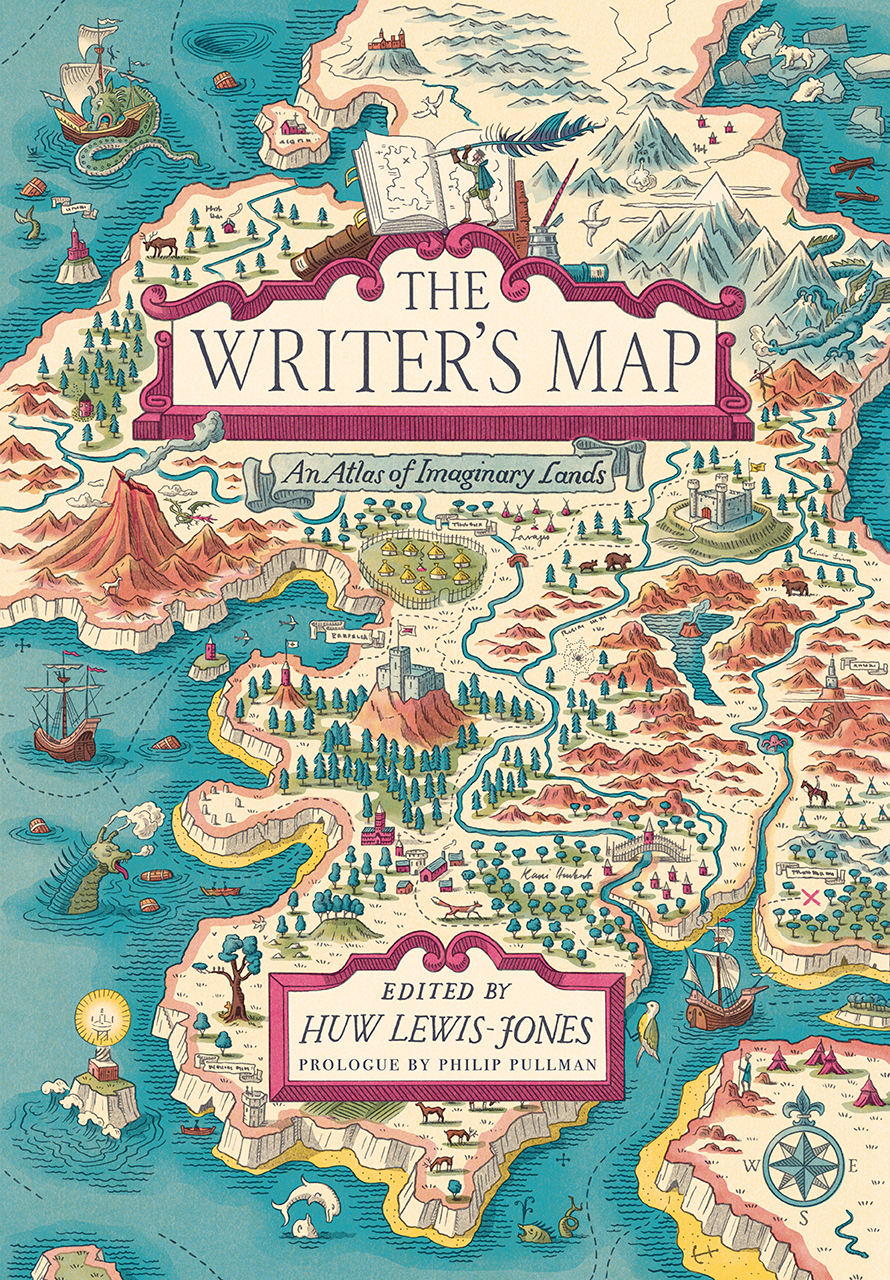
The Writer’s Map: An Atlas of Imaginary Lands ed. by Huw Lewis-Jones

This delightful, engrossing exploration is for every reader who’s ever admired a book or a map, let alone both.

In The Writer’s Map: An Atlas of Imaginary Lands, historian Huw Lewis-Jones offers a collection of essays by authors, illustrators and designers as they ruminate on processes of reading, writing and creating, as well as the link between map and story. They consider maps in two and three dimensions, sketches, stories and outlines that live only in the writer’s mind, and argue that creating maps, like creating stories, is essentially an act of compression, a set of choices about what to leave out.

Contributors include Robert Macfarlane, David Mitchell, Lev Grossman, Joanne Harris, Philip Pullman and the graphic artists for the Harry Potter and the Lord of the Rings movies. Literary references in this gorgeously designed, detailed coffee-table book begin with Kerouac, Tolkien, Twain and Thoreau, and visit Treasure Island, The Wind in the Willows and so many more.


This review originally ran in the November 6, 2018 gift issue of Shelf Awareness for Readers. To subscribe, click here, and you’ll receive two issues per week of book reviews and other bookish fun!


Rating: 8 archipelagos.

Cutty, One Rock: Low Characters and Strange Places, Gently Explained by August Kleinzahler

I bought this book nearly two years ago, on the recommendation of my friend Doug.

Cutty, One Rock has four parts in this edition (three in the original). Generally, the book deals with Kleinzahler’s background–family, hometown and neighborhood–in a Mob-rough New Jersey; it deals with place, relationships with people, and eventually with art. His parents live a middle-to-upper-middle class life, concerned somewhat with appearances; his mother is devoted to Shakespeare. The back of the book calls them “both cultivated and deranged,” which I think is apt. Early in the book, these parents figure as central influences, central characters in the child’s upbringing, but stay tuned for another important family member to come later in the book.

The adult Kleinzahler is an expatriate Jerseyite living in California’s Bay Area, and the differences between these two places, the baggage he carries between them, is another central feature. Here he is describing the “swagger, a bluff air of menace that many of the males wear”:

Once, after leaving a restaurant in North Beach, here in San Francisco, I gave a panhandler a dollar, a middle-aged black guy with some amusing riff or other.

“Thanks, Jersey,” he said, to the great amusement of my companions.

“How did you know I was from Jersey?” I asked.

“Are you kidding?” he said.

The narrator does substantial traveling beyond these two points, east and west, and these other locations and the nature of travel itself offer another recurring thread. The essay “East/West Variations” opens:

There’s a window, thirty-six hours or so, not even, when traveling by air between places, places where you’ve lived for a long time. After you’ve landed and into the next day, perhaps the evening–then you begin to lose it. It goes very quickly, decaying like a tone in the air. But for a while, inside that window, you’re hyperawake.

He goes on to describe this “window,” which I couldn’t help but conflate with the window you look out of when traveling by air–which I was doing, as it happens, while reading this book. He concludes on the next page that “places are conditions of mind.” By the end of this wide-ranging essay (which catalogs several romantic interests and his hard-nosed mother’s reactions to these women), we deal directly with a parent’s mortality. It’s a hell of an undertaking, and I’m not sure I followed him everywhere he tried to take me, but I appreciate the ambitious handling of place and people, and their intersection.

Part three tackles the subject of poetry, and poets. Kleinzahler is a poet; but he’s a rough-and-tumble Jersey poet, with no patience for poetry readings or academia. He writes a particularly scathing send-up of Garrison Keillor’s Good Poems; a profile of Allen Ginsberg (reminding me, not for the first time, of Joseph Mitchell); and a lovely elegy of Thom Gunn. The Keillor criticism, “No Antonin Artaud with the Flapjacks, Please,” is clever, and the Ginsberg profile is incisive; but I love Kleinzahler’s voice best when he writes with love, as he does of Gunn.

Kleinzahler is derisive toward intellectuals,

particularly university intellectuals, [who] indulge in pissing contests over how much they’ve read, quoting at length by heart and so on. No wonder they have no friend off-campus. Thom could more than hold his own if sucked into one or another of these contests, but it wasn’t his sport.

And it’s not Kleinzahler’s sport, either, but I do want to point out that he had me noting (and in some cases looking up) terms like diabase, tibouchina, carillon, cloaca, tatterdemalion (great fun, that one), superannuated, and–very happily–sprezzatura, which I remember from John McPhee’s Draft No. 4, in which McPhee expresses a sense of total consternation at this untranslatable and mysterious term. So there, Kleinzahler.

While there are many fine essays here–like “The Bus,” about public transportation, class in cities, and the invisible weirdness of strip centers–this book held two exceptional highlights for me. One was the essay, in part two, “The Zam Zam Room.” It offers a profile of a bar, a dark and smoky bar with a characterful bartender/owner who professionally throws people out.

When David Letterman came to town to do a week of shows, his advance people phoned Bruno to see if he would throw Letterman out of the bar on the show. “No, I’m sorry, thank you,” Bruno said over the phone. “Who’s David Letterman?” he asked us. “I don’t know this person. Why do these people bother me? He must be some New York person.”

Perfect descriptions of place, local culture, and especially a singular personality, make for an essay I love–but if it’s also set in a bar, I’m really sold.

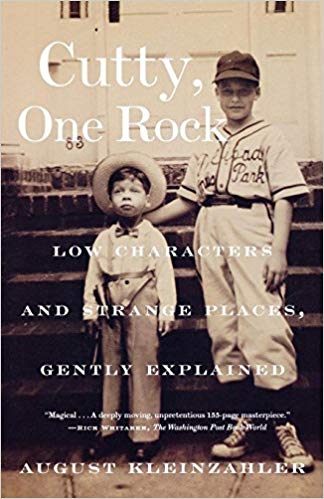
The finest thing in these pages, though, is part four. Where the first three parts contain three to four essays apiece, this is a single essay, which shares the book’s title, “Cutty, One Rock.” That’s what Kleinzahler’s older brother always ordered when he went out, which he did, just about all night and every night until he died young and tragic. I heard echoes and rhymes of Norman Maclean’s “A River Runs Through It” loud and clear throughout. This deeply loving study of a loved brother, its close attention and reluctant acknowledgement of flaws, its worship–because the narrator was the much younger brother, always looking up–is so good it hurts. That’s them on the front cover.

This book is worth reading from cover to cover, but that final section really blew me apart. Booze; sense of place; difficult families and unbeautiful homes. Also, memoirs by poets. Good stuff. Thanks, Doug.


Rating: 8 dry martinis.

PSA: pre-ordering books

Because I recently posted my review of Phil Connors’s forthcoming book, A Song for the River, I wanted to make sure you knew about pre-orders. Of course, you already knew that you could pre-order books before their publication date on Amazon and Barnes & Noble and the like (no sign of pre-order capabilities, sadly, on Alibris or Biblio or Powell’s). But you may or may not have thought about the benefits of your pre-order. For your own sake as the consumer, a pre-order is a good way to make sure you get the best price. Even better, for the author, pre-orders often help determine print runs (how many copies of a book the publisher chooses to initially print), and can cue large retailers to up their orders of a book before it’s even published. In other words, your pre-order can make a huge difference, particularly for a lesser-known or new author.

All of this is to say that if you’re interested in Philip Connors’s A Song for the River, or, say, Mesha Maren’s forthcoming Sugar Run–another one I’m excited about–you should really consider placing your order for one of these books before the publication date comes up. Final bonus: getting that book in your mailbox months after ordering it can really feel like a happy surprise!

did not finish: Three Kinds of Motion: Kerouac, Pollock, and the Making of American Highways by Riley Hanick

I’m sure this is a good book, but not for me at this time.

The idea is definitely intriguing: three creations, linked by place and certain themes. Jack Kerouac’s On the Road; Jackson Pollock’s Mural; and Eisenhower’s development of the interstate highway system. Riley Hanick is in Iowa. Just four years after Peggy Guggenheim commissioned Pollock’s mural for her Manhattan townhome (where “the narrow width of [her] hallway would have made [proper viewing of the painting] impossible”), she gave it to the University of Iowa Museum of Art. Later, Kerouac’s first draft of On the Road, on a single long scroll of paper, will be on display in the same museum. This museum will flood, and the art will itself end up on the road, in transit.

An interesting concept, to weave these three threads together, three movements. Jeremy recommended it to me in part because I was writing about Houston’s Menil Collection, and traveling home to visit it (after Hurricane Harvey, no less, with notes on what precautions the Menil took). This was a wise recommendation for obvious reasons. But as it turns out… Hanick’s style is sketched, abstract, sometimes taking the form of very short chunks, and conflating his two Jacks until I was often unsure of whom we were talking about. His pronouns run from ‘he’ to ‘they’ to ‘we’ to ‘I’ and I was frequently lost. It was nearly 100 pages in when he first quoted Gertrude Stein, and I thought, aha! that is my problem here: there is too much of the Stein here.

As I put this book down, I remain slightly interested, and in another world, one where I have lots of free reading time, I’d fantasize about picking it back up again. But in this life, when I have too much reading to do that will help me (as a student, as a writer, as a book reviewer) and that I can understand, Three Kinds of Motion is not for me.


I’m forgoing the rating this time.

Colson Whitehead at Texas State University

I feel terribly lucky to have seen Colson Whitehead speak and read from The Underground Railroad at Texas State University’s Witliff Collections last month. He was being presented with the L.D. and LaVerne Harrell Clark Fiction Prize, an annual award in its second year through the English Department there. He won for The Underground Railroad, of course, but this is his eighth book (previously six novels and two nonfiction works).

Here’s where I admit that I’ve not read The Underground Railroad, nor any of Whitehead’s work. I’m ashamed! I’ve heard a lot about it, and it sounded appealing, and it’s won (ahem) the Pulitzer and the National Book Award as well as the Clark Prize. So I knew it was worth going; but I went in a bit blind. Now, I further admit that I did not wait on the long lines to buy Whitehead’s books or get one signed. But I bought one from Alibris as soon as I got home, and I look forward to reading it. I had no idea til this reading that it had such an element of magical realism to it. How strange and exciting!

So, early observations: Colson Whitehead is very funny and personable, and humble. One hopes for this in all our heroes, but one is often disappointed. I guess, though, writers tend to do better than other kinds of heroes/celebrities. Maybe because we spend so much time alone and doubting ourselves, and we’re so overjoyed when we are recognized. To this point, Colson took a question from (I think) a student who asked if he knew what a helluva book he’d written, before all the Pulitzers and whatnot started rolling in. Colson responded that the last 30 pages of the book are the best work he’s ever done. So, in a word, he thought it was good. But as he also pointed out, you never know if anyone else will agree.

I was astonished to learn that he conceived of this plot eighteen years ago, but waited til he had the writing chops, and the personal maturity level, wisdom, etc., to write it properly. He waited for fourteen years to begin. This… blew my mind.

He read from chapter one, in which the protagonist Cora is a slave on a Georgia plantation, in her late teens. I learned that the rest of the book follows Cora and another slave named Caesar as they escape north along the Underground Railroad, which in this imagining becomes a literal railroad; and each state they pass through becomes a different “state” in American reality. (I have the impression that this means different time periods and alternate versions of culture and policy. I believe he mentioned a state of Black utopia and a state of white supremacy. But don’t trust me; I haven’t read the book.) These ideas mesmerize me. I can’t wait to read it.

When he got ready to take questions, he said he would also welcome any tips the audience had to offer. This tickled me.

I learned more interesting trivia about the book and the writing process. When asked about his choice of a female protagonist, he said his last several were male and he wanted to mix it up; but also, that female slaves faced a different set of challenges than male ones, and he wanted to dig into that. He was asked about the structural element of interwoven chapters visiting with secondary characters, which is intriguing. And he commented that those secondary characters were “auditioning” with him, the author, vying for those positions; also an intriguing concept.

I also learned that Colson Whitehead as a writer is all over the damn place. He’s written fiction about John Henry; time travel; consumer culture; race relations; and zombies. He’s written nonfiction about the history of New York City; and the World Series of Poker. He says he believes in choosing the right tool for the job, be it realism or something on the spectrum of fantasy. His next book will be either science fiction set in the world of Star Wars; or a romance set at the beginning of the Russian Revolution, for which, as research, he’s been watching a lot of The Golden Girls. He does a mean impression of both C3PO and R2D2. This man, y’all.

I’ll be driving into San Marcos for more readings at Texas State, for sure.

The Wine Lover’s Daughter by Anne Fadiman

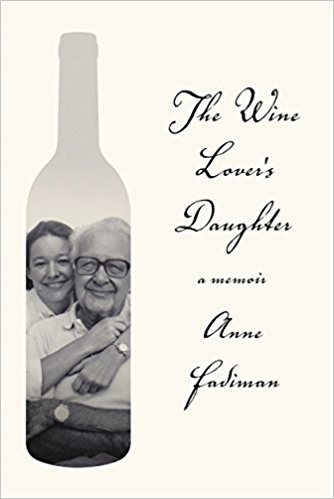
A loving daughter’s memoir of her father portrays the literary mind of Clifton Fadiman through his passionate oenophilia.

Before Anne Fadiman was known for The Spirit Catches You and You Fall Down and At Large and At Small, she was an “oakling,” withering (according to an adage she quotes) in the shadow of an oak. Her father, Clifton Fadiman, enjoyed a long, successful career as a reader, book reviewer and wordsmith. He worked for Simon & Schuster, the New Yorker and the radio quiz show Information Please, and produced numerous collections of essays, criticism and anecdotes, children’s literature, translations and anthologies. Most of all, however, he loved wine.

Fadiman’s The Wine Lover’s Daughter is a beautifully composed memoir of her father’s life, viewed through the lens of his oenophilia. She recalls discovering his essay “Brief History of a Love Affair” at age 10, and being disappointed that it did not describe love for a woman. She should not have been surprised, as even at that age she knew the names of the Premier Cru Bordeaux and which were the Great Years (capitalized as such). Clifton’s passion for wine was prodigious, and it was his daughter’s shame and consternation that her palate never came to appreciate any of its forms. This memoir is in part the story of that struggle–her repeated attempts to love wine, and all the fine bottles wasted on her. Near the end, she embarks on a study of taste buds, supertasters and the possible scientific explanation for her (as she feels it) failure to live up to a legacy.

While she does not shrink from Clifton’s flaws–a condescending attitude toward women, profound insecurity–this portrait is deeply loving. Fadiman seeks to reveal a complex and multi-talented man, and to celebrate his contributions to literature. She also seeks contact with a father she clearly misses. Upon discovering the careful handwritten record of his wine purchases: “He liked thinking about a bottle waiting for decades in a hushed, dark place until a hand reached in, and the corkscrew did its work, and the wine came to life again, a life that had deepened while it bided its time. Opening the Cellar Book was like that.” She calls it “the most serious book he ever wrote, the most heartfelt, the most honest.” Finding him again in his Cellar Book, as well as in his copious writings, brings Fadiman great pleasure, and will edify and entertain readers. Along the way, she touches upon a century of U.S. cultural history, to which her father contributed.

Fadiman’s prose is clear and precise, and while not overtly poetic, perfectly composed as to rhythm and sound. As in her past work, she writes with equal skill of her own memories, family history, science and the finer points of wine appreciation (which she knows by heart and inheritance, if not by personal experience). The Wine Lover’s Daughter is a beautiful remembrance and a loving and well-deserved tribute to a literary figure–and to the joy of imbibing.


This review originally ran in the October 26, 2017 issue of Shelf Awareness for the Book Trade. To subscribe, click here.


Rating: 8 papillae.

Bonus:

I had a moment of joyful recognition when I discovered on page 5 that Anne’s father Clifton Fadiman was the author of the children’s book Wally the Wordworm which I remember enjoying as a child.

My review of Anne Fadiman’s The Spirit Catches You and You Fall Down was one of three brief pieces I sent in to Shelf Awareness when I applied to write for them. The beloved editor who hired me there has retired, but she is still reading and reviewing, and she changed my life in wonderful ways, as did Anne Fadiman’s writings.

Circles and synchronicity, friends.


First We Read, Then We Write: Emerson on the Creative Process by Robert D. Richardson

My advisor Kim recommended this book to me as a craft book, although it is not quite a how-to, but rather a contemplation on the reading/writing life.

This short study of Emerson on the subject of writing (by an Emerson expert) is a brief, accessible view on the man. Quotable, but more than a collection of quotations. Richardson portrays a complete man, not simply a set of accomplishments. This Emerson is fascinated with writing as process and lifestyle, philosophic, and committed to exposing his own shortcomings.

I found it worthwhile, and an easy way into Emerson, who I haven’t found terribly approachable before now. I noted several quotations. The part especially intrigued me, in the final pages, where Emerson and Goethe are in some conversation about how intimidating it can be to observe the greats who have come before us… I often feel, when I discover a wonderful, new-to-me writer, both inspired by their achievement and discouraged by how high the bar has been set. And then of course the closing idea that to be a writer is to “abdicate a manifold and duplex life”! Whew.

An easy read, by turns encouraging, thought-provoking, and challenging.


Trivia of which I was unaware: Richardson is married to Annie Dillard. When I read this at the close of his ‘Acknowledgements’ (at the end of the book), I thought, ah! there’s the wisdom. (Some of you may recall that I have a complicated relationship with Annie Dillard–not all love–but enormous respect.)


Rating: 7 white whales.