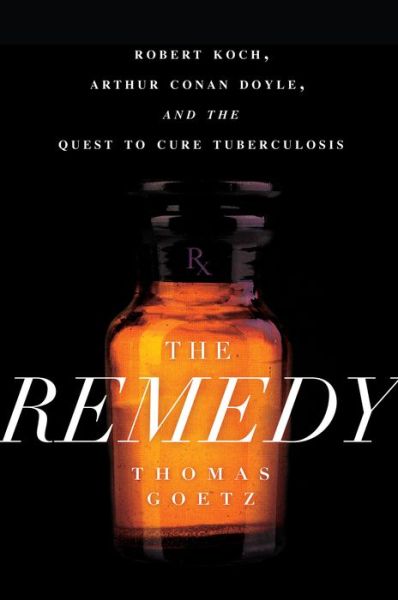
The Remedy: Robert Koch, Arthur Conan Doyle, and the Quest to Cure Tuberculosis by Thomas Goetz

The compelling connection between Sherlock Holmes and the search for a tuberculosis cure.

remedy

Thomas Goetz’s The Remedy achieves a rare feat: serious, accurate scientific writing that is also engaging and entertaining.

In the mid-1800s, the practice of medicine largely resembled groping in the dark. Patients came to doctors “with the hope of a cure but never the expectation of one.” The final decades of that century, however, were marked by extraordinary advances in science, technology and medicine: “germ theory” was developed, infectious diseases were better understood, and more-modern notions of hygiene and sanitation began to catch on. Robert Koch, a provincial German doctor, pioneered experiment design and research standards, and in 1882 he identified the bacterial cause of tuberculosis–the most deadly disease in human history.

Koch attempted to develop a cure for TB, which he presented in Berlin. Despite meticulous empirical methods he had established, Koch’s zeal for his remedy led to his downfall, as his treatment was unprovable. An obscure British doctor and sometime writer, also provincial, was the first to pen an appropriately skeptical response. Despite his criticism, Arthur Conan Doyle was a great admirer of Koch and appreciated his scrupulous observations; in fact, Goetz asserts that without Koch, “there may never have been a Sherlock Holmes as we know him.”

The intersection of Koch and Doyle brought the spirit of scientific discovery to crime detection, and the spirit of investigation to scientific research. Goetz’s exploration of their lives and their impact on the world as we know it is both historically significant and enthralling.


This review originally ran in the April 18, 2014 issue of Shelf Awareness for Readers. To subscribe, click here, and you’ll receive two issues per week of book reviews and other bookish fun!


Rating: 9 dead rabbits.

In addition to my shorter review, above, I’d like to add a few more details. A big part of what I loved about this book was the breadth of scope. For example, to provide his readers with an accurate view of what Koch, Lister, Pasteur, and other scientists of the day were up against, Goetz describes at some length the state of medicine in their time. He warns us against coming too easily to the idea of germs and microbes as self-evident; and funnily enough, I was talking with a friend about this book, and she said just that: isn’t it obvious that surgeons would wash their hands beforehand?? But as Goetz so carefully points out, no, not obvious at all; when first presented as a theory, germs were as ridiculous as the idea that the earth might be round. Etc.

Along with medical background, we learn about the common practices of farming and domestic life; we learn about the lingering national hatred that would have pitted Pasteur and Koch so strongly against one another in the aftermath of the Franco-Prussian War; and about the social constructs that led Arthur Conan Doyle to work so hard at being a doctor when he really wanted to be a celebrated author. (I was reminded of other authors I’ve read about, like Louisa May Alcott: Doyle was always frustrated by the great success of his detective stories in the face of the failure of his more literary novels, just as Alcott was annoyed by the success of Little Women–a book she didn’t like very much. And you know, Doyle killed off Holmes, only to be pressured into his resurrection.)

I suppose I’m a sucker for breadth of scope. Nonfiction that covers history, science, social issues, and literature – and does it in fine literary style, to boot – will always win my heart. Back to the theme of synchronicity that I’m written on before: the older I get and the more of this interdisciplinary study that I encounter, the more I am convinced that this is way we should study history. How many of us found history boring in high school? I did. But once you link music, literature, fashion, politics, science, military conflicts… on and on, once you link all these threads so that the world of the past comes alive – who could not be fascinated? I think we do our kids a real disservice by not embracing this kind of study in their regular schooling.

The Remedy is both a good read, and an examination of a piece of world history whose importance really can’t be overstated.

better to burn out than fade away?

As you know, I’ve recently begun reading Wallace Stegner’s Crossing to Safety. I started with the biographical note (unattributed), and the introduction, which is by Terry Tempest Williams, a friend of Stegner’s. These prepared me well: I began with just a hint of what the story was about, and felt like I got to know the author just a little. I like Williams, so that connection felt good, too. Before beginning to read the novel itself, I was reminded of Norman Maclean. The tone of voice in Williams’s short intro, and in the biographical note, is gentle and loving and matches the tone in which people write about Maclean. And it got me thinking about a very different sort of author.

Ernest Hemingway always thought of himself as a future famous writer, beginning when he was very small; his self-image was one step ahead of his actual place in the world, but he was never mistaken. He designed & intended his identity as the larger-than-life author-man archetype, and then he lived into that legend. (He convinced us to varying degrees, of course, but I don’t think we need argue that he didn’t live the story he’d written for himself.) He then died just shy of his 62nd birthday of a self-inflicted double-barreled shotgun blast to the head while his wife slept a few rooms over. His late years were tormented by mental illness, paranoia, and an increasing and overwhelming distress that he was failing to fulfill his potential. But all his life he fought his demons, and there’s plenty of evidence that suicide was on his mind many decades before he pulled the trigger.

By contrast, Norman Maclean lived to be 87 (and published 2 very important books and a number of essays). Wallace Stegner lived to be 84 (and published 28 books). In their art they both exude a sense of calm, and in late life commanded a quiet, loving respect in their peers and, in death, in their survivors that Hemingway does not. So my question is this. Would Hemingway have chosen for himself a long life, a quiet, respected, accomplished old age, surrounded by contentment? Or would he have joined Kurt Cobain in quoting the Neil Young lyric, that it’s “better to burn out than fade away”?

book beginnings on Friday: The Remedy: Robert Koch, Arthur Conan Doyle, and the Quest to Cure Tuberculosis by Thomas Goetz

Thanks to Rose City Reader for hosting this meme. To participate, share the first line or two of the book you are currently reading and, if you feel so moved, let us know what your first impressions were based on that first line.

remedy

I have an awesome new book to tease you with today. I hope the title alone begins to interest; it did me. The first paragraph sets the stage:

In train after train, consumptives filled the passenger cars, their hacks and coughs competing with steam whistles and screaming brakes as the engines came to a halt in Potsdamer Platz. They came to Berlin without any sense of where to go or what to do once they arrived. And they kept coming, for days, weeks, and months. It must have struck Berliners as a sort of zombie pilgrimage: here were the walking dead of Europe, all suddenly flocking to their city in search of something – some fantastic substance that did not yet officially exist.

Not out til early April, so stay tuned for my review til then. But for now: I am quite impressed with the writing (my favorite: accessible, engaging, nonfiction science), and the fascinating story of the race towards a cure for tuberculosis, including Arthur Conan Doyle’s rather surprising role in it.

This quotation comes from an uncorrected advance proof and is subject to change.

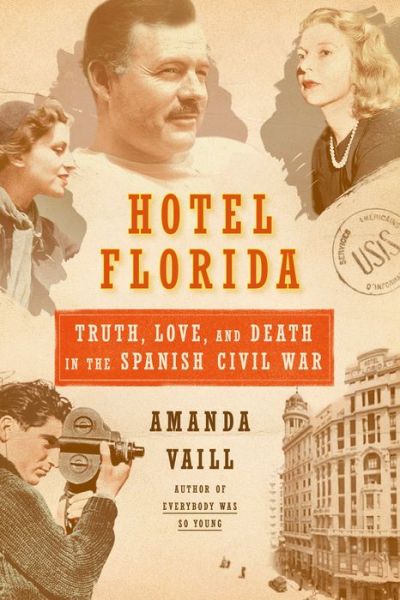
book beginnings on Friday: Hotel Florida: Truth, Love, and Death in the Spanish Civil War by Amanda Vaill

Thanks to Rose City Reader for hosting this meme. To participate, share the first line or two of the book you are currently reading and, if you feel so moved, let us know what your first impressions were based on that first line.

I am quite pleased with Hotel Florida, about the Spanish Civil War and concentrating on six individuals – three couples – who experienced it. I’m offering a little more book beginning than usual today, because I think this way gives a good feeling of Amanda Vaill’s work; so bear with me.

hotel florida

Three book beginnings…

Author’s Note:

“It is very dangerous to write the truth in war,” said Ernest Hemingway, “and the truth is very dangerous to come by.”

Prologue:

On July 18, 1936, at Gando in the Canary Islands, a short, balding, barrel-chested man in a gray suit, carrying a Spanish diplomatic passport in the name of José Antonio de Sagroniz, boarded a private seven-seater de Havilland Dragon Rapide aircraft that had arrived at Gando three days previously and had been waiting on the tarmac for him ever since.

And chapter 1:

Arturo Barea lay on the brown, pine-needled floor of a forest in the Sierra de Guadarrama, northwest of Madrid, with his head in his mistress’s lap. It was mid-afternoon on Sunday, July 19, and the resinous air was loud with the sound of cicadas.

The effect I noticed immediately here, is the connection between the Hemingway quotation and the Hemingwayesque first line of the first chapter. For one thing, note all the sensory detail in that second sentence. This is instantly recognizable to me as Hemingway’s style. And most pointedly, recall the opening line of Hemingway’s novel about the Spanish Civil War, For Whom the Bell Tolls:

He lay flat on the brown, pine-needled floor of the forest, his chin on his folded arms, and high overhead the wind blew in the tops of the pine trees.

I surely don’t need to tell you that this parallel was established on purpose. For that matter, Vaill ends her book with the opening line as (she tells us) Hemingway wrote it in his first draft:

We lay on the brown, pine-needled floor of the forest…

I like her use of structure here, the bookending of her book using Hemingway’s own words. I find that this really pulls it together.

Rather more book beginning than usual, I confess. Thanks for your patience. And let me say that Hotel Florida is about much more than Hemingway; but he is the most widely known of her six individuals, and arguable the biggest and most colorful personality, so I think the occasional emphasis can be excused. That said, I really enjoyed learning so much about her other characters. They include Martha Gellhorn, journalist and Hemingway’s partner (mistress during the war, wife after); photographers Robert Capa and Gerda Taro; and press officers Arturo Barea and Ilsa Kulcsar. As usual, you’ll have to stay tuned for my book review, but for now: I recommend.

This quotation comes from an uncorrected advance proof and is subject to change.

hemingWay of the Day: How To Tell If You’re In A Hemingway Novel

This is totally silly, and doesn’t make Hemingway sound terribly smart, or interesting; but there’s room for that in this world, too. The man was sometimes a caricature. In fact, I’ve been doing some musing lately as I read Hotel Florida: Truth, Love, and Death in the Spanish Civil War, by Amanda Vaill. It’s a lovely book, that examines the experience of six individuals (three couples) in the Spanish Civil War; Hemingway and Gellhorn are two of the six. I have some thoughts to share, but will save those for that book review. (Hint: good book.)

Today for giggles and deprecations: How To Tell If You’re In A Hemingway Novel. Enjoy.

Valentine’s Day in book history

As I’ve done before, I figured I’d note today’s (consumerist, contrived) holiday with some book history, courtesy of A Reader’s Book of Days.reader's book of days

Born today:

Frank Harris (My Live and Loves), Galway, Ireland, 1856. I do not know this man. But I have been to Galway.

Carl Bernstein (All the President’s Men), Washington, D.C., 1944. I know of this one, of course, though I haven’t read the book. Interesting to know he was (is?) a D.C. native.

Died today:

1975: P.G. Wodehouse (The Code of the Woosters and lots of wonderful others, of course), Southampton, NY, at age 93. More’s the pity; would that he had lived to write more and more of those funny books.

2010: Dick Francis (Dead Cert, all those horse racing mysteries), Grand Cayman Island, at age 89. I’ve read none of his books, but I know his fans; I was working in a library where his books were popular at the time of his death, and I remember.

Additionally, I find it amusing that Nabokov features again on Valentine’s Day, since he came up on New Year’s as well!

In 1932, Vladimir Nabokov, in goal as always, played his first match with a new Russian émigré soccer team in Berlin. A few weeks later, after he was knocked unconscious by a team of factory workers, his wife, Vera, put an end to his soccer career.

[Oops.] I am a soccer fan and former player – and Nabokov fan, naturally – so I enjoy this factoid.

And,

1935: Samuel Beckett wrote to Tom McGreevy on Jane Austen, “Now I am reading the divine Jane. I think she has much to teach me.”

Well done, Beckett!

And finally, today in Julia’s personal history: we are typically in the desert wonderland of Big Bend National & State Parks & surrounding locales on this day, and this year follows that pattern. Husband and I are playing on our mountain bikes today, but I’ll check in on you upon my return.

I’m glad I picked today for a historical review in miniature; I learned some things. You?

on author access

I have done some author interviews, as you may have noticed. I did a handful for a podcast, which was an interesting opportunity that I enjoyed but which came to be a little more work, and stress, than I was looking for in an unpaid gig – although many thanks again to Chris at Critical Wit for the chance, which was great while it lasted! And I do the occasional interview for the Maximum Shelf special editions of Shelf Awareness. For the former, I got to choose my own subjects; for the latter, they are assigned to me. When I go to choose interview subjects, I am looking firstly for authors whose books appeal to me (obviously), and nextly for authors that look like they would talk to me – that look like I could get access to them. Reasonably enough, debut authors who aren’t getting ALL the attention in the world are more likely to take the time to talk to little old me than are the Micheal Connellys of the business. (Not to pick on Connelly and for the record, I never asked him for an interview.) A good measure of this is, when I look at their website, does the “contact me” link take me to the author’s email address? or does it say something like “for speaking opportunities, contact the publicist at xxx and for interview requests, contact the whomever at xxx”? The first instance makes for a far better chance of somebody small-time, like myself, getting access.

But when I’m assigned an author interview at Shelf Awareness, I’m guaranteed access, even to the big authors, because the author (or his/her team) has agreed to the special issue in advance. It does promote the upcoming book, you know. So I get the assignment and I get connected with the author or some representative of the author – a publicist, an agent, or somebody with the publishing company. And when we’re both ready, I get set up with the author him/herself. This is easier for me because I don’t have to go seeking access; and it’s presumably easier for the author, for whom usually an appointment is set up and he/she just has to be available by phone or email at the agreed upon time.

So it was surprising when I had a different experience, some time ago. (I am posting this experience well removed, timing-wise, from the incident in question, to preserve this author’s anonymity. And I am calling this author Jane, and making her a woman because I’ve interviewed more women than men and that seems to help preserve anonymity, as well.) I got the book; I read the book; I wrote my review and my interview questions; and I was in touch with Jane’s representative (listed as a “cataloging coordinator” at the publishing company), who asked for an estimated time frame for when I’d be ready for the interview. I gave this estimate, and right about on time, emailed the representative again that I was ready to set up an appointment. As always, I offered the option to do the interview by phone (to be recorded and then transcribed), or by email (no transcription necessary, and more convenient for all parties, but less likely to get off-the-cuff, conversational answers). And that’s when things went south. This author’s representative said, ok, great! so this is what we’ll do: I’ll send you a list of questions you can ask Jane, and you can pick from that list. Um, no. That’s actually not an interview at all; that’s a press release. It’s not like I was going to ask hard or antagonistic questions – c’mon. I passed this issue along to my “boss” for this project, who agreed with my rejection of this option, and followed up with the publisher herself.

This begun a process. My boss and myself eventually communicated with no fewer than 4 people at the publisher: a Cataloging Coordinator, a Director of Advertising and Promotion, an Associate Director of Publicity, and a Publicity Assistant. The cataloging coordinator also referenced the opinions of an editor and a marketing director who apparently weighed in as well. There was a great deal of concern that author Jane (a fairly well established one, with several bestsellers to her name) just couldn’t possibly talk with me, or couldn’t possibly be asked questions that did not come from an approved list. (They did ask for my questions in advance, and I willingly provided them.)

After dealing with these 4-6 folks over a period of weeks, we did finally end up scheduling an interview with the hallowed Jane – a full 7 weeks after my original interview request, which had been preceded by a 2-week notice of my upcoming need for the interview, which was preceded by the original agreement between publisher and my boss. By this time, boss and myself were thoroughly aggravated with the process and all the players involved, including poor Jane, who we realized may very well have no knowledge of any of these goings-on. In fact, as it turns out in the end, she is very active and friendly via social media, and was so friendly and easy-going in the eventual interview that I’m 100% certain that she was innocent in these proceedings.

I had read nearly a dozen books since I’d read Jane’s, which was less than ideal for the interview, with my memory fading somewhat. And I worried that I would have trouble being friendly with her after all the trouble her people had given me – although that turned out to be easier than expected, because she was a peach. Things came out okay in the end; but just barely, and at a certain cost in terms of hairs pulled out by my boss and myself in the two months (plus) that the entire process took. And poor Jane to this day doesn’t know this story, I feel sure; if she reads this blog post (unlikely) I don’t know that she’ll recognize herself.

Should I have told her? I certainly feel that she’s being poorly served by a team that blackened her name with such unprofessional communications with an organization in her industry who was essentially on her side – trying to help her sell her book. I’m assuming they have some sort of mandate to not harass this well-established author – to not give out her home number to anybody who wants it, for example (obviously). But they handled my boss and myself badly.

I didn’t tell Jane this story, because she was just trying to get through this interview and get back to whatever she had going on on the afternoon in question. No hard feelings towards her in the end. But I wanted to share with you the interesting range of experiences I’ve had in interviewing authors… I’ve never encountered one who was less than friendly, professional, and gracious. But this publicity team seemed determined to shoot itself in the foot. How outrageous do you find these events? And for other book bloggers out there – what are your experiences trying to get access to authors? When I was pursuing my own interviews (cold calling), I never even bothered with anyone who looked unattainable. Maybe I’m a coward, but I didn’t want to have to beg, or bother anyone who didn’t want to deal with me. If it’s this hard when agreed to in advance…

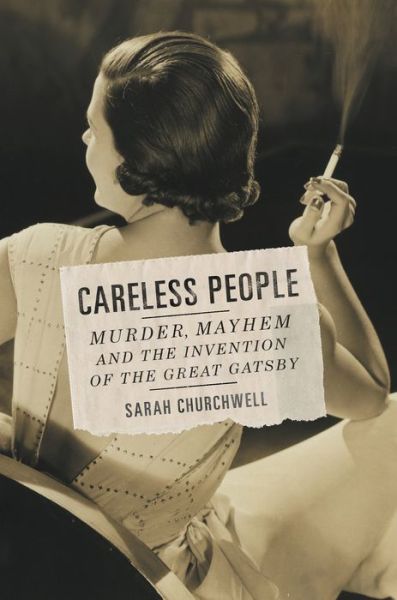
Careless People: Murder, Mayhem and the Invention of The Great Gatsby by Sarah Churchwell

New research and new angles on The Great Gatsby and its place in history.

carelesspeople

Sarah Churchwell (The Many Lives of Marilyn Monroe) takes on F. Scott Fitzgerald’s mythically proportioned masterpiece in Careless People, an expansive study of biography, history, literary criticism and cultural connections. Her inquiries focus on a double-murder involving a socially ambitious lower-class woman and a respected rector, both married but not to each other, found shot to death in each other’s arms. The case captured national attention in 1922, the year Scott and Zelda returned to New York–and the year in which The Great Gatsby is set.

With an appealing, freshly curious manner, original research and newly discovered resources, Churchwell explores the possible connections between Fitzgerald’s experiences in 1922 and what happened at the same time in his most highly regarded novel. She also compares the plot of The Great Gatsby to the real-world action of 1922. In the book, which alternates between the Fitzgeralds’ lives during the period The Great Gatsby came to life with the unfolding of media coverage of the murder case, Churchwell incorporates Fitzgerald’s correspondence, including delightful poems exchanged with Ring Lardner, and lists of slang (including some 70 ways to say “drunk”).

With elements of fun and tragedy–like the lives of its subjects–Churchwell’s study of the Fitzgeralds, The Great Gatsby and the world that birthed it presents new perspectives on a literary icon.


This review originally ran in the January 28, 2014 issue of Shelf Awareness for Readers. To subscribe, click here, and you’ll receive two issues per week of book reviews and other bookish fun!


Rating: 8 unattributed clippings.

Maximum Shelf author interview: Laura McHugh

Following yesterday’s review of The Weight of Blood, here’s Laura McHugh.


Laura McHugh: On Dark and Light.

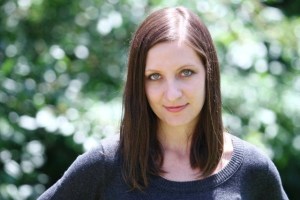
Laura McHugh grew up in small towns in Iowa and the Ozark mountains of southern Missouri. She now lives in Columbia, Missouri, with her husband, two young daughters and one enormous dog. Her background includes computer science, software development and library science; The Weight of Blood is her first novel.
mchugh

Lucy’s voice is convincingly young adult. Did you find it difficult to write in her voice? What kind of preparation did you do?

That made me laugh, because I sometimes forget how far removed I am from being a young person. Lucy is the youngest of the narrators, but her voice came to me first. I didn’t do any formal preparation, though I think a few things in my everyday life gave me a foundation to work from. I kept a journal throughout my teens, and I still remember how I felt and acted at that age. I tried to channel my 17-year-old self to an extent, though only a few bits and pieces of me ended up in Lucy’s character. Some of my favorite books are adult novels with young adult narrators, and I kept those in mind as I was writing Lucy’s sections. And I’m not sure whether this really helped or not, but as the youngest of eight kids, I spent years observing (spying on) my teenage brothers and sisters.

Did the evil side of this novel get to you at all while you were writing? Give you nightmares?

I didn’t have nightmares, but I did spend an unhealthy amount of time worrying about the dangers that await my daughters out in the world. My oldest is in elementary school, and I won’t let her walk home from the bus stop by herself, because I keep a mental list of children who were kidnapped on the way to or from school. I always imagine the darkest possibilities in any situation, which isn’t good for my anxiety level, but serves me well as a writer.

Is this dark story based on truth?

Part of it, yes. I started the novel knowing that Lucy’s friend Cheri was dead, but I wasn’t sure what had happened to her. Then I came across a news article about a shocking crime involving a young woman in Lebanon, Missouri–the small town where I’d attended high school–and I knew that Cheri would suffer a similar experience.

Living in rural communities, it often seems like everyone knows everyone else’s business, and that it would be impossible to keep secrets, but then you see a horrific case like this one–multiple people involved, over several years, and no one said a word. I don’t want to give too much away, though I can tell you that the real-life victim survived her ordeal, unlike Cheri.

What about the Ozarks drew you to place your characters there?

The forbidding landscape and the remoteness of the Ozarks create a sense of foreboding that helps set the tone of the novel. And I’ve always been fascinated by the culture, which is steeped in folk wisdom, home remedies, and superstition. We were outsiders in our tiny town, yet at the same time, it became my home. Years after moving away, I was still haunted by the place, and the novel allowed me to explore the darker side of those tight-knit rural communities where outsiders aren’t welcome.

How did you decide to use a split narrative?

Lucy doesn’t know what happened to her mother, Lila, but I wanted the reader to know. And I didn’t want Lila’s story to be backstory, I wanted it to be as real and present as Lucy’s. The split narrative allowed me to do that, though I often cursed myself for that decision during revisions–I kept thinking how much easier it would have been to write a novel with one timeline and one narrator! In the end, weaving the two narratives together was the most satisfying part of the writing process.

And the secondary characters get perspectives as well, although not in first person. How did that strategy come to you? Was it especially challenging?

I hadn’t initially planned for more than two narrators, but as I worked on the first draft, the other characters kept telling their own versions of events. Each secondary character has secrets–pieces of the puzzle that are hidden from everyone else–and their perspectives were necessary to make the story whole. I wrote the secondary characters’ sections as they came to me, some in first person and some in third, and eventually changed them all to third for consistency. I wanted Lucy and Lila to stand out as the main characters, so I kept them in first person.

The hardest part was integrating the different perspectives and timelines. I clipped an index card to each chapter, with notes on the narrator, timeline, and key events. Then I spread them all out on the floor and moved them around, trying to get the order right and identify any gaps in the story. I was very methodical and possibly a bit crazed. The process took days, during which I fed my children a lot of chicken nuggets and let them watch too much TV. Everyone, including the dog, was relieved when I finished that part and let them back in the living room.

What do you have in mind next? Is there room for a sequel here?

Spiegel & Grau has purchased my second novel, Arrowood, which I’m working on now. A young woman returns to her childhood home in a decaying Iowa river town, where she witnessed the kidnapping of her sisters years ago. A terrible discovery forces her to question everything about her past, including her own memory.

I would love to write more books set in the Ozarks, though I’m not sure if Lucy will make an appearance. I was pretty hard on her in The Weight of Blood, and I think she deserves to rest for a while.


This interview originally ran on January 15, 2014 as a Shelf Awareness special issue. To subscribe, click here, and you’ll receive two issues per week of book reviews and other bookish fun!

New Year’s Day in book history

A review of the *book in question is yet to come, but for a quick teaser today…

Born today: in 1879; E.M. Forster, and in 1919, J.D. Salinger. A big birthday for people who go by two leading initials and are well known for their classic works!! And died today: in 2002, Julia Phillips (You’ll Never Eat Lunch in This Town Again) and in 2007, Tillie Olsen (Tell Me a Riddle, Silences).

Of the other literary notes assigned to January 1st I am choosing my favorite to share with you:

1947: In a Guide to Your Child’s Development she has purchased for the purpose, Charlotte Haze notes on the twelfth birthday of her daughter, Dolores, that the girl is fifty-seven inches tall and possesses an IQ of 121. She also completes an inventory of the child’s qualities: “aggressive, boisterous, critical, distrustful, impatient, irritable, inquisitive, listless, negativistic (underlined twice) and obstinate.”

(Negativistic, indeed!)

…For Charlotte’s new husband, Humbert Humbert, this list of epithets is “maddening” in its viciousness toward the girl he calls Lolita and claims to love. But he has his own reasons to revolt at the child’s birthdays: after just a few more of them she’ll no longer be a “nymphet,” and soon after that she’ll be – “horror of horrors” – “a ‘college girl.'”

What fun!

reader's book of days*The book in question is A Reader’s Book of Days: True Tales from the Lives and Works of Writers for Every Day of the Year, by Tom Nissley, and was a gift from my parents on my most recent visit to see them in the chilly north. I have only flipped through it so far (which is what it’s designed for, obviously), but I will be giving it a closer inspection and writing up a proper review for you at some point this year.

The other thing I will be doing with it is keeping it handy for those few days when I’m scrambling for a blog post! (rubs hands together) Thanks, Mom and Pops, for helping out!