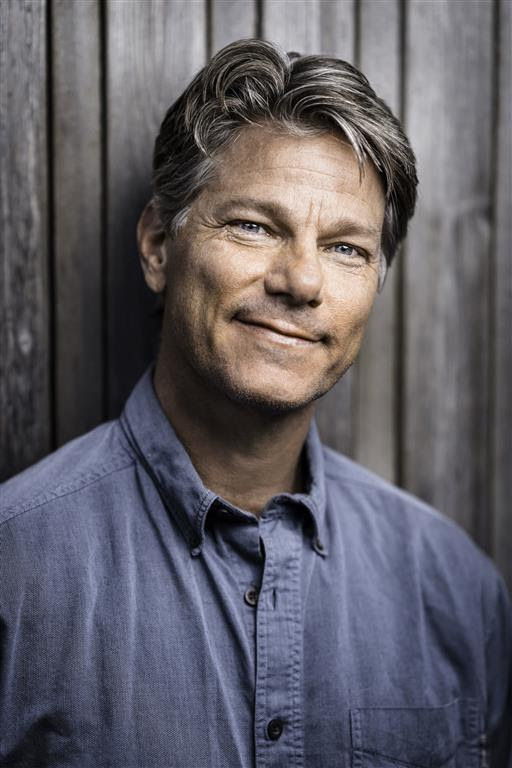
Maximum Shelf author interview: John Vaillant

Following yesterday’s review of The Jaguar’s Children, here’s John Viallant: Looking at the World Differently.


John Vaillant’s work has appeared in the New Yorker, the Atlantic, National Geographic and Outside, among other magazines. His two previous nonfiction books, The Tiger and The Golden Spruce, were award-winners and international bestsellers. Vaillant was born in Massachusetts and lives in Vancouver, B.C. The Jaguar’s Children is his first novel.

vaillantIs Hector’s story based on a specific true account? Where did you get the idea?

The idea came from a conglomeration of different border-crossing incidents. There was one particularly awful case in which a boxcar load of immigrants attached to a train was taken across the border and never opened. It wasn’t found for weeks, until it got to Iowa. Just a hideous, nightmarish situation. I started wondering, what happens in there? What would you go through? And then my family and I lived in Oaxaca for a year, 2009-2010. In Oaxaca, water trucks are a common sight. On one side, they read, “Agua por Uso Humano,” “water for human use,” and I kept thinking about that, and I kept thinking about thirst, and the anagram of agua and jaguar. It just fell into place. All these disconnected observations and ideas gradually coalesced. There was a moment when this fellow, the narrator, just announced himself to me, in January 2010.

This is your first published fiction. What led you here from your past work in nonfiction?

Trying to find a container that was suitable for the story I wanted to tell. Needless to say, Oaxaca is a really interesting place–Mexico is full of stories. There was a nonfiction story that was jaguar-related, that I was pursuing and actively researching down there, and for a couple of reasons it didn’t fully coalesce. A lot of what I was experiencing were more like travel anecdotes, but I didn’t want to write a travel book. It felt too trivial. So then I asked, how do I take all of these things I’m seeing and hearing and feeling, and put them all together in a place where they will make sense and hang together, and create a synergetic narrative and a picture of what is going on down there right now? And the novel was the right form.

This is also somewhat a departure from writing you’ve done about the relationship between people and the natural environment.

I’m really interested in hearing voices that I, or we, don’t usually get to hear, so that’s in a sense what the books are about: creating a platform for these people or beings who are generally invisible, to get some air time. You know, it’s not a selfless, altruistic mission on my part–I’m really curious and I want to see what that world is like, I want to understand it better and re-create it in a way that feels authentic. Ideally people who live that life, whether they’re tigers or conservationists, or biologists or foresters or Mexicans in Oaxaca, will feel that their realities were accurately reflected. So the whole natural world connection is almost incidental, honestly. For me, those margins where human beings and the natural world collide, that’s where the most dynamic tension is. It’s a kind of a front line, and also a fault line. Whether it’s human beings and corn, or human beings and thirst, or human beings and tigers, or the forest, there is a common thread. But it’s certainly not intentional; it’s just where my natural interest seems to go.

Did you go to Oaxaca with any work in mind, a book or a story?

I was deep in The Tiger then. I was in the middle of edits and to be perfectly honest, all I wanted to do was finish that book, lie in a hammock and read books that didn’t have tigers in them. Or any other big cats. That really was the plan.

And here we are.

Here we are. That’s the beauty of the muse, really. All the books I’ve done have really come unannounced. It wasn’t a premeditated objective to write any of those stories, they’ve all come to me and I see them as gifts of sorts. Really time-consuming ones. This again came right when I was just about wrapping up The Tiger and ready to read Under the Volcano or some other books about Mexico. And instead, Hector showed up.

Hector’s perspective is of a Mexican indio from Oaxaca, and his voice is convincing.

I do have a strange, kind of inside track to Mexico. For three generations my father’s family lived there, and I grew up steeped in Mexican lore as it was refracted through their experience. My grandfather was a well-known archaeologist who wrote the first comprehensive history of the Aztec nation, a book called Aztecs of Mexico. My grandmother told us many stories about him. Her house, all her kids’ houses, including my father’s, were filled with things from Mexico, some of them very very old, none of them more modern than 1930 because that’s when they came back. So Mexican art and artifacts were featured in my upbringing, as were stories of my grandfather.

In what ways was your year in Oaxaca helpful?

My wife is a potter and an anthropologist, and she wanted to spend time with traditional Mexican potters. I would follow her around in her trips to these villages, quite remote and very very traditional, so we’d meet people who didn’t speak any Spanish at all. People who have never really succumbed to the dominant culture. They were nominally Christian, but observing and worshiping traditional deities and certainly pursuing traditional practices, whether it was ceramics or agriculture. So it was really like going into another world. I had a notebook and a camera and my innate curiosity. The fact that I had a deep Mexican connection in the family gave me more of a motive to try to understand it. What was it that kept three generations of my family down there when they were all Americans? And perfectly well-connected Americans; they could have had fine lives up here, but for some reason Mexico was the place that offered them something different, something more.

But ultimately this is a story about a Zapotec guy from southern Mexico. Think about the U.S./Mexican border: it’s the most active border on the planet, the site of the largest human migration on earth, and Oaxaqueños play a huge role in that. One in three people from that state go to the States at some point to work, most of them illegally. And all kinds of things happen to them. As I came to understand that, it just started to feel more and more important.

And there was another inspiration. Just as I vowed not to read any more books about tigers, my father-in-law gave me The White Tiger by Aravind Adiga, which won the Booker Prize in 2008. It’s a wonderful novel about a low-caste, indigenous guy from northern India, who notices that there’s something big going on in Bangalore and Delhi. Big money is being made. He’s very smart, but he just doesn’t understand the system well enough to know even how the money’s being made. And that’s how a lot of indigenous Oaxaqueños approach the U.S.–they may have family up there, they may not, but they do not understand the culture terribly well–or often the hazards of the journey, which are many, and can be absolutely lethal. So you have these people who are capable in their sphere but naïve about the wider world, making the journey north, and a lot of them come to grief on the border.

Was this book as difficult or traumatic to write as it may be to read?

I wondered a lot about why I would want to return to this place over and over again, and go back into that truck. It’s a hideous, deadly place. But I thought, nobody else is probably going to do this. And this is something that happens to people, that shouldn’t be happening. And Hector was a very compelling person. But as far as difficulty goes–it was extremely difficult. The novel is a different animal, so to speak, than nonfiction, and certain narrative tools do translate, but being in that voice and pacing it and dealing with the other voices… really was new to me. You’re not really the same after doing something like that. I look at the world differently and feel it differently as a result of spending so much time there.

So the challenge of immersing yourself in the painful subject matter was ultimately rewarding, which I think is the case for readers as well. This is about more than just a nightmarish border-crossing incident.

So much of the book isn’t about that. It’s really about being a young person in a very troubled–some could argue broken–society and first trying to find his place in it, and then ultimately having circumstances align in such a way that he has to leave. The time you spend in the truck is desperate and terrible, but also you get to see how strong Hector is, and what he’s made of. He’s extraordinary in some ways, but he’s not superhuman. It’s amazing what people survive. It’s amazing the kind of clarity and wisdom those kinds of stressors can evoke and inspire. I think it’s a crucible for him, and for his character. I think all of us undergo tests, some of them truly terrible–it’s part of the human experience. Hector is a guy trying to figure it out. Trying to survive at the immediate level, but also at the cultural and occupational levels. The world is changing really fast around us. There are pressures being brought to bear that I have no control over, so what do I have control over? How should I respond to the people around me, to those who are trying to help me and those who are trying to impede me or hurt me? In that sense it feels like a kind of fundamental story.


This interview originally ran on November 5, 2014 as a Shelf Awareness special issue. To subscribe, click here, and you’ll receive two issues per week of book reviews and other bookish fun!

book beginnings on Friday: When Books Went to War by Molly Guptill Manning

Thanks to Rose City Reader for hosting this meme. To participate, share the first line or two of the book you are currently reading and, if you feel so moved, let us know what your first impressions were based on that first line.

books went

You can easily understand, of course, what attracts me about this book: history, even books in history, making a difference in the unlikeliest of places. I was very excited to receive this in the mail. It begins:

“Were you ever so upset emotionally that you had to tell someone about it, to sit down and write it out?” a Marine asked in a letter to the author Betty Smith. “That is how I feel now,” he confided.

And so it continues: confiding in nature, filled with primary sources, on the impact of books in war. Stick around!

This quotation comes from an uncorrected advance proof and is subject to change.

Halloween, or Dia de los Muertos, in book history

This post is part of a series.

To celebrate Halloween (today), or Dia de los Muertos (this weekend), let’s take a look at today’s date in authorly history.

reader's book of daysAccording to A Reader’s Book of Days, on October 31, 1795, John Keats was born, and in 2008, Studs Terkel died. I have not read much Keats, but I think I like him. I am very grateful to have a copy of Terkel’s The Great War on my to-be-read Britannica bookshelves, a gift from my buddy Gerber that I look forward to reading…someday.

In 1967, Richard Brautigan’s Trout Fishing in America was published. I am not sure why this resonates with me. Perhaps Maclean references him?

And in 1615:

Miguel de Cervantes hinted at the end of the first book of Don Quixote that further adventures might be forthcoming, but before he could complete his own sequel, a rival appeared that credited another author, Alonso Fernandez de Avellaneda, on the title page and insulted Cervantes as old, friendless, and boring. Cervantes, meanwhile, took advantage of being second by adding a scene in which Don Quixote and Sancho Panza themselves mock the false sequel. In the second book’s dedication, written on this day, he mentioned “the loathing and disgust caused by another Don Quixote,” and in the book’s preface he completed his revenge: humbly declining to abuse his usurper, he instead told a tale of a madman who, after inflating a dog from behind through a hollow reed, asks, “Do your worships think, now, that it is an easy thing to blow up a dog?” “Does your worship think now,” added Cervantes, “that it is an easy thing to write a book?”

And that is a sufficiently odd anecdote, I think, to recommend its being shared here.

You may recall that I read book one of Don Quixote several years ago, and solemnly promised to get around to book two someday. I have not. And I hear book two is better, too. Sigh. So many books…

Happy weekend, friends.

Teaser Tuesdays: The World of Raymond Chandler: In His Own Words, edited by Barry Day

Teaser Tuesdays is a weekly bookish meme, hosted by MizB of Should Be Reading.

chandler

Yes, it’s true, I just recently did a book beginning; but Chandler is just so quotable (thus this whole book, of course). I couldn’t let this one pass us by.

I write when I can and I don’t write when I can’t, always in the morning or the early part of the day. You get very gaudy ideas at night but they don’t stand up.

That first sentence is unclear: which condition happens always in the morning or the early part of the day? the can, or the can’t? I choose to believe that it is the can; many respected writers (ahem Hemingway) do or did their best work in the mornings. I am certainly a morning person myself. And I like this idea that our nighttime ideas are “gaudy”; I think that’s perfect. I get ideas at night, but they never stand up to sunlit scrutiny. What about you?

This quotation comes from an uncorrected advance proof and is subject to change.

The Lodger by Louisa Treger

In a lively debut novel, H.G. Wells takes a back seat to his lover, the rebellious Dorothy Richardson, a literary figure deserving of the spotlight.

lodger
Louisa Treger’s debut novel, The Lodger, opens in 1906. Family tragedy has landed Dorothy Richardson in a boarding house in a less-than-savory part of London, working at a dentist’s office for a pittance and living hand-to-mouth. She is relieved when Jane, an old friend, extends an invitation to visit her country estate for a weekend of relaxation. Jane has recently married an up-and-coming writer, H.G. Wells. Bertie, as he is called, turns out to be a strong personality: “He was like a volcano, continually bubbling over with urgent thoughts and incandescent ideas.” Dorothy is not sure at first whether she is attracted or repelled; his lively eyes and magnetic intensity are marred by zealous and sometimes off-putting opinions. The comfort of an intellectual who listens seriously to her ideas, however, proves irresistible, and between arguing about science and admiring Bertie’s writing, Dorothy finds herself helplessly falling for the husband of her best and oldest friend.

Bertie assures Dorothy that he and Jane have an agreement that allows for extramarital relationships, although this arrangement is as emotionally complex and problematic as it sounds. Having fallen headlong into an affair, Dorothy is then torn between her hard-won independence, which she feels is worth even the high price of poverty, and her love for a man who needs more of her than she can give. When a strikingly beautiful suffragette named Veronica Leslie-Jones moves into Dorothy’s boarding house in London and becomes a singular new friend, Dorothy’s energies and loyalties are still more divided. Writing becomes the outlet for her pain; Bertie has long encouraged her to make such an effort but, fittingly, Dorothy discovers this outlet, and her talent, on her own terms and schedule.

The Lodger is based on the real life of Dorothy Richardson, a groundbreaking but little-known author of the early 20th century. Treger’s taut evocation of Dorothy’s life and emotional struggles is gripping from the very first page, and readers are thrust into Bertie’s overwhelming presence just as helplessly and thoroughly as Dorothy is. While an unflattering light is shed on her famous lover–H.G. Wells comes off as obnoxiously self-centered–Dorothy herself is undoubtedly the star. She is a sensitive, passionate woman wrestling with the conventions of her time, and even while she experiences several traumas, Dorothy is a source of inspiration–for Treger, for those around her and for the contemporary reader as well.


This review originally ran in the October 2, 2014 issue of Shelf Awareness for the Book Trade. To subscribe, click here, and you’ll receive two issues per week of book reviews and other bookish fun!


Rating: 7 hot London attics.

book beginnings on Friday: The World of Raymond Chandler: In His Own Words, edited by Barry Day

Thanks to Rose City Reader for hosting this meme. To participate, share the first line or two of the book you are currently reading and, if you feel so moved, let us know what your first impressions were based on that first line.

chandler

I love the Chandler quotation that opens the lovely introduction to this collection of his writings in little snippets. I had to share.

I’m just a fellow who jacked up a few pulp novelettes into book form… All I’m looking for is an excuse for certain experiments in dramatic dialogue. To justify them I have to have plot and situation; but fundamentally I care almost nothing about either. All I really care about is what Errol Flynn calls “the music,” the lines he has to speak.

I think that is a fine way to note what sets Chandler aside, which is in many ways the quintessential gruff wit of hard-boiled, pulpy dialog. (Or dialogue.) I love it.

This quotation comes from an uncorrected advance proof and is subject to change.

book beginnings on Friday: The Lodger by Louisa Treger

Thanks to Rose City Reader for hosting this meme. To participate, share the first line or two of the book you are currently reading and, if you feel so moved, let us know what your first impressions were based on that first line.

lodger

The Lodger is a novel about a woman – a true historical figure – who went again the conventions of her time, and about a famous author as well. Those are several elements likely to attract me; and then the cover features a woman in full gown and bonnet with a bicycle? Sold. And check out this opening paragraph:

Dorothy stepped off the train. She could feel the clammy sinking sensation beginning to creep round her, as though she was a ghost drifting through the world of the living. Taking a deep breath to anchor herself, she looked around. It was a small clean station, brightened by hanging baskets of ruffled mauve and white Sweet Peas, the sharp green of their leaves almost translucent in the May sunlight. She told herself there was nothing sinister; no one was going to find her guilty. It was just a visit to an old school friend, recently married.

I find this a fine beginning, designed to hook the reader in. The juxtaposition of clean, bright, ruffled, leafy, and sunny with sinister – and the idea that someone would find Dorothy guilty?? What on earth? Tell me more!

Stick around!

This quotation comes from an uncorrected advance proof and is subject to change.

Maximum Shelf author interview: Yannick Grannec

Following yesterday’s review of The Goddess of Small Victories, here’s Yannick Grannec: On Mathematics and Metaphor.


Yannick Grannec is a graphic designer, freelance art director, professor of fine arts and enthusiast of mathematics. The Goddess of Small Victories is her first novel. She lives in Saint-Paul de Vence, in France.

(Interview translation courtesy of Other Press.).

yannickWhy Kurt Gödel? Why did you feel the need to tell his story, or more accurately, Adele’s?

When I was 18, I read Gödel, Escher, Bach and became fascinated by the work of Kurt Gödel. Twenty years later, I read, by chance, an essay about the friendship between Gödel and Einstein and, as the subject interested me, read other essays. In one of them, I came across a few lines about Adele that struck me as condescending. This question was implied: How could such a genius marry such a common woman?

Knowing Gödel’s life–the man was paranoid, anorexic, depressed–I wondered: How could a woman love such a difficult man for 50 years? There was nothing scientific about it, but that seemed to me to be the real mystery.

I had the intuition of a human story that needed telling, one that came with an opportunity to share what has always fascinated me, the history of science, as part of the fabric. To tell it in the voice of Adele seemed to me completely natural: she was the Candide, which allowed me to transmit complicated ideas with simple words. I felt an immediate empathy for her, as though I’d always known her: she spoke to me of all these destinies of women, of these lives sacrificed for love or out of social obligation. She spoke to me of my mother, my grandmothers, and all those other women howling through my DNA.

What kind of research did you do to prepare for this writing?

Even before beginning to write, I read a great number of documents over the course of at least a year. Of course, I had begun with everything that was within my intellectual reach that had to do with Kurt Gödel, then Einstein, then the biographies of those scientists who shared their destiny. But as soon as I pulled on one thread, an infinite tapestry appeared: I had to stick my nose into epistemology, into history in general, into philosophy, etc. I admit to having had a few periods of discouragement. In particular about Husserl, on whose subject, clearly, I stumbled. Like Adele, I didn’t have the keys. I assembled a wide-ranging collection of photographs to nurture my imagination (the people, the period clothing, the places, etc.) and then I went on reconnaissance to Vienna and to Princeton, to soak up those places. In certain neighborhoods, those two cities seem to be stopped in time. It is very easy to imagine the era before the war in Vienna and the 1950s in Princeton. I had come up with a route, from house to café, from university to sanatorium, to follow in Gödel’s footsteps. I understood why, for example, they lived in the suburb of Grinzing: the 38 tram was direct from the mathematics university. Kurt didn’t like complications in his daily life. Each new discovery stirred up big emotions: seeking Kurt and Adele on the street where they lived, I found an old photography studio at the address that had belonged to Adele’s father. I’ve returned there since, only to discover it has been replaced by a snack bar. Destiny, in this case, gave me this gift. Three years later, I would have missed it. At Princeton, I timed the route Gödel walked with Einstein, to determine the length of their conversations. At the Gödels’ tomb, in Princeton, I cried. I’ve lived with them; they’re my family.

As for having the nerve to make Einstein, Gödel or Oppenheimer speak, I owe it to a kind of wild foolishness, the one that urges you to jump from a diving board into cold water. In retrospect, I shiver at the thought.

How did you come to the decision to switch back and forth between the latter-day view of Anna’s life, and Adele’s life history as it happened?

Anna was born in hindsight. I needed a character who would listen to Adele. And I felt a need to interrogate the Gödels about their lack of reaction to the rise of the Nazis. I needed to explore this gray area. I’m going to say something very pretentious, but the novel’s construction is meant to be a metaphor for the incompleteness theorem. The system observed here is not a mathematical system, but that of Adele and Kurt’s relationship. Extrapolating from the incompleteness theorem–Gödel forgive me!–we can say: one has to be outside of the system to understand the system. So I opted for a double construction: a subjective perspective, from the inside of the system where Adele recounts her story and her feelings in the first person, and a more objective perspective, in the third person, where the narrator observes Adele and the way she tells her story, completed by the letters of the Gödels’ nurse, Elizabeth Glinka.

Anna was therefore supposed to be an objective observer, but the more I wrote, the more her character developed. The relationship with the old woman became a creative re-creation, allowing me to work without documentation, following my intuition. Her destiny became a mirror of Adele’s with, obviously, different paradigms of social origins and historical circumstances. In the end, Anna is, for me, a very positive character: she gives Adele her affection and the possibility to pass on the vital force that defines her. So the novel doesn’t conclude with a disappearance, but with all the possibilities of a life being constructed.

Toward the end of the book, it felt like we got a more intimate look inside Adele’s head. Was this intentional?

The first part of the book takes place during the time of the events that tormented her: life in Vienna during the heady days, the rise of Nazism, the flight across the Pacific, the move to the United States, McCarthyism. At the end of the novel, we accompany the couple through their aging, in a life that’s more and more reclusive. We must understand Adele’s solitude, her boredom. I felt strangely compelled to make the reader feel Mrs. Gödel’s inner battles: her anger, her discouragement followed by a sort of abandon, the acceptance of her own weakness and inevitable decline.

Did you have any role in the translation of this novel by Willard Wood into English? What does the process look like?

My English is really not good enough to judge the translation. I have complete confidence in Judith Gurewich, my American publisher, and Stephen Carrière, my French publisher, both of whom are completely bilingual. I know it’s a very good translation. I loved working with the translator, Willard Wood: we exchanged numerous e-mails. Willard has a sensitivity, an attention to detail that moved me, and a deadpan sense of humor that I greatly appreciated. For other translations, I had to sometimes explain, literally, the idiom or the double senses, which can be very exhausting. That wasn’t the case with Willard, who has a perfect mastery of the second degree in both languages. It was very important to me to keep the humor of the original French, if I can allow myself to describe it that way!

How important is historical accuracy in fiction, and how faithfully does this novel stick to the historical record?

To slip into Gödel’s life demanded a great deal of exactitude. When you use someone’s life, respect is an imperative at every moment. For Kurt, it wasn’t difficult; his life had already been explored and dissected by different biographers, like the “bible” by John Dawson, Logical Dilemmas. For Adele, I had so little information. I had to make myself empathetic, attempt to guess her feelings, her emotions, through the few anecdotes I was able to gather: the aggression of the Nazis on the steps of the university, the naturalization scene in Oskar Morgenstern’s memoirs, Dorothy Morgenstern’s saying that she was very intelligent and funny. I constructed three chronologies: an historic and scientific frieze; a timeline of Kurt Gödel’s life (his trips, moves, work, depressions and health problems); and underlining it, one of Adele’s life as well. She was the unknown in the equation determined by history and the history of her husband. I tried to guess at and date her moods, her joys and, at times, her despair.

The main difficulty lay less in historical exactitude than in approaching scientific exactitude. First of all, it was necessary to attempt to understand. I could talk about this famous incompleteness theorem in a general way, but not in any detail; I’m not a mathematician, and I’m not at all conversant in the language of logic in which it’s expressed. Then, I had to betray. Because the language of mathematics is, by its very definition, objective–but to integrate it into fiction, and to share it, I could only use written language, a subjective tool. To go from sign to metaphor is a betrayal. So I needed to accept, and have others accept, an inevitable inexactitude.

For the part on the continuum hypothesis, I took a course taught by a mathematician friend. This part is more developed, because I thought I understood it better, and my intention was to use only what I thought I understood, because it was important to me to be intellectually honest. Of course, often, we think we understand, but it’s only the surface of things.


This interview originally ran on August 6, 2014 as a Shelf Awareness special issue. To subscribe, click here, and you’ll receive two issues per week of book reviews and other bookish fun!

Shirley by Susan Scarf Merrell

Shirley Jackson is brought back to life in a quietly disturbing tale worthy of its subject.

shirley

Author Shirley Jackson (“The Lottery”; The Haunting of Hill House; We Have Always Lived in the Castle) casts a long and chilling shadow. The psychological thriller Shirley, from Susan Scarf Merrell (A Member of the Family), follows in its namesake’s tradition.

Jackson and her husband, literary critic Stanley Edgar Hyman, lived in small-town Vermont while she wrote and he taught at Bennington College in the 1960s. In this book, Fred and Rose Nemser, Merrell’s inventions, are newlyweds and move into the Hyman-Jackson home when Fred becomes a graduate student and teaching assistant. Rose, our 19-year-old narrator, is pregnant, recently rescued from a childhood of poverty and family dysfunction by her new husband; she is staggered by Shirley’s big house, big family and art. Stan takes Fred under his wing, tutoring him in both their profession and in marriage. Shirley’s mentorship of the malleable Rose is more complex.

Rose wants to write about Shirley; she wants to replace Shirley’s children in their mother’s heart; she wants to be Shirley. In her devotion, she can’t help wondering about the phone calls that go unanswered every night, and the female student who went missing so many years ago (whom Shirley and Stan so emphatically did not know). Naturally, not all of Rose’s overtures are welcome.

An apt tribute to Shirley Jackson herself, Merrell’s novel recalls Daphne du Maurier’s Rebecca and Edgar Allan Poe. Jackson’s fans are the clear winners here; Shirley, Stan, Fred and Rose may not be so lucky.


This review originally ran in the July 29, 2014 issue of Shelf Awareness for Readers. To subscribe, click here, and you’ll receive two issues per week of book reviews and other bookish fun!


Rating: 6 letters.

hemingWay of the Day: on the menu

My favorite bar has an every-Tuesday-night event called Imperial Andy’s Historical Cocktail Tuesday. Andy is my friendly British bartender. He finds a historical event coinciding with each Tuesday’s date, makes up four themed cocktails to go with it, and produces a one-off menu telling the story. I have long wanted to be a part of one. Many months ago I used the book my mother gave me (for Christmas?), A Reader’s Book of Days, to find a Hemingway event: July 8, which fell on a Tuesday in 2014, was the day (night) he was injured in WWI, which led to his meeting the nurse he fell in love with, who would jilt him, who would be the model for the novel A Farewell to Arms for which he is so well known. This event would also be a big part of his self-myth. I’ve had my short write-up of this historical event and its significance waiting since maybe January for July to come along so I could cue Andy to do a cocktail list for it. Obviously the possibilities are endless! Well, I ended up having an un-reschedule-able appointment on that Tuesday evening; I was pretty disappointed. But the week before, I dropped my piece of writing off with Andy anyway. He’s become a great friend. I said hey, if you use this, would you just save me a copy of the menu please? He said he would push the historical event back a week if I could make the following Tuesday! Which I could.

On Tuesday, July 15, I walked into the bar and he had his menu ready for me – but it stated the date of Hemingway’s injury as July 15! I said, you didn’t even acknowledge your rewriting of history! Won’t somebody call you on this?? He said, Julia, there’s only one customer I know who would call me on this, and I think I’m safe from that person tonight. Why? It’s YOU, Julia. Oh. Okay. (I’ve made a note to check every Tuesday’s historical event for accuracy from now on.)

I enjoyed the drinks. And while we talked over drinks, we somehow came around to the concept of the green man. I told him Kingsnorth’s story as I remembered it offhand from an article my father sent me some months back (Andy being logically at least a little interested as a historical cocktail man as well as a Brit), and I sent him the link to the article too. And then, just on a whim, I looked up the date of the Battle of Hastings: October 14, 1066. Guess what day of the week October 14 falls on this year. You got it. That will be another Imperial Andy’s Historical Cocktail Tuesday. Too bad that’s not the week my father was planning to be in town… maybe he can reschedule.

photo