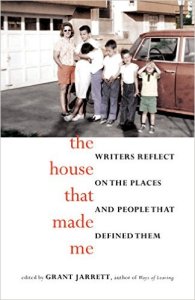
The House That Made Me: Writers Reflect on the Places and People that Defined Them edited by Grant Jarrett

Carefully curated essays take on the concept of home from varied points of view.

house made me

The House That Made Me collects essays by 19 writers reflecting on their childhood homes (or whichever home each writer has found most influential). Editor Grant Jarrett developed the idea for this anthology while contemplating his own first address via Google Earth, and he directs the contributors to that software. While the majority of essays hew close to Jarrett’s initial notion, some also riff on the concept: Roy Kesey considers those who view our homes from above, including birds, spies, angels, gods, astronauts and children climbing on roofs, as he once did.

The resulting assembly of voices offers a range of approaches and backgrounds: Kris Radish’s nostalgia for an idyllic rural community; Patricia Jabbeh Wesley’s attempts at home-building in Liberia just before civil war erupted; and the juxtaposition of Pamela Erens’s privileged upbringing on the lake in Chicago and Jeffery Renard Allen’s difficult one in that same city’s Southside. Justine Musk writes of the possibility that “a person has two homes: the place where you were born (literally, not metaphorically), and the place that fits your soul.” As she works to leave her small Canadian hometown for Los Angeles: “It’s that sense of not-belonging that can become, slowly and over time, its own kind of belonging.” While each essay is a worthy and thought-provoking piece of craft, the true achievement is in the sum of these parts, a chorus of diverse experiences that work together to define “home” in all of its possibilities.


This review originally ran in the April 22, 2016 issue of Shelf Awareness for Readers. To subscribe, click here, and you’ll receive two issues per week of book reviews and other bookish news.


Rating: 8 parachutes, for its matching my personal obsessions, these days.

book beginnings on Friday: Everybody Behaves Badly: The True Story Behind Hemingway’s Masterpiece The Sun Also Rises by Lesley M. M. Blume

book beginnings

Thanks to Rose City Reader for hosting this meme. To participate, share the first line or two of the book you are currently reading and, if you feel so moved, let us know what your first impressions were based on that first line.

Guess what brought me to this one. It’s been a while since I read The Sun Also Rises (first discovered in Mrs. Smith’s English class in high school, which began my Hemingway admiration). I wonder if I’ll find time for a reread…

everybody behaves badly

I think these opening lines set the scene nicely – or the atmosphere of Hemingway’s life and fame, if you will.

In March 1934, Vanity Fair ran a mischievous editorial: a page of Ernest Hemingway paper dolls, featuring cutouts of various famous Hemingway personas. On display: Hemingway as a toreador, clinging to a severed bull’s head; Hemingway as a brooding, café-dwelling writer (four wine bottles adorn his table, and a waiter is seen toting three more in his direction); Hemingway as a bloodied war veteran.

I wonder how much that page of paper dolls would be worth now!

This quotation comes from an uncorrected advance proof and is subject to change.

Maximum Shelf author interview: Dan Vyleta

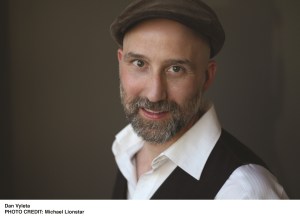
Following yesterday’s review of Smoke, here’s Dan Vyleta: In Dialogue with the Manuscript.


Dan Vyleta is the son of Czech refugees who moved to Germany in the late 1960s. He holds a Ph.D. in history from King’s College, Cambridge. Vyleta is the author of three previous novels: Pavel & I, The Quiet Twin and The Crooked Maid. An inveterate migrant, he has lived in Germany, Canada, the United States and the United Kingdom. When not reading or writing novels, Vyleta watches cop shows or listens to CDs from his embarrassingly large collection of jazz albums. He currently resides in Stratford-upon-Avon, in England.

vyletaYou employ many voices and events. Was this your plan from the beginning?

I’m not a great planner, if I’m honest. I always feel as if you write from the gut and you edit with your brain. It felt right to give people their own voice, let people speak–because it’s a novel about the state of your soul, I suppose. Everybody’s wrestling with this phenomenon that nobody can quite make sense of. The entire society works in a certain way because of it but it’s never been explained, it’s just there. And then, because this is also a novel about class, about different parts of society interacting, I had to find voices more peripheral to the action to give interesting counterpoints. The more I think about it, I think of the structure as quite dramatic, i.e., like a theater play, where occasionally somebody will come out from the chorus and stand there dazzled by the light and start talking at the audience. I think it was a dialogue between the manuscript and myself: things I wanted to do and things that the manuscript responded to. And that’s how a novel is shaped, you push forward and you listen into your own work and it gives you guidance and an architecture emerges out of that.

What makes a good hero, or a good villain?

For both the answer is complexity. Evil comes in many shades. It has to be complex. We have to feel the human being in there, we have to have some level of sympathy. We can fear them, but–there’s something quite attractive about villainy, isn’t there? The villain has to work on you emotionally on a whole range of notes, rather than just hitting the base notes over and over again with a fist. There has to be movement, so we realize there is a thinking person behind this, who is reacting and evolving and changing. And very often there’s a tragedy, since most people don’t grow up thinking, when I grow old I want to be a villain. I think as a writer it’s quite simple: you have to love the people you write, and all the more so if they are your main protagonists. It’s hard to love people who don’t have warts. You love them for the flaws as much as for what they can do. You love them both for the things you recognize of yourself in them and for the things you admire or wish you had. This is a strange refraction. What I admire in the three heroes of the book is courage, in very different keys. One is very… leading with his chin, as it were; one has the courage of emotional honesty, almost a courage of tenderness; and the third, in some ways my favorite, has the courage to change, to actually think differently, which is about the most difficult thing in life, you know.

Do you create those elements consciously, or does it come naturally?

I think anything you try to put in consciously feels off. It’s funny. Obviously you think about your book, and obviously you have plans for it, and hopes. I take reams and reams of notes, often including bits of dialogue or monologue that will never show in the book but which tell me something about the character. But the moment something simply has to happen in a mechanical sense, the page kind of dies. The page becomes an instrument to deliver that prearranged piece. And I think the beauty of writing is that you as a writer are in the position of the reader–each sentence can surprise you. Of course you think about plot and you’re aware of certain plot twists or elements, but the precise rhythm or emotional tone of it–it’s always good if there’s something in it where you think, wow, that’s how it worked out? That’s kind of sad, or very untoward, or funnier than I thought it would be.

In what ways is Smoke like and unlike your previous novels?

I’ve been asking myself that question, and I don’t have a good answer. My first three novels are all historically set, as is this, although in the middle of the 20th century. I feel as if, in this book, I’m writing unchained. When friends ask me what I’m writing I say, it’s like a Foucauldian children’s book for adults [laughs]. What does that even mean? On the one hand it’s more conceptual than anything I’ve written, about how we are trained to function well in society and what it would mean not to function well, and how we differentiate between who’s worthy and who’s unworthy. On the other hand, and this is what I mean by unleashed, it’s channeling this sheer joy for narrative that I remember in reading as a child. A sheer hunger for just turning the next page, which I really admire in the best of children’s literature. I have been thinking of Dickens a lot because this is a 19th-century novel partially set in London. Great Expectations is essentially a children’s book for adults, I think. Its entire engine, the way it drives forward, its tenderness, is very close to a children’s book, but the things that it explores are very adult indeed.

As a physical symbol, why smoke?

As Dickens points out, based on 19th-century medical theory, there must be particles of disease rising out of poor quarters of town where lots of people suffer physical ailments. If we could only see them, we would be scared, and it would be even worse if we saw their moral ailments. That, coupled to Dickens’s emphasis on fog and soot flying through the air, as it did in London in the 19th century, suggested the smoke to me initially. But the more I thought about it, I thought, well, it’s versatile. It’s undeniable, it’s immediate, it leaves a stain, it can’t be suppressed. It correlates with our own suspicions. You know, quite recently and suddenly cigarette smoke has become a sinister marker. You can’t have a hero in a film smoke anymore, right? It has dangerous implications. You can do it ironically if you set it in the ’60s. So that was part of it. And once I realized that the point wasn’t just that smoke marks sin or desire or vice, but that it was infectious, that it was something that could crawl into you, possess you, it became clear to me that smoke is really the perfect metaphor. You can walk through it like a mist, you can inhale it, you’ll feel it on your skin, it’ll be in your hair. And there’s a kind of analogy to sweat, right? Your every pore can be suffused with it. There may be moments where smoke pours out of your eyelids, finds its way around your fingernails. There’s this sort of visual power to it that I love.


This interview originally ran on February 24, 2016 as a Shelf Awareness special issue. To subscribe, click here, and you’ll receive two issues per week of book reviews and other bookish fun!

Portrait of Hemingway by Lillian Ross

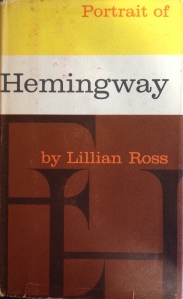
Portrait of HemingwayLillian Ross originally wrote her ‘Profile’ of Ernest Hemingway for The New Yorker, where it was published on May 13, 1950. In book form, it becomes a ‘Portrait,’ and other than the addition of a delightful preface, I’m not sure what the difference is; the opening pages of my first edition note that Portrait originated as Profile, but there is no indication that the text of both is not the same.

The dust cover offers context.

When Miss Ross wrote this Profile, she made several literary innovations, one of which was to compose a portrait entirely in terms of action… She attempted to put down only what she had seen and heard, and not to comment on the facts or express any opinions or pass any judgments… In her writing for The New Yorker she has raised this severely objective method to an art.

We’ll examine that premise shortly.

The Portrait runs 42 pages: long for a magazine article, but perfectly lovely as a brief glimpse in this format. Let me start where the book does, though. I date the preface to 1961: that is the publication date of this first edition printing; the preface does refer to the reception to her Profile in the magazine, and it refers to Hemingway’s death of July 2 of that year. In it, Ross explains how she got to know Ernest Hemingway and his fourth and final wife, Mary, how they corresponded with each other as friends, and how the profile came about: on a brief stay in New York City on his way to Italy, Hemingway invited Ross to come and hang around with him on various errands, over the course of three days. She wrote up those experiences, and gave Mr. and Mrs. H. the chance to mark up her manuscript before she submitted it. She then describes the responses to her profile. Most readers loved it, she said, but some “reacted violently, and in a very complicated fashion.” Some of these disliked Hemingway’s personality (not an uncommon reaction to the man) and thought the piece backed up their views. Others didn’t like the man as represented in the piece (also understandable), and thought “either Hemingway had not been portrayed as he was or, if he was that way, [Ross] shouldn’t have written about him at all.” She assumes that Hemingway’s death has corrected some of these disapproving interpretations, which I found a little odd, but no matter. Finally, she continues the work of profiling Hem by describing the kind of letter-writer and friend he was. The preface introduces the profile nicely because it gives context to the relationship between writer and character.

And the profile (portrait) itself is indeed wonderful, and as promised, follows Hemingway closely: from arriving at the airport, to the airport bar, to the hotel, where the Hemingways order up caviar, champagne and Marlene Dietrich, who visits with photos and stories of her grandbaby. Then it is late in the next morning, and Ross is awakened by an antsy Hemingway who demands she come over and listen to him talk; more champagne, and she accompanies him on his errands while Mary goes on hers. They buy Papa a coat and other small items at Abercrombie & Fitch. The next morning again, Patrick (the middle Hemingway son) has joined the party, which goes to the Met to “look at pictures” for a few hours, followed by lunch back at the hotel with Charles Scribner (Hemingway’s longtime editor). The story ends mid-lunch.

Ross relates this series of anecdotes as scenes, blow by blow, in real time. It is true, as promised, that this is a portrait “in terms of action,” but I wouldn’t call it “severely objective.” For starters, there is the question of what you put in and what you leave out – because obviously Ross didn’t report every cough and sigh and rustle of a pant leg that took place in three days. She writes, “Patrick told me that he’d just as soon spend the whole day looking at pictures.” And a couple of pages later, Hem gets tired and asks Patrick, “don’t you think two hours is a long time looking at pictures?” and “everybody agreed” and the party moved on. Choosing to put in these contradicting statements says a lot about both Hem and Patrick, and I don’t believe for a moment that that was a mistake.

Too, word choice is always telling, I think. In the nature of this excellent piece my mother sent me the other day, consider the sentence: “He moved in and took the room.” Who can objectively say that Hemingway took the room? No, Lillian Ross is communicating something outside of objectively observable events here. I’m not saying I don’t like it: I do, in fact, very much. But I don’t think it’s entirely accurate to claim that the author is not present in her work – here, or ever.

That’s just a quibble with the dust jacket, though. This vignette is packed with great representative moments. I’ve already shared a few (here, here). Or how about this for a Hemingway speech:

…I was ashamed because I had not written any novels. So I wrote ‘The Sun’ when I was twenty-seven, and I wrote it in six weeks, starting on my birthday, July 21st, in Valencia, and finishing it September 6th, in Paris. But it was really lousy and the rewriting took nearly five months. Maybe that will encourage young writers so they won’t have to go get advice from their psycholoanalysts. Analyst once wrote me, What did I learn from psychoanalysts? I answered, Very little but hope they had learned as much as they were able to understand from my published works. You never saw a counter-puncher who was punchy. Never lead against a hitter unless you can outhit him. Crowd a boxer, and take everything he has, to get inside. Duck a swing. Block a hook. And counter a jab with everything you own. Papa’s delivery of hard-learned facts of life.

Seriously, he’s sort of simultaneously a genius and a walking cariacature. I understand perfectly why those readers thought Ross was making fun of Hemingway; this kind of speech reads that way. I also believe he spoke it. And I like him even while recognizing that he was a blowhard, could be a jerk, and struggled to contain his overcompensating machismo. But I get why others don’t. This is sort of in line with that post I wrote.

I had a wonderfully fun time reading the essence of Hemingway in this perfectly pitched profile. Very enjoyable, and a quirky piece of journalism. Do look it up.


Rating: 8 glasses of champagne.

hemingWay of the Day: bravado in metaphor

It has been far too long since I presented a hemingWay of the Day! Lillian Ross’s Portrait of Hemingway provides good material, though. I just offered a teaser last week, and here we are again.

I started out very quiet and I beat Mr. Turgenev. Then I trained hard and I beat Mr. de Maupassant. I’ve fought two draws with Mr. Stendhal, and I think I had an edge in the last one. But nobody’s going to get me in any ring with Mr. Tolstoy unless I’m crazy or I keep getting better.

This is classic: bragging, bravado, hypercompetitive attitude towards writing, all packaged in a boxing metaphor. Oh, Papa.

Maximum Shelf author interview: Molly Prentiss

Following yesterday’s review of Tuesday Nights in 1980, here’s Molly Prentiss: Painting a World.


Molly Prentiss was born and raised in Santa Cruz, Calif. She has been a Writer in Residence at Workspace at the Lower Manhattan Cultural Council, at the Vermont Studio Center and at the Blue Mountain Center, and she was chosen as an Emerging Writer Fellow by the Aspen Writers Foundation. She holds an MFA in creative writing from the California College of the Arts, and currently lives, writes and walks around in Brooklyn, N.Y. Tuesday Nights in 1980 (Scout Press) is her first novel.

photo: Elizabeth Leitzell

photo: Elizabeth Leitzell


Do you have experience within the New York art scene?

It was mostly done by research. Most of my friends are artists or writers, but not in 1980. I went to graduate school at an art school, so I have been around a lot of visual artists, and my fiancé is a visual artist. Conversations with them often influenced the projects and pieces I referenced throughout my book. I go to a lot of gallery openings in the Lower East Side and SoHo with those friends. But I wouldn’t say I’m an expert of any kind. A lot of it was googling and reading books at the Strand and some trips to the New York Public Library.

What about synesthesia? You portray James’s sensations so vividly.

I don’t have synesthesia, and I don’t know anyone very well who has it. But I do think there are elements of synesthesia that exist within a lot of creative people’s brains. I feel I have really strong associations: with days of the week having a certain color, for example, although I don’t actually see those colors. Words pop into my head when I think of a certain smell or color. I often used my own associations to create James’s. I was enthralled by the idea of synesthesia and I did tons of research on it. I read a particularly great book called Wednesday Is Indigo Blue. It includes charts made by people that have synesthesia, where they describe the exact color of every letter in the alphabet, or they talk about every date on the calendar and what it smells like. They see sparks or flashes before their eyes. They talk about it as if it’s a screen in front of their eyes. They know it’s their synesthesia at work, they know it’s not “real” to the outside world. It was a really fascinating thing to look into, and I especially loved working with language surrounding James’s synesthesia. It’s my favorite way to write, to link one thing to another sort of haphazardly, but also in a way that feels organic.

Your choices of subject and setting are exact and evocative. What brought you to this intersection?

You know, the novel has taken many forms throughout the last seven years. Many of them included much longer time periods, and more characters. An original draft had a very different central character, but then I started writing about his mother, and then I started writing about his mother’s brother, who became Raul Engales, and a lot of that character’s action ended up happening to Raul. But that shifted the timeline backwards a bit, to the late ’70s, early ’80s. And I realized that when I struck on that time period, something started happening. I found I was really interested in lingering there. And the same thing happened with the place setting. In previous drafts, large sections took place in Argentina, and eventually my agent (who I worked closely with to edit the book) and I talked about centralizing it in New York. That was the place where the book really came alive, where the action was really happening, and I could render it the most clearly, because I live here and have had such New York experiences and can speak to that the best. So both of those things happened organically. And the location and the time period ended up becoming central pillars of the book, but I didn’t set off with starting to write a book in the ’80s, specifically. I rooted the book in the characters first and the specific position in time and in place came later.

There was a ton of evolution. James in particular was always a thorn in the side of the book. He used to be a side character. In the beginning he didn’t have synesthesia, and in another version he was going blind. I had to learn how to plot the book, move it forward and give it narrative drive, and I used James for that purpose a lot. He became a central character around which the book really revolves. So there’ve been many shifts in dynamics throughout the book, and ways that the plot and the characters have morphed in order to give the story more heft, or more direction, and those are things that I had to teach myself along the way, how to make the story link up and tighten up and push forward.

In a cast of such weird and interesting people, do you have a favorite, or one you most identify with?

It’s hard. I really like Arlene, who is a side character, but she makes me laugh, just thinking about her. I like her relationship with Raul, which is simultaneously motherly and in some way romantic. I think she’s sort of romantically interested in him. She’s also sort of his mentor, and I like that relationship a lot. I ended up loving James, but he was so hard to write that at some points I really hated him. But in the end he wound up softer, more relatable and kinder than in the beginning.

What were the best and worst parts of those seven years spent writing your first novel?

There were many changes, probably just as many ups as downs, and many exciting parts within the actual writing. There are times when you’re inside of a novel when something clicks, and you can feel it just working, bringing everything into place, and those moments are so thrilling. That’s why you do the rest of the hard work. In terms of pitching the book to agents and selling it and all that, there were some crazy ups and downs. I queried my agent something like two years before I signed with her, and we finally signed and then worked together for three more years, so that was a super-long and arduous process. She was so great, and so helpful, but I would often leave her office in tears because she would have me reworking whole sections, and replotting, and there was a lot of grunt work and overhauls that were really difficult. But on the whole it was really great, to learn how to write the book.

What’s next?

Well, I’m working on my second novel. I’m just in the beginning stages of brainstorming and conceptualizing. The full story is to be determined, but it’s rooted in the way that I grew up, in Northern California in the 1970s, in a community living situation. It will have elements of that, totally fictional of course.


This interview originally ran on February 10, 2016 as a Shelf Awareness special issue. To subscribe, click here, and you’ll receive two issues per week of book reviews and other bookish fun!

Teaser Tuesdays: Portrait of Hemingway by Lillian Ross

Teaser Tuesdays is a weekly bookish meme, hosted by MizB of Should Be Reading.

I have read some good books lately – wait til you hear about Lily and the Octopus, oh man – but I’m not sure there’s anything as pleasing and comfortable for me as coming back to Hemingway.

Portrait of Hemingway
This profile was originally published in The New Yorker in 1950, and follows the man closely for two days. That’s it: an anecdote in the life. There is also a most interesting preface, but I will leave that for my review. These are the lines I wanted to share with you today.

He always woke at daybreak, he explained, because his eyelids were especially thin and his eyes especially sensitive to light. “I have seen all the sunrises there have been in my life, and that’s half a hundred years,” he said. He had done considerable revision that morning on the manuscript [of Across the River and Into the Trees]. “I wake up in the morning and my mind starts making sentences, and I have to get rid of them fast – talk them or write them down,” he said.

I feel like that sometimes, too. His sentences are better, though.

Ostend: Stefan Zweig, Joseph Roth, and the Summer Before the Dark by Volker Weidermann, trans. by Carol Brown Janeway

This poetic contemplation in translation illuminates an uneasy creative community of artists and writers gathered one summer as fascism and Nazism are growing in Europe.

ostend

Volker Weidermann’s Ostend: Stefan Zweig, Joseph Roth, and the Summer Before the Dark is a glimmering work of language and an insightful tribute to literary friendship in a singular historical moment.

Stefan Zweig was a successful and popular Austrian writer; Joseph Roth was less successful but also gifted, a tortured, heavy-drinking writer whom Zweig called his “literary conscience.” When war loomed in the summer of 1936, Zweig returned to the Belgian seaside town of Ostend, where he had spent the summer of 1914. His work no longer welcome in Germany, his home in Salzburg defiled by police and his marriage collapsed, he nonetheless joyfully embarked on new work and new love with his secretary, Lotte Altmann. And he brought along Roth, supporting him financially and in his work (support that would strain their complex, fraternal relationship throughout). The troubled Roth, too, found new and rejuvenating love with a German writer, Irmgard Keun, one of the few non-Jews in their small émigré community.

Aside from brief background and epilogue, Weidermann stays within the boundaries of the summer of 1936–the summer before the dark, in which Zweig, Roth and an assortment of “detractors… fighters… cynics… drinkers… blowhards… silent onlookers” manage for a single season to love, laugh and exercise creative genius in a world rapidly falling into war and fascism. Translated from the German into lyrical, meditative prose by Carol Brown Janeway, Ostend is a brief but scintillating portrayal of this season, its spirit and a set of remarkable characters.


This review originally ran in the February 5, 2016 issue of Shelf Awareness for Readers. To subscribe, click here, and you’ll receive two issues per week of book reviews and other bookish news.


Rating: 8 little schnapps glasses.

Alex Haley: And the Books That Changed a Nation by Robert J. Norrell

History and literary criticism enrich the first biography of Alex Haley, author of Roots and Malcolm X’s Autobiography.

alex haley

Alex Haley wrote The Autobiography of Malcolm X (as told to him), and Roots, the story of his family from Africa through slavery and the Civil War. Separately, these books had a profound impact on how the United States viewed race relations and its own history. Together, their influence could hardly be overstated, and that is what Robert J. Norrell argues in Alex Haley: And the Books That Changed a Nation, the first biography of Haley and a study of his two seminal works and the controversies they fostered.

Norrell covers Haley’s forebears and Tennessee childhood, his three marriages and a writing career growing from the Coast Guard (where ghost-writing personal letters led to public relations assignments) to magazine work, which led to his interviewing Malcolm X for Reader’s Digest and Playboy. The process for Malcolm’s Autobiography (1965) was dynamic, as Haley walked the fine line between Malcolm’s voice and Haley’s more moderate political position, and as Malcolm’s views on race relations evolved. The Pulitzer Prize-winning Roots (1976) was even harder won, as Haley drew a short book contract out over more than 11 years of research and travel. The effect of the book, and its accompanying television miniseries, was astounding. And yet the rest of his life and work would be shadowed by accusations of copyright infringements and invention in what Haley called a work of nonfiction.

With sensitivity and careful study, Norrell examines Haley’s embattled life and extraordinary achievements. His final conclusion about this “likeable narcissist” is that despite Haley’s imperfections, his influence was prodigious and deserves our respect and continued study today.


This review originally ran in the December 18, 2015 issue of Shelf Awareness for Readers. To subscribe, click here, and you’ll receive two issues per week of book reviews and other bookish fun!


Rating: 7 pieces of gossip.

Maximum Shelf author interview: Diane Les Becquets

Following yesterday’s review of Breaking Wild, here’s Diane Les Becquets: The Wilderness Within.


Diane Les Becquets is from Nashville, Tenn., and holds degrees from Auburn University and the University of Southern Maine. She has taught writing workshops across the country, and is now a professor at Southern New Hampshire University. In addition, she has worked as a medical journalist, an archeology assistant, a marketing consultant, a sand and gravel dispatcher, a copywriter and a lifeguard. She is a competitive archer, and enjoys bicycling, snowshoeing, snowmobiling, backpacking, competing in sprint triathlons and hiking in the woods with her Labrador, Lacey. Before moving to New Hampshire she lived in a small ranching town in northwestern Colorado for almost 14 years, raising her three sons. Prior to Breaking Wild, Les Becquets published three young adult novels: The Stones of Mourning Creek, Love, Cajun Style and Season of Ice.

Where did the plot concept come from? Did it have to be set in northwestern Colorado?

photo: Nathaniel Boesch

photo: Nathaniel Boesch


I love this question because it triggers so many unforgettable moments from the years I lived in Colorado. The idea for the plot first came to me one evening when I was bow hunting alone. I had ventured into an area called Cyclone Pass, way off the grid, and was bugling back and forth with an elk, following him deeper and deeper into the terrain. The land was steep and littered with deadfall. But then the sky darkened; dusk had passed, and I knew it was too late to take a shot. However, what I also realized was that I was lost. I had gotten so caught up in the adrenaline rush of the hunt that I had failed to keep track of my bearings. The cloud cover was thick, the temperatures cold, and rain began to fall. I went for my headlamp in my backpack, but soon discovered that either the batteries were dead or the bulb had burned out. Not only did I not have a cell phone with me (not even sure I owned one at that time), this was an area where there was no cell signal. Four or five hours later, I found my way back to the trail, and eventually was at my truck. On the drive home that night, I began to imagine a story about a female bow hunter who goes missing. I thought about what that could mean about her life metaphorically. I was at an impasse in my own life, and oftentimes I had that sinking feeling of being lost, of feeling totally confused at which direction to take. I still have the note a friend wrote to me during that time: Within yourself you hold the compass. Together we will choose the direction. The geography of Breaking Wild is a metaphor for these women’s lives.

I chose northwestern Colorado for several reasons. First, this was an area I had called home for almost 14 years, where I had raised my three sons. The land and the people of this part of the state are very distinct from other areas. In many ways this is the last of the true West. It is an area I have tremendous fondness for. But also, geographically, this area is fascinating. It contains what archeologists and geologists refer to as the “edge effect,” where the Great Plains meets the High Desert and the Rocky Mountains. The result is dramatic, with rock formations and crevasses and magnificent storms and winds. Breaking Wild is situated in the Canyon Pintada District, terrain that is not only rich in geological formations, but also in Native American artifacts. There are over 300 archeological sites in this expanse of land. To be immersed in that kind of spiritual geography–very simply, there is nothing like it.

What makes for a compelling protagonist?

This is a difficult question, and I don’t think there is one answer. For me, the protagonists whom I am the most compelled by are those characters whom I care about. They become real to me, as do their stories. My life becomes larger because they are in it. Their lives, their stories, who they are, inspire me in both big and small ways. No longer does the protagonist exist simply as a persona on a page, but the reading experience becomes personal; it becomes a relationship. Once that relationship has been established, I’m going to become completely invested in what happens to her, especially when I know she has something at risk. Have you ever found yourself reading a book or watching a film and praying for the character, literally sending up a little prayer, and then catching yourself and saying, “Wait a minute. What am I doing? This isn’t real”? I am guilty of this quite often and that is an enormous compliment to the artist.

I love the way you switch between Amy Raye’s and Pru’s perspectives. Why is only one of these written in the first person?

This is a question I’ll have to answer in retrospect, as it wasn’t a conscious decision. I believe Pru would be the most similar to me, and perhaps that is why her story is told in first person. But in retrospect, I can also say that Pru is a cause-and-effect person, which makes a first-person account all that more accessible. I felt as if I could inhabit Pru and write what she saw and understood. Amy Raye is much more complicated. I wrote to understand her. I was the observer as I was writing her story.

Do you have a favorite of your two female leads?

Because I identify the most with Pru, because I felt as though I already knew her story before I wrote it, I think Amy Raye would have to be my favorite. She was the fresh, new character for me to get to know. She’s completely flawed and vulnerable and unlikable in so many ways, and yet I am the most compelled by her because I want to know why she is the way she is. I remember my dean once telling me, “We admire a perfect woman. We love an imperfect one.” Amy Raye is so completely imperfect, so completely risky, that I adore her.

How was writing for adults different from your young adult novels?

I never thought of myself as a young adult writer. I simply wrote the stories that came to me. However, I believe the age of each of the protagonists had to do with different situations in my life, places where I was stuck emotionally. The novels were a way for me to work through those places and emerge on new ground. I used to tell people I wrote Love, Cajun Style while I was going through my divorce because I couldn’t afford therapy at the time; I wanted to write something funny because I wanted to make myself laugh. I wanted to feel better. Breaking Wild was a completely different experience for me. I wrote the majority of the novel after emerging from a long space of grief after the death of my husband. It was with this novel that something broke free. The process became a way of being, imaginative and prayerful, rather than a means to work through something and get to someplace else.

What’s next?

I spent this past spring in Montana and Washington conducting physical research for my next novel. As with Breaking Wild, it will be a story of psychological intrigue and suspense. It is also a love story, told from the point of view of a shy, yet strong, female character–a conservationist working in the wilderness, who in her 30s falls in love for the first time. Once again, I find myself intoxicated with the experience. I have so many more stories to write. It is the freest I have ever felt.


This interview originally ran on December 9, 2015 as a Shelf Awareness special issue. To subscribe, click here, and you’ll receive two issues per week of book reviews and other bookish fun!