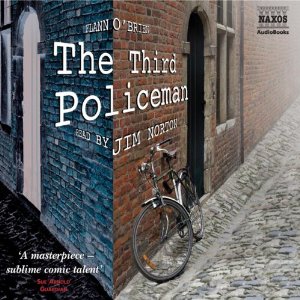
Teaser Tuesdays: The Third Policeman by Flann O’Brien

Teaser Tuesdays is a weekly bookish meme, hosted by MizB of Should Be Reading.

This is an exceptionally strange one, friends. I got a little confused. This was recommended as one of The Ten Best Books About Cycling. But early pages (hours) were devoted to an odd friendship, an odder murder and reanimation, and the main character’s obsessive devotion to and criticism of a fictional philosopher.

third policeman The plot remains weird, which I have come to accept is partly the point; and now we have got around to bicycles.

“I do not want to be insidious,” he said, “but would you inform me about your arrival in the parish? Surely you had a three-speed gear for the hills?”

“I had no three-speed gear,” I responded rather sharply, “and no two-speed gear and it is also true that I had no bicycle and little or no pump and if I had a lamp itself it would not be necessary if I had no bicycle and there would be no bracket to hang it on.”

“That may be,” said MacCruiskeen, “but likely you were laughed at on the tricycle?”

“I had neither bicycle nor tricycle and I am not a dentist,” I said with severe categorical thoroughness, “and I do not believe in the penny-farthing or the scooter, the velocipede or the tandem-tourer.”

MacCruiskeen got white and shaky and gripped my arm and looked at me intensely.

“In my natural puff,” he said at last, in a strained voice, “I have never encountered a more fantastic epilogue or a queerer story. Surely you are a far-fetched man. To my dying night I will not forget this today morning.”

I am totally tickled, naturally. Stick around, and I will try to illuminate the weirdness for you in my final review. For now: worthwhile.

Mink River by Brian Doyle (audio)

mink riverMy second Brian Doyle novel (following Martin Marten, which was one of the best I read in 2015) was also outstanding. Mink River shares much of the subject matter and setting: it takes place in a rather larger small town on the Oregon coast, with a cast of delightful people and animals, all of whom make up a web and community of life and values in which human and nonhuman creatures carry equal weight. It covers an enormous swath of life experiences, truly profound in that sense, but also humble in its small physical scale: a few families and friends form the core of this novel, which is both quaint and all-encompassing.

Centrally, Worried Man and Cedar are the two members of the Department of Public Works in the fictional town of Neawanaka. Worried Man has a wife, Maplehead; a daughter, No Horses; an son-in-law, Owen; and a grandson, Daniel, whose hair forms three braids, of red and black and brown. Cedar does not know his personal history. He remembers nothing before the day Worried Man and Maplehead pulled him out of the river where he was drowning. They make a motley family circle, of which Cedar and Owen are as much a part as the other, blood relations. There is also a mean old man who beats his children, now just the younger two boys, as the elder boy and girl are adults who fish for a living. A young couple learning about each other. An upstanding policeman and his wife, who struggle to express their feelings for one another. The doctor; the old nun; and of course Moses, the crow, whom the nun taught to speak and who is capable of carrying on quite complex philosophical discussions with his human friends. (Crows are very smart, you know.)

The family at the center provides a lovely blend of cultures – the indigenous Salish people represented by Worried Man and Maplehead, and the Irish, by Owen. Worried Man and his son-in-law each speak some of their people’s respective dying tongues, and both pay homage to what that represents; both make efforts to pass their knowledge along. Both cultures also offer a legacy of love of stories, which Daniel inherits. As Owen relates, while telling of his grandfather who survived the Hunger in Ireland:

You can eat stories if you have to. A good story is a very good thing to eat. If you have a true story and some good water, you’ll be all right, he would say…

Sometimes, he would tell stories about stories. The stories of children are green, he would say, and the stories of women are blue, and the stories of men are red…

You can eat an infinite number of stories. No one can ever eat too many stories.

A lovely quotation, and of course fitting for a novel about everything in life.

As well as these human cultures, like Martin Marten, this story addresses the bond between human and nonhuman cultures, as best embodied by Moses the philosopher-crow. Bears and birds and the river itself are given voices and agency, although not strictly personified: the bear is not a person at all, but a bear.

Doyle continues to exhibit spellbinding, lyrical language, and his sentences can flow and flow and flow on, as if they will eventually reach the sea. This book was very enjoyable to listen to, read by narrator David Drummond. It was a trade-off: probably I missed some nuance and detail in favor of that lovely sound. But I felt this was a worthwhile trade-off. Sound is one of Doyle’s great strengths – but so is story. He has it all. Loveable, complex, diverse characters, realistic setting, sweeping large plot, philosophy, and poetry, all in one. Absolutely recommended as ever.


Rating: 8 shared bottles of beer.

Teaser Tuesdays: Mink River by Brian Doyle

Teaser Tuesdays is a weekly bookish meme, hosted by MizB of Should Be Reading.

mink river

Totally unsurprisingly, I am thrilled to be back with Brian Doyle, this time in audio format. Mink River is like Martin Marten in that it examines a small town on the northern Pacific coast, and all its inhabitants, human and otherwise. Whimsical is a good word for Doyle, I think. I’m only a short way in but these lines struck me:

Of course, there are many other people in Neawanaka, so very many. Old and young and tall and short and hale and broken and weary and exuberant. So very many it would take a million years to tell a millionth of their lives, and we don’t have the time, worse luck, for their stories are riveting and glorious and searing. But ah, let us choose two…

I am convinced of this concept, that all creatures’ stories are worth telling, if only we could get to them, which we can’t, not all of them. And isn’t the idea well expressed here? Doyle still recommended.

did not finish: Ripper by Isabel Allende (audio)

ripperAll right, I give up, a little bit, on Allende. The Japanese Lover was stronger on language than on character, and Maya’s Notebook even more so. Not since Inés of My Soul have I been bowled over by the whole package of story, character and language.

Ripper starts out intriguingly, as noted. But I only made it about 10% through the book before finding myself frustrated by the characters. The voluptuous, beautiful blonde with a heart of gold who is blind to people’s flaws; the materialistic rich guy she dates; the obnoxious teen (really, I find this one a lot. I know they can be difficult – I was – but they have to be more complex than this); etc. And then the unrealistic details (which I noted in Maya’s Notebook), as when our teenaged sleuth demands all the details of an ongoing murder investigation, because “it’s public record”: not so.* This kind of disregard for facts, in an otherwise realistic setting, bugs me; and combined with the flat characters, I couldn’t keep going.

Allende is one of the best when it comes to description and language. But that’s not always enough, for me at least. I’ll hold out for her next critically acclaimed work before I come back.


Unrated.

*I felt like I knew this from watching crime shows on television. Obviously not a strong source, so I found some stronger ones, below. The gist of it is, specific details of a crime whose investigation is ongoing are exempt from public records legislation, where the release of those details might jeopardize the investigation. For example, the details of specifically what was done to a murder victim might be held back so that the police can distinguish real confessions from fake ones. This is classic crime fiction stuff, but also fact. “Most states exempt from disclosure law enforcement investigatory records,” from the Connecticut General Assembly’s Office of Legislative Research, reporting on states’ laws. The LA Times refers to “investigative records exempt from public release under California’s public records law.” “Specified facts from investigatory or security records, without disclosure of the records themselves, must be disclosed unless disclosure would endanger the successful completion of an investigation, or related investigation, or endanger a person involved in the investigation. Cal. Gov’t Code §§ 6254(f)(1), (f)(2) and (f)(3),” from Reporters Committee for Freedom of the Press. “Information that may jeopardize an investigation, related investigation or law enforcement proceeding” are exempt from public records access, according to the LAPD. “Law enforcement investigative files may be withheld, but not the basic facts.” Californians Aware, The Center for Public Forum Rights. Etc.

book beginnings on Friday: Ripper by Isabel Allende (audio)

Thanks to Rose City Reader for hosting this meme. To participate, share the first line or two of the book you are currently reading and, if you feel so moved, let us know what your first impressions were based on that first line.

ripper

She is not perfect: I found The Japanese Lover to be, not bad, but less than she is capable of. But I still look forward to reading Isabel Allende.

Ripper begins:

“Mom is still alive, but she’s going to be murdered at midnight on Good Friday,” Amanda Martín told the deputy chief, who didn’t even think to question the girl. She’d already proved she knew more than he and all his colleagues in Homicide put together.

I thought that was a hell of an opening, and the pages that follow are equally engaging. Stick around.

The Year of Magical Thinking by Joan Didion (audio)

I said I was laying off the audiobooks, because my present life & schedule don’t allow for enough listening time. But then I picked up another, and another. Among other things, I’ve hurt my knee again and am back in the gym. But you’re not here to hear about my knee.

year of magical thinkingI’m so glad I tuned into The Year of Magical Thinking. It’s not a feel-good story: it tracks the year in Joan Didion’s life following her husband’s death, and maps her experience with grief. It’s almost New Year’s, and Joan and husband John have been visiting their daughter in the hospital, where she is unconscious with a life-threatening case of pneumonia and septic shock. On December 30, 2003, he collapses at the dinner table, is rushed to the hospital and pronounced dead that night. John is John Gregory Dunne, also an accomplished writer, and their lifestyle has always kept them very close: working from home, together, consulting on every aspect of their lives, from work, food, family and world events to the most insignificant details. Didion is of course, obviously, shocked and unmoored. During the year that follows she experiences different types of grief, shock and bafflement. This book is a little like a diary of that time, which it charts chronologically, ending one year and one day after John’s death.

Along the way, she nimbly weaves in the research she performs on related subjects within psychology, medicine and anthropology: research on grief, on cultural relationships with death and dying, and on medical issues, as she tries to understand when, how and why John died. This last is a surprisingly opaque question, covering the time between his collapse and the doctor’s pronouncement about an hour and a half later. What had been done in the interim? What could have been done? She examines the reports of the ambulance team, the nurses and the ER doctor.

And to compound the complicated and tragic story, daughter Quintana spends most of this year in and out of hospitals, near death on multiple occasions. What we know, although Didion at the time of writing does not, is that Quintana died within the year after the book’s timeline closes. Her later memoir, Blue Nights, covers that personal loss. I haven’t read that one – yet.

The difficulty of this book, then, is obvious: it is filled with sad stuff. Didion is a deft and clever writer, though. We see more than a little joy, although much of it is remembered. We see a strong family, and we see good times. The entwining of personal experience (past and present) and research is beautifully done. Didion uses repeated phrases to draw her reader along the book’s line, to tie everything together. It’s a lovely piece of work, although I did have to turn away when I had a particularly bad day. The subject matter is what it is.

My one criticism is that Didion fails to recognize and acknowledge a certain privilege: that her life is set against the Ritz, the Royal Hawaiian Hotel in Honolulu, the fancy home in Malibu, Chanel, Brooks Brothers, an endless parade of the food, clothing, and scenery of her choice and at her command. This privilege, compounded by her failure to acknowledge it (is it possible she is unaware?), distanced me from her. She is both a fine writer and a complex and sympathetic person; it is my instinct to identify with her, and that is where this memoir shines; but that effect is lessened by her experience of the world to which she is apparently blind. Near the end, she describes a difficulty early in her marriage, when she and John had made a $50,000 down payment on a house in an L.A. suburb but hadn’t yet sold their home in Malibu: where would the money come from? They go to a luxury resort in Hawaii to think it out, then find that the Malibu home has an acceptable offer. She does speak briefly to the irony of the Hawaiian brainstorming session. We could call this a partial exception to my complaint. The episode still comes off a little tone-deaf, though.

This is a fairly small criticism. Because of this privileged position, Didion lost a few degrees of identification with her reader. On the whole, though, she is a sympathetic and fully realized character. Her story is shocking but true; it is beautifully structured and well written, and I will definitely read more Didion.

Barbara Caruso’s narration felt spot-on to me.


Rating: 7 leis.

Selected Shorts: Pets! (audio)

I just said I wasn’t going to do any more audiobooks any time soon; but this different format (and a road trip) convinced me.

petsThis collection includes six short stories, read by six different narrators, around a theme. The interpretation of “pets” varies, from cats and dogs through a mostly-wild parrot and a few mythical (or horrific) creatures. My feelings about the stories vary a little, too, but overall it was great fun.

In my opinion, we start off less than strongly with T. C. Boyle’s “Heart of a Champion,” read by Isaiah Sheffer, which parodies Lassie’s superdog perfection and the perfect haplessness of little Timmy, before winding up with a different and slightly sinister twist. Mom & I (on the road together from Fort Worth to Houston) agreed that this one was less engaging than the others, and didn’t exhibit the taut packaging of the very finest of short stories. Robertson Davies’ “The Cat That Went to Trinity,” read by Charles Keating, was delightful: a gothic story of academic rivalry, in which a professor at Massey College laments that institution’s inability to keep a college cat. They all go to Trinity. In homage to a certain gothic novel our professor (a specialist) is teaching, a questionable project is attempted. The tone of this story is intense parody of that gothic genre, and is completely hilarious. I enjoyed it very much.

Molly Giles’ “Pie Dance,” read by Kate Burton, presents a change of pace. An woman narrates a visit from her ex-husband’s new wife, and the story that unfolds is complicated, multi-layered, and thought-provoking; a person could listen to (or read) this story several time looking for the little clues. It is a real piece of artistry, and very funny to boot, behaving like a fun and entertaining piece and only creeping up as a more complex one. This story is certainly one of the strongest points of this collection. On the other hand, Ana Menendez’s “Story of a Parrot,” read by Jacqueline Kim, is a different kind of literary undertaking, featuring a Cuban couple relocated to Florida, where they do not get along as the wife dreams of a missed stage career. It is dreamy and gauzy, and though intriguing in many ways, it didn’t come together perfectly for me.

Max Steele’s “The Cat and the Coffee Drinkers,” read by Paul Hecht, was another fun one, told by a former student of Miss Effie’s kindergarten, which is very much a nontraditional classroom. It has its moments of poignancy and the opportunity for serious points, but overall is easily appreciated for its tongue-in-cheek humor.

But the best by far was the story that brought me to this collection in the first place: Gail Godwin’s “St. George,” read in fine form by Jane Curtin. A lonely and socially awkward medieval scholar cracks an egg to discover a tiny but very real dragon. Her attempts to raise it up are a comedy of errors, fanciful and hilarious and perfectly portrayed (of course) by Curtin. This story was riotous and smart, and offered a surprising final solution; it also exemplifies the way a short story can be a nicely encapsulated literary experience in miniature, where structure is so important. I’m glad I sought out “St. George” and will have to keep my eyes open for Godwin.

Each of these stories ran 20-30 minutes, a great format for short listening opportunities and one I’ll look for again. Every one was not equally outstanding, but I am pleased.


Rating: 8 pearls.

(Collections are hard. “St. George” would have gone 8 or 9, and the Lassie story maybe a 6. But it was good fun all around.)

Wild by Cheryl Strayed (audio)

wildI took my time getting around to this, because I wasn’t convinced it was really worth my time. But I’m glad I did get around to it.

Then I took my time listening to it, because (as I’ve been saying for several audiobooks now), my listening time is much diminished these days by my lack of commute. In fact, after this one, I’ve decided to lay off audiobooks for a while except for long road trips.

Happily, though, Wild worked just fine with my slow pace and long breaks. The story Cheryl Strayed has to tell is that of her solo hike over much of the Pacific Crest Trail (PCT), at age 26, following a series of self-destructive behaviors and personal tragedies beginning with her mother’s death and including a divorce and a heroin habit. The chronology jumps around: we first see her late in her hike, when she loses her hiking boots; we then flash back to learn much of her history: her childhood, close relationship with her mother, her mother’s death and her struggles afterward. In part because of its episodic nature, it was okay to move into and out of this story over time. If I’d lost track of her momentary situation, I knew she was hiking the PCT and struggling somewhat; and in just a few seconds, I’d placed her again. Credit for this ease is also due, of course, to the engaging and memorable story she has to tell. Her mother is a sympathetic, interesting and engaging character; her brother, sister, stepfather and ex-husband are less developed but still present as individuals. Cheryl’s own voice is clearly portrayed, and while she frustrated me at times (only natural, I promise), she was ultimately absolutely a compelling, likeable and very real person.

Where Bill Bryon’s A Walk in the Woods was a little exasperating in its silliness, Wild achieves the right blend of humor and real struggle. She is definitely hapless; she has definitely made some serious blunders in getting out there on her own, with a wildly heavy pack, and no preparation. But she persists. She won my respect – I am tempted to say my grudging respect; call it semi-grudging – but better than that, she wins her own.

The writing is expressive, occasionally a little overwrought but only (I believe) as Cheryl was herself overwrought in those moments; it is descriptive and plain. I began to write that the writing is not the achievement of this book, that it is rather Cheryl’s distinctive story that carries it; but that’s not actually true or fair. The structure of this book, the pacing and order in which she reveals herself to us, are intelligently put together. The disordered chronology was carefully considered. The writing is not a straightforward narrative but includes metaphors and images that help bring the story to life. It’s more that the writing fades away and the reader experiences the story starkly: I forget I’m listening to a book and just see the journey unfold before me. This is indeed an accomplishment of writing, but it is an accomplishment of invisible writing rather than the decorative sort employed by Amy Leach, Brian Doyle or Terry Tempest Williams, which I also enjoy and which is easier to see.

I’m sorry for my earlier hesitation: pop sensation it may be, but Wild is also an example of fine writing, well-designed structure, and a hell of a story. I’m glad I studied it. Oh, and Bernadette Dunne’s reading on this audio edition felt like it captured the right voice, for me, of a young Cheryl Strayed. I happily recommend this format as well as this book.


Rating: 7 cold glass bottles of lemonade.

The Living by Annie Dillard (audio)

the livingMy difficulty and back-and-forth feelings about Annie Dillard continue with this epic story of pioneer families in my place of residence, Bellingham, Washington.

The Living spans more or less the second half of the 19th century, and it expands to fill all those years and all that space. It is a big story, with lots of characters – several families, over generations – and I’m not sure it ever chooses one or several to center around. This is not a book that benefited from my regrettable new habit of taking months to finish an audiobook: I flailed a little in trying to finish, and I confess a feeling of relief now that it’s over.

There were certainly strengths. Dillard is an inspired writer, some of the time, and there were certainly passages I paused to appreciate, and will share with you here, in a little while. The stories were often moving – individual episodes, that is, within the larger saga – and the characters were often compelling, interesting, diverting people I wanted to get to know better – but again, only for a moment, and then we’d zoom out and on to a different character who was less intriguing. These were all small pieces of a whole that, as a whole, failed to capture my attention. There were moments of glittering, evocative, engaging story or character, but then we returned to a larger, sweeping view that repeatedly challenged me to continue to care. Again, this might work better with a quicker reading. It certainly didn’t work for me in the way I experienced the book.

Witness these shining moments of writing, though…

She lay under mats in the bottom of a canoe once, during the Indian troubles, and Rooney told the Haidas she was clams. Lived in five or six different places, including a stockade. She felt her freedom, reared two boys to manhood, busted open this wilderness by the sea, buried the men on their lands. She saw a white horse roll in wild strawberries and stand up red. She took part in the great drama. It had been her privilege to peer into the deepest well-hole of life’s surprise. She felt the fire of god’s wild breath on her face.

Great imagery there, and a strong retrospective view of the gravity of this woman’s life and what she’s seen.

He had long ago concluded that he possessed only one small and finite brain, and he had fixed a habit of determining most carefully with what he would fill it.

A funny and wise moment.

She read books as one would breathe air, to fill up and live. She read books as one would breathe ether, to sink in and die.

And, who among us doesn’t love such a quotation?

But the whole thing might have worked better if presented as a series of vignettes; the parts of it that I loved were relatively few and brief, with a great deal to be slogged through in between. Dillard created some likeable characters, but it’s almost as if she didn’t like them very much, herself. She asked some interesting questions about humankind and the broader sense of what we’re doing here, but she spent so much time setting them up as sort of clinical questions that she forgot to make me care about them, or about the little creatures involved.

I’m sorry to say this one didn’t work for me, especially (by coincidence) as it came up against Stegner’s The Big Rock Candy Mountain, an infinitely better, more compelling story with its own momentum.

This review was short because I’m a little sick of The Living and very glad to be quit of it. I’m sorry. You can find better reviews elsewhere; me, I’m looking forward now, not back.


Rating: 6 deaths.

The Writing Life by Annie Dillard (audio)

From Dillard’s website:

The Boston Globe called it “a kind of spiritual Strunk & White, a small and brilliant guidebook to the landscape of a writer’s task.

Recalling how I felt about Strunk & White, and my admiration for Dillard, this is promising.

writing lifeThe Writing Life is brief, and very enjoyable. Her voice as read by Tavia Gilbert feels just right for Dillard’s tone, which is knowing, wry, funny, and serious, by turns and often simultaneously (as I believe I noted in my recent teaser).

As fine as this audio version was, however, it left me wishing I’d had more time to peruse and mull. I have already ordered a print version to keep. For one thing: the format is a series of essays, and this format was a little lost on me in audio form. The transitions felt abrupt sometimes. (Perhaps I could have been paying closer attention to signals of transition. A failure of the medium, or of mine? No matter, the point is it didn’t work perfectly for me.) But I let go and just listened. Don’t be fooled by the title: this is neither the story of Dillard’s life as a writer, nor an instruction on how to live it, ourselves. It’s a bunch of musings and meditations. There are pieces of advice, and stories too, mixed in. But it’s a buffet, lots of things at once. It was fabulously enjoyable when allowed to wash over me. Next time, I will study it more closely, in print.

For the Bellingham local in me – and I recommend it to my father for this reason – there are a few wonderful references to this place, including the inspired story of the Bellingham-based stunt pilot. (Other reviewers seem to find this the best chapter of the book. It was certainly among them.) For the place-obsessed me, there were excellent reflections on various places, including islands in the Puget Sound; Roanoke, Virginia; and Cape Cod. About writing, I enjoyed hearing Dillard’s ideas about where to write (“appealing workplaces are to be avoided”) and how to write: I loved the idea that, paradoxically, writers need to live less in order to create the time and isolation necessarily to write about that life which they have somewhat backed away from. There is less firm advice than encouragement – mixed in with discouragement, but of a collegial type.

Reviews out there in the world are mixed, and seem (according to my brief survey) to base their criticism on the idea that this book is made up of wonderful parts, mixed in with less wonderful parts, that fail to make a single, wonderful whole. I guess that might be born out by my struggles with the audio form. But actually, a bunch of wonderful parts is no failure at all, and I was left feeling enchanted. For that matter, I recall that Pilgrim at Tinker Creek had uneven effects on me, too – I can hardly believe that I gave it only 6 mushrooms, because I remember it so strongly and positively, but that shows how much I struggled with some parts of it, too. But really, I say again, we could do worse than many thought-provoking and wondersome components, which is what I found here.

It’s Annie Dillard, y’all. It’s good reading. The audio is good listening, although you may struggle to find it cohesive in that form. But that is the big criticism of this book anyway. So read, or listen, don’t worry about cohesion, and enjoy. I did.


Rating: 8 moths to a candle flame.