Valentine by Elizabeth Wetmore (audio)

This audiobook, also part of my cross-country travels, was a birthday gift from my mom. Thanks, Mom!

Valentine is a powerful novel. It’s set in Odessa, Texas in 1976: a central West Texas oil town in a harsh environment filled with hard-edged, struggling people. The setting is definitely part of the appeal, as I know Odessa a little and its region a little better, and Elizabeth Wetmore’s striking writing about place I found very affecting and authentic. Mostly, this place comes across as rough, stark, unbeautiful; but a close read will reveal appreciation for the natural world and the people who find something to love in it. These characters are really well done, too. Chapters shift between the points of view of a number of them, with a firmer focus on three or four. All are women: men are only viewed through their eyes. As a woman, in a world of books historically over-focused on men, I appreciated this, too.

Let me get in a content warning before we go too much further: the event the book opens with, which is also the event that the entire narrative centers around, is a brutal and violent rape. It’s described in what I’d call moderate detail, which is plenty disturbing. Readers for whom this may present a problem should avoid the whole thing.

This rape and its aftermath affects all our characters in various ways. Even those who are initially unsympathetic become three-dimensional and complicated when they get their own chapters, in that way that I love: all people are complex, no one all good or bad, no perfect heroes or villains. I love a complication like nothing else. There is even a brief – failed – attempt to understand the perpetrator of the rape; that impulse and its failure both feel real and right to me.

Gloria, or Glory, Ramirez rightfully opens and closes the book. Fourteen years old, the US-born child of an undocumented Mexican immigrant mother, Glory’s life brings race and racism into the story. Valentine is centrally concerned with women’s lives and violence against women, but this layer is important and (of course) related. Then there is Mary Rose Whitehead, young mother of a young daughter, drawn into Glory’s life by circumstance. She rebels against many of the structures of the world around her, in ways that we applaud, but this is no fairy tale, so she will not necessarily triumph. Next comes Corrine Shepard, an older woman, recently widowed and handling her grief with booze, cigarettes and not giving two sh*ts what you think about any of it, which serves her well, to a point. I think of these three women as the core, although there are probably other interpretations – I haven’t counted chapters. Again, there are others who get less spotlight but make important contributions: I’m thinking of the bartender/babysitter/waitress we get to hear from near the very end.

This book covers so much. Race and racism and immigration, women’s lives and violence against women, economics patterns and the dire straits it puts all kinds of people in; the cultural and ecological milieu of a particular place, in a particular time, including what it looks like for an oil boom to hit a town like Odessa, which my friends who live in the region today tell me about: it sounds like it looks awfully the same after more than 40 years. Valentine‘s contents contain a lot of ugliness, brutality, violence, hate, tragedy: beware. But it’s also a beautifully rendered novel. And I appreciate its glimpses of beauty even in Odessa in 1976. It’s masterful, in other words. I’m very impressed, and I’ll be thinking about these characters for a long time.

Thanks again, Mom. Good pick.


Rating: 8 pistols in purses.

Before the Ruins by Victoria Gosling (audio)

On a recent cross-country drive, I lifted this year’s ban on audiobooks, obviously. This one took me two days of driving – a much more favorable pace at which to take in an audiobook, especially one involving suspense. Before the Ruins isn’t lightning-paced – it’s not that kind of thriller – but there was a steady building of tension.

Andy’s feeling pretty safely distant from her own past when she gets a phone call from the mother of her childhood best friend, Peter, saying that he’s gone missing. She hasn’t seen Peter in six months or so. They’ve grown apart. Asked to look for him, though, she finds herself drawn into the events of their youth. Andy and Peter were part of a close-knit foursome, with Em and Andy’s boyfriend Marcus, then joined by an outsider fifth, David, during the fateful summer that they were 18 and 19 years old. The events of that summer were followed by a nasty winter a few years later, in which everything changed. Now Andy finds herself pulled back to the old manor estate where it all went down, back when she was a disadvantaged kid with an alcoholic single mom, quick to fight and slow to trust. Perhaps less has changed than she’s realized.

The novel slips back and forth in time, flashing back to the summer of Andy’s late teens and the winter of her early twenties, and back to the present, when she is nearing 40, finally financially secure but personally unmoored. Searching for Peter means reopening old wounds that never healed, and reconnecting with people she hasn’t missed.

In its actual events, the story often left me just a little disappointed, because the conflicts felt so unremarkable: young people, hormones, sex, hurt feelings. It sometimes felt like a lot of dramatic trappings for fairly humdrum activity. The word for this one is definitely atmospheric – driven not by plot but by feeling, and somewhat less so by character. I was reminded, at its best moments, of Tana French. In the final denouement, there are indeed surprises, but it’s the sense of foreboding, the magic of place (that old manor estate, and certain locations in Italy and France late in the book), and the mystery of character that carry this novel. We only get Andy’s perspective, and because of Andy’s trauma, her self-deceit, her constant bid to reinvent herself, and her caginess, we remain unclear on much of her own internal workings; certainly the other characters are enigmas. The slow reveal of each friend’s motives, what they knew and didn’t know, makes for the most interesting mystery of this thriller.

The audio production by Kristin Atherton is lovely, with voices and accents and reinforcement of that all-important atmosphere. I definitely recommend this format.

Final verdict? Not the most masterful thriller I’ve ever encountered, but absorbing and entertaining, and did surprise me at its end. Worth the time.


Rating: 7 sodden-looking sheep.

Salvage the Bones by Jesmyn Ward (audio)

Following on Ward’s excellent (nonfiction) Men We Reaped, I found her earlier novel Salvage the Bones, read by the same narrator, Cherise Boothe. This one I loved less for a while in the middle, but I loved it at the end. And I’m afraid my one real criticism of this novel is my fault and not Ward’s. I’ve read 14 and a half books since I started listening to this audiobook – the shape of my life involves so little listening time these days. The long middle of the book dragged for me; I felt the pacing was off, but it might be the pace at which I took the story in, and not the pace at which the story is told.

Esch is fifteen years old, the only girl in the family. She has three brothers. Skeetah, sixteen, is entirely consumed by his love for his fighting pit bull, the china-white China. Randall, seventeen, is a gifted basketball player, whose friends occupy much of Esch’s attention – especially Manny, who she can’t keep her eyes off of. Then there’s Junior, seven, fed and diapered by Esch and Randall after their mother died giving birth. They live in Bois Sauvage, Mississippi, and their father is present, but only physically. He is drunk and a bully, and more concerned with hurricane season than his four children. Only halfway into these pages do we hear the name Katrina for the first time.

The novel opens with China giving birth in a poorly lit shed to her first litter of puppies. The whole family gathers round. Skeetah is rapt; his dog and her puppies are his whole world. Esch watches him watching them. He is the brother she is closest to, but China’s motherhood also holds new meaning for the girl, who is just realizing she is pregnant. In the novel’s twelve day span, from the birth of China’s puppies to the aftermath of Katrina’s devastation of their coastal town, that pregnancy feels like the subtext of every other story: Daddy’s obsession with the approaching storm; Skeetah’s obsession with his dogs; Randall’s focus on his sport; Junior’s low-level whining and neediness; Manny’s distance from the girl he treats as sex toy and not human; Edith Hamilton’s Mythology, which Esch is reading for school. This thread makes a significant contribution, even though its screen time (if you will) is brief. Esch is captivated by the strength and singlemindedness of Medea, the crooked model of motherhood she presents. In the world of Bois Sauvage – poverty, lack of parenting, the closeness of siblings who care for each other when no one else does – Medea offers a surprising outside point of reference. Also, I read the same book for school at the same age (under very different personal circumstances), and I found the parallel striking.

There is a stagnant time in the novel’s middle, again, where I got a little adrift. And again, it may have been my slow reading (listening) pace. But Esch takes her time acknowledging her pregnancy; she vomits and can’t get enough to eat; China’s puppies begin to die one by one; Daddy behaves badly; the weather hangs heavy and humid. Actually, the weather and restiveness feel a lot like the time before a hurricane hits. Also, Manny is such a terrible guy that I got sick of him very quickly and was forced to spend more time considering his awfulness than I’d have liked. So there was a hard bit for me in the middle.

But once Manny’s betrayal becomes clear, and the storm begins its approach, things pick back up. The stakes rise before the water does; there is a dog fight, and a human one (or several). In the end, this novel considers the profound effects of Katrina and the fierce love of kids who look out for each other. The account of the storm itself is striking and impactful. Esch is a hero, not a victim.

Katrina: the mother that swept into the Gulf and slaughtered. Her chariot was a storm so great and black the Greeks would say it was harnessed to dragons. She was the murderous mother who cut us to the bone but left us alive. Left us naked and bewildered as wrinkled newborn babies, as blind puppies, as sunstarved newly hatched baby snakes. She left us a dark Gulf and saltburned land. She left us to learn to crawl. She left us to salvage. Katrina is a mother we’ll remember, until the next mother with large merciless hands committed to blood comes.

Motherhood is bloody when it is taught by Medea, and by China, the mother who fights and rips, whose white coat is streaked with blood in her victories. Her own mother is gone, so Esch learns this fierceness. It’s not romantic or pretty, perhaps, but it is something to marvel at.

There is no question that this story is beautifully told and I think masterfully told, my problems with pacing notwithstanding (again, perhaps mea culpa). Ward continues to impress. I am hypnotized by the storm, and the storm in Esch. I do recommend this novel, and Boothe’s narration here.


Rating: 8 shoes.

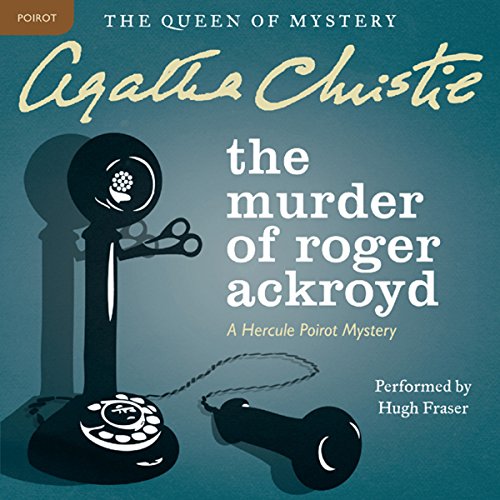
The Murder of Roger Ackroyd by Agatha Christie (audio)

A classic whodunit from Agatha Christie, starring Hercule Poirot, but told through the first-person narration of a character that (as far as I know) appears for the first time in the Poirot-universe. This means we get to see him from afar at first, and recognize him before the narrator understands who we’re dealing with. It’s pure fun. I love the humor and the characters – all of whom, admittedly, are a bit cartoonish, but in entertaining ways. Perhaps the best part of this audio production is the reading by Hugh Fraser, who plays Hasting in the long-running television series I was raised on. The protagonist and first-person narrator of this novel is a Hastings-like character, a stand-in if you will, during the period that Hastings is off living in the Argentine. To have the Hastings actor playing the Hastings-like character, bouncing off Poirot in the loveable way that they do, was just a harmonic moment for me.

Also in classic fashion, the mystery here is clever, ever-twisting and chock-full of red herrings, and the murder takes place in a literal locked room. Everyone is hiding something and harboring overlapping and hidden loyalties. The plot is far from central, however, at least to my enjoyment. (As an aside, I might be a special kind of mystery reader. I can reread the same mystery with no memory of the solution; the plot-level puzzle is rarely my focus; I’m there for characters and relationships. But I might be weird in this regard.) It’s all in the people – here, the caricatures – and the humor. Christie is comfort food, and this is quintessential Christie.


Rating: 7 dropped items.

Bluebird, Bluebird by Attica Locke (audio)

I reviewed Heaven, My Home, which comes second in this series. My father reviewed the highly-regarded first novel Bluebird, Bluebird, and now I’m finally catching up.

Pops did a good job with the high points of this one, and I remember Heaven very fondly (I rated it 8 fingers). There’s no question in my mind that Locke is at her best in handling the complex, nuanced, contradictory nature of Texas history and relationships (particularly in regards to race, but of course there’s more there too). The social justice questions, with no easy resolutions, are Locke’s greatest strength. I found the murder mystery part of this novel less compelling. And I should acknowledge that this audiobook took me way too long to finish, so maybe I didn’t give it the fairest shot in terms of my slow reading (listening) pace. It did get a little draggy for me in the middle; I think the contemplative interiority of Ranger Mathews’ thought processes and turmoil was a mite slow for my personal tastes. Which is related to my bigger concern with the book: I had trouble believing in Mathews (as a fictional character who ‘rings true’), and I had trouble caring deeply about his problems, because he exasperated me.

I had trouble with some of his unprofessional behaviors. Not morally, but in terms of believability: does he really get away with it? The drinking on the job, and the blurred boundaries with the murder victim’s widow, and with Geneva, a powerful matriarch in the small town where he’s investigating a couple of murders. It often felt to me like he was amateur at his job – I expected him to have it together more, or at least be better about hiding his boozing. He sure does rush off half-cocked. And while the widow’s character also made me a little impatient, I bought that this is who she would be. Everyone else feels believable; it’s just Mathews. I’m familiar with the self-destructive, loner, problems-with-authority police detective in fiction – it’s a type, and one I rather specialize in. But this one feels like he’s not very high-functioning in his self-destruction, if that makes sense, and it just rang less true for me.

I do not require that I like a character in order to care what happens in a plot. But there has to be some stakes that I can engage in, and I struggled with that here. My problems with Mathews were distracting.

More compelling was the conflict Mathews feels about the law, nicely encapsulated in his two role models, twin uncles who respectively work(ed) as a lawyer and a Texas Ranger. He’s been drawn in both directions, and still feels the pull of the law, although most of all in the pressures applied by others.

It made him sad, the degree to which this kind of credit hogging mattered to Greg, that three years behind a desk had made him so desperate for the climb that a double homicide was seen as an opportunity first and a crime against nature second. But wasn’t Darren a little guilty of this, too?

…Maybe justice was messier than Darren realized when he’d first pinned a badge to his chest; it was no better or worse than a sieve, a cheap net, a catch-as-catch-can system that gave the illusion of righteousness when really the need for tidy resolution trumped sloppy uncertainty any day.

And,

He got it confused sometimes, on which side of the law he belonged, couldn’t always remember when it was safe for a black man to follow the rules.

Point very well taken. Although, Mathews can occasionally feel like a mouthpiece for these musings, rather than a fully human character.

I did really enjoy the local culture of Lark, Texas, the blues and the home cooking at Geneva’s. And the complex relationships, which Pops refers to in his review, were well drawn (and feel very real).

Narrator J. D. Jackson has a nice voice but sometimes plays this one with a hair more drama than I needed – again, a little distracting.

Some good stuff here, but a lot that bothered me, too. If I’d started here I wouldn’t have read Heaven, My Home, which I think is a superior book. It’ll be interesting to see what comes next for Ranger Darren Mathews.


Rating: 6 plates to go.

Copperhead by Alexi Zentner (audio)

I was quite entranced by Touch and so I jumped into Copperhead with nothing but the author to go on. It’s quite a different book, ambitious, and good, but flawed. This novel takes on the timely – not to say trendy – topic of race and racism in contemporary America. I don’t question Zentner’s earnest commitment to the topic, but it’s a tricky thing to execute seriously in fiction without getting a little overwrought.

Our protagonist is 17-year-old Jessup, a high school senior in Cortaca, New York (a thinly disguised Ithaca, with Cortaca University obviously Cornell). He’s a talented football player and excellent student, but still wrong-side-of-the-tracks because of his family’s hand-to-mouth existence, the trailer they live in, and the fact that his brother and step-father are serving prison sentences for the deaths of two Black college students in what was either self defense or a hate crime, depending on who’s telling the story. Jessup’s mother and sister still attend the Blessed Church of the White America. Jessup would tell you he’s not a racist; his girlfriend is Black. He resents that people judge him for his family history and their association with the white supremacist church.

This is all background information; the novel’s action takes place over four days, Friday night’s football game through Monday night’s protests, but it is action-packed. What might be called a series of unfortunate events explodes into increasing posturing, grandstanding, violence. Jessup is pressured to choose sides. Zentner’s greatest accomplishment is the empathy his reader feels for this kid. We don’t like to spend much of our compassion on white supremacists, but this novel ticks boxes for two intellectual puzzles I’ve long been interested in: 1, the concept that bigots are made or taught, not born, and there’s somebody there, at some early-enough point, that I do feel for. And 2, the question of when we begin to hold a person responsible for his own crimes – the abused child we feel for, but when he grows up to be an abuser we don’t; at what age or stage is the cut-off? I feel like Jessup’s character begs both these questions. He is in some ways a good kid. And while he’s far more fair-minded than some of his family and church, he’s also a white supremacist, by default rather than by hate. The puzzle of Jessup himself I think is well-expressed; we stay with his close third-person perspective throughout the novel, and I find it easy to like and sympathize with him, even though he’s problematic too. I find it realistic that (especially) a 17-year-old boy with such a troubled past would have the kinds of blind spots that Jessup has. That doesn’t mean I think it’s all okay, but I think it’s realistic.

The events that kick off (no pun intended) the weekend’s action are a bit contrived, in terms of narrative: a perfect-storm sequence. Sometimes life really does work in such strange ways, but it is also clearly a novelistic device to get the issues moving that Zentner needs to address. That’s more or less okay with me, but the mechanics of plot here are showing a bit more than some might like. Characters other than Jessup are less well developed than he is (also understandable; a lot has been put into this protagonist, and there’s less left over for everybody else). Things get a little ham-fisted with the stepfather, David John, who is just such a great guy aside from the white supremacist business… and this allows Jessup to wonder how it’s possible for a racist to be such a deeply decent dude? (The answer, staggeringly obvious to everyone but Jessup, is that he’s deeply decent to white people. But honestly, I do buy Jessup’s blindness on this account – again, as one of those believable blind spots. Seventeen years old!) Where the novel goes most wrong is in the final events and epilogue: wrapping up this complicated and fraught story is a challenge, and Zentner was maybe a little overcommitted to a redemption narrative. Only in the final pages (minutes, in my audiobook) does the novel, which excels in drawing out my sympathies, descend into morality tale. It gets a little graceless. Again, Zenter’s earnest good intentions are not in question, and it’s a pretty good morality tale, one that will yield good discussions in classrooms and book clubs. But as a novel, the last bit is a bit cringey.

There are some beautiful, moving, thoughtful moments, and absolutely memorable images, and I think Jessup’s character is all win. The complexities of family, legacy, and the taught-and-learned nature of hate are well illustrated. Copperhead took on an ambitious mission, and as a novel, doesn’t quite stand up to that tall order, but it gives us plenty to think about. I think its greatest accomplishment was in how much I empathized with Jessup, and how uncomfortable I felt with my own empathy – not always a pleasurable experience, but an instructive one. I was certainly engaged throughout, and I do recommend this read, with a few caveats. I respect Zentner’s work here, and I’ll look for more from him.


Rating: 7 text messages.

Blue Moon by Jack Reacher (audio)

I’m going to say this is the best Reacher I’ve encountered in a while. They can be a little up-and-down. But this is classic, vintage Reacher: he blows through town without intending to stay. He sees a (relatively minor) injustice about to play out, and sticks his toe in. Events snowball; he has no fear; he takes on each progressively trickier scenario until he’s chest-deep in it, but he keeps winning. He meets a nice woman and they have an intense, time-limited, but ultimately satisfying time together, both in terms of the sex and the other action. He rides off into the sunset (so to speak). What’s new here is that he builds up a little posse; I can’t think of another example offhand in which he teams up with more than one other person (or maybe two). I found the mix of characters in that posse fun, even if they’re not super well developed. This is a Reacher book, after all. We know better than to get too attached to anyone else.

Other reviewers (on Goodreads and the like) are frequently not so pleased with this installment as I am. For one thing, to each her own; some of Child’s more highly-rated novels have not been among my favorites. For each book, a reader in a time and place, is part of it. Some of the complaints I saw noted that the plotline is unrealistic in many of its details: two rival gangs, Albanian and Ukrainian, in a mid-sized middle-American city (I sure wish I knew which one, but Child doesn’t like to specify), get into a sort-of turf war, with Reacher in the middle. Really, he’s responsible for the body count each ascribes to the other. Many, many deaths receive almost no police response (because the gangsters have bought off the police, naturally). Reacher is Superman. His short-term girlfriend takes up the fight with surprising alacrity. It’s true, all of this is wildly unrealistic; but buying into that is absolutely part of the Reacher experience. I didn’t find this one any more so than usual. If realism is a concern, I’m not quite sure how you got to be a Reacher fan. Oh – and some reviewers were bothered by the excessive violence. Now, if violence is a concern, same answer: Reacher may not be for you. That said, this novel definitely has a higher-than-average body count, so take note.

All the usual good stuff plus a little new good stuff (but not too much, because familiarity is part of the comfort). I am comforted.

This audiobook is narrated by Scott Brick. I have been missing Dick Hill’s work, but Brick has been growing on me, I suppose; I enjoyed this performance. It felt like returning to a place I know and love. Yes, a place of unrealistic plot lines, superheroes, and lots of violence. The good news is it’s only fiction, friends.


Rating: 7 cell-phone pictures.

“The American Paradox,” lectures by Heather Cox Richardson

If you haven’t been receiving Heather Cox Richardson’s daily email “Letters from an American,” you’ve been missing out. She’s also been producing (prodigiously) several series of lectures on YouTube, including “American Paradox,” which we’re told follows the main themes and points of her recent book, How the South Won the Civil War. The paradox Richardson refers to is baked thoroughly into this country: that “all men are created equal” but that “all” doesn’t mean “all”; non-white men, and non-men, as well as certain classes of men, have been excluded from the beginning, and quite purposefully so. As we’ve moved as a country toward the idea that more people should receive equal chances in life, there has been a traditional pushback that is still alive and well, based in the fear that more equality for some people somehow means less equality for the original “all men,” meaning white men with a certain amount of money and power. Richardson portrays these points through storytelling, beginning well before the founding of the U.S., and catching up with Trump’s presidency. This lecture series has nine installments of about an hour apiece.

I listened to Richardson speak while working around the house, which means she didn’t always have my total attention, but I still got a lot out of the experience. I love her infectious enthusiasm for her subject – I feel there’s nothing so inspirational as an expert really excited about their field, and she definitely qualifies. As she occasionally reminds us, she delivers these lectures without notes. It’s astonishing the depth of her knowledge, and I am very comfortable with the trade-off that she is sometimes unsure of a precise date. I also really love the connections Richardson makes across disciplines (something I’ve been working to show my students this past semester), like noting the trajectory of Shakespeare’s playwriting career against world history and technologies, as in: The Tempest‘s setting in the Bahamas places that late-career play in time, as England colonizes that part of the world, a project made possible by new designs in sails and therefore in the shapes of boats. Literature, world history, and shipbuilding technologies are all a part of the same story! This exhilarates me. She also includes references to popular books, movies and television at different points in history, noting their subtle political or ideological contributions to culture, which is a method I recognize from Stamped, where I also appreciated it.

The central paradox in our country-as-concept didn’t feel like a new idea to me, but I think she presents it so logically that this series could serve as an introduction. (Who doesn’t hear the irony in “all men are created equal,” I don’t know, but I guess they’re out there.) For me the most exciting aspects of these talks were Richardson’s mastery of her material, how neatly she integrates interdisciplinary material into a single thread, her avid storytelling, and the big-picture perspectives she brings (which is what I love most about her email Letters). She is definitely, as my father says, a “history wonk,” a geek (I say in the most loving spirit) who excels at and loves storytelling. As my father again notes, this can “result in some enthusiastic ‘really cool!’ diversions into personalities and anecdotes that risk diluting her narrative,” and she sometimes has to pause to clarify that a story might be ‘really cool’ in terms of research and meaning-making, while being abhorrent in terms of what actually happened. This can be a bit jarring, but I think if we accept Richardson’s history-geekness, we can appreciate what she has to offer, which is an extraordinary body of knowledge and ability to draw connections and see patterns, and a boundless, contagious love for her work. I’d take a history class with her any day.

If you’re still learning our history (and who isn’t?) and if you feel that it sheds light on our present and future (which I think it certainly does), I highly recommend Richardson’s expert teachings, free and online for the taking.


Rating: 9 mules downstream.

Auberon by James S. A. Corey (audio)

Early in listening to this novella, I was pleased to be returned to the world of Corey’s imagination (and guided by the familiar reading voice of Jefferson Mays, thank goodness). By the time I looked up and saw that it was half over, I felt a little perplexed by the failure of the plot to draw me in. By the end, I felt frankly disappointed. It was a mildly entertaining return to the worlds of The Expanse, and I do not regret it, but this installment is not a stand-out. I recommend it for completist fans only; Auberon is not a good representation of the extraordinary power of this series.

Auberon is a recently settled planet, even more recently under the control of the far-reaching arm of Laconia. The novella begins when Laconian Governor Rittenaur arrives to take power, hoping to establish a firm but not abusive government. His wife, Dr. Mona Rittenaur, is to take over research operations. In an early scene (and one of the more gripping ones), a sinister older man named Erich with one bionic arm threatens the new Governor, referring to an old Earth western frontier tale: “silver or lead?” he asks, meaning will this leader be purchased by bribe or take a bullet? In the end it is a different vulnerability entirely that will expose Rittenaur to the forces on Auberon.

I found Erich’s scenes (and the bionic arm itself) the most compelling parts of this story. The characters of Governor and Dr. Rittenaur, and the moral challenges they each face, were perhaps meant to be the central and most moving bits, but I found they both fell a little flat, perhaps for lack of development. The original/central foursome of The Expanse–Holden, Naomi, Amos and Alex–captured my heart completely (and make the whole series work), because they are complex, loveable but conflicted, deeply, fully developed as characters with backstories. A little more investment in the Rittenaurs might have made this novella work, but such is the challenge of the novella-length story. (For the record, Corey has sometimes knocked this shorter format out of the park. Just not here.) For me, Auberon didn’t really work. It was a fine few hours, but like I said, I don’t especially recommend it. I’m looking forward to the next Expanse novel or novella, though! This one just whetted my appetite again.


Rating: 6 automatic movements.

Stamped: Racism, Antiracism, and You by Ibram X. Kendi and Jason Reynolds

Liz recommended this book to me (in the audio format) as an excellent, succinct, accessible history of racism (including its purposeful invention) and antiracism, and she was (as usual) right. This is an outstanding introduction to, or review of, the concepts of race and racism in this country, in the context of world history. It’s truly for everyone: those new to such a history will find it manageable, and those not new will learn something new or at least have that larger picture – race in America within world history – clarified in useful ways. The audiobook is just four hours long, and every minute of it is engrossing. I wholeheartedly second Liz’s recommendation.

Stamped: Racism, Antiracism, and You is a “remix” of Ibrim X. Kendi’s highly-regarded Stamped From the Beginning: The Definitive History of Racist Ideas in America. It’s approximately half the length (300 vs. 600 pages). I have not read the latter, fuller version, but my father should be finishing it anytime, and he’s appreciative; perhaps he’ll give us a review to partner with this one. Tables of contents show that the content of each books lines up neatly; they do appear to be two versions of the same material, and I think it’s a real service to give both versions to the world. For this remix, Kendi is joined by young adult novelist Jason Reynolds, who also narrates the audio version (excepting the introduction, delivered by Kendi). It’s my impression that Reynolds does the remixing of Kendi’s original work, bringing his facility with younger readers. The book is labeled for ages 12 and up, but to characterize this as a book for younger readers is too limiting; it’s great for adults, too.

The opening chapter begins,

This is not a history book. I repeat, this is not a history book. At least not like the ones you’re used to reading in school. The ones that feel more like a list of dates (there will be some), with an occasional war here and there, a declaration (definitely gotta mention that), a constitution (that too), a court case or two, and, of course, the paragraph that’s read during Black History Month (Harriet! Rosa! Martin!). This isn’t that. This isn’t a history book. Or, at least, it’s not that kind of history book. Instead, what this is, is a book that contains history. A history directly connected to our lives as we live them right this minute. This is a present book.

And I want to start there because I’m interested in that characterization of what makes a history book. Between you and me, I would like to assert that this is a history book, but I get what the authors are up to here: for those younger readers (or for all of us!), they’re trying to distance themselves from the dry and boring history book, the traditional history book, that separates “history” from what matters in the here-and-now. I think this is a history book, in all the best ways – one for history books to emulate.

Having gotten that out of the way: five sections organize the broad scope of this history. They are organized by years. “Section 1: 1415-1728” opens with “The Story of the World’s First Racist.” (In Stamped From the Beginning [SFtB], Part I is titled “Cotton Mather.” He is not the world’s first racist – that title goes to Gomes Eanes de Zurara.) “Section 2: 1743-1826” corresponds to SFtB‘s “Thomas Jefferson.” “Section 3: 1826-1879” corresponds to William Lloyd Garrison; “Section 4: 1868-1963” is W.E.B. Du Bois, and “Section 5: 1963-Today” is Angela Davis. Those section headings from SFtB appeal to me. Obviously the date ranges handle more than the lives of each individual, but I appreciate the choice of an individual for each section of history, and of the progress of racism in America. Methodically, then, Kendi & Reynolds move through history from the 1400s, and Zurara’s invention of racism (in Europe), to the present day. They hit the highlights in terms of events, personalities, laws, cultural shifts, and theories of race and racism and antiracism, the intellectual arguments offered for why some people should be kept under the boots of other people. I love that they note the markers in media and art for racist thinking, too, commenting on the timing and context of Uncle Tom’s Cabin, To Kill a Mockingbird, Birth of a Nation, Tarzan, and Planet of the Apes. I’m a big fan of spotting the connections across (what we think of as) disparate threads of history and study: movies, literature, history. I think it deepens our understanding of each to see how they fit together.

I found Reynolds’s audio narration completely lovely, and would listen to anything else he reads.

I understand that SFtB is an excellent, deep, rich, dense study. I know I have a lot to learn from it, and I hope to get to it sooner than later. The work of a book like that is important. But I’m so grateful that Stamped exists, too. It’s a truly masterful achievement to make such a swath of history so accessible in just 300 pages, and there are some pretty involved theories and concepts expressed here in a package that I think anyone can grasp (again, it’s labeled for ages 12 and up). I think this book is likely to reach even more people than SFtB. As Liz suggested, I can realistically recommend this one to my first-year college students. This is a book for anyone and everyone. It proves, through history and observations and stories, that we are not living in a post-racial world; racism (and a caste system based upon race) is alive and well in this country and culture, even if it’s learned to disguise itself – that just makes it more important that we learn how to recognize it in its trickier forms. Stamped is the book to help us begin that work. Recommended for everyone.


Rating: 9 privileges.