The Hard Way by Lee Child (audio)

Okay, you all know I’m a big fan of the Jack Reacher series by Lee Child. I have read 9 of the 15 currently out (with The Affair to come in September, yay!). So please take me seriously when I say this is the best one I’ve read yet!

As has become my habit, I listened to this one as an audiobook in the car. I love the narrator, Dick Hill. I think he has just the right mix of slow, serious cadence (imbuing Reacher’s words with the gravity they deserve), and a lightheartedness in the right moments.

And like all the Reacher novels, this novel is fast-paced, suspenseful – I mean real edge-of-the-set, sitting-in-the-driveway-biting-my-nails-while-Husband-wonders-what-I’m-up-to suspense – and action-packed. Reacher is his usual superhero self. Mysterious characters approach him as he tries to mind his own business, and (with limited reluctance) he enters their world, to try and save a kidnapped woman and child. But wait! Are the bad guys really who we think they are? There is intrigue, including military and international intrigue. There are beautiful, sexy, strong, independent women; some of them are also traumatized. There are loyal sisters. Reacher is cool, funny, comforting, and simultaneously rock-hard strong and smart, and brutally violent. (Only when it’s appropriate, of course.)

In The Hard Way, Reacher is recruited by a team of mercenary ex-special forces soldiers to assist in solving the kidnapping of the boss’s wife & step-daughter. As things unfold, he discovers that he hasn’t been told everything – like the fate of the boss’s first wife, kidnapped five years prior, and the fate of two former employees. His loyalties shift; he’s not sure who he can trust. He meets a former FBI-agent, who was involved in the earlier kidnapping case, who may turn out to be a partner of sorts.

I think part of what made this one extra-special to me was the extremity of the danger and trauma at stake, and the happy ending that our sympathetic characters are teased with, the happiness they MIGHT achieve if Reacher is successful. There are some gruesome images offered up; this is not for the faint-at-heart. But if you love a lone ranger with iron-clad morals, a heart of gold, and a Rambo-style ability to inflict pain on those who deserve it, in a world of beautiful/handsome good guys and really bad bad guys, Reacher may be for you. In fact, it’s rather like the traditional Western novel in that lone-ranger sensibility. But these have an intelligence lacking in the traditional Western (not trying to call them stupid; bear with me). Reacher thinks things through in a split second, and we get to share his thoughts on bullet trajectories, angles, percentages, and the weighing of one possible outcome against another. It’s very cerebral at the same time that it’s very physical. I love it.

Before this novel, I didn’t think I’d have favorites within the series. They’re all pretty great. But I’d put this one up there, and if you’re curious, I’d also pick out Echo Burning as a favorite. It was my first Reacher novel, and I picked it up because of the setting: far West-Texas desert on the Mexican border, which is an area where I have spent some very good times. That got me in the door, and opened up the whole series for me, and I’m SO grateful. It had another extra-high-stakes plot (at least for me… I mean, they’re all high stakes, but these two got me somehow, I don’t know. maybe you’d be “got” by a different pair of them) and that setting that I appreciated so much. Also a real knock-down, drag-out OK Coral sort of final scene that really got me going.

Do you read Reacher? Which one is your favorite? And if you don’t – why not?!? No, I jest, sort of. We don’t all have the same tastes. But for suspense and action, I couldn’t recommend it more highly. If not this one, what’s your favorite series? And do you have a favorite within it?

book beginnings on Friday: The Fifth Witness by Michael Connelly

Thanks to Katy at A Few More Pages for hosting this meme. To participate, share the first line or two of the book you are currently reading and, if you feel so moved, let us know what your first impressions were based on that first line.
My current audiobook (for the daily commute) is the latest from Connelly, also the fourth of his books featuring Mickey Haller. Here we go!

Mrs. Pena looked across the seat at me and held her hands up in a beseeching manner. She spoke in a heavy accent, choosing English to make her final pitch directly to me.

“Please, you help me, Mr. Mickey?”

I’ve got to say this narrator may not be my cup of tea; but it’s early days yet and I’m certainly glad to be back in Connelly’s competent hands.

Thanks for stopping by. What are YOU reading this weekend?

Towards Zero by Agatha Christie (audio)

After my disappointment with going outside my known tastes, I have switched back to a tried-and-true. I’m sure somebody out there doesn’t like Agatha Christie, but they have yet to tell me to my face.

I had never heard of Towards Zero, and it involves neither Hercule Poirot nor Miss Marple. But it did have one of the most important Christie trademarks: a twisty-turny puzzle-plot that begs for the reader to try solving the crime before the end of the book. I, at least, am generally incorrect several times over because the plots of her books tend to double back on themselves so often.

This novel opens with a meeting of lawyerly minds (which you can see, incidentally, here), in which the title is explained. Most murder stories (and criminal trials), we are told, begin with the murder, when in fact the relevant story begins much, much earlier, and culminates in the murder as the result of all the previous action. Then we switch to the story at hand. In which…

Nevile Strange and his new wife, Kay, decide to visit Nevile’s mother-figure, Lady Tressilian, not at their usual time of year, but at the same time that Nevile’s first wife Audrey will be visiting. This, predictably, results in a number of uncomfortable, awkward, embarrassing moments and some conflict. (I found it interesting to observe the manners of the day which required referring to both women as “Mrs. Strange.”) Kay is rather bleatingly jealous and unsympathetic; Audrey is long-suffering and stoic but seems forgiving; Nevile is wont to refer to Audrey as “his wife” and ignore Kay, which of course irritates her still more. They make an interesting household, along with Audrey’s longtime admirer, Thomas Royde, just returned from overseas to pursue her; Lady Tressilian’s companion Mary Aldin; and visitor Ted Latimer, Kay’s childhood friend and admirer (parallel to Audrey’s Thomas, although rather opposite in temperament). So. All these folks in a classy country home together trying to be polite and play nice and dance around the love quadrangles, and then a murder takes place, and it’s one of those that could only have been committed by someone from within the household. Very Agatha Christie.

Love Suchet's Poirot.

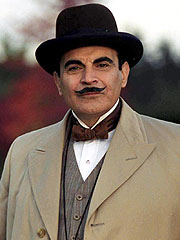
Missing was Hercule Poirot’s biting wit, though. [Aside. Here is where I admit that I’ve never read Miss Marple! Only Hercule Poirot! Also, I grew up with Poirot on television as played by David Suchet and can’t hear or see him in any other way, for better or for worse. But didn’t he make a wonderful Poirot?] There wasn’t really much humor in this story, which is a Christie-staple in my mind, so that was odd; but it was very, very enjoyable without it, so no foul.

Into this closed household comes the vacationing Superintendent Battle and his nephew, the local Inspector Leach, to solve the crime. There are red herrings by the bucketful, and false leads, and I thought I knew whodunit SO many times, but Christie is a tricky one. The final scenes involve the Superintendent talking through the crime with the lot of them and eliciting a confession – also Christie trademarks. Finally, a little surprise romance which I did not entirely see coming topped off this charming, delightful, delicious little tale.

I love Agatha Christie. There’s a reason she’s hailed as a master (and Wikipedia claims she’s the all-time bestselling writer of books). I haven’t read anywhere near a majority of her works, but what I’ve read is always entertaining and clever and usually funny, too. Recommend.

book beginnings on Friday: The Hard Way by Lee Child

Thanks to Katy at A Few More Pages for hosting this meme. To participate, share the first line or two of the book you are currently reading and, if you feel so moved, let us know what your first impressions were based on that first line.
Welcome back to Jack Reacher’s hard-hitting, fast-paced, intelligent world of good-vs.-evil action. I’m psyched to step into this series again. My last audiobook was Agatha Christie’s Towards Zero which was wonderful, so I’m on a roll now. We begin:

Jack Reacher ordered espresso, double, no peel, no cube, foam cup, no china, and before it arrived at his table he saw a man’s life change forever. Not that the waiter was slow. Just that the move was slick.

Ah, Reacher. YOU’re the slick one.

What are you reading?

did not finish: The Rocky Road to Romance by Janet Evanovich (audio)

To be fair, I barely even started this audiobook. I was trying to expand my horizons a little bit. I’ve never read anything by Janet Evanovich! –shocking, to many readers of genre pop fiction, as she’s one of the bestselling romance/mystery crossover authors out there. She’s also one of the big names here in my little library. But then again, not so shocking when you consider I’m not a reader of romance, really. I am a huge fan of mystery novels, but hers are known to be cozy, funny, romantic/sexy mysteries, which isn’t my style. But, so. I wanted to broaden my reading world and thought I’d pick up one of hers, just to know what I’m missing.

I’ll give JE the benefit of the doubt and assume I picked the wrong one. To be fair, this is a romance – not mystery – title, and not one of her more popular, just judging from circular numbers in my library.

I didn’t even make it through one cd. What I did get was the beginning of the sparks flying between Daisy – cute, hard-working, quirky – and Steve, boss at one of her several jobs and obligatorily hunky, mysterious, and distant. The dialog and general writing was just so stilted, and the characters so pat, that I couldn’t take it. I was eye-rolling so hard I couldn’t watch the road, which was a hazard, so I hit eject. The narrator, C.J. Critt, didn’t help matters any, but I don’t think I should blame her necessarily; she was playing along with the book.

I’m being completely honest about the fact that I couldn’t stand this audiobook. But note the qualifications: not my genre or my style; and not Evanovich’s star character (that would be Stephanie Plum, of the numbered series starting with One for the Money).

I think I’m still determined to give JE a try, but will aim for a Stephanie Plum mystery next time for sure. (Thanks to my mother, with whom I mostly share reading tastes, and who enjoyed One for the Money although not outrageously much.) This one made me grit my teeth.

book beginnings on Friday: Towards Zero by Agatha Christie

Thanks to Katy at A Few More Pages for hosting this meme. To participate, share the first line or two of the book you are currently reading and, if you feel so moved, let us know what your first impressions were based on that first line.
I am settling comfortably into an audiobook that I am fully confident in. I love Agatha Christie, and it’s been years since I’ve read any of her. I especially like Hercule Poirot, and have very fond memories of listening to Ten Little Indians (aka And Then There Were None) on audiobook with my mother (both parents?) on a road trip somewhere when I was small. That’s about the only audiobook I can ever remember listening to until recently, in fact. Too much lead-in, sorry, let’s hear from the master. This book begins:

The group round the fireplace was nearly all composed of lawyers or those who had an interest in the law. There was Martindale the solicitor, Rufus Lord, KC, young Daniels who had made a name for himself in the Carstairs case, a sprinkling of other barristers, Mr. Justice Cleaver, Lewis of Lewis and Trench and old Mr. Treves. Mr. Treves was close on eighty, a very ripe and experienced eighty.

A relatively sedate opening, yes, but I can already feel Christie’s pull and I know a good mystery awaits! As a side note, I’m enjoying these British accents accompanying me to and from work (recall, the last audiobook I listened to was Thank You, Jeeves). Happy Friday!

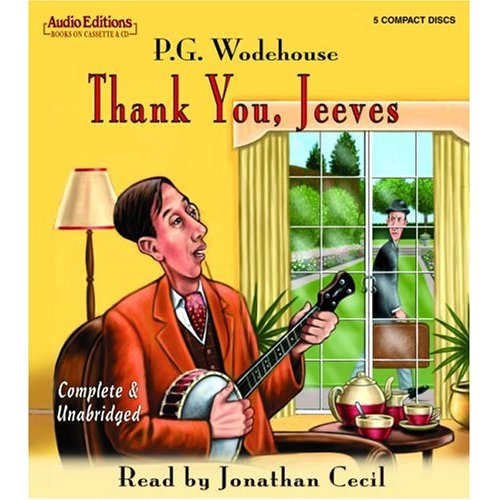
Thank You, Jeeves by P.G. Wodehouse (audio)

What a charming little venture into the British peerage. This may be a first for me, but I think the audio format actually improved this experience! (I actually have Right Ho, Jeeves at home in paperback, so I can compare then. Although the voice may already be established in my head… we may never know.)

Sir Pelham Grenville Wodehouse was an extremely prolific British humorist; he wrote plays, poems, short stories, novels, and more (I’m getting this mostly from Wikipedia, FYI, along with a general sense I’ve had of him). The stories in his Jeeves series are among his best-known, and I, not knowing much about him, decided to start there.

Thank You, Jeeves is just silliness, but of the most enjoyable sort.

Bertram Wooster (Bertie), our narrator, retires to the country when London society ostracizes his playing of the banjolele, and for the same reason he loses his valet, Jeeves, who can’t stand the playing of the banjolele any more than London can. Jeeves enters the employment of Bertie’s old friend Chuffy, who also houses Bertie in a cottage on his country estate. American millionaire Stoker shows up to discuss business dealings, along with his daughter Pauline, formerly engaged to Bertie, soon engaged to Chuffy. A rather Shakespearean case of mistaken identities, love triangles, and well-meaning bumblings ensues. (Like so often in Shakespeare, a good dose of Telling Everyone The Truth In A Forthright Manner would have solved everything early on, but then there wouldn’t have been a funny book.) Also in Shakespearean fashion, the servant Jeeves is a sharper tack than his employers. Eventually the talented, intelligent, well-read, scheming, and discreet Jeeves solves everyone’s problems up neatly, reuniting several estranged couples, keeping everyone out of jail, and even returning Bertie to London where he belongs, and himself to Bertie’s employ. But not before I get to enjoy all sorts of hilarity and irony, in the events of the book but most especially in the dialog. I think this Wodehouse is a master of goofy dialog, and this narrator Jonathan Cecil performed it admirably. Husband did not follow the action at all but greatly enjoyed hearing the characters exclaim over Lord Whatwhatly (I don’t know how this is spelled as I was listening, not reading, but it is funny-sounding).

I will definitely search out more Wodehouse; he is deserving of his fine reputation as a humorist. This was funny and lighthearted and easy to “read.” I recommend.

Nothing to Lose by Lee Child (audio)

Lee Child is one of my favorites, as you will know if you’ve been following my blog. His serial character, Jack Reacher, is a tough guy with a good heart who travels the country with nothing but his ATM card, an expired passport, and a folding toothbrush to slow him down. He’s a retired military policeman, just trying to enjoy the scenery, but he keeps getting pulled into hairy situations in which he decides to right the wrongs of the world and protect the little people.

In Nothing to Lose, we observe yet another of those episodes. Reacher is trying to travel diagonally across the country, from Maine down to San Diego. While moving west across Colorado, he stalls in a town called Hope, unable to hitch a ride into the neighboring town of Despair. (Yes, these names have meaning. You’re so sharp!) So he walks instead, but only to discover that the inhabitants of Despair don’t want him around.

Reacher eventually teams up with the sometimes-reluctant Officer Vaughan of the Hope PD. The town of Despair seems to have a lot to hide. At first glance, it’s an unpleasant little company town, owned entirely by the self-satisfied owner of the metal recycling plant, Mr. Thurman, who is also the mayor and the lay preacher. But there’s oh so much beneath the surface, including ties to international military concerns; and Mr. Thurman and his thugs are willing to go to great lengths to get Reacher, and any other stranger, far away.

This, along with the last Reacher I read (or rather, listened to), Gone Tomorrow, tackles issues of politics, the military and US foreign relations. Reacher is surprisingly anti-war, for being military – that is, not anti-war exactly, but against stupid wars of racism and oil-sucking that get American kids killed. He’s a very rational, thinking man. I like this about him. Don’t worry, the politics are way, way background.

Like all the Jack Reacher novels, this one is fast-paced, suspenseful, exciting, and has sympathetic, likeable, complex characters. You’ll be on the edge of your seat; you’ll care very much about what happens. You’ll be outraged along with Reacher, you’ll cheer him on, and you’ll be first impressed and then feel vindicated by his prowess.

I definitely enjoy the Reacher series on audio. Dick Hill is great at Reacher; he’s started to be Reacher inside my head. These get me to and from work very happily every day. 🙂 Thanks Lee Child and thanks Dick Hill, and keep ’em coming! (Unabridged, please.)

the audio format

I think this post has been somewhat overdue. I mentioned here a while ago that I found the audio format difficult; but in the last several months, I’ve gradually found audiobooks to be a useful addition to my life. I spend about an hour a day in the car just getting to and from work – which I believe is well below average for here in Houston, but is still a good amount of time. I started listening to audiobooks in the car, and never looked back.

I’ve been meaning to dedicate a post here to the question of format, and I got a special prompt yesterday from Sheila over at Book Journey.

So first, the audiobook format. I guess my greatest difficulty at first was just with getting used to somebody else filling in some of the holes that I’m used to filling in for myself: inflections, pace at which characters talk, what their voices sound like. I still find myself taking issue, occasionally, with a reader’s interpretation of a line of dialogue. My other real problem is with the inability to pause and reread. I mean, yes, I can pause and rewind my cd player – but I’m trying to drive, and anyway it breaks up the momentum and flow of a story in a much different way than it does when I’m reading. I like to pause and contemplate while reading, and the audio format is just plain old less tolerant of this habit.

These quibbles aside, however, I’ve come to really enjoy the time I spend listening to books in my car. What used to feel like lost time now is time spent… reading! The reading time I gain is worth my little complaints.

But that said, there are books that are appropriate for audio, and those that aren’t. I like to listen to genre fiction – like murder mysteries – good, fast-paced, entertaining books. For example, I have fully embraced Lee Child’s Jack Reacher series on audio. The reader, Dick Hill, is great; his Reacher voice feels right to me (and what a deal-breaker it would be if it didn’t!), and even if I differ with his timing or inflection occasionally (am I an outrageously picker listener? do you do this too?), I consistently enjoy his work.

I use the audio format to try out new genre authors, too. For my job as a librarian, I like to broaden my horizons when possible; I won’t like every author I encounter, but at least I can better understand what my patrons want when they request something like Stuart Woods (ugh). I intend to pick up some romance on audio soon; I have many dedicated romance readers as my patrons, and although it’s not my genre of choice, I should stay abreast. For that matter, I haven’t really hated any of the few romance novels I have read. I’ll pick a short one. 🙂

On the other hand, there are books I wouldn’t so much want to listen to on audio. For example, the book I’m reading right now, Fire Season, is a beautiful, lyrical meditation on the outdoors, the natural history of the American Southwest, and much more. I’m relishing each line slowly, and I need the option of flipping back a few pages here and there. It just wouldn’t be enjoyable for me to try to follow it at a reader’s relentless pace, with the necessity of rewinding to try and find that sentence I wanted to hear again. Audiobooks have their place – in my life at least, and there’s a limit to that place.

Now to answer Sheila’s questions! Her post is about the problem of becoming engrossed in an audiobook and having to take it inside. I have SO done that! (See above re: my preference for fast-paced, suspenseful mystery/action audiobooks.) And then I discover a new problem: audiobooks really do belong in the car, for me. Even the most exciting one puts me to sleep eventually if I take it inside to listen to from the couch, lol. No, I have found some utility for them in the house, for doing chores like washing dishes. But mostly, they need to stay in the car. I definitely can NOT do like Sheila and listen to several at one time. I read one book and listen to one audiobook at a time, in general; of course I do pick up and put down books from time to time, so that I sometimes have more than one going at once. I think most of us do that. But as a general rule, I like to stay more or less faithful. It helps keep my thoughts in order so I can write a cogent review for you here! Plus, if I were to have 5 or 6 books going at a time, it would take so long to finish one!

I guess I’ve rambled on. Thanks Sheila for the inspiration for this post. My conclusion is, I do have an appreciation for the audio format. I think I’d prefer to read print books exclusively if I had my way, but at certain times (which for me means driving and little else, but to each her own) the audio version is a great solution.

You can see ALL the audiobooks I’ve read recently here.

guest review: Suite Française by Irène Némirovsky (audio), trans. by Sandra Smith – from Pops

I have an exciting guest reviewer today: my father. He’s off for the season now – he leaves Houston for the hot months (must be nice to be retired!) and does all his favorite things: running, riding his bike, camping and hiking and visiting beautiful outdoor settings all over. Not to mention, visiting all the great craft beer and brewpubs he can find. He’ll settle for a few months at a time in some hip small town with the right combination of culture, outdoors, and beer; and he’ll move on for the next attraction. This summer I sent him off with a small collection of audiobooks for all that driving, and he has hesitatingly agreed to see about writing up his reactions to them for me to post here. Today he’s sharing with us his thoughts on Suite Française by Irène Némirovsky. Pops, you’re on.

This is not a major work, but is indeed unique, intriguing and noteworthy in a number of respects.

Synopsis: this is a work of fiction written contemporaneously with the author’s own experience during the 1940 German onslaught in France and the subsequent occupation and collaboration. Unlike many journal-type works from the period, this is stylishly written with a now-familiar formula using a cast of fictional, intertwining characters to personalize incidents and experiences amidst real-life events. (Among a number of intriguing questions raised by this work – was this formula at all established at the time?)

For me, this reading was reminiscent of Winds of War (Herman Wouk, 1971); while not nearly as ambitious in scope (actually, a strength), Suite Francaise was as engaging both for the characters as well as for revealing historical nuance. I thoroughly enjoyed it, spent time reflecting over it, and was left wishing for the narrative to continue.

So – what’s exceptional about it?

First, much of the impact derives from knowing the author’s own story and how the book came to life. Born 1903, she was a Russian Jewish immigrant to France (1918), converted to the Catholic Church (1939), published numerous works of renown before the war (including one brought to film), was denied French citizenship in 1938 due to Jewish heritage, and has since been criticized for being a self-hating Jew. She was in the course of writing this work as events unfolded, expecting to create a novel in 5 parts. She finished two parts, was denounced by French collaborators and deported to Auschwitz where she died within a month. Many more of her writings were published since the war. But her daughters retained this notebook manuscript, keeping it unread until 1990 due to anxiety over the expected pain of reading her wartime “journal” – only then, before donating the pages to an archive, did they realize what powerful words those pages held. Written 1940-42, it was published in 2004, acclaimed, translated and read internationally.

Reading with this background, there are numerous elements that may gain impact or raise questions either in the context of her own experience or a clear sightline to contemporary thinking of the time.

  • There are a number of musings by characters and narrator about the future during and after the war that raised chills for me knowing they were written so early in the war.
  • The story contrasts individuals’ different experiences of war, from common civilians feeling powerless and distant from the passions of aggression versus the anonymous, indistinct elites and politicians driving the conflict.
  • She sharply depicts still-thriving class contradictions that threaten to surmount the national conflict: aristocrats of mixed national heritage, communists, resistance fighters, the Church, city vs provinces, villagers vs farmers.
  • There is one passage that strongly evokes scenes from Lord of the Flies. This includes one of several “arbitrary” non war-related deaths in the story. I was left wondering about the origin and meaning of these.
  • Aristocrats and other characters tending to be collaborators make reference to their sympathies opposing the advance of Jews, communists and Freemasons (a triad central to Nazi propaganda). Freemasons?
  • How the French characters respond to the war depends greatly on whether they experienced the “first war” only 25 years (and one young generation) earlier, or the 1870 war (with Prussia, resulting in a victorious German Empire); for the entire society the immediacy of both was stunning.
  • As often occurs with translated works (and in this case the separation of 60+ years), numerous passages had me wondering about the author’s full meaning.

Well you’ve sold me on needing to read this book; and I certainly didn’t know any of that backstory, which does indeed enrich the experience. Thanks for the guest post! Please do give us more as you keep listening!