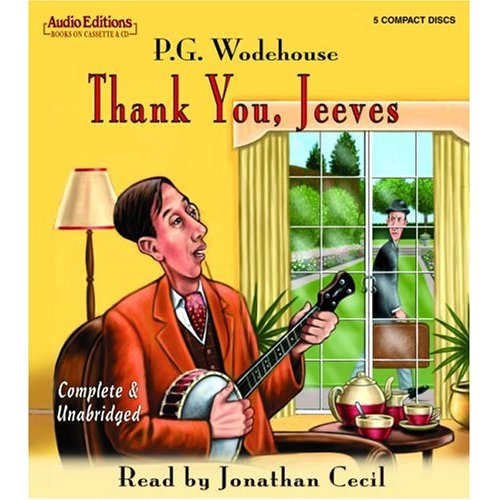
Thank You, Jeeves by P.G. Wodehouse (audio)

What a charming little venture into the British peerage. This may be a first for me, but I think the audio format actually improved this experience! (I actually have Right Ho, Jeeves at home in paperback, so I can compare then. Although the voice may already be established in my head… we may never know.)

Sir Pelham Grenville Wodehouse was an extremely prolific British humorist; he wrote plays, poems, short stories, novels, and more (I’m getting this mostly from Wikipedia, FYI, along with a general sense I’ve had of him). The stories in his Jeeves series are among his best-known, and I, not knowing much about him, decided to start there.

Thank You, Jeeves is just silliness, but of the most enjoyable sort.

Bertram Wooster (Bertie), our narrator, retires to the country when London society ostracizes his playing of the banjolele, and for the same reason he loses his valet, Jeeves, who can’t stand the playing of the banjolele any more than London can. Jeeves enters the employment of Bertie’s old friend Chuffy, who also houses Bertie in a cottage on his country estate. American millionaire Stoker shows up to discuss business dealings, along with his daughter Pauline, formerly engaged to Bertie, soon engaged to Chuffy. A rather Shakespearean case of mistaken identities, love triangles, and well-meaning bumblings ensues. (Like so often in Shakespeare, a good dose of Telling Everyone The Truth In A Forthright Manner would have solved everything early on, but then there wouldn’t have been a funny book.) Also in Shakespearean fashion, the servant Jeeves is a sharper tack than his employers. Eventually the talented, intelligent, well-read, scheming, and discreet Jeeves solves everyone’s problems up neatly, reuniting several estranged couples, keeping everyone out of jail, and even returning Bertie to London where he belongs, and himself to Bertie’s employ. But not before I get to enjoy all sorts of hilarity and irony, in the events of the book but most especially in the dialog. I think this Wodehouse is a master of goofy dialog, and this narrator Jonathan Cecil performed it admirably. Husband did not follow the action at all but greatly enjoyed hearing the characters exclaim over Lord Whatwhatly (I don’t know how this is spelled as I was listening, not reading, but it is funny-sounding).

I will definitely search out more Wodehouse; he is deserving of his fine reputation as a humorist. This was funny and lighthearted and easy to “read.” I recommend.

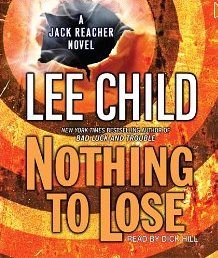
Nothing to Lose by Lee Child (audio)

Lee Child is one of my favorites, as you will know if you’ve been following my blog. His serial character, Jack Reacher, is a tough guy with a good heart who travels the country with nothing but his ATM card, an expired passport, and a folding toothbrush to slow him down. He’s a retired military policeman, just trying to enjoy the scenery, but he keeps getting pulled into hairy situations in which he decides to right the wrongs of the world and protect the little people.

In Nothing to Lose, we observe yet another of those episodes. Reacher is trying to travel diagonally across the country, from Maine down to San Diego. While moving west across Colorado, he stalls in a town called Hope, unable to hitch a ride into the neighboring town of Despair. (Yes, these names have meaning. You’re so sharp!) So he walks instead, but only to discover that the inhabitants of Despair don’t want him around.

Reacher eventually teams up with the sometimes-reluctant Officer Vaughan of the Hope PD. The town of Despair seems to have a lot to hide. At first glance, it’s an unpleasant little company town, owned entirely by the self-satisfied owner of the metal recycling plant, Mr. Thurman, who is also the mayor and the lay preacher. But there’s oh so much beneath the surface, including ties to international military concerns; and Mr. Thurman and his thugs are willing to go to great lengths to get Reacher, and any other stranger, far away.

This, along with the last Reacher I read (or rather, listened to), Gone Tomorrow, tackles issues of politics, the military and US foreign relations. Reacher is surprisingly anti-war, for being military – that is, not anti-war exactly, but against stupid wars of racism and oil-sucking that get American kids killed. He’s a very rational, thinking man. I like this about him. Don’t worry, the politics are way, way background.

Like all the Jack Reacher novels, this one is fast-paced, suspenseful, exciting, and has sympathetic, likeable, complex characters. You’ll be on the edge of your seat; you’ll care very much about what happens. You’ll be outraged along with Reacher, you’ll cheer him on, and you’ll be first impressed and then feel vindicated by his prowess.

I definitely enjoy the Reacher series on audio. Dick Hill is great at Reacher; he’s started to be Reacher inside my head. These get me to and from work very happily every day. 🙂 Thanks Lee Child and thanks Dick Hill, and keep ’em coming! (Unabridged, please.)

the audio format

I think this post has been somewhat overdue. I mentioned here a while ago that I found the audio format difficult; but in the last several months, I’ve gradually found audiobooks to be a useful addition to my life. I spend about an hour a day in the car just getting to and from work – which I believe is well below average for here in Houston, but is still a good amount of time. I started listening to audiobooks in the car, and never looked back.

I’ve been meaning to dedicate a post here to the question of format, and I got a special prompt yesterday from Sheila over at Book Journey.

So first, the audiobook format. I guess my greatest difficulty at first was just with getting used to somebody else filling in some of the holes that I’m used to filling in for myself: inflections, pace at which characters talk, what their voices sound like. I still find myself taking issue, occasionally, with a reader’s interpretation of a line of dialogue. My other real problem is with the inability to pause and reread. I mean, yes, I can pause and rewind my cd player – but I’m trying to drive, and anyway it breaks up the momentum and flow of a story in a much different way than it does when I’m reading. I like to pause and contemplate while reading, and the audio format is just plain old less tolerant of this habit.

These quibbles aside, however, I’ve come to really enjoy the time I spend listening to books in my car. What used to feel like lost time now is time spent… reading! The reading time I gain is worth my little complaints.

But that said, there are books that are appropriate for audio, and those that aren’t. I like to listen to genre fiction – like murder mysteries – good, fast-paced, entertaining books. For example, I have fully embraced Lee Child’s Jack Reacher series on audio. The reader, Dick Hill, is great; his Reacher voice feels right to me (and what a deal-breaker it would be if it didn’t!), and even if I differ with his timing or inflection occasionally (am I an outrageously picker listener? do you do this too?), I consistently enjoy his work.

I use the audio format to try out new genre authors, too. For my job as a librarian, I like to broaden my horizons when possible; I won’t like every author I encounter, but at least I can better understand what my patrons want when they request something like Stuart Woods (ugh). I intend to pick up some romance on audio soon; I have many dedicated romance readers as my patrons, and although it’s not my genre of choice, I should stay abreast. For that matter, I haven’t really hated any of the few romance novels I have read. I’ll pick a short one. 🙂

On the other hand, there are books I wouldn’t so much want to listen to on audio. For example, the book I’m reading right now, Fire Season, is a beautiful, lyrical meditation on the outdoors, the natural history of the American Southwest, and much more. I’m relishing each line slowly, and I need the option of flipping back a few pages here and there. It just wouldn’t be enjoyable for me to try to follow it at a reader’s relentless pace, with the necessity of rewinding to try and find that sentence I wanted to hear again. Audiobooks have their place – in my life at least, and there’s a limit to that place.

Now to answer Sheila’s questions! Her post is about the problem of becoming engrossed in an audiobook and having to take it inside. I have SO done that! (See above re: my preference for fast-paced, suspenseful mystery/action audiobooks.) And then I discover a new problem: audiobooks really do belong in the car, for me. Even the most exciting one puts me to sleep eventually if I take it inside to listen to from the couch, lol. No, I have found some utility for them in the house, for doing chores like washing dishes. But mostly, they need to stay in the car. I definitely can NOT do like Sheila and listen to several at one time. I read one book and listen to one audiobook at a time, in general; of course I do pick up and put down books from time to time, so that I sometimes have more than one going at once. I think most of us do that. But as a general rule, I like to stay more or less faithful. It helps keep my thoughts in order so I can write a cogent review for you here! Plus, if I were to have 5 or 6 books going at a time, it would take so long to finish one!

I guess I’ve rambled on. Thanks Sheila for the inspiration for this post. My conclusion is, I do have an appreciation for the audio format. I think I’d prefer to read print books exclusively if I had my way, but at certain times (which for me means driving and little else, but to each her own) the audio version is a great solution.

You can see ALL the audiobooks I’ve read recently here.

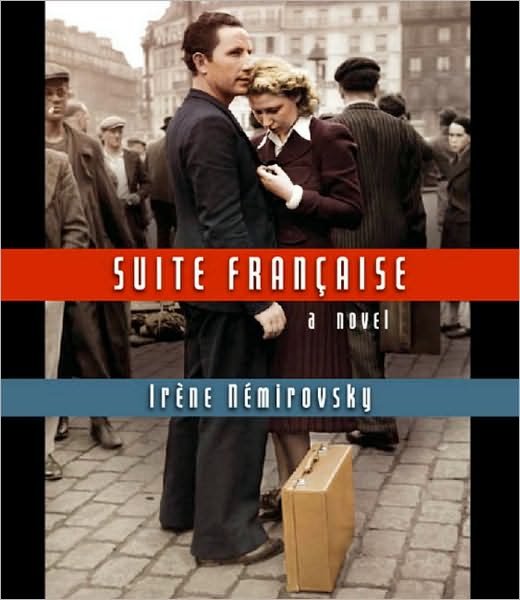
guest review: Suite Française by Irène Némirovsky (audio), trans. by Sandra Smith – from Pops

I have an exciting guest reviewer today: my father. He’s off for the season now – he leaves Houston for the hot months (must be nice to be retired!) and does all his favorite things: running, riding his bike, camping and hiking and visiting beautiful outdoor settings all over. Not to mention, visiting all the great craft beer and brewpubs he can find. He’ll settle for a few months at a time in some hip small town with the right combination of culture, outdoors, and beer; and he’ll move on for the next attraction. This summer I sent him off with a small collection of audiobooks for all that driving, and he has hesitatingly agreed to see about writing up his reactions to them for me to post here. Today he’s sharing with us his thoughts on Suite Française by Irène Némirovsky. Pops, you’re on.

This is not a major work, but is indeed unique, intriguing and noteworthy in a number of respects.

Synopsis: this is a work of fiction written contemporaneously with the author’s own experience during the 1940 German onslaught in France and the subsequent occupation and collaboration. Unlike many journal-type works from the period, this is stylishly written with a now-familiar formula using a cast of fictional, intertwining characters to personalize incidents and experiences amidst real-life events. (Among a number of intriguing questions raised by this work – was this formula at all established at the time?)

For me, this reading was reminiscent of Winds of War (Herman Wouk, 1971); while not nearly as ambitious in scope (actually, a strength), Suite Francaise was as engaging both for the characters as well as for revealing historical nuance. I thoroughly enjoyed it, spent time reflecting over it, and was left wishing for the narrative to continue.

So – what’s exceptional about it?

First, much of the impact derives from knowing the author’s own story and how the book came to life. Born 1903, she was a Russian Jewish immigrant to France (1918), converted to the Catholic Church (1939), published numerous works of renown before the war (including one brought to film), was denied French citizenship in 1938 due to Jewish heritage, and has since been criticized for being a self-hating Jew. She was in the course of writing this work as events unfolded, expecting to create a novel in 5 parts. She finished two parts, was denounced by French collaborators and deported to Auschwitz where she died within a month. Many more of her writings were published since the war. But her daughters retained this notebook manuscript, keeping it unread until 1990 due to anxiety over the expected pain of reading her wartime “journal” – only then, before donating the pages to an archive, did they realize what powerful words those pages held. Written 1940-42, it was published in 2004, acclaimed, translated and read internationally.

Reading with this background, there are numerous elements that may gain impact or raise questions either in the context of her own experience or a clear sightline to contemporary thinking of the time.

  • There are a number of musings by characters and narrator about the future during and after the war that raised chills for me knowing they were written so early in the war.
  • The story contrasts individuals’ different experiences of war, from common civilians feeling powerless and distant from the passions of aggression versus the anonymous, indistinct elites and politicians driving the conflict.
  • She sharply depicts still-thriving class contradictions that threaten to surmount the national conflict: aristocrats of mixed national heritage, communists, resistance fighters, the Church, city vs provinces, villagers vs farmers.
  • There is one passage that strongly evokes scenes from Lord of the Flies. This includes one of several “arbitrary” non war-related deaths in the story. I was left wondering about the origin and meaning of these.
  • Aristocrats and other characters tending to be collaborators make reference to their sympathies opposing the advance of Jews, communists and Freemasons (a triad central to Nazi propaganda). Freemasons?
  • How the French characters respond to the war depends greatly on whether they experienced the “first war” only 25 years (and one young generation) earlier, or the 1870 war (with Prussia, resulting in a victorious German Empire); for the entire society the immediacy of both was stunning.
  • As often occurs with translated works (and in this case the separation of 60+ years), numerous passages had me wondering about the author’s full meaning.

Well you’ve sold me on needing to read this book; and I certainly didn’t know any of that backstory, which does indeed enrich the experience. Thanks for the guest post! Please do give us more as you keep listening!

The Big Sleep by Raymond Chandler (audio)

I know Chandler as the mystery author who inspired, among others, Michael Connelly. Connelly is one of my favorite genre authors and cites Chandler as an influence on his work. In fact, Shelf Awareness quotes him (as their Book Brahmin on April 22, 2011), in answer to a question of the book that changed his life: “The Long Goodbye by Raymond Chandler. I was a casual reader of genre fiction. This book made me want to write it.” Thank goodness for that!

I read The Long Goodbye first (and before the above quotation!), and found it to be delightful. I recognized Connelly in his writing style and Harry Bosch in the style of his lead detective. (Of course obviously the influence went the other way around.) So when I saw The Big Sleep on audio – unabridged, necessarily – I snapped it up. I believe the latter was actually his most-renowned work.

You can’t help but like a guy who doesn’t write that “time passed slowly”, but rather writes

Another army of sluggish minutes dragged by.

That’s pretty great. And this:

‘It’s goddamn funny in this police racket how an old woman can look out of a window and see a guy running and pick him out of a lineup six months later, but we can show hotel help a clear photo and they just can’t be sure.’

‘That’s one of the qualifications for good hotel help,’ I said.

You see my point, right? There are some awfully clever, funny, classic moments in this story; Chandler is a fine writer with a distinct style.

The actual story qualifies, too, as clever, funny, and classic. It’s easy to see that this man is one of the fathers of the genre I love. I’m a bit ashamed to note that I’ve read mostly recent authors, and neglected their heritage.

In this novel, Philip Marlowe, PI, is asked to look into a little matter of blackmail for General Sternwood, who has two young, beautiful, highly deviant and troublesome daughters. Marlowe is a man of relatively few, but quite witty words. He fends off both sisters at various point or another while looking into the missing husband of one, unasked. He’s a classic PI; he drinks alone in the morning; I’m pretty sure he wears one of those pulp detective hats – a fedora? At any rate, he releases the Sternwoods from the blackmail and pulls all the pieces together at the end to explain the missing husband too. It’s a tidy little ending, crowned by some grumbled musings on The Human Situation and The Big Sleep.

I liked this book very much and recommend it to readers of detective fiction who want to go back to the genre’s roots.

Do you read in the present or in the past? Do you miss the past, if you read in the present? I know I love my current genre authors (Lee Child, Michael Connelly, James Lee Burke, Elizabeth George) but it’s important and definitely enjoyable also to appreciate the pioneers. I’ve enjoyed Agatha Christie, Raymond Chandler, and one little gem from A.A. Milne; I’ve got a P.G. Wodehouse waiting in the wings. What are YOU up to?

Slaughterhouse-Five by Kurt Vonnegut (audio)

Full title:

Slaughterhouse-Five, or the Children’s Crusade: A Duty Dance with Death

It seems a little odd to me that I’ve never read this book, and in fact I wondered if maybe I had, and had just forgotten. But as soon as we started listening to this audiobook (my parents and I, on the way home from New Orleans) I knew I’d never heard or read this book before. Vonnegut is always thrilling and fascinating! I know I really enjoyed his Cat’s Cradle and Breakfast of Champions, and Slaughterhouse-Five shares with them a very surreal, time-warped, rambling, fantastical tone. It feels like Fear and Loathing in Las Vegas, particularly the scene in the movie where they take the ether and things turn on their sides.

For those who don’t know, this is Vonnegut’s autobiographical story of the bombing of Dresden, which he experienced, like his protagonist Billy Pilgrim, as a POW in a slaughterhouse. Vonnegut, and Billy, survived only because they were holed up in the meat locker there, while the vast majority of the city burned.

Billy’s story involves war, bullying, sex, time travel, optometry, drinking, and misunderstanding. Overarching themes of death and timelessness tie the winding threads together. The world does not believe that Billy travels in time or that he was kidnapped by little green aliens from the planet of Tralfamadore. We hear of Billy’s whole life, as a small child, as a student, as a soldier in the war, as a young husband, as a professional optometrist, as a feature in a zoo on Tralfamadore, and as an old man. Like Billy, we don’t keep these experiences in sequence, but drop in here and there.

Billy’s story is preceded by a long intro in which Vonnegut narrates, not his experience as a soldier or a POW, but as a writer, many years later, struggling to write about Dresden. He visits an old war buddy and learns of this buddy’s wife’s fear of war. She’s concerned that he’ll write a book glorifying the experience and thereby encouraging future generations to make war. He reassures her that “there won’t be a part for Frank Sinatra or John Wayne” in his book, if he even ever finishes it. He also promises her he’ll call it “The Children’s Crusade”, agreeing with her that they were just babies over there.

This is a very powerful story. Descriptions of the horrors of war are evocative, perhaps even more so the depiction of the POW’s in the railroad cars passing steel helmets filled with their excrement to the men standing near the ventilation slots. War is bad. But there’s much more to this book than the point that war is bad; it’s also a fascinating story about family and relationships. (I’m reminded of Breakfast of Champions with its bizarre family structures and roles and dysfunction.) And the world of Tralfamadore is fantastical, incredibly imaginative, and so fully-developed in its details, I just wonder at Vonnegut. Where does he get this stuff? The turns of phrase are memorable. A drinking man’s breath smells of mustard gas and roses. That’s poetry.

This story is beautiful, strange, and strangely feels endless. It finishes with a question-mark; loose ends are not entirely tied up. How could they be, when events are presented out of sequence, and Tralfamadorian concepts teach that no one moment ever ends? Vonnegut was a genius, and I want to keep reading him all my life. (There are still a number of titles I haven’t touched, and were you aware? just this January, a new volume of his previously unpublished short fiction came out. It’s called While Mortals Sleep.) Oh, and I want to mention the reader of this audio version. He speaks in a strange whisper, and his style is very, very effective for this book. Guess who? None other than Ethan Hawke. I was surprised, and tried throughout to place this handsome actor behind the voice I was hearing; but I couldn’t put the guy I know from Reality Bites and Training Day into Vonnegut’s world. Very strange. I guess that’s the mark of a great actor, that he can fill different roles believably. I’m impressed.

Gone Tomorrow by Lee Child (audio)

YAY for Lee Child as usual! Especially after a couple of unimpressive audiobooks in a row, it’s been such sweet relief to hear Dick Hill’s deadpan narrative. I feel like he suits Jack Reacher very well.

Backstory: Jack Reacher is a serial character. He’s a former MP (military policeman), fairly decorated, who’s retired young to travel the country at random. He has enough money to get by just wandering, and seems to want to be left alone (although it’s not clear what would occupy him if it weren’t for the circumstances that keep drawing him in). He is repeatedly pulled, against his will, into events of dangerous or criminal intrigue, and he uses his general bad-ass-ness to beat up the bad guys and uplift the righteous little people.

I really appreciate Reacher. He’s a character that works for me very well. He’s almost a superhero – big, strong, smart, quick-thinking, and with a general inclination to do the right thing. He has integrity. He’s just about perfect; but just when he starts to really look like a caricature, we find he’s not so perfect after all. In Worth Dying For, the bad guys got him tied up and hurt for a little while; I was surprised to see him thwarted. But you can’t keep Reacher down. In Gone Tomorrow, too, he gets captured and held, but not forever! I’m not saying he’s an entirely realistic character or anything, but for my tastes, Child pulls back just in time, right before I say “oh, come on…”

And he’s not just a physical hero – although he is enormous, very strong, has no body fat, is a highly skilled gunman, a formidable hand-to-hand fighter, etc. He’s also smart, and an expert in all things military as well as in many other obscure areas of knowledge. It’s a bit uncanny, how much he knows and how much he can figure out. But in this area, too, he’s pulled back from the brink of cartoonish superiority: for example, Lila Hoth convinces him of the American military’s role in a time and place he didn’t think it was possible. I like that in this conversation he listens, asks discerning questions, and isn’t afraid to learn, even to be wrong. In short, Reacher is, to me, a real hero: almost perfect but with a few human deficiencies and – best of all – aware of them (rare though they be).

I also get these little nuggets of information. Like, he muses that there are experts out there who could look at the dimensions of the bricks, and the arrangement of them, in his unknown little dungeon-cell, and know pretty precisely where the building is and when it was built. But Reacher’s not one of those experts. (I’m paraphrasing the audiobook from memory.) See what I mean? It might have been just a little too much if Reacher had been the brick expert, too, on top of everything else. And what a cool little historical nugget. Of course there are brick experts; it makes perfect sense. It had never occurred to me, though.

At any rate, aside from my ramblings about the wonder that is Reacher, this is a good book. I love the little details. When Reacher wakes up after being drugged, he wonders how long he’s been out; with all four limbs bound, he ducks his head to rub his chin against his shirt, thereby feeling how much stubble he has. Now he can make an educated guess. This is a neat detail – evocative, realistic, and also impressive. Reiterates how proficient this guy is. I just hope we really do have guys this effective in our military and/or law enforcement systems.

I came across just one or two points of contention. I think the 9/11 aftermath and international politics was rather clever but also rather pat; 9/11 politics is a fairly common thread in mystery-intrigue genre fiction, and I was a little disappointed and a little bored there for a minute, although Child handled it fairly uniquely. And I was a little bothered by a certain person, for whom English is not a native language, uttering sentences like “…you employed a deductive process. Do you think you are uniquely talented? Do you think that deductive processes are unavailable to others?” This didn’t sound very realistic for this character to me.

But overall this was another great Reacher story. Fast-paced, gritty, suspenseful, funny and witty, and, for me, just the right balance of realism and hero-worshipping-fantasy. Go get you some Jack Reacher right now if you have any interest in action-adventure, mysteries, intrigue, or loveable heroes.

book beginnings on Friday: Nothing to Lose by Lee Child

Thanks to Katy at A Few More Pages for hosting this meme. To participate: Share the first line (or two) of the book you are currently reading on your blog or in the comments. Include the title and the author so we know what you’re reading. Then, if you feel so moved, let us know what your first impressions were based on that first line, and let us know if you liked or did not like the sentence. You might also consider stopping by the original post.

I am listening to this one in the car on audio. (You will note, if you’ve been following, that I am listening to more and more audio. More on that later, but suffice it to say the format is more or less working for me.) I love my Lee Child… Here’s your book beginning:

The sun was only half as hot as he had known sun to be, but it was hot enough to keep him confused and dizzy. He was very weak. He had not eaten for seventy-two hours, or taken water for forty-eight.

I have faith, Reacher! Especially as there’s so much more yet to come. 🙂

The Pied Piper by Ridley Pearson (audio)

Another effort to become more universally familiar with the mystery genre. Another lackluster review; but to be fair, two things: 1) the Husband and I listened to the abridged audiobook, and I’m going to go out on a limb and say that it was very heavily abridged. 2) this was a fair audiobook. Passable. Got us through Tyler and almost up to Texarkana. Which is to say, vastly superior to Shoot Him If He Runs.

It was just a bit too rushed. In only 3 cds, I’m going to assume we lost quite a bit of character and plot development. Even at this rate, the characters were interesting and likable; I’m genuinely concerned about Boldt’s wife who’s dying of leukemia and intrigued by her spirituality. I wanted to get to know these people better and, to give Pearson the benefit of the doubt, I’ll guess that I could have, if I had read the unabridged book. This level of abridgement hurt the flow, style, and interest of the plot, assuming it was a good book to begin with.

Would I give Pearson another try? I’d be willing to if he fell in my lap at the right moment. I’m not against him.

Shoot Him If He Runs by Stuart Woods (audio)

I tried Stuart Woods out because he’s popular with some of my library patrons and I want to be as well-rounded as possible, especially in the mystery genre which is my personal favorite.

Shoot Him If He Runs sees Stone Barrington return to the scene of earlier action on the small Caribbean island of St. Mark’s with ex-girlfriend and CIA spy Holly Barker. There is governmental corruption (no mysteries there); there are vodka gimlets, nude beaches, beautiful people, and other accoutrement of the good life; there is a a very talented former-CIA spy, master of disguise, now thorn-in-the-side of the CIA, who Stone and Holly are trying to find and identify. There is no action, terrible dialog, no intrigue, a tiny touch of gratuitous and pointless sex, undeveloped characters and unexplained lose ends. I don’t know what to say that’s nice about this book. I fell asleep during some of the most important parts, but I don’t think it mattered (the Husband was driving and therefore presumably awake throughout and could name no redeeming features) and is only a statement of my feelings about the action. I guessed what was coming at about halfway through. Then I went to sleep.

I’m sorry, Stuart Woods. I wanted to see what so many of my older male patrons like about you, but I just didn’t.

I’m pretty sure I won’t pick up another Stuart Woods novel again unless I’m in serious book-deprived distress, but that’s a state I’m generally able to avoid.


Edit: I asked Husband to share his perspective for us, and he said “It’s no Reacher. [referring to Lee Child’s Jack Reacher series we both love so much] No suspense.” There you have it, folks: the succinct review. Well put, Husband.