Without Fail by Lee Child (audio)

Reacher is back!

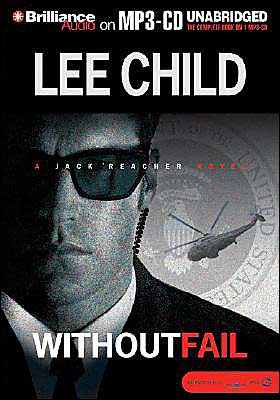
This one follows Echo Burning, my very first Lee Child read. Reacher has just hitchhiked cross-country, from Los Angeles to Atlantic City, with a pair of musicians who, while minor characters, I came to appreciate. Reacher’s interactions with these minor players help to form his character as a basically good-hearted and generous guy; he goes out of his way for them. In Atlantic City, Reacher is tracked down by a Secret Service woman who knows him through his brother Joe, her ex-boyfriend. She wants to hire him to assassinate the Vice President elect. Weird, right? No, she wants him to sort of mock-assassinate. It’s meant to be a security audit. But of course, the reason why she wants a security audit is… someone is trying to kill the Vice President. (Elect).

I have to confess that my first reaction to the plot premise was… do Vice Presidents really get assassinated? I thought the old joke was that they were sort of insignificant, until somebody assassinates the President. At any rate, I gladly buy in because it’s a fascinating storyline. So Reacher is working with Froehlich – that’s Joe’s ex, the Secret Service ace – and Neagley, a fellow retired MP and general badass who Reacher calls in. Neagley was a fun character to meet, too: she’s got skills and smarts much like Reacher, and they’re clearly pretty close, but she also has baggage that I’d love to learn more about in a later novel. The layers that are discovered! Well, so we spend a lot of time in DC for obvious reasons, and also in North Dakota where the VP-elect has been serving as Senator; and the final scene takes place in the middle of nowhere in Froehlich’s home state of Wyoming. It’s a well-traveled book (have you been counting? CA, NJ, DC, ND, and WY) and naturally ends with a bang.

I have just a handful of new observations with this listen. As stated, I’m really enjoying some of the minor or side characters. I have also noted something in this book that I’ve been unconsciously appreciating throughout this series: Child presents back-story, technical details, and general exposition in a smooth and natural way. You know how sometimes, if we need to know that the kid goes to soccer practice every Wednesday, the mom will say to the dad, “Can you pick up Billy from his usual Wednesday night soccer practice this week even though I usually do?” And that’s silly, because real people don’t put in all that detail in dialog when the other person already knows it? Child does it better.

Also, I’m beginning to notice speech patterns. Reacher has a way of ending a lot of his statements with a rhetorical “…right?” As in, “so, we need to get there first, right?” It’s just one of those colloquialisms people have. But what I think I noticed in this book is… other people have the same verbal habits. I’m not sure that’s entirely realistic, since one of the features of the Reacher books is travel, geographic instability, everybody being from different places. Reacher even emphasizes this, observing from people’s speech and clothing that they come from different parts of the country; he’s really big on regionalism. I like those touches. But everyone having the same rhetorical “…right?” seems somehow less authentic. I don’t know, it’s just something I noticed.

Along the same lines, I think I’m beginning to hear narrator Dick Hill (who I love for this series!) use the same voices for several different characters. All women, I think, and that may explain it; it may be difficult for his deep man’s voice to come up with different female-character-voices. But still. I guess I’m beginning to recognize patterns. Is it perhaps time for a break from Reacher? Ha ha ha. NO! I’m still loving it. Don’t take my Reacher away.

Teaser Tuesdays: Without Fail by Lee Child

Teaser Tuesdays is a weekly bookish meme, hosted by MizB of Should Be Reading. Anyone can play along! Just open your current read to a random page and share a few sentences. Be careful not to include spoilers!
Yet another Lee Child! Yes! In this one, Reacher is hired to try to assassinate the vice-president of the USA. You know, as a sort of security audit; not for real. But is somebody out there trying the same thing – for real? (My first reaction to this is, the vice-president? Really? Do they get assassinated?) Here’s your teaser:

The guy on the right took his hands out of his pockets. He had the same neuralgic pain in his knuckles, or else a couple more rolls of quarters. Reacher smiled. He liked rolls of quarters. Good old-fashioned technology. And they implied the absence of firearms. Nobody clutches rolls of coins if they’ve got a gun in their pocket.

Yes, I used more sentences than prescribed, but wasn’t it worth it?

Booking Through Thursday: reading aloud

Ack, sorry folks, I know I’m filling us right up with posts this week!! But I couldn’t resist today’s BTT topic, because it brings back such memories.

Booking Through Thursday asks,

1. What do you think of reading aloud/being read to? Does it bring back memories of your childhood? Your children’s childhood?

2. Does this affect the way you feel about audio books?

3. Do you now have times when you read aloud or are read to?

1. I can remember being read aloud to, barely; my parents took that parental duty very seriously, which I think is the obvious beginning of my lifelong love of reading. I also went to a sort of experimental preschool where, among other things, they taped me reading aloud; hearing some of those tapes a little later in life was awfully funny. The little-me voice reading aloud and critiquing and imagining and adding onto what I read was very interesting. I believe my parents and I took turns reading chapters aloud to each other when I was old enough for “chapter books.” (I also know I had to be made to turn the lights off and stop reading to go to sleep.)

2. Audiobooks? I don’t think I’d much made that connection, although obviously that’s what an audiobook is: somebody reading aloud to me. Interesting. I had some trouble getting into the audio format, but did finally catch onto it this year, finding my commute time to be a good way to get some more reading in. Did my early-life reading aloud (and being read to) affect my current appreciation of audiobooks? I don’t know, but I do appreciate them!

3. Not much, but yes: Husband doesn’t really read much (until I pushed the audiobooks upon him! oh joy!), but I so wanted him to enjoy The Old Man and the Sea that I read it aloud to him on one long car trip. (To Eldorado, maybe? I don’t remember.) He did appreciate it. I have an interest, too, in sharing the Odyssey with my friend Gala by reading aloud – since it was originally an orally recited “book,” it seems like such the perfect way to enjoy it. We’ve talked about it but never gotten it together; perhaps it’s finally time? And, while I’m thinking of Gala, I remember The Lincoln-Douglas Debates which I was to read for class in college (as an undergrad political science major). I was having trouble with it, and finally teamed up with Gala’s son, my best friend, and we read them aloud to one another, taking turns, like I did with my parents when I was small. This way we got to debate and discuss as we went, and the topics came alive to me, which of course helped me in class.

I do think that reading aloud is very important for little kids – that’s where you get to begin to instill a love of reading! – and for adults, as well. It allows a different kind of connecting to the book; sharing the experience with another person means discussion and greater involvement, and generally greater enjoyment. I think there’s an obvious application for study, but also for pleasurable reading of fiction or whatever you like. Yes please to read aloud!

Tripwire by Lee Child (audio)


Y’all, I just have to tell you something as an aside: I suspect I’m pretty unique in this, because I know so many strict series-in-order readers, but I LOVE reading out of order. Is there something wrong with me? I love the fun feeling of knowing something the in-order reader won’t. Rather than ruining the surprise (which, honestly, I don’t think I can remember happening to me ever!) I often find it enhancing things; it’s like a whole new fun, knowing what’s coming, especially in that moment of realization. In Tripwire, for instance: I will try to do this nonspoilerarily, but there is a character we meet for the first time, who I pretty quickly recognized as a character from a later book I’ve read. So I had this moment of OH! she will be THIS later, and now I have a new angle from which to watch the action unfold: I’m looking for hints of what I know is to come. No, I don’t want to know who the bad guy is right from the start. But that’s not the kind of thing I find spoiled by a series out of order. Perhaps this is because often, in mystery series, we don’t see the same bad guy in book after book. Or if we do, it’s not the FACT that he’s the bad guy that drives the later book – it’s finding him. So, no spoiler. See? Flipping to the end would spoil the book; reading the book after the book often does not. On the other hand, though: knowing that there are more Reacher books after 61 Hours definitely does spoil the question of whether or not he survives. I guess the only way to be cliff-hanged on that one was if you read it when it came out and before the next in the series…

I’m sorry. Back to Tripwire. Ahem. I loved this book… I seem to say this every time… this is one of my favorites of the series. It opens in Key West, which is fun because we were just there recently. I love the idea of Reacher digging swimming pools (by hand!!) and getting even more muscled, gaining weight, and getting a tan while he’s at it. I also love that he’s drinking lots of water. I’m a fan of water, too, and like Reacher I like mine at room temp, not cold. I’ve digressed again. So we open in Key West but then quickly move up north to New York City, where Reacher is reunited with a friend from his past. Again I’m working to avoid spoilers here, but the relationship, past and present, was extra special to me because it continues to develop Reacher’s character, and is especially poignant in exposing his strong emotions and vulnerability. What makes Reacher so loveable is that he is a Rambo superhero type, yes, and also very clever, but also vulnerable. There are humorous moments. Will the house have… closets?? (Go read it, you’ll understand.) And of course the mystery is clever and complex and kept me guessing. I love Reacher’s deductions, like in dealing with decades-old skeletal remains – this puzzle dates back to the Vietnam War – and I love how it ends, with a new chapter in Reacher’s life.

I recently bothered you with a rundown of my reading of Reacher to date. While putting together that list, I realized that they fall into two categories for me: memorable, and not so much so. I’ve enjoyed every single Reacher I’ve read, but some I LOVE and continue to mull over after the fact, and some, in compiling my list, I had to reference to even see what they were about. (The titles are not always descriptive of the action of the book.) Are you curious? Below, see those I have read and loved, those I have read and mostly forgotten, and those I have not yet read. (For links to my reviews, see this post.)

1. Killing Floor
2. Die Trying
3. Tripwire
4. Running Blind
5. Echo Burning
6. Without Fail
7. Persuader
8. The Enemy
9. One Shot
10. The Hard Way
11. Bad Luck and Trouble
12. Nothing to Lose
13. Gone Tomorrow
14. 61 Hours
15. Worth Dying For
16. The Affair
and the short story, The Second Son.

Tripwire ranks up there. I fear my Reacher reviews are getting repetitive for you. Excellent as usual. Continuing on with Without Fail next. What are YOU reading?

Teaser Tuesdays: Tripwire by Lee Child

Teaser Tuesdays is a weekly bookish meme, hosted by MizB of Should Be Reading. Anyone can play along! Just open your current read to a random page and share a few sentences. Be careful not to include spoilers!


Here’s my confession. Those of you who were paying close attention may have caught the *brief* posting of the teaser below a few weeks ago, incorrectly attributed to the book just before this one in the Reacher series, Die Trying. I’m trying again; it’s actually from Tripwire, which I’m adoring. I think it’s a great teaser and it wasn’t up very long on that day so once more…

Here is your teaser from page 432:

An hour later Reacher was drifting down Duval Street, thinking about new banking arrangements, choosing a place to eat an early dinner, and wondering why he had lied to Costello. His first conclusion was that he would cash up and use a roll of bills in his pants pockets.

It was fun that this teaser visited Key West, because Husband and I have just returned from that very island.

Die Trying by Lee Child (audio)

I fear that it’s beginning to test my powers of creativity to review these Reacher books. For one thing, yes, I admit it, they are rather alike. The general plotline is: Reacher is wandering aimlessly. He stumbles into a situation of danger (or it stumbles into him), generally danger to someone else, a relatively defenseless individual, possibly of the attractive and female persuasion. He becomes involved. There is intrigue, mystery, different bad guys than we originally thought; usually there is an attractive female; there is violence, fighting, skill and cleverness. Reacher wins at all the various contests; there’s a satisfactory ending for the good guys and he rides off into the sunset.

This is so SATISFYING though, I still like reading it. Reacher is such a big cute clever badass, I never tire. And it doesn’t hurt that Child keeps the intrigue intriguing, and suspenseful, and smart enough that the puzzle keeps me engaged right through to the final nailbiting moments. Keep ’em coming, Child, they’re still doing it for me even if there is a formula.

The other reason my creativity is being challenged is the already-evident fact that I just rave about them on and on. So now that I’ve admitted that, I’ll give you the plot and try to keep the raving to a minimum.

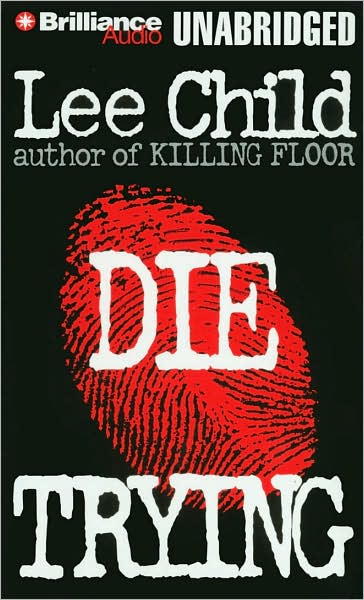
In Die Trying, the second book in the series, Reacher stops in the doorway of a Chicago drycleaners to help a young, attractive woman with a crutch who is mid-stumble and about to drop her drycleaning. In the moment of their contact, she is kidnapped at gunpoint by three goons, who see fit to just take Reacher along for the ride. The woman, Holly, turns out to be an FBI agent – quite a good one – with some lofty connections, and they are being driven cross-country for reasons unknown. There is attempted rape, and a crazy right-wing militia bent on establishing a new nation in the Montana wilderness. The FBI and the US military higher-ups are involved; it is unclear to various parties which side other various parties are on; as Raych noted, there’s dynamite. The above formula is followed, but as always, there will be some surprises.

I love it; it’s a very satisfying formula. And here’s the thing: I think I keep saying this, but I think it’s the best one yet! I can’t decide. Echo Burning was my very first Reacher experience, and holds a special place for me because of the South Texas setting. Strangely, I really liked One Shot for all the gun stuff. But The Hard Way has to be one of my top two or three, because of the high stakes and how much I got invested in the little family unit that was at risk, and especially the little girl and the horrible danger she was in… and I really liked Reacher with the lady-friend in that one, too. The small family he forms towards the end was the one I mourned the most, knowing he must move on as always. Worth Dying For also had very high stakes that upped the tension a notch for me. I guess those are my favorites…

So, I do have a problem with always liking “this one” the best. But Die Trying is a new favorite, too! The militia was an interesting twist for a bad guy. There was a psychological-thriller aspect to it. (I don’t want to give away too much.) And, what can I say, I never tire of Reacher’s ability to figure things out quicker than his peers.

If you’re interested, I mildly recommend to you that you start at the beginning of the series, with Killing Floor, but only mildly. If you start in the middle you may find yourself very satisfied – just look at me.

Teaser Tuesdays: Tripwire by Lee Child (audio)

Teaser Tuesdays is a weekly bookish meme, hosted by MizB of Should Be Reading. Anyone can play along! Just open your current read to a random page and share a few sentences. Be careful not to include spoilers!

Love my Lee Child on audio, y’all. It was especially fun to find this one starting off in Key West, since we (thought we) were headed there on vacation a few weeks ago. Not that Reacher sticks around in Key West for long, though; this one mostly finds us in New York, so far.

Here’s your teaser:

An hour later Reacher was drifting down Duval Street, thinking about new banking arrangements, choosing a place to eat an early dinner, and wondering why he had lied to Costello. His first conclusion was that he would cash up and use a roll of bills in his pants pocket.

Stop back by and I’ll have a review for you shortly! What are you reading this week?

In Cold Blood by Truman Capote (audio)

Truman Capote captured my undivided attention with this medium-largeish* book in remarkable fashion. My first issue for this review: is this fiction, or non? It is most commonly referred to as a “nonfiction novel,” a term I have a lot of trouble with. The story is either based very closely on, or is, the true story of the quadruple murder of the Clutter family in small-town Kansas, and the investigation, arrest, and eventual execution of the two perpetrators. (My library’s OCLC listing calls it “postmodern fiction.”) Capote himself said, “I wanted to produce a journalistic novel, something on a large scale that would have the credibility of fact, the immediacy of film, the depth and freedom of prose, and the precision of poetry.” So, fiction or non? I’m going with fiction, but clearly this is one of those areas where the line blurs. More on that in a bit.**

I came across this book recently in several blogs, which is curious because it’s not new; it was first published serially in Life magazine in 1965, and in book form in 1966. I already had the book on my radar, but these fine fellow bloggers definitely solidified my interest. In telling you about the story, and the book constructed about the story, I’m going to be fairly spoilery, because this is history. If you want to read it yourself and be surprised, I’m not your top-choice review.

So. The subtitle reads, “A True Account of a Multiple Murder.” On the night of November 15, 1959, the Clutter family was bedding down on their farm in Kansas, just outside the small town of Holcomb, itself a suburb of Garden City. Herbert Clutter, the patriarch, was a respected member of the community and devout Methodist; his wife Bonnie had been suffering from depression and had been in and out of hospital, but at this time was home. Sixteen-year-old Nancy, the belle of local society, sweet, talented, generous, and universally beloved, had just sent her boyfriend Bobby home and was getting ready for bed. Fifteen-year-old Kenyon was slightly socially awkward but friendly and respected as a member of a well-liked and important family. The two older Clutter daughters were living on their own outside the home – one married, one about to be.

Meanwhile, two paroled convicts of the Kansas state prison system were on the road. Perry Edward Smith and Richard Eugene “Dick” Hickock had been cellmates and although very different in temperament, had teamed up for an endeavor that Dick described as being the perfect crime. As you’ve already guessed (or already knew), these six characters converge when Dick and Perry kill the Clutters in the night and make off almost as perfectly as Dick imagined. They spend months traveling, living briefly in Mexico where Perry hoped to become a successful treasure hunter, and then roaming the US again until they were apprehended in Las Vegas. They were tried in Kansas, convicted, and finally hanged in April of 1965.

Capote follows both groups of characters – the Clutters, and Perry & Dick – alternately in the days leading up to the night of the murder. Then he follows Perry and Dick in their roaming, and then through their imprisonment and trial, and right up to the hangings. His voice is omnipotent third person, and he quotes extensively from letters, documents, and trial proceedings, as well as from his interviews with various players and especially Dick and Perry themselves. Capote was on the case (so to speak) well before they became suspects, and published after they were killed, so his perspective and the timeline of his coverage is pretty extensive.

But, perhaps not entirely objective. The Clutters are painted in admirable detail, in lovely little vignettes. But their role is minor and short-lived (ouch, pun not intended). And of the two killers, Perry Smith is treated far more sympathetically and examined more deeply. I was pondering this as I listened to the book, wondering if this was all Capote’s apparent subjectivity, or if Perry was inherently more sympathetic; in other words, would I have found him so if I had been researching this case myself? There are a few fairly easy markers for this, at least for me: for one, Dick liked to rape little girls. Perry apparently stopped him from raping Nancy (by both their accounts). Dick ran over stray dogs with his car for fun, which Perry found revolting (as do I, obviously). Perry’s childhood was patently rough, while Dick’s is characterized as fairly normal. Perry seems to more clearly have a mental illness or defect that “causes” his criminal and violent tendencies. But, I’m not sure we get all of Dick’s story; Capote looks much more closely into Perry’s past. So what I’m trying to say is, I think there may be a bias in favor of poor Perry the murderer, having been manipulated by evil Dick. Apparently, it was alleged that Capote in fact had a sexual relationship with Perry while he was imprisoned, although obviously I can’t speak to that. This is not a criticism. I just want to point out that perhaps Capote is not entirely impartial with regards to his two main characters.

I found this book incredibly powerful. Capote has a fine sense of drama and of timing. Scenes and people are sketched artfully, sometimes quickly and with broad strokes that paint a pretty complete picture just briefly, and sometimes in painstaking detail. The stories of the Clutters’ deaths and Dick and Perry’s adventure and executions are fascinating and engrossing, yes. But it’s Capote’s rendering that makes this book, more than his subject matter. (I guess this is always the case.) I was blown away by the emotional effect of this story. I couldn’t get enough; I wanted more of the inside of Perry’s head, of Dick’s (ew, how creepy), of the small-town life of Holcomb and Garden City. This is my first experience with Truman Capote, and I’m a fan.


Also, as Marie said at The Boston Bibliophile, Scott Brick’s narration is excellent. I recommend this book on audio if you’re so inclined. (I also picked up a paperback, though, to have on hand. I never did reference it while listening but I think I’d like to have it for future use.)


*My audio version is 12 cd and 14.5 hours; my paperback edition is just under 400 pages.

**Back to the fact vs. fiction question. It does seem that Capote behaved like a journalist in putting this book together: gathering facts, interviewing key players, confirming dates. It could pass as “true crime,” a genre which itself may have trouble with fact vs. fiction. The biggest place where Capote appears to leave the realm of nonfiction behind is in dialogue; he has recreated a great many pieces of dialogue, mostly between Perry and Dick, that were unrecorded. He has relied upon Perry and Dick themselves in this recreation, I think, but memory being what it is, some creativity definitely come into play. I did note that on the night of the Clutters’ deaths, Capote has not tried to recreate their experience or any dialogue, except in the accounts shared by Perry and Dick in their confessions. This seems to show a reluctance to just “make things up,” and a respect for the question that (I think) still remains: did Perry kill the two male Clutters and Dick the two women, as Perry originally claimed? Or did he Perry kill all four, as he amended his story to say, and as Dick claimed all along? Capote doesn’t answer this question for us – presumably because he respects the fact that he can’t answer it authoritatively. (I do wonder what he thought, though, considering that he apparently was very close to Perry in particular.)

Teaser Tuesdays: Die Trying by Lee Child

Teaser Tuesdays is a weekly bookish meme, hosted by MizB of Should Be Reading. Anyone can play along! Just open your current read to a random page and share a few sentences. Be careful not to include spoilers!


These days I’m listening to Die Trying on audio. It’s the second of the Reacher series; I’m going back and reading the ones I’ve missed in order, catching up. The new one, The Affair, comes out this month. I will probably keep going in order and thus avoid the early rush to it. So, here’s our teaser from page 432:

Holly had wanted to see the sky. She was standing there under the vastest sky Reacher had ever seen.

EDIT: I had to change my teaser because I had quoted the wrong BOOK! I’m so sorry, friends. Stay tuned for the next in the Reacher series, where the first-posted teaser came from…

The Picture of Dorian Gray by Oscar Wilde (audio)

I am having some trouble writing up my experience with this book. Please bear with me if I ramble.

I struggled with this book, which frankly surprised me a bit. I tend to enjoy The Classics; I expect to enjoy them. I’ve had relatively few failures (ahem, Faulkner and Henry Miller, I’m looking at you). But I fear that Oscar Wilde may not be for me. I listened to this book on audio. Is that the wrong way to do it? It may be my first attempt at a classic in this format. You’d think it would be more accessible this way.

We open with a scene in which Lord Henry is visiting his friend Basil, a painter. They admire Basil’s masterpiece to date, a portrait of a beautiful young man. Basil expresses a deep infatuation with the young man, whom he does not want to share with Lord Henry in any way, not even to tell him his name; but shortly, Dorian Gray appears. His new friend Lord Henry makes him a speech about the glorious and fleeting nature of his (Dorian’s) youth and beauty, which leads Dorian to make a speech (there’s a lot of speech-making, more so than dialog, if you ask me) in which he wishes that he could always be young and beautiful, and his portrait grow old and ugly in his place.

Well. In case you haven’t heard of this famous story, he gets his wish.

Dorian follows other advice of Lord Henry’s, which is not advised. A large part of his new life philosophy involves taking every pleasure one can without considering consequences, seeking beauty. Dorian courts a young woman from the lower classes and then dumps her, resulting in her suicide; this is when he first notices that the portrait has begun to change. It shows marks of sin; there was a “touch of cruelty round the warped lips.” After some agonizing, he decides to go on living an evil and dissolute life, and letting the portrait shoulder the results.

I found my interest fading in and out. Wilde has these moments of brilliant, shining beauty: his descriptions of people can be remarkably fancifully, finely painted. For example, the people Lord Henry finds when he comes in to dinner at his aunt’s:

Dorian bowed to him shyly from the end of the table, a flush of pleasure stealing into his cheek. Opposite was the Duchess of Harley, a lady of admirable good-nature and good temper, much liked by everyone who knew her, and of those ample architectural proportions that in women who are not duchesses are described by contemporary historians as stoutness. Next to her sat, on her right, Sir Thomas Burdon, a Radical member of Parliament, who followed his leader in public life and in private life followed the best cooks, dining with the Tories and thinking with the Liberals, in accordance with a wise and well-known rule. The post on her left was occupied by Mr. Erskine of Treadley, an old gentleman of considerable charm and culture, who had fallen, however, into bad habits of silence, having, as he explained once to Lady Agatha, said everything that he had to say before he was thirty. His own neighbor was Mrs. Vandeleur, one of his aunt’s oldest friends, a perfect saint amongst women, but so dreadfully dowdy that she reminded one of a badly bound hymn-book.

But I found Lord Henry to be entirely intolerable, and Dorian and Basil only slightly less so. When any combination of these three self-centered gentlemen of leisure shares dialog, I want to throw things.

“Harry, you are dreadful! I don’t know why I like you so much.”

“You will always like me, Dorian,” he replied.

I can’t stomach the tone of self-satisfaction. (I wonder if if the voice of the narrator is part of my aversion.) Lord Henry, especially, philosophizes endlessly and meaninglessly. I can’t pay attention to him, no matter how hard I try. He is forever telling his young, impressionable friend Dorian that things will “always” be one way or the other. It irritates me. Perhaps this is Wilde’s point? Maybe I am responding just as he intended me to. I don’t care; I don’t enjoy it.

So to carry on. Dorian hides his portrait and lives a life of sin and pleasure. The storytelling speeds up; we see many years go by while the (anti)hero pursues one indulgence, then another. There are more gems of beautiful, poetic writing in the description of the items Dorian collects, like jewels, tapestries, and music. Here, discussing the lore of the gemstones he collects:

In Alphonso’s Clericalis Disciplina a serpent was mentioned with eyes of real jacinth, and in the romantic history of Alexander, the Conqueror of Emathia was said to have found in the vale of Jordan snakes “with collars of real emeralds growing on their backs.” There was a gem in the brain of the dragon, Philostratus told us, and “by the exhibition of golden letters and a scarlet robe” the monster could be thrown into a magical sleep and slain. According to the great alchemist, Pierre de Boniface, the diamond rendered a man invisible, and the agate of India made him eloquent. The cornelian appeased anger, and the hyacinth provoked sleep, and the amethyst drove away the fumes of wine. The garnet cast out demons, and the hydropicus deprived the moon of her colour. The selenite waxed and waned with the moon, and the meloceus, that discovers thieves, could be affected only by the blood of kids. Leonardus Camillus had seen a white stone taken from the brain of a newly killed toad, that was a certain antidote against poison. The bezoar, that was found in the heart of the Arabian deer, was a charm that could cure the plague. In the nests of Arabian birds was the aspilates, that, according to Democritus, kept the wearer from any danger by fire.

There’s a lilt, a rhythm to that passage, that makes it almost musical, itself.

And through it all, the portrait bears the ugliness of his actions. I guess this is where I say, I had some trouble with all the discussion of the physical manifestation of sin and of goodness; Dorian’s society takes for granted that beautiful people are good and evil people become ugly, so no argument against Dorian’s virtue can be entertained, since he’s so youthful and beautiful even 18 years after the story begins in Basil’s painting studio. This may be one of those fancies one should just accept in fiction, and maybe I was just too grumpy at my other complaints to accept it, but it didn’t work for me. Or, more to the point: perhaps Wilde is actually attacking this very concept, and I’m missing his point. The whole thing grated on me, though, instead of making me think, if that was indeed his intention.

My gripes are numerous, aren’t they? Am I being unfair? There were definitely a few moments of glistening gorgeous writing; but the philosophizing was intolerable, and the dialog was more like a series of monologues, and I just couldn’t buy into the gravity of the ideological arguments. It was all fluffy talk, and I fear Wilde meant for it to be taken seriously.

I spent the bulk of this book waiting for it to be over so I could go on to Truman Capote’s In Cold Blood, which by the way is so far really wonderful. (Timely bonus link: 10 Writers Who Moonlighted as Dandies lists both Wilde and Capote, naturally.) I feel sorry I couldn’t appreciate more of this classic work, but I couldn’t. On the other hand, because of those beautiful bits, and Wilde’s reputation, I sort of wish I could take on this book as a subject of study with an expert – maybe in a college course – and have its quality explained to me. I’m really baffled.

Do you love this book? Can you please explain its redeeming qualities?