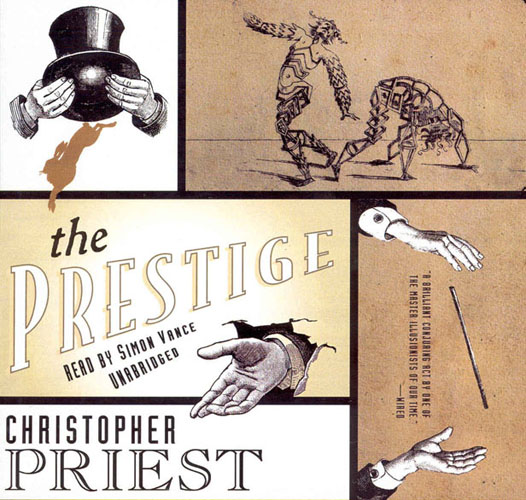
The Prestige by Christopher Priest (audio)

I felt confident in choosing this audiobook because – while I can’t remember who recommended it – I recall that two sources I respected (book blogs, I think) both praised it around the same time. Safe, I thought. Well, I am reminded again: we cannot all like the same things.

The Prestige opens with a first-person narrator named Andrew, embarking on a trip to cover a story for his newspaper job which he finds generally uninteresting. Andrew is adopted, and cares nothing for the truth of his birth family except for the all-consuming feeling he has that he has a twin. What he has managed to learn about his birth parents indicates that there was no twin, but he feels the presence of that other person too strongly to entertain any other explanation. So he arrives in search of the newspaper story – and if this already sounds disjointed, then right ho, that’s how I found it too – and what do you know, the story he’s pursuing turns out to be related to the mystery of his family’s past. Apparently Andrew’s great-grandfather was a magician, one of the very best in Britain and in the world, and his nemesis – the other greatest magician in Britain and in the world – was the great-grandfather of this young woman from whom he finds himself sitting across a table. In pursuit of, um, a newspaper story. But there is no story, really it’s about getting these two together.

And then the story of Andrew (and Kate, the young lady descended from the other magician) breaks off, and we are treated to the diary of Alfred Borden, Andrew’s predecessor. Now the story of Borden’s life, magical career, and lifelong enmity with the Great Danton is presented from Borden’s point of view; after which we break off and view the corresponding histories from the Great Danton’s perspective, via his own diaries. Finally we come back around to Andrew’s narrative.

The overarching mystery of the book is the question of how each of these magicians performs his great iconic stage act. The two illusions are similar, but apparently are performed in different ways, which are not made clear to us until the final few chapters. It is an interesting mystery, and frankly it is that that kept me going until the end of this book. Andrew, and his desire to discover the truth about the mysterious twin, interested me. But the flashback stories (in diary form) of the rival magicians really failed to compel me, and dragged on too slowly. The mysteries of the magic trick, and of the questionable twin, I must confess were so engrossing that I wanted to continue and learn the truth. But the path there was more frustrating in its pace than enjoyably anticipatory, and I cannot give this book much of an endorsement. I was interested enough in the overall story to finish the book, but almost constantly impatient to get to the big reveal. And, worse, I was disappointed in the big reveal; but no more should be said about that in case you check it out yourself. I suppose you’re unlikely to do so on my recommendation! But I assure you there are positive reviews out there.

I wonder if it wasn’t the frame element of stage magic that failed to grab me. I don’t find myself particularly interested. (Despite all the excitement over The Night Circus, I am unlikely to pick that one up.) The pacing was a lot of what did this one in for me, and the personalities of the two magicians, Borden and Danton: they weren’t terribly sympathetic or likeable. I was frustrated and exasperated with them for most of the book. What can I say, this review has descended into a litany of complaints. Sometimes they don’t work for us. Better luck in the next book, yes?


Rating: 3 magic tricks.

book beginnings on Friday: The Prestige by Christopher Priest

Thanks to Rose City Reader for hosting this meme. To participate, share the first line or two of the book you are currently reading and, if you feel so moved, let us know what your first impressions were based on that first line.

I am listening to The Prestige based on the recommendations of (I think) multiple fellow book bloggers. I am fairly sure that one of them was The Boston Bibliophile, but I am only fairly sure of that, and the other recommender(s) escape me. At any rate… I know the book involves magicians, stage magic, and I know little else, so here we are:

It began on a train, heading north through England, although I was soon to discover that the story had really begun more than a hundred years earlier. I had no sense of any of this at the time: I was on company time, following up a report of an incident at a religious sect.

I like that, “it began on a train…” reminds me actually of Agatha Christie’s Murder on the Orient Express, and there are worse things than evoking the Queen of Crime! Although she’s a hard act to follow… I’ll keep you posted.

The Great Psychedelic Armadillo Picnic by Kinky Friedman (audio)

This is an odd book, that somewhat defies definition. If you don’t know Kinky Friedman, I should definitely start there. He’s a country music singer/songwriter, mystery author, politician (he ran for Governor of Texas a few years ago, didn’t win), Jewish cowboy, and general personality. Last I heard, my mother was a fan of his. He has a reputation for being politically incorrect. This was my introduction to his work. The Great Psychedelic Armadillo Picnic is a whimsical musing on Austin, Texas, Friedman’s adopted hometown. It is part travel guide, part history lesson, and large part tongue-in-cheek, self-aggrandizing, stereotyped Texas-style humor.

My reaction was mixed. I should share that we down here in Texas have something of a Houston-Austin… not rivalry, necessarily… maybe it is a rivalry. The cities are quite different and trade blows, each claiming superiority. I live in Houston; it’s my hometown; and while I think Austin has many charms, I have a somewhat typical Houstonian response to Austin’s shameless self-promotion: I get a little defensive. Austin’s pretty cool, but Houston has its advantages, too – in fact I prefer my hometown to the so-hip Central Texas college town – and I get quickly tired of the typical Austinian eye-rolling and patronization, so. I have a dog in this fight, is what I’m saying. Full disclosure.

So, when Kinky brags on Austin, I have to suppress an knee-jerk impulse to say “but!” – which is a good thing to suppress, because there is some funny stuff in this book, and some history lessons that I truly appreciated, not being as familiar with my iconic state’s history as I should be. Snippets of history and Texas trivia I can appreciate. There is a fair amount of Kinky’s own personal musings on the state of our culture today, which are a mixed bag, in my opinion, varying in value. I think maybe he thinks of this book as more strictly travel guidebook than I found it. I double-checked and yes, my edition is unabridged, so. There are travel-guide-like sections on restaurants, famous residents (and their grave sites), and places of interest. Perhaps it was just the audio format; who listens to travel guides on audio?? (No one, I’m fairly sure.) But this is not strictly a travel guide. It’s a glimpse into Kinky’s personality and oddities – and let me tell you, eccentricity is part of the Kinky brand, and a part he’s playing up. So, will you like this book? Answer: as much as you like Kinky Friedman himself. Me, I’m on the fence. I think Austin does all right without his “everything is bigger here,” chauvinistic (he thinks it’s funny), bombastic help.


Rating: 3 bars on 6th St.

book beginnings on Friday: The Great Psychedelic Armadillo Picnic by Kinky Friedman

Thanks to Rose City Reader for hosting this meme. To participate, share the first line or two of the book you are currently reading and, if you feel so moved, let us know what your first impressions were based on that first line.

Here’s an odd little nonfiction mashup, if I can say that, by an odd Texas personality. It is subtitled, “a ‘walk’ in Austin,” and it begins:

Time, they say, changes the river. Time changes the city, too. Over the years, many people have helped Austin to shine in the spotlight, bask in the limelight, and skinny-dip in the moonlight.

Welcome to Austin, Texas, which has birthed the Republic of Texas, Janis Joplin (okay, she was born in Orange, but Austin helped bring her up), Willie Nelson, and (shudder) George W. Bush. Kinky Friedman is an appropriately eccentric guide. What are you reading this weekend?

book beginnings on Friday: Touch by Alexi Zentner

Thanks to Rose City Reader for hosting this meme. To participate, share the first line or two of the book you are currently reading and, if you feel so moved, let us know what your first impressions were based on that first line.

I’ve just begun Touch, and I’m not entirely sure what I’ve gotten myself into – I was recommended this book, by whom I do not know, and am not sure yet even what genre to put it in. But I can say for now that it is, well, touching. It begins:

The men floated the logs early, in September, a chain of headless trees jamming the river as far as I and the other children could see. My father, the foreman, stood at the top of the chute hollering at the men and shaking his mangled hand, urging them on.

I love the setting, the woodsy northern (Canadian?) feel.

And what are you reading this weekend? Do share.

The Dorothy Parker Audio Collection

Dorothy Parker is a flippin’ hoot. She is hilarious. This was a great way to enjoy her work, too: I enjoyed the variety of narrators, with Cynthia Nixon (yes, of Sex and the City) and Alfre Woodard being my favorites. But they were all great.

This is a collection of Parker’s short stories, mostly, with a few reviews and journalism pieces thrown in. The narrators bring different tones to each piece, which was a great touch. Parker has a distinctive sense of humor: wry, dry, tongue-in-cheek, a little bit dirty here and there, decidedly satirical. She pokes fun at the women of her era (mid-twentieth century) and their ambitions and affectations; her own sex comes under by far the harshest criticism in this collection, at least overtly. But I think, too, that there is a more subtle criticism of society in general hidden in there.

I struggle a little bit when reviewing collections; I don’t want to get into plot summaries of all the component parts, but here are a few for you… The opening story, Big Blonde is both funny and full of pathos; Dusk Before Fireworks excoriates a jealous girlfriend (although her ladies’ man boyfriend doesn’t come out smelling too nicely either). But the One on the Right tickled me to no end – I only regret that it was so short! Pathos, I suppose, is a theme here, because Horsie was almost painful. Just a Little One is an amusing story set in a speakeasy; Cousin Larry and The Game both deal with infidelity again. The Bolt Behind the Blue examines a hypocritical and poisonous “friendship” between two women of different social standings. And these are but a few of the included pieces.

You must experience Dorothy Parker for yourself. This is a great selection, and I hope to get my hands on more. Sad, but oh so funny, too.


Rating: 7 giggles.

did not finish: The War of the Worlds by H.G. Wells (audio)

The War of the Worlds is a classic, and H.G. Wells is a respected name. I guess I’d only read his The Invisible Man, as a very young (I had assumed, too young) girl; it didn’t resonate much with me. I thought I’d give him a second chance with this sort of landmark work in early science fiction, and I selected the audio version because of the story attached to its original radio production that caused all that panic when people thought the Martians were *really* attacking. But this one was a fail for me. I quit about halfway through.

First, I’ll give you a partial plot synopsis: Our unnamed narrator-character (not to be confused with the narrator of the audiobook, who will be discussed shortly), a resident of the English countryside, describes what seemed to be falling stars but turn out to be giant cylinders fired from a rocket on Mars. These land, every 24 hours, around London and disgorge Martians, who turn out to be better-armed than the locals, technologically superior, and unfriendly. They operate giant tripod-machines that shoot fire and destroy land, crops, vegetation and people. The Brits try to fight back with their inferior weapons but are getting their butts kicked. And then I stopped listening.

The style of narration was dry. I was easily bored; my mind wandered. I think the audio-narrator, Bill Weideman, was part of my problem. For one thing, he has the odd habit of dropping the occasional leading consonant, like so: “we are ‘ill waiting” (for “still waiting”) and the like. I am perplexed at why you would choose someone with such a strange habit of speech to narrate an audiobook; I was frequently confused as to certain words he pronounced in this manner. Another oddity involved accents. This story is set in England, and when the narrator quotes other characters he gives them an English accent (which by the way seemed excessively nasal and frankly annoyed me), but in the voice of the main-character-narrator, no accent was used (meaning, he sounded American to me). I did not learn, in the half of the book I listened to before giving up, if the narrator was in fact American. But perhaps most generally, Weideman and Wells between them created a monotonous, even soporific effect on me. I couldn’t seem to focus on following the story, as the narrator (in both senses) felt emotionless to me. I can understand how the idea of “total warfare,” total destruction of acres upon acres of land and men and women and children were demolished wholesale in a single sweep of the Martians’ weapons, was shocking to this book’s original audience (1898) and that of the radio drama (1938). But in a world that has seen an atom bomb dropped on Hiroshima, perhaps the impact is lessened.

Of course, as is always the case when I read a Great Classic and do not find myself moved, there is the question of whether there’s something wrong with me: what did I miss? I do not discourage you from trying out this well-known and well-respected book (although I might discourage you from trying Weideman’s audio narration). I hope you like it. I did not.

Teaser Tuesdays: The Dorothy Parker Audio Collection

Teaser Tuesdays is a weekly bookish meme, hosted by MizB of Should Be Reading. Anyone can play along! Just open your current read to a random page and share a few sentences. Be careful not to include spoilers!

I am listening to the most delightful collection of Dorothy Parker’s short stories and reviews and the like. Her style of humor is wry and cynical but right up my alley. Here’s your teaser, from the story Dusk Before Fireworks:

“Please don’t call me ‘women,'” she said.

“I’m sorry, darling,” he said. “I didn’t mean to use bad words.” He smiled at her. She felt her heart go liquid, but she did her best to be harder won.

Parker is frequently hard on her female characters.


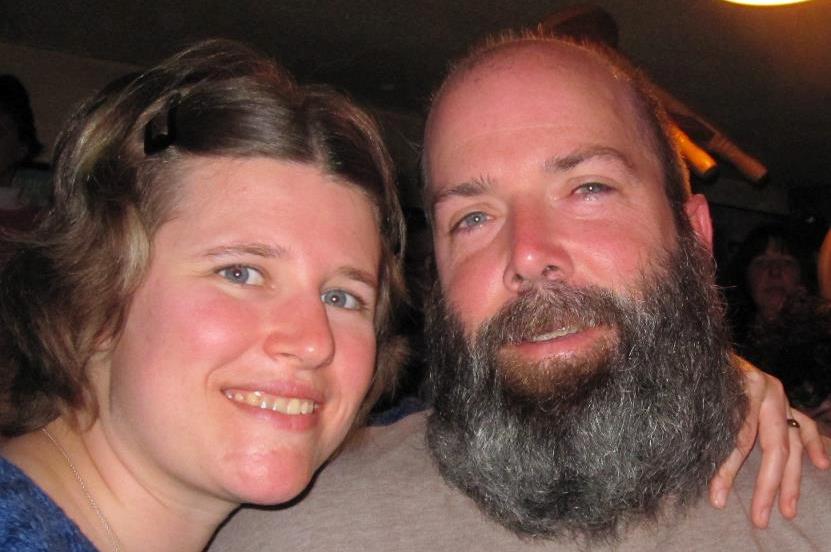
And, bonus: Happy Birthday today to my beloved Bearded Husband!!

Saturnalia by Lindsey Davis (audio)

Saturnalia is book 18 in a series, and my first, but it didn’t bother me any. I followed everything just fine. Perhaps the characters would have been richer if I’d been getting to know them progressively better for 18 books (!), but I found them rather well-drawn even in this one.

Our main man (and first-person narrator) is Marcus Didius Falco. He is employed as a “private informer”, which seems to be ancient Rome’s version of a private investigator (at least in Davis’s ancient Rome). He is called in by the government of Vespasian to try and recover an escaped political prisoner, a German woman named Veleda that Falco knew years ago; his brother-in-law Justinus, in fact, had something of a brief romance with her. Now, Veleda has gone missing, a headless corpse has been attributed to her, and in an especially personal twist, Justinus disappears at the same time. His wife is furious, thinking he’s off rekindling an old flame with Veleda. Falco is left searching for both of them – Veleda, for pay and for the sake of the empire (although in secret, as the public is unaware she’d been captured in the first place), and Justinus for the sake of family peace. Add to all this the bacchanalia of Saturnalia, the December holiday in which masters serve their slaves and everything is turned on it ear. Falco attends wild parties, hangs out in graveyards interrogating ghosts, does battle with the Chief Spy (a bumbling government employee with whom he apparently spars regularly), finds the odd lost dog… and carries on a very sweet relationship with his wife, Helena. I liked her addition to the story: she is from a social strata above Falco’s (her father is a senator), and routinely assists him in his investigations. Their relationship is well-done. She’s spunky, intelligent, not to be tamed, but also a doting wife; their home life feels very real and likeable, although I wonder if Helena is not a few centuries ahead of her time.

Which brings me to the historical question(s). I am no scholar of ancient Rome. This world felt real to me, and I was happy being immersed in it for the course of this book, but I cannot speak to the historical accuracy. It was great fun, but I make no promises.

This was a fun mystery. Falco has a great tongue-in-cheek, irreverent, dry humor, and the narrator of this audio version, Christian Rodska, represents that tone well. Saturnalia leans toward the ridiculous, with that straight face that makes such things all the more funny. The historical setting was new to me, but I had a good time with it.


Rating: 4 Roman senators.

book beginnings on Friday: The War of the Worlds by H.G. Wells


Thanks to Rose City Reader for hosting this meme. To participate, share the first line or two of the book you are currently reading and, if you feel so moved, let us know what your first impressions were based on that first line.

I am listening to this classic on audiobook, read by Bill Weideman. It begins, somewhat philosophically:

No one would have believed in the last years of the nineteenth century that this world was being watched keenly and closely by intelligences greater than man’s and yet as mortal as his own; that as men busied themselves about their various concerns they were scrutinised and studied, perhaps almost as narrowly as a man with a microscope might scrutinise the transient creatures that swarm and multiply in a drop of water. With infinite complacency men went to and fro over this globe about their little affairs, serene in their assurance of their empire over matter. It is possible that the infusoria under the microscope do the same.

I admit I’m finding it a tad slow, but here we go. Have you read this one? I was attracted by the audio format because of the stories of its original radio broadcast, in which people panicked, thinking it was a real-life news story! What an exciting time that must have been.

What are you reading this weekend?