did not finish: The War of the Worlds by H.G. Wells (audio)

The War of the Worlds is a classic, and H.G. Wells is a respected name. I guess I’d only read his The Invisible Man, as a very young (I had assumed, too young) girl; it didn’t resonate much with me. I thought I’d give him a second chance with this sort of landmark work in early science fiction, and I selected the audio version because of the story attached to its original radio production that caused all that panic when people thought the Martians were *really* attacking. But this one was a fail for me. I quit about halfway through.

First, I’ll give you a partial plot synopsis: Our unnamed narrator-character (not to be confused with the narrator of the audiobook, who will be discussed shortly), a resident of the English countryside, describes what seemed to be falling stars but turn out to be giant cylinders fired from a rocket on Mars. These land, every 24 hours, around London and disgorge Martians, who turn out to be better-armed than the locals, technologically superior, and unfriendly. They operate giant tripod-machines that shoot fire and destroy land, crops, vegetation and people. The Brits try to fight back with their inferior weapons but are getting their butts kicked. And then I stopped listening.

The style of narration was dry. I was easily bored; my mind wandered. I think the audio-narrator, Bill Weideman, was part of my problem. For one thing, he has the odd habit of dropping the occasional leading consonant, like so: “we are ‘ill waiting” (for “still waiting”) and the like. I am perplexed at why you would choose someone with such a strange habit of speech to narrate an audiobook; I was frequently confused as to certain words he pronounced in this manner. Another oddity involved accents. This story is set in England, and when the narrator quotes other characters he gives them an English accent (which by the way seemed excessively nasal and frankly annoyed me), but in the voice of the main-character-narrator, no accent was used (meaning, he sounded American to me). I did not learn, in the half of the book I listened to before giving up, if the narrator was in fact American. But perhaps most generally, Weideman and Wells between them created a monotonous, even soporific effect on me. I couldn’t seem to focus on following the story, as the narrator (in both senses) felt emotionless to me. I can understand how the idea of “total warfare,” total destruction of acres upon acres of land and men and women and children were demolished wholesale in a single sweep of the Martians’ weapons, was shocking to this book’s original audience (1898) and that of the radio drama (1938). But in a world that has seen an atom bomb dropped on Hiroshima, perhaps the impact is lessened.

Of course, as is always the case when I read a Great Classic and do not find myself moved, there is the question of whether there’s something wrong with me: what did I miss? I do not discourage you from trying out this well-known and well-respected book (although I might discourage you from trying Weideman’s audio narration). I hope you like it. I did not.

Teaser Tuesdays: The Dorothy Parker Audio Collection

Teaser Tuesdays is a weekly bookish meme, hosted by MizB of Should Be Reading. Anyone can play along! Just open your current read to a random page and share a few sentences. Be careful not to include spoilers!

I am listening to the most delightful collection of Dorothy Parker’s short stories and reviews and the like. Her style of humor is wry and cynical but right up my alley. Here’s your teaser, from the story Dusk Before Fireworks:

“Please don’t call me ‘women,'” she said.

“I’m sorry, darling,” he said. “I didn’t mean to use bad words.” He smiled at her. She felt her heart go liquid, but she did her best to be harder won.

Parker is frequently hard on her female characters.


And, bonus: Happy Birthday today to my beloved Bearded Husband!!

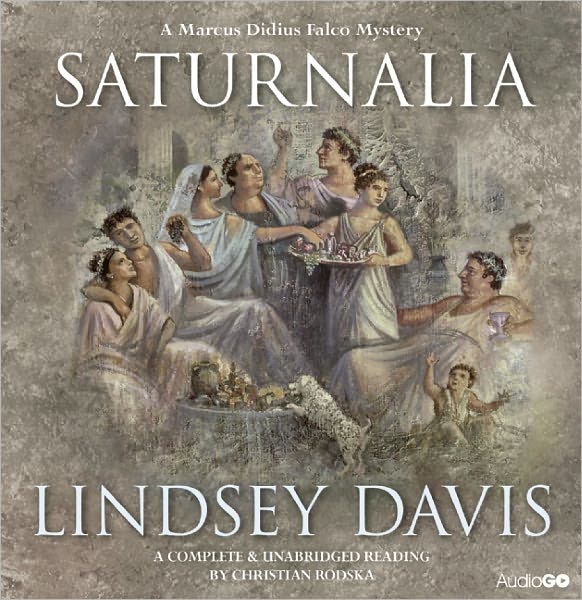
Saturnalia by Lindsey Davis (audio)

Saturnalia is book 18 in a series, and my first, but it didn’t bother me any. I followed everything just fine. Perhaps the characters would have been richer if I’d been getting to know them progressively better for 18 books (!), but I found them rather well-drawn even in this one.

Our main man (and first-person narrator) is Marcus Didius Falco. He is employed as a “private informer”, which seems to be ancient Rome’s version of a private investigator (at least in Davis’s ancient Rome). He is called in by the government of Vespasian to try and recover an escaped political prisoner, a German woman named Veleda that Falco knew years ago; his brother-in-law Justinus, in fact, had something of a brief romance with her. Now, Veleda has gone missing, a headless corpse has been attributed to her, and in an especially personal twist, Justinus disappears at the same time. His wife is furious, thinking he’s off rekindling an old flame with Veleda. Falco is left searching for both of them – Veleda, for pay and for the sake of the empire (although in secret, as the public is unaware she’d been captured in the first place), and Justinus for the sake of family peace. Add to all this the bacchanalia of Saturnalia, the December holiday in which masters serve their slaves and everything is turned on it ear. Falco attends wild parties, hangs out in graveyards interrogating ghosts, does battle with the Chief Spy (a bumbling government employee with whom he apparently spars regularly), finds the odd lost dog… and carries on a very sweet relationship with his wife, Helena. I liked her addition to the story: she is from a social strata above Falco’s (her father is a senator), and routinely assists him in his investigations. Their relationship is well-done. She’s spunky, intelligent, not to be tamed, but also a doting wife; their home life feels very real and likeable, although I wonder if Helena is not a few centuries ahead of her time.

Which brings me to the historical question(s). I am no scholar of ancient Rome. This world felt real to me, and I was happy being immersed in it for the course of this book, but I cannot speak to the historical accuracy. It was great fun, but I make no promises.

This was a fun mystery. Falco has a great tongue-in-cheek, irreverent, dry humor, and the narrator of this audio version, Christian Rodska, represents that tone well. Saturnalia leans toward the ridiculous, with that straight face that makes such things all the more funny. The historical setting was new to me, but I had a good time with it.


Rating: 4 Roman senators.

book beginnings on Friday: The War of the Worlds by H.G. Wells


Thanks to Rose City Reader for hosting this meme. To participate, share the first line or two of the book you are currently reading and, if you feel so moved, let us know what your first impressions were based on that first line.

I am listening to this classic on audiobook, read by Bill Weideman. It begins, somewhat philosophically:

No one would have believed in the last years of the nineteenth century that this world was being watched keenly and closely by intelligences greater than man’s and yet as mortal as his own; that as men busied themselves about their various concerns they were scrutinised and studied, perhaps almost as narrowly as a man with a microscope might scrutinise the transient creatures that swarm and multiply in a drop of water. With infinite complacency men went to and fro over this globe about their little affairs, serene in their assurance of their empire over matter. It is possible that the infusoria under the microscope do the same.

I admit I’m finding it a tad slow, but here we go. Have you read this one? I was attracted by the audio format because of the stories of its original radio broadcast, in which people panicked, thinking it was a real-life news story! What an exciting time that must have been.

What are you reading this weekend?

Teaser Tuesdays: Saturnalia by Lindsey Davis

Teaser Tuesdays is a weekly bookish meme, hosted by MizB of Should Be Reading. Anyone can play along! Just open your current read to a random page and share a few sentences. Be careful not to include spoilers!

I’ve just started this audiobook, randomly selected from the new-to-me series of mysteries by Lindsey Davis set in ancient Rome. (This book opens in AD 76.) It is rather late in the series, but that never stops me. So far I’m charmed by the humorous moments, and I like the audio-narrator, Christian Rodska, too. From almost the very beginning, here’s your teaser:

Pa gazed at me with those tricky brown eyes, running his hands through the wild grey curls that still clustered on his wicked old head. He was daring me to be flippant.

I like that “wicked old head” and the “tricky brown eyes.” There’s something a little bit engrossing about Pa, and I like the main character-narrator, Marcus Didius Falco. Hope you’re enjoying whatever you’re reading this week!

The Lacuna by Barbara Kingsolver (audio)

Another long review – sorry – but one of the best books I’ve read this year, so consider sticking it out with me. Or, go to the very bottom for my two-sentence review. 🙂 Many thanks.


Reviewing The Lacuna daunts me. How to capture the enormous world that is this book in a brief (readable) blog post? I have only read three other of her books (liked The Bean Trees and Animal Dreams; not so much The Poisonwood Bible; all pre-blog, unfortunately) but from what I know, this is by far her best. (Her own website calls it her “most accomplished novel”). It is a Big Thing.

I shall take this one step at a time. Plot summary. A young boy named Harrison William Shepherd is born in 1916 to an American father, a bean-counter for the government in Washington, D.C., and a Mexican mother, Salomé. He spends his childhood mostly in Mexico, with a brief interlude at a military school in the US, and ends up working in his teens for Diego Rivera and Frida Kahlo, first as Diego’s plaster mixer, then as a cook and secretary and Frida’s companion. When Lev Trotsky arrives as a political exile from Soviet Russia, he acts as secretary and cook to him, too, following Trotsky when he splits from the Riveras; he is at Trotsky’s side when he is assassinated. Shepherd (who goes by various names depending on who’s talking) never considers himself exactly an ideological follower of the communist cause, but his sympathies are naturally aligned with those of his famous employers, for whom he has great respect.

Following the assassination, he begins a new life in Asheville, North Carolina, becoming a famous author of novels set in ancient Mexico; but the trauma of Lev Trotsky’s bloody demise, Shepherd’s sexual orientation, and his extremely shy and self-effacing demeanor keep him isolated from an American world that feels foreign. He closely follows international politics through the second World War, the United States’ sudden reversal of regard for Stalin, and the Dies Committee (which contacted Trotsky when Shepherd was with him) becoming the House Unamerican Activities Committee – which eventually begins to investigate Shepherd himself. This turn of events shocks our protagonist, who sees himself as an insignificant and apolitical player, but whose new Jewish-New-Yorker lawyer is alarmed at the skeletons he hides in his closet: to the point, an association with the late Trotsky and the still-active Kahlo and Rivera. The Asheville era in Shepherd’s life yields new and likeable characters in the lawyer, Artie Gold, and Shepherd’s secretary-companion, Appalachian native Violet Brown. (I think Kingsolver had fun with these *colorful* names, ha.) The FBI’s investigation of Shepherd threatens to tear down the precariously balanced, agorophobic life that he has so carefully constructed in Asheville; and here I’ll stop. I liked the ending, despite its considerable sadness.

Violet Brown is an important part of the story in terms of format. The story is told almost entirely in Shepherd’s own voice. As presented, he wrote the first chapter of his memoir and then quit; this chapter opens the book, and then we get Mrs. Brown as “archivist” explaining the reversion to Shepherd’s journals starting at age 14. The rest of the book is pulled from these (fictional) journals, with interjections from our archivist here and there, as well as a number of newspaper and magazine articles (Kingsolver notes which are real articles at the beginning of the book for your reference; my impression without checking each one is that most are real) and assorted samples of Shepherd’s correspondence. It is a very interesting format, raising all kinds of questions about voice and the progression of voice. I wondered, upon that first shift from an already-published 30-year-old author’s writing to a 14-year-old’s journal, whether Kingsolver didn’t trust her audience to start off that way? But I ended up feeling that this shifting voice felt very real; I enjoyed it. Violet’s role in Shepherd’s life was ambiguous quite far into the story, which kept me wondering, in a good way.

Another aspect of format I must mention is the audio version I listened to – narrated by Kingsolver herself, and to great effect. I loved her work here; every character had a voice, an accent, a lilt, a manner of speaking, and these were important in a story peopled by Mexicans with various backgrounds, a cross-bordered Mexican-American confused about where he might belong, an Appalachian-hills woman who worked hard for her education, and a New York Jew. Shepherd’s speech cadence as performed by his creator was remarkable and memorable; it increased my enjoyment of this story. The only drawback to the audio format is that I am always driving, or washing dishes, or in the gym, etc., when I’m listening, and therefore failed to mark down for you any number of remarkable lines I would have liked to share.

I was completely drawn into Shepherd and his world. I found Frida Kahlo compelling, which I think is faithful to her real life. The Mexico Kingsolver paints is so real, so filled with sensory stimulation, and in some ways familiar – the foods I eat, the places I’ve visited – which I think always gets a positive reader reaction. And the linguistic nuance of a boy (and man) who speaks both his languages with an accent, who brings Spanish structures into English, was so authentic, I just ate it up. (Like Hemingway’s For Whom the Bell Tolls, one of my most favorite books ever.) And then the politics – the evocation of such a complex, rapidly changing, schizophrenic period in our history, through the Bolshevik Revolution, the Roaring Twenties, the Great Depression, Hoovervilles, WWII, Roosevelt’s death, HUAC… it was so very dense. I was reminded of Stephen King’s 11/22/63 (which is the more recent work), another novel set in real historical events that successfully evoked a vivid time and place; but The Lacuna built a bigger world, was more literary and flowery, and in my opinion was better (sorry, Stephen).

Part of this book’s fascination for me lay in its explanation of the hatred and fear of communism, Communism, and its various permutations and misunderstandings during an era before my birth. Kingsolver’s characters helped me work through some of my questions about this time and this perplexing, unreasonable fear; Shepherd shares my confusion, and the lawyer Artie Gold does a fair job of helping him think it through (as does Violet Brown, for that matter). Coming near on the heels of A Difficult Woman which I loved so much, and which raised so many questions for me, The Lacuna‘s further exploration of the anticommunist era and my reading of it was very timely.

I’m sorry I’ve gone on so long; it’s only out of my enthusiasm for this dense and complex story that brought me so many emotions and questions. In a few words, The Lacuna is beautifully constructed and beautifully written, a story about artists and the power of art, about Frida Kahlo and Lev Trotsky and American anticommunism. I highly recommend it.


Rating: a rare 10 Mexican murals.

book beginnings on Friday: The Lacuna by Barbara Kingsolver


Thanks to Rose City Reader for hosting this meme. To participate, share the first line or two of the book you are currently reading and, if you feel so moved, let us know what your first impressions were based on that first line.

I’m listening to Kingsolver’s The Lacuna on audio. I loved her The Bean Trees and I think I loved Animal Dreams, but it’s hazy; The Poisonwood Bible really didn’t work for me (which, from my reading of other book blogs, appears to be a common reaction). But The Lacuna comes recommended from my mother, so here we go. It begins:

In the beginning were the howlers. They always commenced their bellowing in the first hour of dawn, just as the hem of the sky began to whiten.

The hem of the sky. Lovely. And what are you reading this weekend?


Be advised: I’m out of town, so you’re viewing pre-scheduled posts until April 9. I love your comments and will respond when I return! But I’ll be out of touch for a bit. Thanks for stopping by!

Teaser Tuesdays: Claire DeWitt and the City of the Dead by Sara Gran, again

Teaser Tuesdays is a weekly bookish meme, hosted by MizB of Should Be Reading. Anyone can play along! Just open your current read to a random page and share a few sentences. Be careful not to include spoilers!


That’s right, you’re getting a repeat today. I teased you from this book two weeks ago, but this passage was too funny to me to skip. Enjoy.

The black alligator purse had been Constance’s. Supposedly it had been custom made for Constance in Paris by Mademoiselle herself. It was bigger on the inside than on the outside, and could get almost anything through an x-ray machine or a Geiger counter. It had pockets inside pockets, secrets inside secrets. The solution to approximately 17 mysteries could be found in this purse at any given moment. In a jam, it could unfold into a tent and I could live in it until circumstances improved.

As I said in my review of this book, there is a mystical element. Constance’s purse may very well actually unfold into a tent. I like these details. If you had a magic purse, what would you want it to do for you?


Be advised: I’m out of town, so you’re viewing pre-scheduled posts until April 9. I love your comments and will respond when I return! But I’ll be out of touch for a bit. Thanks for stopping by!

Claire DeWitt and the City of the Dead by Sara Gran (audio)

The “City of the Dead” is New Orleans during & after Hurricane Katrina, and that’s what drew me to this mystery. That’s the whole sum total of my knowledge of Sara Gran’s book when I began it, and that was enough. I love New Orleans and I think my favorite mysteries are those with a strong sense of place, a well-developed sense of location as a pivotal part of the story – stories that couldn’t happen anywhere but where they do. (I’m thinking of Harry Bosch’s Los Angeles, Tana French’s Ireland, Lisa Gardner’s Boston, James Lee Burke’s New Iberia.) And even as far away as Houston – not so far, especially considering all the Katrina-displaced New Orleanians who now live here – the idea of Katrina is evocative and powerful. So the idea of a mystery set in Katrina’s New Orleans was enough to sell me. Of course, that wouldn’t necessarily make the book good… I’ll give Sara Gran herself credit for doing that.

This was a great, and entertaining read (listen). It’s part mystery and part study of New Orleans, and large part mystical magical musings – but perhaps that last is necessary of a study of New Orleans, with myth, legend, Mardi Gras Indians intruding upon the mystery. Our private investigator, Claire DeWitt, bends the classic hard-drinking, silent-loner-type PI to fit into New Orleans’s unique culture: she uses hard drugs and channels her detective hero, Jacques Silette (author of Détection, her bible of detective skills) as well as her mentor, the late Constance, former apprentice to Silette himself. Claire is sort of secondarily hunting her childhood friend and former fellow junior detective, Tracy, who disappeared so many years ago.

So what is the mystery? Claire comes down to NO from California when she’s hired by Leon, who wants to know what happened to his uncle, Vic Willing. Vic disappeared during Katrina, never to be seen again. I’m not sure we ever really settled why this indicates foul play, as lots of people got “lost” in Katrina, but it’s accepted throughout the story that something sinister must have befallen him, and I’m okay with getting on that train. Vic was a successful local DA, and fed birds from his apartment. And there the clues seem to end. Claire quickly gets herself entangled with some local delinquent youngsters, and has various adventures involving gunplay and drugs. Despite her hard exterior, she’s a bit of a softie towards these young men who’ve been dealt “a bad hand,” but she doesn’t let it show much. The mystery of Vic’s disappearance is not the star of this book. Its eventual wrap-up is a bit simplistic; as a strict, standalone mystery it might not impress. But that’s not what this book is about. Rather, several other threads steal the spotlight: Claire’s relationship with Andray and Terell; her relationship with her late mentor Constance; and the mystery (unresolved – maybe that’s another book?) of Tracy’s childhood disappearance, not to mention the interest (the framing element, if you will) of Claire’s nontraditional methods of detection, including throwing the I Ching and analyzing dreams and drug-induced hallucinations. Claire’s approach to mysteries in general is mystical.

There are also some decidedly funny moments; I giggled out loud several times (which will always make people look at me funny). Claire’s voice is wry and cynical, and she speaks in metaphors and self-deprecates. She’s prickly but altogether someone I’d like to know. In conclusion, while Claire has certain qualities in common with your traditional loner-drunken-detective archetype (which, by the way, is not a criticism!), she has plenty of unique quirks that make her very interesting to know. The mystery here is only a backdrop for the drama of New Orleans to play against. Claire DeWitt and the City of the Dead includes a number of characters I’d like to know better, and while it has a satisfactory and complete ending, it does leave the door open for a sequel. Sara Gran! I want it! Recommended.


Rating: 7 grumpy detectives.

final review: The Likeness by Tana French (audio)


Well, I don’t suppose I have much more to say about this one than I already did in my early review, other than to assure you that the positive feelings persisted! Tana French kept me guessing til the end, and she had me deeply invested in her characters. The final denouement was satisfying. Cassie felt real to me; all the characters felt real to me. I was sorry it was over, and especially sorry that I’ve now read all three of French’s novels. This is in my opinion her best. I hope there are more to come – and I hope Heather O’Neill narrates them.

I ended up feeling that The Likeness is really very reminiscent of Rebecca in some aspects: the house as a character, as a force, with a personality and motivations all its own, with a history that intrudes upon the lives of the present residents even when they’re unaware of that history… and more (avoiding spoilers). Further, the mood and tone of this book share a slightly spooky atmosphere, a sense of foreboding, a feeling of something unknown looking over one’s shoulder, with Rebecca. But it’s not derivative. No, The Likeness is a fresh, new piece of work, with accomplishments all its own. I would love to hear Tana French’s explanation of the role she feels Rebecca plays in this novel, though.

I’ve been asked if I think it’s necessary to read In the Woods first. That’s French’s first novel, and introduces some of the characters we meet here. I don’t think it’s all at necessary. (Full disclosure: I’m a fan of reading series out of order.) I read In the Woods about 2 years ago, and don’t really remember it at all. Those characters that transfer over into this book are in very different circumstances now, and their histories are explained enough that I felt comfortable. That said, there is much reference to “that big thing that happened that changed everything,” and “that thing” is not explicated at all. I wasn’t bothered by it; some readers may feel motivated to go read the first book to answer their questions. I didn’t find it necessary. If that’s the kind of thing that bothers you, by all means go read In the Woods first. I found The Likeness far superior, but to each her own; maybe you’ll feel the opposite. I guess my main point here is that while these two books share characters, they are not serial in the sense that the action of the first book is built upon in the second. They can confidently stand alone.

This book is amazing and I found it unique. (Simon has drawn a comparison to Tess Gerritsen’s Body Double. I may have to go find that one.) Beyond that, I refer you back to my earlier post (link at top of this one) in which I rave. The ravings stand.


Rating: 9 questions of identity.