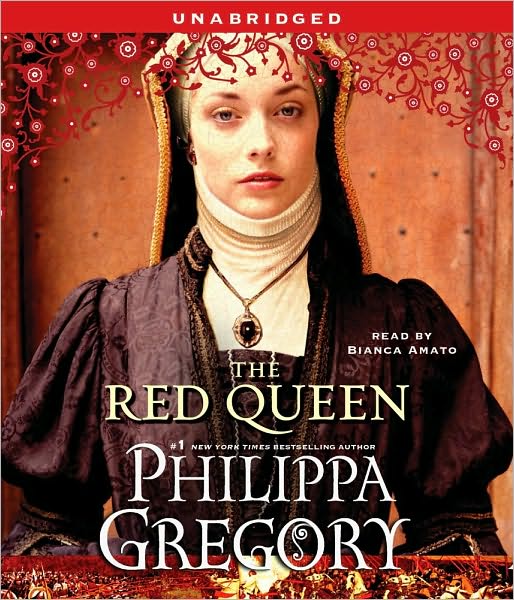
The Red Queen by Philippa Gregory (audio)

Ah, Philippa Gregory, my choice “fluffy” historical fiction author. A slightly guilty pleasure, yes.

In a nutshell, this is the (fictionalized) life story of Lady Margaret Beaufort. She is a very pious young girl, married off against her wishes first to Edmund Tudor, who widows her before she gives birth to his son at the age of 13, and then to Henry Stafford. After she’s widowed a second time, she makes her own marriage of politics, not love, to Thomas Stanley. The Tudors’ fortunes have shifted, and her son has been raised by his paternal uncle Jasper, as the House of York holds the English crown. Margaret works to promote her own son’s claim to the throne through various machinations and deceptions, pretending service to the York King Richard III and his Queen Anne. Richard is defeated on the battlefield and her son does finally take the throne himself as King Henry VII. The story is told in Margaret’s voice in first person, aside from a few passages of third-person narration towards the end, describing battles and events that (presumably) Margaret could not have described as she would not have been present.

I found Margaret unlikeable. This does not necessarily preclude me liking the book. She was self-consciously pious to the point of being self-righteous and often hypocritical: as in, “my piety is so great and God loves me so that I am deserving of the highest of honors, you should make me an abbess although I am only 13 years old,” etc. She demanded a life that was unavailable to girls or young women of her time and of her social standing; this struck me as anachronistic. I am certainly fuzzy on my historical accuracy for 15th century England! But I suspect it is unlikely that this young lady, nearly from the cradle, as it were, would be demanding such an unknown level of independence and control over her own destiny. On the other hand, perhaps the point about the young Margaret is just this: that she was odd, demanded unusual or unheard of honors. After all, the book opens with her having visions of herself as Joan of Arc. She certainly saw herself differently. So, my criticism here is qualified. And it didn’t particularly take away from my enjoyment of the book; it’s something I noted, as I continued to listen with interest in what would happen next. Did I like Margaret? Not for a moment. But I enjoyed and was held captive by her story.

There were weaknesses. The political intrigue aspects tended to be painted with a broad brush, in the fairly lazy literary convention of having a character recite the action in a monologue with explication that would not realistically be necessary if she were really making this speech. In other words, an info dump in the voice of a character. [Late in the book, we do get some passages of narration in a third-person-omniscient voice. Unfortunately, this didn’t improve things for me, particularly in this audio format, because a different reader took over; I found it a little jarring. But maybe by that point I was becoming difficult to please.] I felt that the book was most concerned with Margaret’s feelings and internal action, and it was occasionally necessary to fill us in on why so-and-so is riding into battle with so-and-so, and Gregory did it as quickly and easily as possible. This stands out in contrast to a historical fiction author I really like, Sharon Kay Penman, who takes her historical accuracy very seriously and takes the time to spell it all out very meticulously while keeping her characters very lifelike. Now, Penman and Gregory create very different reading experiences, and readers – entirely validly – are likely to prefer one or the other, and both are okay. Gregory’s books are fast-paced, emotional, hopefully riveting, and lighter on historical accuracy. Penman’s are longer, rather denser, accurate, and engrossing in that they bring the world in which they are set fully to life. One is not “better,” but they are different.

A few character developments felt rushed and unexplained to me. There is a certain man with whom Margaret suddenly shares a seeming bond of love, but I missed the progression of feelings; they were just there and then suddenly… staring into each other’s eyes and making declarations (or worse, references to an unspoken but understood shared feeling). And again, Margaret’s loyalty to and passion for her Tudor line came out of nowhere for me. When the book began, her mind was focused on God; and a little later she is full of loyalty to the Lancasters and rebuking those whose loyalty wavered. Again, I seem to have missed the part where she discovered the strong tie she felt to her relatives.

And yet I remained intrigued and kept reading. I was occasionally exasperated, but overall my experience was overwhelmingly one of enjoyment. Verdict? I am more a Sharon Kay Penman reader than a Philippa Gregory reader! I seem to be left feeling like I need to do a little research when I finish a Gregory book. But they’re good fun. And I haven’t found any audiobooks of Penman’s work yet!


Rating: 4 haughty sniffs.

book beginnings on Friday: The Red Queen by Philippa Gregory

Thanks to Rose City Reader for hosting this meme. To participate, share the first line or two of the book you are currently reading and, if you feel so moved, let us know what your first impressions were based on that first line.

This is a bit of a guilty pleasure for me, but in the lighter area of historical fiction: Philippa Gregory! We begin…

The light of the open sky is brilliant after the darkness of the inner rooms. I blink and hear the roar of many voices. But this is not my army calling for me, this whisper growing to a rumble is not their roar of attack, the drumming of their swords on shields.

I am intrigued so far.

And what are you reading this weekend?

Bossypants by Tina Fey (audio)

This book has been out for a little over a year. What took me so long? Thank you, fellow bloggers who raved about this book, for finally getting it into my ears. As others have said before, get the audiobook! It does make it slightly cumbersome to go find your pdf file to see the pictures she refers to; but it’s so worth it to hear her make her jokes herself.

Tina Fey is a funny lady. This I knew, and I looked forward to the laughs, which are there in abundance. But what I hadn’t entirely expected was the more serious handling of issues like a woman’s place in male-dominated industries – which was silly of me, because Tina Fey does address issues. She tells stories about her own upbringing, her youth, her discovery of acting and comedy, her time spent at SNL, the creation of 30 Rock, her honeymoon, motherhood, and more. She is always classy in her discussion of other celebrities or folks from the industry: any criticisms are well packaged in understanding and explanation, while she mostly praises her colleagues in glowing and meaningful terms. She doesn’t just call everyone talented and charming – she gives thought-out, complex, positive evaluations. And any time she has dirt on someone, she leaves that someone entirely cloaked in anonymity (“the letters from their names are sprinkled randomly through this chapter”). I never got the impression she was being less than honest, because she still made her criticisms, but she was always respectful of the people she has worked with, and that impressed me.

Tina analyzes the challenges that face a woman in a position like hers, breaking into a field that (in her early days especially) was thought to be men’s work, and she does so fairly. For example, she writes (narrates) a funny and wise anecdote about the moment that she realized that she was experiencing, not institutional sexism, but a sheer male ignorance of menstruation and “feminine hygiene.” And she gives good advice.

She is also hilarious, and wise, about women’s fashion and body image, and the culture of Hollywood, modeling, and television. In the chapter entitled “Amazing, Gorgeous, Not Like That,” she describes a “typical” magazine photo shoot in great detail. I found the scenes regarding hair and makeup especially exotic, weird and different. I’m pretty far from a fashion photo shoot, myself.

This book was great fun and very funny, as you might expect; but as you might not have guessed right off (I didn’t), it also makes some good, serious points. There’s some well-stated feminism to be found here amid the good times. Highly recommended, and as many others have said before me, do get the audio version.


Rating: 7 pairs of Tina Fey glasses.

Loving Frank by Nancy Horan (audio)

I don’t know why I didn’t expect much of this book. Where did I get the idea that it was a fluffy love story? Not so. This is the fictional tale of Mamah Borthwick’s extramarital affair with architect Frank Lloyd Wright. Mamah really lived, and she really had an affair with FLW; but her story here is fictionalized. Another of those sticky questions of historical fiction: where is the boundary between fact and fict? Horan includes a nice author’s note at the end (probably my favorite way of handling this question) and gives some details about where she began using her imagination. History has not taken great note of Mamah Borthwick; most of the information available to her was about FLW.

This is a lovely story, well told. Several different threads are explored that I found interesting. Frank Lloyd Wright himself, and his art and architecture (subjects I had not explored previously) are outlined, along with his Oak Park celebrity and the birth of his “organic architecture.” Mamah is involved in the women’s movement, for suffrage and equal pay and general independence and equality. I especially loved the scenes where she picks up a book, and attends a lecture given, by the Swedish feminist author Ellen Key. Mamah is so moved, considers the topics so well – she is an intellectual and an artist herself, you see. She takes on a mid-life career translating Key’s work (again, this is true to history), and I found the depiction of translation, and Mamah’s own writing as well, to be a really rich part of her story. This is far from being a book about Frank Lloyd Wright. It is a book about love, and morals, and the dilemma of being married to one man and loving another. Mamah and Frank have nine children between them. Imagine that: nine children! There is also the issue of their reputations being irreparably damaged in the national media.

Frank and Mamah are fellow residents of Oak Park, Illinois (suburb of Chicago, and hometown of Ernest Hemingway, who was a small boy during the events of this book) when Mamah and her husband hire the local celebrity to build them a new home. There is chemistry immediately, although it takes a few years for the affair to begin. As their own marriages begin to fall apart, Mamah leaves Oak Park and takes her children with her to visit an old friend in Colorado, eventually leaving her children for her husband to collect, and meeting up with Frank for a tour in Europe. Their relationship blossoms and takes form as they travel, experiencing the world, getting to know one another more openly; it is here that Mamah meets Ellen Key, whose philosophies are hugely important in the couple’s worldview and feelings about their own actions. Frank has left a wife and six children; Mamah has left her children as well, and we can imagine how the world more than a century ago viewed a mother abandoning her children.

The two will eventually move to the Wisconsin valley that has been home to Frank’s family for generations, where he builds for Mamah the home called Taliesin. They are plagued by public disapproval, and the continuing unhappiness of various family members. But they also find the local community eventually supportive. And then there is the big event. Mamah’s story concludes with a shocking final episode that comes out of the history books, so let me say: if you don’t already know what happens, you might consider letting Horan surprise you. It is not a happy ending. But I feel that Horan handles it with great dignity.

I was reminded time and time again of another lovely work of historical fiction, Susan Vreeland’s Clara and Mr. Tiffany. These books are both about women who really lived but are marginalized in history, allowing two authors to write their stories, fictionalized, from research; both were involved (in different ways) with far more historically well-known men; both involve art and art appreciation; both are beautifully written, exploring emotions, and the issues of women’s role in art and in society at more or less the same time in history. I find myself noting these read-alike relationships, and sometimes worry that I may be seen as lowering one or the other of these books by comparing them to others, like I’m calling them less original. I am not. Both of these books are beautiful and original; just allow me to say that if you like one you may like the other.

I loved this book from start to finish. Horan, and narrator Joyce Bean, immersed me completely in the time and the many places of Mamah’s story. I cared very much about all the characters. The events of Frank and Mamah’s lives – bittersweet, shocking, loving, touching, tragic, hopeful, all of them – came fully to life. I really enjoyed getting to know these interesting people, even when they were not at their best. I am charmed, and impressed.


Rating: 8 translated lines.

book beginnings on Friday: Bossypants by Tina Fey

Thanks to Rose City Reader for hosting this meme. To participate, share the first line or two of the book you are currently reading and, if you feel so moved, let us know what your first impressions were based on that first line.

I am coloring outside of the standard and accepted “book beginnings” lines here, because just beyond the first two sentences Tina Fey gives us our first giggle, and I thought that was worthwhile.

Welcome, friend! Congratulations on your purchase of this American made, genuine audio book. Each component of this audio book was selected to provide you with maximum audio performance, whatever your listening needs may be. If you’re a woman and you bought this audio book for practical tips on how to make it in a male-dominated workplace, here they are. No pigtails. No tube tops. Cry sparingly. Some people say, never let them see you cry. I say, if you’re so mad you could just cry, then cry. It terrifies everyone. When choosing sexual partners, remember, talent is not sexually transmittable. Also, don’t eat diet foods in meetings.

And that, friends, is a great sample of what this book is: punchy, pithy, and containing some good advice, actually, amid the giggles. I heard it far and wide – good book, excellently narrated by the lovely talented Ms. Fey – and I think I’m going to add my voice to the chorus. Check it out, kids! Happy Friday!

Teaser Tuesdays: Loving Frank by Nancy Horan

Teaser Tuesdays is a weekly bookish meme, hosted by MizB of Should Be Reading. Anyone can play along! Just open your current read to a random page and share a few sentences. Be careful not to include spoilers!

I am mightily enjoying this novel about the woman who loved Frank Lloyd Wright even though they were both married to other people. I chose this teaser today because I liked the sentiment. Hope you enjoy…

“Forgive my bluntness, but leaving a boring man for a stimulating one is only interesting for a while. In time, you are back where you started: still wanting. Better to find your own backbone, the strong thing in you.”

Good advice, no?

And what are you reading this week?

book beginnings on Friday: Loving Frank by Nancy Horan

Thanks to Rose City Reader for hosting this meme. To participate, share the first line or two of the book you are currently reading and, if you feel so moved, let us know what your first impressions were based on that first line.


I am listening to Nancy Horan’s Loving Frank on audio, and loving it. It is the fictionalized story of the real-life woman named Mamah Borthwick, who had an affair with Frank Lloyd Wright. Most of the book is in third person, but it begins with a rare piece of first-person narrative told in Mamah’s voice:

It was Edwin who wanted to build a new house. I didn’t mind the old Queen Anne on Oak Park Avenue.

…and that says quite a bit, I think. Oak Park Avenue, for me, evokes Hemingway, whose hometown was Oak Park, Illinois; he grew up a few years behind the beginning of FLW’s career and aware of his work around town, so with my past reading of multiple Hemingway biographies, I feel comfortable with the setting already. And saying that it was Edwin who wanted the new house – when we know that the speaker ended up having an illicit affair with the architect – is rather telling, don’t you think? I call those a weighty first two lines.

Hope your reading weekend is looking fine!

Touch by Alexi Zentner (audio)

I didn’t know what this was about when I started it. I know I got this recommendation from somewhere – possibly another book blog – but the source is lost to me now. (Thank you, whoever you are.) So I went in absolutely cold, which is sometimes a really fun way to do things.

It turned out to be a great book, and a great audio version. Our narrator, Stephen, begins the story reminiscing about his childhood in Sawgamet, a fictional British Columbia town, growing up with his mother, father, and sister, and quickly leading into the tragic accident that claims half their family. Then we go back even further, to visit his paternal grandfather, Jeannot, who founded the town. It gradually becomes clear that Stephen has returned to Sawgamet after several decades’ absence, bringing along his own wife and children, to sit at his mother’s deathbed. I’m not sure if we ever learned who his intended audience is in this reminiscence, whether he’s working on a memoir or leaving a story behind for anyone in particular, but he does directly address the reader from time to time. He muses quietly, lovingly, contemplatively, on the experiences of three generations of his family scraping their livings from the bitterly cold winters and dark woods surrounding the town.

Jeannot founded Sawgamet with a gold rush, finding first one and then a second large chunk of gold, with panners and miners following on his heels; but his gold-luck ran out and he quickly turned to logging, which industry outlasted the gold by many years. The young Jeannot takes a wife and their child will become Stephen’s father, Pierre, but Pierre is but a babe when the first tragedies hit their family. No spoilers here, but my, it is a brutal place, where people are sometimes snowbound for months on end, and the woods offer not only gold, and lumber, but also a supernatural element of danger, fear, insecurity. By the time Stephen is born, gold is a distant memory and the town is employed by logging, which has its own obvious expiration date.

The story, switching between the lives of Jeannot, Pierre, and Stephen, is beautifully told, and the narrator of this audiobook, Norman Dietz, performs wonderfully. There is a wondering quality – appropriate, since much is recalled through the eyes of a very young Stephen – that makes the lyrical language feel lovely and dreamlike. The setting was quite exotic and fantastic for me, a Texas native with limited experience with snow; the cold that is described here is literally beyond my imagination. Make no mistake, there are scary, disturbing, dark moments. But there is also love, romantic as well as a loyal familial love. There is death, but also redemption and reunion. I didn’t know what I was getting myself into, but I’m so glad I did. I highly recommend this book. It is evocative, beautiful, loving, quietly disturbing and engrossing; and I recommend this audio version, as well.


Rating: 8 trees felled.

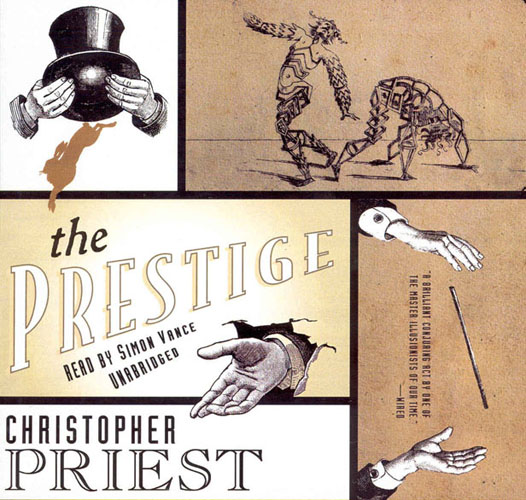
The Prestige by Christopher Priest (audio)

I felt confident in choosing this audiobook because – while I can’t remember who recommended it – I recall that two sources I respected (book blogs, I think) both praised it around the same time. Safe, I thought. Well, I am reminded again: we cannot all like the same things.

The Prestige opens with a first-person narrator named Andrew, embarking on a trip to cover a story for his newspaper job which he finds generally uninteresting. Andrew is adopted, and cares nothing for the truth of his birth family except for the all-consuming feeling he has that he has a twin. What he has managed to learn about his birth parents indicates that there was no twin, but he feels the presence of that other person too strongly to entertain any other explanation. So he arrives in search of the newspaper story – and if this already sounds disjointed, then right ho, that’s how I found it too – and what do you know, the story he’s pursuing turns out to be related to the mystery of his family’s past. Apparently Andrew’s great-grandfather was a magician, one of the very best in Britain and in the world, and his nemesis – the other greatest magician in Britain and in the world – was the great-grandfather of this young woman from whom he finds himself sitting across a table. In pursuit of, um, a newspaper story. But there is no story, really it’s about getting these two together.

And then the story of Andrew (and Kate, the young lady descended from the other magician) breaks off, and we are treated to the diary of Alfred Borden, Andrew’s predecessor. Now the story of Borden’s life, magical career, and lifelong enmity with the Great Danton is presented from Borden’s point of view; after which we break off and view the corresponding histories from the Great Danton’s perspective, via his own diaries. Finally we come back around to Andrew’s narrative.

The overarching mystery of the book is the question of how each of these magicians performs his great iconic stage act. The two illusions are similar, but apparently are performed in different ways, which are not made clear to us until the final few chapters. It is an interesting mystery, and frankly it is that that kept me going until the end of this book. Andrew, and his desire to discover the truth about the mysterious twin, interested me. But the flashback stories (in diary form) of the rival magicians really failed to compel me, and dragged on too slowly. The mysteries of the magic trick, and of the questionable twin, I must confess were so engrossing that I wanted to continue and learn the truth. But the path there was more frustrating in its pace than enjoyably anticipatory, and I cannot give this book much of an endorsement. I was interested enough in the overall story to finish the book, but almost constantly impatient to get to the big reveal. And, worse, I was disappointed in the big reveal; but no more should be said about that in case you check it out yourself. I suppose you’re unlikely to do so on my recommendation! But I assure you there are positive reviews out there.

I wonder if it wasn’t the frame element of stage magic that failed to grab me. I don’t find myself particularly interested. (Despite all the excitement over The Night Circus, I am unlikely to pick that one up.) The pacing was a lot of what did this one in for me, and the personalities of the two magicians, Borden and Danton: they weren’t terribly sympathetic or likeable. I was frustrated and exasperated with them for most of the book. What can I say, this review has descended into a litany of complaints. Sometimes they don’t work for us. Better luck in the next book, yes?


Rating: 3 magic tricks.

book beginnings on Friday: The Prestige by Christopher Priest

Thanks to Rose City Reader for hosting this meme. To participate, share the first line or two of the book you are currently reading and, if you feel so moved, let us know what your first impressions were based on that first line.

I am listening to The Prestige based on the recommendations of (I think) multiple fellow book bloggers. I am fairly sure that one of them was The Boston Bibliophile, but I am only fairly sure of that, and the other recommender(s) escape me. At any rate… I know the book involves magicians, stage magic, and I know little else, so here we are:

It began on a train, heading north through England, although I was soon to discover that the story had really begun more than a hundred years earlier. I had no sense of any of this at the time: I was on company time, following up a report of an incident at a religious sect.

I like that, “it began on a train…” reminds me actually of Agatha Christie’s Murder on the Orient Express, and there are worse things than evoking the Queen of Crime! Although she’s a hard act to follow… I’ll keep you posted.