NOS4A2 by Joe Hill (audio)

nos4a2Warning: here comes another rave review.

NOS4A2 is terrifying, enthralling, highly imaginative, and a deliciously entertaining wild ride. As much as I’m tempted to write a play-by-play plot synopsis, I shall resist, because discovering those twists and turns as told by Joe Hill is an excellent experience that I can’t match. So, a few brief sketches.

Victoria McQueen – known as Vic, or The Brat – rides a Raleigh Tuff Burner, a boy’s mountain bike that her dad bought her even though it’s really too big for her. We meet her at age 8, but follow her through several decades. Maggie Leigh is a small-town Iowa librarian with purple hair and an equal passion for Romance poetry and Henry Rollins. Lou Carmody is a fat man with a heart of gold who is passionate about superheroes, comics, fantasy, and his family. He works as a mechanic and is arguably the most loveable character in this story. There is a bad guy with a warped sense of “fun” and a love for little children; there is another bad guy who never really grew up and doesn’t want to. Settings range from the New Hampshire coast, to the Massachusetts woods, to the snowy mountains of Colorado, and of course that Iowa library.

NOS4A2 combines realism and a deft hand for family dynamics and truly touching, human, fully-wrought relationships with horror – and by horror I mean little children smiling sweetly while wielding chainsaws and singing Christmas carols by the light of an animate moon (and on from there). I came to love and care for Vic, Maggie Leigh, both Vic’s parents, Lou, Wayne, and all the rest: they are fully developed characters with all the quirks and back-stories a reader could ask for. The imagination employed to create these characters – not to mention the outrageous, chilling, perfectly explicated otherworld they have to deal with – is prodigious. I marvel at the mind that can create such things.

Spooky creepy world-building combined with all-American realism, horrifically menacing little children, and an expert sense of pacing and suspense put NOS4A2 in the highest class. Not to put too fine a point on it, then, Joe Hill has all the goods his daddy does. Full points as well to Kate Mulgrew for her narration, which ranges over numerous distinctive voices, including accents, genders, and terror. As Hill points out in the author interview at the end of this audiobook (on which more to come in a later post), a well-read audiobook is a uniquely awesome experience, and this is one. Fully absorbing, realistic and petrifying, NOS4A2 is a juicy good time, but not for the faint of heart. I’m on to find more of Joe Hill.


Rating: 10 Scrabble tiles.
(Final tip: DO listen to the audiobook!)

Farewell, Dorothy Parker by Ellen Meister (audio)

farewellI “like” the Dorothy Parker facebook page, available here, which is run by Ellen Meister and posts Parker quotes and anecdotes regularly. This is how I became aware of Meister’s new book, a nod in novel form to the feisty one.

In wrapping up this audiobook experience I am a little conflicted. I was alternately spellbound and greatly entertained, and exasperated, with the novel’s protagonist, Violet Epps. Violet is a movie critic in present-day New York, and her verbal wit on the page is razor-sharp (as they say), in the spirit of her acknowledged hero, Dorothy Parker. But in real life, she’s petrified of everything, rarely finding the voice to ask for a seat at a restaurant; in the opening scenes (quite frustrating) she is trying to break up with a dirtbag loser boyfriend but can’t. And then she obtains a book signed by Dorothy Parker, and discovers – gasp – that she can summon the dead writer at will. This changes Violet’s life enormously.

Violet needs a helping hand in several areas of her life: dumping the boyfriend and fielding a new one; dealing with a horrible bratty new underling at work; and fighting a custody battle for her recently orphaned niece. Mrs. Parker (as she insists on being called) is a great help – or sometimes a great interferer – in these matters, giving Ms. Epps (as she insists on calling her) the backbone she needs. Sometimes this takes the form of encouragement (or even feeding her lines); but Mrs. Parker also has the ability to enter Violet and take charge of her body, which can be messy. There is always the questions of where to give credit (or blame) – how much is Violet in control of herself? She is apt to give Dorothy Parker the credit, but she’ll have to learn how to stand up for herself by herself in the end, of course. The satisfying flip side to Violet’s growth is that she has something to offer Mrs. Parker, as well.

On the one hand, Meister’s characters were well-developed and believable (with the possible exception of a rather ogre-ish grandmother), and I cared about them. Dorothy Parker was wonderful, everything you’d want her to be, realistic, heroic but humanly flawed. I was honestly desperate to get back to this audiobook when I had to shut it off. I needed to know what was going to happen next; I was excited or anxious for Violet, who I liked.

On the other hand, Violet’s behavior was often infuriating. She was so slow to learn, so allergic to speaking up for herself in even the most obvious of needs, that I wanted to shake her. We spent what felt like eons in situations where she should have just done something. Now, I’m not a person who typically struggles to speak up for herself; I don’t suffer from social anxiety except in the most exceptional of circumstances. Perhaps I should be tolerant of this portrayal because perhaps it is entirely realistic for people who truly fight these issues. [Although, the explanation for Violet’s social anxiety – a trauma involving her recently-deceased sister when they were small – I found rather trite.] But even if this was a realistic portrayal, I found it tiresome.

Similarly, perhaps I should give allowances for this part because I’m not a romance fan – but in the thread of this story that was a romance novel, there occurs that maddening trope wherein the woman wants the man but pushes him away, and it takes far too long for them to reconcile their totally obvious mutual desire. My patience was tested. But, romance fans, you should like that part.

I know I sound harsh here, but I point out again, the plot’s action had me riveted and I am going to miss Violet Epps (and Dorothy Parker!) very much now that this book is finished. I just want to communicate that I had conflicting moments throughout.

And in the end, I was silly putty in this book’s hands. I was so pleased for the happy endings and for all the characters that I forgot my earlier quibbles. Had I been I overreacting? Or did the later success of this novel simply wash away the memories of my frustration? Whatever it was, my patience with this book was rewarded and I’m won over. Three cheers for Violet and Dorothy, both.


Rating: 6 edits.

The Black Monk and Other Stories by Anton Chekhov (audio)

blackmonkI am tagging this as a did not finish, although I did, in fact, finish two short stories (and barely started a third). I DNF’d the story collection, though. Meaning, I don’t seem to be a Chekhov fan. It’s funny when things turn out that way: when I turn out not to like an author who is Classic, or in this case, revered as one of the best short story writers of all time (I can’t remember where I’ve heard this, but I have. More than once. sigh). But it does happen.

I listened to The Black Monk and Gooseberries. It was remarkable to me how much these stories reminded me of Tolstoy (who, if you recall, I also did not like). I don’t know if it’s Russian writers with shared characteristics, or that they both evoke the same world and that’s what bothers me. At any rate, the Russian society on the estate felt very much like the same background, transferred from Anna Karenina to Chekhov’s short stories.

In The Black Monk, our protagonist visits the estate where he was raised family-like by non-relations. The father figure encourages him to marry the daughter of the estate (so, the sister figure?), and he does. At a party somebody shares the legend of the black monk, who is imaginary but shows up… sometimes, some places. Our protagonist sees the black monk, talks with him, and uses their conversations as fodder for his own writing (oh yes, he is a writer by profession). He gets caught talking to himself (as it seems – he’s talking with his imaginary black monk) and “treated” for his “illness,” which frustrates him. He and the wife split up. The end. This is a story in which nothing much happens, and the black monk bits I found uninteresting. Is this minimalism as a stylistic statement, or something? Is it not what’s there, but what isn’t there? (Like action, personality, conflict?) This is a well-regarded piece of literature, but it passed me right by.

In Gooseberries, a few friends gather and sit around and tell a story: the brother of one of these men, having grown up in the country but found work as a bureaucrat in a city, dreams about retiring to the country. He will have a farm, or something like it; and he will have gooseberry bushes. In time he accomplishes this: he has a country estate, and gooseberry bushes. The brother (who is telling the story, to his friends) visits, and is served gooseberries. The country-aspiring brother praises them highly, but they are in fact bitter. I assume this is the grand symbolic conflict of the story that is meant to impress me, but again I found it banal. Oh, there is some social commentary on the fact that this bureaucrat-brother now professes to be a nobleman and high-handedly distributes buckets of vodka to the peasants on special occasions, pretending grandeur. But again, this is a story in which nothing happens, and I am bored. So I stopped listening.

In many literary cases, we praise the understated. I’m thinking of Cheever’s short story, The Swimmer, and Hemingway’s, Hills Like White Elephants. The under-context of these stories remains pretty well hidden, but they are praised as masterpieces. (I enjoyed both, for the record.) In Hemingway’s story, nothing really happens; but it is still thought-provoking and oh, so emotionally evocative. In Cheever’s, a little more happens; nothing is said about what Cheever really wants to say; but it still works. I wonder if there’s something hidden in The Black Monk that, if explained to me, would make it so much more enjoyable? I suspect not.

Funnily enough, this audiobook I picked up right after The Gunslinger is read by the same narrator, George Guidall. That was an interesting experiment in the different voices and moods a good narrator can evoke. When I thought to notice, I could tell – obviously – that the same man read the two books; but it never would have occurred to me mid-story, because he does a fine job of bringing to life two such different worlds. The fantastic, dramatic made-up world of King’s fantasy series couldn’t be more different than Chekhov’s staid, frustrated Russian society, and Guidall did well by each, so none of my criticism falls on him. I was annoyed by the characters Guidall read; but I think he read them as they were written.


Rating: 2 empty comments.

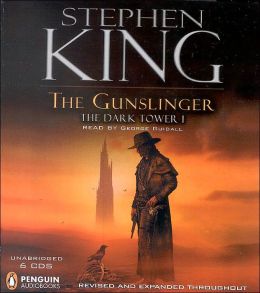
The Gunslinger by Stephen King (audio)


This is my 1000th post! Thanks for your support, friends!

gunslingerI so very much enjoyed The Wind Through the Keyhole from Stephen King’s Dark Tower series that I had to find The Gunslinger, book one in that series. I was captivated by King’s own narration of the former, and disappointed to find that he didn’t read this one himself; but narrator George Guidall did a fine job, and I shouldn’t punish him for not being Stephen King.

In a fantastical spin on the western genre, we open with Roland Deschain walking alone with his mule, his guns holstered at his hips. He is pursuing “the man in black”, with an eventual destination of “the dark tower.” These terms are archetypal and possibly metaphorical. He has to cross a desert. He talks with a lone farmer (accompanied by a talking crow), and tells the man a story. (The story-within-the-story is repeated in The Wind Through the Keyhole, very enjoyably.) In the gunslinger’s story we experience the town of Tull, where Roland had also stayed for a spell, in pursuit of the man in black, with some nasty consequences. This is the first of the gory-bloody bits in The Gunslinger, but not the most extreme. We are also learning something of the magical nature of this world that the gunslinger inhabits. The man in black casts spells to entrap Roland; time doesn’t flow normally. At a glance, however, this could be our own world – possibly following war or other disaster.

Next, Roland meets “the boy,” Jake, who has himself come from some other world. As he describes it, Roland thinks he must be making things up; but the reader recognizes modern-day New York City. Jake and Roland travel together for a spell, still across the desert, and then have to climb a mountain, and then go into the mountain. I’ve put off saying this for long enough: The Lord of the Rings is strongly present. The dark tower, the linguistic touches, the lone-ranger type which is borrowed both from western books & movies and from Tolkien, and now the trip into the evil mountain with the ghoulish parahumans threatening them along the way, are all clearly inspired by that exemplary world-building trilogy. Come to think of it, I’m pretty sure I referenced Tolkien in my review of The Wind Through the Keyhole, too.

Anyway. They’re traveling, and Roland tells Jake a story, too – another story-within – this time about his training as a gunslinger, and the climactic, life-determining moment when he fought his teacher. This is the truly gory bit: it made me cringe a little, and I don’t consider myself a squeamish reader, so take note. This is Stephen King, after all. Horror joins western and fantasy-epic in King’s genre mashup. Roland and Jake will have a final meeting with the man in black; and I shall leave you there.

I enjoyed this book very much. Stephen King is, without question, expert at world-building and believable, fully-wrought, finely detailed backgrounds. Roland is both an archetype and a real person I easily learned to care about. The tension, suspense, and dramatic action are engaging and had me sitting up straight waiting for the next blow. The boy Jake is sympathetic. There is a mystery surrounding the man in black, and the final confrontation – I said I wouldn’t go there. On the other hand, The Gunslinger felt to me grittier, grainier, less literarily refined than The Wind Through the Keyhole, which in my memory, at least, was a superior book; but not by much. And for that matter, a grainier, less refined beginning feels like it suits this series. I am enchanted by the pulling together of genres, as I stated: western, horror, fantasy, and epic adventure. I don’t think I’m doing it justice in this review, but this is fine work, friends. I’ll be seeking out book two.


Rating: 7 slow mutants.

did not finish: A Killing in the Hills by Julia Keller (audio)

killing in the hillsI made it less than 20% of the way through this audiobook (28 of 156 tracks, if you like to be precise), so on the one hand I should go easy on it, not having read it to completion (or even close). But on the other hand, the fact that I quit so early does indicate my feelings about it.

I read good things about this debut mystery novel – somewhere – but can’t add to those praises. The setting in the West Virginia hills (or mountains) was promising at the start, and I liked the idea of our small-town female prosecutor and her troubled past; likewise her friendly, almost filial relationship with the much older sheriff. But there the character development ended. Our prosecutor hero, Bell, turns rather flat, and her teenage daughter Carla is far worse: a cariacature of the worst kind of whiny teen girl, she speaks in overly-self-aware brattiness, as if she were her own psychoanalyst which – hello – obnoxious teenagers are not. Similarly, the early bad guy is so hideously ugly in every feature as to be a cartoon – how easy to identify bad guys if they all looked like this! And he somehow simultaneously is a stark idiot, and shares Carla’s preternatural self-awareness. The dialog felt like nails on a chalkboard. And so I gave it up. The mystery remains unsolved, for me, and that’s just fine.

Narrator Shannon McManus was sometimes amusing, but sometimes a little overly dramatic (although a certain amount of that falls to the author, for sure). Her rendition of Carla I found unbearable, but that’s squarely on Julia Keller; that’s how Carla was written, I fear.

I’m happy for those who enjoyed this novel, but I am not among them.


Is it fair to rate a book I read this little of? Probably not.

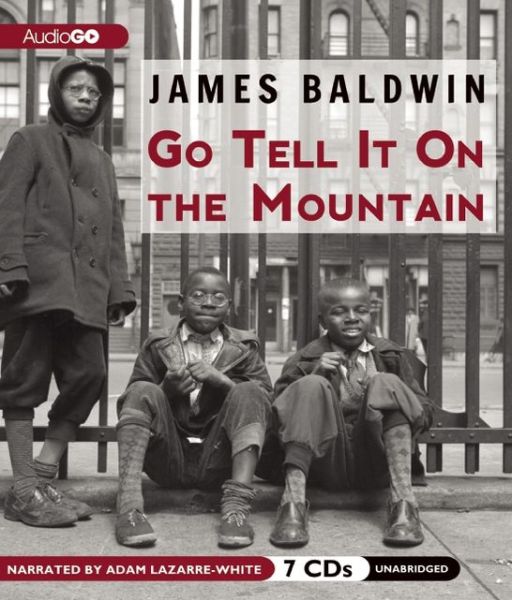
Go Tell It on the Mountain by James Baldwin (audio)

go tell itI come away with the impression that this book had a large, sweeping scope. It is on the surface the story of John Grimes, and takes place in the present over the course of just a day or three, on and around his 14th birthday. His father Gabriel is a deacon in a black church in New York City in the 1950’s, and appears very pious, but beats his wife and children; as his sins add up from there, he comes clear as a hypocrite. The story begins and ends with John and focuses on his relationship with the church or with God; the first and last lines of the book are concerned with his eternal salvation. But in between, we ramble in space and time, and get to know Gabriel in his youth in the South; John’s mother Elizabeth in her youth in the South and in New York City; Gabriel’s sister Florence, who introduced him to Elizabeth; and a surprise character I’ll leave unnamed here. As such, although John is the focus that bookends all the action, this turns out really to be the story of a family and even of a shared experience. I was glad to have the background I gained by reading The Warmth of Other Suns, because like that work of nonfiction, Go Tell It on the Mountain is the story of black Americans moving north in the mid-20th century. It’s concerned with black society’s relationship with the church, and family patterns, and race relations. And it’s for these focuses that I call it “sweeping.”

John is a likeable character in that he feels like a real boy of that age, and my heart goes out to him for the challenges he faces: an overbearing and violent father with the significant authority of the black church in Harlem behind him is no small thing, and the question of his immortal soul and eternal salvation is weighty as well. Clearly I bypassed some of the weight of the religious question, not being able to sympathize with those parts, but I did appreciate the atmospheric nature of the church and the power of that institution in John’s society and in his family life.

Baldwin’s writing is undeniably lovely. I feel a little inadequate because I’m afraid I missed some of the depth of this story, mainly in the religious vein. But what I got, I appreciated, and part of that in this case meant just letting the language flow over me. The narration by Adam Lazarre-White is powerful, dynamic, and dramatic to the right extent; the phrasing feels accurately portrayed, and the cadence of the prayers is well executed and adds a lot to the feel of the story. Full marks for audio performance, and having such a fine narrator read such beautiful words was a grand experience.


Rating: 7 calls to the alter.

Z: A Novel of Zelda Fitzgerald by Therese Anne Fowler (audio)

zThis is a fictionalization of the life of Zelda Fitzgerald, wife to F. Scott Fitzgerald. The main events of their lives are fairly well-known: married in 1920, Fitzgerald was a professional writer who never saw the success in his own lifetime that his friend Hemingway did; the couple lived back-and-forth in France and the US; Zelda was “the first flapper” according to Scott; they were famously wild partiers, alcoholics, and rather nut jobs; Zelda was eventually institutionalized, and died in a mental hospital. They had one daughter. These main events are followed in the novel, which is told first-person by Zelda herself.

It started well. I really did love Zelda’s voice – as written by Fowler, and as read by Jenna Lamia. She’s spunky and irreverent, and likeable. She reminded me of Scarlett O’Hara from the very beginning, which is both a compliment and a caution: is she entirely original? I enjoyed what Fowler created in her fictionalized Zelda Fitzgerald, but I worried that she was overly informed by hindsight. Scott talks like he writes; Zelda speaks as if aware of her audience, aware of the legacy she’ll leave behind – which she wouldn’t have been, regardless of her faith in her husband, because his fame as we know it today came largely after both their deaths.

Ernest Hemingway likewise speaks in a caricatured version of one of his own heroes. This is a common technique when writing Hemingway into fiction: I recognize it from Midnight in Paris. I’m comfortable with people criticizing, even despising Hemingway; he’s my hero, but I certainly see his flaws. But I wish they wouldn’t make him into a cartoon, because that, I think, he wasn’t. He could be ridiculous, and he definitely overdid the machismo, but he was a complex human being, troubled, tortured, insecure, boastful and antagonistic; wouldn’t it be more fun, and more satisfying for a novelist, to write him as a full person than as a cartoon version of his own fiction? Ah well.

Expand this concept to apply to Scott Fitzgerald, too. I’m less qualified to speak about his life, having read much less about him than I have about Hemingway. However, I feel confident that neither Scott nor Zelda could have been as black-and-white as Fowler’s fictional characters are here. Scott Fitzgerald is a monster in this novel! Despicable, horrendous, a nightmare. I suspect that in life, he was, like Hemingway, capable of monstrosities, but also a full human being, with likeable bits alongside the flaws. Such a well-loved and artistically accomplished alcoholic would seem to have to be conflicted, ambiguous, and – importantly – multi-facted. Fowler’s characters lack facets. Similarly, though I have read still less about Zelda, my general understanding of her was that her dissipated party-girl period lasted well out of her early 20’s. The fictional Zelda we meet here becomes rather saintly after giving birth to her daughter. She is the squeaky-clean foil to Scott’s ogre; and I suspect that the one is as realistic as the other.

In contrast to this novel, I am simultaneously reading the yet-to-be-published The Trip to Echo Spring: On Writers and Drinking by Olivia Laing. Z suffers by comparison; Laing’s (nonfiction) work is very well researched, beautifully written (although I’ll try not to turn this into a review of her book!), and, to my point here, respects the dueling forces for good and evil in her subjects, including F. Scott Fitzgerald. (And Hemingway.) Possibly I would have appreciated Z more if it were presented not as historical fiction but as alternate history, since I am increasingly concerned that it’s not true to the history of the Fitzgeralds as we know it. Even then, however, fully developed characters should have complexity rather than read as saints and devils, so my concern remains.

The net effect of having read this book in the end is that I feel the need to go read up on Zelda a little more thoroughly; I’ll be looking for a biography next. She always struck me peripherally as a colorful, conflicted character: just the kind I like, that is. I’m always most interested in those individuals who offer both sympathetic and distasteful qualities in the same package; they’re so engrossing that way. One of Fowler’s major flaws, then, would be in having omitted my favorite character feature: ambiguity.

I began by enjoying this book, and Zelda’s voice and personality. Much of the middle troubled me, as the black-and-whiteness of the characters emerged. Scott was such a terrible husband that I was just frustrated and angry with him; and while these can be useful emotions to evoke in your reader, Fowler didn’t take me anywhere interesting or cathartic or instructive with them. Zelda briefly considers leaving Scott (because she is, after all, a saint and a martyr) and then realizes she can’t afford to support herself as a single woman, so she decides to stay. Very cut and dried, you see. Towards the end, when the couple is separated by Zelda’s incarceration in various mental institutions, I liked it a little better again; maybe removing the hateful Scott cheered me. But then it was disappointing to end with Scott’s death – Zelda lived another 8 years! but those years are handled only in an epilogue. Why couldn’t she have continued to speak in her own voice until she died? Perhaps this novel should have been called Z: A Novel of F. Scott Fitzgerald told through the eyes of Zelda. Hmph.

In closing, clearly, my concerns were many. I credit Fowler for entertaining me (at least early and late) with a likeable Zelda in a spunky Southern drawl, well read by narrator Lamia. But I was dissatisfied with many aspects of the art of the novel as executed here. Subjects like the Fitzgeralds offered so much opportunity for nuance, and catharsis, and analysis, that was not undertaken. Complex characters were flattened into single dimensions. And my limited knowledge of their lives makes me hesitant, but I worry about the historical accuracy, and I wish more information were given to indicate where the fiction begins. Several letters from Zelda to Scott and other friends are quoted; are these real letters? I don’t know; and I’d like to know. Credit Fowler with inspiring some further reading; but this experience in itself was less than satisfying. I can’t recommend that you spend your time on this book. There are lots of books written about the Fitzgeralds; start elsewhere. Me, I’m considering Tennessee Williams’s play, Clothes for a Summer Hotel.


Rating: 4 fingers.

The Other Typist by Suzanne Rindell (audio)

typistThis book reminds me very much of Rules of Civility by Amor Towles, with similarities extending to the audio narration, as well. And considering how much I loved that book, and narration, this is a high compliment. They share a setting in New York City early in the 20th century (in this case, Prohibition era), a concentration on class differences, a slinky sensual tone, and an appreciation for the finer things in life. The final shared characteristic is a major plot twist late in the book, here subtly foreshadowed from early on. And that is where I struggle a little with this review: I don’t want to spoil the surprise for you, because it makes the book. Read on safely; I’ll be careful.

Meet Rose Baker, our narrator. She was raised in a Catholic orphanage and now works as a typist in a precinct office of the New York Police Department. The book opens with a discussion of the controversy surrounding young women working as typists at all, let alone in the “rough” environs Rose inhabits: she frequently witnesses and transcribes the confessions of murderers and rapists (gasp). That opening passage helps establish the setting, along with a following reference to the Volstead Act (which prohibited alcohol in the United States).

And now, meet Odalie Lazare, the “other typist.” There were already two typists besides Rose at the precinct, but Odalie is a different sort. Glamorous, seductive, and strangely well-off for someone who would work as a police department typist, Rose is bewitched from the first. The two become “bosom friends,” and Rose becomes… devoted? obsessed? It all depends upon your definitions, of course.

Suzanne Rindell’s construction and development of Rose Baker as an unreliable narrator is delicious. We know Rose for a great many pages as a sober, morally upright young lady and professional; she describes Odalie’s entrance into her life with a sense of foreboding, but with no clue as to what has happened between them. And then there is the first, very brief, reference to Rose’s doctor. Later, there is another flashing reference to the “incident.” Thus, our sober and reliable narrator is undermined, but just so swiftly and for just a moment – did we even see it at all? And I’m left, as the reader, wondering about this incident and why Rose needs a doctor; and then I’m back in Rose’s story, seeing her as the responsible character again. It is a masterful building of tension and questions; I ate it up.

One of the many strengths of this story is in its strong sense of time and place. Prohibition New York is colorful; one can hear and smell and taste its flavors. I will have to leave it to another, older reader to speak to its authenticity, but I am certainly convinced. The writing style, and Gretchen Mol’s reading style, contribute to the feel of an earlier time; sentences are a little long and formal, in a way that just creates more atmosphere.

Rindell’s fine sense of pacing, the doling out of detail and prolepsis, is adept. It is not everyday that I am this drawn in and enchanted by a story; I couldn’t wait to hear what would happen next; I was guessing and second-guessing. As a thriller, The Other Typist evoked some of Tana French’s best work (as here).

Although I was captivated by the swirling mists of speakeasies and Odalie’s wily ways as the femme fatale, I think my favorite part of this experience was the buildup to the big reveal, and the mystery left therein. The Other Typist was a pleasurable rush and romp, and has left me wanting more of Suzanne Rindell’s magic. Reader Gretchen Mol was perfect and not to be missed: do find this one on audio if you can.


Rating: 8 champagne cocktails.

A Wrinkle in Time by Madeleine L’Engle (audio)

wrinkleWhat fun to dig back into this children’s classic. I only vaguely remembered enjoying this as a kid, and I got to rediscover it via this audiobook, read by the author. My memory didn’t provide much: I think I was most familiar with the opening scene, in which Meg Murry is awake and frightened in her attic room alone by a storm outside. She is grumpy, frustrated with her family: her father for being away for so long; her baby brother Charles Wallace for not feeling her pain and coming to her as he usually does.

Next, of course, Meg and Charles Wallace meet the not-quite-mortal Mrs. Whatsit, Mrs. Who, and Mrs. Which, and an unusual boy from Meg’s school named Calvin. This unlikely team will adventure together via the “tesseract” – a wrinkle in time and space as well, if you will – to try and find Mr. Murry, and save him, and save the world (and all the worlds) from the Black Thing.

This is a children’s chapter book. Madeline L’Engle notes in an introductory section that publishers thought it would be too hard for children; but her own kids loved it, and as it turns out, so does the world. It’s won several awards including a Newberry, and remains popular today. (Originally published in 1962 and still in print.) I can see how it would be “hard” for children, particularly the physics bits; but then, we don’t have to understand it fully to enjoy it, do we? And lots of adults are puzzled by physics too! This book has appeal for adults – perhaps obviously, here I am, and I don’t read a whole lot of children’s books. It still rings like a kids’ book, but I found the characters and the plot both engaging. I have a slight criticism that Meg occasionally sounds a little adult for her age; she does whine appropriately, but sometimes her observations are startlingly astute. It’s a common complaint with young characters in books. But only slightly, here.

Meg, Charles Wallace, and Calvin are all likeable but human; their parents are similarly well-rounded, sympathetic characters. The Mrs’s are charming, and the world-building – in the world of Aunt Beast, for example – is well done. I like that Meg grows some in the course of the story; and L’Engle certainly leaves us open for a sequel, what with the possibility of a burgeoning romance, and the happily-ever-after-at-least-for-now ending (with the Black Thing still looming). Mostly I was just disappointed that it was over so quickly! (Another feature of children’s books.)

I was a little surprised to find religious references within; I didn’t remember those. Not many, but a few mentions of having God on one’s side, or being the chosen ones, fighting for good. It got me thinking. I’m not particularly good at spotting religious allusions, not having been raised in church or on the bible. They mostly pass me by. But spelling out G-O-D will catch my eye every time! It’s not a technique that appeals to me but it wasn’t a central enough theme here that it threw me off much, either. A theme that is central is a good-versus-evil dichotomy, which of course could be interpreted as being religious; but the book-banners have protested certain aspects of this story, too – including the grouping of Jesus with mortal fighters-for-good such as Da Vinci, Michelangelo, Shakespeare, Pasteur, Einstein, Gandhi, Beethoven, Copernicus and a lone woman, M. Curie. So there you are: all matters of interpretation.

In a nutshell, I found this book a delightful, too-brief romp in another world. I am tempted to pursue further work by L’Engle; four books follow this in a quintet, and others of her oeuvre reference the same characters. Realistically, I don’t know if I’ll get to them. But this was an enjoyable read, and not just for children.


Rating: 7 pairs of spectacles.

Yale lectures on Hemingway, Fitzgerald and Faulkner by Wai Chee Dimock: lectures 17-25; conclusions

(See my first two reviews: lectures 1-7 and lectures 8-16.)

First I’d like to share another example of something that I wished to debate with this professor. The discussion below contains spoilers regarding For Whom the Bell Tolls, which is probably my very favorite book ever ever (possibly competing with The Odyssey and The Jungle), so if you haven’t read it, you might skip this part of my review.


Spoiler begins

At about 32 minutes into lecture 19 (“For Whom the Bell Tolls,” Part IV), regarding the scene late in the novel when Robert Jordan’s leg is broken and Pablo is going to lead his small band onward without him:

The symmetry here is between Robert having a broken leg and Pablo having much head. He is the brainy one. This is the ultimate rewriting of the power dynamics in For Whom the Bell Tolls. We’ve been going along with the assumption that it’s the person with the knowledge and the technology, the person with the knowledge of the world, the person that speaks several languages, we’ve been going under the assumption that that person is going to be on top, that the future belongs to him. The ultimate irony of this novel is that in fact this is the person who’s going to lose out, who’s going to have no future at all.

While I see her point about the disruption of power between the educated, foreign-empowered Robert and the rather much maligned and dissipated Pablo, I couldn’t disagree more about the disruption of the reader’s expectations. I realize I can only speak for myself, but I think I can find some Hemingway to back up my impressions.

When I read this book for the first time (in a beach camp in the little town of Sayulita, Nayarit, Mexico), I had a strong sense of foreboding about Robert’s fate, and indeed, the fate of Pablo, Pilar, and the rest. Robert’s daydreaming of his life together with Maria in other times and places – in Paris, in the United States, as the wife of a professor entertaining undergraduate students – has a tone of wistfulness, as if Robert suspects this will not come to pass. He likewise daydreams about suicide – his father’s, and the avoidance of his own – and is increasingly pessimistic about the fate of this band of guerrillas. The end of El Sordo has an air of doom about it, which reflects further than those who die on the hilltop; the odds are admittedly against a little guerrilla group in these mountains. When I read this book without knowledge of the ending, I felt sure that Robert and Maria wouldn’t make it out of these hills together and alive; I suspected Robert’s demise specifically, and worried for the rest of them as well. And while I know this is just one person’s reading, I think there’s evidence that Hemingway directed me toward these suspicions. So I’m not sure Dimock has grasped it when she says she’s turned all our expectations on their head. Hemingway has disrupted the power dynamic, yes, but intentionally and with foreshadowing; I’d argue that one of the messages of this novel lies in his statement on war and the value of military technologies, in the way that Dimock shows, but he didn’t surprise us with it so much as build us steadily towards this ending.


Spoiler ends

I am arguing with Dimock here not because I think she’s unintelligent or anything, but because I enjoy debating literature I love. I just wish I could be there and ask my questions and make my points, engage the prof and my classmates. In other words, I would like to be back in school again. What else is new.

I both enjoyed very much, and was very frustrated (see above) by Dimock’s study of For Whom the Bell Tolls. I think this is natural. Next we studied Tender is the Night, which I reacted to similarly but less strongly; that’s a book I’ve read, though not recently, and I feel less strongly about it than I do FWTBT; it might be my least favorite Fitzgerald (I thought The Last Tycoon, for example, was better), but ho hum. And then there was Light in August, the only Faulkner I’ve read, and if you read my two reviews of that, you know I’m settling in as not a Faulkner fan. So, the final question of this semester of Hemingway, Fitzgerald and Faulkner: for me personally, did this class help me understand and enjoy Faulkner, or make me want to read more of him? And to that, a resounding “no.” I am discouraged by Dimock’s repeated confession that he is difficult, makes little or no sense, that she often does not understand what he’s up to. I was turned off by the other two works discussed in this course, and the final four lectures on Light in August shed precious little (wait for it…) light.

I now want to go back to school and study more literature; and I want to avoid William Faulkner from here on out. Those of you who enjoy him are welcome to your enjoyment and I’m happy for you. I’ll be over here.

As for Wai Chee Dimock’s course: I think she fails to articulate her thoughts sometimes; also, I disagree with some of them, but respectfully. I would certainly be happy to take courses from her if I were going back to school. As for this course via iTunes U, however, I give the combination of Dimock’s speaking style and the poor audio recording quality a C-, at best. However, I listened to all 25 lectures at ~50 minutes apiece. If you’re interested, they’re out there, and for that I’m grateful. We’ll see if I have any success with iTunes U in the future.