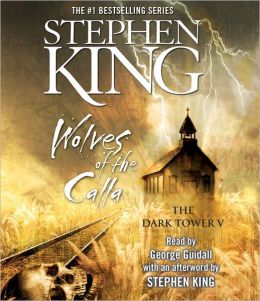
Wolves of the Calla by Stephen King (audio)

Just to review the Dark Tower series:

The Gunslinger (I)

The Drawing of the Three (II)

The Waste Lands (III)

Wizard and Glass (IV)

The Wind Through the Keyhole, written last but fitting between books IV and V.

and here we are with V: Wolves of the Calla.
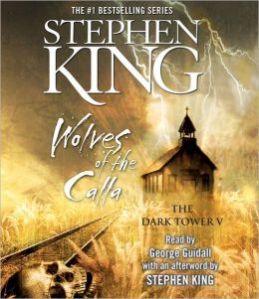

wolvesThis is a very long one. My library copy of the audio came on 22 CD’s. Off the top of my head, I can only remember Anna Karenina being longer; but where that was a painful experience for me (sorry, Tolstoy fans), this was pleasurable.

The action of Roland’s ka-tet of 5 – Roland, Eddie, Susannah, Jake and Oy – takes up very little geographical space, unlike most of the previous volumes. They leave Topeka and the Wizard of Oz world, and encounter an envoy from a local town, Calla Bryn Sturgis. The locals are tormented by the Wolves from Thunderclap, the neighboring badlands: these “wolves” come about once a generation to the Calla, where a single-born child (or “singleton”) is a rarity. Most children are born in twins, and the wolves come to take own of each set away with them; when they are sent back to their families shortly after, they grow into severely mentally handicapped giants who live short, painful lives. The folken of the Calla have heard that there are gunslingers in the area, and they are struggling to decide whether to ask the gunslingers’ aid in defending their town against the coming wolves – or letting them take half the town’s children, as always.

Among them, to the great surprise of Eddie, Susannah and Jake – all originally from New York City, although of three different whens – is Father Callahan, also transplant from their world, and with terrible stories to tell about the vampires he had hunted in his former life, before coming to the Calla and settling among the people of Roland’s world. He will be an important player, among other reasons, because he is in possession of another piece of the wizard’s glass: the big bad one, Black 13. As he tells his strange life story, and the gunslingers interview the townspeople in preparation to fight against the wolves, Roland worries about this delay of their greater mission, the quest for the Dark Tower. He has a bad feeling about what will befall them here; but a gunslinger asked for his aid cannot demur.

To complicate things further, each of the ka-tet becomes aware on his or her own schedule of another terrifying fact: Susannah is pregnant, or at least one of the women living inside her body is – a result of the fighting-sex she had with a demon in the second drawing of Jake, in The Waste Lands. We recall that when we first met the woman who is now Susannah Dean, wife of Eddie, she was Odetta Holmes – and also Detta Walker. This schizophrenic (or possessed?) double became one, healthier, stronger woman in Susannah; but now she has a new inhabitant, the one called Mia, who is mother to a demon child that threatens Susannah’s life. (Whew. Got that straight?) It is a weakening of the ka-tet that each of them learns this fact separately and is reluctant to share it with the others. Also, Detta appears to be making a comeback within the split body of Susannah Dean. We still haven’t entirely categorized her as being mentally ill, or a victim of black magic… but considering the setting for this fantasy series, I think it’s the latter.

And in a final plotline and complication: the rose in the vacant lot in New York is confirmed as being an important part of the quest as well, being firmly linked to the Dark Tower itself. The ka-tet is now concerned with getting back and forth to New York to buy the lot and protect the rose as well.

As this lengthy (but not wearying) epic plays out, Roland and the reader begin to understand that beating the wolves, seeing Susannah safely through Mia’s pregnancy, protecting the rose, and handling the awful power of Black 13 are all related to the great mission of this series: achieving the Dark Tower. At the end of the story, the wolves are vanquished (at least for now), but Susannah/Mia is off on her own; Eddie is distraught, the ka-tet is splintering, and its efforts are divided between multiple aims.

My praise of the series continues; the strengths of one are the strengths of all. I’m still deeply invested in our ka-tet (and OH, when Oy made his little speech and bow! he still might be my favorite) and in their eventual fate; and I continue to find the shorter-lived characters of each book – in this case, the Calla-folken – worthwhile investments, too. I marvel at the mind of Stephen King that can create such large and involved worlds with all their interconnections. And what a tricky one he is! For Father Callahan comes from another of his novels, Salem’s Lot – one I’ve not read, so I had to have the joke spelled out for me, but it tickled me nonetheless; I can only imagine for the folks who had read it, what a great joke and mindbender this was.

I am now heading into book VI, Song of Susannah. I was on a road trip when the one ended, and just started right up into the next without pause. As we begin this next installment, the integrity of our little group is highly questionable, and I’m anxious for them. Stay tuned!


Rating: 7 sharpened dishes.

Heart-Shaped Box by Joe Hill (audio)

heart-shaped boxWell, NOS4A2 is a hard act to follow. Although of course, Joe Hill wrote that one second; I’m out of order.

Heart-Shaped Box is about an aging rock star. Judas Coyne is mid-fifties when we meet him; he’s a little melancholy, a little rough around the edges, a little broody over his ex-wife and two dead bandmates. His collection of the obscurely macabre makes him an easy mark for an online auction offering a ghost for sale; but when he buys the dead man’s suit – which is supposed to come with the dead man’s spirit – he gets more than he paid for. The ghost turns out to be no stranger to Jude, but the step-father of an ex-girlfriend he called Florida. She was just one in a string of much younger women who he calls by the states they hail from; his current live-in is Georgia, and it turns out that by buying the ghost, Jude has gotten her into a pickle, as well.

Judas (real name Justin) and Georgia (real name Marybeth) will battle the dead man together, and in so doing, they’ll have to confront some metaphorical ghosts as well: her youthful traumas, his lifelong ones, and his dying father he hasn’t seen in 30 years. Jude’s two dogs, big beautiful German shepherds named Angus and Bon, play a role as well. They travel from a New York farm to the southern homes of Florida, Georgia – and Jude himself, who has been trying to outrun Louisiana all his life. It’s no coincidence, I think, that all his state-named conquests come from south of the Mason-Dixon line.

There are many strengths in this book, and I can’t help but think of them in terms of Hill’s outstanding second novel and the work of his larger-than-life father (ahem), for better or worse. Like King, Hill excels at creating believable worlds: Jude’s heavy metal rock stardom, the goth chicks he dates, and the world of the dead. As in NOS4A2, the creepiness of the supernatural, the other, is both deliciously excruciating, and entirely real – fully wrought, finely detailed, rooted in our true greatest fears, and with a sense of style. I really liked his characters, too: complex and ambiguous but ultimately people we want to root for.

I did have a few concerns here and there. I worried that Hill might struggle to keep up the tension. When I’d already had my heart raised by several repeated near-deaths and checked to see that I was about 1/3 of the way through, I wondered. But it turned out I should never have doubted! Because not long after that came the moment – I was walking home from the train and stopped in my tracks in an “oh shit” moment where he racheted things up and oh, good, we’re back in the world of the man who wrote NOS4A2. And in hindsight I like the time we spent prior to that moment, too; it was all necessary to build up the background that paid off in the end, so my bad, Mr. Hill. Hats off.

Later I had a few moments of doubt when Georgia and Florida began to be conflated… I wondered if it wasn’t a little misogynistic to have these two young women (who each have a lot of personality and personal history to build them out) begin to merge into one. It was a plot point, and not an accident born of Hill’s inherent prejudice, which helps some. I’m a little ambivalent on that point.

But really, that’s searching for criticisms. This supernatural, psychological thriller rattled my bones and kept me rapt; and I loved the cultural references (there’s Stephen King again) and strong sense of place(s), which is another of my favorite things in novels. I’ve left the plot purposefully pretty blank here because I want you to enjoy it for yourself: if you love being frightened by a truly well-put-together feat of storytelling with great characters, you’ll love Heart-Shaped Box. Um, you should be okay with blood, too.


Rating: 8 swings of the razor blade.

Teaser Tuesdays: Heart-Shaped Box by Joe Hill

Teaser Tuesdays is a weekly bookish meme, hosted by MizB of Should Be Reading.

heart-shaped box

I am enjoying Joe Hill’s first novel, as read by Stephen Lang. And today I wanted to share with you a much longer teaser than usual, because I liked this passage so much. I wonder if I’m the only reader who cringed a little.

Jude was aware that he belonged to an increasingly small segment of the society, those who could not quite fathom the allure of the digital age. Jude did not want to be wired. He had spent four years wired on coke, a period of time in which everything seemed hyperaccelerated, as in one of those time-lapse movies, where a whole day and night pass in just a few seconds. Traffic reduced to lurid streaks of light. People transformed into blurred manikins, rushing jerkily here and there. Those four years now felt more like four bad crazy sleepless days to him, days that had begun with a New Year’s Eve hangover and ended at crowded smoky Christmas parties where he found himself surrounded by strangers trying to touch him and shrieking with inhuman laughter. He did not ever want to be wired again. He had tried to explain the way he felt to Danny once, about compulsive behavior and time rushing too fast and the internet and drugs. Danny had only lifted one of his slender, mobile eyebrows and stared at him in smirking confusion. Danny did not think coke and computers were anything alike. But Jude had seen the way people hunched over their screens, clicking the refresh button again and again, waiting for some crucial if meaningless hit of information, and he thought it was almost exactly the same.

Sound like anyone you know?

book beginnings on Friday: Heart-Shaped Box by Joe Hill

Thanks to Rose City Reader for hosting this meme. To participate, share the first line or two of the book you are currently reading and, if you feel so moved, let us know what your first impressions were based on that first line.

heart-shaped box

I’m sure you will recall that I was entranced by Joe Hill’s NOS4A2; so naturally I enter his debut novel with high hopes. It begins:

Jude had a private collection.

He had framed sketches of the Seven Dwarfs on the wall of his studio, in between his platinum records. John Wayne Gacy had drawn them while he was in jail and sent them to him. Gacy liked golden-age Disney almost as much as he liked molesting little kids; almost as much as he liked Jude’s albums.

I’d say that’s a fairly impactful few lines, considering 1) the mention of a well-known serial killer and 2) the implication that our man Jude is a famous musician of the creepy variety. As you might guess, the following paragraphs describe further items in his collection; and none are as benign as this first one, a series of Disney-themed sketches. I’m on board so far!

did not finish: The Borrower by Rebecca Makkai (audio)

borrowerI made it exactly 25 pages into this one (although via audio, which was about 30 minutes, give or take). I remember hearing about The Borrower ever since it came out in 2011, and it sounded real cute: children’s librarian befriends sweet little boy who might be gay and whose censorious, bigoted, ultra-religious parents are a drag; she ends up either liberating or kidnapping him, depending on your angle, and they have adventures together. Nice story, right? In fact, it opens with a story time reading of Roald Dahl’s Matilda, which drives home the fact that this plot has been done before. And that’s no complaint or criticism. As Makkai notes in the voice of her narrator, “you can always count on a librarian for a derivative prose style.” I can dig that little joke (and also fear it is too true).

But things went south quickly after that. Faced with the censorious mother, Lucy (the librarian/narrator) rails that she would never “defy the Constitution” by refusing to check out certain books to a ten-year-old boy at his mother’s request. Now, I sympathize with Lucy’s gut reaction and not with the nasty mother; but I think it’s only respectful to be clear on what the Constitution actually says. The First Amendment protects the right to speech, press and assembly; it most certainly does not protect the right to read anything one likes (unfortunately), and the rights of minors have been curtailed in our courts in favor of their parents’ right to decide for them, with abundant clarity. This use of the “defy the Constitution” argument was outrageous and left me reeling. From a librarian, no less!

Next Lucy notes that

I wasn’t at all concerned about (the boss) enforcing this, or even remembering it a month later. And if she tried to fire me because I’d checked out a book to a patron of the public library, I’d have so much free legal representation within ten minutes that her gin-soaked head would spin.

Well, that’s bold – and naive. If this librarian were fired for checking out a book to a ten-year-old that the child’s mother had expressing forbidden her to check out to him, I think her legal case would be in some doubt; and while it’s conceivable that the ACLU or a similar organization would take the case on, I wouldn’t bet my job on it. I’d put the chances pretty low, in fact. To think that every unjustly-fired, underpaid city employee gets “so much free legal representation within ten minutes” to make heads spin is… idealistic, at best.

And then Lucy snobs out on her profession of librarianship, except oops, it might not be fair to call her a professional because she’s non-degreed and thus in most work environments ineligible to be called a “librarian” at all (this is a subject on which there is some controversy within the field and I don’t want to enter into that now, but I think it does bear on the credibility of this novel): in reference to the cardigan she’s wearing,

I hated that I’d started to look like a librarian. This wasn’t right. In college, I’d smoked things. My first car had angry bumper stickers. I came from a long line of revolutionaries.

Now this made my head spin. Librarians are about as diverse as any other demographic group you’d care to examine, and certainly there are those cardigan-clad shh-ing grannies with buns; but there is also no dearth of tattooed, funny-looking, hipster, punk, revolutionary-as-hell librarians. And you know what? Some of us wear cardigans, too. Despite the disappointingly cartoonish view of librarians represented by these lines, they also made me wonder if Makkai realizes who her audience is for this book: I am assuming that at least in part those attracted by her basic plot would be librarians (I am one), and she just alienated us with her snobby narrator.

So. This review threatens to be as long as the tiny piece of this book that I read; I should stop. I think I’ve effectively communicated that I was disgusted by the 25 pages’ worth that I listened to, and very comfortable turning away towards greener pastures. In fact, I’m now starting a novel by Joe Hill, whose librarian character in NOS4A2 was possibly a little bit of a cariciature in the other direction – with her purple hair and all – but also closer to the librarians I know. So there.


I am not assigning this a number rating after such a brief read but clearly if I did, it would be a low number of my grumbles.

Wizard and Glass by Stephen King (audio)

wizard and glassHow to continue to describe the outrageously imaginative, engrossing masterpiece that is Stephen King’s Dark Tower series? Oh my word.

Wizard and Glass is book 4 and, I think, my favorite so far. We met the gunslinger in book 1; met his three compatriots in book 2; and were reunited with the boy Jake in book 3. As this next installment opens, the ka-tet of Roland, Eddie, Susannah, Jake and Oy find themselves in Kansas; but it is a strange, other-worldly Kansas, perhaps parallel to the one we recognize. Along the road, the group stops for the night and Roland tells a story. This telling will fill the vast bulk of the book, so that as in The Wind Through the Keyhole, it’s a story within a story, with the inner one taking top billing.

Roland’s tale is that of his first love, his first adventure and battles as a gunslinger, and the genesis of his quest for the Dark Tower, which is by this point a quest willingly shared by his companions. It’s a great story, what King does best.

Roland begins by referring to the way he won his guns, and his right to be a gunslinger, in a fight against his teacher, Cort. Roland was 14, and his father was angry, and also worried, and sent Roland away along with his two best friends, Cuthbert and Alain. They travel to the back-country town of Hambry, in the barony of Mejis, where they are given a deceptively simple task that immediately complicates. Roland encounters a young woman named Susan and falls in love; their love is (naturally) thwarted by her unwilling role in the intrigue in which Mejis is entwined. Roland, Cuthbert and Alain, assisted by Susan and a deeply likeable local named Sheemie, will end up doing battle with the forces of “the good man” (who is of course bad) in this outer barony; and Roland’s love is doomed.

This story is endlessly moving, and engrossingly suspenseful. There is something sweepingly large and yet entirely believable about the teenage love story of Roland and Susan; and Cuthbert and Alain, who until now have been referred to only obliquely, become fully-developed great friends to the reader as well as to Roland. The reader is every bit as enthralled as Roland’s contemporary ka-tet (Eddie, Susannah, Jake and Oy) are; and I loved the slight jolt King inserts when Eddie breaks in to ask how Roland could know the story from all angles: what Susan thought, what the witch did when she was alone… this reminds us just when we’re starting to lose ourselves in Roland’s tale, that we’re actually still on the side of the road in Kansas with the new ka-tet, at the same time.

When Roland finishes talking, the five companions continue on the road towards… the emerald city. Genres, and worlds, mash up again when they come to the emerald castle and encounter the Wizard (of Oz?) – he of the book’s title, and we’ll also see the glass for the first time (which played such a role in Roland’s story). At the finish of the book, relatively little has happened to our main characters; they return to following the path of the Beam in search of the Dark Tower. But the wizard does entreat them to abandon their quest, and each in turn gets to articulate that he or she is by Roland’s side by choice now and from now on. The saga continues.

I am reeling; I never wanted this book to end; I reveled in it and rather tore at my hair when I realized I’m still wait-listed at my local library for the next in the series. (The horror!) My former policy of reading series willy-nilly with no respect for their order is gone; I am a purist. Stephen King has reformed me.


Rating: 9 pulses of pink.

Drinking with Men by Rosie Schaap (audio)

drinking with menI picked up this memoir for what I’m sure are obvious reasons. The title alone appeals to me: I am, ahem, a drinker, and a tomboy who’s been most commonly and comfortably in the company of men. Read a blurb, and find out further that Rosie Schaap is a fan of hanging out in bars, which puts her generally in male society; I’m right there with her.

And I was immediately charmed at this audiobook, read by the author in her somewhat gravelly (drinker’s, smoker’s) voice. She opens the introduction by calling herself a serial monogamist when it comes to bars: she becomes a regular at one for a year or years, then moves to another to which she will also be faithful for the medium-long-term. This memoir is organized by bars where she achieved “regularhood” (a status that she points out is even more overwhelmingly male-dominated than bar-drinker-hood generally), and covers the rest of her life – relationships, school, careers, living arrangements – as it relates to the bar, mostly. Her brother, parents, and husband get sketched rather more lightly than do her drinking buddies, for example. Her bars are located in New York City, small-town Vermont, Dublin and Montreal – but mostly New York City, her hometown and persistent home.

As expected, and as her first few lines indicated, I felt a real connection with Rosie. (I consider us to be on a first-name basis, as we would be on our barstools.) Her inexplicable (to some) comfort going to bars alone as a woman struck a note with me: I share that comfort (at the right bar, of course), and confirm her observation that this is rare behavior. I certainly agree that the definition of the best sort of bar is where one can go alone while female – and even read a book, or carry a conversation without shouting. (See here.) I also agree that these bars can come in different shapes and sizes (well, small is the ideal size), and that they overlap, but not entirely coincide, with dive bars. I often felt as if she were speaking right to me – like this is a long-lost sister I’m listening to. How lovely. We should get a drink sometime.

She did lose me for a little while mid-way, when she got enthused about religion and becoming a minister. I couldn’t follow her there; we got separated; and I worried that we had taken permanently distinct roads. But she sort of let that part of her story lapse; I don’t know if that part of her life lapsed, too, but I was certainly okay with the book taking that turn. Personal preference, there.

Rosie’s life has taken a few turns that I think will be familiar to many of us: youthful rebellion, difficulty determining What She Would Do With Her Life, and a troubled marriage. She experience 9/11 as a New Yorker, and lost her father the same season. She moved away a few times, and returned. And she has had some very cool relationships with some very cool bars. I felt very close to her as I experienced what she had written, and as she read it aloud for me. I think that has to be one of the aims of memoir.

As an aside, I had a fun “aha!” moment: as Rosie talked to me, I had a niggling feeling of deja vu. I recalled a story I’d read somewhere, about a young woman in a bar wearing an ugly hat, who was approached by an intimidating biker who wanted to buy her hat for his friend. It was a good story, and I was reminded of it. Sure enough, just as I was wondering, she told it. I figured out that I’d read it in the New York Times Magazine, courtesy of my mother. (You can read it here.)

Schaap’s writing style sort of disappeared for me, which I mean in a good way: that is, that there was no discernible style. It just felt like she was telling her story. I would have enjoyed ten times this length of the same – although on the other hand, she seems to have shared exactly the right amount.

If you’re at all interested in bar culture or women in a men’s world – I recommend Rosie’s story told in her own voice.


Rating: 9 pints.

A Wind in the Door by Madeleine L’Engle (audio)

wind in the doorThe second book in L’Engle’s Time Quintet series stars the same quirky, likeable Murry family members: chiefly Meg, along with her brother Charles Wallace; and to a lesser extent, their mother and twin brothers. (Their father is again away in this story. I wonder if he’ll come to play a stronger role in later books.) Calvin, friend of the family and Meg’s tentative romantic interest, plays a lead role alongside Meg. Where their task in A Wrinkle in Time was to save the Murry father, this time it’s Charles Wallace himself who’s in danger: there’s something wrong with his mitochondria, and the farandolae who dwell therein.

As A Wrinkle in Time used outside supernatural influences – Mrs. Whatsit, Mrs. Who, and Mrs. Which – to direct Meg and Charles’s actions, A Wind in the Door features a Teacher named Blajeny and a cherubim named Proginoskes (Progo for short). Yes, cherubim is generally considered to be plural, but Proginoskes is “practically plural” – he is at first mistaken for a drive of dragons by Charles Wallace.

To save Charles Wallace from the rebellion of his farandolae (and you can look it up: while farandolae are fictional, mitochondria are as real as the tesseract that starred in A Wrinkle in Time), Meg and Calvin, along with Blajeny and Progo, must become very very very small and get to know one of Charles Wallace’s farandolae intimately, going inside Charles Wallace to fix him up.

I enjoy the characters that L’Engle creates. I will say that her young people don’t always sound like young people – which is explained in Charles Wallace’s case because he is nothing like a normal young person (this book opens with him being constantly beat up at school for talking about mitochondria and the like); but I think Meg is supposed to represent a more approachable, normal-ish girl, and along with Calvin, Sandy and Dennis, she can be a little odd. But somehow, even as I note this, it doesn’t bother me. Realism is not a central dogma of this series; it is fantasy after all.

I love the science (even though it’s science fiction, and I suppose might confuse the young readers – and the not-so-young – as to what’s real; that’s a concern), and I love that L’Engle makes science interesting and relevant in a series starring a girl. That’s no small thing even today, but these books were published in the 1960’s, 70’s, and 80’s, and I think this deserves note and applause. That said, Meg is on the one hand a mathematical genius, and on the other a little whiny and reliant upon big strong Calvin. Perhaps that’s where the realism comes in.

With a few quibbles, I definitely did, again, enjoy this listen. It’s read by the author in a somewhat gravelly voice, and she does voices for her characters. I recommend the books, for readers of all ages (I am not much of a YA [young adult] reader, myself), and I recommend the audio. I’ll be continuing with the series: next up is Many Waters.


Rating: 6 snakes.

The Orchardist by Amanda Coplin (audio)

orchardistI read about this novel… somewhere… some time ago, and had it loaded on my iPod along with many others. And then Christine Byl (author of Dirt Work) praised it mightily on her facebook page, and it moved to the top of my list.

I will by sharing the plot outline as I vaguely understood it when I started this book: an old man manages an orchard in the hills, alone, as he has for many years, when a pregnant girl appears at the edge of a field and seems to need his help. He helps her.

That’s all I knew going in, and I’m a little tempted to leave it at that for you, too. I’ll tell you a little more, but I do want to leave a lot for you to discover on your own reading.

The old man, Talmadge, has indeed managed his expansive orchard property in Washington state for some 40 years, ever since he was 17 and his 16-year-old sister disappeared into the woods one day without warning. He has one friend from town, Caroline Middey, and a few friends among a group of Indian horse wranglers who seasonally stop by to help him pick his fruit; but he is mostly alone. And then the girls show up – two of them – and begin by stealing some apples from him on market day. He sets them out plates of food at his cabin and wanders off to let them eat; when he returns, they have cleaned the cabin of every scrap of food. They are both visibly pregnant, and look about 13 years old.

Talmadge does his best to care for these girls, who are consistently portrayed, early in the novel, with the imagery of wild animals. They stare, they watch him carefully and warily, they flinch away; they don’t talk. Their loyalty is towards each other; they have no more ability to trust Talmadge than a stray dog that’s been beaten. They are strongly identified with the wild. And somehow, in my early understanding of this book, I had thought that the story began and ended with the pregnant girl (or as it turned out, girls), but I was wrong. This novel spans a number of years – about 25 of them. Early on, it appears that the action is in essence Talmadge’s recovery of a family, lost when his mother died and his sister disappeared and now replaced by these young women and their children. But no, it’s not that simple. That does seem to be the momentum, the effort of at least some of the characters in question, but the world that Coplin portrays is too much the real world for anything to come out that easily, or for anyone’s dreams to be fulfilled so fully.

I enjoyed very much the simple depiction of central Washington state in the early 1900’s. Coplin, like her characters, doesn’t use flowery speech, but communicates nonetheless the gnarled beauty of a landscape of hills, canyons, and fruit trees, and the careful loving care Talmadge puts into the details of his orchard: it’s an art, really. Her writing evokes the feeling that this is another time, only a little related to our world today. It’s a beautifully written story, and beautifully read as well by Mark Bramhall.

The pace of this story is careful and measured. Talmadge is a contemplative man; seeing as how he’s past middle age and employed at growing trees, it should not surprise us that he takes his time in all things, which Coplin reflects in the rhythms of her writing. Bramhall follows suit in his reading, which is lovely and sedate. In the first, say, third of the book, the reader feels some tension about the two pregnant girls and their immediate fate: there are presumably labors and deliveries to come, at a schedule that cannot be denied, which gives the pace a little push. But in the middle third things slow considerably, and if one is going to get impatient with this book, this is when it will happen; I got a little impatient myself at the slower middle bit. Come to think of it, the story is sectioned off rather like a person’s life, which it resembles in several ways. In its youth, the plot leans forward into the future; in middle age it slows somewhat; and it regains a sense of urgency in its old age, when it feels its death coming – or the death of its characters. So, on pacing I have some mild criticisms, which can be alleviated by being a little patient because you enjoy the story so much, or by being a more patient reader than I am.

An overarching theme is clearly family, or relationship. The characters in this novel almost without exception lack family in the traditional sense of blood relatives; they make their own families outside those bonds – or fail to, and also relate strongly to the earth. There is a fine passage near the end about a young woman losing track of her physical self while doing physical work, feeling closer to the dirt than to her own body. In fact, women doing physical work is a thread throughout, which I also appreciated. (And now that I think of it, is another clear connection to Dirt Work.)

Overall, The Orchardist is a moving story, beautifully written, sad and exquisite and with some fine statements on human nature, and an underlying statement on our diminishing relationship with the land. Fine narration by Bramhall. Caveat for pacing, but that’s a matter of preference.


Rating: 7 Rhode Island Greenings.

book beginnings on Friday: The Orchardist by Amanda Coplin

Thanks to Rose City Reader for hosting this meme. To participate, share the first line or two of the book you are currently reading and, if you feel so moved, let us know what your first impressions were based on that first line.

I already had this book on my list (already had it loaded on my player, in fact), but then Christine Byl recommended it and it raced to the top of the figurative stack.

orchardist

The Orchardist is a novel set in late-1800’s Washington state, and it begins with a description of the title character:

His face was as pitted as the moon. He was tall, broad-shouldered, and thick without being stocky, though one could see how he would pass into stockiness; he had already taken on the barrel-chested sturdiness of an old man.

I knew almost nothing about this book going in, except that I had heard good things; and I will tell you even less at this point about what’s inside the covers. I think this story is most enjoyable when you start it blind. So I’ll just say that so far, I’m mesmerized by the descriptions, the character-building, and the remarkable, quiet reflection of humanity. Do check it out. (I’m very much enjoying Mark Bramhall’s narration, too.) Happy Friday, friends.