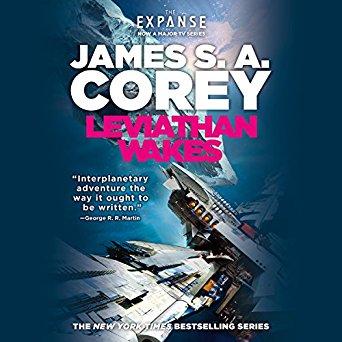
 This was a definite departure from my usual reading, in part because it was listening and not reading. Two life changes contribute: one, that I live in a van now, and do a fair amount of driving, therefore time to listen. And two, I graduated! and have far fewer reading commitments, so I thought I might have brain-room for audiobooks again. Yay!
This was also a genre departure. A friend set me up with The Expanse series on audio, highly recommended. He calls these books “hard-boiled film noir in space,” which all rings true, although I would have said sci fi as a first-level categorization.
I did a little research and reading around as I wrote this review, which is fairly unusual, but I’m so unfamiliar with the genre that I felt at a loss. I am glad I poked around like I did. I learned, in this article from Tor.com, about the “space western” sub-genre, which made instant sense for Leviathan Wakes even before I read the full description of that genre distinction. On the other hand, it was interesting to note in that article that its author found Miller a trying character and was always anxious to get back to Holden. While I can’t say the opposite – I certainly found Holden compelling – I did feel Miller was sympathetic and genuine. Some people really are that depressed, depressing, and self-sabotaging. Or maybe it’s just that I love noir mysteries, with their disturbed PIs.
But I’m getting ahead of myself. Leviathan Wakes takes place in a future in which humans have colonized Mars and a good chunk of the solar system. The major political players in this world are Earth and Mars, with an outer asteroid belt roiling and muttering rebellion under the name OPA (Outer Planets Alliance), which has been labelled a terrorist organization by the major powers. In this setting, we have a handful of protagonists, chiefly two men: James Holden, Earthborn captain of a commercial ship and former officer in the United Nations Navy, and Joe Miller, a rundown Beltborn detective and classic noir figure (his wife left him, he drinks too much, he’s dysfunctional but still has a good heart). There’s also Holden’s crew, Naomi, Amos, and Alex; and Julie Mao, rich girl turned OPA fighter, who we meet only briefly at the beginning of the book. She becomes a missing person and Miller is assigned (by nontraditional means) to find her. He becomes obsessed.
This is a hard plot to summarize because a lot happens (the paperback is some 600 pages, the audiobook 21 hours). If you want more, the Wikipedia page does a pretty good job of summary, but beware spoilers there. I’ll turn to another’s words again: Aidan Moher, the writer at Tor.com, praises this book “for being open and approachable for anyone with even a remote interest in science fiction, but specifically for those who are intimidated by the hard science that often forms the backbone Space Opera. It focuses instead on the intricacies of the human machine — relationships, anxieties, dreams, loss, redemption, acceptance.” Well put, and explains why I was able to enter so easily into this world. Human relationships, etc., are definitely my main interest in literature.
I had a great time listening to this one. I felt pulled in by the momentum of both character development and plot; it stayed entertaining always. There were a few elements I let slide by me: the tech (and anything I missed was not a problem), and also the lovely patois spoken by Belters, which mixes a few languages (English, Spanish, Hindi, and more: there’s a great page here). That pidgin language offered great color and I felt like I understood enough to get along. (I’m often a fan of foreign languages used in English writings, where context clues or cognates give me enough to get by, and I’m generally able to trust the author that what I miss is unnecessary to my understanding of the larger work.) In other words, I thoroughly agree with Moher: this was an easily accessible sci fi novel that I loved for its human elements. Despite being a longish book, pacing was snappy, and the alternating viewpoints of Holden and Miller kept things lively as well. I am absolutely looking forward to the next book in the series, which is Caliban’s War. Stand by: I’m going to switch gears in a big way and listen to some Stegner next, and then back to the old space western. My friend who has given me the series tells me this one will be “more horror and psych thriller,” with which I am right on board.
Thanks for the hook-up, Paul.
Filed under: book reviews | Tagged: audio, noir, sci fi, The Expanse, thriller | 7 Comments »