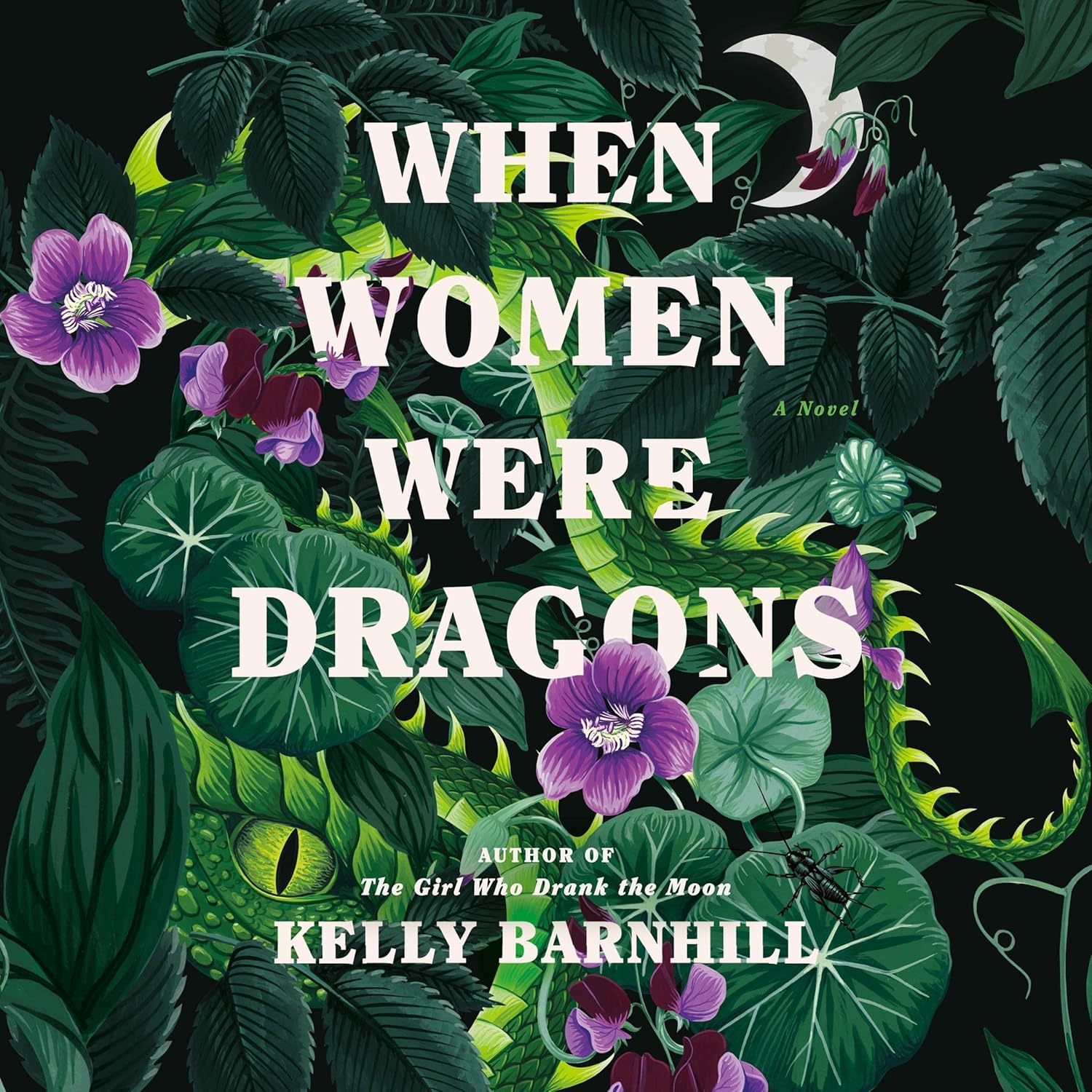
When Women Were Dragons by Kelly Barnhill (audio)

I don’t recall where I got this title from, but I loved this book, and am grateful to whatever review or list sent it my way. Also to my lovely partner who gifted it to me for the long drive from Texas to West Virginia.

When Women Were Dragons: Being the Truthful Accounting of the Life of Alex Green–Physicist, Professor, Activist. Still Human. A memoir, of sorts is a living, breathing tale, ever expanding, filled with metaphor that reshapes itself with the reader’s interpretation. It opens with a strange letter from a Nebraska housewife in 1898 to her mother, shortly before the woman spontaneously dragoned. Next we have an excerpt from the opening statement given by Dr. Henry Gantz to the House Committee on Un-American Activities in 1957. Then we get into the first-person narration of Alex Green, who will tell most of this story, with brief insertions mostly from Dr. Gantz’s work – bit of an epistolary format. (The audiobook is narrated by Kimberly Farr, as Alex Green, and Mark Bramhall, as Dr. Gantz, which I thought was a great choice.) “I was four years old when I first met a dragon. I didn’t tell my mother. I didn’t think she’d understand.”

I think this must be right around 1950. Alex grows up in small-town Wisconsin, in a pretty 1950s world: there are many things we just don’t talk about, including cancer, menstruation and most aspects of girlhood and womanhood, what to expect on one’s wedding night, diversity in sexual orientation and gender expression, our feelings, and dragons. When Alex is a little girl, her mother goes away for some time – months – and no one explains or even acknowledges the change; likewise when her mother returns, gaunt, weak, different (she doesn’t even smell right). The reader understands better than little-girl Alex when her mother’s chest is glimpsed, missing breasts, two scars like smiles. This world is recognizably our own except for the dragons. Women in this world can dragon (that’s a verb), or become dragons, at which point they sometimes eat their husbands (this seems to happen frequently with very unlikeable, not to say abusive, husbands) before flying away. Dragoning is a poorly understood phenomenon because, as with much that is female or feminine, society judges it too shameful to examine, and science mostly averts its gaze. Dr. Gantz is a rare exception: he believes in the scientific mandate to learn, whatever truths are revealed. Biology should never be shameful. His research articles and responses to an oppressive world are useful seasonings to this story, and he is himself a delightful character, alongside the heroic librarian Mrs. Gyzinska.

And oh, Alex’s auntie Marla, a wonderful woman who comes and cares for her while her mother is away in cancer treatment, a big powerful woman who flies airplanes during the war and works as a car mechanic and wears men’s clothes and takes very little shit, and who we lose to the Mass Dragoning of 1955. When Marla dragons, she leaves behind an infant daughter, Alex’s cousin Beatrice, who from here on is raised as Alex’s sister. Such is the gaslighting of Alex’s family and world that she learns to really believe – almost – that she has no aunt, that Beatrice has always been her sister. (Echoes of 1984. We have always been at war with Eastasia.) And boy, the time Alex has raising her younger sister, Beatrice, a delightful dragon of a child if there ever was one.

Despite all I’ve just thrown at you, I’ve barely scraped the surface of this remarkable novel. It contains many stories and many layers, much that is very recognizable from our ‘real’ world, and lots of potential metaphors to ponder. I wondered at different times if dragoning were a metaphor for menstruation; for puberty; for “un-american activities” (certainly, HUAC seems to conflate them); for simply being independent, self-determining, and female (except that those who dragon are overwhelmingly but not universally girls and women). This story tackles the way we handle difference, and especially gender, sexuality, and gender expression. It contains such maddening (if entirely realistic) renderings of sexism that it was sometimes hard to listen to. It contains transcendent moments of personal discovery, joyful academic inquiry, love and coming-of-age, and some lovely iterations of family and built family, which I always appreciate. “Sometimes,” confides Alex at an advanced age, “the expansive nature of family takes my breath away.” There is such good fun; I especially liked the line “If that dragon was hoping for sympathy, she was crying in front of the wrong teenager,” which I got to share with my favorite dragon-loving teenager. It considers the looping of time and relationships. It’s got science and wonder, a bit like A Tale for the Time Being, but I liked this better. I’m a bit over the moon about it, and am giving it a perfect score. Also, I loved the audio format, with the one caveat that I wish I could pull more quotations that I loved.

Do give it a go, and let me know what you think.


Rating: 10 military-issued boots.

Elektra by Jennifer Saint (audio)

I made a 2,500 round-trip drive recently, so check out a few *audiobooks* for the first time in quite a while. I had a blast with them!

I’d been just recently telling a friend my paraphrased-from-memory version of the curse on the house of Atreus, so when I went looking for an audiobook, I was delighted to find Jennifer Saint’s Elektra, read for us by Beth Eyre, Jane Collingwood, and Julie Teal. (It looks like I put this one on a wish list based upon my interview with Claire North aka Catherine Webb.) I liked that this was a retelling with, if you will, a modern angle – told from the points of view of the women – but it is not a modern retelling; it’s still set in the ancient Greek and Trojan world. The three women who narrate their intersecting stories are Cassandra, Clytemnestra, and Elektra. The latter gives her name to the novel, perhaps, because she is the one who survives to its end.

I think this is the most in-depth telling I’ve encountered of Cassandra’s story, in which she, a princess of Troy, becomes a priestess in Apollo’s temple and undergoes the conflicting honor and agony of his gift of prophecy, and his curse that no one will ever believe her (always correct) prophecies. She then sees her city destroyed – sees it in advance and experiences it in real time – and is taken as a war prize by the Greek king-of-kings Agamemnon (who, in all tellings I’ve ever found, comes across as a consistently unlikeable man). Her life ends not long after his does, although with a little different nuance in this version.

[Here, an aside. These events, lying somewhere between myth and, in some cases, *possible* history, originate in an oral tradition. There are many versions, but all are translated at this point across both language and transcription; there are many retellings, but it seems there can be no single, original, authoritative one. I like how freeing this is: there is no reliably “correct” version of Cassandra’s story, or any of them, which I think offers a liberty to riff.]

Clytemnestra has always been a puzzler. She kills her husband (using some deceit, and after cheating on him); she has usurped power in a man’s world; many, especially the more traditional versions, paint her in an unsympathetic light. More modern perspectives point out that one of her greatest crimes may be that she holds power with confidence – she possesses traits that tend to read positively when they belong to men. And it’s not always remembered and pointed out that she kills her husband because he killed their firstborn daughter – sacrificed her to the gods for the fair winds needed to sail for Troy. That sacrifice, or murder, is in turn painted differently depending on whether the storyteller believes in the gods’ need for sacrifice (and the Greeks’ need to sail for Troy). What is one young woman’s life against glory in battle for all the greatest warriors ever, etc., etc. The same dual and dueling perspectives apply to Clytemnestra’s famous sister, Helen of Sparta / Helen of Troy. There the great question will forever be: did Paris abduct her? Or did she leave her husband and run away with another by choice? Victim, or whore? (A shocking number of ambiguities in Greek myth turn on the question of sexual consent.) Clytemnestra remains a difficult character in Jennifer Saint’s version of her story. Her grief over the loss of Iphigeneia is sympathetic; her desire for revenge feels righteous, if perhaps bloodthirsty. But because of the third point of view Saint gives us, we’re also aware of how fully she orphans her remaining three children in her singlemindedness about the one she’s lost.

Elektra is herself single-minded and bloodthirsty, and this is the essence of the curse on the house of Atreus: each killing, meant to set right the last, only sets the next one in motion. Clytemnestra means to avenge Iphigeneia by killing Agamemnon; Elektra feels it necessary to avenge Agamemnon by killing Clytemnestra. She has lived her life in father-worship, mostly in the absence of that father (and again, I’ve not read of anybody who spent time around Agamemnon and liked him). It’s notable to me that both Clytemnestra and Elektra show signs of finding some nuance, rather late in the game for it to make a difference. But I think that’s the curse again, inexorable.

I liked the choice, on audio, of three different readers for the three parts. I’m not sure I ever learned the voices well enough to tell from the first few syllables who we were with, but the changes always nudged me to listen for context clues (which take no time at all).

I always appreciate revisiting these stories that I’ve been taking in, in various forms, for most of my life. I love that they are both familiar and always new – every version offers a fresh perspective or a new take, and each encounter I have enriches the later ones; it’s such a genuine pleasure for me to spend time in this known but changing ancient world. ‘Pleasure’ is a strange word, of course: these stories are full of blood and death and rape (so much rape). But I seem to have a great appetite for the big themes, the continual question of predetermination and personal choice, these gods who are capricious and silly and lustful and jealous and awfully human, although immortal. It’s just always captured me. I loved Jennifer Saint’s contribution to my understanding of these stories.


Rating: 7 old dogs.

rerun: The Lacuna by Barbara Kingsolver (audio)

I know there have been a lot of these lately, friends; please bear with me, and know that I have a backlog of review still to come at the Shelf – I’m not slowly down, just having some funky timing. For whatever it might be worth, I do find it stimulating to revisit old standouts. Happy holidays! Year-in-review and best-of-the-year posts are coming!

Now, please enjoy this rave review from 2012.

Another long review – sorry – but one of the best books I’ve read this year, so consider sticking it out with me. Or, go to the very bottom for my two-sentence review. Many thanks.

Reviewing The Lacuna daunts me. How to capture the enormous world that is this book in a brief (readable) blog post? I have only read three other of her books* (liked The Bean Trees and Animal Dreams; not so much The Poisonwood Bible; all pre-blog, unfortunately) but from what I know, this is by far her best. (Her own website calls it her “most accomplished novel”). It is a Big Thing.

I shall take this one step at a time. Plot summary. A young boy named Harrison William Shepherd is born in 1916 to an American father, a bean-counter for the government in Washington, D.C., and a Mexican mother, Salomé. He spends his childhood mostly in Mexico, with a brief interlude at a military school in the US, and ends up working in his teens for Diego Rivera and Frida Kahlo, first as Diego’s plaster mixer, then as a cook and secretary and Frida’s companion. When Lev Trotsky arrives as a political exile from Soviet Russia, he acts as secretary and cook to him, too, following Trotsky when he splits from the Riveras; he is at Trotsky’s side when he is assassinated. Shepherd (who goes by various names depending on who’s talking) never considers himself exactly an ideological follower of the communist cause, but his sympathies are naturally aligned with those of his famous employers, for whom he has great respect.

Following the assassination, he begins a new life in Asheville, North Carolina, becoming a famous author of novels set in ancient Mexico; but the trauma of Lev Trotsky’s bloody demise, Shepherd’s sexual orientation, and his extremely shy and self-effacing demeanor keep him isolated from an American world that feels foreign. He closely follows international politics through the second World War, the United States’ sudden reversal of regard for Stalin, and the Dies Committee (which contacted Trotsky when Shepherd was with him) becoming the House Unamerican Activities Committee – which eventually begins to investigate Shepherd himself. This turn of events shocks our protagonist, who sees himself as an insignificant and apolitical player, but whose new Jewish-New-Yorker lawyer is alarmed at the skeletons he hides in his closet: to the point, an association with the late Trotsky and the still-active Kahlo and Rivera. The Asheville era in Shepherd’s life yields new and likeable characters in the lawyer, Artie Gold, and Shepherd’s secretary-companion, Appalachian native Violet Brown. (I think Kingsolver had fun with these *colorful* names, ha.) The FBI’s investigation of Shepherd threatens to tear down the precariously balanced, agorophobic life that he has so carefully constructed in Asheville; and here I’ll stop. I liked the ending, despite its considerable sadness.

Violet Brown is an important part of the story in terms of format. The story is told almost entirely in Shepherd’s own voice. As presented, he wrote the first chapter of his memoir and then quit; this chapter opens the book, and then we get Mrs. Brown as “archivist” explaining the reversion to Shepherd’s journals starting at age 14. The rest of the book is pulled from these (fictional) journals, with interjections from our archivist here and there, as well as a number of newspaper and magazine articles (Kingsolver notes which are real articles at the beginning of the book for your reference; my impression without checking each one is that most are real) and assorted samples of Shepherd’s correspondence. It is a very interesting format, raising all kinds of questions about voice and the progression of voice. I wondered, upon that first shift from an already-published 30-year-old author’s writing to a 14-year-old’s journal, whether Kingsolver didn’t trust her audience to start off that way? But I ended up feeling that this shifting voice felt very real; I enjoyed it. Violet’s role in Shepherd’s life was ambiguous quite far into the story, which kept me wondering, in a good way.

Another aspect of format I must mention is the audio version I listened to – narrated by Kingsolver herself, and to great effect. I loved her work here; every character had a voice, an accent, a lilt, a manner of speaking, and these were important in a story peopled by Mexicans with various backgrounds, a cross-bordered Mexican-American confused about where he might belong, an Appalachian-hills woman who worked hard for her education, and a New York Jew. Shepherd’s speech cadence as performed by his creator was remarkable and memorable; it increased my enjoyment of this story. The only drawback to the audio format is that I am always driving, or washing dishes, or in the gym, etc., when I’m listening, and therefore failed to mark down for you any number of remarkable lines I would have liked to share.

I was completely drawn into Shepherd and his world. I found Frida Kahlo compelling, which I think is faithful to her real life. The Mexico Kingsolver paints is so real, so filled with sensory stimulation, and in some ways familiar – the foods I eat, the places I’ve visited – which I think always gets a positive reader reaction. And the linguistic nuance of a boy (and man) who speaks both his languages with an accent, who brings Spanish structures into English, was so authentic, I just ate it up. (Like Hemingway’s For Whom the Bell Tolls, one of my most favorite books ever.) And then the politics – the evocation of such a complex, rapidly changing, schizophrenic period in our history, through the Bolshevik Revolution, the Roaring Twenties, the Great Depression, Hoovervilles, WWII, Roosevelt’s death, HUAC… it was so very dense. I was reminded of Stephen King’s 11/22/63 (which is the more recent work), another novel set in real historical events that successfully evoked a vivid time and place; but The Lacuna built a bigger world, was more literary and flowery, and in my opinion was better (sorry, Stephen).

Part of this book’s fascination for me lay in its explanation of the hatred and fear of communism, Communism, and its various permutations and misunderstandings during an era before my birth. Kingsolver’s characters helped me work through some of my questions about this time and this perplexing, unreasonable fear; Shepherd shares my confusion, and the lawyer Artie Gold does a fair job of helping him think it through (as does Violet Brown, for that matter). Coming near on the heels of A Difficult Woman which I loved so much, and which raised so many questions for me, The Lacuna’s further exploration of the anticommunist era and my reading of it was very timely.

I’m sorry I’ve gone on so long; it’s only out of my enthusiasm for this dense and complex story that brought me so many emotions and questions. In a few words, The Lacuna is beautifully constructed and beautifully written, a story about artists and the power of art, about Frida Kahlo and Lev Trotsky and American anticommunism. I highly recommend it.


Rating: a rare 10 Mexican murals.

*I have since read Flight Behavior and gave it a 10 as well! I have not read Demon Copperhead and don’t believe I will, but yes, I’ve heard.

rerun: The Warmth of Other Suns: The Epic Story of America’s Great Migration by Isabel Wilkerson (audio)

Now seems like a fine time to revisit Isabel Wilkerson’s excellent 2010 work, in my 2012 review here. (For later reads, also check out Caste and a corresponding interview I was lucky to get.)

I didn’t really know what this book was about when I picked it up – only that it was well-regarded. I’m so glad it found its way into my hands. Isabel Wilkerson has taken on a large-scale, ambitious subject here, and rendered it beautifully. And the audio reading by Robin Miles is lovely to boot.

The “great migration” in the subtitle refers to the movement of black Americans out of the South and into the northern and western United States in 1915-1975. Wilkerson starts from the very beginning, looking at the experiences of former slaves just after Emancipation in an impoverished region struggling to rebuild with a new order of things. The creation and expansion of Jim Crow laws designed to hold blacks down took time after the end of the Civil War to take effect. In the new caste system, former slaves and their descendants were unable to move up in the world and were in constant fear for their lives if they were to misstep around Southern whites. By 1915, they had begun to move out of the South, in what became a mass migration along lines so distinct that enclaves of blacks from specific towns and states were recreated in new locations.

Wilkerson shifts between two ways of studying the Great Migration. Sometimes she takes a broad view of history, in which she cites her own interviews (she states that she did over 1,200) with migrants and their descendants as well as a number of historical sources, to render the story of the Migration generally. And sometimes she follows the specific personal stories of three individuals who she interviewed at great length over a long period of time, traveling the country with them and becoming part of their lives. (In this respect, the journalist/author becoming part of the family of her subject, I was reminded of Rebecca Skloot’s amazing The Immortal Life of Henrietta Lacks.) George Swanson Starling moved from Eustis, Florida to New York City, later sending for his wife Inez to join him there. He had to leave Florida suddenly because a friend tipped him off that a lynch mob was coming for him; he had been involved in organizing his fellow citrus pickers to demand higher wages. Ida Mae Brandon Gladney moved with her husband George and their two children, with a third on the way, from Mississippi where they had been sharecroppers. They would eventually end up in Chicago, by way of Milwaukee. And Robert Joseph Pershing Foster was an ambitious surgeon and veteran from Monroe, Louisiana, with his heart set on Los Angeles. Known as Pershing in Monroe, he would resettle as Robert (or Bob, or Doc) in LA and send for his wife and daughters to join him there, where he built a new life in high society with the big house and booming practice he’d always wanted.

I found this shifting back and forth between the broad view and three personal histories extremely effective. Anecdotes from the lives of Southern blacks drove well home the misery of their bottom-rung status there; some of these stories are horrific, but important to show the desperation some migrants felt when they left their homes in the South. National trends played a role – for example, during WWII demand for Florida’s citrus was high while the supply of labor to pick the fruit was low, with everyone off at war, and this imbalance led to George Starling’s ability to demand higher wages. And the history of Chicago’s race relations and residential segregation puts Ida Mae Gladney’s home ownership into the proper perspective. You get the point. The history is well-documented and, I’m convinced, well-researched; and the personal stories make it all, well, personal. I was deeply involved with our three representative individuals by the end of the book and, yes, I cried.

I love that Wilkerson brought such a large-scale, important trend, that has had such huge effects on American history, to life the way she did. I also like that she examined the broad effects of the Great Migration, in terms of the cultures of both white and black residents of the North and the South, and took the time to show that black migrants were really far more like immigrant groups in history than like migrants within their own country. I recommend this book as part of a study of American history – but one need not be an academic to appreciate it. The story of the Great Migration is made accessible here, and I’m glad I know more about it now. This 19-disc audiobook (over 600 pages in print) went by easily. This is how I like to take my history lessons. Check it out.


Rating: 8 train rides north.

Salem’s Lot by Stephen King (audio)

It took me a while to get to this one, but I am very pleased to be back in the Stephen King universe. Salem’s Lot is classic horror. King doesn’t get everything right (and this was published in 1975), but there’s not much question that he’s a supremely great writer. His stories are very easy to take in and get lost in. I enjoyed this very much, and I’ll keep working my way through his extensive catalog.

I won’t spend too much time on plot; you can find that elsewhere. My audio version opens with a short foreword or introduction which King reads himself, and it made me feel so good about what I was headed into. In his own voice, I heard the style and easy sentences of a master, and heard him discussing reading and writing as lifetime loves. He describes reading Dracula as a young boy, and then a bunch of secondhand E.C. Comics, and reimagining the vampire story for a contemporary U.S. of A. He confesses that Salem’s Lot, only his second novel, is dated, but he still counts it among his favorites. “Carrie, the book which came before it, seems almost fey by comparison. There is more confidence here, more willingness to be funny.” It only made me more excited about the story to come. Ron McLarty reads the novel itself, and very well I think: I have no comment on his reading either way, which is a good sign.

In Salem’s Lot, the moderately successful novelist Ben Mears returns to the Maine town where he spent just a few years as a boy, but where he had an indelibly frightening experience in a moody old mansion where a famous recluse had hung himself. He meets a nice girl, and settles in to a room in a boarding house to work on a spooky fourth novel. To a mild, idyllic backdrop, Ben courts the girl, Susan Norton, and makes new friends. But the town of Jerusalem’s Lot (or Salem’s Lot, or simply The Lot) isn’t done with mysterious, creepy figures. Ben’s not the only newcomer in town. A beloved dog is found impaled on a cemetery fence. Two young brothers disappear in the night, and one death follows another. A small but tough motley crew forms up: Ben, the writer; Susan, the young woman; Matt, an aging high school English teacher; Mark, a middle-school boy new to town; Father Callahan, the town’s Catholic priest, who will figure in the Dark Tower series; and Dr. Jimmy Cody. Together they will fight an ancient evil. The novel’s prologue serves as a teaser, with an unnamed man and boy on a cross-country trip. This action actually falls chronologically at the end of the book, just before its epilogue–sending me immediately back to the beginning when I finished listening to it.

King absolutely excels at realism, exquisite detail, and a combination of quaint small-town living (as sordid as sweet, but very true to life) with horror. He’s got a social conscience perhaps ahead of his time. His characters feel accurate, and everything flows very naturally; his sentences are that very special kind of smooth and easy that appears effortless but is actually extremely rare and difficult to achieve. It’s masterful and I’m a little bit in awe. On the other hand, there was one element that got under my skin. To protect plot spoilers, I’ll discuss it here briefly in white text (highlight to read): I really liked Susan Norton’s character, and was invested in her development not only as character but as strong young woman coming into control of her own destiny. She was the first of our powerful little team to fall to the big bad vampire, and I quite resented how that worked; after I’d come to see her as a proper strong woman and major player, it felt like she got thrown away like the cheap girl character in a pulpy horror story. Jimmy Cody later falls, too, but I was left with the sense that Susan didn’t get the treatment she deserved. I was left with the taste of misogyny in my mouth and felt sad about it. I respect Stephen King’s efforts, and find him better (in the lyrics of the Drive-By Truckers, who were talking about somebody entirely different) “at worst, no worse than most white men of his generation, north or south”… but it still made me sad. I’ll also recall again that in his introduction he acknowledged that this novel is dated. I hope this is part of what he meant, and that we’re still getting better now.

This issue, for me, was worth noting but did not fatally poison the experience. It’s an outstanding horror novel, and it’s sticking with me, and King is a marvel. I sort of want to go back and read the entire Dark Tower series over again (ha), but there’s so much more King out there, too. I do recommend. There’s not much perfect in this world.


Rating: 8 ice cream sodas.

Pleasantville by Attica Locke (audio)

Attica Locke is a very strong mystery writer. I was utterly absorbed by her characters, who felt perfectly real to me, such that I worried about them when I stepped away from the book. It’s a fully-fledged world. I will say that I was a good reader for this one, too, because it’s set in my hometown of Houston, and Locke’s Houston is extremely detailed and true to the original. I loved this aspect of it as much as any other, and that won’t be quite such a nostalgic, moving experience for just any reader; but the strong sense of place and that level of detail will certainly work for anyone who appreciates those strengths.

The plot of Pleasantville is quite complex, again quite detailed, and operates at the intersection of crime, criminal and civil law, and politics, in a particular milieu. This is both a great strength and a potential liability: it asks of the reader a fair degree of attention. If you bring that to this book, you will be amply rewarded. I am still a bit reeling from it, and my admiration of Locke is solidified.

It’s 1996, and a hotly contested mayoral election in Houston is expected to hinge – as they often or always do – on the neighborhood of Pleasantville, an early-established haven for middle-class African Americans 50 years earlier and a continuing close-knit community. Then a teenaged girl disappears off the streets of Pleasantville on election night, and the criminal case clashes strangely with the political drama, and both threaten to swallow whole the man we meet on the first pages: lawyer Jay Porter, whose office has just been burglarized. Porter is still reeling from the loss of his wife to cancer a year earlier. His teenaged daughter and grade-school son are struggling in their own ways. His law practice is on its final legs. He specializes in class-action suits handling issues of environmental racism, like one at work in Pleasantville; he does not want a criminal defense case, but the most powerful players in Pleasantville have other ideas.

There are so many compelling characters in this story that my head almost spins, but it’s all woven together incredibly well, keeping me both engaged and on track (if I put in a bit of effort myself – and I’m happy to). I’m very much still thinking about Jay Porter and hoping his daughter Ellie comes through okay; I can’t wait to get more from Locke. Whew.


Rating: 8 blocks.

The First Fifteen Lives of Harry August by Claire North (audio)

I am doing the unfortunate thing where I’ve waited too long since I listened to this one. In my defense, it was a whirlwind two-week road trip that allowed me to listen to several (!) audiobooks.

Another recommendation by Liz, this one’s pretty mind-bending. Harry August narrates the story of his lives himself, beginning with the first time, when he lived unremarkably. He was born in a train station washroom in 1919, and was then adopted but didn’t know it; his adoptive mother died when he was young, and his adoptive father remained distant; he served in World War II and then returned to the estate where his father had served as a sort of maintenance man, which role Harry takes over until his own death in old age. Ho hum. Then… it all starts over again. In his second life, he does not handle well the knowledge that this has all happened once before. In his third life, he uses what he knows of the war (for example) to his advantage, staying away from high-casualty battles and the like. With each life, he gains a little better understanding of what he’s experiencing. But he struggles to make meaning of it all, even as he meets others like himself: ouroborans, they call themselves, or kalachakras. Until, that is, he meets one man in particular, a fellow ouroboran who will become perhaps his greatest friend and nemesis.

I’ve already said too much, and will let you discover Harry’s many lives and acquaintances for yourself from here.

It’s quite a thought-provoking concept, and a new twist on time travel and the tricky question of the butterfly effect. (Would you kill Hitler? What if he’s only replaced by something worse?) The novel is not plot-driven, precisely, and it’s not character-driven at all. Harry has remarkable drive to learn, understand, and explain; this intrigues me about him, but he’s a bit short on actual personality (and has more of it than anyone else in the book). So, a concept-driven novel, which is a change. I found it perfectly absorbing, one to get lost in, and to occasionally pause and ponder. I will say, there weren’t characters I liked, and that can make it a little tough to hook in. I was very intrigued, but often bemused too.

The audiobook was a strong production on the whole. Peter Kenny does a wide range of voices, which are often pleasing, but I must say his American accents are not convincing.

It will be interested to see how this one sticks with me.


Rating: 7 beakers.

Fingersmith by Sarah Waters (audio)

I got this title off some list of bests somewhere, and queued it up behind In the Woods on the return trip from Texas. It was a delightful, weird, engrossing adventure. I am going to be careful and vague with this one, as it hinges on big reveals that I don’t wish to spoil.

Set in Victorian London, Fingersmith begins with the first-person narration of Sue Trinder, an orphan who has been raised by a household of ‘honest thieves’ and a mother figure, Mrs. Sucksby. Sue and her comrades are fingersmiths, or pickpockets (and they partake in other crimes and cons, mostly of the property reassignment category). One day Sue is invited into a masterful heist: she will pose as lady’s maid to an innocent, sheltered woman of just her own age, the also-orphaned Maud Lilly, to aid in a fellow crook’s seduction of the lady. He will then marry her, steal her fortune, and have her locked away in a madhouse (which is sinfully easy to do to women, in those times and into quite recent history). Sue has never been a lady’s maid before, so she has much to learn about the job, but off she goes. The plot proceeds, but Sue’s loyalties become split, as it turns out she rather likes her mistress.

This is just the very beginning of the complications. But then! Part two! The first-person perspective shifts, which I did not see coming. And everything the reader thought she knew about this story gets turned on its head. I will stop writing about plot now, but it continued to surprise me, repeatedly, and Waters gets full marks for this feat. Also, I was not expecting erotica, which popped up a few times to (again) surprise me and was remarkably well done. Fingersmith is absolutely a plot to get thoroughly lost in; really great road trip fodder. I did feel in the middle that it dragged on a bit longer than it needed to – especially when the victim of this or that plot must wallow in her misfortune. I could take much less of the wallowing. But eventually we stepped out of that puddle, and the story continued to twist and turn; I was riveted right until the end, and was sorry to be done. Masterfully plotted; do recommend.


Rating: 8 ink stains.

In the Woods by Tana French (audio)

Loading up on audiobooks for the big drive to Texas and back, I made an unusual call: I chose to reread a book, or rather to listen to one I’d read years before. Life is mostly too short for rereads, but: 1, I love Tana French and have read everything of hers already. 2, I found this one on a best-of list of some sort, I think specifically referring to the audiobook (or else it’s just that I discovered late that she is especially good on audio, because of the Irish accents). 3, I am that lucky mystery fan who forgets plots and can therefore enjoy them again and anyway 4, I read this one of hers first and (mostly importantly) before I had this blog. So, off on the big drive with this excellent book…

…which it turns out I had forgotten wholly, because the plot scarcely felt familiar at all past the introductory scenes. First, a prologue flashback: in 1984, in a Dublin suburb, three 12-year-old best friends don’t come home when called for tea. Two of them, a boy and a girl, will never be seen again. The third, Adam, is found with his broken fingernails dug into a tree’s bark, with blood in his shoes but unharmed. He is catatonic and unable to help the police with their investigations. He goes away to boarding school; his family moves away; and then the reader discovers that he is the novel’s narrator, now a grown murder detective who goes by the name Rob Ryan (having taken his middle name to avoid his rocky past). Hilariously, Rob believes that his career choice has nothing to do with his lost childhood best friends.

In the present, some twenty years later, the body of a murdered child turns up in the very same suburb, in the same woods (now much abbreviated by development, and under controversy as a freeway expansion runs up against an archeological dig). Ryan and his partner and best friend, Cassie Maddox, pull the case, despite being rather the young misfits of the department. Unbelievably, the murder squad does not know that Rob Ryan was once Adam Ryan, the very famous found boy of that old–and possibly connected–crime. Cassie is the only one, beside Rob’s parents (whom he feels he barely knows), who knows his identity.

In the Woods is an atmospheric, contemplatively-paced mystery novel in two timelines. As Ryan works on the present-day murder, he also probes at his own lost memories of that childhood trauma. It is also the story of relationships: Rob and Cassie share a very special bond, a very special friendship, which both resists and succumbs to stereotypes. I think it’s worth remarking that I do not actually like Rob Ryan, our narrator, protagonist, and therefore one might expect our hero. He isn’t that. Cassie is a compelling and likeable character, but since she is only seen through Ryan’s eyes (we get the story from him), I fear she never quite becomes fully known–not only in the way that none of us ever really knows anyone, but also because for all his adoration and attempts to understand her, she is finally a cipher for Ryan’s own issues. Perhaps what disappoints me most about him is that even after all his complexities and soul-searching, Ryan winds up predictable after all. I do not like him in the end.

The plot is however not predictable, even to this rereader. In fact, as I think about other Tana French books, it’s not actually the whodunit solution that I remember, but the atmosphere, the experience of being in the story as it unfolds. There were times when the pacing felt a bit off, when I felt we spent too much time wallowing, and that feels perhaps familiar from other T. French novels as well, but that’s a fairly minor quibble when I think about how real these characters felt. Also, the accents are completely wonderful on audio, which I think is the best way to do Tana French.

As I write this review, I’ve let too much time pass (because vacation), and already the denouement’s details are fading for me, but the relationships – between Ryan and Maddox, and other ones – still feel very near to me, the personalities and the conflicts. And I’ll always be back for more French.


Rating: 8 home-cooked meals.

The Late Show by Michael Connelly (audio)

We have another mediocre showing from Connelly here, I’m afraid. This one is a departure from the Bosch series: The Late Show features Detective Renee Ballard, who is also a renegade anti-establishment figure who gets shit on by the LAPD, but with an added woman-in-a-man’s-world angle. (She is also younger.) I was once more a little indifferent as to plot for most of the novel, but I was pleased with some significant twists and reveals in the final denouement, so that was nice. The narrator again felt awfully wooden – what is up with this trend? And why are there so few contractions? (I am instead of I’m, can not instead of can’t) …Connelly’s writing feels consistently awkward over the last many books. I wonder, is it him or is it me? I keep meaning to go back and read some early Bosch (in print!) and investigate this question, whether Connelly’s writing has become less good or I have become harder to please. But devoting that time feels like asking a lot at this point.

Ballard is appealing in some ways but doesn’t quite feel fully fleshed. She has interesting relationships with other cops, and an interesting backstory, referring to various traumas; but all of this feels told and not shown. I kept feeling like I was waiting for the story to ramp up, but instead it ended.

Maybe one more experiment with this formerly beloved author before I give up, with deep regrets.


Rating: 6 and a half black buttons.