Verity Vox and the Curse of Foxfire by Don Martin

This lovely book came to me from a Shelf Awareness review. I was hopeful that it will be right for one of my young friends next, especially with the Appalachian connection. And I think I was right!

The town of Foxfire, deep in the dark woods in a holler, is cursed. Following the withdrawal of the coal companies, struggling, the townspeople had made some deals with a traveling peddler who calls himself Earl. It started out innocently enough, but Earl’s prices were untraditional: one’s ability to see the color blue for fair weather. The hearing in one’s left ear for his horse to be healthy. A man’s jaw for some good canned vegetables. When the town pushes back against their tormentor, he takes his revenge. The bridge that connects the town to the rest of the world is destroyed, and attempts to rebuild it always fail. Animals sicken, food rots, the earth will no longer yield produce. The people seem doomed to despair and slow deaths, able neither to provide for themselves nor to leave.

Someone in Foxfire sends out a message.

And then the reader meets Verity Vox, a young witch in training, awaiting her next assignment. Her familiar, Jack-Be-Nimble (generally known as Jack), who normally appears as a black cat (sometimes a kitten) and sometimes as a black bull, a jaguar, a black rat, a crow (etc.), finds the message: “We’re cursed. Send help!” And Verity Vox goes to Foxfire.

Verity is young and still learning. Part of any witch’s training involves moving around: she can only stay in a place for one year, and then she must follow the signs to the next place she can help. Her powers and talents have come naturally to her; she is accustomed to easy success, and to being welcomed wherever she goes. People are glad to have her assistance. In Foxfire, however, things are different. The town got burned hard by the last magical being from whom they accepted ostensible help. And these hills can be a little insular. For the first time, her advances are unwelcome. Verity is perplexed; but she only wants to help, she keeps repeating. Her first reluctant customer (so to speak) keeps asking what she owes Verity, and Verity is baffled. Mistrust, it seems, is an unfamiliar concept.

So, Verity and the town have much to learn about each other. And then there is the pressing mystery of Earl – who he is, from where he draws his power, what it would take to rid Foxfire of his malice once and for all. Magic can do a lot, but there are still rules. For example, “tea… eluded even the most powerful of witches. It simply could not be rushed and every attempt to do so resulted in a brew that was bitter, bland, or box turtles.” Verity is very powerful. But there is much she doesn’t know yet about the world, and Earl is an unprecedented challenge, and the more she gets to know the people of Foxfire, the more she wants to improve their lot. There is a point where she thinks she will be able to offer them an escape, a literal exit from the place, and is surprised to learn that they don’t want to leave their home. More lessons to learn for our young witch protagonist, but she remains determined. “What was magic after all but having the gall to believe you could tell the world around you how it ought to be and then watching as it did as it was told?”

This is a beautiful story about learning and growing up, facing challenges, relationships formed with people and with place. The connection to Appalachia feels very special to me, and I have been telling everyone I know about it. The book is recommended for grade levels 10-12, although I see no reason not to give it to kids a little younger than that, and obviously it has enormous appeal for some of us adults, as well. Will be on the lookout for more from this author!


Rating: 8 candles.

Mailman: My Wild Ride Delivering the Mail in Appalachia and Finally Finding Home by Stephen Starring Grant

Within the high highs and low lows of rural mail delivery, a laid-off white-collar worker builds new relationships with place, with his neighbors, and with himself.

In 2011, Stephen Starring Grant moved his wife and two daughters back to his hometown of Blacksburg, Va. In early 2020, Grant, the family’s primary wage earner, was laid off from his consulting job. He found himself unemployed at the start of the pandemic in a town that had limited employment options, and with a recent cancer diagnosis to boot. Unable to find anything in his field, he took a job as a rural-route carrier for the United States Postal Service. Mailman: My Wild Ride Delivering the Mail in Appalachia and Finally Finding Home offers his stories and reflections on a year spent in a position he’d never thought much about before.

Grant began with a bit of an ivory-tower complex, as he imagined his intellectual background overprepared him for the simple drudgery of mail delivery (which turned out to be untrue), but he ended with a profound respect for postal and other service workers, and balanced thoughts on class and background. These pages vary in tone, by turns hilarious and thoughtful. Grant describes religious experiences, being threatened at gunpoint, bonding with strangers over their deliveries and finessing their political differences. He discusses types of incompetence (a few months in, he “graduated to the consciously incompetent stage, lost in the burning wasteland of self-awareness that I was really not very good at delivering the mail”) and the intense discomfort involved with learning new things, with great effort and limited success, in adulthood. Musing on the origins and purpose of the USPS, he expresses a nuanced patriotism: “America is the greatest country in the world… America is a steroidal monster… Both versions of America are true.” And, he notes: “Our delivery vehicles were like democracy, the worst of all possible vehicles, except for the alternatives.”

Between indulging in fantasies of delivering the mail with Barack Obama at his side and performing neighborly services like basic car maintenance for favorite people along his route, Grant brought his kids for added help and dropped in on his parents for pancakes. Along the way, he informs the unschooled reader of the process that mail carriers undertake to sort, order, and “case” the mail for delivery, and the hazards: backbreaking labor, the ergonomic disaster of right-hand drive (especially in a left-hand-drive vehicle), extremes of heat and cold, and dog attacks. Via an adventure with unfamiliar blue-collar work, Grant discovered new values, new people, and a new relationship with home. Mailman is a classic memoiristic blend of whimsy, storytelling, and insight.


This review originally ran in the May 22, 2025 issue of Shelf Awareness for the Book Trade. To subscribe, click here.


Rating: 7 Slim Jims.

Highland Outdoors magazine

When I looked, I was a bit surprised to see that I’ve not written before about this high-quality, locally-produced magazine. Highland Outdoors is regional in its focus as “West Virginia’s outdoor magazine,” but its contents will interest those further abroad; I’ve bought gift subscriptions for friends and family in Texas and Washington state who have appreciated it. And while you can buy subscriptions – and I do, to support such a great product – it’s available for free on a number of stands in local businesses, as well as on the website above. I appreciate that free availability and am glad to pay my way to help make that possible.

I love everything about this production. Large-format, glossy, sustainably printed, with well-written and -edited articles and really great photography (the publisher and editor-in-chief is a photographer), this is the first magazine that’s ever inspired me to read even all the ads: I appreciate knowing who the local businesses are who support the mag, and figure some of them might actually interest me, and I appreciate the design that goes into arranging those ads (they tend to be grouped by location, so that businesses in the same town cluster together, and often near an article that refers to that same town, etc.). It’s just a gorgeous product…

and I and my friends love the local/regional nature of the content. It feels really good to sink into a place and a people that you know well, or are trying to know better. It’s a joy to read about (or read words written by) people we know a little, and get to know them better that way. In the words of a friend of mine (also a subscriber), it’s a great insight and way to engage more deeply with our community. I’ve loved reading about strong women like Cassie Smith (league director of WVICL, our state’s NICA chapter) and Vicky Weeks (Leadville finisher and regular competitor of mine). HO covers stories about outdoor sports, conservation, flora and fauna, and the people who help to make this place great or keep it that way. I think my more distant friends and family are pleased to get a glimpse into my life (my place and why I love it) through this lens. I’m grateful we have such a quality rag around here. And I hope you love your home like I do mine.


Rating: 8 whirring wheels.

Fairy Tales of Appalachia ed. by Stacy Sivinski, photographs by Jamie Sivinski

I really loved The Crescent Moon Tearoom earlier this year, so imagine my delight to find that its author had also compiled and edited this collection of fairy tales from my adopted home region. The two books are of course very different. But I can hear the echo that the same author/editor was involved with each.

Sivinski opens with twenty-plus pages of introduction in which she details how this book came to be, and this was my favorite part of the book. She begins with her childhood, which was rich with oral storytelling, via her family and community and a unique elementary school that emphasized oral history. An early interest in oral history, and the experience of folktales as living, breathing, changing, current beings, took her through college and graduate school. It was as a graduate student that she found a shortage of “books that portrayed Appalachian folklore as a living genre.” Those she did find felt dated, in their illustrations and in their text, and often felt patronizing or stereotyped, as in their use of ‘eye dialect.’ A new term for me, this is the “transcription process that deliberately misspells words to make them seem more ‘authentic.'” In her graduate research, Sivinski was delighted by the recordings she found of Appalachians telling stories that often featured strong women and girls as central characters, and that played in curious ways on the familiar fairy tales and folktales of Scotch-Irish and German (Grimm) traditions. She quickly began thinking about how to offer those stories in a more modern and ‘living’ book than the ones she found available. And, wouldn’t you know, her sister Jamie Sivinski was already working as a photographer “who specializes in fairy-tale shoots.” So here is this book, a family affair.

There is more to the introduction, about fairy tale traditions, about research and transcription processes and Sivinski’s decision making there, about storytellers and collectors who’ve come before, and about the definitions of fairy tales, folktakes, and wonder tales. I found all of it fascinating, but I liked Sivinski’s personal history and story of this book’s birth the best.

Fairy Tales of Appalachia focuses intentionally (although not exclusively) on stories that center girls and women, with a bit of a corrective aim in response to a story-collecting tradition that has tended to center men. Stories are short – eight or ten pages or just two or three. Each is preceded by Sivinski’s brief notes placing the story in a larger context, for example, of fairy tale traditions: some play on Cinderella or Beauty and the Beast, some combine known elements, and some subvert them. Each contains a reference to the recording (or, in a few cases, transcription) where Sivinski found it. “The Hare Bride” comes from a transcription, with two credited storytellers – Sivinski interprets that one was the teller and the other the transcriber – and one of them hailed from Upshur County, West Virginia, where I live now.

The stories themselves are short, simple, often formulaic, and were not the part of the book that interested me most. (I found the same thing with the Foxfire book, Oral Tradition in Southern Appalachia.) To be fair, Sivinski points out that these stories are best read aloud and shared that way. I did read one aloud and agree that it improves the experience; haven’t tried it with friends yet. I liked the academic work and personal background at least as much as the stories themselves. I’m so grateful they’re collected here.

Jamie Sivinski’s accompanying photographs are certainly beautiful. Some are in black and white and some in color, all matte rather than glossy. I didn’t find that they especially correspond with or illustrate any stories in particular, but rather felt that they just set the tone. While I appreciate the effort, I actually found their inclusion a little distracting, in part because I was looking for connections I didn’t find. I worry that the effort to update the dated illustrations of past collections will only be dated in turn. And… there wasn’t a ton of diversity in the characters / models depicted. I know we think of Appalachia as overwhelmingly white (and my little town here certainly is), but that’s less true throughout than the reputation asserts. The characters in these pictures are almost all girls and women, almost all white, and all stunningly beautiful – rather than looking like ‘real’ people. Maybe that’s the fairy-tale aspect of it. It didn’t work all that well for this reader, although the photos are undeniably lovely in themselves.

I’m glad this scholarship exists and glad the stories are collected in this way, and I’m just trying to figure out which of several friends I’ll pass this one on to.


Rating: 7 apples.

repost: No Son of Mine by Jonathan Corcoran

This is a repost of an earlier review, because this moving book has just become available today.


Disclosure: Jon has taught as guest faculty in my MFA program. I admire his work and he is a dear friend.


I found this memoir remarkable. It encompasses much in terms of its time span and the bigger events in the world, and Jon accomplishes something special by being raw and vulnerable, and never self-indulgent. I think the struggles he portrays here will offer something to any reader, because we are all struggling to navigate even the closest of relationships. I am impressed by the writing in terms of that larger storytelling and meaning-making, as well as line by line.

Corcoran grew up in a small town in West Virginia that is just a few minutes’ drive from where I live now. (It’s always a little exciting to read a place written well that you personally know, and I did enjoy that part here. Elkins is not perfect, but I think this author has handled it with respect for both positive and negative qualities.) As a gay kid, he suffered in the town, in the evangelical church his family attended, and in his family itself. He did some secretive explorations of sexuality in West Virginia (not too dissimilar, I think, from those in The Rope Swing, which is however fiction), but did not live as an openly gay man until he left for college at Brown University. Coming from poverty, Brown was both a great accomplishment and a shock: a wider world, but rarified, and Jon was a foreigner to many of his peers and professors there. It’s at Brown that he met Sam.

In his second year at Brown, Jon is in Portland, Maine, with his boyfriend, Sam, meeting Sam’s family for the first time. It’s his twentieth birthday when his mother calls, seething with what she’s discovered. Jon confirms that he is gay. “You are no longer my son,” she says, and she hangs up. This leaves him traumatized, trying to finish college with no financial or emotional or any other kind of support, with no family, and no options, surrounded by Ivy League administrators whose understanding of what all this means is so poor that he is advised to take a year off and travel. His mother spends the next six months calling in the early morning and waking him up to tell him he will die of AIDS or go to hell, or both.

Jon and his mother spend years–fifteen years, the rest of her life–being estranged and trying again, having massive, blow-up fights and years of silence, and abuse and toxicity and cautious attempts at peace and acceptance. Her bad behavior is horribly, shockingly bad. But tangled up with the bad is the fact that this is his mother, his caretaker, whom he has loved, and who still (somewhere, twistedly) loves him, and misses him when they are on the outs. It’s a level of trauma that’s hard to fathom if you haven’t lived it. But as a narrator, he does a good job of describing its effects, including a mistrust of memory and various physical ailments. It also poses some challenges for his relationship with Sam, which will continue until they eventually marry, and into the present.

This is a memoir of trying to reconcile a parent that the narrator loves, his memories of her and of his hometown, with the pain inflicted at the hands of that same person (and place). It’s all a puzzle, to question the causes, to wonder how much forgiveness is due to such a figure. It’s a memoir that is also an assay, both a personal narrative and an exploration of ideas. “…some part of my brain is perpetually trying to explain her actions, to find the root cause for them, and what this really comes dangerously close to is the notion that her actions have an excuse, that if I searched hard and long enough the hurt and pain she caused me can be written away. But she hurt more, a voice says, and I don’t doubt that. So here I am, operating the world’s worst justice system from the recesses of my brain.” “I do not know how to balance all the pain she caused with all the pain she felt.”

There’s a lot to appreciate here, and a lot of wisdom that I think will help just about anybody. Not to say answers, but wise observations about one man’s experience. Most of us are wrestling with difficult, tangled-up relationships where abuse and love meet; many of us are struggling with what to take and what to leave about a family or a place. “I hear her laugh, hear the crinkle of her dyed-blonde hair. I rub her cracked feet, feel her hand on my back. I smell her nicotine fingers. There is her cup of Lipton tea in the little ceramic mug that is white with flowers around the brim. I taste the milky black tea. And I say, I don’t want to lose this all. I don’t want to lose what made me.” There is also some lovely writing here. If the story itself is often difficult, there’s a remarkable amount of grace, beauty, and hope. I think it’s a book for anybody and everybody. Thank you, Jon, for sharing so much in a way that feels both raw and wide-open, and careful and thoughtful. I’m awed.


Rating: 9 paper bags.

Starling House by Alix E. Harrow

I still love Alix Harrow! Starling House has been much anticipated, and I think it fits neatly into her body of work, combining fantasy and whimsy with darkness and grit, as well as romance and a touch of sweet, but not so much that you don’t still feel the hard bite underneath. This protagonist reminds me quite a bit of Chuck Wendig’s Miriam Black; she’s hard-edged and a resolute loner, even though her heart is much softer than she’ll allow. She’s rough and dirty and antisocial, damaged but so strong.

I’m a cheat and a liar, a trickster and a tale-teller, a girl born on the ugly underside of everything. I’m nobody, just like my mother before me.

Her name is Opal. No last name, or whichever one she’s chosen for herself in the moment, like her mother before her. Her mother died when Opal was fifteen, and she’s been parenting her little brother–who was only five–ever since. Jasper is her only priority in life.

I’m a high-school dropout with a part-time job at Tractor Supply, bad teeth, and a brother who deserves better than this dead-end bad-luck bullshit town… People like me have to make two lists: what they need and what they want. You keep the first list short, if you’re smart, and you burn the second one. Mom never got the trick of it–she was always wanting and striving, longing and lusting and craving right up until she wasn’t–but I’m a quick learner. I have one list, with one thing on it, and it keeps me plenty busy.

Jasper is smart and talented, and his debilitating asthma is a bad match for the coal town of Eden, Kentucky. Opal is determined to get him out.

But she is distracted by the magnetic pull of the Starling House, a mysterious old haunted mansion that you can’t see from the road, but this doesn’t stop Opal from dreaming about it. One day she just sort of allows her body to take her there, and she meets its latest enigma of an owner/resident: Arthur Starling, an unkempt, haunted man about her own age. They both know Opal should steer clear of the House, but the House has a consciousness of its own, and once the seal has been cracked–contact made–her life is irrevocably intertwined with Arthur’s, and the House itself, and its weird and inexplicable history. The Starling House, it seems increasingly clear, is all bound up with the town of Eden and the terrible bad luck and sin and crime and hopelessness that Opal wants so badly to free Jasper from.

This is a novel that focuses on place, history, what it means to belong, to stay or to leave, and the meaning of home. Eden’s history includes coal mining, slavery, exploitation, and class divisions. The Starling family has been around for generations, and their role is ever-changing and unclear; the Gravely family has been around just as long, and they are the wealthy coal and power magnates, handing out favors around town or made of pure evil, depending on your perspective. There are a host of other compelling characters, including a loveable motel owner and an even more loveable librarian and a country cop who, again, falls somewhere between doofy and evil. I quite like Jasper, too. Harrow is good with characters, although not all of these are equally well developed.

So, a strong sense of place and a big role for place to play in the narrative. Great characters, with cleverness and snark and grit. And an emphasis on the power of storytelling, and questions about story versus history. “I told myself that writing down somebody else’s story wasn’t as bad as making up my own, the way repeating a lie isn’t as bad as telling one.” “I know that part of the story must be made up, because there’s no such thing as curses or cracks in the world, but maybe that’s all a good ghost story is: a way of handing out consequences to the people who never got them in real life.” “I saw this old map of the Mississippi once. The cartographer drew the river as it actually is, but he also drew all the previous routes and channels the river had taken over the last thousand years. The result was a mess of lines and labels, a tangle of rivers that no longer existed except for the faint scars they left behind. It was difficult to make out the true shape of the river beneath the weight of its own ghosts… That’s how the history of Starling House feels to me now, like a story told so many times the truth is obscured, caught only in slantwise glimpses. Maybe that’s how every history is.”

Finally, at the heart of Starling House is a mystery about power dynamics and the very nature of reality–as well as monsters, imagination, dreams and hopes and hopelessness, family, connections and home, and even romance. It’s a wild ride of a good time. I’m enchanted.


Rating: 8 Ale-8s.

No Son of Mine by Jonathan Corcoran

Disclosure: Jon has taught as guest faculty in my MFA program. I admire his work and he is a dear friend.


Also, I am teasing you about a book that will not be published for months (April 1 of this year, no foolin’), but I’ll repost then to remind you.

Now on to the show.


I found this memoir remarkable. It encompasses much in terms of its time span and the bigger events in the world, and Jon accomplishes something special by being raw and vulnerable, and never self-indulgent. I think the struggles he portrays here will offer something to any reader, because we are all struggling to navigate even the closest of relationships. I am impressed by the writing in terms of that larger storytelling and meaning-making, as well as line by line.

Corcoran grew up in a small town in West Virginia that is just a few minutes’ drive from where I live now. (It’s always a little exciting to read a place written well that you personally know, and I did enjoy that part here. Elkins is not perfect, but I think this author has handled it with respect for both positive and negative qualities.) As a gay kid, he suffered in the town, in the evangelical church his family attended, and in his family itself. He did some secretive explorations of sexuality in West Virginia (not too dissimilar, I think, from those in The Rope Swing, which is however fiction), but did not live as an openly gay man until he left for college at Brown University. Coming from poverty, Brown was both a great accomplishment and a shock: a wider world, but rarified, and Jon was a foreigner to many of his peers and professors there. It’s at Brown that he met Sam.

In his second year at Brown, Jon is in Portland, Maine, with his boyfriend, Sam, meeting Sam’s family for the first time. It’s his twentieth birthday when his mother calls, seething with what she’s discovered. Jon confirms that he is gay. “You are no longer my son,” she says, and she hangs up. This leaves him traumatized, trying to finish college with no financial or emotional or any other kind of support, with no family, and no options, surrounded by Ivy League administrators whose understanding of what all this means is so poor that he is advised to take a year off and travel. His mother spends the next six months calling in the early morning and waking him up to tell him he will die of AIDS or go to hell, or both.

Jon and his mother spend years–fifteen years, the rest of her life–being estranged and trying again, having massive, blow-up fights and years of silence, and abuse and toxicity and cautious attempts at peace and acceptance. Her bad behavior is horribly, shockingly bad. But tangled up with the bad is the fact that this is his mother, his caretaker, whom he has loved, and who still (somewhere, twistedly) loves him, and misses him when they are on the outs. It’s a level of trauma that’s hard to fathom if you haven’t lived it. But as a narrator, he does a good job of describing its effects, including a mistrust of memory and various physical ailments. It also poses some challenges for his relationship with Sam, which will continue until they eventually marry, and into the present.

This is a memoir of trying to reconcile a parent that the narrator loves, his memories of her and of his hometown, with the pain inflicted at the hands of that same person (and place). It’s all a puzzle, to question the causes, to wonder how much forgiveness is due to such a figure. It’s a memoir that is also an assay, both a personal narrative and an exploration of ideas. “…some part of my brain is perpetually trying to explain her actions, to find the root cause for them, and what this really comes dangerously close to is the notion that her actions have an excuse, that if I searched hard and long enough the hurt and pain she caused me can be written away. But she hurt more, a voice says, and I don’t doubt that. So here I am, operating the world’s worst justice system from the recesses of my brain.” “I do not know how to balance all the pain she caused with all the pain she felt.”

There’s a lot to appreciate here, and a lot of wisdom that I think will help just about anybody. Not to say answers, but wise observations about one man’s experience. Most of us are wrestling with difficult, tangled-up relationships where abuse and love meet; many of us are struggling with what to take and what to leave about a family or a place. “I hear her laugh, hear the crinkle of her dyed-blonde hair. I rub her cracked feet, feel her hand on my back. I smell her nicotine fingers. There is her cup of Lipton tea in the little ceramic mug that is white with flowers around the brim. I taste the milky black tea. And I say, I don’t want to lose this all. I don’t want to lose what made me.” There is also some lovely writing here. If the story itself is often difficult, there’s a remarkable amount of grace, beauty, and hope. I think it’s a book for anybody and everybody. Thank you, Jon, for sharing so much in a way that feels both raw and wide-open, and careful and thoughtful. I’m awed.


Rating: 9 paper bags.

The Same River Twice by Chris Offutt

First book I’ve read in the new year and it is a big winner. I read Offutt’s No Heroes some years ago, and I have a few clear memories of it – and I gave it an 8 – but I have to say it’s faded some since then. This one, I think, will be different. From the first pages he had me nodding along in recognition and agreement, when I wasn’t laughing til my sides split. This is a remarkable book in several ways.

For one thing, as an example of craft and structure in memoir, I appreciated the format: alternate chapters switch between two timelines, one (the narrator’s present) in which his wife is pregnant (with the courtship & marriage compressed at the start), and an earlier one in which the younger man leaves his home in the eastern Kentucky hills and travels for more than a decade around the country as an itinerant, not to say bum, short-term laborer and modestly aspiring artist. In the end, this is a memoir of becoming a father. The younger Offutt’s travels, bumbles, attempts at self-destruction eventually make him the man (for better or worse) who meets Rita, marries, and enters on purpose but somewhat reluctantly into the pregnancy that defines the narrative present. When the two timelines meet at the book’s end there is, again, heavy compression, rushing us through Rita-to-pregnancy; I can sense some readers protesting at that rush, but I think it suits the scope of this book. True memoirists have at least several memoirs in them; there’s a piece of Bernard Cooper wisdom on this topic. The Same River Twice is about Offutt becoming a father within himself. It’s not so much about Rita, who in these pages is a lovely and likeable person but mostly remains off-page.

In his roamings of the country, Offutt recalls Blue Highways (maybe even On the Road) but with perhaps more angst – or at least angst that felt more familiar to my own – and definitely more laughs. I could hardly breathe at Offutt’s first couple of sexual encounters, and his adventures in the Florida swamp had me pretty riveted. This is some of the best humor writing I’ve seen in some time.

And on the other hand, in the later timeline, a more mature and serious-voiced narrator (who nonetheless self-deprecates) walks alone in the floodplain woods near his and Rita’s rental home on a dirt road on the Iowa River. This man is contemplative and highly observant of the natural world. He’s struggling with pending fatherhood; he always wanted children but felt less ready than Rita. She worried about her age, while he worried that he still lacked stable employment (he’s trying to sell his writing) and general responsible adulthood. When Rita becomes pregnant, he feels pride, relief, and happiness that she is happy; he feels terrified of the responsibility, and selfishly (he’d say) sorry to lose his freedom. He’s afraid he’ll damage his child; his father has always said he comes from a long line of bad fathers. Fear, in fact, is paramount. “I fear the loss of independence although I didn’t do so well alone.” He’s on a journey to learn about pregnancy and babies, partly through library books and an ill-fated hospital-based Lamaze class, but also via walks in the woods, where he watches the natural world cycle through life and death. Seamlessly integrated facts about biology and natural and human history add to his musings. If the earlier hapless-bum episodes are woeful and hilarious, the older man is quietly thoughtful and wise (even if he denies it). I thought there were some fascinating observations about what it means to be a parent. (I am not a parent. I did call up a few friends to discuss their experiences.)

Let me also note, I found Offutt because of my connection to writing in Appalachia. Relatively little of this book is set there: we see young Offutt leave as a teen, with two brief returns (one for recuperation from injury, one under great duress for his brother’s wedding); otherwise he is all over the country or settling in Iowa. But eastern Kentucky looms throughout; it’s what he’s escaping and it continues to define him, most obviously in the accent that other people feel marks him as a type.

Where I’m from, the foothills of southern Appalachia are humped like a kicked rug, full of steep furrows. Families live scattered among the ridges and hollows in tiny communities containing no formal elements save a post office… Our hills are the most isolated area of America, the subject of countless doctoral theses. It’s an odd sensation to read about yourself as counterpart to the aborigine or Eskimo*. If VISTA wasn’t bothering us, some clown was running around the hills with a tape recorder. Strangers told us we spoke Elizabethan English, that we were contemporary ancestors to everyone else. They told us the correct way to pronounce “Appalachia,” as if we didn’t know where we’d been living for the past three hundred years.

This is a narrator who then travels to, of all places, Manhattan, where he has to relearn how to walk to accommodate the traffic of other people doing the same thing near him. After some hours on a bench watching New Yorkers walk near each other, he concludes his stride is too long and regular for the environment; the locals use quick, short steps, like dancing. “As long as I concentrated, everything was jake, but the minute my attention wavered, my gait lengthened and someone’s legs entangled with mine.”

Offutt makes repeated references to Kentucky’s Daniel Boone and explorer-to-America Christopher Columbus, as he styles himself also an explorer and a frontiersman, but without the aggrandizement that implies. “Two hundred years back, someone asked Boone if he had ever been lost. He answered no, but that he’d once been bewildered for three days. I knew exactly how he felt.” On returning home for the brother’s wedding: “After Columbus’s third trip across the sea, he was brought home in manacles and chains. I knew how he felt.” The aspiring-writer Offutt is a funny thread: he journals compulsively, copiously, but despite defining himself as a poet for a long stretch, writes no poetry. (He also decides to be a painter and a screenwriter at different points without actually producing any art.) I loved this bit:

My adherence to the jounal slid into a strange realm where I viewed my immediate interactions as a form of living diary. If riding a bicycle through a snowstorm sounded like good material for the journal, I borrowed a bike in a blizzard. The actual ride didn’t matter. What I did was try to observe myself as carefully as possible, while simultaneously imagining myself writing everything down later.

If that doesn’t sound like a social media obsession before its time, I don’t know what does.

Offutt is a gorgeous writer of prose. The subject matter – family dynamics and stress, the natural world, travel and restlessness, the meaning of life, place and particularly Appalachia, the angst of trying to be a writer – certainly speaks to me. An entire chapter is devoted to the importance of names (a special interest of mine). But the writing is notable for its own sake. Check out this metaphor-to-simile turn: “The sky was a gray flannel blanket like a watercolor background with too much paint.” And metaphor plus anthimeria: “The riverbank is a crouching porcupine, bare tree limbs quilling the sky.” This is probably my favorite travels-in-America chronicle yet, and I’ve read a few. I’ll be thinking about this one.


Rating: 9 tracks.

*this book was published in 1993.

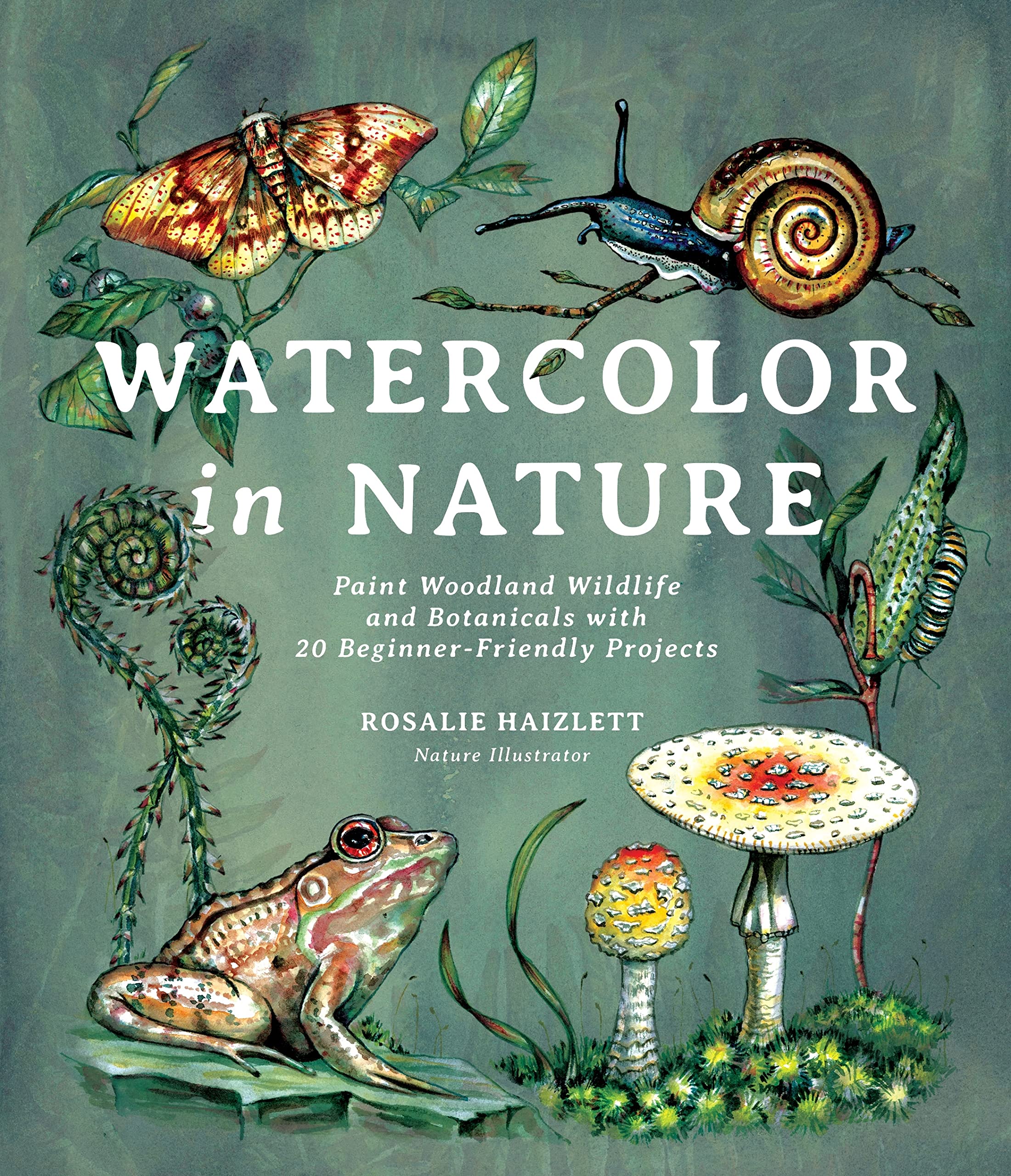
Watercolor in Nature: Paint Woodland Wildlife and Botanicals with 20 Beginner-Friendly Projects by Rosalie Haizlett

This book was a perfect birthday gift. Rosalie Haizlett is a local/regional artist from West Virginia whose work I’m familiar with (it’s in local coffee shops and gift shops, and I’ve got some of her stickers) and and admire. I’ve done a little painting with acrylics over the last decade or so, but no watercolors since kindergarten. And this instructional book is positively wonderful.

Things I love about Watercolor in Nature: clarity and ease of use. Haizlett opens with very brief (one page) sections on how she became an artist and how to use this book (slow down, breathe, take breaks! and, take it in order: each project builds on the one before). She goes over materials, colors, and basic techniques. And then there are the projects, 20 of them in two groups: ten use pencil and ink and ten are watercolor-only. Each adds a new skill to the painter’s toolbox, so it does make sense to take them in order. And the way she walks you through each is perfect – even the most intimidated learner can do this, because she breaks it into intuitive steps, always with images. If you just follow the directions you end up with more or less the intended outcome – that easy. (I say more or less because these are paintings of nature, which is asymmetrical and changeable, and each individual painting is a little different, as it should be.) I was a little intimidated by Haizlett’s lovely art – and another benefit to this book is that it’s filled with her art! – but she made it super easy and friendly; I was never confused. I am a little tempted to cut out some of these pages and put them on my walls. But I’m making my own art, too.

Totally, 100% recommend this to anyone interested in learning watercolor with natural subjects. I’m extremely pleased. After playing around in this book, I trust and like its narrator completely; I feel like she’s a friend. Delightful.


Rating: 9 wild blueberries.

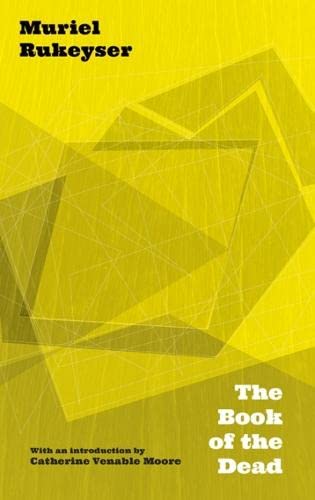
The Book of the Dead by Muriel Rukeyser; introduction by Catherine Venable Moore

Muriel Rukeyser’s The Book of the Dead was originally published as a poem cycle in her 1938 collection U.S. 1. It was unearthed, if you will, by Catherine Venable Moore, and republished in a new edition in 2018 with Moore’s introduction. (Disclosure: Moore was a visiting faculty member in my MFA program when I was a student there; I have met her, very briefly.) That introduction is lengthy, occupying fully half the pages of this book, which I hadn’t realized in advance; that is to say, while Rukeyser’s poetry is its raison d’etre, Moore’s essay is indispensable to the reading experience I’m reviewing here. That essay was published in Oxford American (a magazine I adore) in 2016, in its entirety – I did a pretty close page-by-page spot check, and if the two versions differ, it’s by words or punctuation marks, not paragraphs. (OA actually offers more images, too.) You can read Moore’s work here, and you absolutely should (I write, at the risk of unselling a copy of this book; but you will still want Rukeyser’s poems!).

The subject is the years-long industrial disaster at Hawk’s Nest Tunnel near Gauley Bridge, West Virginia. Miners were tasked with both tunnel construction and the mining of silica, a convenient byproduct of the tunneling; they worked without protective equipment and inhaled quantities of silica, which caused silicosis (as it was known at the time it would), of which they died by the hundreds. Most of the miners were migratory Black Southerners housed in temporary work camps. The death toll is still unknown.

Rukeyser, a young lefty poet/journalist, traveled to West Virginia to document these events in 1936, as the last of the miners testified before a congressional committee even as they coughed and died. She was accompanied by a photographer friend (whose photographs, but two, were lost). The Book of the Dead was Rukeyser’s result: documentary, poetry, journalism, testament. Moore’s essay places this and much more information in context so that the reader is ready to appreciate Rukeyser’s poems when they come. Recall that I am infinitely more at home with essays than with poetry, but I found Moore’s work to be very moving, beautifully done, and informative. I found the poems more challenging, and I would not have gotten as much out of them without Moore’s help. Perhaps my favorite was the title poem, which is also available online at The Poetry Foundation, for whom I am grateful.

I’m very glad I spent a day immersed in this story, certainly an important one in our national and regional history. This was a bit of homework before, hopefully, visiting the recently dedicated memorial myself. I am very glad that Moore did the work of getting these poems and this story out into the world again.


Rating: 8 hills of glass.