Nothing to See Here by Kevin Wilson

Thanks to Liz for this one! I’ve had this on my shelf for a few… years? since she recommended it. I really enjoyed it. It was fun, and absurd, and sweet, and funny, and then quite poignant. Unique. I’m pleased.

Lillian comes from a life of not much money, love, or opportunity. She works hard for a scholarship to a fancy private school, where she makes one essential friend: Madison is from the kind of wealth where just almost literally anything is possible. They match each other’s weird, that one year. Then Madison gets busted with coke, and it’s all a bit foregone: Madison’s father pays off Lillian’s mother. Lillian takes the fall. She goes back to her depressed and depressing little life. Madison’s star continues to rise. When we meet Lillian, she’s working a series of shit jobs, pen-palling with Madison, who is now married to a senator, with a perfect little boy “who looked like an expensive teddy bear that had turned human.” Madison sends her $50 and tells her to come on down to Franklin, Tennessee “because she had an interesting job opportunity for me.” Lillian gets on a bus.

Senator Roberts was married before Madison. His ex-wife has just died. And left behind are his elder children, ten-year-old twins named Bessie and Roland. Lillian, who has no prior experience, expertise, or interest in childcare, is to take them on as charges. She has to keep them safe and relatively happy and oh yea, very private and low-key, because Senator Roberts is hoping to become Secretary of State in the near future, and the twins are a little different. They spontaneously combust. They are uninjured by this event, but their clothes burn off, as does everything around them. The Senator doesn’t need this kind of publicity.

And before Lillian can get used to limitless bacon sandwiches on demand (the Roberts estate employs a large staff, including an outstanding if weird chef named Mary), she is reinstalled in the guest house behind the mansion, which has been retrofitted to house small, recalcitrant fire children.

I love absurdism when it is reality-adjacent and also sweet and odd and fun, which this is, although it is also sad stuff. I love a literalization: the two children in Lillian’s care have been hurt by their life so far. They are a little damaged, slow to trust, quick to combust. Lillian is a bit that way, herself, but her combustion isn’t literal, where the twins’ is. Especially late in the story, Nothing to See Here gets to be about what it means to love someone, to choose to love someone and to take care of them. Lillian is not a parent, but she is as smitten and as wrecked as any parent, and as far at sea. “There was so much that I should have been doing, that I could have been doing, but not a fucking thing made sense to me. I just fed them, made them wash their hands, listened to whatever nonsense they wanted to tell me. I took care of them, you know?”

I should find some more Kevin Wilson. Outstanding.


Rating: 8 bounces.

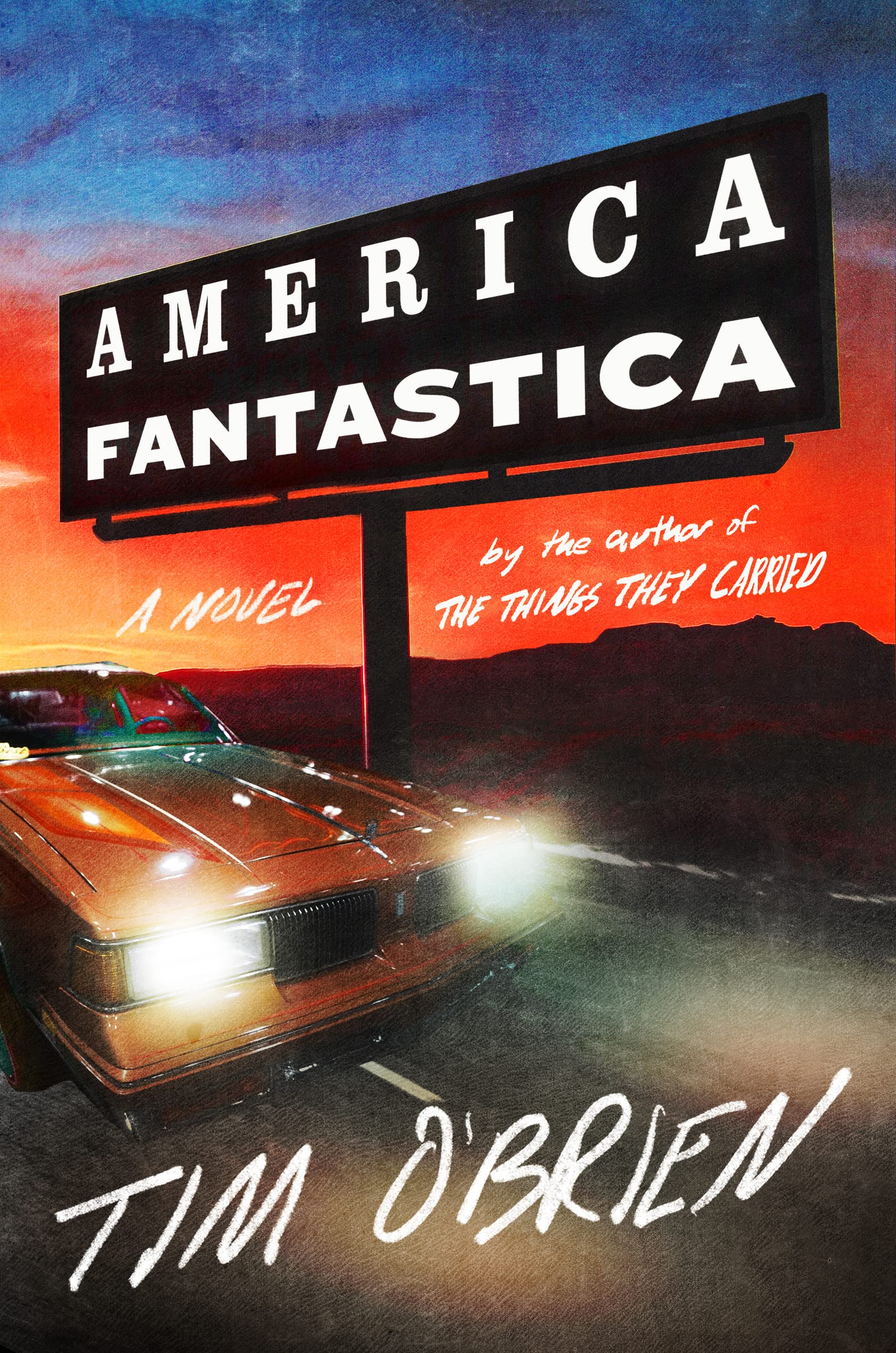
Maximum Shelf: America Fantastica by Tim O’Brien

Maximum Shelf is the weekly Shelf Awareness feature focusing on an upcoming title we love and believe will be a great handselling opportunity for booksellers everywhere. The features are written by our editors and reviewers and the publisher has helped support the issue.

This review was published by Shelf Awareness on July 27, 2023.


Set against the backdrop of an unnamed but recognizable American presidency, Tim O’Brien’s black comedy, America Fantastica, takes both the dark and the comic to epic proportions with simultaneous absurdism and poignancy. O’Brien (The Things They Carried; If I Die in a Combat Zone, Box Me Up and Ship Me Home) here offers his first novel in more than 20 years–a sprawling, madcap tale of road trips, crimes large and small, love, loss, and, most of all, lying. Like The Things They Carried, America Fantastica revels in detail and highly specific lists, so that the world it portrays feels robust and brimming.

Its opening lines set the tone, far-reaching and grandiose: “The contagion was as old as Africa, older than Babylon, wafting from century to century upon sunlight and moonbeams and the vibrations of wagging tongues. During the second decade of the twenty-first century, the contagion alighted in Fulda, California, riding aboard the bytes of a MacBook Air…. Reinvigorated by repeated utterance, fertilized by outrage, mythomania claimed its earliest victims among chat room patrons–the disappointed, the defeated, the disrespected, and the genetically suspicious…. The disease spread northward into Oregon, eastward into Idaho, arriving on Pennsylvania Avenue in January of 2017.”

Readers first meet O’Brien’s antihero in action. “On an afternoon in late August of the year 2019, after locking up the JCPenney store on South Spruce Street, Boyd Halverson strode out to his car, started the engine, sat without moving for several minutes, then blinked and wiped his eyes and resolved to make changes in his life. He had grown sick and tired of synthetics, rayon in particular.” He departs his Kiwanis brunch early to head to the bank, where he presents a gun and leaves with just under $81,000 and the teller, “a diminutive redhead named Angie Bing.” She is technically kidnapped, but Boyd will repeatedly try and fail to ditch her over the coming months. His name is not really Boyd Halverson and his entire résumé is a fiction. He had in fact been married, had a child, had an impressive career as a foreign correspondent and nearly won a Pulitzer Prize. But that life was built on lies, culminating when “at last he collided with the sudden, brutal, and well-earned catastrophe he’d been patiently anticipating for decades.”

Boyd and Angie hit the road, seeking first Boyd’s ex-wife, Evelyn, and then her father, Dooney, against whom Boyd holds a significant grudge. Their travels prompt movements by an increasingly colorful cast of bizarre characters. Dooney and his partner Calvin flee the possibly murderous Boyd from Port Aransas, Tex., to Bemidji, Minn., and onward. Randy, Angie’s boyfriend, an almost-laughably amoral electrician/rodeo cowboy/burglar, tracks Angie from Santa Rosalía, Mexico, to Santa Monica, Calif., and beyond. Along the way, he meets two ex-cons at a diner in Los Angeles who latch onto his interest in an unreported bank robbery. These characters set the tone of a novel dealing equally in ludicrous comedy, political commentary, and pathos. They will be joined in O’Brien’s imaginative, wide-ranging tale by a violent, egomaniacal CFO; a bank president and his wife, both with a gift and passion for fraud; a racist cop; an Amazonian CrossFit gym owner and amateur detective; a small-town sex worker with either an excellent act or multiple personalities. Events range from disturbing to ridiculous, often simultaneously, as when Boyd gets his toes broken with a monkey wrench by an unlikely pair of sidekicks. These characters and events, in a series of deftly drawn American locales, form a fantasmagoria, a version of reality that both bizarrely exaggerates and digs directly into the emotional truth of the real world.

O’Brien opens with a Yeats epigraph: “We had fed the heart on fantasies,/ The heart’s grown brutal from the fare.” His novel speaks of a nation that craves delusion and deception; O’Brien’s profile of the 2019 United States is savage, blending satire and realism. “Off with their heads! Climatologists? Chemists? Off with their tongues! Who needs reality when you have Venom? Who needs history when you can manufacture your own?” Is it plausible that Boyd, an esteemed investigative journalist, exposed as a liar, might in turn expose larger wrongs than his own?

America Fantastica showcases a broad emotional range, as Boyd Halverson (aka Otis Birdsong, aka Junior, et al.) turns out to harbor some very real trauma amid a fabricated personal history, and at least one complex personal relationship. It is a story chock-full of lies or fictions, a theme O’Brien has explored in earlier works as well. “[Boyd] had fervently believed every word, every unearned moment of an unlived life. Yes, he was a Princeton graduate. Yes, he had distinguished himself in the Hindu Kush, scaled Mount McKinley, survived brain cancer, scored near-perfect on his SATs. But so what? Why risk failure when a fib was always conveniently at hand?” By the novel’s end, readers will have learned–more or less, as far as we can tell–the “real” truth. This feels in some respects like a hopeful conclusion. But the truth itself is more grim than hopeful, which is perhaps the most realistic–truthful–possibility.

As in the earlier works for which he has long been recognized, O’Brien here demonstrates an electric combination of deadpan humor, vicious wit, and a masterful eye for detail in capturing a peculiarly American form of torment.


Rating: 7 wiggles.

Come back Monday for my interview with O’Brien.

Rabbit Cake by Annie Hartnett

Thanks to blog reader Annie Long for the excellent recommendation.

This is a sad, sweet book with an accurately written first-person child protagonist struggling with loss and grief, and with a decidedly odd view of the world, possibly reflecting neurodivergence. (Someone at school calls her ‘retarded.’) If this sounds a lot like the mad originality of The Curious Incident of the Dog in the Night-Time, I thought so too. That earlier novel was so unprecedented it blew readers’ minds; and while this one has a lot in common with that one, I don’t think that makes it a bit unoriginal. It’s still a pretty wild (and wildly unusual) model; there’s plenty of room for more surprises in this area.

“On my tenth birthday, six months before she sleepwalked into the river, Mom burned the rabbit cake.” It was one of the wonderful things about her mother Eva that she made rabbit cakes for all occasions – believed in celebrating all the small events of life. Elvis is ten-and-a-half when her mother dies, and she has questions. For one thing, how could such a good swimmer have drowned? Her mother was a frequent if not constant sleepwalker, and “she was an excellent swimmer in her sleep.” Her mother was a gifted scientist. And besides, her mother’s psychic had always been very clear that Eva would die by suicide.

Elvis is clearly a young person who craves control, and so she sets out to take care of things around the house, because her father surely isn’t; he’s taken to wearing Eva’s lipstick and her bathrobe around the house, and mostly ignoring his daughters. Elvis’s fifteen-year-old sister Lizzie has moved on from beer drinking and breaking her best friend’s jaw (in three places) to a particularly self-destructive sort of sleepwalking (although no sleepswimming). Elvis dutifully sees the counselor at school once a week during recess, until she says something especially disturbing and gets upgraded to daily sessions. Ms. Bernstein instructs her that the grieving process generally takes eighteen months, and so dutiful Elvis marks her chart counting down the days until she will not grieve her mother any more. She also works on finishing her mother’s massive book (working title: The Sleep Habits of Animals and What They Tell Us about Our Own Slumber). Elvis knows a lot about animals – enough to annoy everyone around her, until she gets a volunteer posting at the zoo. She comes across an entry in The Reference Guide to Porcupine Anatomy and Behavior in the zoo’s library that mistakenly relates the echidna to the porcupine when it is closer to the platypus. She makes a note to write to the publisher.

You get the picture: this is a child precocious in some areas and a bit hopeless in others. She indulges in magical thinking, but what child doesn’t? and for that matter, who in the throes of grief? Despite Elvis’s story being completely heartbreaking at every turn (warning, friends: this family also has an old dog. Will it never cease? Don’t ask what happens to the giraffe), it’s also frequently hilarious. There is a strong current of absurdism running through it. Lizzie the sleepwalker and breaker of jaws is institutionalized, and returns home with a pathological liar who the distant and negligent father allows to move in. Lizzie decides what she needs is to set the Guinness World Record for most number of rabbit cakes baked. Most, but not all of them, will need to be decorated. Elvis is driven mad by the delicious smell of baking cakes – which she associates with happy memories of their mother – but she is not allowed to eat any of the cakes, which Lizzie must preserve for her world record. I won’t even tell you about the troubles Elvis gets into at the zoo. Or what she discovers about her mother’s sex life.

Delightful, absurdist, ridiculous, heartbreaking; laugh-out-loud funny in the most morbid ways, if you’re into that sort of thing. (Case in point: the reason Elvis’s school counseling gets upped to daily sessions.) I was frequently quite angry at the adults in this child’s life who consistently, near-criminally fail her; I usually keep my cool with fictional characters better than this. In other words, it’s a deeply involving story, with some very wise points to make about grief in the end. That ending is surprisingly upbeat – or maybe it’s not surprising at all.

I’ll be thinking about Elvis for a long time, and about this singular, weird, troubled, endearing little family. I’m remembering Have You Seen Marie?, another gorgeous meditation on grief in fictional form. Cisneros said about that book that she did not conceive of it as being for children. And even though Rabbit Cake‘s star is a child, I don’t think this is a children’s or YA book, except to the extent that any book is right for the reader who’s ready for it. (Tin House, who does not publish children’s books, has marketed it as simply fiction. Although these labels may be worth less than we think they are.) It’s quite a deep-thinking novel, with nuances to satisfy readers of all levels of maturity, especially those who may need to laugh and cry in the same sitting.


Rating: 9 librarians aptly named Reasoner.