Hamilton soundtrack

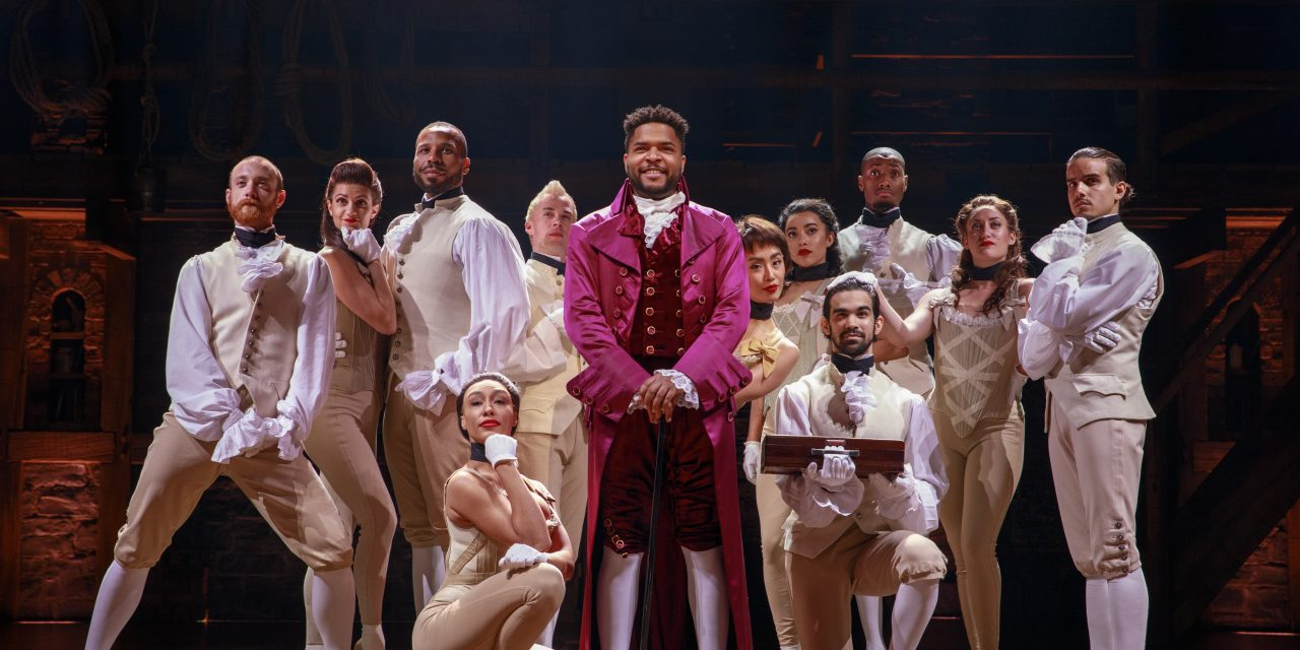
I don’t usually review music around here, but I’m making an exception for this double-album soundtrack because a) it’s a preview of the actual musical I’ll get to see in about a month’s time (squeal!), and b) it’s highly narrative, so it feels like it belongs.

We’ve all by now heard about the musical Hamilton by Lin-Manuel Miranda, right? Based on the biography Alexander Hamilton by Ron Chernow (which I may need to read next). I had heard of it, but hadn’t paid much attention until I heard Miranda interviewed on my favorite podcast, Another Round (rest in peace). (That episode is here.) Once I started paying attention, I knew I had to see it. So I got tickets! to go with my friend Jacinda (talented author of Saint Monkey) next month in Louisville, and we can’t wait. (Sadly, I will not see Miranda perform, himself, but I will trust that they’ve chosen a good replacement.) My parents recently saw it performed in San Francisco (still waiting on their guest review[s]!), and my mother sent me this soundtrack.

And it’s phenomenal. The music is impressive in itself – that is, as music, you want to lean it, turn it up, nod along with the beat. There is such a full story communicated in its lyrics – all of which are perfectly legible, rare enough with any genre of music. I can immediately hear that Hamilton’s life was full of drama and inspiration, and I can imagine Miranda reading Chernow’s book and being captured by the wild true story of one man’s experience in and out of American politics. That he took that story and put it into varied and captivating song… is another inspiration in itself. I can hardly believe people are this talented.

My impression is that the entire play is available in these songs – leave it to be seen how true that is, but this double-album is quite a complete narrative in itself. It has everything: compelling, dramatic story; catchy beats; wildly crisp, awesome, technical execution; feeling, voice, and talent. I am deeply excited to see it live.

I’ve listened to the whole thing exactly two times through before writing this review, but of course I’ll be going back through it over and over before the show. So far, my favorite tracks include the introductory opener, “Alexander Hamilton,” and the following “Aaron Burr, Sir,” in which Hamilton meets this central character; the pairing “Helpless” and “Satisfied,” which offer parallel love stories with two Schuyler sisters; and the Cabinet Battles, #1 and #2, which are rap battle versions of the stand-offs between Hamilton and Thomas Jefferson. This is so exciting! This is how you get the kids (and me) excited about history. I’ve written before about the importance of interdisciplinary studies; I think rap-battle-meets-history-lesson might be the best yet. Also the “Ten Duel Commandments,” and “The Reynolds Pamphlet” for its sheer drama, and the final two numbers, “The World Was Wide Enough” and “Who Lives, Who Dies, Who Tells Your Story.” And, well, I love every track.

I also appreciate the threads that tie these songs together: for example, the repeated refrains of helpless and satisfied (in regards to Hamilton’s love life and ambition). I admire the narrative artistry of the song “Satisfied,” in which we rewind to see a scene and story just told in the previous track, from a very different point of view. This is some fine storycrafting.

I’m afraid of going in circles now – or of creating expectations that are too high to satisfy for the live show. So I’ll stop with this high praise.


Rating: 9 shots.

Amish Facts of Life in a Changing World by Gerald S. Lestz

While visiting with family on a horse farm in Lancaster County, Pennsylvania – Amish country – I had so many questions that they lent me this little book. It’s a pamphlet, really, at just 71 pages. And despite the title, a publication date of 1978 means it remains quite dated: for example, “mortgages for several hundred thousand dollars might be eyebrow-raisers among city folk” amused me. That said, I still learned a lot about the Amish way of life – maybe the Amish way of life in 1978, but the idea is that it doesn’t change that much, right? And in conversations with my hosts here, it sounds like quite a lot of what I’ve learned is still true.

Author Gerald S. Lestz is not Amish, but he has a good relationship with the community, who let him spend time in the one-room schoolhouse he profiles here, for example. His five essays can easily stand alone: “An Amish Teacher and Her School,” “Amish Pay High Prices to Keep Their Farms,” “The Diary: An Old Order Newsletter,” “Amish Story in Wood Carvings,” and “Demand Soars for Amish Quilts.” I think I enjoyed the school part the most, perhaps because it’s an area that interests me anyway; I am intrigued by the question of whether the school board allows the Amish to self-educate and take their kids out of school early. But each of these essays had something that piqued my interest.

Lestz is not impartial. He admires his subjects, and thinks we should all learn from them. Check out this description of one of the lovely wood carvings he features, by Aaron Zook:

Home prayer takes place every evening, and this is a touching scene. It is in the large kitchen of an Amish farm home. All members of the family are kneeling. The father is reading the prayer. Studying this, one can understand why the Amish way of life persists, and why there is so much goodness and so little crime among its members.

I do think the Amish offer some interesting solutions to some of our societal problems, but I think it’s a stretch to say that a kneeling family scene equals low crime and goodness. At any rate, you see the bias. And fair enough: it’s right out there where we can see it, which is always nice, if there’s going to be a bias at all.

The purpose of this slim book is education and information, not entertainment or artistic accomplishment. Lestz’s writing style is simple and forthright (notwithstanding his “paraphrase [of] Gertrude Stein in the negative: you can no longer say a quilt is a quilt is a quilt.” Clever, that). But it’s information I wanted, and I’m happy to have it. (I supplemented this read with a few issues of local rag The Fishwrapper, a little more treacly and Jesus-y but not unhelpful.) I’m glad I read it.


Rating: 6 vendues.

Cibola Burn by James S. A. Corey (audio)

Following Leviathan Wakes, Caliban’s War, and Abaddon’s Gate, Cibola Burn makes book four of The Expanse.

First remark: I noticed within seconds that this audiobook is read by a different narrator than books 1-3. I guess it is one of those quiet tragedies that we often don’t notice or remark on the narrator at all if they do a good job; done right, their work kind of fades into invisibility behind a great story. (I do try and recognize narration, and sometime comment on it, but I’ve probably failed to credit some fine work. In this format, no news is probably good news.) The earlier narrator of this series, Jefferson Mays, has given me each of the characters’ voices and accents; he gave me a world that I invested in. And this new guy is messing it up.

According to this fan wiki, Erik Davies stepped in to read book 4 because Mays had a scheduling conflict, and a later audio edition was released with Mays reading again. I regret that I didn’t find this out earlier and go seek that one out! I’m sure Davies is a nice man, but he butchered this reading. It would seem reasonable to go back and listen to the earlier narrations (this is a series; fans are invested) to find how each character was played and try to follow that, but maybe the scheduling issue provides a clue: too rushed to research? Not only are characters played inconsistently with past portrayals (Avasarala loses her accent; Amos’s voice moves way down in pitch), they are played inconsistently within this one book. Alex’s famous accent (practically defines his character) comes and goes, sometimes entirely absent. Our villain Captain Murtry has the accent Alex should have, but it sort of comes on slow and ramps up as the story unfolds. He changes the pronunciation of Coordinator Chiwewe’s name partway through, then changes it back. This is sloppy work. Additionally, Davies has a sort of droning monotone style in general, and he is apt to deliver lines like… remember Horatio Caine from CSI? The way he would take off his sunglasses and put them back on again and sigh and emphasis. every. word. very. slowly? Davies does this too, and it drives me crazy.

I know I’m going on at length about a single element of this audiobook and have not even gotten into its contents yet, but this is important stuff, friends. It took me every bit of half the book to get my bearings in this new world. I’m sorry I never gave Mays credit for his earlier work.

And my narration complaints don’t help my overall impression, certainly, but I also think this was the weakest installment in the series (interesting, because my friends at Tor.com loved it). The plot shows promise – shall I get around to plot, now? Following the opening in book 3 of “the ring” as a station to access a bunch of new solar systems, one of the “new” planets has been colonized by Belter refugees from Ganymede. Only now, a ship from an Earth corporation has shown up ready to do a sanctioned scientific study, and the two groups (to put it very simply) don’t get along. Blood is shed immediately, and the OPA/Earth alliance headed by Fred Johnson and Crisjen Avasarala sends Holden and his Rocinante crew out to set things right. For political reasons, they share a thinly veiled hope that Holden will actually fuck things up.

So here come Holden and Amos down to the surface of a planet… not quite at war, but certainly very tensely at odds. (Alex and Naomi stay up in the Rocinante in orbit nearby, along with the two much larger ships held by the two factions who beat them there.) Besides the political/social complications, we face challenges like superstorms, “death slugs” (which crawl out of the ground and kill on contact), and a mysterious growth that threatens to blind every person on the planet except Holden, for whatever mysterious reason. (I was calling this bullshit – the way Holden is such a superman and is the only one immune to this blindness threat – but it turned out to be explained pretty neatly, so okay.)

Again, the plot shows promise. We get (as usual) a couple of engaging new characters, especially the brilliant, work-obsessed scientist Elvi Okoye, who has one misguided crush and then finds true love, and her sidekick Fayez. The clear villain, as I said (and I don’t think this is a spoiler) is one Captain Murtry; he is a sociopath, I think, and I enjoyed him not one bit, but I suppose we need him for the story. We also meet again a few characters from earlier books: Miller’s old partner Havelock, and Basia Merton, from Caliban’s War. The Tor writer, Stefan Raets, found these reappearances a little too unlikely, but I’m on board. I also cheered the return of Sergeant Bobbie Draper in the prologue, but she scarcely shows her face past that beginning.

I loved the new world being discovered here, the new planet, with its totally unique biology and scientific challenges; Elvi’s overwhelming enthusiasm and love for her work is contagious. The mimic lizards captured my imagination and reminded me of Oy the billy-bumbler from King’s Dark Tower series. I remember Oy so fondly, this gave me a good feeling. (Corey is good, but King is better, hands down.)

Plot, check, characters, check. But the weakness comes in in the actual writing. I felt that where we used to see subtlety we are now being banged over the head. The emphasis on Holden’s crew being like family used to be mentioned offhandedly or merely demonstrated; here we have repeated overt references, as in “these are my family. I’m not going to let them die” sort of things. One of the book’s clearest themes is this idea that it’s silly for us to fight when we should be working together… we’re facing so many dangers, why can’t we remember that we’re all people, and band together… and then finally, common enemy, working together against dangers… look, we did it, we pulled together! And I think this theme would have been perfectly evident, and impactful, without saying all those things all the time. It got really cheeseball; I think it’s insulting to the reader to spell things out so thoroughly; and most importantly, it ruins the effect. Dialog, as well, moved from clever and quippy (especially among the Rocinante‘s crew) to over-explainy. Somebody actually said “I said that so you’d know I know.” The writing felt so different to me here that I wonder if something changed in how the writing team (that goes by the name Corey) works together; it just really didn’t feel like the same authorial voice. Of course, I have no idea how much Davies’s sub-standard reading played into this impression. The way a line is delivered can very much change how it’s read.

Finally, the interludes. A new addition here, these short sections seem told from the aliens’ point of view (I am following Raets’s usage here), and they remind me thoroughly of Gertrude Stein and not in a good way.

I do appreciate (as Raets points out) the way this book integrates some of the material of those that have come before. I appreciated Alex getting a bit more backstory – I said in my last review that he was little more than an accent, and finally he gets more characterization, which is just as well since he just about lost his accent in this narration… And if we get Avasarala and Bobbie Draper back together again in the next book, I’ll be very pleased. I’m still in, is what I’m saying, but please let’s get back to Jefferson Mays’s narration and back on track. C’mon, team…


Rating: 6 blue fireflies.

Maximum Shelf author interview: Alex North

Following Wednesday’s review of The Whisper Man, here’s Alex North: The Heart of the Book Starts Beating.


Alex North was born in Leeds, where he now lives with his wife and son. He studied Philosophy at Leeds University, and prior to becoming a writer he worked there in their sociology department.

Chapter by chapter, your characters take turns holding center stage. Was it complicated to manage so many points of view? Is there a strategy for writing this way?

I think the structure is just what this story demanded. Although the characters do come together as the book progresses, they start off in different places, and they each have their own storyline to follow until they do. Tom is clearly the main character, and we follow the majority of the book from inside his head, but there is a surrounding cast whose stories gradually begin to dovetail with his, until all of them are inextricably linked by the end.

I don’t think it’s necessarily any more complicated to write than a more straightforward single narrative. You do have to keep track of things very carefully, though, and you certainly don’t want one strand of the story to overshadow another. In an ideal world, a reader will finish a chapter that focuses on one specific character completely desperate to find out what happens to them next–but equally eager to pick up on things from another character’s perspective in the meantime and see what happens there.

It’s a balancing act, but I do like stories that use this technique. For one thing, if it’s done well, it can drive you through the book. For another, it can sometimes become quite claustrophobic for me if I’m trapped in a single character’s head for the entire story. But most of all, I think it’s interesting when these characters eventually collide and interact with each other. Writing from different perspectives allows you to see things from different angles, because the characters will understand and interpret the same event in their own unique ways. We all do that in real life. And I think it helps to bring nuance and ambiguity to the story, with the truth being revealed through a combination of viewpoints.

Fathers’ impact on their sons forms a central theme of the book. Was that intended, or did it arise as the story unfolded?

It was intended to an extent. To begin with, all I knew was that I wanted to write about a father left alone to care for his son, and finding it difficult. But there was a moment, shortly after moving into our new house, when my own son briefly mentioned that he was playing with “the boy in the floor”–which obviously gave me a bit of a chill! Thankfully, that didn’t last, but at that point I knew the little boy in my story would have imaginary friends, and that some of them might turn out to be quite sinister and disturbing. The book unfolded from there.

But the background theme of fathers and sons definitely expanded the more I wrote. It was on my mind the whole time, and so I found different connections emerging as I went. It felt a lot like things appearing through the mist: the more you write, the more the events in the book begin to link to each other, suggesting other connections, and so on. I was writing about fathers and sons from the beginning, but it took a first draft of the book before I discovered all the different ways that theme fed into the story.

What are your favorite parts of writing a novel like this?

Writing a novel is a marathon rather than a sprint, and I think you have to accept that there will be good and bad days–and far more of the latter–but I’ve learned that you have to go through all those bad days to get to the good ones. As is so often the case, half the battle is showing up.

But while I’ve enjoyed the handful of days when the writing has flowed, there’s also immense pleasure to be had in the ones when you had to drag yourself to the keyboard… and something just clicks. It’s enough to keep you trying the next day and then the next. Which of course is what you have to do.

For The Whisper Man, the moments I most enjoyed were towards the end, when all the connections began to make sense to me and the book finally came together. It’s easy to say what my favorite scene to write was, but also a bit of a spoiler. Speaking carefully, it involves a conversation between a little boy and a little girl. While there was still a whole load of writing and rewriting to do afterwards, that was the moment where I felt like I’d found the heart of the book and felt it start beating.

Can you give us any hints about your next novel?

I’m really superstitious when it comes to talking about work in progress. For one thing, I think it robs you of the impetus to write the book itself but, more importantly, my books tend to change all the way up to the wire. I have to try to write the story to figure out what I should have written all along, which means my final draft can be very different from my first. I write slowly to begin with, and then frenetically in the last month or so. But one thing I can say is that the next one is another very dark psychological thriller with creepy undertones. If The Whisper Man made it difficult to fall asleep, my hope is that the next one will make you very scared indeed of what might happen when you do.


This interview originally ran on April 17, 2019 as a Shelf Awareness special issue. To subscribe, click here, and you’ll receive two issues per week of book reviews and other bookish fun!

Maximum Shelf: The Whisper Man by Alex North

Maximum Shelf is the weekly Shelf Awareness feature focusing on an upcoming title we love and believe will be a great handselling opportunity for booksellers everywhere. The features are written by our editors and reviewers and the publisher has helped support the issue.

This review was published by Shelf Awareness on April 17, 2019.


Alex North’s The Whisper Man is an exemplary thriller, offering plenty of suspense, things that go bump in the night and complex psychological maneuverings that may–or may not–explain the good and the bad that is shared by fathers and sons.

As the novel opens, off-duty Detective Inspector Pete Willis wearily heads out to help search for a missing six-year-old boy. He doesn’t want to think about the similarities between this case and an old one that he still can’t forget. At the same time, Tom Kennedy, a successful novelist and deeply bereaved widower, is struggling to connect with his young son, Jake. A gifted but troubled child, Jake knows more about the world around him than seems natural. He tries to be good, quietly drawing by himself, but his pictures profoundly disturb Tom.

Detective Inspector Amanda Beck–a generation younger than Pete–wrestles with the case of the missing child, which does indeed turn out to be linked to the case that haunts the older detective. The serial killer, dubbed by the press “the Whisper Man,” appears to have returned, although he’s been in prison some 20 years; Pete was never able to pin down for certain whether there had been an accomplice. And now, there’s another child-snatcher whispering to his victims before he takes them. Kids repeat the rhyme on school playgrounds: “If you leave a door half open, soon you’ll hear the whispers spoken. If you play outside alone, soon you won’t be going home….”

Tom and Jake have just relocated to a new village to start over, after the loss of Jake’s mother. But it seems they’ve moved into a maelstrom of evil, like something out of one of Jake’s drawings. The tension and the action ratchet up as the distant past becomes very present again.

The Whisper Man is told from a number of different perspectives, chapter by chapter–Tom, Jake, Pete and the Whisper Man himself. They are occasionally joined by others, including up-and-coming DI Amanda Beck, who looks to Pete as a mentor; but the story centers on Jake, his father and their connection to the bad guy. Tom’s perspective is the only one written in first person, giving him a compelling narrator’s authority– appropriate, as he is the novelist of the bunch. These differing voices exhibit North’s adeptness with character, including the precocious child’s view of the world in Jake’s chapters. They also give the reader a chance to sleuth alongside the professionals. But North gives nothing away: even the most mystery-savvy reader will be gasping and page-turning to the very end.

North’s characters are multi-layered, deeply relatable while keenly entertaining as they reveal themselves. Pete struggles with alcoholism in a day-to-day battle that is both fraught and poignantly banal. A young man whose father didn’t love him focuses on the meaning of a meal prepared with or without care. One of Tom’s daily challenges involves taking Jake to school, where he waits for his son to look back over his shoulder or not, and where he worries about fitting in with the other parents (one of whom will become a significant side character). Each chapter in its turn, and each featured character, is so absorbing that the reader wishes to follow this lead and then that one–but the momentum of the plot is relentless. Characters that the reader has invested in are in danger, and the pages fly by. At nearly 400 pages, The Whisper Man is nonetheless a quick-reading, fast-paced novel.

The psychology is complex. There’s more than one bad guy, blurring into one another in the eyes of frustrated investigators Willis and Beck. And if The Whisper Man has a hero, or heroes, they are imperfect, each occasionally thinking themself the villain. Whether it surfaces as evil or good intentions, there is a strong theme throughout of the connections between fathers and sons: what is passed down, and what role free will has to play.

In the end, The Whisper Man has all the hallmarks of a great murder-mystery thriller: suspense, the battle between good and evil, surprise twists and turns, fresh takes on classic detective characters and sympathetic civilians. But more than that, North offers nuance and questions about human agency. For all the darkness in this novel about serial killers and trauma, there is a sweet strain of filial love and creativity, and even a note of redemption.


Rating: 8 circles.

Come back Friday for my interview with North.

“Road Writing” at Heartwood blog

My MFA alma mater’s lit journal, Heartwood, also hosts a blog for program-related news and such. Check out my recent guest post.

Thanks! (Remember you can always read my travel-related reporting at Foxylikeaturtle.)


Housekeeping: yes, it’s Monday. I’m having to switch back to three posts per week now, as the backlog grows! Good problems; semi-retirement is working! So, look for posts on Monday-Wednesday-Friday for a while now. I’m sure when I start teaching in the fall things will dry up again…

movie: Hillbilly (2019)

Disclosure: I am a degree or two removed, socially, from some of the folks involved with the making of this film.


I just think no matter where anybody’s from, if they’re honest with themselves they’re gonna have a love/hate relationship with where they’re from.

–Jason Howard

I found Hillbilly deeply moving, beautiful, and appreciated the diversity of people it put in front of the camera.

I heard about this film from several sources at once, all of them sympathetic, and some of them personally connected; the above quotation (which you know resonated with me so strongly) comes from Jason Howard, who’s been guest faculty at WVWC during my tenure as a student there. His husband Silas House is an executive producer. So I came in with a positive preconception, and it was rewarded. I was surprised (but perhaps shouldn’t have been) to see the negative reviews on Amazon; the “top reviews” were all critical of its political stance (“this is a liberal agenda documentary be forewarned”). Well, fair. I think the film’s perspective was clear from the start. As I watched, I kept thinking of confirmation bias and where we all start out from when we enter a project like this, either as creator or viewer/consumer. My politics align with those of Ashley York, co-director and narrator/”face” of the film, in many or most ways. I appreciated what she’s done here. Those with different politics are likely to appreciate the film less. As much as I loved watching it, I was left kind of sad, too, that we can’t do more real listening to each other.

Not for lack of trying on Ashley’s part. Within the narrative of the film, she introduces herself as an Appalachian native from Kentucky who now lives in Los Angeles. As the 2016 presidential election draws near, she realizes how far apart her pro-Hillary politics are from those of her pro-Trump relations, chiefly her Granny Shelby. So she travels home to talk to Shelby and others, hear their side. I am so glad somebody’s trying to do that work; little enough of it seems to be happening. Ashley is respectful and listens quietly as her family explains why they support Trump. There was not the dialog here that one might wish for, but maybe Ashley was shooting for some level of journalistic neutrality? A separate issue… Speaking of issues, there wasn’t really any discussion of issues or stances, or the gap between Trump’s talk (coal! jobs! economy!) and his concrete plans for action. In the end, this film is less about politics than it is about culture.

I empathize with Ashley’s experience some, especially when she points out how difficult it is to hear a majority-progressive community throw Trump supporters out in one homogeneous basket, in their thinking. This is especially difficult when you come from a place where you’ve rubbed shoulders with some of the people in that basket, and know them as individuals. “They” are no more homogeneous than “we” are. Her uncle tells the story of serving in the military and being ridiculed and rejected by his fellow service members – it was worst in California, he tells her, “no offense” – and he chokes up, saying that he never found the brotherhood he’d sought. I don’t care if you hate his politics, that’s a sad moment. I don’t think “we” liberals gain anything by making fun of people we don’t agree with.

A good chunk of the movie deals with media portrayals of Appalachians. Deliverance makes an appearance, of course. Ashley visits with Billy Redden, who played Lonnie, the younger, hillbilly half of the “Dueling Banjos” scene. He works at Wal-Mart; he got paid $500 for his part in the movie; he hopes to make it to California one day. That Appalachians or hillbillies have gotten a bum deal with Hollywood, there is no question. The rest of us, somebody in the film suggested (I’m sorry I can’t say who), get to feel better about ourselves by making fun of “them.” There’s also some treatment of the history of the region, including the fact that when big business saw how much money there was to be made by extractive industries (coal, for one), it was convenient to evolve from treating hillbillies with gentle contempt, to viewing them as sinister and depraved: people from whom we should definitely take things away.

As a summing-up of a region, its history, its culture(s), and its current contradictions, Hillbilly does a neat job; it is necessarily incomplete, but what do you want from an 85-minute film? I’m so glad that it put people of color and queer people at center, too (and discussed the strange portrayal of Appalachia as white when in fact it’s quite diverse, skin-tone-wise). Any time we sum up any place, we’re going to resort to generalizations that can range from inadequate to damaging. Considering these truths, I think this movie does as good a job as it could have. If that sounds like faint praise, I don’t mean it that way. I’m just trying to acknowledge the inherent shortcomings of the form, and of any attempt to portray a place with more than, I don’t know, a couple dozen people in it.

Hillbilly gives us Election Night 2016 again, “live,” as it were, and I found it painful all over again. Silas House and Jason Howard speak with some emotion about their feelings – Silas seems to feel betrayed – he has spent his life defending his people (I paraphrase) and (he implies) they have failed to defend him with their votes. He turns to Jason: “You always say you love Appalachia. You don’t feel it loves you.” Jason replies with the line at the top of this review: “I just think no matter where anybody’s from, if they’re honest with themselves they’re gonna have a love/hate relationship with where they’re from.”

I just wanted to repeat that because I find it so true. Thank you, Jason, and everyone involved with this film.


Rating: 8 questions.

marginalia: Blue Highways: A Journey into America

He may have thought I was joking, but here I am, writing about the highlights, marking, and marginalia of Matt Ferrence in the copy of Blue Highways that he gifted me. (Reviewed here last week in two parts.)

thanks, buddy.

We’ve exchanged some text messages as I read the book, and I’ve found it interesting to see where Matt marked (rarely where I was moved to), and where I thought the earth shook and Matt made no note at all. Not once did we mark the same lines. Go figure. I’m also intrigued to hear that he’s tried to teach this book to writing students who were left cold. I wish I could be in that class; I wish I could be that class; I wish I could co-teach that class!

If I buy a used book and it comes to me with someone else’s markings in it, I’m annoyed. It changes the way I read the book; someone else’s signal of what is and is not important gets in my way. This was different, though. Rather than a stranger, this was the hushed voice of a fellow writer I like and respect, nodding to me. I’m curious to see how he reads. There are highlighted sections; there are (only a few) marginal notes; and there are a number of dog-ears marking those pages that show highlighting or notes, but not all marked pages are dog-eared. I don’t know if that’s significant, or an oversight.

For comparison, this is what it looks like when I take notes:

Matt does not believe that Heat-Moon recorded all the dialog faithfully; he thinks that a lot of dialog reads in Heat-Moon’s own voice. (But he carried a microcassette recorder! I am most curious at this accusation! Matt also highlighted “I played a tape recording of the last few days and made notes.”) My favorite page marking is the one that reads, large in highlighter at the top of the page, Monks! (Exclamation mark!) Monks, indeed!

Matt (teacher of creative nonfiction writing) highlighted the phrase at the beginning of a sentence on page 131: “I’m an authority because…” and oh, the richness of that assertion. Classes have been taught on the voice of authority and the way a narrator achieves authority over a given subject. Hint: rarely does he claim it outright.

I love these highlighted lines:

What is it in man that for a long while lies unknown and unseen only one day to emerge and push him into a new land of the eye, a new region of the mind, a place he has never dreamed of? Maybe it’s like the force in spores lying quietly under asphalt until the day they push a soft, bulbous mushroom head right through the pavement. There’s nothing you can do to stop it.

Amazing. The inexorability of soft forces.

Matt highlights the line, mid-paragraph: “He was starting to ruin Cave Creek.” A man has visited Heat-Moon’s camp, unexpectedly and, it turns out, unwelcomed. Usually our narrator welcomes company, but this man is a complainer, and ruins the idyllic natural setting. I hadn’t remarked it without the help of this pink highlighter mark, but now it reminds me of the travels of Huck and Jim on the Mississippi, and how the river was always a place of calm and safety, while anytime they went inland and interacted with humans, they ran into trouble. “Man,” as Heat-Moon would have it, ruins what is desirable about the state of nature.

I’m glad I got this copy of this book. I learned some things. As Heat-Moon writes (and Matt marks):

I can’t say, over the miles, that I had learned what I had wanted to know because I hadn’t known what I wanted to know. But I did learn what I didn’t know I wanted to know.

And maybe that’s always the most instructive thing.

Blue Highways: A Journey into America by William Least Heat-Moon, part 2

Without the errors, wrong turns, and blind alleys, without the doubling back and misdirection and fumbling and chance discoveries, there was not one bit of joy in walking the labyrinth. And worse: knowing the way made traveling it perfectly meaningless.

Today I continue my review of Blue Highways begun on Wednesday.

The above quotation refers to a literal labyrinth, a maze the narrator walks that is too obvious. But clearly its meaning applies to the mad trip of life: the joy and pathos and point is not in knowing but in discovering.

Unavoidably, in the deep South, Heat-Moon finds racial tensions, which he follows to Selma to ask what’s changed since King’s march. He has a totally chilling experience there: this question is not welcome among the whites of the town he encounters, although the Black citizens have a little more to say. He is shaken down in the middle of the night by cops who, he’s warned, didn’t like him talking with Black residents at all. He’s curious about the experiences of Native Americans everywhere he goes, which is unsurprising considering his own heritage; he is also sensitive about his status as a “mixed-blood.” “Let his heart be where it may,” such a person “is a contaminated man who will be trusted by neither red nor white.” This feeling of not quite belonging inhibits his investigations on the road, which happens but rarely, and usually only out of concern for his immediate safety. The reader feels this “mixed-blood” identity is a pressure point for the narrator, and I’m curious whether he’s explored it in his other works (there are several, but this is all of his I’ve read to date). I accept that this book is not where that material belongs, but it does seem like something he has to write about.

I appreciated his exploration of environmental concerns, although as a topic for this book, the natural world is at least as obvious as racial issues. “Everyone believes what the dredge and bulldozer can do, they can also undo; but a Cajun named Cassie Hebert told me he had yet to see a bush-dog make a mink.” Part of what Heat-Moon is out for is a view of a changing world, to grasp the last of the real, the old, the rural, before it is corporatized and made same – a process much completed between his trip and my own. “I took to the open road in search of places where change did not mean ruin and where time and men and deeds connected,” he writes (and as always, the use of ‘men’ pisses me off, but on with it). Places where change did not mean ruin. One of my first thoughts about this book, in its earliest pages, was: I cannot visit the places this man visited. I can go to towns with the same names, which occupy the same spaces, but the diners he judges by the number of past-year calendars on their walls have surely fallen to Subways and Sonics by now.

When Heat-Moon gets into the question of where “the West” begins, I am intrigued. I’m not sure where I’d say, but maybe somewhere west of San Antonio, in my home state of Texas, which is where the question arises for him. “Texans say the Brazos River,” he asserts, and first I want to state that I’ve never heard of an agreed-upon general Texan answer to this question; but I would personally argue hard against the Brazos. Why, that’s east of Austin! His generalizations about Texas fall short for me, because it’s too big a state to generalize (I’d argue that probably even Delaware is too big to generalize, but that’s a different story. Also I’ll be in Delaware soon and let you know). I was tickled to see several of my own homes appear in these pages: for example Johnson City, Texas (“truly a plain town”), where my friend lives who sold me my van. And a little trivia about Fredericksburg, Texas, another town in my old neighborhood: “Main Street’s wide because an ox is stupid,” Heat-Moon is told, although there is a little longer story to it than that. Go buy this book to read it on page 144. Much later in the book – in its final pages – we encounter Elkins and Buckhannon, West Virginia, giving me a thrill, since I’ll be teaching in Buckhannon this fall and taking a rental home maybe as far out as Elkins (not far).

Heat-Moon travels largely spontaneously and by whim. He may study his atlas the night before he drives; he may turn the wheel when he sees a sign that looks interesting. Exceptions to this seat-of-the-pants rule are made for major destinations and to visit friends. This is very much the way I travel, too, and I was frequently pleased and sometimes flabbergasted to find us so much in sync.

Had I gone looking for some particular place rather than any place, I’d never have found this spring under the sycamores. Since leaving home, I felt for the first time at rest. Sitting full in the moment, I practiced on the god-awful difficulty of just paying attention. It’s a contention of [the author’s father] Heat Moon’s – believing as he does any traveler who misses the journey misses about all he’s going to get – that a man becomes his attentions. His observations and curiosity, they make and remake him.

Etymology: curious, related to cure, once meant ‘carefully observant.’ Maybe a tonic of curiosity would counter my numbing sense that life inevitable creeps toward the absurd. Absurd, by the way, derives from a Latin word meaning ‘deaf, dulled.’ Maybe the road could provide a therapy through observation of the ordinary and obvious, a means whereby the outer eye opens an inner one. STOP, LOOK, LISTEN, the old railroad crossing signs warned. Whitman calls it ‘the profound lesson of reception.’

New ways of seeing can disclose new things: the radio telescope revealed quasars and pulsars, and the scanning electronic microscope showed the whiskers of the dust mite. But turn the question around: Do new things make for new ways of seeing?

Coming early, on page 17, this felt like a lot to consider at the time I read it – so new to Heat-Moon – and it still feels like a lot to consider now. But it also feels like the essential question. Later,

She longed for the true journey of an Odysseus or Ishmael or Gulliver or even a Dorothy of Kansas, wherein passage through space and time becomes only a metaphor of a movement through the interior of being. A true journey, no matter how long the travel takes, has no end. What’s more, as John Le Carré, in speaking of the journey of death, said, ‘Nothing ever bridged the gulf between the man who went and the man who stayed behind.’

Maybe this is Heat-Moon’s subtle point, but I want to ask the question outright: doesn’t the Le Carré line apply equally well to more worldly journeys? Forgive the self-reference here (so sorry), but I wrote early in my creative thesis about moving into the van: “I hope to return home from these travels as someone else. But is that not also the scariest thing imaginable: to jump into a crucible hoping to be transformed, not knowing what will spill out the other side? How on earth does one pack for such a trip?” How are we changed by the things we do and the places we go?

This book is a source of many one-line philosophies, koans even, that a traveler could spend her time on. Part of me thinks I should put them on note-cards and consider one every morning as I set out.

There are two kinds of adventurers: those who go truly hoping to find adventure and those who go secretly hoping they won’t.

A Brooklyn-police-officer-turned-monk says (among many other wise things),

I learned to travel, then traveled to learn.

Heat-Moon again:

A rule of the blue road: Be careful going in search of adventure – it’s ridiculously easy to find.

On the road, where change is continuous and visible, time is not; rather it is something the rider only infers. Time is not the traveler’s fourth dimension – change is.

Let me tell you, never in life have I lost track of time like I have out here.

In a hotel room at the geographical center of North America, a neon sign blinking red through the cold curtains, I lay quietly like a small idea in a vacant mind.

This line, coming a little past the center of this book, is immediately and obviously sad, and poetic. And I so sympathize: I too have sat sad and poetic in a rundown hotel room. But look more closely. Like a small idea in a vacant mind? Well, the idea is small: maybe this is a bad sign, the smallness of the idea. But maybe it’s hopeful: in a vacant mind sprouts something small. A beginning. I don’t know. I’m still deciding.

Before I left home, I had told someone that part of my purpose for the trip was to be inconvenienced so I might see what would come from dislocation and disrupted custom. Answer: severe irritability.

I do so sympathize. And yet, only a few lines later:

I built a little fire, cut some sausage, and put it in the skillet with two eggs. The pine popped and snapped in the flames, the sausage hissed like serpents, the warm air moved, and I was washed. Nights like last night made for mornings like this. I could stay on the road forever.

This too I’ve experienced. Move a few miles down the road and find new life.

On this topic, though, I confess I’ve felt some of the same malaise, aimlessness, and sadness that Heat-Moon has; in fact, it sometimes feels like he conjures his experiences again in me. When a full day’s rainstorm keeps him holed up in Ghost Dancing reading his atlas, the same rainstorm kept me holed up in Foxy, reading Blue Highways. When his mood turns dark, mine does as well. I’m not sure I should blame him – coincidence, causation, correlation? Certainly, if he has cause to feel morose at the America he finds, I can only have more cause. At any rate, it makes me feel his words ring truer.

I gained so much from this book. For one thing, I added a number of places from Heat-Moon’s travels to my own map of maybes: Crater Lake in Oregon, Selma (how could I have passed this by?) in Alabama, Manteo and Wanchese in North Carolina. And I hope to be goaded to my own increased writing by his prodigious output. A mere three months gave Heat-Moon this book of 420 pages, which began as an 800-page manuscript. My five months have given me mere notes and jottings (and copious blog entries, of course, as McKibben warns against).

But its value is vast, and not just for fellow van-dwellers. Blue Highways teaches about America, a place in time, or a series of small places in relationship to time. It teaches how to live in the world, how to relate to strangers. It’s an extraordinary series of sentences, gorgeously and wisely and hilariously written. It’s an absolute classic.

Matt, thanks again.


Rating: 7 for objective value and 9 for its commentary on my life right this minute, so call it 8 spontaneous redirections.

And come back next week for my examination of Blue Highways marginalia!

Blue Highways: A Journey into America by William Least Heat-Moon, part 1

I am eternally grateful to Matt Ferrence for sending me this book at the right time (and then I goofed and waited three months to read it, but that’s on me). Matt is the author of Appalachia North, which I am also carrying around in the van and not getting around to as early as I’d like (I swear I’m just saving it for a special occasion). And he is a very fine teacher – check out this awesome talk on Big Hair Drum Fills, one of the highlights of last winter’s residency at my school.

First, the personal significance of this book cannot be overstated. Matt sent it to me near the start of my own van travels cross-country; Blue Highways is Heat-Moon’s travelogue of the same sort of journey. It will be hard to separate my experience of this book from my similar life experience. I will try, but it will be hard. I have so much to say about this book that I’m breaking this review into two posts, starting with general comments and moving into selections and closer looks.

A brief foreword by Bill McKibben was most remarkable to me because of McKibben’s significance to me and (more so) to my father, who points out that this book was “published and lingering on the NYT bestseller list in the year of your birth; and the author was the age you will be when you hit the road again a year from now.” He didn’t catch the foreword, though. That’s okay: there’s not much to it. It amounts to McKibben’s praise of this classic, and some cursory observations about how the world has changed since 1978 when Heat-Moon took to the road. Books have been written about the changing world; I think it’s to McKibben’s credit that he doesn’t try to write that book in the preface to this one. He gets out of the way quickly, which I appreciate.

So, in we go. At his opening, William Least Heat-Moon is in some crisis. He learns he’s lost his job teaching English; he calls to check in with his wife, from whom he’s been separated nine months, and she lets another man’s name slip. And he finally breaks, and takes off in a way (he later realizes) he’s always been tempted to do. He moves into a truck he calls Ghost Dancing, outfitted with bunk and other gear, and heads out. (This already holds many parallels to my own life.)

Heat-Moon travels the nation in a great loop, some 11,000 miles of it, and in a mere three months. (I have decided that he’s a little cagey about his timeline, although it’s there if you read closely. I’ve been out nearly twice as long now as he was, but I’ve traveled only 9,000 miles or so. And written very little.) His goals for his trip are vague, and he’s generally a little put out when asked to articulate them (something he’s asked to do rather more often than I am, possibly because dogs [see below re: dogs]). These goals get a little clearer – or a little clearer in their muddiness – as his trip progresses. This makes perfect sense to me. He had to take the trip to figure out why he had to take it.

the Blue Highways route (click to enlarge)

Along the way, he talks to people and sees the sights. He seeks out small towns with interesting place names: Nameless, Tennessee; Whynot, Mississippi; Dime Box, Texas. He wants to eat good Cajun food, and authentic diner food anywhere; he wants to hear what people think, of their place and of the changing world. He sets out to record (literally, he carries a microcassette recorder, and a camera and backup lenses), and conducts what I think I’ll call interviews, although he clearly wouldn’t call them that – not to his interviewees, who think they’re just having conversation. Heat-Moon picks up hitchhikers, of course, including a proselytizing Bible-thumper, and they match quotations: Whitman versus the Bible. It is an invigorating episode, actually, although I would not have had quite the patience Heat-Moon shows. (Maybe this is why I travel with a dog!) As McKibben advises, “If at any point these passages look like blog posts from someone’s summer trip, read them again more carefully. Savor them. Because this is about as good as writing ever got.” (I love the implication that writing is not still getting, but has got.) Well, the passages in question are blog-like: they read like journal entries, and they are chronological. But McKibben’s point is well taken. These are not mere journal entries. They add up to a greater sum. (I’m already giving the lie to what I said about the insignificance of McKibben’s foreword, aren’t I. Well, so be it.)

When a waitress in Gainesboro, Tennessee insists, “Cain’t travel without a dog!” Heat-Moon replies: “I like to do things the hard way.” If you’ve been following that other blog, you know my instant reaction to this. He continues: “It isn’t traveling to cross the country and talk to your pug instead of people along the way. Besides, being alone on the road makes you ready to meet someone when you stop. You get sociable traveling alone.” And you know, that’s true. I keep to myself quite a bit; because I’m not really by myself at all.

Hops in a van on a boat

Among the enjoyable features of Heat-Moon’s writing: he writes a hell of a phrase, often causing me to guffaw aloud in public. Indiana 66 is “a road so crooked it could run for the legislature”; Sulphur Spring, which the Shawnees believed was curative, tastes “bad enough to cure something.” “Golden Styroform from Big Mac containers blew about as if Zeus had just raped Danae. Shoot the Hamburglar on sight.” “Muddy holes a small man on a small unicycle would have disappeared in…” “Note to mapmakers: without a gas station, cafe, water tower, and stoplight, you don’t have a town.” And a coinage: he spots something with a toothy grin looming in front of his truck “just before I smunched it.” I like a good, onomatopoetic coinage. Note that, aside from the indictment of McDonald’s, these phrases are pleasing in themselves, purely for their words, and not for their greater meaning.

I love his descriptions of the strange and the wonderful in the everyday – McKibben praises this too, although he chooses different passages to highlight – me, I’m partial to the one with the bicycle in it. Driving up a steep rise in Arizona,

I shifted to low, and Ghost Dancing pulled hard. A man with a dusty, leathery face creased like an old boot strained on a bicycle – the old style with fat tires. I called a hello, he said nothing. At the summit, I waited to see whether he would make the ascent. Far below lay two cars, crumpled wads. Through the clear air I could count nine ranges of mountains, each successively grayer in a way reminiscent of old Chinese woodblock prints. The Mogollon was a spectacular place; the more so because I had not been anesthetized to it by endless Kodachromes. When the cyclist passed, I called out, “Bravo!” but he acknowledged nothing. I would have liked to talk to a man who, while his contemporaries were consolidating their little empires, rides up the Mogollon Rim on a child’s toy. Surely he knew something about desperate men.

I will forgive the dig about the child’s toy (especially since I didn’t see the bicycle in question), and recognize that the final sentence I quote here hints at a mostly unstated theme of Blue Highways. At least not until late in the book does Heat-Moon begin to address the pain of his failing marriage, and the fact that he is, on some level, running from something (its failure) or seeking something (its salvation). The desperate man who may have something to teach our narrator is one of the subtle through-lines of the book, and this moment with the leather-faced cyclist points it out. It is not til page 327 that he puts it plainly: “Some men take their broken marriages to church-basement workshops. I took mine to the highways and attempted to tuck it away for nearly eleven thousand miles.” I think it a charming touch of realism, that the reader must wait for thousands of miles, along with the narrator, to learn what the hell is really going on here.

As McKibben points out, Heat-Moon “is fluent (unobnoxiously) in the literature of our language).” Our narrator quotes Whitman and Black Elk (from Neihardt’s Black Elk Speaks) most frequently, I think, as well as Heat Moon (the author’s father), and (naturally) Thoreau; I also appreciated reference to Steinbeck’s Travels With Charley (which I read before this blog was born, and I regret that, because I’d love to compare the two. I remember it fondly). Likewise John McPhee’s The Pine Barrens. Here’s Gertrude Stein, too: “In the United States there is more space where nobody is than where anybody is. That is what makes American what it is.” Now, I have visited Big Bend and I hear tell of the wide open spaces of Montana and Alaska, but I wonder if this statement is still true at all. The quotation is credited (not here, but I found it) to Stein’s 1936 The Geographical History of America, more than 80 years ago now. I can believe it was true then. When I read this line, I stopped and put down the book to sit with it and ask myself: is this what I want? Space where nobody is? It’s part of an ongoing and important series of questions I’m asking myself these days. This is not necessarily material for this book review; but it’s significant, I think, that a book makes one stop and question.

I love an author who will teach me new words, too. Heat-Moon had me look up quodlibet, which is either “a topic for or exercise in philosophical or theological discussion,” or “a lighthearted medley of well-known tunes.” The usage here is “a mockingbird knocked out a manic of quodlibets,” so I guess we’ll go for the latter definition. He had me look up mochila, which turns out to be (prosaically) Spanish for ‘backpack.’ He teaches me conterminous, which means ‘sharing a common boundary,’ as in the conterminous or contiguous United States. Tallywhacker: slang for penis. Arrack: distilled spirit made from coconut flowers or sugarcane. Swiving: having sexual intercourse. Cockahoop: as a verb, to carouse, basically, but used here as an adjective it means something more like ‘extremely and obviously pleased.’ Whilom: former or erstwhile.

On the other hand, Heat-Moon can be a little creepy in his appreciation of the bodies of young coeds, and in his sympathies with other grown men and their appreciations. I know this is a sign of the times (as Pops pointed out, the year of my birth, this book was published – that’s four years after Heat-Moon took his trip). It’s something I’ve noted with Abbey, not to mention Hemingway – two of my all-time favorites. But still, ugh.

On the other other hand, Heat-Moon impresses with his openness to consider any- and everything put in his path, and he deserves credit for his sensitivity to issues of social justice, racism, and environmental concerns. That’s where we’ll start up again on Friday with more on Blue Highways. Now go order your copy.