The School Between Winter and Fairyland by Heather Fawcett

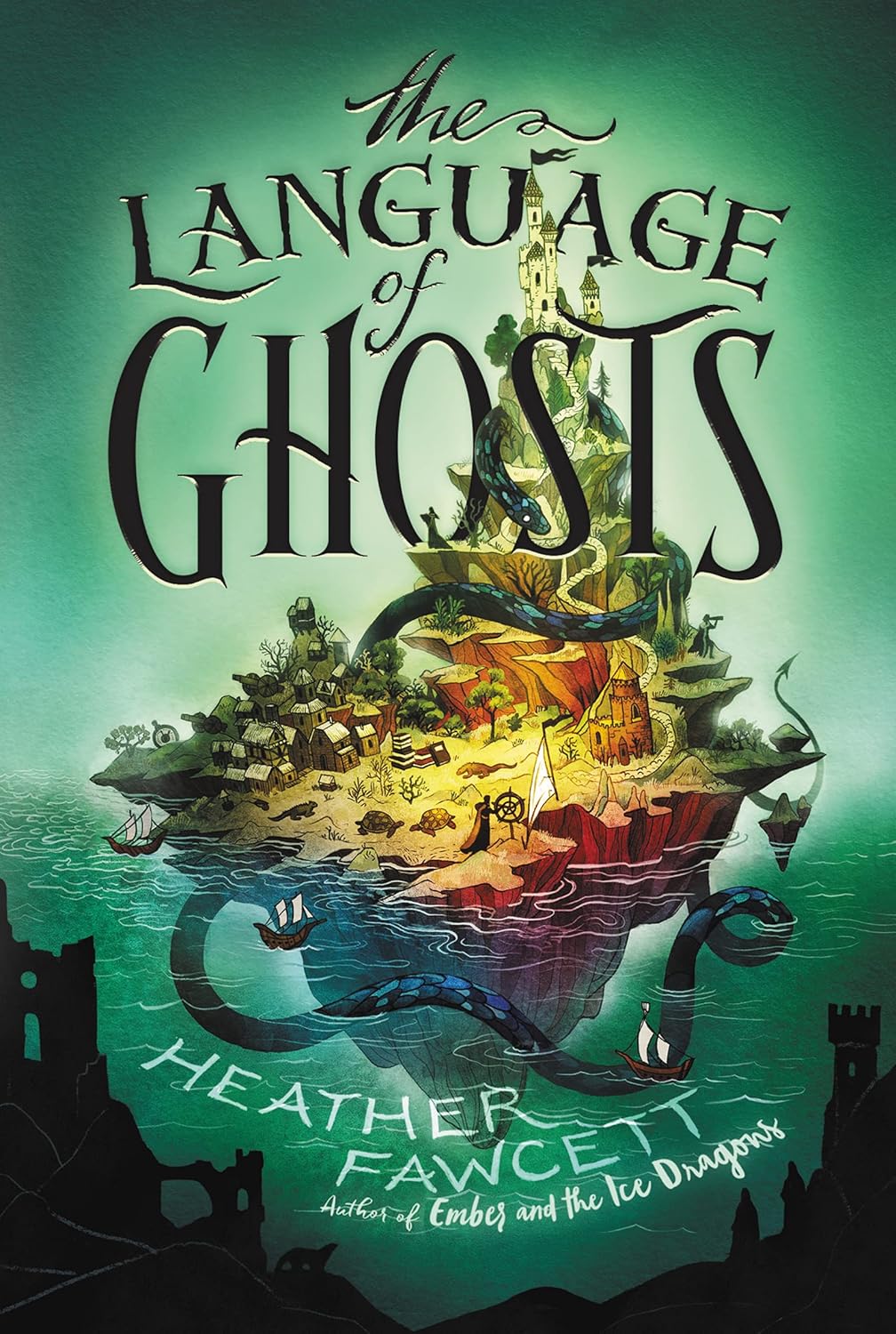
Can’t get enough Heather Fawcett; I’m powering through her books for younger readers. This is offered to ages 8-12. Autumn Malog is twelve years old when we meet her. She serves as a beastkeeper for the Inglenook School for young magicians, as the Malogs always have. It is a humble role, and she’s a little wistful for the magicians’ cloaks and privileges and learning, but you can’t change what you come from. And anyway, she’s far more concerned about her twin brother, Winter, who has been missing for nearly a year now, presumed dead by everyone but Autumn. She has always been able to feel Winter and his whereabouts; she can’t tell where he is now, but she is sure that he still is. “Nobody believed her, and she couldn’t really blame them. It sounded far-fetched even to her. So, rather than trying to convince anyone, she set about gathering evidence.” Autumn is no-nonsense like that. Better to get it done than to muck about. She is burdened with three useless older brothers, and the family is rounded out by Gran, even more no-nonsense than Autumn, unsentimental, but gifted in her care of the monsters that the family keeps safe and healthy for Inglenook.

Then Autumn encounters Cai Morrigan, one of Inglenook’s most famous students ever. Just twelve years old, he is prophesied to save their kingdom from the Hollow Dragon. But he is less impressive up close than his reputation would have it; and he shares with Autumn his great secret: he is terrified of dragons, to the point of fainting within dozens of yards of them. He asks for her help, and Autumn in turn asks him to help her find Winter. These two quests will bond the two young people, and offer bigger, more existential challenges than either anticipates.

I love this wholesome story about toughness, finding one’s tribe, and when to accept and when to push back against the limitations life proposes. It is also about friendship as well as familial love. And fanciful monsters, and plucky heroes, and the call of the forest. All good things, compellingly told. I will continue to live in Fawcett worlds as long as she creates them.


Rating: 7 slices of seabread.

Trouble the Saints by Alaya Dawn Johnson

Trouble the Saints is bewitching, mesmerizing. It begins mid-scene, a move that is always risky but can have big rewards: the writer asks the reader to wade through a little confusion in favor of action and immediacy, trusting her to wrangle the context clues and have patience with the pace at which details and secrets unfold. It’s well done here. There are cards, and dreams, and magic hands – saints’ hands – and a violent backstory for a protagonist who is however strongly committed to her own concept of justice. The reader finds out as she does how she’s been betrayed – and by the one she loves the most.

Phyllis, or Pea or Sweet Pea to those she is close to, is a paid assassin for a Russian mobster in early 1940s New York City. She is known as Victor’s knife, or Victor’s angel – because she only agrees to kill when the victim deserves to die. She is also a ‘high yellow’ woman of color passing for white in a pretty high-stakes setting. Her years-ago lover, Dev, is a Hindu man guided by karma and reincarnation; he could not abide Pea’s work. His current partner is also one of Pea’s dearest friends, the singer/dancer/entertainment manager Tamara, who is Black enough to suffer the full weight of prejudice and discrimination when Pea can sometimes skirt it. So: violence, organized crime, race and racism and colorism, oh and Hitler’s on the rise, and also Pea’s immaculate skill with her knives is owing to her saints’ hands, which manifest in different ways for different individuals. Dev can sense threats with his. Tamara doesn’t have the hands, but she is an oracle: with her great-aunt’s cards she can read fortunes, or the future, or both – the rules are revealed slowly, to us as well as to these characters. There are others, with different backgrounds, skin tones, and degrees of magic or understanding. Danger and hauntings are everywhere, but there is also romance and the kind of connection that transcends that label.

Trouble the Saints is an astonishing book that keeps surprising, not least with its changes in perspective. These subjects range widely and never feel overambitious for the remarkable Alaya Dawn Johnson, who imbues even the gruesome with poetry. She’s a new name to me but one I’ll be looking for. It took me a day or two to recover, and I’m still thinking about love, friendship, and what we carry on with us. Whew.


Rating: 8 letters.

Maximum Shelf author interview: Victoria Redel

Following Friday’s review of I Am You, here’s Victoria Redel: Our Obsessions Reveal Themselves.


Victoria Redel is the author of Paradise and three other books of poetry; three novels, including Before Everything; and two story collections. She has received fellowships from the Guggenheim Foundation, the National Endowment for the Arts, and the Fine Arts Work Center. She is a professor in the Creative Writing programs at Sarah Lawrence College and lives in New York City. I Am You (SJP Lit/Zando, September 30, 2025) is an expansive novel about two 17th-century Dutch women painters and the hardships and joys they experience together.

These characters are based in history, but upon scarce information. How did you deal with such a shortage of fact?

Victoria Redel
(photo: George Rings)

It is great to have a shortage of facts because it provides freedom for invention. I encountered Maria Oosterwijck and my first whiff of a novel reading Russell Shorto’s Amsterdam, where he says little is known about the painter Maria Van Oosterwijck. I was curious and began to research, and what he’d written turned out to be true. I believe I’ve learned all that’s known about her–maybe there’s untranslated Dutch sources–but, mostly, the same scant information was repeated everywhere: that Maria had not been allowed in the Guild because she was a woman; that she’d had a prominent reputation and a prosperous life as a painter despite that; that she trained the family servant, Gerta, to be her paint-maker and assistant. They lived together for a time, though they were not together at their deaths. This posed the question of why? What transpired between them? These seemed like interesting questions for a novel.

I also gave myself the freedom to challenge the received facts. For example, because of the nature of her paintings, it’s assumed that Maria was highly religious. I’ve imagined her spiritual choices differently. I also did a ton of research about life in the 17th century. It’s an essential moment in Dutch history and much is written about trade and everyday life. When the novel expanded to include England, I needed to learn about the English court.

One pleasure in writing a novel has always been diving into research. But the trick is to learn and learn and then not exactly try to forget it all, but, hopefully, create a seamless world, not so jammed with details that you feel the writer bragging, “look what I know.” That’s the hope: that the world is effortlessly stitched on every page. I want the world I shape to feel inevitable.

Do you have a background in the visual arts, or paint-making?

Yes, I was a visual studies major in college. In many ways this book has been gestating for 20 years, when I walked into a paint and pigment store on the Lower East Side, saw shelves stocked with jars of pigment. I wanted to know about and use every one of those brilliant colors! I read about the very storied global history of paint and pigment with the idea of writing a novel, but I couldn’t find the story.

Then, a few years ago I had the opportunity to spend a couple of months living in Amsterdam, and it occurred to me that I might find a clue for that long-abandoned paint book. Every day, I went to the astonishingly beautiful art library in the Rijksmuseum to finish another book. But also to study the Dutch Golden Age. Then I’d leave the library to roam the canal streets. It was wandering through Amsterdam that I began imagining Maria and Gerta.

You excel at sensory writing: food, painting, color, sex.

Thank you for saying that. I say to my writing students, you have to love the thinginess of the world. Witness, observation, that’s at the core of my job on the page. If I want you, the reader, to engage with characters and a world of my making, my task is to render a believable and sensual world. In 17th-century Amsterdam, smells and tastes were right in your face, for good and bad. There were fewer opportunities to be discreet about what you did with garbage. You threw it in the canal! You threw bodily waste in the canal. Those same canals were the lifeblood of the city. My job as a writer dovetails with Gerta, my narrator, who moves from a profound physical knowledge–caring for animals, for a house, making food–and, over the course of the novel, extends her range from house servant to studio assistant, to painter, and lover. Paint-making, botany, lovemaking are beautiful and messy. Her awareness expands. She has an artist’s awakening. I want the reader to accompany her on that journey.

Gerta and Maria’s story offers commentary on power dynamics, especially gender and class, in society and in interpersonal relationships. Was that by design or a natural feature of their lives?

It’s what I learned through writing the book. There was an initial glimmer of power dynamics, understanding that Maria had a maid and assistant. And I right away knew it was Gerta who must tell their story. I needed to learn what Gerta needed to learn. As the story of what happens to them and between them unfolded, I saw that both interpersonal and societal power became more layered. What was at stake for each person? Their situation, their story complicates as it unfolds. What were their essential questions? I had to discover how they would each respond. I knew none of this when I started the book. I know very little when I begin. Which I think is good. Otherwise, I’d want to protect them from their choices and actions. The surprise and mystery of my characters’ choices is the hardest and greatest fun of the whole enterprise.

Where does this novel fit in your larger body of work? What was different this time?

I started as a poet. My relationship to language as a poet is, I’d like to believe, present inside all the fiction. My prior novels take place in loosely contemporary periods–though I’d argue every novel is a historical novel–and I Am You takes a leap back in time. If one of the goals in writing fiction is to enlarge and engage the empathic imagination, to let oneself enter into what it is to be another human, here I had the opportunity to consider people in another historical moment with all that might entail. Certainly, there’s much that reverberates in a contemporary way, but my task was to honor my characters, the choices and limitations of their present-day lives, and not impose current ideas and values on them. I didn’t think about overlaps while I was writing, but perhaps obsessive love, devotion, autonomy, and secrecy are themes that ribbon through all my work. But as I say to my writing students, we don’t choose our obsessions; for better or worse, they reveal themselves to us.


This interview originally ran on June 10, 2025 as a Shelf Awareness special issue. To subscribe, click here, and you’ll receive two issues per week of book reviews and other bookish fun.

Maximum Shelf: I Am You by Victoria Redel

Maximum Shelf is the weekly Shelf Awareness feature focusing on an upcoming title we love and believe will be a great handselling opportunity for booksellers everywhere. The features are written by our editors and reviewers and the publisher has helped support the issue.

This review was published by Shelf Awareness on June 10, 2025.


Victoria Redel (Before Everything; The Border of Truth) presents a bold, poignant historical novel about art, love, power, and authorship with I Am You. In the 17th-century Dutch Golden Age of painting, two women with greatly contrasting social and economic status achieve enormous closeness. One is a successful still life painter, the other her maid and assistant. Through their shared story, Redel finds room to muse on art and observation, the wonders of paints and pigments, social strata, interpersonal relationships and power dynamics, gender expressions, and much more. I Am You is no treatise; it is firstly a story of human relationships. But like all great stories, it allows for reflections beyond its literal subjects.

The novel opens in the town of Voorburg in 1653. A child named Gerta is put out to work by her family. Because the household where she is to live needs a boy, Gerta becomes Pieter in service to the wealthy Oosterwijcks. At age seven, Pieter is fascinated by the 14-year-old Maria Oosterwijck: “Her particular words. The varieties of her laughter. The concentration of her fingers as she skimmed or flicked the board with a paintbrush.” Pieter is a quiet child and a hardworking servant, gentle with the rabbits he cares for and butchers for the family meals. Maria, an aspiring painter, is permitted to study only still life, a form considered appropriate for “woman’s art.” She compulsively sketches and paints young Pieter at work: he is “the body most available” to a girl forbidden the study she craves. In his turn, and in his fascination, Pieter begins preparing inks for Maria’s use. He collects the materials–black walnut husks, alder cones, willow bark, oak galls, lichen, marigolds–and crafts them into inks and reed pens. In this way, Maria and Pieter grow up together, intertwined by art and separated by their stations in life. Then Maria, bound for Utrecht to continue her studies, peremptorily declares Pieter a girl once more, in order to to take her as her maid to the larger city.

In Utrecht and then Amsterdam and beyond, Maria and Gerta remain joined. Maria is an increasingly successful painter, commercially and socially, despite the significant impediment of being a woman. Gerta, serving as her maid, becomes progressively indispensable as a talented maker of paints and pigments. Eventually, she teaches herself to sketch and then to paint, becoming Maria’s studio assistant in more functions.

Sometimes Gerta still goes out as Pieter: “How could I erase all I’d known as a boy? Why would I? How much more useful to have known the world both male and female, to traverse brazenly with the rude mind of a boy or angle delicately with a girl’s careful polish.” Her gender-bending is a mode of social expediency, more than of self-identity: “Inside both costumes was me.” In this and other ways, I Am You comments on gender in society, which is only one of Gerta’s disadvantages, but Maria’s chief one. Gerta (or Pieter, as Maria will call her in private all their lives) narrates the novel from start to finish, providing a nuanced perspective on their world, with an evolving appreciation of her limits in it. Even as Gerta’s privileges in Maria’s household expand–she has a nicer bedroom, furnishings, and clothing than any maid should expect–she is reminded that she enjoys these advantages only by Maria’s whim.

Their relationship deepens until the two women become partners in every aspect of life, but Gerta remains subservient. Her devotion to Maria is total, so that even when Maria’s circumstances change and she finds herself ever more dependent on her maid, Gerta is glad to provide a broad range of support. But calamities arise, and there may come a time when the subordinate’s need for recognition, for identity, surfaces. Maria has had a painter’s eye for detail in the visual world from a young age, thanks to both talent and training, but it is Gerta who sees the changing nature of all. “Every day since childhood, hadn’t it been my daily job to make one thing into another? Nut into ink. Stone into viscous paint. The chicken I clucked to as I scattered melon scraps became the stew I spooned into bowls. Even myself, a constant transformation–girl child to boy, servant to budding girl, woman to man to woman, maid to painter to lover….” In the end, it is Gerta who will navigate the hardest choices for the two of them.

Redel excels at sensory and imagistic writing, particularly in the thrilling qualities of color, inks, paints, and pigments, and revelatory art. Her descriptions of the sights, smells, and sounds of daily life, food, and housekeeping are visceral. She writes expressively about sex, which in this novel can be both pleasure and communion, and also disturbing–as an abuse of power, and with questionable consent. The canals of Amsterdam, the butchering of dinner, and the disposal of bodily wastes alongside tender caresses and vivid achievements on the canvas: Redel offers compelling descriptions of both splendor and pain.

I Am You is a novel that deals with heavy themes and tough choices. Gerta’s sensitive, incisive perspective often reveals sad and distressing events, as well as the transcendent revelations of creative work. In considering art, love, gender, and class, her story confronts injustice and tragedy as well as beauty. The result is sensual, thought-provoking, and unforgettable.


Rating: 7 rabbits.

Come back Monday for my interview with Redel.

rerun: Gone to the Woods: Surviving a Lost Childhood by Gary Paulsen

I still think about this book and should find time for a reread. In case you missed it, please check on Gary Paulsen and his wonders (and traumas).

I had not thought of Gary Paulsen in years, until I saw the Shelf Awareness review of this new book. (Hat tip to my colleague Jen Forbus for that review.) Paulsen might have been the first author I really fixated on; I remember setting out to own all his books, and while I didn’t get very far (maybe six or eight of them), I’m pretty sure I wrote “Julie’s Gary Paulsen library” or some such inside the cover of each one, and had them set up on their own little shelf. Early signs of something, there. My favorite was Hatchet, of course, and its sequel; and I vividly remember a scene from the beginning of another book where the narrator watches a… chipmunk? eating another creature, blood down its front… what book was that?

Anyway – when I saw that he’s returned with a memoir of his own childhood, I was sold. And let me tell you. This book had me entranced from the opening lines. I wept.

Gone to the Woods has an innocence and a simplicity built into its writing style and the value system, I think, of its narrator. This makes it accessible to younger readers, but not at all to them alone. I think this is a memoir for everyone. Paulsen tells his story in the third person, calling his protagonist only ‘the boy,’ although the name ‘Gary’ is used once or twice by other characters. This helps to give the boy an elemental quality, like he’s sort of an archetypal boy, although his story is very specific. When the book opens, he is five years old, living in Chicago with his mother in 1944. She has a factory job, and coming from a small farm in northern Minnesota, is “not even remotely prepared to resist the temptations of the big city.” She lives in the bars and does not parent her small son, who she’s trained to perform for the men who try to win her favor. Grandmother hears of this lifestyle and is “critical, then concerned, and finally… past horrified and well into scandalized.” Her solution colors the boy’s method of problem-solving for life: “If it doesn’t work Here, go over There.”

The first adventure of the book, then, is the five-year-old boy’s solo journey by train from Chicago to International Falls, Minnesota. This takes several days and involves a train absolutely jam-packed with severely injured soldiers, smelling of and oozing pain and death, so that the boy is physically ill from it all – because didn’t I say, his father, who he’s never met, is a soldier off in the war. The boy becomes stuck in a train toilet, among other things, and observes out the train window the woods that will become his sanctuary. By the time he arrives at his aunt and uncle’s farm he is wrung out with exhaustion, trauma, and confusion. But the farm will be a perfect place for him, the first place he feels he belongs, is valued, is taught. He’s given his own room and bed. It’s lovely. Then it’s taken away from him.

I’ll stop summarizing here. The boy’s upbringing is one trauma after another, including a few years on the streets of American-occupied Manila, and a continuing absence of parental concern. I appreciate that the narrator is slow to judge his parents, and I think it would have been easy (narratively speaking) to be ugly about the mother’s drinking and many boyfriends, for example, but neither the young boy nor the adult man who writes these lines takes that easy road. (At least until the teenager’s perspective, at which point he thinks of both parents as vipers. But this is about the damage they do to him, rather than some puritanical judgment of mom’s moral choices.) He is an unjudgmental creature in general. Paulsen is wonderfully good at the innocent child’s perspective, elements of which are present in the teenager too.

Trauma after trauma, but with a few bright points, like the aunt and uncle in the Minnesota woods, and a saintly librarian when he is thirteen years old who makes him a gift of notebook and pencil, for whom this book might be considered a gift in return. And the woods and rivers and streams, which are always a bright point. From age five, the boy learns that the woods will allow him to take care of himself, even when he lives in a city again, keeping to the alleys and nights to avoid bullies, and escaping to the stream where he can fish for food or shoot squirrels and rabbits when his parents fail to provide for him. Even in Manila, a city of a certain sort of trauma (truly, the violence and death this child witnesses by his sixth birthday is unfathomable), he finds beauty and human kindness.

At times the events were hard for me to take in, and I wondered if younger readers were really the right audience for this. But on reflection, I think Paulsen offers just enough. I think children might take away what they need from this book – I’m no proponent of censoring life’s pains from kids – and it’s the adult mind and perspective that makes it even harder to read, if that makes sense.

The story is harrowing but also lovely, always riveting, and an important testimonial from a generation that we will eventually lose access to. It is excruciatingly beautiful in how it’s told. The immediacy of traveling with the boy is heart-rending and direct. I can’t imagine how this book could be improved upon.


Rating: 10 willow branches.

The Grace of Wild Things by Heather Fawcett

Another hit by Fawcett; I’ve just checked to be sure that *all* of her books are either here or on their way to me.

The Grace of Wild Things is based on Anne of Green Gables, loosely enough that all of its parts move freely, but with enough connection to be recognizable if you know the original. Of course, no knowledge of the earlier classic is required here, and I think Fawcett’s telling will be more accessible to modern young readers, and possibly younger ones. As much as I love Montgomery’s original, I suspect her writing style would be a little harder for my favorite rising eighth grader to take in. This book is absolutely headed to her bookshelf next.

We meet twelve-year-old Grace as she gazes out of the dark woods at the witch’s cottage. Accompanied by her crow friend, Windweaver, she has made a remarkable overland journey to get here, despite hearing about the witch’s evils (including cooking children in her oven and eating them, à la “Hansel and Gretel”). Grace has spent her life at an orphanage featuring no great abuse but a pattern of rejection, loneliness, friendlessness, and a lack of appreciation for her unique qualities, which include talking too much, a love of poetry (shared by Windweaver), an excess of imagination, and oh yes, magic. She is here to apprentice herself to the witch and try to find a home and a life where she can be accepted for who she is.

The first day’s cycle is rough: the witch pretends to welcome her, throws her in the oven and tries to roast her, then, thwarted, rejects her once again: “tomorrow you will go back to that orphanage, if I have to drag you there by your hair.” Grace decides she’d rather be eaten. And she really did love the witch’s cottage, and the perfect little bedroom there that she’d hoped to call her own. But in a combination of cleverness, determination, and dumb luck – or is it magic? – she meets a fairy and saves his life, and impresses the witch with a gift sufficiently that the witch agrees to let Grace attempt a challenge. If Grace can cast every spell in the witch’s first grimoire, from her own childhood, before a venerable cherry tree blooms the next spring, she will become the witch’s apprentice. If she fails, she will give up her magic to the witch. This also means losing Windweaver, her only friend in the world, who the witch says is Grace’s familiar: she never realized.

What else is there to do? Grace agrees. But there are 100 1/2 spells in the grimoire – the last one is incomplete – and they appear increasingly impossible to her untrained eye. (The witch refuses to help.) Luckily, our plucky protagonist quickly makes a friend, Sareena, a clever, no-nonsense neighbor girl who pledges lifelong loyalty. The fairy boy she’d saved, Rum, is bound to come at Grace’s command for three years, the deal they’d cut; but he also insulted her and she desires never to speak to him again. (Some readers will recognize the reworked Diana and Gilbert.) As the always-game Sareena and the increasingly devoted Rum dedicate themselves to helping Grace gather the impossible ingredients for the witch’s spells (a piece of the moon, a pitcher of midnight, three left footprints of a deer, a day lasting twenty-five hours), their little group grows, until Grace is overwhelmed by kindness and friendship. Even the prickly old witch softens slightly, and more disturbingly, sickens. When an outside force threatens their idyllic cottage and garden in what locals have long known to be the witch’s woods, Grace may have even bigger problems than the grimoire. But her powers are growing, too.

Anne-with-an-e is definitely alive and well here, with the imagination, the verbosity, the flair for drama, the questions, the enthusiasm and the emotions. “I never thought witches would be so leaky,” Sareena says of Grace’s disconcerting habit of expressing feelings through tears. We’ve identified Diana and Gilbert; the raspberry cordial episode is reworked, more magically, and that of saving Sareena’s beloved younger sister. The witch makes a fine Marilla, grumpy but secretly charmed by her unwanted orphan girl; she even has a brother, although he’s a bit less corporeal than Matthew was. Prince Edward Island remains the setting, and I am inclined to trust (but did not fact-check) that the many botanical details and spell ingredients are appropriate.

But Grace is also a lovely invention. She struggles with wanting to do good in the world while embracing her true identity and powers, which she takes for granted must be associated with evil. She feels gratitude and loyalty to the witch who gave her a home, even though she can see the witch’s wrongdoings (although we also benefit from learning more about her long and adventurous life). She learns the big lessons. “…the witch had said in one of her few helpful moments that many spells had more than one use. Since then, Grace had come to think of magic like poetry–a poem, after all, could mean more than one thing, or mean different things to different people.” Upon achieving a spell for wisdom: “Being wise, apparently, was not knowing a lot of things, but knowing all the things you didn’t know. It was dreadful. She felt very sorry for all the wise people of the world.” And of course, she has every bit as much gumption and potential as Anne Shirley ever did.

I am devoted to this author. Loved every page, can’t get enough.


Rating: 9 buckets of ice cream.

We Lie Here by Rachel Howzell Hall

This tense, suspenseful thriller slipped easily along with the momentum of a well-designed plot, for the most part. There were a few hiccups in the late-middle for this reader, but the finish got me, and this author deserves a hat tip for the big reveal which in hindsight feels almost obvious, but I never did see it coming.

We meet Yara Marie Gibson when she’s on her way back to Palmdale from Los Angeles. L.A. holds her moderately successful (it’s still early) career as a writer for television, her awesome boyfriend Shane, and her young-adult life; Palmdale, in the Antelope Valley in northern Los Angeles County, is home, and it’s trying to kill her. The novel’s first line is “The city of Palmdale takes my breath away,” and she means it literally. Yara suffers from severe asthma and allergies, worsened by anxiety, which is in turn worsened by her family in general and her mother in particular, plus the fact that her mother and sister smoke cigarettes every waking moment, and indoors. Yara is highly motivated by the party she’s throwing for her parents’ twentieth wedding anniversary, a very elaborate affair for which she’s footing the bill; nobody even pretends that her younger sister Dominique is not her mother’s favorite, but Yara is driven to give her parents this gift. Her father seems loving, but Barbara Gibson (who goes by a multitude of nicknames in Yara’s first-person narrative) is the sort of figure who sucks all the oxygen out of a room – this works metaphorically as well as in the sense that Yara, again, cannot breathe here…

These 400 pages take place over just a week or so, as Yara prepares for the party while choking to death in her childhood bedroom, and a series of strange events and characters arise: mysterious long-lost family members show up and disappear, threatening messages new and old come to light, bodies are found. There are numerous fights and shouty phone calls, and old secrets from before her parents’ marriage come to light. The Gibsons are a family with some messes and dysfunction–in other words, perfectly normal, if not perfectly healthy. They are also “the only Black family on the block,” and Yara is always aware of the impact of race on her life and safety. There are links to old Black Hollywood royalty, and racism both then and now.

A plot element that threw me for much of the book was Yara’s amateur sleuthing, which is accepted as natural by so many characters, including an old friend of hers who is a sheriff’s deputy. It didn’t quite follow for me that Yara’s job as a writer for a fictional TV crime show, and her blood relationship to a recently deceased woman (potentially a murder in which Yara would be a suspect), would qualify her to get the inside information she receives from such an official source; I expected a little more leave-it-to-the-professionals. This was a minor sticking point, but it lasted long enough for me (a hundred pages or more?) to impact my experience of the book. A lot of Yara’s personality, bless her heart, is her anxiety, forgetfulness, and breathing difficulties. And (highlight white text to reveal spoilers): at the discovery that her father was married before he married her mother, Yara’s reaction is more violent than I found likely. I mean, I guess she might have heard of this before, but the way she flips out felt outsized to me. I did pause and remind myself that we don’t all react to anything in the same way; and it’s clear that Yara’s parents’ marriage carries a lot of weight for her, thus this big party. Ah well. I coached myself through it.

As I said, in the middle portion of the book, there were some draggy bits – especially as I dealt with these small but persistent questions. But it does pick back up again! My experience of the novel’s opening pages was electric: Hall grabbed me with scene, dialog, sensory detail, and a strong sense of place, and anxiety about family is pretty universally relatable; it was a great start. And by the big crescendo and denouement (including a compelling epilogue), we were right back on track and on pace. It was an enjoyable fictional world to sink into, overall: escapism, suspense, momentum. Not perfect, but well worth the price of admission.


Rating: 6-and-a-half puffs on the inhaler.

The Wild Dark: Finding the Night Sky in the Age of Light by Craig Childs

A longtime nature writer directs his gaze upward with this travelogue and love song for the dark night sky.

Prolific nature writer Craig Childs (The Secret Knowledge of Water; Atlas of a Lost World) takes readers on a journey away from the light with The Wild Dark: Finding the Night Sky in the Age of Light. He’s in search of a clear view of the heavens, stars, constellations, planets, galaxies, and beyond–and all that they stand for–and offers a quest narrative with a circular structure, which starts and ends in that bastion of illumination, Las Vegas, Nev.

Childs teamed up with an old friend and fellow adventurer, Irvin Fox-Fernandez, and together the two men rode loaded off-road bicycles north out of the city, which his friend called “Bortle-hopping.” Bortle, Childs explains, “is a naked-eye scale for determining a night sky’s quality”; in this book, Childs describes moving from Las Vegas’s Bortle 9 to the joys and profundities of Bortle 1, “where only stellar light and backscatter from sunshine in space can be seen.” He chronicles this trip with lyricism, gentle humor, and an obvious passion for darkness preserved, for the human ability to consider something larger than ourselves: “Beaming overhead, they live their lives regardless of how we see them, and for all I’ve heard that stars don’t care, I disagree. I just don’t know what they care about.” As environmental causes go, this one entails an easy fix: just turn the lights off. Referring to mythology, biology, archeoastronomy, and more, Childs makes a strong argument.

Beautifully written, fervent, and lavish in imagery both light and dark, The Wild Dark is a moving call to action.


This review originally ran in the May 30, 2025 issue of Shelf Awareness for Readers. To subscribe, click here, and you’ll receive two issues per week of book reviews and other bookish news.


Rating: 6 ginger cookies.

The Usual Desire to Kill by Camilla Barnes

A quick-witted, quintessentially English domestic comedy drama set in an old manor in rural France explores the baggage-laden relationship between two sisters and their elderly parents.

As I sometimes do, today I’m just going to repost the review that sold me this book, written by one of my colleagues at Shelf Awareness (Pro edition, March 11, 2025). I’ve added a few of my own notes at the end.

Set in a dilapidated old French country manor, The Usual Desire to Kill by Camilla Barnes is a quietly dazzling, sharp-witted generational drama featuring the family of an aging couple from Oxford, England, long settled in rural France. As families go, this one has more than its fair share of quirky personalities, which makes for a delightful story. Narrating it all is their daughter Miranda, a theater actress in Paris whose visits home leave her utterly exasperated.

Barnes is a British-French stage writer with a flair for superb dialogue and bitingly clever insight into the baggage-laden relationship between almost-50 Miranda, her sister, Charlotte, and their Mum and Dad. The parents, spectacularly ill-matched, spend much of their time talking at cross purposes. Human relationships are tricky for Dad; he much prefers animals, so Miranda’s visits invariably involve serving as translator and umpire between her parents. Yet no matter the state of Mum’s bad hip or whether Dad has his hearing aids in, they are always up for a game of tennis and are united in their fondness for wine and pudding.

Meanwhile, the siblings must contend with the nagging rivalries that pursued them into adulthood and their parents’ “insanely irritating” idiosyncrasies. They are also determined to uncover a potentially scandalous incident concerning Dad’s flamboyant American friend Barbara. The cast is rounded out by the Miranda’s daughter, Alice, and various animals who play supporting roles in the daily life of Miranda’s parents. The erratically furnished family residence, La Forgerie, houses two llamas, ducks, chickens, and a pair of entitled cats who dine alongside their masters in theatrically grand formality every evening.

The novel’s structure marks an entertaining departure from convention. Sprinkled in between e-mails from Miranda to Charlotte venting about her trips to La Forgerie are scenes that take the form of a play and old letters Mum started writing when she was an undergraduate student at Oxford. Miranda’s mother is clearly the star of Barnes’s debut, an intelligent matriarch with thwarted ambitions who doesn’t let logic, reality, or her husband’s maddeningly circular philosophical arguments get in the way of her agenda. And once Mum’s guard is down with the help of post-surgery wooziness, her secrets come tumbling out, each revelation a missing piece of the puzzle that is Miranda and Charlotte’s mother.

Relishing this quintessentially English domestic comedy, readers peeking below the surface will be astonished by the complex generational and emotional undercurrents guiding Barnes’s memorable characters.

–Shahina Piyarali

The tone of the book is frequently very funny, in a snarky, frustrated way, but overall quite sad. The adult daughters, Miranda and Charlotte, long for better connection. Alice wonders what it would be like to have a bit more family. Mum (who is nameless??) strikes us on the page as quite unlikeable, but her youthful letters reveal to the reader what the rest of her family cannot see: she has had, oh, such disappointments. It makes her significantly more sympathetic, if not likeable, and gives the whole thing a strong streak of tragedy. Dad (who does have a name: Peter) is certainly exasperating, with his reliance on logic and philosophy and staunch refusal to do people, but I found him amusing, even accidentally charming; I guess I’m guilty, like Miranda, in Charlotte’s eyes, of taking his side… (from the book itself this time:)

He only did things that he could do very well, and then did them brilliantly. If he couldn’t do something well enough, he simply didn’t try to do it. Other people was one of those things.

Dad is indeed most comfortable with his animals (or battling brambles), and I thought the llamas (et al) were another pleasing note. So: overall I found this book often funny, certainly insightful, apt, and even brilliant – but with a strong thread of sadness. Such is life.

Very good.


Rating: 7 numbered eggs.

Mailman: My Wild Ride Delivering the Mail in Appalachia and Finally Finding Home by Stephen Starring Grant

Within the high highs and low lows of rural mail delivery, a laid-off white-collar worker builds new relationships with place, with his neighbors, and with himself.

In 2011, Stephen Starring Grant moved his wife and two daughters back to his hometown of Blacksburg, Va. In early 2020, Grant, the family’s primary wage earner, was laid off from his consulting job. He found himself unemployed at the start of the pandemic in a town that had limited employment options, and with a recent cancer diagnosis to boot. Unable to find anything in his field, he took a job as a rural-route carrier for the United States Postal Service. Mailman: My Wild Ride Delivering the Mail in Appalachia and Finally Finding Home offers his stories and reflections on a year spent in a position he’d never thought much about before.

Grant began with a bit of an ivory-tower complex, as he imagined his intellectual background overprepared him for the simple drudgery of mail delivery (which turned out to be untrue), but he ended with a profound respect for postal and other service workers, and balanced thoughts on class and background. These pages vary in tone, by turns hilarious and thoughtful. Grant describes religious experiences, being threatened at gunpoint, bonding with strangers over their deliveries and finessing their political differences. He discusses types of incompetence (a few months in, he “graduated to the consciously incompetent stage, lost in the burning wasteland of self-awareness that I was really not very good at delivering the mail”) and the intense discomfort involved with learning new things, with great effort and limited success, in adulthood. Musing on the origins and purpose of the USPS, he expresses a nuanced patriotism: “America is the greatest country in the world… America is a steroidal monster… Both versions of America are true.” And, he notes: “Our delivery vehicles were like democracy, the worst of all possible vehicles, except for the alternatives.”

Between indulging in fantasies of delivering the mail with Barack Obama at his side and performing neighborly services like basic car maintenance for favorite people along his route, Grant brought his kids for added help and dropped in on his parents for pancakes. Along the way, he informs the unschooled reader of the process that mail carriers undertake to sort, order, and “case” the mail for delivery, and the hazards: backbreaking labor, the ergonomic disaster of right-hand drive (especially in a left-hand-drive vehicle), extremes of heat and cold, and dog attacks. Via an adventure with unfamiliar blue-collar work, Grant discovered new values, new people, and a new relationship with home. Mailman is a classic memoiristic blend of whimsy, storytelling, and insight.


This review originally ran in the May 22, 2025 issue of Shelf Awareness for the Book Trade. To subscribe, click here.


Rating: 7 Slim Jims.