Who Is Maud Dixon? by Alexandra Andrews

This delightfully disquieting novel explores identity, deceit and extreme measures through two women’s shape-shifting lives.

Is it really possible to shed one’s history “as easily as a coat slips off the back of a chair” and walk away? And if so–what might one walk into? That’s the puzzle posed by the cunningly plotted Who Is Maud Dixon? by Alexandra Andrews.

Florence Darrow thinks of her past in Florida “as a gangrenous limb that needed to be severed for the greater good.” Now that she’s landed an editorial assistant position in New York City, she can begin remaking herself. However, she can’t quite make out the shape of the new version of herself she’s trying to form. “How did one go about building up someone new? She tried on moods and personalities like outfits.” Then the opportunity of a lifetime comes along: she is hired as personal assistant to Maud Dixon, pseudonym for the electrifying and mysterious author of the biggest bestseller in recent history. Florence becomes one of just two people to know Maud’s true identity. And she finally has a model to guide her own transformation into the bestselling author and confident self-made woman she knows she can be.

Florence sinks with pleasure into her new life: living in the carriage house behind Maud’s lovely old stone house in the country, enjoying Maud’s cooking and fine wines and opera. This, she thinks repeatedly, is where she belongs, this is the life she’d choose for herself. On Maud’s advice, Florence stops returning her mother’s increasingly petulant phone calls.

But who, really, is Maud Dixon? Florence knows her name, and the name of the Mississippi town she comes from. But much of her hero’s persona remains enigmatic: Maud is unpredictable, thorny, wise and (to the Florida ingenue) perfectly captivating. Florence can’t figure out the road map to get from here to there. (Maud says that “here and there are overrated.”) Florence is thrilled to travel with her to Morocco on a research trip for Maud’s long-awaited second novel, but in the new setting, what Florence doesn’t know about her boss quickly turns sinister. Florence may not be the only one with a past she’d like to shed.

Who Is Maud Dixon? is a wickedly fun study in deception, secrets, striving and longing. Andrews’s stylish, intricate debut novel showcases deft prose and expert use of tone and atmosphere: the cooing of pigeons “had the aggressively soothing tones of a nursery rhyme in a horror movie.” What means might one justify to grasp the life she really wants and (she’s tempted to believe) deserves? These memorable pages hold one possible answer.


This review originally ran in the February 26, 2021 issue of Shelf Awareness for the Book Trade. To subscribe, click here.


Rating: 8 clean white towels.

Rabbit Cake by Annie Hartnett

Thanks to blog reader Annie Long for the excellent recommendation.

This is a sad, sweet book with an accurately written first-person child protagonist struggling with loss and grief, and with a decidedly odd view of the world, possibly reflecting neurodivergence. (Someone at school calls her ‘retarded.’) If this sounds a lot like the mad originality of The Curious Incident of the Dog in the Night-Time, I thought so too. That earlier novel was so unprecedented it blew readers’ minds; and while this one has a lot in common with that one, I don’t think that makes it a bit unoriginal. It’s still a pretty wild (and wildly unusual) model; there’s plenty of room for more surprises in this area.

“On my tenth birthday, six months before she sleepwalked into the river, Mom burned the rabbit cake.” It was one of the wonderful things about her mother Eva that she made rabbit cakes for all occasions – believed in celebrating all the small events of life. Elvis is ten-and-a-half when her mother dies, and she has questions. For one thing, how could such a good swimmer have drowned? Her mother was a frequent if not constant sleepwalker, and “she was an excellent swimmer in her sleep.” Her mother was a gifted scientist. And besides, her mother’s psychic had always been very clear that Eva would die by suicide.

Elvis is clearly a young person who craves control, and so she sets out to take care of things around the house, because her father surely isn’t; he’s taken to wearing Eva’s lipstick and her bathrobe around the house, and mostly ignoring his daughters. Elvis’s fifteen-year-old sister Lizzie has moved on from beer drinking and breaking her best friend’s jaw (in three places) to a particularly self-destructive sort of sleepwalking (although no sleepswimming). Elvis dutifully sees the counselor at school once a week during recess, until she says something especially disturbing and gets upgraded to daily sessions. Ms. Bernstein instructs her that the grieving process generally takes eighteen months, and so dutiful Elvis marks her chart counting down the days until she will not grieve her mother any more. She also works on finishing her mother’s massive book (working title: The Sleep Habits of Animals and What They Tell Us about Our Own Slumber). Elvis knows a lot about animals – enough to annoy everyone around her, until she gets a volunteer posting at the zoo. She comes across an entry in The Reference Guide to Porcupine Anatomy and Behavior in the zoo’s library that mistakenly relates the echidna to the porcupine when it is closer to the platypus. She makes a note to write to the publisher.

You get the picture: this is a child precocious in some areas and a bit hopeless in others. She indulges in magical thinking, but what child doesn’t? and for that matter, who in the throes of grief? Despite Elvis’s story being completely heartbreaking at every turn (warning, friends: this family also has an old dog. Will it never cease? Don’t ask what happens to the giraffe), it’s also frequently hilarious. There is a strong current of absurdism running through it. Lizzie the sleepwalker and breaker of jaws is institutionalized, and returns home with a pathological liar who the distant and negligent father allows to move in. Lizzie decides what she needs is to set the Guinness World Record for most number of rabbit cakes baked. Most, but not all of them, will need to be decorated. Elvis is driven mad by the delicious smell of baking cakes – which she associates with happy memories of their mother – but she is not allowed to eat any of the cakes, which Lizzie must preserve for her world record. I won’t even tell you about the troubles Elvis gets into at the zoo. Or what she discovers about her mother’s sex life.

Delightful, absurdist, ridiculous, heartbreaking; laugh-out-loud funny in the most morbid ways, if you’re into that sort of thing. (Case in point: the reason Elvis’s school counseling gets upped to daily sessions.) I was frequently quite angry at the adults in this child’s life who consistently, near-criminally fail her; I usually keep my cool with fictional characters better than this. In other words, it’s a deeply involving story, with some very wise points to make about grief in the end. That ending is surprisingly upbeat – or maybe it’s not surprising at all.

I’ll be thinking about Elvis for a long time, and about this singular, weird, troubled, endearing little family. I’m remembering Have You Seen Marie?, another gorgeous meditation on grief in fictional form. Cisneros said about that book that she did not conceive of it as being for children. And even though Rabbit Cake‘s star is a child, I don’t think this is a children’s or YA book, except to the extent that any book is right for the reader who’s ready for it. (Tin House, who does not publish children’s books, has marketed it as simply fiction. Although these labels may be worth less than we think they are.) It’s quite a deep-thinking novel, with nuances to satisfy readers of all levels of maturity, especially those who may need to laugh and cry in the same sitting.


Rating: 9 librarians aptly named Reasoner.

The Sentinel by Lee Child and Andrew Child

Here we have it: the first book of Lee Child’s transition to his brother’s eventual takeover of the Reacher series. The Sentinel credits Lee Child and Andrew Child together, as will the next (Better Off Dead is due later this year). I have had my doubts, but I really enjoyed this installment. Hooray!

A little like Blue Moon, this plot has Reacher step into a scene in media res, where he sees something bad about to happen. (This is not an uncommon Reacher device, actually; I’m thinking of Gone Tomorrow too.) In a little town in Tennessee, the streetlight is out and the police phones are down. Something’s a little odd here, and why does everybody seem so angry at one rather nerdy man in particular?

There is nothing new about the broad strokes: Reacher takes on the PI role even though nobody really wants him to, let alone the local cops, whose job he can do better than they can. The details are rather fascinating, though. I’m not sure it always works for me when Child tries to be uber-timely (here, the Russians might be trying to hack an American election, which is a subject I’d like a break from in my fiction, I think). But that’s a personal call, maybe. I do like when Reacher finds himself a team of local amateurs, or quasi-amateurs, as he did in Blue Moon, to my great enjoyment then and again here. And I think I appreciated that we took a bit of a break from Reacher’s amorous exploits.

Instead, Reacher ends up the knight in shining armor for a dweeby, dreamy (male) IT manager, and that relationship struck me as sweet and a bit of a departure for our hero. Knight-in-shining-armor is a bit of a theme here, actually, because the opening Reacher scenes involve both his love for quality live music (and especially blues), and his tendency to stick up for the little guy. I liked that the action didn’t open with Reacher, but jumped around among a few characters whose relationship is not immediately clear. I found a few lines of dialog here and there a bit out of character – and I’m sorry I didn’t mark those to share with you, but I read this book in a day, staying up too late to finish it, which doesn’t happen much these days (because it shouldn’t; teaching has me busy and exhausted). Being a smidge out of character may be a result of bringing in a new coauthor (who, we assume, knows the Reacher oeuvre as well as anybody, but still). However, my need to finish this book in a single day is an excellent commentary. It’s been a while.

I’m shying away from plot here, as I sometimes do with Reacher, to say that this is pretty straight-on Reacher with just a few twists, already mentioned, which worked well for me. If this is the new Andrew Child style, I am sorry I doubted, and I’m looking forward to more.


Rating: 8 cables.

movie: Escher: Journey Into Infinity (2018)

I had left Italy. I lost the Italian landscape and architecture and something else had to take its place. This stimulated the formation of inner images. I started working with passion when I discovered that I had things of my own that had to come out, that I could express something others don’t have.

What a beautiful, completely absorbing and eventually transcendent film. For starters, something like Fantastic Fungi, there is such a rich body of work in the weird world of M.C. Escher that any proper documentary should turn out to be visually stunning, and this one does the job properly. I loved the animations of his prints, which it turns out he’d imagined happening. (There was a moment when a tessellated lizard clicked, came to life, and clambered out of its print. Hops lost his shit.) What I didn’t see coming was such a fascinating life – I’d known nothing of Escher the man, I guess, and in fact hadn’t realized how recently he lived and worked, and therefore how World War II and the rise of fascism had affected his life. I had not expected Graham Nash (of Crosby, Stills and Nash) to be onscreen early, telling the amusing story of Escher’s claiming he was a mathematician and not an artist at all. The Escher that emerges here is grumpy and flummoxed by the hippies’ interest in his work, and their annoying tendency to colorize his black-and-whites with such bright hues. His eldest son is there too, describing (chillingly) how the family chose to leave Italy 1935 after the son (as a small child) showed a disturbing interest in playing the baby fascist. This whole story was fascinating, whimsical, frequently funny and also pathos-ridden.

I appreciated Escher the romantic (in his relationship with his wife), the curmudgeon, and the tortured artist:

What I can say is that no print ever succeeds. They all fail. Simply because I always pursue a vision that cannot be realized… my prints, none of which were every made with the primary aim of making something beautiful, simply cause me headaches… that is the reason that I never feel fully at home among my colleagues. They pursue beauty first and foremost. Perhaps I only pursue wonder.

And this film was simply mind-blowing. The music, the diegetic sound, the still photography, the video of landscapes and architectures referred to in Escher’s work, the animations from his work, the delightfully performed narration (“told in his own words from hundreds of letters, diaries and notes”) by Stephen Fry – it all came together for a very special experience. I’m so glad my parents clued me in. (This has inspired purchase of an Escher art book, so stay tuned for more reviews. Always more.) Definitely recommended.


Rating: 9 steps.

Forget Me Not by Alexandra Oliva

A woman with a strange past struggles with a near-future reality in this riveting, moving masterpiece of both character and plot.

In Forget Me Not, Alexandra Oliva (The Last One) introduces a strong, damaged protagonist in a near-future world very similar to our own. Captivating characters carry this absorbing cautionary tale.

It’s been six years since the pandemic. Everyone wears a Sheath around their forearm that links them into social networks, maps, business reviews and details about the people they pass on the street. But Linda didn’t grow up in this world: she was 12 years old when she climbed over the walls that circumscribed the only world she’d ever known. Twelve years old when she was thrust into a never-ending spotlight, because of where she’s come from and who she is.

Now, as an adult, she lives alone in an apartment in Seattle, terrified to step outside, to make eye contact, to interact. “People bemoan the inhumanity of her childhood, but the outside world is so much worse.” That childhood remains an enigma for much of the book, but Linda remembers running barefoot and relying on herself, a life that seems more natural and straightforward than the one she knows now. “She was limber and determined and not once in her life had someone ever asked her, Are you okay? She knew no other way but to keep going.”

Then an unusual woman moves in down the hall. Anvi seems open, forthright; Linda knows better than to trust anyone, but Anvi captivates her. She’s persistent. And she introduces Linda to a virtual reality gaming world where she feels, perhaps paradoxically, a bit more real. Reality itself begins to look less certain: “Could her whole existence simply be someone else’s side quest? She can feel the urgency with which she wants some version of this to be true. To wipe herself of responsibility–to claim it wasn’t fear but an algorithm that made her run….” When Linda’s past resurfaces, Anvi accompanies her back to the place where she grew up, to search for answers she may regret finding. Linda’s shaky understanding of her very existence is thrown into question.

Forget Me Not explores humans’ relationships with the natural world, with technology and with each other. It is far from polemic, however, with affecting characters, a real sense of urgency for their various plights and a thriller’s racing plot. Linda is deeply troubled and deeply sympathetic; Anvi is a dear, quirky young woman with insecurities of her own. This is a poignant novel of isolation, terror, misperceptions and, ultimately, empathy.


This review originally ran in the February 19, 2021 issue of Shelf Awareness for the Book Trade. To subscribe, click here.


Rating: 8 buzzes of the Sheath.

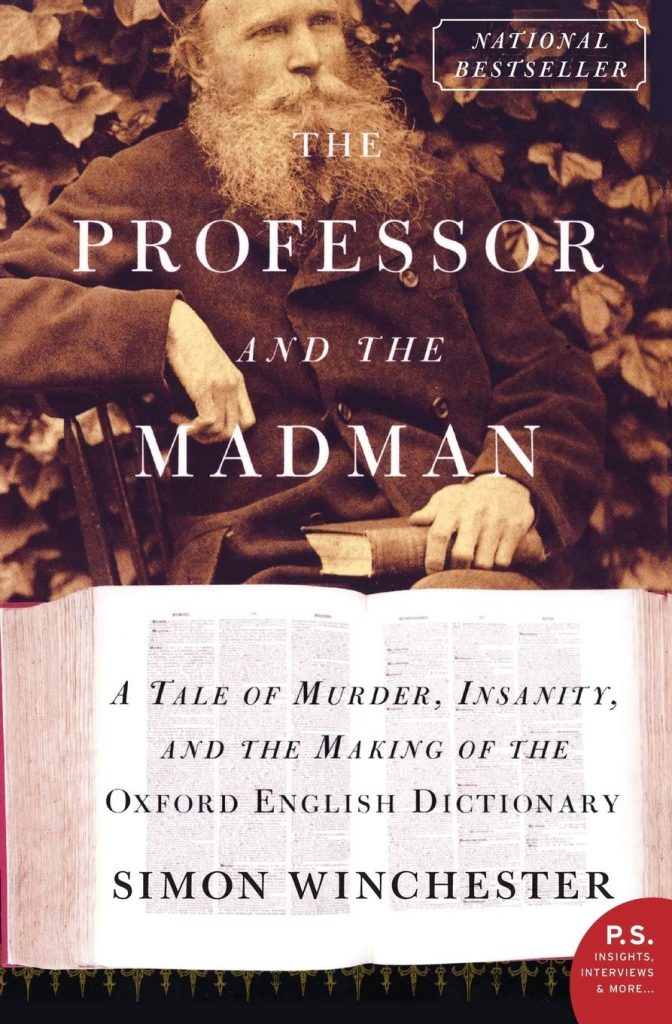
The Professor and the Madman: A Tale of Murder, Insanity, and the Making of the Oxford English Dictionary by Simon Winchester

Liz sent me a clipping from The New York Times Book Review recommending this book, which turned out to be a happy synchronicity in two ways: one, I had had the book on my shelves for years, still bearing a sticker from the library where I worked when I first met Liz. Two, I stuck that clipping, that slip of paper, in the book as a reminder, and the book turns out to be in some ways about little slips of paper, which I had learned by the time I found the clipping in its pages again. Good work as ever, Liz.

Simon Winchester’s The Professor and the Madman is a fine example of creative nonfiction writing of the less-personal kind: not memoir, but history; but history told with a novelist’s eye. This Tale of Murder, Insanity, and the Making of the Oxford English Dictionary is for word-fans, of course – that OED mention has pulled them in – but also for readers who enjoy an absorbing historical narrative.

The Professor, here, is the Scottish Dr. James Murray, teacher and philologist who was eventually recruited to take on a formidable role: the editorship of a project of such enormity that most thought it could not be done. Here, Winchester backs up to give us a quick history of lexicography (Samuel Johnson figures centrally). The new project attempted something unprecedented: to define every word in the English language, not only those deemed “difficult” or somehow deserving of promotion; to describe rather than prescribe how they were used; and to record the history of each word, using quotations from written material, including the identification of each word’s first entry in written history. The philologists and word-nerds who undertook this goal repeatedly declared that they thought it would take a handful of volumes or a handful of years; it would take more than seventy years to publish its first “complete” version in twelve volumes, which of course needed immediate supplementing and updating. Dr. Murray was the editor and boss of this project, which would become the OED, in one of its earliest incarnations (the one that stuck).

That’s the title’s Professor. And then there was Dr. William Chester Minor, an American who spent his childhood in Ceylon with missionary parents, then trained as a medical doctor at Yale, served as a surgeon for the Union army in the American Civil War, and was later institutionalized for his delusions. Enjoying a little freedom in London in 1872, those delusions convinced him that he was pursuing one of the bad men who abducted and molested him at night, which is how he came to shoot and kill an impoverished local brewery worked named George Merrett, who left behind a pregnant wife and seven small children. For this, Minor would be “detained in safe custody… until Her Majesty’s Pleasure be known.” He spent nearly the next fifty years of his life in an asylum in Broadmoor, just outside of London, “a certified criminal lunatic.”

Winchester offers that Minor’s life was saved, in a sense, when he came across an advertisement from Murray, seeking volunteers to read… well, everything, and search out the quotations needed to write what would become the Oxford English Dictionary. Minor happily had some spending money (his family was well-off, and he drew a pension from his military service), and the good graces of the asylum leadership at Broadmoor let him build a prodigious library of rare and old books. Aside from these he had nothing but time, and created his own system of indexing that changed the way he was able to serve Murray and the OED. Over decades, he would serve as one of the most prolific volunteer contributors to the project, sending in tens of thousands of little slips of paper with words and quoted texts carefully penned. He and Murray would build a friendship, and together they built a book. It is Winchester’s conclusion that while Merrett’s murder was tragic, and Minor’s life another tragedy, they were both necessary to contribute to something of a miracle in lexicography.

Liz’s clipping from the NYTBR (by Charlie Savage) calls The Professor and the Madman a “mashup of erudition and melodrama,” and I think that is a fine description. There is plenty of hearty history and lexicographic detail here, which I loved. There is also a definitely flair for the dramatic, and there were a few points where I didn’t love Winchester’s editorial tone. (A laugh at the expense of one dictionary reader and then “one of the women readers” – why that detail? – or a snobbish note about a slum. He could be a bit creepy about the naked girls on the Ceylon beaches. I didn’t care for the way he characterizes the stepmother as “so often the cause of problems for male children.”) There’s no question that this is a novelistic history, in the spirit of Erik Larson or Jon Krakauer – who were among my first experiences with creative nonfiction. By novelistic I mean that the storytelling is clearly meant to be entertaining: an eye for the colorful detail, a leaning into suspense, even a bit of a red herring here or there. It’s great fun. When Samuel Johnson is “damned” as “a wretched etymologist,” I cackled.

Chapters open with dictionary definitions of a word that will figure in that chapter’s narrative. This was a fun way to keep the OED in our sights and a little history in our perspective. There were a number of words and phrases in the text that I had to go look up, too: manqué, astrakhan, vade mecum, pudicity, rebatos, Rhinegrave, perukes, nostalgie de la boue, tocsin, rebarbative, swingeing… and you know I always enjoy that part of my reading, too. (Haven’t convinced my students yet that it’s fun to learn new words, but I’m working on it.) So again, is this a book for word-nerds and OED fans? Emphatically yes; but not only for them (us). It’s also just a ripping tale, a bit sensational and pathos-ridden. If you like dramatic historical fiction, this one is for you, too.

Not perfect, no, but enormous fun.


Rating: 7 catchwords.

Maximum Shelf author interview: Shawna Kay Rodenberg

Following Friday’s review of Kin, here’s Shawna Kay Rodenberg: The Timing of Revelations.


Shawna Kay Rodenberg is originally from Seco, a tiny former coal camp near the headwaters of the Kentucky River in Letcher County, Kentucky. She is a mother, grandmother, community college English instructor and a registered nurse. Her poetry, essays and reviews have appeared in Consequence, Salon, the Village Voice, the Bennington Review, the Crab Creek Review, Kudz and Pine Mountain Sand & Gravel; she won a 2017 Rona Jaffe Writers’ Award in creative nonfiction. Rodenberg is also a vocalist; she and her husband, David, are collaborating on an album, a mix of original Americana, vintage country and traditional mountain songs. Her memoir, Kin, will be published by Bloomsbury on June 8.

Your story moves freely backward and forward in time. Why this format?

Shawna Kay Rodenberg

(photo: Joshua Lucca)

Kin was born, at least in part, from an obsession with the past, which is not to say I romanticize it, at least not anymore, but I definitely used to. My little niece, Norah, once walked into my house, looked around, and exclaimed, “I just love the way your house is full of past things!”–the best compliment I can imagine. I think maybe my love for past things has something to do with an early realization that they extend infinitely just as the future does, just in a less explored, and often darker, direction. I love uncovering family members who have died as much as I enjoy imagining future generations. No matter how much I research my family’s history, I can never get to the bottom of all the mysteries that inevitably crop up, begging to be solved, and I love a good mystery. I think I grew up, thanks to the elderly folks in my life, knowing there was a treasure trove of information to be found there, and that it was disappearing, or at least access to it was becoming more limited with each passing year. Families change, or at least the stories they tell about themselves do. Places change, too. Schoolhouses and family homes crumble and return to the earth, especially in places where money for maintenance is scarce.

As a very little girl, I began “saving” things–relics, photos, family recipes, perfume bottles, letters–and I never stopped. Ultimately, in writing Kin I came to understand that my story began long before I was born, and that telling it well would be an effort of preservation, of saving. What’s more, it seems to me that often when people write about Appalachia, they usually begin in the middle of our collective story–they analyze our responses to difficult experiences, without addressing the historical moments that led us to the places, both physical and spiritual, that we inhabit. Chimamanda Ngozi Adichie warns against this in her TED Talk, “The Single Story,” and references the Palestinian poet Mourid Barghouti, who said that “if you want to dispossess a people, the simplest way to do it is to tell their story and to start with, ‘secondly.’ Start the story with the arrows of the Native Americans, and not with the arrival of the British, and you have an entirely different story. Start the story with the failure of the African state, and not with the colonial creation of the African state, and you have an entirely different story.” So often when people write about Appalachia, they begin with opiate addiction, for example, rather than the marked efforts of pharmaceutical companies to ship more narcotics into the region than can safely be used by the population that lives there. Or they talk about poverty without discussing the decimation of the region by underregulated mining practices and extractive American theologies. Or they talk about violence without talking about our history of conflict, conscription and PTSD. More than anything, Kin was an attempt to get as close to the beginning of my story as I could.

You’ve closed the story of your life before it quite catches up with the present. How do you choose the memoir’s scope?

I wrote the first 20 years for a couple reasons. First, because it seemed like a natural stopping point, since I was 20 when I married and left the mountains. But, more than that, I admit I often wish women would write longer, lavish, indulgent memoirs like their male counterparts, like Knausgaard, for example, do. I’ve been told that women tend to write shorter books and poems. Maybe this is solely pragmatic, because we are often busy, but I also think we tend to be more self-conscious about taking up space and wasting a reader’s time. I tried to give myself permission to slow down and tell an indulgent, sprawling story. The next book, which I am already thinking toward, will likely follow the next 20 or so years.

How do you navigate the emotional challenges of writing about difficult memories?

I think I struggled most with this aspect of writing Kin, and I relied heavily on many creature comforts and rituals (British mysteries, too many dessert coffees, miles-long walks in the woods) to carry me through the five-plus years it took to plumb the first years of my story. Even harder to manage than my own discomfort was my worry about the overlapping of my story with the stories of many beloved family members I knew might not appreciate me running my mouth. Privacy is important anywhere but particularly in small communities where there is no anonymity, nowhere to hide. In Evansville, Indiana, where I now live, I can go to the grocery without seeing a single person I know, but this isn’t true in the mountains. Even now, a couple decades since I’ve lived there, when I walk into the IGA in Fleming-Neon, people recognize me and call me by name, sometimes even by nicknames, and their conversations with me often include my parents and extended family members. I have worried myself to death about the responsibility of this, of telling the truth without becoming just another extractive, exploitative entity, especially since I no longer live there. Still, my story is my story, and I believe the entire world would benefit from more women, especially underrepresented rural women, telling the truth about our lives. It feels like navigating uncharted territory, though, and requires more courage than I thought I had.

You are also a poet. What does poetry bring to memoir, or vice versa?

I think it makes sound, the rhythm of a line, the timbre of language, paramount. I read this entire manuscript aloud many times, and not just for purposes of proofreading. I come from people who spin elaborate yarns whenever they get together, and it’s such an art, the telling, the timing of revelations, the tone of voice. Poetry is also by its very nature, because of the brevity of the form, about what isn’t being said, about the words that have been cut away, which tell their own story in tandem with the one that is actually being told. I think readers are smart enough to recognize this even if it’s happening on a subconscious level, that the story they’re being told is a fragment floating over unfathomable depths, and that those depths are part of the story as well.

Your acknowledgements express hope for more memoirs from rural-born women, with their “gorgeous, complicated voices.” What would you say to women in Appalachia and beyond about telling their stories?

That it’s the most important thing we can do, and that it’s worth every moment of doubt. When you’re a writer, the world becomes your family, and it desperately needs your voice.


This interview originally ran on February 17, 2021 as a Shelf Awareness special issue. To subscribe, click here, and you’ll receive two issues per week of book reviews and other bookish fun.

Maximum Shelf: Kin by Shawna Kay Rodenberg

Maximum Shelf is the weekly Shelf Awareness feature focusing on an upcoming title we love and believe will be a great handselling opportunity for booksellers everywhere. The features are written by our editors and reviewers and the publisher has helped support the issue.

This review was published by Shelf Awareness on February 17, 2021.


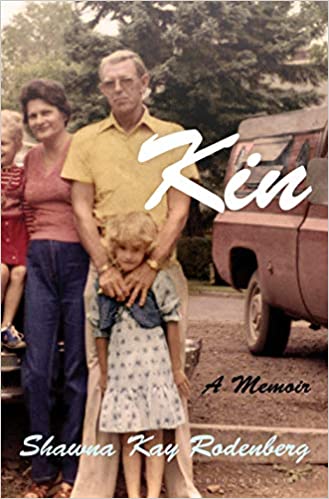
Shawna Kay Rodenberg’s harrowing memoir Kin leads the reader backward and forward in time and across an American landscape of trauma and healing. With a persistent focus on family and home, Rodenberg documents a process of learning and personal growth that is both unique and universal.

Kin opens in 2017, as the author guides CBS reporters though her native eastern Kentucky. They seek to crack open what they see as Trump country, and Rodenberg hopes to complicate that story. The backdrop is “my family’s mountain, the mountain where my grandfather mined coal, where my father was reared with great love and brutality, where I picked my grandmother’s strawberries and my grandfather’s roses… the mountain on which my family sought refuge after leaving The Body, an end-times wilderness community, cloistered in the woods of northern Minnesota, that my father joined when he was red-eyed and mad with fear, following his tour of duty in Vietnam.” The narrative then moves back in time to Rodenberg’s childhood in Grand Marais, Minn., and the purposeful deprivations of The Body.

Rodenberg’s upbringing in this strict religious sect gives her a cultural background that will make it hard for her to fit in later, and she suffers more than one form of abuse within The Body, including her father’s recurrent rages. “Instead of following in alcoholic, workaholic footsteps, he made religion his primary vice, religion that was unconventional, ecstatic, even perhaps rebellious–and virtually militaristic, which must have felt familiar.” The family eventually moves back to the secular world, to Ohio, to Kentucky and finally to the mountain of family origin. The austere, often angry influences of The Body will follow them.

This memoir recounts family stories, some from Rodenberg’s memories, some passed down. She writes of each of her parents’ childhoods, and of her aunts, uncles, cousins, grandparents and neighbors. She recounts the history of her hometown, Seco, Ky., a former coal-mining camp. Kin begins well before the traumatic story of Shawna’s birth, “bruised-ass-backward into a world of chaos.” The chronology is disjointed, jumping back and forth, shifting timelines as well as locations, which can be disorienting for the reader, but that effect feels true to the narrator’s experience: Kentucky exerts a strong pull even in Minnesota, and pains felt by generations past are ever present.

At each stage, Rodenberg struggles with the meaning and shape of love and caring, and the confusing truth that those who love us most can hurt us most. Religion will continue to play a large role in her life, complicated by her father’s movements to and away from a strict adherence to The Body’s teachings. She will continue to wrestle with sex and the aftermath of childhood sexual abuse, through her troubled first attempt at college and beyond. Kin closes with Rodenberg on the cusp of pregnancy and marriage, but hints at what is to come: “I wish I could tell [that earlier version of myself] she had come to the beginning, not the end.”

Rodenberg’s prose is graceful and effortless, vulnerable and raw, beautifully descriptive without drawing attention to itself. She emphasizes character of place, from coal country where women “kept the food covered and draped cribs with quilts to keep the dust off their babies” to “town-sized time capsules, stoppered and sealed…. Barns sank beneath fields of kudzu and the roofs of old houses bowed in the middle like the backs of the ancient, singular mares that waited outside to be fed and put away.”

While Kin is first and centrally a memoir of family, it is also about Appalachia, about histories more complicated than the opening scene’s reporters care to see. It is ultimately about forgiveness, understanding and love. Rodenberg seeks an emotional reconciliation with her parents, especially the father she has butted heads with all her life. Of that battle, “even now, writing about it fills me with worry that I might be inadvertently reengaging, and that is why talking about it, why telling was and still is the hardest thing…. This is what it means to come from people who have been broken and exploited, they see the world in sides, theirs and the other, and disloyalty is the gravest offense, the blasphemy of the mountains.” In a world of just two sides, it might be an act of rebellion to both love someone and hold them responsible.

As narrator, Rodenberg is intelligent and insightful. As character, she is resourceful, scrappy, defiant, brave and exposed. Her memoir is heart-rending and hard-won. “I didn’t know when I started writing this book that it would become my own book of Revelations, rife with warning and promise, an account of my own and other apocalypses that created me, end times that predated me but shaped me as surely as if I’d lived through them myself.” That sense of regional and filial legacy defines Kin, a work of nuance that complicates received narratives in all the best ways.


Rating: 7 skirts.

Come back Monday for my interview with Rodenberg.

Gambusia geigei” at Kestrel

I had a brief (flash) piece of my own creative nonfiction writing published over at Kestrel recently, and I want to thank those fine folks for their support! You can subscribe to Kestrel in print here.

Bluebird, Bluebird by Attica Locke (audio)

I reviewed Heaven, My Home, which comes second in this series. My father reviewed the highly-regarded first novel Bluebird, Bluebird, and now I’m finally catching up.

Pops did a good job with the high points of this one, and I remember Heaven very fondly (I rated it 8 fingers). There’s no question in my mind that Locke is at her best in handling the complex, nuanced, contradictory nature of Texas history and relationships (particularly in regards to race, but of course there’s more there too). The social justice questions, with no easy resolutions, are Locke’s greatest strength. I found the murder mystery part of this novel less compelling. And I should acknowledge that this audiobook took me way too long to finish, so maybe I didn’t give it the fairest shot in terms of my slow reading (listening) pace. It did get a little draggy for me in the middle; I think the contemplative interiority of Ranger Mathews’ thought processes and turmoil was a mite slow for my personal tastes. Which is related to my bigger concern with the book: I had trouble believing in Mathews (as a fictional character who ‘rings true’), and I had trouble caring deeply about his problems, because he exasperated me.

I had trouble with some of his unprofessional behaviors. Not morally, but in terms of believability: does he really get away with it? The drinking on the job, and the blurred boundaries with the murder victim’s widow, and with Geneva, a powerful matriarch in the small town where he’s investigating a couple of murders. It often felt to me like he was amateur at his job – I expected him to have it together more, or at least be better about hiding his boozing. He sure does rush off half-cocked. And while the widow’s character also made me a little impatient, I bought that this is who she would be. Everyone else feels believable; it’s just Mathews. I’m familiar with the self-destructive, loner, problems-with-authority police detective in fiction – it’s a type, and one I rather specialize in. But this one feels like he’s not very high-functioning in his self-destruction, if that makes sense, and it just rang less true for me.

I do not require that I like a character in order to care what happens in a plot. But there has to be some stakes that I can engage in, and I struggled with that here. My problems with Mathews were distracting.

More compelling was the conflict Mathews feels about the law, nicely encapsulated in his two role models, twin uncles who respectively work(ed) as a lawyer and a Texas Ranger. He’s been drawn in both directions, and still feels the pull of the law, although most of all in the pressures applied by others.

It made him sad, the degree to which this kind of credit hogging mattered to Greg, that three years behind a desk had made him so desperate for the climb that a double homicide was seen as an opportunity first and a crime against nature second. But wasn’t Darren a little guilty of this, too?

…Maybe justice was messier than Darren realized when he’d first pinned a badge to his chest; it was no better or worse than a sieve, a cheap net, a catch-as-catch-can system that gave the illusion of righteousness when really the need for tidy resolution trumped sloppy uncertainty any day.

And,

He got it confused sometimes, on which side of the law he belonged, couldn’t always remember when it was safe for a black man to follow the rules.

Point very well taken. Although, Mathews can occasionally feel like a mouthpiece for these musings, rather than a fully human character.

I did really enjoy the local culture of Lark, Texas, the blues and the home cooking at Geneva’s. And the complex relationships, which Pops refers to in his review, were well drawn (and feel very real).

Narrator J. D. Jackson has a nice voice but sometimes plays this one with a hair more drama than I needed – again, a little distracting.

Some good stuff here, but a lot that bothered me, too. If I’d started here I wouldn’t have read Heaven, My Home, which I think is a superior book. It’ll be interesting to see what comes next for Ranger Darren Mathews.


Rating: 6 plates to go.