The Wasp Trap by Mark Edwards

Six estranged friends and colleagues gather at a sumptuous dinner party to find themselves terrorized by old secrets in this gratifying tale of suspense and psychopaths.

The Wasp Trap is an absolutely thrilling, tautly plotted puzzle of a novel by Mark Edwards. This double-locked-room mystery, with all the tension that that implies, presents a cast of well-developed characters facing various hidden challenges.

The first timeline, introduced in the novel’s prologue, takes place in July 1999. A group of recent college graduates are gathered at a country estate outside London by a charismatic psychology professor to work around the clock on a dating website meant to achieve maximum dotcom-era profits. In truth, they also work at developing a test to identify psychopaths (their mentor’s first interest). The estate is well outfitted with “fruit-colored iMacs” and age-appropriate entertainment. For a few months, in these pleasant confines, the group becomes very close. “The lothario. The salesman. The affluent couple, the joker and the local girl. Finally, me, the wordsmith, whose role was to write it all down. If any of us were a psychopath, I already had a good idea who it would be.” The bulk of the novel is narrated by Will, an aspiring writer who often feels trapped on the outside, thwarted in his attempts to connect. He is well-suited to observe the character of his counterparts, but not unbiased.

Twenty-five years later, they gather again, to commemorate the death of their former employer. Two members of the original project have married–they are the only two to have kept in touch, after what seems to have been a rocky and abrupt ending. Now “the affluent couple” hosts their old friends for a lavish dinner party in their high-security Notting Hill townhouse. But immediately the evening shifts from awkward to nightmarish, part home invasion and part sinister game. The group is commanded to reveal a secret from the storied summer of ’99. Each dinner guest denies knowing what information is sought, but each, of course, does harbor secrets. The key to The Wasp Trap‘s deliciously frightening uncertainty lies in the pain and horror of not knowing whom, in a closed environment, one can trust. The once-tight-knit group fractures amid secret and not-so-secret sexual tensions, financial pressures, and old jealousies, especially with a suspected psychopath or two in their midst.

Offering twists and turns and surprises through his novel’s final pages, Edwards executes a highly satisfying thriller with this intriguing blend of terror and nostalgia for youth and freer, more hopeful times.


This review originally ran in the July 22, 2025 issue of Shelf Awareness for the Book Trade. To subscribe, click here.


Rating: 8 cans of Pepsi.

No Ordinary Bird: Drug Smuggling, a Plane Crash, and a Daughter’s Quest for the Truth by Artis Henderson

A daughter’s study of her father’s life and death artfully reveals intrigue, astonishing slices of world history, and a loving but flawed man.

In June of 1985, a small private plane, a Piper Cub, crashed on its owner’s property in northern Georgia. The pilot, Lamar Chester, was killed. His only passenger, his five-year-old daughter, AJ, sustained severe injuries but lived. In death, Lamar escaped prosecution as a marijuana smuggler. His widow, hoping to protect her child, removed the young AJ from the life she’d known, isolating them from family and friends who had been involved in the smuggling business. AJ grew up to be Artis Henderson (Unremarried Widow), who spent decades turned away from her father’s story, interpreting her mother’s silence as shame. Her eventual readiness to examine the truth of her father’s life, their brief but loving relationship, and his end has resulted in No Ordinary Bird: Drug Smuggling, a Plane Crash, and a Daughter’s Quest for the Truth, which combines investigation and personal excavation in a searing, moving memoir.

In their few years together, Lamar made a strong impression on his youngest child, one that has been enriched by her later research. She remembers him as a loving and beloved father, and deeply charismatic, although his attitudes toward women in particular appear problematic through a modern lens. Henderson is thoughtful about such judgments, and careful in considering her father’s upbringing as a factor in his life. And a wild life it was, with an early marriage yielding three surviving children and one lost; divorce and remarriage; and a colorful career as a pilot, smuggler, and ostentatious party boy in 1970s Miami. Increasing profits and outward success allowed Lamar to acquire ever-more-impressive possessions, and he became involved in ever-more-risky ventures, until he faced federal prosecution and the plane crash that killed him.

Henderson’s work is both investigatory and personal: “I’m grappling with this story as much as I’m reporting it.” She loved her father, sympathizes with the demons he faced, and remembers a childhood of “uncomplicated happiness. My father made me feel safe and protected.” She trusts that there was a time when, “to him, the line between the good guys and the bad guys was still very clear,” but also realizes that he made choices that endangered his family and, she concludes, led to his own death. No Ordinary Bird is a loving portrait that benefits from the nuance of understanding that, as Lamar liked to say, “you can’t tell the good guys from the bad guys.” It is both research-based inquiry–involving travel to Miami, Georgia, Colombia, Nicaragua, Iran, and beyond–and also a memoir of family, love, and risk. Henderson excels at the subtlety required by such a story, and her telling is intriguing, painful, and cathartic.


This review originally ran in the July 18, 2025 issue of Shelf Awareness for the Book Trade. To subscribe, click here.


Rating: 8 bear claws.

The True True Story of Raja the Gullible (and His Mother) by Rabih Alameddine

An especially wry, wise, comic style distinguishes this unforgettable tale of national trauma, community, familial love, and forgiveness.

The True True Story of Raja the Gullible (and His Mother) is a novel as expansive, funny, and poignant as its title promises. With his signature wit and irreverence, Rabih Alameddine (The Angel of History; The Wrong End of the Telescope; An Unnecessary Woman) charts decades of Beiruti history and trauma through the life of his narrator, Raja, a reclusive, aging teacher of French philosophy.

The novel opens and closes in 2023, when Raja shares his apartment with his overbearing but deeply endearing mother, Zalfa. The bulk of its sections jump back in time: to the pre-civil-war 1960s, Lebanon’s civil war in 1975, the banking collapse and Covid-19 epidemic, and Raja’s ill-fated trip to the United States for an artists’ residency in Virginia. (He should have more fully recognized how suspicious the invitation was: he had written a book 25 years earlier, but “I’m not a writer, not really. I wrote a book, that was it. It was an accident.”) Writer or no, Raja is a knowing, purposeful narrator, teasing his reader with what is to come, defending his story’s chronological shifts: “A tale has many tails, and many heads, particularly if it’s true. Like life, it is a river with many branches, rivulets, creeks….” Self-aware and self-deprecating, Raja names himself the Gullible, the Imbecile, the Neurotic Clown, the Dimwit. His mother is “Raja the Gullible’s Tormentor.” “Deciphering [her] was a feat that would have surely flummoxed Hercules–my mother as the unthinkably impossible thirteenth task.” They bicker constantly, foul-mouthed but fiercely loving.

In past timelines, the reader learns of Raja’s troubled childhood as a gay younger son, bullied by much of his family, especially Aunt Yasmine, “the wickedest witch of the Middle East.” During the civil war, in his teens, he is held captive for weeks by a schoolmate and soldier with whom he begins a sexual relationship that is part experimentation, part Stockholm syndrome. He describes his accidental path to teaching, 36 years of it; he refers to his students as his “brats,” but his care for them and, even more, theirs for him will become gradually apparent. Amid terrible events, like the port explosion of 2020, Raja’s mother befriends a neighborhood crime boss named Madame Taweel: “Only my mother would find a mentor at eighty-two, let alone the most inappropriate one.” Bawdy, rude, and impossibly sweet, with “a laugh so delightful, so impetuous, so luminous,” Raja’s mother is the indomitable star of this loving, heartwrenching novel.


This review originally ran in the July 14, 2025 issue of Shelf Awareness for the Book Trade. To subscribe, click here.


Rating: 7 cans of tuna.

Lessons in Magic and Disaster by Charlie Jane Anders

Adult daughter and mother, both struggling and bickering, work to come together with magic spells, an impossible dissertation, and lots of love.


“Jamie has never known what to say to her mother. And now–when it matters most of all, when she’s on a rescue mission–she knows even less.”

At the start of Charlie Jane Anders’s Lessons in Magic and Disaster, Jamie’s mother, Serena, is struggling. Since the death of her wife, Mae, six years ago, simultaneous with Serena’s career imploding, Serena has been holed up with her grief in a one-room schoolhouse in the woods. Now Jamie, wrestling with her dissertation on 18th-century literature, has decided enough is enough. In the interest of pulling Serena out of her black hole, Jamie’s finally going to tell her mom her big secret: Jamie is a witch.

But her attempt to teach Serena some nice, wholesome, positivity-based magic misfires, because Serena is prickly, powerful, and pissed at the world. Learning magic proves hazardous, to her and to Jamie. There are also ill effects on Jamie’s partner, Ro, an endlessly patient and lovely person whom Jamie values above all–although she’s yet to tell Ro about her magic. Meanwhile, the college where Jamie studies and teaches is once more threatening to cut her already pitiful stipend, she’s at a sticking point on her dissertation, and her undergraduate students can be terrifying. But she’s just discovered a previously unknown document that might decide the authorship of a novel at the heart of her research. And with Serena’s frighteningly intense powers, it is both scary and tempting to consider what Jamie might do.

As the younger witch attempts to teach her mother the rules of magic (which self-taught Jamie has defined for herself), both women must confront relationships past and present, with each other and with their partners. In flashback sections, Serena’s early years with Mae offer heartbreakingly sweet and thought-provoking reflections on love and childrearing. Jamie’s present life with Ro, a Ph.D. candidate in economics, is nerdy and deeply loving, strongly rooted in intentional reinvention of traditional roles. Serena and Jamie are a prickly and troubled mother/daughter duo, but both are earnestly trying to come together. They will face challenges to their love as well as to their personal safety, as the stakes rise in a world of bigotry and social injustice, but they will also form stronger bonds with each other and other strong women.

Anders (Never Say You Can’t Survive; All the Birds in the Sky) excels at dialogue and the portrayal of relationships both loving and thorny. Her characters face profoundly serious dangers, but there are frequent notes of levity, joy, fun, and intimacy throughout. Lessons in Magic and Disaster features the magic of spells and charms but also that of human connection, and readers will be richer for the experience.


This review originally ran in the July 3, 2025 issue of Shelf Awareness for the Book Trade. To subscribe, click here.


Rating: 8 slices of chocolate fudge cake.

The Favor by Nora Murphy

I really enjoyed this thought-provoking drama. I wondered about that word, ‘enjoy,’ but I did, despite the tough subject matter. The story is well told and it made me think, and talk with a handful of friends about, some very tricky real-life issues we’re all facing in different ways. It had momentum; I was always glad to find time to read more, and sad when it ended. I did find the ending a little bit anticlimactic, for a book with such high tension and high stakes, but I’m still a fan.

The bulk of the book is told from the perspective of two women, Leah and McKenna. They don’t know each other, but they live parallel lives, a short distance apart, in a suburb between Baltimore and DC. One is a lawyer, married to a lawyer, and the other is a doctor, married to a doctor; both have recently become unemployed, following the machinations of their respective husbands. Both are in coercive, abusive relationships. Both were formerly independent, strong, professional women, outwardly successful and attractive in a certain traditional style: fit, blonde, white, put together. Both are now living in an utter nightmare from which they see no escape. That’s when Leah sees McKenna at the liquor store, follows her home, and watches through a kitchen window as a scene unfolds that she recognizes intimately. After a brief spell of observation, Leah sees McKenna’s husband throw her to the floor and begin kicking her in the stomach. Leah shoots him dead.

Mild spoiler there, but these are the events that set off the rest of the novel. McKenna has been suddenly, unexpectedly, and in the most shocking fashion set free of the abuse and control that may well have killed her. She is under police investigation; she is also liberated. Leah is not. The Favor unfolds from there.

There are strong echoes to Strangers on a Train, as well as important differences. We start with an archetypal issue, a sort of classic model of intimate partner violence: male on female, married, with the husband being of sufficient social standing and social skill that if his wife were to make accusations, she is unlikely to be believed. Manipulation, both of the wife and of the surrounding community. And then there are some fascinating moral questions. Self-defense would be one thing (although, I’ve read, such women killing in self-defense are rarely believed in court), but one woman killing in defense of another is still shakier ground… And then there is the inaction of friends and family, when by outward appearance nothing was wrong in a picture-perfect happy marriage, and simultaneously, asked head-on about that marriage, all admit to a sense (at least) of unease. It all gets very sticky very quickly. This work of fiction (authored by a lawyer with significant experience in domestic partner violence) is written in gripping fashion; I felt the pull of the plot, and concern for these characters, to the very end. It was compelling content, well told.

I would just add that this kind of violence and coercive control happens to all kinds of people, in all kinds of relationships – all sorts of combinations of gender roles, across race, ethnicity, education and professional status, social and economic class. Murphy has focused here on one ‘type’ of abusive relationship, but this is only one.

I found this a very engaging book and it’s led to some conversations with friends. Do recommend.


Rating: 7 empty bottles.

A Galaxy of Whales by Heather Fawcett

I needed this little break in between heavier reads, and I love knowing I can turn to Heather Fawcett to scratch that itch. A Galaxy of Whales is offered for readers ages 8-12, and features 11-year-old Fern, who is having a difficult summer. Her best friend Ivy has been pulling away from her, spending more time with other friends. Her family’s business, Worthwhale Tours, is in some trouble. Their main rivals, Whale of Fortune, are also their next-door neighbors, the Roys; and 11-year-old Jasper Roy is especially annoying to Fern. Her one-year-older brother Hamish is always buried in a Space Dragons book – also annoying. Worst of all, Fern still misses her father. “Maybe if your dad had died three years and two months ago, you shouldn’t be sad enough to cry anymore.” She’s not sure.

Then she learns about the youth wildlife photography contest. It’s perfect: if she wins, her photo will be on the front page of the paper. It might be enough to win Ivy back. The prize money could help the family business. She could defeat Jasper, who wants to enter the contest as well, despite not being into photography at all. And photography is absolutely Fern’s thing – the thing she shared with her father, whose camera and gear she takes with her everywhere, who taught her everything she knows. She has to win.

Just off Fern’s little Pacific Northwest town of Goose Beach, on the Salish Sea, there is a famed pod of endangered killer whales that she knows is just the right subject for her award-winning shot. But they’re hard to track, and time is running out. Fern tries to work together with Ivy, who is clearly not all that interested. She tries to work with Hamish, who is decidedly indoorsy, not a natural wildlife photography assistant. Finally, she resorts to working with Jasper, the enemy – unless he’s becoming her new best friend.

In this momentous summer between fifth and sixth grades, Fern learns a lot about family, friendship, whales, astronomy, and how to continue to navigate grief. A Galaxy of Whales offers these lessons organically and sweetly, in just the sort of package I was looking for: wholesome and loving.


Rating: 8 ice cream sandwiches.

Most Ardently: A Pride & Prejudice Remix by Gabe Cole Novoa

I wasted no time after Into the Bright Open in getting into the next remix. Here, Pride and Prejudice retains its setting in time and place and the essentials of characters, with one great exception: the individual we know in the original as Elizabeth Bennet is here a trans boy named Oliver. Only a few people know his truth: his older sister Jane, his aunt and uncle, and two dear friends, Charlotte and Lu, who are, secretly, a same-sex couple and not the close friends their community believes them to be. He has arranged a workable system for going out as himself, sometimes climbing out the bedroom he shares with Jane at night in clothes stored under his bed, and sometimes going to Charlotte’s to change into clothes she keeps there for him. When he meets Darcy for the first time, he finds him handsome, but is repelled by his poor social graces and Darcy’s obvious disdain for the young person presented as Elizabeth.

Gabe Cole Novoa opens this novel with a note acknowledging that Oliver is frequently misgendered, and his deadname used, by his community and his own family, “though never by the narrative.” Novoa observes that this will be painful for some readers, and gives them fair warning: the author has done his best to handle the issues with sensitivity, but the book centers in some ways around Oliver’s dysphoria. As a reader who does not share this experience, I can only say that I thought Oliver’s dysphoria, misgendering, and seeking against convention for his authentic self were represented with nuance and grace, and accurately as far as I can see from here. Indeed, I thought the portrayal was of a sort to help other cis people like myself empathize with something we haven’t experienced for ourselves, in the best ways, which is some of the best work fiction can do for us.

Beyond that good work, Most Ardently is as sweet and transporting a love story (and a mess of misunderstandings) as the original it’s based on. Oliver presenting as ‘Elizabeth’ versus himself, to the same groups of people – and most importantly Darcy – offers some Shakespearean scenes of confusion, although these are less comedic because the Elizabeth character is a painful lie Oliver is forced to tell. There is one scene when Darcy laughs and laughs at an ironic turn that I do find nicely funny. And there is a parallel to the expected happy ending that is so oh satisfying – perhaps more so for its unlikeliness. (Novoa includes a historical note speculating on trans people who have ‘passed’ undetected in history. By definition, these are unknown to us. Novoa takes a hopeful stance.) I found the whole result sweet, entertaining, sympathetic, and wholly rewarding in the end. This was an easy and fulfilling read, and I’m ready for more in the series. I’m so glad this book is in the world.


Rating: 7 pairs of trousers.

The El by Theodore C. Van Alst Jr.

Young gang members in 1979 Chicago take public transportation across the city on a single, important day in this shape-shifting, kaleidoscopic novel of big risks and dreams.

Theodore C. Van Alst Jr. (Sacred Smokes; Sacred City) offers a love letter to the city of Chicago via a single-day odyssey in The El, an expansive novel featuring young gang members on a circular journey through an urban landscape. With strong imagery, dreamlike sequences, and gritty considerations of family, love, spicy potato chips, and gun violence, this unusual story will capture and hold the imagination.

On an August day in 1979, teenaged Teddy wakes up early, eats a few buttered tortillas, and gets ready for a momentous event. He will lead 18 fellow members of the Simon City Royals across town via Chicago’s elevated train (the El) to a meeting with another “set” of the gang and many others, where a new alliance formed in prison would be applied on the outside. The new Nation will include old enemies, but Teddy is a team player. It is a day of high stakes, and while they all share trepidations, not everyone shares Teddy’s hopeful outlook. “Jesus, Coyote, Al Capone… I was sure all of us prayed to them equally.”

Teddy narrates as he sets out with his best friend, Mikey. Then the perspective switches to Mikey’s. Teddy remains the protagonist and most common narrator, but a broad variety of players cycle through, providing different angles on the potential impacts of the Nation alliance as well on as the scenes themselves: a fire on an El platform, an attempted murder, various deaths, moments of beauty. Teddy’s Native identity matters because race is a question for the new Nation, spoken of but not exactly on the official agenda. Teddy can see a character he knows to be Coyote, “walnut brown and wiry, wearing a pair of mirrored Aviators,” who “tends to hum in and out of focus.” This character, or force, plays an important role in the day.

The El is utterly intriguing at every turn, shifting pace from high-drama action scenes to contemplative minutes and hours spent rocking in rhythm with public transit and the city itself. Van Alst portrays a strong sense of both time and place as his characters grapple with race, class, and culture in a very particular big city. The novel is about cusps: of the season, the turning of the decade, the gangs’ political shifts, the move away from “skins-only” violence and toward more guns, and comings of age. Van Alst gives us tragedy as well as beauty, and a sharp, loving portrait of a place, with Teddy “riding all the way back toward the neighborhood, window wide open, warm wind howling in, and me in love with everything we could ever be.”


This review originally ran in the June 24, 2025 issue of Shelf Awareness for the Book Trade. To subscribe, click here.


Rating: 7 Jay’s Hot Stuff chips.

Into the Bright Open: A Secret Garden Remix by Cherie Dimaline

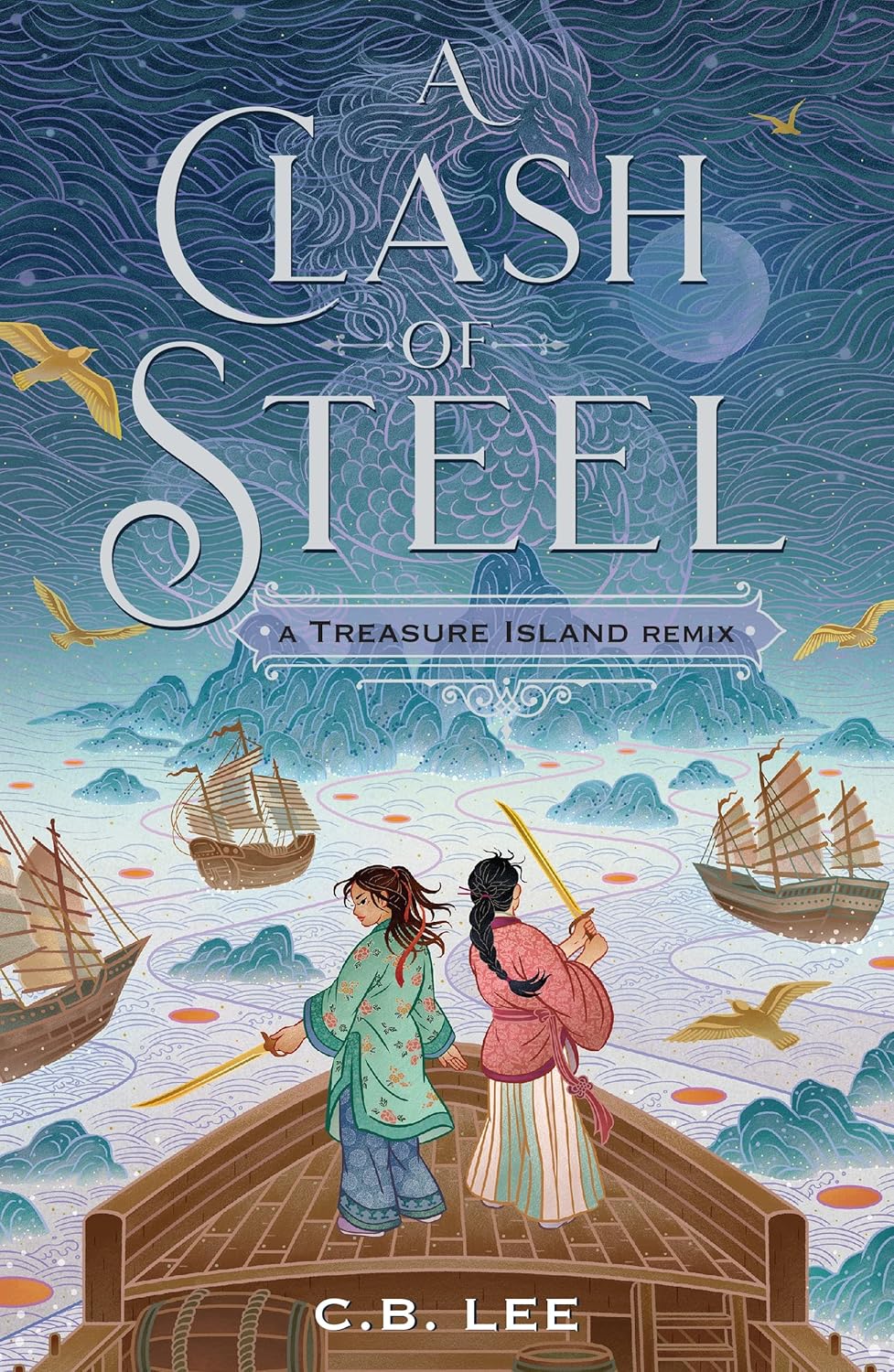
I stumbled into this book because I was following Cherie Dimaline (VenCo), but am glad to have discovered the “Remixed Classics” series from Square Fish, in which “authors from marginalized backgrounds reinterpret classic works through their own cultural lens.” I’m looking into a few of those, including Clash of Steel (Treasure Island), So Many Beginnings (Little Women), and Most Ardently (Pride and Prejudice). I love a daisy chain like this.

Into the Bright Open retells Frances Hodgson Burnett’s The Secret Garden, but in 1901 Ontario. Mary Craven is the unpleasant, lonely, spoiled-and-simultaneously-neglected child of a wealthy, important couple in Toronto, raised mostly by a nanny she does not like who does not like her, when her parents are killed in a car crash and she is shipped off to the Georgian Bay to live with an uncle she’s never met. He is not present when she arrives; she is greeted instead by household staff who treat her with more familiarity than she finds appropriate, but she quickly rethinks her stance as she finds them also warm, even friendly. Her uncle’s estate is grand, but by Mary’s standards, wild. Gardens border upon woods, and the ocean is an untamed thing. Native people and “half-breeds” initially offend her snobbish sensibilities, but Mary is just fifteen: young enough, and lonely enough, to change her mind. This version of Mary struck me as more introspective and more capable of self-criticism than I remember the original Mary Lennox to be. It also got me thinking: while readers are certainly accustomed to accepting flawed and imperfect protagonists, Mary Lennox might be an unusually unlikeable one. This Mary Craven, though: she definitely does unlikeable things, but with the benefit of access to her thoughts & feelings (this is told in a close third person), I find her quite sympathetic. She’s learning. She’s growing.

So. At the uncle’s house, Mary of course discovers the expected (if you know the original): the secret garden, and the secret child, a new friend for the friendless orphan girl, hidden away. There is a neighborhood friend as well, here a girl with wondrous comfort, confidence, and skills in the outdoors. There are further parallels to the original novel, but also a sinister twist.

This version, though set at the same point in history, feels more modern in its perspective, and I suspect would feel a bit more accessible to the modern young reader. I’m excited about the “Remix” series, and still excited by Dimaline.


Rating: 7 lines of poetry.

The Grand Paloma Resort by Cleyvis Natera

Missing children and a category-five hurricane converge in desperate circumstances at an exclusive luxury resort in the Dominican Republic in this heart-wrenching novel.

The Grand Paloma Resort by Cleyvis Natera (Neruda on the Park) is a novel of race, class, secrets, and striving, set within a luxury resort staffed by struggling locals amid the natural beauty of the Dominican Republic.

Sisters Laura and Elena have only each other and the Grand Paloma Resort. Laura has been her sister’s caretaker since they were 14 and four years old, when their mother died. The Grand Paloma has been Laura’s career and lifeline. Through her work, she was able to send Elena to a global academy, meant to secure the younger woman’s future. But Elena persists, in Laura’s eyes, in slacking, taking Ecstasy and partying while working as a babysitter at the resort. In the novel’s opening pages, a young child in Elena’s care–from a family of great wealth and privilege–has been badly injured. It falls to Laura, yet again, to clean up: Elena must be protected from criminal charges, and the resort from bad press.

But this time, despite Laura’s experience in saving the day, a bad situation spirals. Elena thinks she sees a way out by accepting a large sum of money from a tourist in exchange for giving him access to two young local girls. Although she initially believes the girls won’t come to harm, the crisis worsens when the children go missing. All of that–with a frightened Elena and Laura at maximum stress and frustration–coincides with an approaching category-five hurricane. A larger cast of already marginalized resort employees are endangered in a ripple effect, and Laura’s career is at risk. Over the course of seven days, it becomes increasingly clear that these various lives will never be the same.

Natera deftly splices into this narrative the history of the Dominican Republic and the plight of Haitian workers. The Dominican Republic is a beautiful paradise beset by poverty and racial stratification, emphasized all the more when locals intersect with the extraordinary wealth and power of the Grand Paloma’s guests. One of those guests sees it as “a humanitarian crisis so large, so seemingly without end, that there was little to do but look the other way.” At the heart of the novel’s conflict is the question of what each character will do to survive.

With a propulsively paced plot and heart-racingly high stakes, The Grand Paloma Resort interrogates capitalism and exploitation through a community’s concern for two little girls. The result is exhilarating, entertaining, and thought-provoking.


This review originally ran in the June 17, 2025 issue of Shelf Awareness for the Book Trade. To subscribe, click here.


Rating: 7 cocktails, obviously.