Maximum Shelf: in the words of Richard Powers

Following Monday’s review of Bewilderment, here’s Richard Powers: ‘Homesick for a Place They Never Knew.’


Richard Powers’s novels include The Echo Maker (winner of the National Book Award for Fiction, 2006) and The Overstory (Pulitzer Prize for Fiction, 2019). His work often explores the connections between human lives, the natural world, science and technology. He has received a MacArthur Fellowship, a Lannan Literary Award and the James Fenimore Cooper Prize for Historical Fiction, among many others, and he has taught at Stanford University and the University of Illinois. Bewilderment (coming from Norton on September 21) is his 13th novel.

Powers wrote a special “Note from the Author” for the advanced reader copies of Bewilderment that explores the meaning of his novel’s title and inspiration, reprinted here.

A Note from the Author

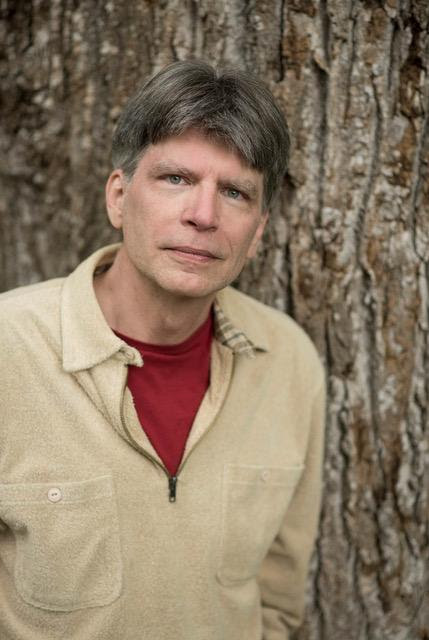
Richard Powers (photo: Dean D. Dixon)

I read the classic “Flowers for Algernon” in sixth grade, when I was eleven years old. Written the year I was born, the story lit up my imagination and settled into that permanent place children reserve for those fables that capture the mystery of life.

In my early sixties, when I came across an account of a remarkable new therapeutic technique called decoded neurofeedback, Daniel Keyes’s story returned to me, every bit as vivid as it had been half a century earlier. “Algernon” told of a cognitively challenged man who is granted intelligence far beyond ordinary human limits. Decoded neurofeedback raised the prospect of a similar fable. Suppose researchers perfected an empathy machine that could greatly magnify emotional intelligence? What might we humans learn to become?

Children possess enormous emotional intelligence, but adult illogic can defeat it. While finishing my previous novel, The Overstory, I kept reading accounts of the toll our growing environmental catastrophe is taking on the young. A new word, solastalgia, seemed to take hold overnight. I began to see how we were raising a generation of troubled kids born homesick for a place they never knew. And we adults were relying more and more on a single response for treating the epidemic ravaging our children’s mental health: medication.

All children are natural scientists. At the same time, they’re also pantheists who know that God is crawling over every inch of the backyard. I had a fierce niece who loved butterflies, and for a long time couldn’t stop drawing them. I had a deeply affectionate nephew who talked to “critters,” but who flew into violent rages at the stupidity of humans. The little girl managed to grow into an accomplished and mostly happy young adult. The little boy did not. Could another kind of emotional therapy have made a difference?

Bewilderment was, in part, my way of remembering those two, along with so many other troubled children whom I loved without being able to reassure. The reward of writing this story lay in the daily chance to recover my own childhood joy in the endless replenishment of the living world. The word bewilder means to perplex or confuse. But in its origin, it also means to head back into wildness. A childlike love for our wild, entangled home is the only thing large enough to cure what is wrong with us. As Thoreau puts it, “In wildness is the preservation of the world.”

Copyright (c) 2021 by Richard Powers. Bewilderment to be published by W. W. Norton & Company, Inc. September 21, 2021.


This author’s note originally ran on August 23, 2021 as a Shelf Awareness special issue. To subscribe, click here, and you’ll receive two issues per week of book reviews and other bookish fun.

Maximum Shelf: Bewilderment by Richard Powers

Maximum Shelf is the weekly Shelf Awareness feature focusing on an upcoming title we love and believe will be a great handselling opportunity for booksellers everywhere. The features are written by our editors and reviewers and the publisher has helped support the issue.

This review was published by Shelf Awareness on August 23, 2021.


Bewilderment by Pulitzer Prize-winner Richard Powers (The Echo Maker; Orfeo; The Overstory) is a novel of great pain and empathy. Focusing on a nuclear family but also concerned with ecological collapse and the possibilities of distant space, this is a heart-wrenching story with an important message to convey.

Theo Byrne is an astrobiologist: he writes programs to explore, hypothetically, distant planets that may host life. His work is at the nexus of science, coding and imagination. But readers meet him first in a still more important role: that of single parent to Robin, who is just turning nine. Robin is a special child: artistic, caring, intelligent. “So far the votes are two Asperger’s, one probable OCD, and one possible ADHD,” but Theo resolutely resists the push to medicate him. Bewilderment begins with father and son in the Smoky Mountains on a camping trip, intended as alternative therapy following yet another outburst at school. It helps Robin immensely, but the larger world awaits. “The cars, the asphalt, the sign listing all the regulations: after a night in the woods, the trailhead parking lot felt like death. I did my best not to show Robin. He was probably protecting me, too.” Robin will not tolerate lies. But how can Theo tell the truth about just how vicious our world really is?

Theo’s wife, Robin’s mother, is absent. Aly was a tireless animal rights lawyer-activist, fierce and indomitable and loving; both man and boy are daily devastated by her loss, which readers slowly piece together: a car accident, swerving to avoid an opossum. “I didn’t know how to be a parent. Most of what I did, I remembered from what she used to do.” The novel is told in Theo’s first-person voice, in constant interaction with Robin; but Aly is ever present, too, as a voice in Theo’s head and to whom he turns for advice. On leaving the Smokies, he appeals to her: “We’re fine together, in the woods. But I’m afraid to take him home.”

Indeed, back in Madison, Wisc., Robin struggles at school and Theo, trying to care for him, falls behind at work. Planetary exploration and the sciences in general are underfunded and under attack by a government administration that blusters and crows on social media. Theo’s research partner refers to Robin as “the boy.” The school pushes harder to medicate him. Many evenings, Theo and Robin travel together in imagination to distant, dreamed-up planets that just might support life. These interludes are gorgeously rendered demonstrations of love and inventiveness. But the real world continues to rattle.

Another colleague makes an unusual offer. Decoded Neurofeedback, or DecNef, allows patients, or “trainees,” to mimic the moods of “target” subjects using real-time, AI-mediated feedback: emotional training via carefully monitored neural states. At nine, Robin is an unusually young subject, but he also has a unique opportunity. Before her death, his mother Aly allowed her own neural activity to be recorded. Now the precocious, troubled, earnest Robin has access to her mental state.

Theo and Robin share an appreciation for the Daniel Keyes story “Flowers for Algernon,” and its implications are not lost in Robin’s own unprecedented experience. Theo continues to agonize over his parenting, life on Earth and life in the beyond: “Decoded Neurofeedback was changing [Robin], as surely as Ritalin would have. But then, everything on Earth was changing him.” Robin sees enormous improvement in his ability to handle his rages and his blues, enjoying learning widely about the natural world, with a switch to home-schooling. He shows an uncanny harmony with and knowledge of his mother’s mind, enough to unnerve his father. But there will come a reckoning. Theo and Robin live in a recognizable version of the contemporary United States, beset by climate disasters, political upheaval and hate, wildfires, ignorance. Even as Robin makes his way as an increasingly well-adjusted young activist, bad news bombards their family from all sides, until disaster strikes. Bewilderment circles back to the Smoky Mountains for a gut-wrenching finish in the same place where it began. “From behind us, upstream, the future flowed over our backs into the sun-spattered past.”

Powers deserves his reputation as a consummately talented writer. His careful, lyrical prose conveys precisely the intended emotion and tone at the right time, and weaves meanings and significances in complex layers. This superlative novel invites readers to meditate on the natural world, human and animal rights, the potentialities of deep space, the role of science and technology in human societies, the challenges of modern childhood and more. “Maybe humanity was a nine-year-old, not yet grown up, not a little kid anymore. Seemingly in control, but always on the verge of rage.” Robin is a delightful character, a bright, sincere, intense child, lovable and challenging. Theo is deeply sympathetic in his dual tendencies toward far-thinking astrobiology and the care of his child (“They share a lot, astronomy and childhood”), and in his fear that he will fail his son. Powers pulls no punches: he portrays a brutal world that will damage Robin, Theo and all humanity in profound and irreparable ways. Bewilderment is a beautifully told story, but one that hurts, too.


Rating: 8 opossums.

Come back Friday for a follow-up in Powers’s own words.

Snowflake by Louise Nealon

Coming of age from an oddball Irish country family in the chaos and snobbery of Dublin’s Trinity College has never been so sweet, funny, moody and real.

Louise Nealon’s Snowflake is a novel that keeps readers guessing, a madcap family drama and coming-of-age saga for Debbie, who has grown up on a dairy farm outside Dublin in an eccentric household. “My uncle Billy lives in a caravan in a field at the back of my house,” it begins. Billy is a bit of a drunk with an unusual interest in constellations and Greek mythology; he keeps the farm running and is devoted to his niece. His sister, Maeve, Debbie’s mother, is less stable. She considers herself a writer and a prophet, fanatically recording and interpreting her dreams. Maeve’s much younger lover, James, “was stitched into his John Deere overalls when he came out of the womb and was born into a family without any land.”

Debbie is now off to Trinity College as a commuter student to study English, but she is deeply self-conscious and without city skills; she spends “half the day scoping out toilets to squat in and take a break” and cry. Her first friend on campus is Xanthe, a young woman of greater experience and privilege but, to Debbie’s surprise, with problems of her own as well. The idea that everyone is suffering something, even unseen, is not a new one, but it is refreshingly presented by this cast of wonky, wonderful, traumatized characters in a chaotic, beautiful, flawed world.

Debbie’s first-person narrative is self-deprecating and endearingly messy. Her life is constantly off-kilter, one wrench thrown after another, and this quality could be too much, but Nealon’s earnestly wacky protagonist pulls it off. Sometimes life is too much, but Billy will have another pint and Maeve will take to her bed and Debbie will muddle through–at least until tragedy strikes. An Irish country farm (with side trips to Dublin and to a dubious beach house) provides backdrop to an unlikely list of themes: mental illness, social awkwardness, art, class, guilt and different kinds of love.

The title offers layers of meaning: a little fun at the expense of millennials like Debbie? A fascinating shape worthy of study and analogous to the stars Billy so loves? Something precious, unique, ephemeral? Snowflake is that sort of novel: twisty-turning, multifaceted, smart, funny even when it is at its most serious. Nealon’s debut shows an expert eye for detail and pitch, and an appreciation for the absurd, the profound and the ridiculous–especially when they converge.


This review originally ran in the August 20, 2021 issue of Shelf Awareness for the Book Trade. To subscribe, click here.


Rating: 7 pink dressing gowns.

The Mothers by Brit Bennett

It was such a treat to return to the revelatory writing of Brit Bennett with this one – I read The Vanishing Half first but this one was earlier, her debut. The two novels definitely feel like they come from the same hand; The Vanishing Half spanned generations, while this one covers only two decades or so, but still feels expansive, because of the narrative voice (more on that in a minute), and both zoom out to accommodate cross-country travels, so that their scope is large. Both deal with a defined but largish cast of characters and decidedly big issues. In under 300 pages, The Mothers gives the impression of being about capital-L Life in a way that is powerful and well done.

The narrative perspective in this novel is unusual. For good chunks of the text it feels like close third-person, meaning the pronouns are ‘she’ and ‘he’ but the reader has intimate knowledge of the thoughts and feelings of the character highlighted at any given time. But occasionally we get a first person plural perspective: the pronoun ‘we,’ which is rare in fiction. Much is said of the rarity of the second person (‘you’), but I think we see more of that than we do ‘we.’ It made me think immediately of “Appalachian Swan Song,” the opening short story in Jon Corcoran’s collection The Rope Swing, which I love and have taught twice now. In Corcoran’s story, the ‘we’ is not quite defined; my students and I discuss it and feel that it’s the townspeople, or the town itself, the community, in some way. It’s a story very much about place, and the town or some representative(s) of it get to speak. In The Mothers, the ‘we’ gets better defined, although not right at first. ‘We’ are the Mothers of the Upper Room Chapel in Oceanside, California, where the story is most solidly set. These Mothers are the church’s elder women, and they offer nosiness, wisdom, and a long view; they are a Greek chorus of sorts. I really appreciate the effect.

I love the different ways the title works, too. These Mothers who tell the story are an obvious reference point; the book is about motherhood in many other ways, too. Our chief protagonist is Nadia Turner, who we meet at 17, when her mother has just killed herself in rather spectacular fashion (gunshot to the head). She has gotten pregnant with the help of the pastor’s son Luke (that’s the pastor of Upper Room), and had an abortion just before going off to college in Michigan. The couple’s relationship, such as it was, did not survive the abortion, but each remains caught up in the other without knowing it’s mutual. That same fateful summer, Nadia becomes friends with a girl her age named Aubrey. Aubrey is also motherless but by different means: she lives with her older sister, because their mother was guilty of some severe mistreatment (trying to avoid spoilers here). The girls understand early that motherlessness is part of their bond. “Aubrey wondered if they were the only ones who felt they didn’t know their mothers. Maybe mothers were inherently vast and unknowable.” Nadia’s choice not to become a mother at 17 will affect her life, and Luke’s, and Aubrey’s, for years to come. Nadia wonders about her mother’s choice to keep her own accidental teenaged pregnancy. Imagining a world in which she, Nadia, hadn’t been born, and her mother hadn’t turned to suicide: “Where her life ended, her mother’s life began.” You see the layers of significance around “the mothers.”

The novel mostly follows Nadia, but we get to spend time with Aubrey and Luke as well. The community that surrounds them, in Oceanside and at Upper Room, are of secondary importance. It’s a story about family ties and secrets (“After a secret’s been told, everyone becomes a prophet”) and obviously motherhood but much more besides. Race is a background issue – these characters are Black but that’s a simple fact and not The Point of the book. The quietly reset default in that is one I value and I’m trying to mix a little more of it into my reading.

This is a writer I’ll follow anywhere. I hope there are many more to come.


Rating: 9 crab bites.

The Crossing by Michael Connelly (audio)

The first, good news is that this one went over better than my last Connelly effort, Two Kinds of Truth. I found the plot absorbing throughout. I repeat my criticism of Titus Welliver’s narration, though – I’d forgotten until I reread that earlier review, but I again find him uninflected or occasionally putting the emphasis in what feels like the wrong place in a phrase or sentence. I like him onscreen but not here.

Harry Bosch has been retired from the LAPD for a few months, having been pushed out against his will; his half-brother and lawyer Mickey Haller is suing the Department on his behalf, so the blood is generally bad. (To place us in time, Bosch’s daughter Maddie is finishing her senior year of high school and getting ready to go off to Chapman for college.) Haller then asks Bosch to do some investigation work for a client who Haller is sure is innocent of the murder he’s accused of. Bosch has a strong reaction to the idea: working for the defense would be crossing a line. Defense = bad. (I easily believe that many officers feel this way, so I don’t doubt the realism, but it rankles. The whole point of the adversarial court system is to push back against all charges, forcing their proof, and protecting against false convictions. No one is served by law enforcement’s insistence that it never ever gets anything wrong [even leaving aside purposeful wrongdoing].) Bosch does come around to the idea: if this accused client is innocent, that means there’s a murderer out there roaming free. This activates his sense of justice; plus he’s gotten pretty bored with his motorcycle rebuild project. We all know Bosch needs to be crime-solving. So he agrees to just take a look at the case for Haller. And we’re off and running.

For a little added plot interest and complication, the novel mostly follows Bosch, but also switches over to the bad guys here and there, so the reader has more information than he does (although far from all), which is a fun narrative device.

I like that the title has several meanings within the story. The narrator makes reference to a crossing between murder victim and murderer, where events get set in motion; a crossing over from public heterosexual lifestyle to same-sex relations; and the crossing over that most troubles Bosch throughout this story, as he moves into investigative work for the defense. There are a number of other crossing-the-line references, which might even be considered heavy-handed – I again feel that Connelly flirts with over-explaining – but in the case of the title’s role I ended up appreciating the multiple connections.

There’s something just a little stilted about the dialog and characters here, like Bosch’s (and I think Haller’s) avoidance of contractions, but I’m not even certain how much is Connelly and how much is Welliver. There was again a bit much explaining, especially between Haller and Bosch. I understand that it’s a trick, as the writer, to let your reader in on need-to-know information without having your (expert) characters explain in dialog. I just didn’t remember Connelly being as clumsy about it as I find him here.

That’s nit-picking, though. The plot and intrigue was sufficient to keep me engaged and generally distracted from minor quibbles. Neither Connelly’s best nor his worst work; a perfectly serviceable listen.


Rating: 7 references to Walmart.

L.A. Weather by María Amparo Escandón

In a novel alternating between fun and heartbreak, a prosperous, big-hearted, messy family struggles to weather literal and metaphoric disaster in 2016 Los Angeles.

L.A. Weather is a lovely, compelling and occasionally brutal novel by María Amparo Escandón (Esperanza’s Box of Saints) about a family on the brink of disaster, in a city similarly on edge. Captivating, sympathetic, funny characters and never-ending surprises (that even those involved compare to a telenovela) form a world for readers to get lost in.

Patriarch Oscar Alvarado has become a shell of his formerly assertive self; his wife, Keila, a sculptor, is losing patience. Their daughters are Claudia, an author and television chef; Olivia, an architect and mother of twin girls; and social-media maven Patricia. The Alvarados are a close-knit family of successful, high-powered professionals, bridging Oscar’s Catholicism, Keila’s Judaism and their shared Mexican-American heritage in Los Angeles, a vibrant city beautifully evoked by Escandón’s loving descriptions of food, traffic and culture.

In L.A. Weather‘s opening pages, a horrifying accident befalls Olivia’s daughters (parents beware), prompting various responses to trauma and launching the story directly into the Alvarados’ family dynamic and cascading failures. Oscar’s obsession with drought and wildfire may at first seem random, if not nonsensical, but it reflects a secret he’s been keeping from his family, and serves as symbol for their shared concerns. When Keila announces she wants to divorce him, their daughters protest vehemently, although it is soon their own respective marriages that threaten to catch fire. The city crackles with heat as one crisis or shenanigan after another ensues.

“[The] family’s stories were never neatly wrapped up at the end of the year. They just went on, and it felt good, this continuum.” The novel is defined by time, however: Escandón chronicles events from January through December of 2016. Her story is a feat of both plot and character. Each member of the extended Alvarado clan is intriguing and flawed but deserving of empathy; even when they make questionable decisions, they are both convincing and entertaining. Climate change serves as a clever way to monitor the metaphoric fire risk to a family that loves fiercely but stumbles in the execution of that love. L.A. is richly portrayed: “the wildland-urban interface, that zone where nature and city cohabited (or collided?), where your surveillance camera could spot a mountain lion roaming in your backyard while you slept…. [Oscar] could not stop thinking that it was this unashamed human encroachment into nature that was causing so much destruction.” This is a story of people, place and connection. Absorbing, moving, comic and tragic, L.A. Weather will capture readers and never let them go.


This review originally ran in the August 9, 2021 issue of Shelf Awareness for the Book Trade. To subscribe, click here.


Rating: 7 squash-flower mini tamales.

The Searcher by Tana French (audio)

Tana French never disappoints. This 2020 novel (her latest to date) reminded me quite a bit of her second book, The Likeness (2008), which is still my favorite, I think. In line with all her work, The Searcher boasts intriguing characters with shadowy pasts; a very strong sense of place; and some of the most atmospheric writing I know. What most reminded me of The Likeness was a general, foreboding suspicion about the people around our protagonist, a low-level nagging sense that we’re not sure who everyone is really and what their motivations might be.

It’s still set in Ireland, now in a rural area of tiny villages, but in a departure from her past work, French’s protagonist is American. Cal Hooper is a recently retired detective from the Chicago Police Department, trying to renovate the dilapidated little farmhouse he bought from afar, not too hopeful of making new friends but amenable to the gifted-in-gab locals like his new neighbor Mart. He talks to his adult daughter about once a week. He misses his ex-wife. The reader has to wait to find out what these dim shapes, back in the States, exactly mean to Cal. Meanwhile, he’s getting cautiously adjusted to no longer looking over his shoulder for crime all the time, but somebody’s definitely been watching him – aside from the rooks in the tree out back, whom he rather appreciates – and it’s creeping him out. His peeping tom turns out to be a 13-year-old kid named Trey. What does Trey want, exactly? It will take Cal a certain amount of interview skills to find out. And what he discovers threatens to launch him back into the kind of crime investigation he’d hoped to leave behind.

There are many layers to absorb here. In its handling of gender, The Searcher subtly offers commentary or at least food for thought; the tensions of changing times in a rural setting (technology, employment options, young people moving away, the urban/rural divide, options by gender) are a minor but important focus. Moral ambiguities and the importance of having a “code” feature throughout – other reviewers have placed this novel at least partly within the Western genre. Another slight but important thread deals with police brutality and race in the United States, too, for currency. I appreciated the natural world as… more than backdrop. Events play out against a natural world that can be cruel but only in the ways of nature, with parallels that inform the human dramas. Those rooks, which (tellingly) open the book, provide a keystone for Cal’s experiences. Finally, this rural Ireland made me think repeatedly of small-town Appalachia where I’ve settled. And of course many Scots and Irish settled in Appalachia, so it’s not too strange to think of cultural threads crossing over. But it felt a bit uncanny, and comforting.

Roger Clark’s performance on this audio edition wound up feeling perfectly pitched, although it took me a while to get used to the American accent when I was expecting an Irish one, based on past experience with French. I think Clark performed the accents well all around. There was a brief howdy-partner backwoods bit that felt put upon to me, but I’m ascribing that momentary awkwardness to French and not Clark. I still love her work in this format.

This novel has lots to sink into for the discerning reader. And there’s a compelling plot regarding young Trey and the mystery Cal finds himself roped into, and all the fine work of suspense and mood that French does best. If this isn’t her finest novel yet, it’s right up there, and more multifaceted than most mysteries. Strongly recommend.


Rating: 8 rabbits.

The Turn of the Screw by Henry James

It’s that time again: due to life in general and reading-related issues, I’m taking us back to two posts a week for the foreseeable. They will appear on Mondays and Fridays. Sorry & thanks for your continued interest!


Not sure what prompted me to take in this classic – it might have been The Cambridge Introduction to Narrative.

randomly chosen atmospheric cover (I read a free ebook from Project Gutenberg)

I didn’t have a terribly successful read, but now I know. I’m going to say that this one didn’t age as well as some writers of James’s era. Two central concerns are sentences and what we fear. First, James’s habit of complex syntax and copious strung-together clauses drove me nuts. I found it quite distracting and frequently had to reread to follow the logic of comma-packed sentences. Check out this completely typical (not extreme) example:

At the hour I now speak of she had joined me, under pressure, on the terrace, where, with the lapse of the season, the afternoon sun was now agreeable; and we sat there together while, before us, at a distance, but within call if we wished, the children strolled to and fro in one of their most manageable moods.

There’s a style there that just doesn’t work for me, and I’ll wager works for few modern readers.

Perhaps more importantly, though, even after I’d puzzled through the sentences: The Turn of the Screw is a horror story, but it no longer horrifies. Reading this book was like waiting for the jump scare that never comes. [Spoilers follow, although I’ll not share the ending.] A governess takes charge of two charming children at an impressive country estate: the little girl who is supposed to be her pupil, and the slightly older boy sort of by accident, when he is expelled from boarding school. Our protagonist can’t understand why, because he (like his sister) is perfect, angelic, cherubic, just the sweetest and smartest etc., etc. But then she has a few sinister sightings of two individuals, man and woman, who turn out to be the ghosts, respectively, of a former servant and the last governess. These two committed the incredible sin of having a romantic and sexual relationship even though they were not only unmarried but (gasp) of different social backgrounds. The idea of who is a “gentleman” (and how we can tell by looking at him) is of great importance. Perhaps you can imagine that this just doesn’t impress me; I couldn’t muster any outrage.

The ghosts have some sort of influence over our dear angelic children, who thereby become sinister by association, although they don’t actually do anything bad beyond wandering around unsupervised. This is no Orphan. In general, ho hum.

(There is also an interesting bit of story-within-the-story here: we open with a bunch of Victorians at a country home for a long weekend, where the governess’s story itself is introduced and then read aloud. I’m always intrigued by this narrative device. We never return to the country weekend, so it doesn’t perhaps do the work it might have done for this book.)

My friend Vince teaches a class on horror films and literature, and he could speak to all of this more effectively than I can, but I recall him saying something about how different eras in horror reflect what we feared at a societal level at each point in time. Here, James is clearly concerned with the innocence of children (and the terrifying lack thereof), and class distinctions. That’s my fairly surface-level read, and frankly, it’s as deep as I feel motivated to go. My friend Liz points out that Stephen King has “ruined” (depending on your position) all the horror that came before, by figuring how how to really terrify us. She’s probably right, too. She cites Frankenstein: the modern reader approaches that classic novel looking for a fright that just never surfaces. I’d say that’s a finer novel than this one, though.

Somewhat in James’s defense, I did finish this novella, after faltering in the middle, because I wanted to see what happened. That’s good for something. The ending held a note of some profundity. Still can’t recommend it, except as an act of completionism, if you want to get a good historical grasp of this genre. Next challenge: what horror story of a similar era is still scary?


Rating: 6 commas, which (on theme) might be one too many, but credit for James’s long influence.

“Pursuit as Happiness” by Ernest Hemingway

In June of 2020, The New Yorker published a previously unpublished Hemingway short story, “Pursuit as Happiness,” here. “That year we had planned to fish for marlin off the Cuban coast for a month,” it begins. The narrator is a writer named Ernest Hemingway, but the author’s grandson (who unearthed the manuscript) reads it as a work of closely autobiographical fiction, and certainly for Hem the line was well blurred; I am comfortable with this classification.

The New Yorker‘s illustration

Similarities in subject matter with The Old Man and the Sea are obvious, but it’s a very different story in its events. The Hemingway voice is clearly recognizable. This narrator/protagonist/version-of-Hemingway is in search of really big marlin, and he and his friend/charter boat captain, Mr. Josie (whose boat is the Anita, but I think we recognize the Pilar) are doing some fine fishing, but they haven’t found the big ones. They keep extending their trip, even though they’re on credit; Mr. Josie encourages Hemingway to write for a little income. He drinks. They get a truly big fish on the line, but it doesn’t go as it should. Again, you see the parallels, but this is a story of its own.

There is less finality here than in The Old Man and the Sea, more optimism. The other is the more masterful story (and longer), but this one has a lot to offer. Even the title nods at something my fisherman friends say: we call it fishing, not catching; pursuit as happiness. This sanguinity is uncharacteristic for Hemingway, and I’m not surprised he followed Old Man rather than this one. But this one is awfully rewarding, too. And it was (of course) an absolute pleasure to find a new Hemingway story to fall into. Familiar but new.


Rating: 8 fathoms of line.

“Home Habitat Range Niche Territory” by Martha Wells

What I loved most about this short Murderbot story is that it’s the first I’ve read that’s not from Murderbot’s point of view. For the first time, we view our hero through someone else’s eyes: those of Mensah, its friend and sort-of boss (protector? patron? owner?) for most of the series, so hers is a sympathetic, wryly humorous perspective, and loving. It’s the briefest glimpse of events, again: basically an excuse for SecUnit (aka Murderbot) and Mensah to interact, so that the latter can show us the former from a different angle. (It also provides just a hair of perspective on Mensah’s trauma.) Like last Friday’s story, it would serve as a pretty good intro to the series, although it’s more of an outlier. Again, it’s another treat of a small reentry into this world that I so appreciate.

I hope Martha Wells is off writing right now.


Rating: 8 free sessions.

Thanks for bearing with these short stories & reviews, folks – we’ll be back to whole books again soon.