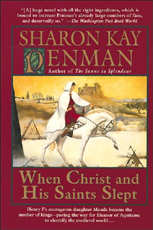
As I near the end of this masterpiece, I’m marveling at author Penman’s ability to keep everything straight. The number of people, castles, battles, the family relationships, the sequence of events, the shifting loyalties – I’m doing okay as the reader at staying clear, but only because I allow myself to drift and be re-seated by my gracious guide every so often; and of course because she’s created strong enough characters that it’s easy to follow each personality. (No one would ever get Henry and Eustace confused.) I wonder just how close to true history she stays? Clearly there’s an unbelievable amount of research involved; but I wonder how truly accurate this novel is. Of course, the devil’s advocate might wonder how truly accurate our “history” books are on this time, too, considering how long ago (the 1100’s) and that history is written by the victor, and all. At any rate, this book has encouraged me to do some research of my own: into Penman herself.
First I went looking for the author’s website; these are often my favorite resources in answering questions about a series, like series order and years of publication, as well as what’s coming out. (I figure generally an author has an interest in promoting upcoming work and in keeping them straight.) Penman lists her books both alphabetically and chronologically, isn’t that helpful of her. And wouldn’t you know, she has a blog! What fun.
The first thing I learned on her website is that I lied when I said I’d only read one book of hers before this one. I read The Queen’s Man several years ago and forgot who the author was. Now that it’s been pointed out to me I do recall that book as being in her style, but call me suggestible. I’m such a haphazard reader: I read the third in one Penman trilogy and am now reading the first in another… no respect for series order. You know, I kind of think it’s the mark of a good book that it stands alone even if it is part of a series. I’m generally not bothered by spoilers or out-of-order reading. Maybe I’m just fortunate to have a short memory; I have certainly reread books (like mysteries) that benefit from surprise plot twists, and been surprised all over again! (I consider this a gift, allowing for repeated enjoyment of the same revelation.) I love Penman and would love to read more; but I’ll most likely just fall upon whatever crosses my path next, without regard for order. With so many wonderful books in the world, I rarely find myself seeking out particular ones; it’s so easy to just read the wonderful book that lands on my desk next.
But my purpose in seeking Penman out was to look into her research methods. The first thing I came upon was her research recommendations, sort of an annotated list with discussion of resources. But I had a lot more fun reading her medieval mishaps, where she confesses to mistakes in historical accuracy, including a number of anachronisms that I, for one, would never in a million years have spotted. Remember, I read historical fiction in part because it teaches me history! …which I love, but I also want to remain aware of the inherent risk of learning something incorrectly as fact. So again, how closely researched? If Penman is concerned about whether or not Stephen’s hunting hawks wore hoods, or the expected life span of an Irish wolfhound in the 1400’s, I can’t believe she’d get the sequence (or victors!) of major battles wrong. But let’s not make assumptions.
According to her blog, Penman’s normal contract for a novel is three years, during which she does research that she repeatedly calls obsessive-compulsive. This is promising. But I’m not sure that reading her own characterization of her research is a fair way to judge; surely any author of historical fiction would claim exhaustiveness? This leads me to look for similar information about Philippa Gregory, another author of historical fiction I’ve enjoyed. A few minutes of internet research makes it easy to see that the internet, at least, gives Penman much more credit for accuracy than Gregory. This doesn’t surprise me too much, as Penman’s books read a bit more “seriously” than Gregory: P spends more time on historical details while G is a bit fluffier, a bit more romance-novel.
I fear that the final conclusion I’m coming to, is that one would have to do considerable research, nearly become an expert oneself, to best judge how accurate Penman’s (or Gregory’s) fiction really is. I’m not interested in that much research just now! Short of such an investment myself, I can only look at the statements made my other readers, who are themselves experts to greater or lesser extents, unknown to me. I found an interesting discussion here from librarything that sort of illustrates my point: it’s open to interpretation, depending on your level of expertise. I guess what I’d most like to read is an article of literary criticism written by an academic scholar of the era of history under discussion; but I don’t think those sorts of scholars tend to spend their time critiquing Sharon Kay Penman.* sigh.
Does it matter how historically accurate a work of fiction is? Yes and no. Historical accuracy does not effect my enjoyment of this book, because I don’t know any better. (If I know better, we’re in a whole new topic; see below.) As a work of fiction, it can be very very strong, both as literary achievement and as entertainment, without being very accurate at all. At some point, of course, it might be best to let it stand as “fiction” rather than claiming to be “historical”; but you get my point. However, there is a real danger in educating ourselves through fiction. Using fiction to learn history requires vigilant attention be paid to historical accuracy. So, it depends on what your purpose is in reading. But awareness is always important in life and in reading: awareness of our purposes in reading; awareness of historical accuracy; awareness of what our reading is convincing us of, regardless of our original purpose.
I especially appreciated a comment on that same librarything discussion, made by margad in message 28: “sometimes small inaccuracies can completely spoil one’s trust in an author.” This is a real concern. I deeply disliked a book called Sophie’s World, by Jostein Gaarder, for a number of reasons, but immediately off the bat I disliked it for a reference to what Homer “wrote.” Homer was prehistory; there was no writing; this is incredibly important in appreciating what he achieved, grumble grumble. Get a fact that I know wrong in the early pages, and you will lose me, immediately and probably irreconcilably.
Have I gotten far enough off topic? My original purpose in writing today was to say wow, Ms. Penman, hats off to you for writing such a lengthy and detailed novel that keeps everything so straight – whether it’s perfectly accurate or not, that’s an achievement, and I’ve enjoyed it mightily, and have no idea how true to fact it is. 🙂
*I did find a little smidge of such criticism, of all things, about Gregory here:
Internationally renowned novel critic Dr. James Higgins (who has a PhD in Historic Literature from the University of Australia) said of Gregory when he reviewed The Other Boleyn Girl: “Philippa Gregory has created a mesmerising work of fiction, seamlessly intertwined with historical fact. While her list of sources may give some reason to believe her novel contains more fact than fiction, it is quite clear to me that Gregory has gained a knowledge of the basic storyline, as well the culture and customs of the Tudor Court, and embellished and dramatised it even more (if that is possible).”
Conclusion? She writes historical fiction. Thank you Mr. Higgins. At least I know such a scholar exists!
Filed under: book reviews, musings | Tagged: historical fiction, reading as education | 13 Comments »