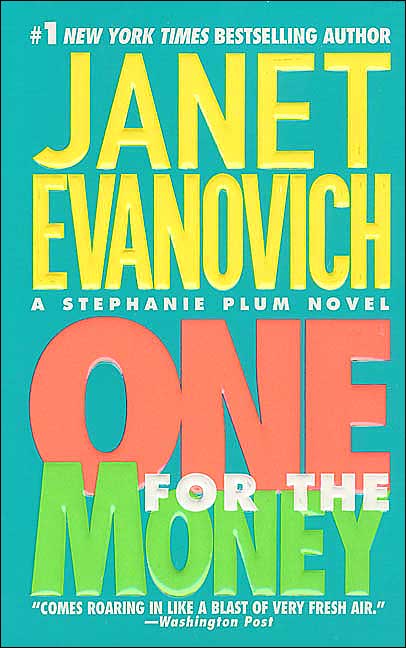
One for the Money by Janet Evanovich

Perhaps you noticed how badly my last Evanovich experiment turned out. Perhaps you are shocked (as am I, rather) that I tried again. Well, for one, I was still trying to figure out what people like so much about Evanovich; I hope to be the kind of librarian who at least knows something about all the different genres and tastes. Also, I spoke with a friendly regular patron after my failed attempt with one of her little-known romance novels (above), and decided I was misguided in judging her based on that. I was advised to try again with the Stephanie Plum series, and so I picked up the very first. [For the record, yes, duh, I should have started here in the first place. I did know these were her bigtime contributions. But I guess I was trying to knock out a pure-romance-genre read – again for the sake of breadth in my reading – at the same time. Failure. Note: Always read what the author is famous for.]

For those that don’t know, Stephanie Plum is reluctantly and accidentally employed as a bounty hunter in New Jersey. This first book is her intro to the business. She’s an unlikely candidate, but she needs the money – Plum is kind of a mess, but a cute one. Her first job is to hunt down Joe Morelli, to whom she lost her virginity behind an eclair case in high school. Her feelings for him are mixed, but she barely has time to even try to work them out as the corpses mount up around her, she’s stalked by a sadistic serial rapist, and somebody else is trying to kill her.

I know, just from cover blurbs and general awareness, that Plum has a ping-pong-style love triangle with Morelli and fellow bounty hunter Ranger. This love triangle and sexual tension, as I understand it, is going strong – and still unresolved – after the recent publication of Smokin’ Seventeen, the 17th (yes, true) in her by-the-numbers Plum series. On top of these there are a number of between-the-numbers Stephanie Plum novels, so that for over 20 books, Evanovich’s fans have been eagerly awaiting resolution. Or have they? Maybe they enjoy this ongoing tension and drama, but I have read a few reviews myself indicating that her readers do desire decision. I confess, this is something that would get old for me. Indecisiveness, especially of the multiple-lovers variety, is a bit of a peeve of mine.

Another mild complaint: I’m not offended by sex or violence. I literally haven’t found my boundaries yet; I can handle whatever an author throws. But! I am offended, stylistically, by gratuitousness. And I found some of the sexual references gratuitous. Again, I’m not much of a reader of romance novels; I suspect this is a staple of the steamier of that genre that its readers expect and cherish. But the random appearance of genitalia for its own sake throws me off and yes, offends me – not because it’s sex, but because it’s random. [Seekers of “clean” books, look elsewhere.]

I was conflicted during most of my reading of this book. Stephanie Plum is feisty, hectic, and cute; she has attitude; her narrative voice is funny. Funny things happen to her: awkward moments and moments of conflicted sexual tension. There is some real humor here. But I was annoyed, too. I realize that the outlandish, unrealistic, pure silliness of these story lines are part of their appeal – Evanovich’s fans appreciate this – but I don’t think it’s for me. I’m too easily exasperated with Plum and her indecision (did I say that already?) and her clumsiness and poor decision-making. These books may not be my cup – but of course that’s a subjective judgment, and that doesn’t mean others can’t enjoy them.

I was repeatedly tempted to put this book down, but I hung in there. Just as I got annoyed by Plum (I promise you, if we were friends, I would constantly be rolling my eyes, sighing, and giving her unsolicited advice. Maybe we wouldn’t be friends very long), she’d make me giggle and I’d decide to keep going. Plus, I already quit on Evanovich once, and I was determined to see this one through.

After finishing the book, I remain ambivalent. This book did make me laugh, and it did keep me turning the pages, so Evanovich accomplished several goals: suspense and humor. But I finished with the same exasperation and frustration I’d felt for the whole book. I don’t entirely respect Plum. I’ve had my share of male-female interactions, and I don’t think people behave like this in the real world. It reads like a romance novel, not like life. I’m bothered by the scene, prevalent in romance novels, wherein a man can seduce a woman by being aggressive, rough, rude, even violent. I think this is a dangerous concept to propagate. But perhaps my overarching complaint is, this book is silly. And pointing to this as a criticism rather than a selling point is a matter of my personal taste, not of the objective value of Evanovich’s work.

As a final aside, it was cute to see how dated some of the details were. Cassette tapes, and the impressive tape deck in Morelli’s tricked-out Jeep, made me flip to the front for the publication date: 1994. Rather a fun little blast from the past. As you may have noticed, I’m not too concerned with reading series in order, but I’m glad I started at the beginning of this one. I’m willing to give Evanovich credit – sight unseen – that her characters & style develop as the series progresses. I’m happy to have started off at the beginning.

Final verdict? My options would have to be pretty slim to pick up another one of these books, but at least I now understand what Evanovich fans are looking for. She’s not to my personal taste. But I can see the appeal.

book beginnings on Friday: On Bicycles: 50 Ways the New Bike Culture Can Change Your Life by Amy Walker (ed.)

Thanks to Katy at A Few More Pages for hosting this meme. To participate, share the first line or two of the book you are currently reading and, if you feel so moved, let us know what your first impressions were based on that first line.

On Bicycles is sort of a book of advice, not necessarily to be read cover to cover. But I’m finding myself doing just that, which should be taken as a compliment, especially as, in all humility, I don’t need this kind of advice, being rather an experienced cyclist.

Amy Walker edits, and writes a number of chapters, but by no means the majority of the book. Her chapter one, entitled “Bicycling is Contagious,” begins:

Warning! Cycling can be addictive. Before you grab onto those handlebars, before you throw a leg over the saddle and start pumping away at those pedals, be aware: once you start, you may never want to stop.

Well, she’s off to a good start for me! I couldn’t agree more.

This quotation comes from an uncorrected advance proof and is subject to change.

What are YOU reading?

miscellany: what writers eat

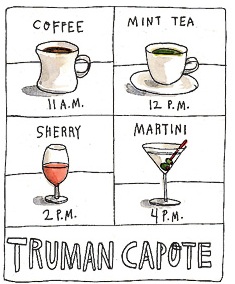
Thanks to the New York Times for this cute little piece of writerly trivia: Favorite Snacks of the Great Writers. I especially like Truman Capote’s drinking schedule.

Which one do you like the best?

Right Ho, Jeeves by P.G. Wodehouse

Oh, Bertie Wooster. You are so silly and so deadpan. The dialogue is killer. The abbreviations are droll. The voice of Bertie is priceless. (I did get a voice – literally – for Bertie in my head in my first Wodehouse encounter via audio, which if anything has increased my enjoyment. Luckily the narrator was great and I now hear him in my head as I read this.) Wodehouse is a comic genius. These Jeeves-and-Wooster books are light, easy, even fluffy, but also pure gold: so easy to consume and so very pleasurable.

The story is this. Our narrator, Bertie Wooster, is a man of leisure in the London scene, light on the brains, perhaps, but blissfully unaware of it. He doesn’t have real problems, but rather those of a Shakespearean comedy plot. In my limited (two book) experience, they are the problems of confused lovers. Think A Midsummer Night’s Dream. Luckily, Bertie, and his surrounding community, are served by the genius valet Jeeves – so quintessentially useful, wise, clever, and discreet that his name has become an eponym. Jeeves solves all the problems, in the end, with aplomb, good taste, and tact. He even lets Bertie think he’s clever too – sometimes. I should also point out that Wodehouse has a genius for names. Bertie Wooster, Reginald Jeeves, and “the Bassett” are tamely named in comparison to Gussie Fink-Nottle, Tuppy Glossop, and the Market Snodsbury School. (Husband’s favorite is still Whatwhatley, or however you might spell it, from Thank You, Jeeves.)

In this book, Bertie is called to Aunt Dahlia’s country home to help out a pair of troubled lovers: cousin Angela and her fiance Tuppy. They are quickly joined by Madeline Bassett and her admirer, Bertie’s old friend Gussie, who has a debilitating fascination with newts, to the exclusion of everything else until Madeline came along. Gussy is having trouble wooing Madeline; Angela has throw Tuppy over. Bertie finagles Gussy into speaking at the Market Snodsbury grammar school in his stead. Bertie decides the answer to teetotaler Gussy’s problems is to get him drunk just before his speech. This results in a switcheroo (as my mother would say), and Angela ends up engaged to Gussy. Bertie’s machinations not seeming to do the trick, as usual, Jeeves steps in and saves the day. Right ho, Jeeves.

I love these little books and think I need to keep one on the nightstand always. They are laugh-out-loud silly job. If you can find audiobooks read by Jonathon Cecil, I recommend them as well.

10 books you really should have read in high school

I’m a sucker for a list like this.

MSN gives us a list of 10 books you really should have read in high school.

  • Frankenstein by Mary Shelley
  • The Scarlet Letter by Nathaniel Nawthorne
  • The Catcher in the Rye by J.D. Salinger
  • The Great Gatsby by F. Scott Fitzgerald
  • Pride and Prejudice by Jane Austen
  • Siddhartha by Herman Hesse
  • Lord of the Flies by William Golding
  • The Adventures of Huckleberry Finn by Mark Twain
  • To Kill a Mockingbird by Harper Lee
  • The Fountainhead by Ayn Rand

My stats on this list are pretty good: 8 out of 10. Here’s your list again with my comments.

  • Frankenstein by Mary Shelley: I found this moving and interesting; I think I read it twice in high school, and only once was required. Thumbs up.
  • The Scarlet Letter by Nathaniel Nawthorne: I’m pretty sure I didn’t read this book until I was back in college after my BA, taking post-bacc courses. It was required reading, then. I did find it to address some important concepts, and I think it would do well in high school, too. Thumbs up.
  • The Catcher in the Rye by J.D. Salinger: I did read this in high school, although I feel fairly sure it wasn’t for school. Although there is no end of discussion of and raving about this book, it didn’t grab me. Perhaps there’s something specifically male about the perspective. I found it dull. Because I know it’s spoken of as being important, I’ll generously give it a meh.
  • The Great Gatsby by F. Scott Fitzgerald: Wonderful book. Was required reading for me in high school and I think it should be. Thumbs decidedly up.
  • Pride and Prejudice by Jane Austen: Nobody made me read this in high school, but it’s one of the best books I’ve ever read. Funny, and relevant in any age, witty, clever, and important. Thumbs up!
  • Siddhartha by Herman Hesse: Have never read. You tell me, what am I missing?
  • Lord of the Flies by William Golding: Loved it. Read for school in high school. I think this is an important book. Thumbs up, absolutely.
  • The Adventures of Huckleberry Finn by Mark Twain: If I had to choose just one that every high school kid should read, this would be it.
  • To Kill a Mockingbird by Harper Lee: Another no-brainer in my book.
  • The Fountainhead by Ayn Rand: And here’s the other I’ve never read. I have heard that Ayn Rand is a) difficult and b) not, politically, for everyone. What are your thoughts? This is certainly the first I’ve heard of her as a high school required reading selection.

Please share, what are your reactions? How many have you read?

two-wheeled thoughts: A.L. Anderson

two-wheeled thoughts

In olden times the women rode
As fitted one of subject mind:
Her lord and master sat before,
She on a pillion sat behind.
But now upon her flying wheel
She holds her independent way,
And when she rides a race with man,
‘Tis even chance she wins the day.
–A.L. Anderson, as quoted in Around the World on Two Wheels

Little Free Library


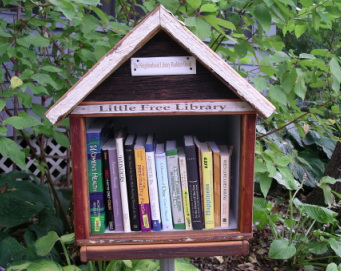
Thanks to Shelf Awareness, I discovered something called the Little Free Library today. I am excited and inspired by this concept. Go look around the website at some of the beautiful and artistic versions – but the basic concept is a tiny little box of books on a post, in a neighborhood somewhere, where folks can take-a-book, leave-a-book. I want to play! I’m ready to pay the $50 to “join the club,” and I’m hoping to get Husband to help with the carpentry side of things. If you live in Houston: would you help by donating a few books? Used is fine, of course. And, what location do you like? I’m thinking Lindale Park or the Heights. I wonder how you keep the city from being upset with you for constructing things on public land, though.

Teaser Tuesdays: The Picture of Dorian Gray by Oscar Wilde

Teaser Tuesdays is a weekly bookish meme, hosted by MizB of Should Be Reading. Anyone can play along! Just open your current read to a random page and share a few sentences. Be careful not to include spoilers!


I am tackling another classic, this time via audiobook in the car. Unabridged, of course! Here is your teaser. Happy Tuesday.

I remember her bringing me up to a truculent and red-faced old gentleman covered all over with orders and ribbons, and hissing into my ear, in a tragic whisper which must have been perfectly audible to everybody in the room, the most astounding details. I simply fled.

Gone with the Wind part 1 (ch. 1-7)

Oh my. Am I ever glad that I have finally begun to read this book! I shouldn’t have waited so long. It IS a chunkster, and I AM busy right now. But what a book.

How did I get here?

The Great Gone with the Wind Readalong is hosted by The Heroine’s Bookshelf blog. This is what finally prompted me to read a book that’s been on my list for years. Thank you so much, Heroine.

Where am I coming from?

I feel like this is weird, but I have never read this book, never seen the movie, and had only the slightest and vaguest idea what it was about. All this, and I am a Southerner (to the extent that a Houstonian is a Southerner… that’s a different post). In my mind, this book is a little bit crossed with The Glass Menagerie. I don’t know why. I read the latter, in high school, although I do not seem to have a lasting impression of it. I think I did admire it; I remember the glass menagerie itself; I remember the suitors and my frustration with the mother. But there are some blurry lines between the one masterpiece of Southern-set fiction which I have never read, and the one I have. By the end of this readalong I certainly expect to have that cleared up!

What’s the drill?

Erin of The Heroine’s Bookshelf is hosting this readalong that involves 5 discussion dates, by which we will all have read 5 sections of the book. I am doing my best to pace myself so that the section in question is still fresh when the discussion comes along. So, we can all hop over there to join in a discussion, which I certainly will. But! I have my thoughts to share with you here, too.

What do I think so far?

This is an extraordinary work, just in the sense of evocative description, Mitchell’s ability to place me firmly in the time-and-place. At the end of the first page, I was hooked and admiring. She chooses very unique adverbs that draw my attention and let me see what she sees. The twins’ “long legs, booted to the knee and thick with saddle muscles, [were] crossed negligently.” Crossed negligently? She could have spent a paragraph trying to tell me what she has shown with that one adverb. “They were as much alike as two bolls of cotton.” Or earlier, Scarlett’s “green eyes in the carefully sweet face were turbulent, willful, lusty with life, distinctly at variance with her decorous demeanor,” because “her true self was poorly concealed.” I already feel like I know a great deal about all 3 of these characters – with no dialogue – and all this on page one! I’m all the way in.

As promised (threatened?) by Erin, I was indeed tempted to just rush past this first section and keep going. I’ve decided to stick with the schedule, though, which allows me to read other books in between. Part one was delightful, and able to stand alone, at least for a bit. I got to know Scarlett, appreciated her odd and not completely likeable personality and traits. This is a good stopping point, as a chapter of her life ends; part two will clearly begin the next. I look forward to it.

Please be sure to stop by the hosted readalong discussion, too.

Othello by William Shakespeare

Wow, what a work. There’s a reason we still read, admire, study, and act this play today, what, 4 centuries after its creation. I read this, like The Taming of the Shrew, years ago, but I needed the refresher for the performance I’m going to see tonight.

What can I say about Othello? Othello is “the Moor,” a general in the Venetian army. He has happily married the beautiful Desdemona, and they have set out together to Cyprus where Othello has been posted. They are a happy and loving couple, but Shakespeare gives them a tragic fate. There are men about who do not wish them well. Iago is the main villain; he is jealous of Cassio, who Othello chooses as a second in command. He uses Rodrigo, who wanted to marry Desdemona, as a pawn. Iago tricks Othello, who believes him to be a faithful friend, into thinking that Desdemona and Cassio are lovers. He convinces Rodrigo that Desdemona will be his if he will just kill Cassio; really, Iago wants them both dead, and also encourages Othello to kill his wife. His intention is to gain himself political power. He also uses his wife, Emilia, servant to Desdemona. The handkerchief is the fateful detail: Othello gave it to Desdemona; Iago obtains it and plants it on Cassio; and it seals the innocent, saintly Desdemona’s fate. The final tragic scene ends with Othello’s murder of Desdemona, his discovery of Iago’s treachery, and his suicide.

It is classic Shakespearean tragedy, reminiscent of Romeo and Juliet in that final scene as Othello laments over his beloved wife’s body. The important difference, of course, is that there was no murder in Romeo and Juliet; Othello cannot be an entirely sympathetic character. It is especially frustrating to hear the faithful Emilia argue Desdemona’s innocence and have Othello reject it. But Iago, as I said, is the real villain; Othello is victim to his machinations.

I enjoyed this play all over again and always recommend it, as I do all of Shakespeare’s work. I’ve always been a big fan. I tend to think that I prefer the comedies, but in rereading his tragedies I find the same genius and the same ability to wrench my emotions in the desired direction. He was truly a great artist. I do have a fondness for the comedies, though; I forget, until I see or read them again, how accessible and universal the humor is. Last summer I went to A Midsummer Night’s Dream as produced by the Houston Shakespeare Festival, and marveled, once more, at how appealing, funny, and fun it is. Please! If you’re in Houston, don’t miss this annual summer event. Again, this year they’re producing Othello and The Taming of the Shrew, and it’s FREE, and you can sit on the hill with your dog and/or your picnic dinner and/or your beer, wine, whatever. Couldn’t be better. Check out the Miller Outdoor Theatre schedule for details.