Black Sun by Edward Abbey

I love Edward Abbey for Desert Solitaire, and for his reputation (compounded of course by my love of Fire Season too). My Pops has gotten into him this year, and has brought me quite a few of his books, and I’ve been excited to pick them up. I confess I chose this one for its setting as I’m now working on completing the Where Are You Reading? Challenge, and it covers Arizona for me. But oh! this book has value all on its own. Those 3-4 other Abbey books that are sitting on my shelf right now just moved up the list a little bit. He wrote more nonfiction than fiction, and his best-known novel is The Monkey Wrench Gang; this lesser-known novel involves a fire lookout, which was my attraction (see again Fire Season).

The story is this. Will Gatlin has abandoned his life as college professor and husband to become a reclusive fire lookout in the Grand Canyon National Park. He is mostly alone up there, but does get a few visits and letters from his friend Art Ballantine, who still teaches college but expends more energy on chasing women. To say he is obsessed with sex, breasts, the female anatomy (he uses the c-word), young girls in every application, would be putting it mildly; his letters are raving and silly and self-deprecatingly intellectual. And very funny. In between Ballantine missives Will does his fire-lookout work, observes nature – these parts are poetic, loving and appreciative – and carries on a love affair with a girl named Sandy. I’m not sure we ever learn Will’s age, but he is probably old enough to be nineteen-year-old Sandy’s father. She is a virgin when they meet, and engaged to another man, but none of this stops them from cavorting the wilds (desert, river, canyon and forest) in the nude, wittily teasing one another and having wonderful sex. Here Abbey falls into that lamentable and oh-so-distinctive habit that older male writers sometimes fall into (Papa included!) of creating nubile young beauties who want nothing more than to have endless sex with old men. It’s unfortunate in that it seems to give away the author’s own dirty-old-man fantasies (I don’t know this about Abbey in particular but it is my reaction to the cliché). But if we can move past this issue, Will and Sandy have a great time running around the wilderness, la dee da. That is, until Sandy disappears and her fiancé shows up to accuse Will of disappearing her and punches him in the face.

Abbey writes beautifully, lyrically about nature and about love or at least attraction. The letters from Ballantine (and others) are amusing. The story is tragic, but it requires a certain overlooking of the older man’s fantasy before we could really sympathize with Will’s sense of loss. If you can move past this, it’s a beautiful little story with flora and fauna of the Grand Canyon painting the background. I was only partly successful in that requisite overlooking, but enjoyed it all the same. I have great hope for the other Abbey books waiting on my shelves.

I thought I could clearly see connections in Abbey’s writing style and subject matter to Keruoac, as well as Philip Connors, who in Fire Season acknowledges the debt. I recommend Black Sun, unless of course you’ve had too much euphoric losing of teenage virginities to much older men, in which case perhaps start with Desert Solitaire and I’ll let you know how the rest of them go, too!

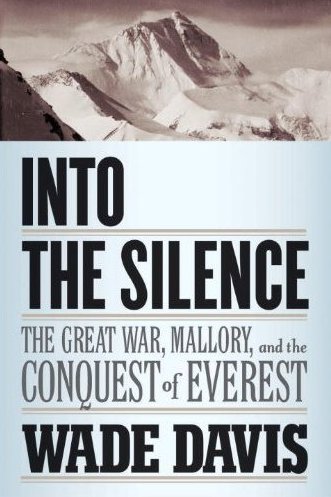
Into the Silence by Wade Davis

An epic history of adventure and adversity, of one man and a nation’s quest for redemption.

In Into the Silence, Wade Davis (The Wayfinders, The Serpent and the Rainbow) portrays several attempts to climb Mount Everest during the 1920s within the context of the state of the British Empire after the First World War. With the benefit of new access to primary sources, he begins with visceral descriptions of the Great War in all its horrifying violence, as seen through the eyes of several players in the later Everest drama, and then follows these men through the postwar numbness of a Britain that had lost the bulk of a generation. Davis makes a convincing argument that the assault on Everest was “the ultimate gesture of imperial redemption.”

George Mallory was the star of three successive attempts to summit a mountain that was at the time a complete mystery–its weather patterns and geography entirely unknown, the cultures that surrounded it viewed by the British with a misguided paternalism. Along with a host of fellow climbers, adventurers and scientists, Mallory was driven toward an accomplishment that the nation came to grasp as an outlet for its frustrations and a hopeful liberating triumph. While he was the principal character in the eyes of his contemporaries and in history, the other explorers also receive well-deserved and detailed attention in Davis’s account.

Into the Silence is a book about mountaineering and a respectable adventure epic with all the alpinist details, but it’s also so much more: a heartbreaking portrayal of war; the story of more than a dozen individuals whose lives were rocked by a war and a mountain; and finally, a history of a nation watching its own imperial era come to an end.


This review originally ran in the November 4, 2011 issue of Shelf Awareness for Readers. To subscribe, click here, and you’ll receive two issues per week of book reviews and other bookish fun!

Definitely Dead by Charlaine Harris (audio)

Definitely Dead is a Sookie Stackhouse book from the Southern Vampire Mystery series. Yes. Southern Vampire Mystery Series. The television series True Blood is based on these books. This is not my standard reading material, but (this is becoming a theme) I picked it to cover Louisiana for the Where Are You Reading? Challenge, on rhapsodyinbooks‘s recommendation. I like James Lee Burke for Louisiana normally, but took this opportunity to expand my knowledge (if not my reading loves) – for professional reasons as a librarian, if for no other reason. One of my first pleasant surprises was the narration; Johanna Parker’s southern accent is fun. (Her Irish accent, for Father Riordan, on the other hand, is a travesty. Luckily we don’t hear too much from him.) The redeeming features didn’t end there; Sookie is a pleasant, likeable enough protagonist. She’s a little bumbling, and she struggles a little bit with her sense of self-worth, but she’s not whiny; she’s just human. Ha – that’s a joke, as her being human makes her fairly unique in Bon Temps, Louisiana, a world full of supernatural beings: were-wolves, were-panthers, were-tigers, vampires, goblins, and sundry shape-shifters.

In this book, Sookie is being attacked by various enemies: one, the family of the Pelt girl that she apparently killed in an earlier book, and two, okay I won’t give it away just yet… The vampire Queen of Louisiana (what a funny phrase, it made me smile every time) marries the King of Arkansas (even funnier!) in a political match, but Sophie’s cousin Hadley is the Queen’s real love. Hadley has just died, and when Sookie goes into New Orleans to clean out her apartment she finds a dead werewolf in the closet – and the intrigue just increases from there. Meanwhile, Sookie begins to date a sexy were-tiger, Quinn; he’s there with her when she’s attacked on several occasions, so they bond while fighting various supernatural beings. There is an unusual sex scene between the two of them that I am still contemplating and finding unlikely, but I’ll let you discover that one on your own.

It’s an odd world that Harris builds here; a number of phrases got me giggling just for their oddity (I wish I’d taken better notes here). It was strange enough to me that the novelty was rather amusing, although I guess regular readers of paranormal whatnot are beyond this. Sookie is relatively charming, and Quinn is an attractive character; I found myself entertained once I got into things. But this book is no literary feat. The dialog can be awkward, and I found enough grammatical errors to be distracting.

In the end, this wasn’t a painfully bad book to listen to. (Well, the cd’s in my audio copy were badly scratched and sometimes that got a little painful, but I don’t hold Harris or Sookie responsible for that.) It had its moments, but it failed to make me care deeply; the world Harris built was more silly than interesting. Unfortunately I don’t care what happens to Sookie next, although I wish her well.

book beginnings on Friday: Black Sun by Edward Abbey

Thanks to Katy at A Few More Pages for hosting this meme. To participate, share the first line or two of the book you are currently reading and, if you feel so moved, let us know what your first impressions were based on that first line.

Black Sun is a novel by Edward Abbey (renowned author of much nonfiction, whose best-known novel is The Monkey Wrench Gang; he has been called “the Thoreau of the West”) about a fire lookout. If you read my earlier review of Fire Season you will understand my interest in the subject. I like it so far. Check out this beginning:

Each day begins like any other. Gently. Cautiously. The way he likes it. A dawn wind through the forest, the questioning calls of obscure birds. He hears the flutelike song, cool as silver, of a hermit thrush.

I love this picture of a day beginning gently, the way he likes it… very evocative, mood-setting.

What are you reading this weekend?

what I love about living in Houston

Just because I love lists and bragging on my underrated hometown, I’m riffing off Katie again. Thanks for the prompt Katie! (Go read what she loves about Boston too.)

what I love about living in Houston:

1. It’s such an international city. I love that there is such a diversity of languages spoken and cultures represented in my melting pot port city.

2. …and spinning off #1… ethnic food! Restaurants specialize in Mexican, Indian, Vietnamese, Chinese, Japanese, Jamaican, Cuban, Greek, Moroccan, French, Spanish, German, Belgian, Brazilian, Turkish, Malaysian, Caribbean, Mediterranean, Thai, Korean, Mongolian, Peruvian… And if you want to cook, local grocery stores sell all the exotic ingredients necessary to cook ethnic foods, too. (Although you should make your own paneer fresh; it’s quite easy and delicious!)

3. This one’s qualified: when it’s not (ahem) summer, the weather’s pretty friendly. You can play outside (whatever that may mean to you!) year-round here. The summers will challenge your tolerance for heat & humidity, but during the winter you’ll be happy to wear shorts.

4. What we call “culture” is well represented: we have world-class symphony, ballet, and theatre companies; Broadway comes through regularly; and your band of choice is likely to play here if they’re on tour. (And if not here, definitely Austin, which is just 2 1/2 hrs away.)

5. Memorial Park! Almost double the size of New York’s Central Park at 1500 acres, Memorial Park offers tennis, golf, road cycling, running, swimming pool, fitness center, mountain bike trails, an arboretum with nature and birdwatching tours, sports fields and playgrounds – and it’s central. I feel incredibly lucky to have a park of this caliber right smack in the middle of my hometown – which is why I give money to the Conservancy and volunteer there doing trail maintenance.

6. Strangely, the cycling scene. Despite (or perhaps in part because of?) our notorious reputation for unfriendliness to bicycles, we have a great local community. In 2007, I was in the unique position of at least peripherally knowing many different cycling circles: I worked in a bike shop and so knew customers who were roadies, mountain bikers, charity riders, even spin-class-takers; I raced road, track, and cyclocross; I was a commuter and a former bike messenger. When I had my bad wreck that year, an amazing variety of cyclists contacted me to show support in various ways. I’ve been a member of several really awesome teams. It’s an inspiring local scene.

7. Proximity to Mexico and Central America! This gives us great access to vacation spots – and means we have plenty of Mexican food here at home, yum.

8. Low cost of living (and cheap gas), especially when compared with other big international cities. Win-win. Unemployment stays relatively low here, too. I certainly count myself very lucky (although hopefully it wasn’t all luck) and grateful to have gotten a great job right out of grad school in the fabulous economy of 2008.

9. There’s a beach nearby! I can’t imagine being one of those millions of people who live hours upon hours away from the nearest ocean – and they make up most of our country’s population. I like to be near the sea.

10. It’s in Texas. 🙂

What about you? What do you love about YOUR hometown?

The Story of Beautiful Girl by Rachel Simon

I have a lovely book to tell you about today. I’m sorry I took so long to read The Story of Beautiful Girl.

We follow three characters for the course of the book. Lynnie is a beautiful young woman at the beginning, living at “the School” (that is, the School for the Incurable and Feebleminded in Pennsylvania) because she is mentally retarded. No one knows that Number Forty-Two’s name is actually Homan; he is deaf and no one around him understands his brand of sign language, so he has landed at the School as well (he thinks of it as the Snare). And Martha is in her seventies, widowed and living alone in the opening scene in which all three lives coincide.

Martha opens the door in a rainstorm to find Lynnie and Homan standing on her stoop cradling a new-born babe. As Lynnie and her baby are both white and Homan is black, Martha assumes he is not its father; but while these questions of race are clear at a glance, it takes her a little longer to observe that her guests are differently abled. She clothes them and they hide their small charge in her attic just as the authorities arrive; Lynnie is tied up and taken back to the School, and Homan disappears into the woods.

Now we follow the three as they lead independent lives. Martha had a baby many years ago who turned out to be “defective” – we never learn the details – and never left the hospital with her; now she gets to start fresh with the newborn that has been entrusted to her. Lynnie goes back to a miserable institution. Homan runs, intending to return and rescue Lynnie but being thwarted, victimized, blown around the country like a leaf; being unable to communicate cripples him at least as surely as any physical disability. Martha leaves her home to hide the baby whose provenance she can’t explain; she moves around, fleeing the possibility of discovery. Eventually she takes on the identity of grandmother to the child she names Julia, and eventually she is able to start a new life and find new joy and happiness with Julia’s help. She finds a way to turn a spotlight on Lynnie’s plight, and the School is closed down. Lynnie gradually grows as a person; with the help of a School caretaker who becomes and remains a friends, she learns to speak again, learns to read and write and carry on a life. But she always looks for Homan, who never stops thinking of her either – his Beautiful Girl.

This is a beautiful love story, and a story of families and parents trying their best. Several relationships are rekindled after years apart (romantic and otherwise). There is also an exposé of institutions like the School, which is heartbreaking and true-to-life. Simon’s bestselling memoir, Riding the Bus with My Sister, chronicles her experience reconnecting with her sister Beth, a mentally retarded woman as well, and her Author’s Note explains her connection to the subject matter and how she went about her research. I enjoyed this brief look into the process.

This is a lovely book. Sad, yes, but also redemptive. I recommend it highly. (And, it fulfills Pennsylvania for me in the ever-present-these-days Where Are You Reading? Challenge. :))

Teaser Tuesdays: Definitely Dead by Charlaine Harris

Teaser Tuesdays is a weekly bookish meme, hosted by MizB of Should Be Reading. Anyone can play along! Just open your current read to a random page and share a few sentences. Be careful not to include spoilers!

I’m listening to Definitely Dead on audio, and I’ll be honest about my reasons: somebody suggested it to fulfill my Louisiana reading need for the Where Are You Reading? Challenge, and I thought what the hey, it’s not really my usual choice but I do like to occasionally push my own boundaries. For one thing, I’m a better librarian if I have a better understanding of what Charlaine Harris has to offer. I had originally intended to use James Lee Burke (an old favorite) to complete Louisiana but here we go with a little variety.

So far, I’m still not sure this is my style, but I am enjoying the southern accent of the reader!

Here’s your teaser today:

But gosh darn it, I liked him, and it always smarts when you find out you’ve been replaced with apparent ease. After all, before his dad’s death Alcide had suggested we live together. Now he was shacking up with this young Were, maybe planning to have puppies with her.

Okay, I’m trying to flow with the vampires and the werewolves…

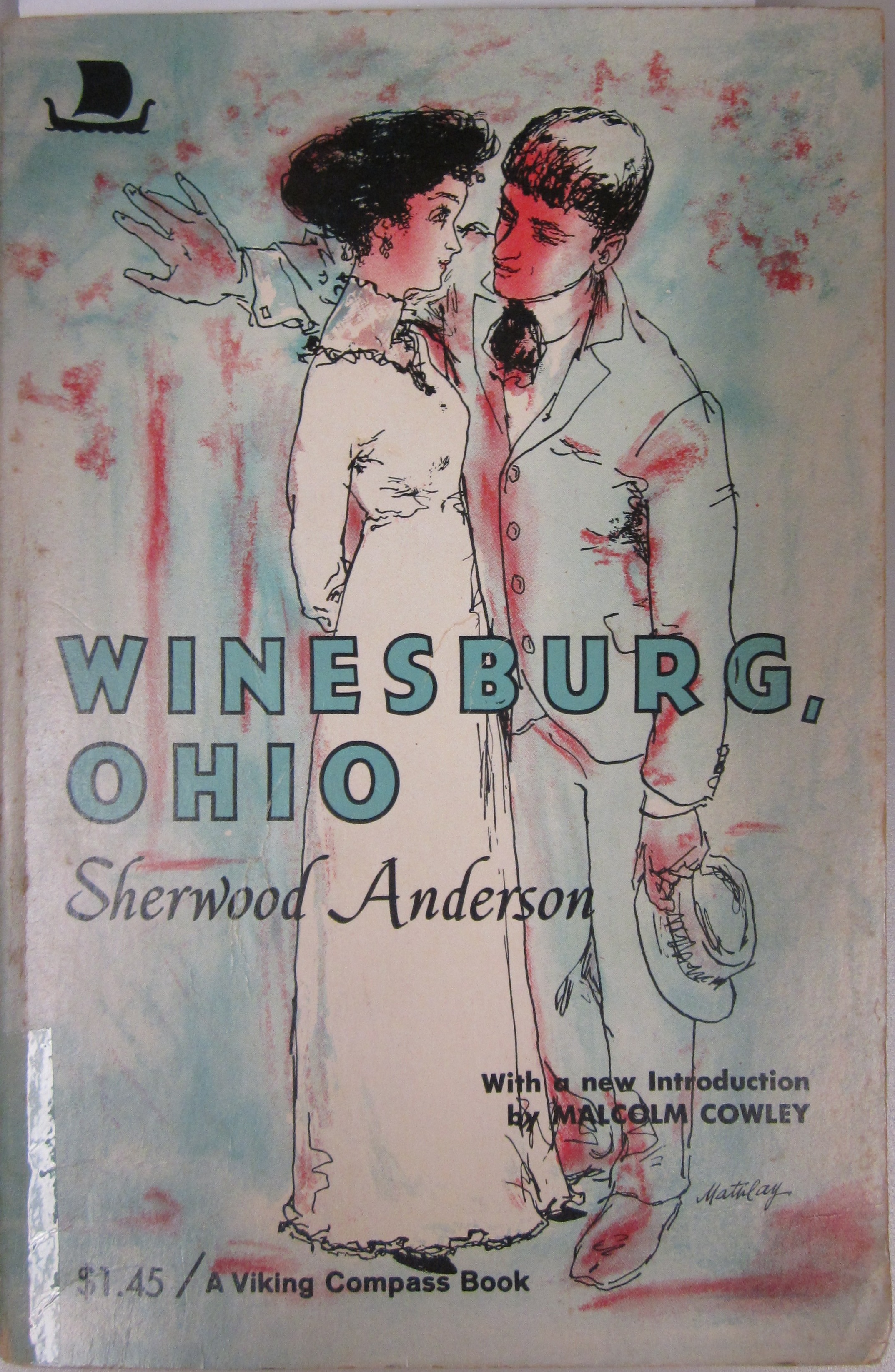
Winesburg, Ohio by Sherwood Anderson

Winesburg, Ohio is a collection of short stories that is more than the sum of its parts; the short stories are connected, all being set in the fictional town of Winesburg and concerning overlapping characters. We are most interested in George Willard, a town native who we most often see as a young man working as a reporter at the town paper (or, “the” reporter). Several of the stories give us Willard’s experiences (always in third person), but a number of them concern other inhabitants of the town. These men and women usually have some small personal tragedy that has thrown off the rhythm or intentions of their lives.

The work as a whole has a very quiet, contemplative tone and mood. Very little of great import goes on; but simple, sad lives are carried out, and hearts are broken quietly. It is moving. Anderson excels at bringing a character to life for a brief moment; and then he moves on.

I came to this book through Hemingway’s recommendation (and was finally motivated to get it off the bookshelf for the Where Are You Reading? Challenge‘s Ohio requirement). It has been a little while since I’ve read a biography of Hemingway so I’m a little rusty on the details, but I recall that Anderson played a role in his early writing career – encouraged him to write, gave him tips, maybe recommended him for publication. I think he pushed Hem to move to Paris as a youngster, which he did with his first wife Hadley, with results that I think we can safely say influenced his career as a writer. Anderson definitely influenced his style; I got this out of Malcolm Cowley’s excellent introduction, but it’s readily evident even without that clue. The same short, simple sentences that say so much with so few words are recognizable in Anderson’s stories; see my book beginnings post, or:

The Presbyterian Church held itself somewhat aloof from the other churches of Winesburg. It was larger and more imposing and its minister was better paid. He even had a carriage of his own and on summer evenings sometimes drove about town with his wife. Through Main Street and up and down Buckeye Street he went, bowing gravely to the people, while his wife, afire with secret pride, looked at him out of the corners of her eyes and worried lest the horse become frightened and run away.

This quotation comes from “The Strength of God,” one of my favorite stories.

As character sketches, these short stories are outstanding. As a whole, though, this book failed to grasp me the way I’d hoped – certainly it failed to grasp me the way Hemingway does. While I saw Papa on these pages, unmistakably, I was also constantly reminded of Sinclair Lewis’s Main Street, another quiet, subdued story about everyday, small-town life and its quiet tragedies. Perhaps it is the repetition of that phrase, “Main Street,” that got me, but I kept seeing Lewis’s work in this one, and frankly Main Street is a more memorable book. Like happens to me sometime when I fail to deeply appreciate one of the “classics” (ahem The Picture of Dorian Gray), I worry that it’s me, not the book, that I’ve missed something beautiful that would be obvious to someone with just a little higher IQ. I have to shrug this off, though. This collection does have value; I don’t want to give an impression otherwise, it just might not be *my* ideal cup. Almost every story builds a character who is real and often sympathetic. The tone is unique and if nothing else, the view into small-town life of a certain era is fairly unique. We can’t all love the same books, and life is more colorful for it.

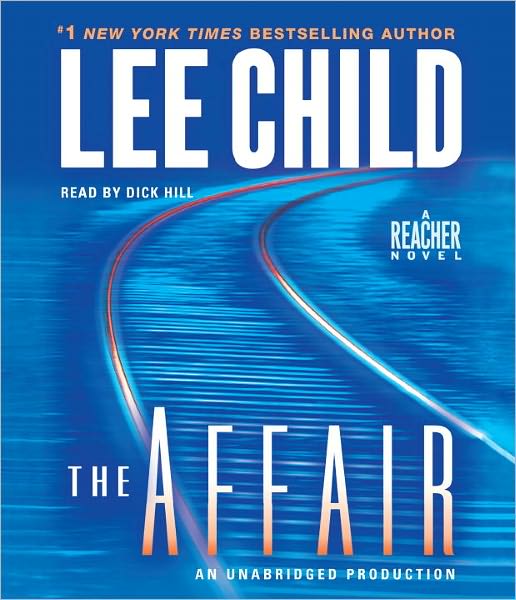
The Affair by Lee Child (audio)

The brand-newest Reacher, just out a few weeks now, is another flashback or prequel: it’s 1997, and Reacher is still in the army. He is sent out to Carter Crossing, Mississippi to do damage control on a murder case that threatens the army’s good reputation. There’s a lot of politics involved: the local army base is sending companies secretly into Kosovo, and one of the captains in question is the son of a senator in the Armed Services Committee. It develops that this very captain has some connections to the murdered woman – or maybe his father the senator does. Reacher breezes into town intending to remain under cover while investigating the case parallel to the above-board MP working from the base; but his cover is immediately blown by the local sheriff, a former Marine MP herself. The one murdered woman turns out to be the third in a series of similar killings – the first two having been ignored apparently because they were black. And then more people start dying. What exactly is going on here? And who can Reacher trust? He’s inclined to trust Elizabeth Devereaux, the sheriff, but he’s getting conflicting messages from various sources at the army.

The Affair is in several ways a standard Reacher production, and in several ways not. Reacher does his investigating; he’s a smart guy and he figures things out; he eventually will get the bad guy(s), no doubt about that. There is rather less ass-kicking in this book, though. Husband was disappointed, and I was just flat-out surprised at how easily and relatively bloodlessly the hooligans were taken down. There is rather more sex – Reacher does tend to get laid in many of the books, but the sex got a little more attention in this one. It was well done – I’m not complaining – but I was a little confused at the shifting focus. I wonder if Child has figured out that he has a number of female fans swooning over Reacher and decided to play up to them (us)? As a swooning Reacher fan myself, let me say: more ass-kicking please! I don’t begrudge him the sex but that was never the primary focus, and I’d rather stick with the classic model of ass-kicking with sex on the side, rather than the other way around.

This bit is very slightly spoilery… I had some trouble suspending disbelief as we discovered all the mistakes made by the illustrious Elizabeth Devereaux in investigating the murders before Reacher’s arrival. If she’s such a veteran hotshot MP herself, how did she miss that there was no blood on the white collar of the woman who had her THROAT CUT? Etc. She beats Neagley at the mind game at which the latter supposedly excels but makes all kinds of amateurish mistakes in the murder investigation. It just didn’t ring true for me. End spoiler. But hey, maybe I’m just mad at the whole Reacher camp right now because… have you heard? They’ve cast Tom Cruise, of all people, to play him in the movie they’re making of One Shot! Blasphemy, says I. Reacher is supposed to be 6’3″ and 230+ pounds, muscular, and blonde. Sigh. And I’m not alone – you should see the Reacher fans raising hell over at the facebook page.

But all in all, this was another satisfying edition of the Reacher adventure. I liked it. It just wasn’t my favorite. I wonder where Child is going to take Reacher from here? It occurs to me that he’s getting older (possibly a reason to keep writing prequels!) – but Child came up with another possible plot thread here: the younger version of Reacher, named Duncan Monroe, just a bit earlier in his career and otherwise apparently a spitting image. I guess we could always revisit Monroe as Reacher ages. What do you do with an aging hero? Realistically we could see him forced to accept some realities and calm down a bit; but action/adventure/thriller/hero/mysteries don’t always take the realistic route! At any rate I’m still hooked in. What’s next, Reacher?

The Red Badge of Courage by Stephen Crane

I came into this book with a vague notion that it is a classic that was taught in schools more commonly before my day, and that it was popular with boy-children, also mostly before my time. It is a Civil War story. “The youth,” as we mostly know him, Henry Fleming, signs up against his mother’s wishes to go fight for the Union, and the book follows his war experience.

The bulk of this story is taken up not with events but with the turmoil inside Henry’s head. He is fascinated by war and wants to participate; it takes a certain amount of internal argument before he signs up, and then he thinks he’ll make his mother proud. Then after much waiting in camp, when it appears that he might actually see battle, he becomes petrified with the fear that he’ll run. He meets battle, stands and fights at first, wondering at his nonchalant courage; and then turns and runs. While a fugitive deserter in the woods on his own, he convinces himself that running was in fact the wise and respectable decision; then upon encountering the army again he comes filled with self-loathing. He watches a friend die. He rejoins his regiment with an excuse for his absence and becomes confident again. And on and on – you get the idea. It’s the story of a young boy’s difficulty with the concept of fighting and, most centrally (as in the title), the concept of courage. I’m not sure we ever learn the age of “the youth,” which I regret; I kept wondering how old he was, but maybe the point was that we’re unclear on that question. There is more fighting; our youth stays and fights; there is a victory. (Perhaps it is The Victory; I’m not sure.) At the end of the story, Henry has found a peace and a confidence in himself; the war seems to have helped him grow up.

I kept track, off and on, of the uses of the color red in this book. Aside from the obvious red of blood, war is repeatedly characterized as a red animal, and the flag is a red and white woman who demands and inspires Henry’s courage. And red is not the only color to receive repetitive attention. Yellow is cowardice and men’s pale, sickly, frightened or wounded faces. (Henry’s mother threw a yellow light on the color of Henry’s ambition, by opposing his wish to join the army.) Purple is twilight; blue is the Union uniform as well as the sky, and rage is variously red, black, and purple.

I like this passage; note all the colors used:

He was being looked at by a dead man who was seated with his back against a columnlike tree. The corpse was dressed in a uniform that had once been blue, but was now faded to a melancholy shade of green. The eyes, staring at the youth, had changed to the dull hue to be seen on the side of a dead fish. The mouth was open. Its red had changed to an appalling yellow. Over the gray skin of the face ran little ants. One was trundling some sort of bundle along the upper lip.

Honestly, though, I was not particularly taken with The Red Badge of Courage. It had its moments of colorful imagery that I found charming; and at times Henry’s turmoil felt very human and sympathetic. But for the most part I was a little bit bored. Relatively little action takes place; mostly we hear about Henry’s anguish. I hate to be callous about his struggles – this is war, he is but a “youth,” war is terrible – but it felt to me like rather much circling around the same emotions. It wasn’t as evocative, at least for me, as it could have been. Books about the war experience should twist the knife deeper than this one did.

I also found a few aspects of Crane’s treatment of war a little surprising. For one thing, we almost never heard about the enemy; aside from being dressed in gray and being the antagonist of the battle scenes, the Confederates aren’t developed at all. Many war stories, and especially Civil War stories, paint the opposing army as tragically familiar, thus illustrating the futility and ultimate tragedy of war. This book seemed to take a pass on any such message, which left me feeling a little hollow.

As I sum up my experience reading this book, I have to say I didn’t find it very moving. I would love to hear from someone else who did, though. Any fans of The Red Badge of Courage out there?